Germany to pay nuclear operators 2.4 bln euros for plant closures
|
Germany to pay nuclear operators 2.4 bln euros for plant closures, https://www.reuters.com/article/germany-nuclear-settlement/germany-to-pay-nuclear-operators-24-bln-euros-for-plant-closures-idUSS8N2IR026 By Reuters Staff, (Reporting by Vera Eckert, Tom Kaeckenhoff and Markus Wacket, editing by Thomas Escritt)
FRANKFURT, March 5 21, (Reuters) – The German government has agreed to pay nuclear operators 2.4 billion euros ($2.86 billion) in compensation for forcing them to shut their nuclear plants early in response to the the Fukushima disaster, ministries said on Friday.The Frankfurter Allgemeine Zeitung daily had reported on Thursday that a sum of 2.4 billion euros will be made available from the general budget, citing government sources. The four affected companies are the German listed utilities RWE, which will get 880 million euros, and E.ON , which will get 42.5 million euros, as well as Swedish state-owned rival Vattenfall, which will get 1.425 billion euros, and mainly publicly-owned German EnBW , which will get 80 million euros. A Constitutional Court ruling in November had found in favour of the companies in their complaint that the government’s previous offer had not gone far enough. The court called for a speedy settlement of the dispute, which was mainly pursued by Vattenfall. The court had already ruled in 2016 that while the nuclear phase-out was legal, the operators needed to be better compensated for lost production. ($1 = 0.8389 euros) |
|
Get the Nuclear Weapons Out of Germany
What can this possibly mean? Nuclear weapons may be unpleasant, but what exactly is newly illegal about them, and what do they have to do with Germany?
Since 1970, under the Nuclear Nonproliferation Treaty, most nations have been forbidden to acquire nuclear weapons, and those already possessing them — or at least those party to the treaty, such as the United States — have been obliged to “pursue negotiations in good faith on effective measures relating to cessation of the nuclear arms race at an early date and to nuclear disarmament, and on a treaty on general and complete disarmament under strict and effective international control.”……….
Change, including on such practices as slavery and child labor, has always been far more global than one might infer from the typical self-centered U.S. history text. Globally, nuclear weapons possession is becoming thought of as the behavior of a rogue state — well, a rogue state and its collaborators.
Can the German government be brought up to international standards? Belgium has already come very close to evicting its nuclear weapons. Sooner rather than later, a nation with U.S. nukes will become the first to toss them out and to ratify the new treaty on the prohibition of nuclear weapons. Even sooner, some other member of NATO will probably sign onto the new treaty, putting it at odds with NATO’s involvement in the hosting of nuclear weapons in Europe. Eventually Europe as a whole will find its way to the anti-apocalypse position. Does Germany want to lead the way to progress or bring up the rear?
New nuclear weapons that could be deployed in Germany, if Germany allows it, are horrifyingly characterized by U.S. military planners as “more usable,” despite being far more powerful than what destroyed Hiroshima or Nagasaki.
Do the people of Germany support this? Certainly we have never been consulted. Keeping nuclear weapons in Germany is not democratic. It is also not sustainable. It takes funding badly needed for people and environmental protection and puts it into environmentally destructive weaponry that increases the risk of nuclear holocaust. Scientists’ Doomsday Clock is closer to midnight than ever before. If you want to help dial it back, or even eliminate it, you can get involved with World BEYOND War. ……….. https://davidswanson.org/get-the-nuclear-weapons-out-of-germany/
Germany hosts France, Britain for talks on Iran nuclear deal
Germany hosts France, Britain for talks on Iran nuclear deal, DW, 25 Nov 20,
German Foreign Minister Heiko Mass met his counterparts Dominic Raab and Jean-Yves Le Drian in Berlin for talks on the Iran nuclear deal. The trio hopes for a change in US policy once Joe Biden is sworn in.
German Foreign Minister Heiko Maas held talks with his French and British counterparts in Berlin on Monday, with the partners urging Iran to stop breaching a nuclear deal it signed in 2015.
“From our view, Iran is systematically violating the agreement,” a spokeswoman with the German Foreign Ministry said. “Together with our European partners, we urge Iran to stop these violations and return to fulfilling all its nuclear obligations.”
Maas met with Britain’s Dominic Raab and France’s top diplomat Jean-Yves le Drian ahead of an expected change of policy towards Iran when US President-elect Joe Biden is sworn in as president in January.
Maas’s spokeswoman said she “confident” that a “constructive” US approach would help rein in the Iranian government, German news agency DPA reported.
The agreement, which world powers reached with Iran, sought to limit Tehran’s nuclear program to prevent it from developing nuclear weapons in return for the easing of economic sanctions…….
Changing US policy
Biden, who takes office on January 20, has said he would re-join the accord if Tehran first resumed strict compliance.
He wants to work with allies “to strengthen and extend it, while more effectively pushing back against Iran’s other destabilizing activities.”…..https://www.dw.com/en/germany-hosts-france-britain-for-talks-on-iran-nuclear-deal/a-55699826
Uranprojekt -The Nazi Nuclear Program
|
Uranprojekt -The Nazi Nuclear Program , Heritage Daily, 17 Nov 20,
Uranprojekt, also known informally as the Uranverein (meaning Uranium Club) was a secret German project, to research and develop atomic weapons and energy during the Second World War.Prior to the outbreak of hostilities, Germany was at the forefront of nuclear fission, with the discovery of the first nuclear fission of heavy elements by Otto Hahn (referred to as the father of nuclear chemistry), and his assistant Fritz Strassmann from the Kaiser Wilhelm Institute in 1938. This was shortly followed by Lise Meitner, an Austrian-Swedish physicist who theorised, and then proved in 1939 that the uranium nucleus had been split, giving the name “fission”. In light of the recent discoveries, Germany was encouraged by a paper submitted by experimental physicist Wilhelm Hanle, which proposed the use of uranium fission in a reactor. This led to a small team being tasked to study the potential military applications of nuclear energy. The Germans then established a new research project on the 1st September 1939 (the same day generally considered to be the start of WW2 with the invasion of Poland by Germany), under the auspices of the Wehrmacht’s Heereswaffenamt (HWA), the German Army Weapons Agency responsible for researching weaponry, ammunition, and equipment. The USA also became aware of the German program that same year, when Albert Einstein wrote to President Roosevelt, warning of the German threat in creating a “nuclear chain reaction in a large mass of uranium, by which vast amounts of power and large quantities of new radium-like elements would be generated.” It was quickly realised by the HWA that the project would be unable to make a decisive contribution to ending the war in the near term, so authority was placed under the Reichsforschungsrat (RFR, Reich Research Council), maintaining its kriegswichtig (war importance) designation. The project was then expanded into three main areas of research, the Uranmaschine to investigate creating a nuclear reactor, the production of uranium and heavy water, and the separation of uranium isotopes. Research struggled with the German invasion of the Soviet Union in 1941 (Operation Barbarossa), as the majority of Germany‘s scientific minds were turned to focus on developing other new technologies that could have a more immediate impact on the war effort (namely rocket technology and jet aircraft). The project also suffered from a drained talent pool. Many top German scientists and nuclear physicists (some of which were Jewish or with Jewish heritage) had fled the country, and there was a lack of understanding and investment from the regime in the pure scientific application of the research (in comparison, the Manhattan Project consumed some $2 billion (1945) in government funds, compared to a mere 8 million reichsmarks $2 million (1945) on the Uranprojekt). This resulted in the Germans never achieving a successful chain reaction, nor did they manage to develop a method of enriching uranium (having never seriously considered plutonium as a viable substitute). In 1942, a conference was initiated by Albert Speer as head of the “Reich Ministry for Armament and Ammunition” (RMBM: Reichsministerium für Bewaffnung und Munition) to discuss the continuation of research, and the prospects for developing nuclear weapons……. https://www.heritagedaily.com/2020/11/uranprojekt-the-nazi-nuclear-program/136152 |
|
German Court rules that government must review compensation for exit from nuclear power
German Court Demands Gov’t Review Compensation for Nuclear Exit, Courthouse News, November 12, 2020 FRANKFURT , Germany (AFP) — Germany’s highest court said Thursday the government must revise the terms of compensation paid to energy companies forced to switch out of nuclear power, calling current arrangements “unreasonable.”
Ruling on a case brought by Swedish group Vattenfall, the constitutional court took aim at a payout condition set by Berlin in 2018 that would essentially require energy companies to make the change first before knowing how much compensation they would receive.
Judges in Karlsruhe urged the government to “revise the regulation as soon as possible”, saying the 2018 amendment to nuclear energy legislation, which is still not in force, was tainted by irregularities.
Environment Minister Svenja Schulze said the government respects the decision, and that it will “thoroughly analyse the ruling and swiftly initiate a legal regulation that meets the requirements of the court.” https://www.courthousenews.com/german-court-demands-govt-review-compensation-for-nuclear-exit/
Nuclear Technology Germany Association says Small Nuclear Reactors (SMRs) will always be more expensive than large ones.
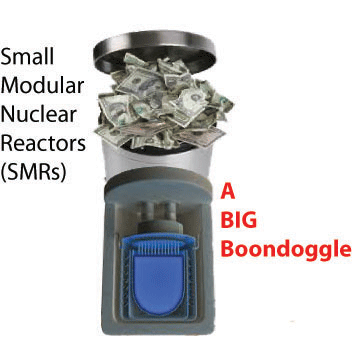 German nuclear industry cautious about usefulness of small reactors for energy transition, Nuclear phase-out Technology, Clean Energy Wire, Süddeutsche Zeitung , 6 Nov 20 Small Modular Reactors (SMR) are increasingly hailed as an effective way for using nuclear power to curb the climate crisis without the major risks associated with conventional nuclear plants, but Germany’s nuclear industry is sceptical whether the small reactors really can help boost international climate action, Christian J. Meier writes for the Süddeutsche Zeitung German nuclear industry cautious about usefulness of small reactors for energy transition, Nuclear phase-out Technology, Clean Energy Wire, Süddeutsche Zeitung , 6 Nov 20 Small Modular Reactors (SMR) are increasingly hailed as an effective way for using nuclear power to curb the climate crisis without the major risks associated with conventional nuclear plants, but Germany’s nuclear industry is sceptical whether the small reactors really can help boost international climate action, Christian J. Meier writes for the Süddeutsche Zeitung
……… Nicolas Wendler of industry association Nuclear Technology Germany (KernD) says SMRs are always going to be more expensive than bigger reactors due to lower power output at constant fixed costs, as safety measures and staffing requirements do not vary greatly compared to conventional reactors. In terms of levelised energy costs, SMRs will always be more expensive than big plants.” In order for SMRs to be profitable, these should run at maximum utilisation most of the time, Wendler argues, concluding that the potential on the German market would not be much greater than what is needed to adjust oscillating renewable power production…. https://www.cleanenergywire.org/news/german-nuclear-industry-cautious-about-usefulness-small-reactors-energy-transition
|
Nuclear wastes from Sellafield UK to arrive in Germany
A ship carrying six containers of waste from the Sellafield reprocessing plant in England docked in the early morning in Nordenham, news agency dpa reported. From there, it is to be transported by train to the now-closed Biblis nuclear power plant south of Frankfurt, several hundred kilometres (miles) away.
Germany has a strong anti-nuclear movement and waste transports have often drawn large protests. Activists question the safety of the waste containers and storage sites.
Following the Fukushima nuclear disaster in Japan nine years ago, Germany decided to phase out its own nuclear power generation by the end of 2022. The Biblis plant is one of several that was taken offline in 2011, but the site remains in use as a provisional storage facility for nuclear waste.
Germany recently launched a new search for a permanent site to store its most radioactive waste. A final decision is slated for 2031 and the aim is to start using the selected site in 2050.
Hitler’s quest for nuclear weapons
WW2: Hitler’s true nuclear capacity exposed in secret sabotage mission that ‘saved world’
WORLD WAR 2 saw the Allies cooperate to fight Adolf Hitler’s Nazi Germany but jaw-dropping documents reveal just how close he came to using nuclear weapons. Express UK By CALLUM HOARE Oct 21, 2020 The German nuclear weapons programme was an unsuccessful scientific effort to research and develop atomic weapons during World War 2. It went through several phases but was ultimately “frozen at the laboratory level” with historians and scholars alike generally agreeing it failed on all fronts. With that, Hitler is thought to have focused more on his revolutionary V1 and V2 rockets, but he came terrifyingly close to arming them with nuclear warheads, according to declassified papers unearthed by writer and filmmaker Damien Lewis.
“The greatest fear was that the Nazis had mastered the technology to fit a nuclear or radiological charge to the V2s, in which case there would be no defence possible.
“Churchill ordered aerial surveys to forewarn of such attacks – dry-run rehearsals to prepare for such an ordeal, and for frontline doctors to be briefed on the symptoms of radiation poisoning.
Such fears were very real. Following German physicist Otto Hahn splitting the atom in December 1938, the Allies believed the Germans to be two years ahead in the race to build the atom bomb.”
In May 1940, German forces struck a further blow in the race for nuclear supremacy after seizing Olen, Belgium, where the largest remaining stock of European uranium was located.
British intelligence reports on Operation Peppermint found by Mr Lewis revealed fears from London.
One read: “Since the fall of Belgium, much of the largest stock of uranium has been available [to Germany] from the refinery.”
According to Mr Lewis, its destination was the AuerGesellschaft refinery, at Oranienburg, Germany.
Allied research suggested it would require 20,000 workers, half a million watts of electricity and $150million (£114million) in expenditure to build the world’s first atom bomb.
Hitler, who now controlled most of western Europe, could demand such resources.
And, in concentration camps, he had access to millions of workers.
According to Mr Lewis, its destination was the AuerGesellschaft refinery, at Oranienburg, Germany.
Allied research suggested it would require 20,000 workers, half a million watts of electricity and $150million (£114million) in expenditure to build the world’s first atom bomb.
Hitler, who now controlled most of western Europe, could demand such resources.
And, in concentration camps, he had access to millions of workers.
“Details of Operation Peppermint and the measures taken to prepare for a Nazi nuclear strike were revealed in papers that I unearthed from the National Archives.
“This came as a great surprise to me, for I was unaware that the Allied wartime leaders viewed Nazi Germany’s nuclear programme as such a real and present threat.”
However, a top secret heroic mission would lead to a breakthrough……..
Hunting Hitler’s Nukes: The Secret Race to Stop the Nazi Bomb’ is published by Quercus and available to buy here. https://www.express.co.uk/news/world/1350513/world-war-2-hitler-nuclear-capacity-secret-winston-churchill-operation-peppermint-spt
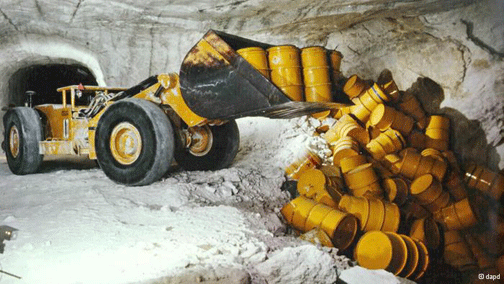
In Germany , a new dispute over the old abandoned Gorleben nuclear waste site
16 October 2020 Pledge Times (India/Germany)
New dispute over Gorleben
In an interview, the President of Germany’s Federal Office for the Safety of Nuclear Waste Management says it was problematic that Gorleben (current interim but beleaguered radwaste site) has been ruled out in the first review stage of the process to identify a geological repository site. The Green Party responded that the President “did not understand the procedure for which he is in charge. The search for a repository follows scientific criteria.”
Lower Saxony opposes building of nuclear power plants by Netherlands – location all too close

 German state of Lower Saxony against nuclear power plant in bordering Netherlands, Nuclear phase-out 08 Oct 2020, Kerstine Appunn,– NWZ Online
The northern German state of Lower Saxony has been rattled by Dutch plans to assess the construction of up to 10 new nuclear power plants, one of which could be located near the German border. “I will do everything in my power to prevent the Netherlands from seeing a new dawn of nuclear power,” Lower Saxony’s environment minister Olaf Lies (SPD) told Stefan Idel at NWZ online. The Netherlands has only one of formerly two nuclear power stations operating but governing party VVD has suggested that reaching the Paris Agreement climate targets would require the construction of new nuclear plants.
Lies said he was surprised by the Dutch announcement, calling it a “a gigantic step backwards into old times” to invest into new nuclear power plants and “irresponsible” to produce more nuclear waste. The minister said he expected strong resistance in the Northwest of the state. Members of the Green Party in Lower Saxony’s parliament announced they would work together with their Dutch sister party “GroenLinks” to stop this “economic and ecologic lunacy”.
While a study for the Dutch government said that nuclear power had a similar price as renewable installations, critics insist that nuclear power is by now much more expensive. Lies said he would focus on promoting joint renewable energy projects. Germany will phase-out its last nuclear power plants by the end of 2022 and is currently in the decade-long process of finding a permanent repository for the nuclear waste generated in the past 60 years. https://www.cleanenergywire.org/news/german-state-lower-saxony-against-nuclear-power-plant-bordering-netherlands
Nuclear no option for hydrogen production: German government
Energy ministry state secretary Feicht says, however, that the rule of nuclear will be discussed at an EU level, Recharge 6 October 2020 By Bernd Radowitz
“Nuclear isn’t an option for our energy system, be it the production of electricity for our electricity demand, [or] for the production of hydrogen,” Andreas Feicht, secretary of state in Germany’s economics and energy ministry, said at a virtual conference on hydrogen organized by his ministry……..
Green’ or ‘carbon-free’ hydrogen?
Germany by the end of 2022 will phase out its last atomic power stations, and in its €9bn ($10.6bn) national hydrogen strategy has laid down that it strives to ramp up a ‘green hydrogen’ economy mostly based on renewables such as offshore wind, with a temporary and limited role for ‘blue hydrogen’ produced from natural gas linked to carbon capture and storage (CCS)…………..
the Dutch government is planning to launch a consultation on building new nuclear power plants after a study commissioned by its economics and climate ministry claimed atomic energy is as cheap as wind or solar power – and supposedly the safest way to produce electricity in the country.
The study was conducted by a nuclear energy consultancy with links to the nuclear industry, though. At the same time, a flurry of studies advises against a nuclear renaissance.
‘Nuclear and renewables don’t mix’
The University of Sussex Business School and the ISM International School of Mangement this week published an analysis of 123 countries over 25 years in Nature Energy that concludes that nuclear and renewables don’t mix, and only the latter can deliver truly low carbon energy.
The researchers found that unlike with renewables, countries around the world with larger scale nuclear attachments do not tend to show significantly lower carbon emissions – and in poorer countries nuclear programmes actually tend to associate with relatively higher emissions.
The researchers found that unlike with renewables, countries around the world with larger scale nuclear attachments do not tend to show significantly lower carbon emissions – and in poorer countries nuclear programmes actually tend to associate with relatively higher emissions.
Champagne of power fuels
Michael Bloss, a Green Party member of the European Parliament, at the same hydrogen conference stressed that only “green hydrogen is clean hydrogen.”
Blue hydrogen as considered as a temporary option by the German government is no real option due to high amounts of methane leakage during its production, which he argued is “much more detrimental for the climate than CO2.”
Despite €3.7bn in EU investments into CCS since 2009 (according to the European Court of Auditors), the technology remained at the “beginning of its development” and is still “not ready to be applied,” Bloss said.
Renewable energies such as offshore wind, meanwhile, are the most cost-competitive energy source and should be used for hydrogen production, he added, without going into the nuclear versus renewables controversy.
Bloss, however, stressed that it has been said that “hydrogen is the Champagne among power fuels,” which must be used only in difficult-to-decarbonise sectors where it cannot be replaced by other applications, such as steel, cement or chemicals.https://www.rechargenews.com/wind/nuclear-no-option-for-hydrogen-production-german-government/2-1-887905
90 areas in Germany identified as potentially suitable for nuclear waste burial
 Agency report identifies 90 areas in Germany suitable as nuclear waste repository, https://www.thestar.com.my/news/world/2020/09/29/agency-report-identifies-90-areas-in-germany-suitable-as-nuclear-waste-repository By M OritzRommerskirchen and Zhang Yirong, BERLIN, Sept. 28 (Xinhua) — Germany had 90 areas with favorable geological conditions to facilitate the final storage of nuclear waste, the federal agency for radioactive waste disposal (BGE) announced on Monday.According to the interim report of the BGE, around 54 percent of Germany’s total territory, or about 194,000 square kms, were classified as potential sites for nuclear waste repository.
“The geology in Germany is so favorable that we can say with conviction that the one site with the best possible safety for the repository of high-level radioactive waste can be found,” said BGE managing director Stefan Studt during a press conference.
However, identifying a potential area is “still a long way off” from becoming a repository site in Germany, said Studt but stressed the chances of finding a site in Germany that offers safety for a million years are “very good.”
The German government is scheduled to close all of its nuclear power plants by 2022. The process of looking for a repository site for nuclear waste in Germany has been ongoing since 2017. The BGE interim report started the first of the three phases and would also serve as a basis to involve the public.
“We have achieved the first widely visible progress in the search for a repository,” said Environment Minister Svenja Schulze, adding that “this is a good news. Because it is a task for society as a whole.”
In the coming months and years, the list of potential locations would be gradually narrowed down further. According to BGE, after the completion of the underground exploration, the final recommendation of a site is expected in 2031.
UK to return high-level nuclear waste to Germany
|
UK to return high-level nuclear waste to Germany https://www.energylivenews.com/2020/09/28/uk-to-return-high-level-nuclear-waste-to-germany/
28 Sept 20, Preparations are underway for the first of the three shipments in late 2020, The UK will be returning high-level nuclear waste in the form of vitrified residues to Germany over the coming years.The waste results from the reprocessing and recycling of spent nuclear fuel at the Sellafield site in West Cumbria, which had previously been used to produce electricity by utilities in Germany. Preparations are underway for the first shipment in late 2020 under the Vitrified Residue Returns programme, which is a key component of the UK’s Nuclear Decommissioning Authority (NDA) strategy to repatriate high-level waste from the UK. A total of three shipments will be made to storage facilities in Germany, with the returns involving Sellafield Ltd working with International Nuclear Services (INS), a subsidiary of the NDA. INS will transport the waste by sea on a specialised vessel to a German port, followed by rail to the final destinations. Daher Nuclear Technologies has been contracted to safely manage the overland transport in Germany. |
|
Germany launches new search for permanent nuclear waste disposal site
|
Germany has named 90 locations that could safely house containers of radioactive nuclear waste permanently. The controversy over what to do with waste from the country’s nuclear power plants has been long and divisive. Germany formally launched its new search for a permanent nuclear waste disposal site on Monday. BGE, the nation’s waste management organization, named 90 areas around the country as possible candidates for the permanent waste disposal. It said in a long-awaited report that a location needs to be found by 2031. The aim is to start storing containers of radioactive waste at the site by 2050. Germany is seeking a safe place to store 1,900 containers of waste. The containers make up only 5% of the country’s nuclear waste but 99% of its radioactivity, according to BGE chairman Stefan Studt. Regions in Bavaria and Baden-Württemberg in southern Germany, as well as Lower Saxony and states in eastern Germany, are among the potential waste disposal sites. The locations suggested “favorable geological conditions for the safe disposal of radioactive waste,” the BGE said. The sites will now be vetted to account for other factors, including population density. Gorleben ruled outNot on the list of possible storage sites is Gorleben, a small settlement in Lower Saxony of 650 residents, and the location of a salt mine which had been earmarked as a site for nuclear waste disposal almost forty years ago. The dispute that led to so much bitterness in Germany over the years began on 22 February 1977: the State Premier of Lower Saxony, the conservative Ernst Albrecht, father of the current European Commission President Ursula von der Leyen, made an announcement: Gorleben, near the border to what was then East Germany, was to be the site of Germany’s facility for permanent nuclear waste storage. Locals never accepted the decision, arguing that the salt in the ground cold weaken containment structures and cause radioactive leaks. Gorleben became the focus of Germany’s anti-nuclear movement. Protestors staged sit-ins at the building site and rallied round the farming community in the region. In subsequent years, every transport of nuclear waste to Gorleben was accompanied by major demonstrations. Despite these massive protests, construction work on a new mine began there, in which the salt dome’s geological characteristics were to be explored. This mine alone, which never produced a grain of salt or any other natural resource, has already cost the German tax-payer 1.6 billion euros ($1.9 bn.) So much money has been spent conducting research there that the announcement by Kanitz that the salt dome’s surface cover is not intact and that the chemical composition of the ground water is unsuitable, amounts to a political bombshell. This is exactly what opponents of nuclear power have been saying for years. The debate is almost certain to keep reverberating. But Monday’s announcement in Berlin by Stefan Kanitz, managing director of the state “Federal Society for Permanent Nuclear Waste Storage” still marks a milestone: “Gorleben is not the best possible location,” he said. Following decades of debate which, above all, fueled the rise of the anti-nuclear Green Party, the German government decided after the reactor disaster at Fukushima in Japan in 2011 to permanently phase out nuclear power. Of the roughly 20 nuclear power plants once built, many have already been disconnected from the grid. Currently, six are still in use. They are all scheduled to be decommissioned by the end of 2022. Germany is likely to run into resistance from local politicians at whichever waste disposal site it chooses. Bavaria’s state government has already insisted that it is unsuited for permanent waste disposal. The plan now is to discuss things step by step with the local communities in the 90 regions shortlisted. That is one reason why the process is scheduled to take so long. Construction is to begin on a new permanent storage facility for nuclear waste in 2031. ……… https://www.dw.com/en/germany-launches-new-search-for-permanent-nuclear-waste-disposal-site/a-55077967 |
|
Nuclear energy CHEAP? Nuclear has drained Germany of more than €1trn to date

|
‘No higher cost energy’: nuclear has drained Germany of more than €1trn to date Subsidies tot up to €287bn since 1955, refuting atomic energy’s cheap power myth, says Forum for Ecological-Social Market Economy study https://www.rechargenews.com/transition/no-higher-cost-energy-nuclear-has-drained-germany-of-more-than-1trn-to-date/2-1-877313 17 September 2020 ,By Bernd Radowitz Development of the nuclear energy industry since the mid-1950s has led to more than €1trn ($1.18trn) in costs to the German society, and is wrongly portrayed as an inexpensive power source, according to a study by the Forum for an Ecological-Social Market Economy (FÖS) estimated.
FÖS calculated the support, which includes both state support, power prices and external costs, had been the most draining of all energy sources on the finances of the country, which is Europe’s largest economy. “No other energy source has caused costs as high as those of risky atomic power, which even after 65 years continues highly uneconomical,” said Sönke Tangermann, chairman of independent power provider Greenpeace Energy, which had commissioned the study. Germany by the end of 2022 is phasing out nuclear power. Since a first reactor started operations in 1955, the country had built more than 100 nuclear facilities, including power and research stations, and waste deposits. Other countries, such as Switzerland, have followed Germany’s lead and will also phase out nuclear power, while France at least wants to diminish the share of atomic power in its energy mix. But at the same time a new debate has started to build supposedly cheap mini nuclear reactors for power or hydrogen production. While none of these have been built yet, prices for the construction of conventional new nuclear plants in countries like France or Finland have ballooned into amounts several times the original cost estimate. Direct and indirect German government subsidies alone, including research grants and tax credits, since the mid-1950s have added up to €287bn, FÖS has calculated. Another €9bn were spent on other costs for the state, such as police operations during anti-nuclear protests, or follow-up costs from nuclear operations in former Eastern Germany. “Great part of these costs never had been included in the electricity price, which is why atomic energy wrongly was considered as a cheap power source,” Tangermann said, adding that the study for the overall costs of nuclear energy has included external costs that had been passed on to society for decades, such as the risk of accidents. Even after Germany’s nuclear exit, the country will face high costs, such as at least €7bn for the rehabilitation of the Morsleben nuclear storage facility and the Asse research storage facility as well as the Wismut uranium ore mine, or for the closure of former nuclear power plant sites. Tangermann said he hopes Berlin will resist current demands for an extension of Germany’s nuclear power plants, or investments into new ones, also as those would serve to discredit the expansion of renewables. “Given the enormous costs and aging infrastructure with ever greater risks, nuclear power cannot be a serious alternative to effectively tackling the climate crisis,” he said. |
|
|
1 This Month

of the week – Shut Down Drone Warfare!


Tell the Ukrainian Government to Drop Prosecution of Peace Activist Yurii Sheliazhenko

Petition to revoke the licensing of the Near Surface Nuclear Disposal Facility (NSDF) at Chalk River. https://www.ourcommons.ca/petitions/en/Petition/Details?Petition=e-7247
To see nuclear-related stories in greater depth and intensity – go to https://nuclearinformation.wordpress.com
-
Archives
- March 2026 (244)
- February 2026 (268)
- January 2026 (308)
- December 2025 (358)
- November 2025 (359)
- October 2025 (376)
- September 2025 (257)
- August 2025 (319)
- July 2025 (230)
- June 2025 (348)
- May 2025 (261)
- April 2025 (305)
-
Categories
- 1
- 1 NUCLEAR ISSUES
- business and costs
- climate change
- culture and arts
- ENERGY
- environment
- health
- history
- indigenous issues
- Legal
- marketing of nuclear
- media
- opposition to nuclear
- PERSONAL STORIES
- politics
- politics international
- Religion and ethics
- safety
- secrets,lies and civil liberties
- spinbuster
- technology
- Uranium
- wastes
- weapons and war
- Women
- 2 WORLD
- ACTION
- AFRICA
- Atrocities
- AUSTRALIA
- Christina's notes
- Christina's themes
- culture and arts
- Events
- Fuk 2022
- Fuk 2023
- Fukushima 2017
- Fukushima 2018
- fukushima 2019
- Fukushima 2020
- Fukushima 2021
- general
- global warming
- Humour (God we need it)
- Nuclear
- RARE EARTHS
- Reference
- resources – print
- Resources -audiovicual
- Weekly Newsletter
- World
- World Nuclear
- YouTube
-
RSS
Entries RSS
Comments RSS
 nuclear-news