30 arrested after break-in to France’s Tricastin nuclear power plant

 Greenpeace members arrested after France nuclear break-in CBC News 16 July 13, Intrusion raises questions about the security of France’s 19 nuclear power plants Around 30 Greenpeace activists were arrested on Monday after breaking into an EDF nuclear power plant in southern France, saying they wanted to expose security flaws and demanding its closure…… The action echoed tensions between the Socialist government and ecologists, who accuse Hollande of not doing enough to reduce France’s reliance on nuclear power and increase the use of renewable sources of energy.Greenpeace activists occupied this French nuclear power plant site before dawn Monday, a media stunt deeply embarrassing to a government intent on demonstrating that France’s reliance on nuclear power is safe. (Micha Patault/Greenpeace/AP)
Hollande sacked his energy and environment minister for publicly criticizing cuts to her budget earlier this month.
The president has pledged to cut the share of nuclear energy in the country’s electricity mix to 50 per cent from 75 per cent by 2025. He has also said he wants to close the country’s oldest plant at Fessenheim, near the German border, by 2017.
Greenpeace said to honour his promise, Hollande would have to close at least 10 reactors by 2017 and 20 by 2020. The campaign group said this ought to include Tricastin, which was built more than 30 years ago.
The dawn raid came less than a week after six female Greenpeace activists climbed London’s Shard, the tallest building in Western Europe, in protest over plans by oil producer Royal Dutch Shell to carry out drilling in the Arctic circle.http://www.cbc.ca/news/technology/story/2013/07/15/france-greenpeace-nuclear-plant.html
Antinuclear campaigners break in to French nuclear power plant
 Break in at French nuclear plant Sky News, July 15, 2013 Around two dozen Greenpeace campaigners have broken into a nuclear plant in southern France, in the latest such break-in by the environmental group.
The activists managed to enter the grounds of the Tricastin plant, some 200 kilometres north of Marseille, at around 5am (1300 AEST), Greenpeace and police said.
They hung banners reading ‘Tricastin: a nuclear accident’ and ‘Francois Hollande: president of a catastrophe?’ in reference to the French leader, according to Isabelle Philippe, a Greenpeace spokeswoman.
Twelve of the activists were arrested more than two hours later, according to the EDF energy giant that runs the country’s atomic power plants……
Members of the environmental anti-nuclear group have staged several break-ins at French nuclear plants in recent years in an effort to highlight what they say are dangers of atomic power and to expose security problems at the power stations.http://www.skynews.com.au/world/article.aspx?id=888225
Nuclear power forces get France’s Environment Minister sacked
 Sacked French minister lays blame on nuclear power, fracking groups SMH, Tara Patel July 6, 2013 France’s former environment minister Delphine Batho, who was sacked on Tuesday, has blamed the fracking and nuclear power industries for her dismissal.
Ms Batho, who held the energy and the environment portfolios, was fired by President Francois Hollande after she called his 2014 spending plans ”bad” because they cut her department’s funds by about 7 per cent.
These forces that I am talking about wanted my scalp.
Mr Hollande announced her sacking via Twitter.
But Ms Batho said on Thursday that her support for France’s ban on shale gas drilling and reducing its dependence on nuclear power were the real reasons behind her departure. ”The battle crystallised notably on the question of shale gas and more discreetly on the reduction of nuclear in France,” she said at a news conference at the National Assembly in Paris. ”These forces that I am talking about wanted my scalp.”
She left at a critical time as the nation debates its future energy mix after Mr Hollande pledged to lower the proportion of power France derives from nuclear energy, the highest in the world.
An energy law was to be formulated in coming months and sent to parliament early next year.The stakes are high for Electricite de France SA, operator of the country’s 58 nuclear reactors, because it wants to extend the lives of its generators rather than have any of them shut down.
Socialist Philippe Martin was named to replace Ms Batho……… Mr Hollande has pledged to lower the dependence on nuclear energy to 50 per cent of total output by about 2025 from the present 75 per cent. http://www.smh.com.au/world/sacked-french-minister-lays-blame-on-nuclear-power-fracking-groups-20130705-2phc7.html#ixzz2YIsVQFKn
Deadly plutonium fallout over Mururoa – truth now revealed
Mururoa fallout worse than first thought http://www.stuff.co.nz/world/south-pacific/8872214/Mururoa-fallout-worse-than-first-thought 3 July 13 MICHAEL FIELD Newly declassified French military documents have revealed that nuclear tests at Mururoa Atoll were far more deadly than has previously been admitted with plutonium fallout at much higher levels and over wider areas.
The documents cover the 46 atmospheric nuclear tests conducted at Mururoa and Fangataufa in French Polynesia between 1966 and 1974 and reveal that warships near the tests were hit by higher levels of radioactivity than known.
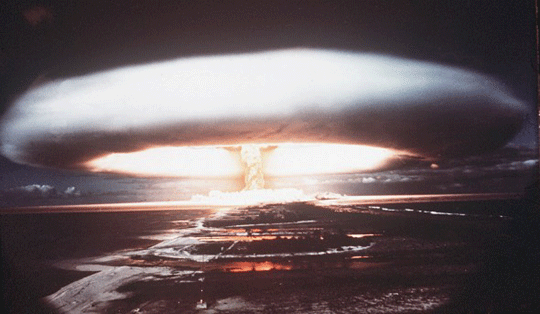
A New Zealand Labour Government in 1973 sent two warships, HMNZS Canterbury and HMNZS Otago, to monitor the Mururoa tests. It was not believed, at the time, that they may have received nuclear dusting but these new documents reveal there were much higher levels of radiation than were known.
A 1974 test, code named Centaur, dumped 500 times the maximum allowed level of plutonium fallout on Tahiti, 1250 kilometres away, the documents show.
There were also 140 more incidents of nuclear fallout above the 209 incidents already known. Tahiti, home to around 178,000 people, was hit 37 times by fallout. Continue reading
Britain cosying up with France in financing nuclear power research
UK invests £48.7m in nuclear cooperation with France http://eandt.theiet.org/news/2013/jun/nuclear-cooperation-uk-france.cfm 25 June 2013 By Tereza Pultarova A new £21.7m facility at the Atomic Weapons Establishment in Aldermaston is to be built as a further part of the UK’s contribution to the nuclear weapons information project with France.
According to the parliamentary sources, the overall investment in Project Teutates will amount to £48.7m.
The deal to share resources, in order to cut cost of military projects, between the UK and France was signed in 2010 by UK Prime Minister David Cameron and former French President Nicolas Sarkozy. Both countries committed to invest into new centres dedicated to experiments on warhead materials and parts.The facilities will use extremely high power X-rays to test materials at high temperature and pressure, mimicking conditions during nuclear explosions. The data gathered should help to assess performance and safety of warheads and might be used in development of new warhead types.
The facilities involved are the French Valduc Centre for Nuclear Studies and the UK’s Atomic Weapons Establishment at Aldermaston.
Defence Minister Philip Dunne has confirmed the construction of the Technology Development Centre, which is part of the UK’s contribution to Project Teutates, has so far cost £27m and the remaining part will be invested into a new facility within the Atomic Weapons Establishment in Aldermaston.
According to Mr Dunne, wider costs of Project Teutates have been withheld as disclosure would be “likely to prejudice commercial interests and would impact on the formulation of Government policy”.
France investigating low security at nuclear submarine base
France launches probe into ‘vulnerable’ nuclear base after media disclosure RT.comJune 13, 2013 The French government ordered an inquiry into a nuclear submarine base off the coast of Brittany after the claims in the local paper that the strategic site is vulnerable for terrorist attack due to poor security.
The country’s defense minister, Jean-Yves Le Drian, took the publication by Le Telegramme de Brest daily very seriously, calling for an immediate check at the base on the Ile Longue island, AFP reports.
The paper has called the base “a fortress on paper,” revealing huge security flaws at the facility, which hosts France’s four nuclear attack submarines.
According to the publication, access controls to the base were very weak as they didn’t use biometric identification systems, which are common for most modern airports. ……
The submarines at the Ile Longue island constitute the bulk of France’s nuclear deterrent after the country closed its land-based, long-range nuclear system at the Albion Plateau back in 1999.
The four nuclear subs, which are commonly known as ‘Boomers’, are each equipped with 16 inter-continental ballistic missiles.
Le Telegramme warned that there’ll be serious trouble if they fall into the wrong hands as firepower of just one submarine is equal to 960 times the nuclear explosion in Hiroshima in 1945.
Independent defense consultant, Jean-Marie Collin, told Francetv Info that the investigation into the Ile Longue base is an “an admission of weakness” by the French defense ministry, which indicates problems in the country’s national security. …… http://rt.com/news/france-nuclear-submarine-security-645/
Japan and France in a marketing frenzy to sell nuclear technology
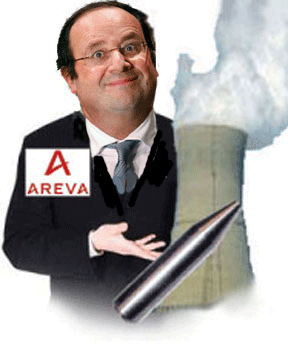 Hollande is on a three-day visit to Tokyo accompanied by several cabinet ministers and
  more than 30 executives, including the head of France’s nuclear energy giant Areva, Luc Oursel.
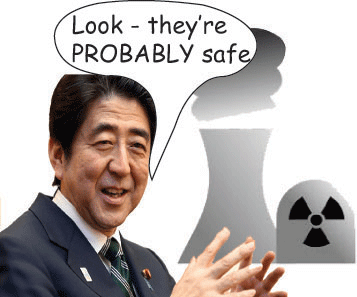
As well as agreeing to boost the exports of nuclear technology, Tokyo and Paris confirmed plans to cooperate on Japan’s troubled nuclear spent fuel reprocessing and fast-breeder projects,
France, Japan join forces for larger share of nuclear market http://www.reuters.com/article/2013/06/07/us-japan-france-nuclear-idUSBRE9560C720130607 By Antoni Slodkowski TOKYOJun 7, 2013 Japan and France on Friday agreed to boost nuclear cooperation to secure a larger share of global atomic energy markets as Tokyo’s pro-nuclear government looks to restart reactors despite public unease in the wake of the Fukushima disaster. Continue reading
France investigating effects of extreme weather on nuclear power plants
French nuclear plant research to include heatwave, tsunami analysis, http://www.platts.com/RSSFeedDetailedNews/RSSFeed/ElectricPower/26951912 Robin Sayles, newsdesk@platts
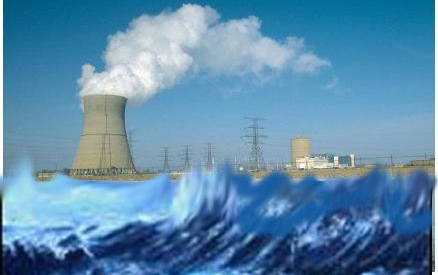
France is to invest Eur50 million ($64.2 million) in nuclear safety projects, taking into account knowledge gained from the Fukushima disaster in 2011, caused by an earthquake and huge tsunami.
In a document published late Friday, France’s energy ministry said it has selected over 20 research projects, ranging from operations management studies to disaster impact and radiation risk analyses.
Two of the accepted research projects are to analyze the risks of climate change and extreme weather occurrences. The SEEN project aims to “estimate the current and future climate risks for nuclear power production better,” including heatwaves, droughts and torrential downpours, the government said.
France’s 58 nuclear power reactors, operated by state-owned EDF, rely on river or sea water for cooling purposes.
Sustained hot and dry periods can prompt reactor shutdowns as water temperatures rise, while stormy weather can also release debris into rivers, such as tree branches, which must be filtered before the water is deemed safe for use.
The TANDEM project is to study the impact on France’s coastline of tidal waves, in particular the Atlantic and English Channel, where many of France’s nuclear power plants are situated.
The government did not give the specific leaders of the projects, but it has previously said that the projects would be carried out by academic and state-run nuclear bodies such as IRSN, the national radiological risk body.
Following the Fukushima disaster in 2011, EDF committed to carry out extra safety work recommended by nuclear watchdog ASN, which it said would cost around Eur10 billion.
France starting to deliberate on what to do with nuclear radioactive trash

it would be wise to stop making the stuff
 France Starts Public Debate on Underground Nuclear Waste Site http://www.bloomberg.com/news/2013-05-15/france-starts-public-debate-on-underground-nuclear-waste-site.html By Tara Patel – May 15, 2013 France has started a public inquiry into a plan to build a nuclear waste repository to be buried half a kilometer under the northeastern countryside.
A series of public meetings will be held through Oct. 15, according to the inquiry’s website, and the government and regulators will consider the outcome when they decide whether to approve the site.
If approved, the Cigeo project will store highly radioactive waste from Electricite de France SA’s 58 reactors in a site near Bure that straddles the Meuse and Haute-Marne regions. Andra, the waste-management agency spearheading the plan, wants to start construction in 2019 and begin operations in 2025.
The facility will cost 13.5 billion euros ($17.4 billion) to 16.5 billion euros for construction and operation over 100 years, according to Andra’s website.
The inquiry is “a masquerade and pure exercise in public relations,” anti-nuclear group Sortir du Nucleaire said yesterday in a statement. No one can guarantee the safety of the site for such a long period, it said.
EDF now stores waste at reactor sites and at above-ground facilities at La Hague in northern France. Sweden and Finland are also developing deep repositories after the European Union established nuclear waste disposal standards in 2011.
Under French law, nuclear operators including EDF and Areva SA (AREVA) have to build portfolios or amass funds to pay for the decommissioning of reactors and radioactive waste storage.
A parliamentary report published last year concluded operators may not be setting aside enough money. Cost estimates for the Cigeo site vary from 14.4 billion euros to 35 billion euros, that report said.
France determined to keep and upgrade its nuclear weapons
 France Isn’t Aiming for Nuclear Zero | The National Interest, Frank Klotz May 8, 2013 The French government finally unveiled its long-awaited livre blanc on defense and national security last week. As expected, the white paper contains grim news for the French military, capping spending at current levels and calling for substantial personnel reductions over the next five years. But one aspect of the French defense posture emerged virtually unscathed. Despite earlier reports about possible cuts in order to save money, the white paper reaffirms long-standing policies on the fundamental purpose and composition of French nuclear forces. While many officials and observers in the West discount the role of nuclear weapons in national security strategy now that the Cold War is over, the French government clearly takes a different view…….. Continue reading
Astronomic costs if France had a nuclear accident: report kept secret
 French Nuclear Disaster Scenario Was So Bad The Government Kept It Secret http://au.businessinsider.com/potential-cost-of-a-nuclear-accident-so-high-its-a-secret-2013-3 WOLF RICHTER15 MARCH 2013 Catastrophic nuclear accidents, like Chernobyl in 1986 or Fukushima No. 1 in 2011, are, we’re incessantly told, very rare, and their probability of occurring infinitesimal.
But when they do occur, they get costly. So costly that the French government, when it came up with cost estimates for an accident in France, kept them secret.
But now the report was leaked to the French magazine, Le Journal de Dimanche. Turns out, the upper end of the cost spectrum of an accident at the nuclear power plant at Dampierre, in the Department of Loiret in north-central France, amounted to over three times the country’s GDP. Continue reading
GDF’s wind energy provides over 50% of the company’s electricity: France
Renewable energy accounts for 50% of GDF Suez production capacity in 2012 http://www.utilityproducts.com/news/2013/04/10/renewable-energy-accounts-for-50-of-gdf-suez-production-capacity-in-2012.html
 Apr 10, 2013 – French utility GDF Suez’s (EPA:GSZ) production capacity from renewable energies stood at 5.1 GW at the end of 2012, or over 50% of the total production capacity of the group in France, the company said.
GDF Suez is the first producer of wind energy in the country and the second major producer of electricity from hydraulic energy, accounting for 25% of France’s capacity.
The group invests in all types of renewable sources, including solar and tidal power, offshore wind energy, biomass and biofuels, such as biomethane.
France – to phase out nuclear at home, but keen to sell it to India
Trust our nuclear technology: French president to India Deccan Herald, Mumbai, Feb 15, 2013, (IANS) French President Francois Hollande Friday urged India “to trust” his country’s nuclear technology and extended France’s support to the Indian nuclear power generation programme……
France is helping India construct two nuclear power reactors at the proposed 9,900 MW Jaitapur Nuclear Power Project in Ratnagiri, 400 km south of Mumbai. The project has been facing stiff resistance from locals, NGOs, anti-nuclear groups and some political parties..… Earlier Friday, Hollande met Maharashtra Governor K. Sankaranarayanan, Industry Minister Narayan Rane, Tourism Minister Chhagan Bhujbal and Protocol Minister Suresh Shetty and stressed the importance of nuclear energy.
Oh dear! a major nuclear accident would damage France’s image!
The bulk of financial losses would come from damage to France’s image
Major nuclear accident would cost France $580 billion: study By Michel
Rose SAINT-PAUL-LES-DURANCE, France Feb 6, 2013 (Reuters) – A
nuclear accident similar to the one at Japan’s Fukushima reactor would
cost France about 430 billion euros ($580 billion), or 20 percent of
its economic output, French nuclear safety institute IRSN said in a
study on the possible financial impact of a nuclear crisis.
A major disaster damaging one of France’s 58 nuclear reactors and
contaminating the environment with radioactive material would displace
an estimated 100,000 people, destroy crops and create massive power
outages, the study said….. Continue reading
Major nuclear accident in France – unlikely, but would be catastrophic
A “major” accident, rated 7 on the INES scale and similar to the 1986
Chernobyl disaster in Ukraine and Japan’s Fukushima, however, would be
a “catastrophe,” that would “strongly and durably traumatize the
country,” it said.
The health impact from the release of radioactive material would be
severe, the contamination of land would be long-lasting and
neighboring countries would be affected.
Major nuclear accident would cost France $580 billion: study By
Michel Rose SAINT-PAUL-LES-DURANCE, France Feb 6, 2013 (Reuters)
“……The IRSN and former World Bank economist unveiled two disaster
scenarios prompting a core meltdown at a typical 900-megawatt (MW)
French nuclear reactor.
A “serious” accident, rated 6 on the one-to-seven INES scale used by
the International Atomic Energy Agency and one notch higher than the
Three Mile Island accident of 1979 in the United States, would cost
France about 120 billion euros ($162 billion), or 6 percent of its
gross domestic product (GDP).
The consequences – with up to 10,000 people ousted from contaminated
zones – would be “manageable”, the IRSN said. Continue reading
1 This Month
Chernobyl: The Lost Tapes – A good documentary on Chernobyl on SBS available On Demand for the next 3 weeks– https://www.sbs.com.au/ondemand/tv-program/chernobyl-the-lost-tapes/2352741955560

of the week–London Campaign for Nuclear Disarmament

Tell the Ukrainian Government to Drop Prosecution of Peace Activist Yurii Sheliazhenko
To see nuclear-related stories in greater depth and intensity – go to https://nuclearinformation.wordpress.com
-
Archives
- April 2026 (152)
- March 2026 (251)
- February 2026 (268)
- January 2026 (308)
- December 2025 (358)
- November 2025 (359)
- October 2025 (376)
- September 2025 (257)
- August 2025 (319)
- July 2025 (230)
- June 2025 (348)
- May 2025 (261)
-
Categories
- 1
- 1 NUCLEAR ISSUES
- business and costs
- climate change
- culture and arts
- ENERGY
- environment
- health
- history
- indigenous issues
- Legal
- marketing of nuclear
- media
- opposition to nuclear
- PERSONAL STORIES
- politics
- politics international
- Religion and ethics
- safety
- secrets,lies and civil liberties
- spinbuster
- technology
- Uranium
- wastes
- weapons and war
- Women
- 2 WORLD
- ACTION
- AFRICA
- Atrocities
- AUSTRALIA
- Christina's notes
- Christina's themes
- culture and arts
- Events
- Fuk 2022
- Fuk 2023
- Fukushima 2017
- Fukushima 2018
- fukushima 2019
- Fukushima 2020
- Fukushima 2021
- general
- global warming
- Humour (God we need it)
- Nuclear
- RARE EARTHS
- Reference
- resources – print
- Resources -audiovicual
- Weekly Newsletter
- World
- World Nuclear
- YouTube
-
RSS
Entries RSS
Comments RSS
 nuclear-news