Hinkley nuclear fiasco is a threat to French company EDF
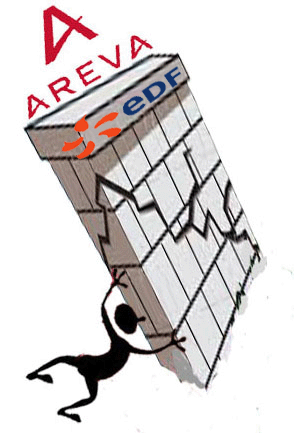 Nu Clear News No 87 5 Aug 16 EDF’s future threatened. Perhaps of more immediate concern is that a go-ahead for Hinkley could threaten the future of the company itself. EDF is a company in a very precarious financial situation. The ratings agency, S&P, postponed a decision to downgrade its credit rating when the UK Government announced the review. (7) EDF has €37 billion of debt. The collapse in energy prices has pushed earnings down 68% in 2015. The Company needs to spend €50 billion upgrading its network of 58 ageing reactors by 2025. It is scrambling to sell €4 billion of new shares and €10 billion of assets to strengthen its balance sheet. EDF is also expected to participate in the €5 billion bailout of Areva, the bankrupt developer of EPR technology, by taking a 75 per cent stake. (8) About the last thing it needs is a new €15 billion millstone around its neck.
Roy Pumfrey said “The EDF Board should take the opportunity presented by this pause to see that its Nuclear SatNav has taken the Company down a dead end; it’s only a matter of time before we hear that voice saying “At the next opportunity, turn round!”‘
He continues: “Perhaps most disappointing if not unexpected has been the reaction of the big UK Union leaders. Whilst confessing themselves ‘baffled’ by the government’s ‘bonkers’ decision, they should ask why the French union leaders representing EDF’s own workers were (and are) solidly and vocally opposed to HPC. This project involves a reactor which many of EDF’s own staff regard as unconstructable, selling off the family silver to fund it and putting EDF and therefore their own livelihoods at risk. UK unions do not seem to appreciate that the fantasy 25,000 jobs on HPC are a conjurer’s trick. Only 30% will be ‘local’, which means 90 minutes drive time from HPC, and with only 5,600 on site on any one day, a job with a particular skill set will only be good for two years at most. That’s assuming that
HPC can be built in an optimistic ten years, even that too long to keep the lights on.”
Over recent months several different alternative to building Hinkley Point C have been detailed (10) Most recently consultancy firm Utilitywise has described the proposed nuclear station as an “unnecessary expense” Energy efficiency measures could save the equivalent amount of electricity along with £12bn
Roy Pumfrey said: “This Government review of Hinkley Point C provides us with a wonderful opportunity to turn Somerset into a sustainable energy hub for England. The alternatives would be better for jobs, better for consumers, would reduce the mountain of dangerous waste we don’t know how to deal with and save Somerset from a decade of disruption caused by one of the biggest construction projects in the world The sooner EDF and the UK Government come to their senses the better. http://www.no2nuclearpower.org.uk/nuclearnews/NuClearNewsNo87.pdf
French trade unions consider further legal action against EDF’s Hi8nkley nuclear project

 Now French want to block Hinkley nuclear plant with unions set to launch second legal challenge http://www.thisismoney.co.uk/money/markets/article-3720786/Now-French-want-block-Hinkley-nuclear-plant-unions-set-launch-second-legal-challenge.html By CITY & FINANCE REPORTER FOR THE DAILY MAIL, 2 Aug 16 Fresh fears have emerged over the future of Hinkley Point nuclear power station as French trade unions look poised to launch a second legal challenge against the project.
EDF gave its long-awaited approval for funding of the £18billion nuclear plant last week.
But yesterday it was claimed board members were only given 48 hours to read the 2,500-page proposal document before voting on the investment. Complaints about the brevity of the two-day window have prompted French trade unions, who voted against the project, to consider further legal action against the energy company.
It follows an earlier legal bid from the unions over claims EDF did not provide enough information during the consultation on Hinkley.
EDF declined to comment.
France disturbed at possibility of Theresa May dumping Hinkley C nuclear station plan
 French Are Left Reeling as May Mulls Nuclear-Power Dilemma, Bloomberg, Robert Hutton RobDotHutton Francois De Beaupuy FrancoisDeBeaup July 29, 2016 —
-
New prime minister could dump project and blame Cameron
-
U.K. concerns are over Chinese involvement and rising cost
Even so, the French were stunned on Thursday evening when Britain said it needed more time to think about the plan. A planned signing was canceled. Hollande, with an election coming next year, has been attacked by labor unions who say the 18 billion-pound ($24 billion) project could bankrupt state-owned Electricite de France SA………
May’s joint chief of staff, Nick Timothy, last year described the decision to allow Chinese involvement in the project as “baffling.” He raised the prospect of China being able to shut down British energy production “at will” in an article for the Conservative Home website.
Brexit Talks
But there are risks to blocking the deal. It would infuriate the French, a needed ally in the Brexit talks. It would also lead to a dispute over where the costs of unwinding the project should fall………
“My assumption is still that the U.K. will probably sign off on it,” said Joel Kenrick, a political adviser to Energy Secretary Chris Huhne from 2010 to 2012.. “But then, I can’t actually see it being built. EDF have just got such a poor track record.” http://www.bloomberg.com/news/articles/2016-07-29/french-are-left-reeling-as-may-mulls-her-nuclear-power-dilemma
France’s State-owned nuclear company EDF decides to go ahead with UK’s Hinkley nuclear station
£18 billion Hinkley Point nuclear power station gets go ahead from EDF, Mirror, 28 JUL 2016 BY ALAN JONES , MIKEY SMITH
The French energy giant has decided to press ahead of a new plant in a crunch board meeting in Paris
EDF has given the go ahead to building a new nuclear power station at Hinkley Point, after a crunch board meeting in Paris.
The French energy giant had been expected to make the final investment decision today , clearing the way for the £18 billion project to go ahead.
Reports said the board voted by 10-7 in favour. EDF in the UK made no immediate comment.
John Sauven, Greenpeace executive director, said: “This deal was more riven with dissension in the EDF board than anyone expected. It’s unprecedented division and far closer than predicted.
“Countless experts have warned that for British families this power station will be terrible value for money.
“This is a bitter pill to swallow for hard up people who have been told that the Government is trying to keep bills down while dealing with energy security and lowering carbon emissions………..
A director opposed to the construction of Hinkley Point C resigned before the board met.
Gerard Magnin said in his resignation letter that Hinkley Point was “very risky”.
He did not attend the board meeting, leaving 17 directors to make the crucial decision. http://www.mirror.co.uk/news/uk-news/18-billion-hinkley-point-nuclear-8514859
French government propping up nuclear company EDF with a cash boost
French nuclear company EDF to get cash infusion http://www.dw.com/en/french-nuclear-company-edf-to-get-cash-infusion/a-19428058
The French government has said it will go ahead with a 4-billion-euro share issue for state-controlled electricity firm EDF. The move will help finance the construction of two controversial nuclear reactors in the UK. The French state – which holds 85 percent of EDF – said it will buy three billion euros’ worth of the newly issued EDF shares sometime this year. The fourth billion will be chipped in by other investors.
EDF’s board of directors is expected to give final investment approval this week for the construction of two EPR nuclear reactors at Hinkley Point in southwestern England, home to two old Magnox reactors that are no longer in operation and two AGR gas-cooled reactors whose construction began in 1967 and are still in operation, but whose decommissioning date is currently set for 2023.
EDF had delayed the final investment decision on the new Hinkley Point reactors several times, as it sought other investors to share the costs amid concerns the heavily indebted company will struggle to meet its financial commitments.
Internal skeptics abound The six labor-union representatives sitting on EDF’s 18-member board have repeatedly opposed the project. They wanted to see it delayed by three years to give EDF time to complete the construction of similar reactors in France, Finland and China, which are several years behind schedule.
The company’s works council secretary, Jean-Luc Magnaval, told the news agency Reuters that his union had filed a complaint on the matter with a Paris court, which has scheduled a hearing on the case for August 2.
EDF’s chief financial officer has resigned over the threat the project represents to the company’s finances.
EDF is also planning to speed up renovation of its 58 nuclear reactors in France, a task expected to cost about 51 billion euros.
EDF, which has already spent about 3 billion euros on Hinkley Point C, needs the project “to maintain its know-how and prepare for the retirement and renewal of its aging French and British nuclear fleet,” chief executive Jean-Bernard Levy told shareholders on Tuesday. He added that the new capital would also help the bolster the company’s credit rating and its ability to refinance its 37.4 billion euro debt.
Sparing no expense The Hinkley Point project is a joint venture between EDF and China General Nuclear Power Corporation. It’s one of the world’s most costly nuclear power plant projects.
The most recently projected price tag was a whopping 18 billion pounds ($24 billion, 21.7 billion euros), before Brexit lowered the value of the pound.
However, a complex system of subsidies approved by former UK finance minister, George Osborne, could cost up to 37 billion pounds, according to a recent estimate published by the UK Department of Energy and Climate Change.
Nuclear renaissance?
The UK’s environment secretary, Andrea Leadsom, recently reiterated that the Hinkley Point project will kick-start a “nuclear renaissance” in Britain that would see 18 gigawatts of new capacity added if sites at Sizewell, Bradwell, Moorside, Wylfa and Oldbury are developed along with Hinkley Point C.
Nuclear power accounts for around 16 percent of the UK’s energy requirements, which could drop to three per cent in 2030 unless new reactors are built in the meantime, Leadsom said.
EPR reactors are third-generation nuclear reactors which use pressurised water as their cooling fluid. At present, most operating reactors around the world are second-generation reactors; only around a dozen Generation 3 reactors are in operation so far.
A variety of Generation 4 reactor designs, which engineers hope will be more inherently safe and more cost-efficient than previous generations, are in various stages of prototype development, but none are expected to be commercially available before about 2030 or 2040.
By that time, however, renewable energy technologies and battery storage systems may have attainedsuch a low cost that construction of new nuclear power stations may prove a tough sell financially. That’s already the case for the Hinkley Point C project and for EDF’s other three existing EPR reactor projects around the world, all of which have proven to be far more expensive than optimistic early estimates, and very likely none of which would be getting built had they not been supported by heavy government subsidies.
EDF’s 900-MW Fessenheim-2 nuclear reactor may have to remain shut, until anomalies are corrected
EDF reactor may remain shut after regulator suspends certificate London (Platts)–19 Jul 2016 EDF’s 900-MW Fessenheim-2 nuclear reactor may have to remain shut beyond the end of scheduled maintenance after French nuclear safety authority ASN said Tuesday it had suspended a certificate for one of the reactor’s steam generators, in which several anomalies were discovered in June.
ASN issues test certificates for the most important nuclear equipment, and these certificates are required for the commissioning of the equipment. The suspension of the test certificate, ASN said, would result in the Fessenheim-2 reactor remaining shut until Areva NP — the reactor unit of Areva and owner of the Creusot Forge — demonstrates the steam generators can meet the regulatory standards.
Le Creusot Forge manufactures forgings and castings for the large components of nuclear reactors.
ASN said it had asked Areva NP to send the agency details on how it intends to rectify the steam generator’s problems……..http://www.platts.com/latest-news/electric-power/london/edf-reactor-may-remain-shut-after-regulator-suspends-21023392
Politics trumps good sense as EDF prepares to approve Hinkley Point C nuclear project
handing billions of energy bill payers money over to the French government for an outdated technology makes no business sense
 Hinkley Point C nuclear project expected to get go-ahead next week EDF likely to greenlight construction of power plant in Somerset, providing boost to UK government amid Brexit fallout, Guardian, Terry Macalister, 23 July, The Hinkley Point C nuclear project is poised to get the go-ahead from EDF next week in what will be a major boost to a new government trying to steady nerves on the economy after the British vote to leave the European Union last month.
A board meeting of the French energy group on Thursday 28 July is expected to give a final investment decision in favour of building new reactors in Somerset despite internal divisions over the £18bn scheme.
The decision has been repeatedly postponed, partly because of pressure from trade unionists on the board of the partly state-owned French group who claim EDF cannot afford the cost and risk of such a massive project in the UK.
But Jean-Bernard Lévy, EDF’s chief executive, has the support of the British government to press ahead with a scheme that represents an important shop window for selling nuclear technology and expertise worldwide.
EDF said it would discuss Hinkley Point C (HPC) – which involves building two so-called European pressurised reactors (EPR) – at its forthcoming board meeting and underlined the importance of building in Britain. “The HPC project is a major element of the group’s … strategy. The two EPR reactors at Hinkley Point would strengthen EDF’s presence in Britain, a country where its subsidiary EDF Energy already operates 15 nuclear reactors and is the largest electricity supplier by volume.”
EDF would not publicly commit itself to a decision in favour of the project, but nuclear industry sources said all company preparations were being made as if it was a done deal. “We are all expecting the go ahead next week,” the sources said.
The timing could not be better for the UK government, which regards Hinkley as a flagship energy scheme despite criticism from the City about its massive cost.
EDF insists it can build the project for £18bn but a complex system of subsidies agreed by the former chancellor, George Osborne, could cost the consumer up to £37bn, according to a recent estimate published on the Department of Energy and Climate Change (Decc) website………
Critics remained vocal. “It’s right that the UK should remain open for business but handing billions of energy bill payers money over to the French government for an outdated technology makes no business sense,” said John Sauven, executive director of Greenpeace UK.
“A possible final investment decision next week will only show that high-level post-truth politics trumps good sense. The type of reactor EDF wants to build at Hinkley hasn’t yet been shown to work.
“For UK bill payers, the rationale for a massively over-priced power station like Hinkley has long since disappeared but all the key players are too embarrassed to stop it.”………https://www.theguardian.com/uk-news/2016/jul/22/hinkley-point-c-nuclear-project
Several French trade unions want “out” of EDF’s Hinkley nuclear project – walk out of meeting
French unions walk out of nuclear sector meeting with minister, Reuters, 18 July 16 Several French trade unions walked out of a meeting with the economy minister on the nuclear sector on Monday, saying they did not want their participation used as a cover to sanction decisions such as on EDF’s Hinkley Point project in Britain.
Economy Minister Emmanuel Macron was expected to meet the energy branch of the trade unions to discuss the overhaul of the French nuclear sector which has been in turmoil since the Fukushima disaster in 2011.
The unions, worried that heavily indebted state-controlled utility EDF is taking on too much, are against the company pushing ahead with an 18 billion pound ($23.4 billion) plan to build a nuclear reactor complex at Hinkley Point in southern England and have asked for it to be delayed.
Macron has backed the project and said he expects EDF to make a final investment decision in September.
Representatives of several unions, including the hardline CGT and FO, arrived at the meeting, read a brief statement and left. “Nothing guarantees us that this meeting is not a facade to endorse a decision that we do not agree to. Among others, we reject any forceful decision on Hinkley Point,” the CGT, FO, CGC and UNSA unions said in a joint statement.
The unions said that although the meeting was about the French nuclear sector that comprises several players such as AREVA and CEA, only EDF was present at the talks….http://uk.reuters.com/article/france-nuclear-edf-idUKL8N1A443U
How to warn future society about nuclear wastes – 100,000 years on?

all nuclear agencies have a duty to try to prevent radioactive sites from being disturbed by future civilisations, who may decide to excavate an area in ignorance or even in the misguided hope of finding some kind of treasure buried underground. To this end, they are trying to find a way to communicate with the distant future, in order to warn its inhabitants about what will happen if they become too curious, and also to encourage them to look out for any technical problems at the site. This is not just a moral obligation. In the US, for example, there is a legal obligation to try to keep the “memory” of the site alive so that it can be managed “in perpetuity”.

This is a mind-bending task. About 100,000 years ago Europe was populated by a different species of human, Homo neanderthalensis. We know they had heavy, ape-like facial features, and used basic hunting tools, but we have no knowledge of the language they used. We have no idea what will happen in the next hundred thousand years, and what kinds of societies will populate the planet, let alone how we might communicate with them.
Nuclear waste: keep out for 100,000 years, Ft.com Michael Stothard, 14 July 16 Nuclear agencies are searching for the signs, language and solutions that will warn our descendants to stay away We are in a red metal cage bumping slowly down a mineshaft to our destination, half a kilometre under the ground near the small town of Bure in eastern France. Above us are yellow fields of oilseed rape. Below is the maze of reinforced concrete tunnels that, if it wins final approval from the French government, will from 2025 be the last resting place for the most destructive and indestructible waste in history. This is the €25bn deep geological storage facility for France’s high and medium-level radioactive waste, the residue of more than half a century of nuclear power. When the work here is finally finished, no one must ever take this journey again or, at least, not for 100,000 years.
France is the world’s largest exporter of electricity and the world’s most committed nuclear nation, with 58 reactors producing 75 per cent of the country’s power. As a result, it also produces enough toxic radioactive waste every year to fill 120 double-decker buses (about 13,000 cubic metres worth, or 2kg a year for every French person). The challenge at Bure is not only to build a massive dump for radioactive trash but also to guard it from human intervention for an impossible amount of time — more than 4,000 human generations.
Our cage stutters and almost comes to a halt. The French workers dangling with me continue chatting about their shifts, but I quickly check the emergency oxygen tank on my belt. When we finally reach the cavern floor, we are at the start of a 1.6km network of winding laboratory tunnels. The air is thick and dusty; dozens of men in blue and grey overalls drill into the walls with car-sized machines. Others walk around checking the scientific equipment embedded in the rock. Above us, the curved grey ceilings are covered by a dense thicket of wires and tubes sending data back to technicians on the surface.
The waste, which will be placed in a quarter of a million sealed containers slotted into horizontal tunnels more than 100m long, is the byproduct of burning uranium in the nuclear reactors and includes some of the most deadly and long-lasting radionuclides in the world. Chlorine-36 has a half-life of 300,000 years and neptunium-237 a half-life of 2 million years. People do not often come into direct contact with such materials, aside from in a nuclear accident, but those that do meet a horrific end. In 1987, thieves in Brazil stole a source of high-level radiation from an old abandoned hospital. It was sold, its lead case broken open. After three days, four people who were handling it began to suffer internal bleeding in their limbs, eyes and digestive tracts, according to doctors. Then their hair fell out. Within weeks, they were dead……..
nuclear agencies have two problems, however, as they try to devise schemes that will win regulatory approval for deep geological repositories. The first is to design a site that can last for ever, even as tectonic plates shift and a new ice age — which scientists expect to occur within 100,000 years — radically erodes the soil above. The nightmare scenario is that the radioactive elements will seep out into the groundwater, gradually, silently poisoning wildlife and humans. In Germany the Asse former salt mine, where 126,000 drums of nuclear waste were buried in the 1970s, is already collapsing, forcing the authorities to dig up the dangerous material to place it elsewhere.
The second issue is that all nuclear agencies have a duty to try to prevent radioactive sites from being disturbed by future civilisations, who may decide to excavate an area in ignorance or even in the misguided hope of finding some kind of treasure buried underground. To this end, they are trying to find a way to communicate with the distant future, in order to warn its inhabitants about what will happen if they become too curious, and also to encourage them to look out for any technical problems at the site. This is not just a moral obligation. In the US, for example, there is a legal obligation to try to keep the “memory” of the site alive so that it can be managed “in perpetuity”.
This is a mind-bending task. About 100,000 years ago Europe was populated by a different species of human, Homo neanderthalensis. We know they had heavy, ape-like facial features, and used basic hunting tools, but we have no knowledge of the language they used. We have no idea what will happen in the next hundred thousand years, and what kinds of societies will populate the planet, let alone how we might communicate with them. Will they even understand our language? A large part of the written Mayan language, used until the 17th century in Central America, is indecipherable to us today……..
Today, a fragile new consensus is evolving around the world. Under the umbrella of the Nuclear Energy Agency (NEA) in Paris, 17 organisations from 13 countries came together in 2011 to form the RK&M initiative, or Preservation of Records, Knowledge and Memory across Generations. At a landmark conference in 2014 in Verdun, France, it was agreed there should be some form of marker for a nuclear waste site to warn future generations. On the marker should be basic information about what is buried, not just emotive messages to keep out, and this information should also be archived around the world to maximise the chance that it will not be forgotten.
But there is still no consensus at all on what should be written and what the markers should be…….. http://www.ft.com/cms/s/2/db87c16c-4947-11e6-b387-64ab0a67014c.html
Glory to Areva, benefactor of humanity!
Areva, you’d better venerate it or it’ll retaliate. When it comes to evoke the French nuclear corporation, you’d better choose your vocabulary in the praise glossary, if you do not want to be dragged into court.

Areva has filed a libel suit against Jean-Jacques Mu, a former blogger on Club Mediapart, just for having relayed a critical article from the Anti-Nuclear Southeast Coordination.
Already in 1974, the anti-nuclear environmentalist newspaper La Gueule Ouverte, which did not mince words, warned its readers: “Corporations, fascism without borders. “
Heil Areva! Today’s freedom of reporting on the nuclear machinations and horrors is exerted only at the risk of citizens who believed to be in democracy.
And since we need to know that no one is too small enough to dare challenge Areva, Areva is taking out a sledgehammer to crush a gadfly: Jean-Jacques Mu, retired, blogger, not belonging to any group or any party. Jean-Jacques Mu is now dragged into court by Areva for defamation. His offense ? To have relayed an article of CAN-84 (Anti-Nuclear Southeast Coordination) on his blog hosted by Mediapart.
On 27 July 2014, Areva spotted the article relayed by Jean-Jacques Mu on Mediapart. Areva’s lawyers found some terms that could be taken for libel into court: they contacted Mediapart which immediately removed the offending article. The matter could have stopped there. But a few days later (July 31, 2014) Areva finds that Jean-Jacques Mu released a new blog post, which though having removed the offending words, gave the link to the same article of the CAN-84 (Anti-Nuclear Southeast Coordination).
In August 2014 (the traditional summer month holiday in France), the lawyers of the Areva Corporation were not idle: they hired a bailiff who traced the IP code of the administrator of the CAN-84 (Anti-Nuclear Southeast Coordination) website as well as the one of the blogger Jean-jacques Mu.
CAN is a collective, there is no single author of the article: who cares, Areva filed a complaint against X and … against Jean-Jacques Mu, based on the Law on the Freedom of the Press of 29 July 1881, which states that if one can not condemn the author of the allegedly defamatory words, then the editor of the words, its media, its distributors, its peddlers, and therefore in the twenty-first century the bloggers-relayers will be the ones to be condemned.
Jean-Jacques Mu faces a condemnation for having posted on his blog an article from the Anti-Nuclear Southeast Coordination, which he considered important to inform the public of.
What was it about? It was about the municipal council of Avignon and the signing of a contract between the city and the Areva Foundation. Like all the corporations, benefactors of humanity, Areva has a foundation that funds, among other things some educational projects.
Better to stuff early into the heads of the “children of a parent–teacher association” the propaganda conditioning them to worship profit ogres who will exploit them their whole lives while destroying the planet: It is cheap and pays off. And as the Ministry of Education’s pockets are increasingly empty, money even radioactive has no odor.
The article of CAN84 roundly blamed some EELV elected officials (Green Ecology Party) to have not voted against the signing of this contract with the Areva Foundation: they did not vote at all, they just got out of the room at the appropriate time.
Areva was only a secondary point of the article relayed by Jean-Jacques MU, which was aiming at the municipal council of Avignon. Yet Areva attacks the CAN84 and the blogger Jean-Jacques Mu, for a handful of forms as it considers defamatory because they are critical.
To be mentioned as the “giant of nuclear death” is bad for the image of Areva, and never mind if from its dirty uranium mines to its power plants operations its nuclear is nothing clean nor favorable to the bright future that its advertisements are promising us.
Good people, never mention “the Areva crimes” nor the permanent ongoing risks that this flagship of French industry poses to entire populations. Forget Chernobyl, forget Fukushima, forget the thyroid cancers that strike massively contaminated populations of children during the nuclear disasters that destroyed their cities, do not use the words “contaminate and kill children”, they could be badly perceived by susceptible Areva which will not hesitate to stick you with a court case.
It is obvious that the relay, in extenso for only 24 hours of a CAN84 article on the blog of Jean-Jacques Mu, has not infringed the notoriously booming business of the nuclear corporation. Areva, which manages to get in economic jeopardy while stirring billions, is very intolerant of criticisms from ordinary citizens and shows a much greater exigency for words in an article relayed by a blog that for the safety of workers in its uranium mines in Niger.
Since it is the freedom of information and expression that Areva is threatening through this libel case to be held in a Paris court on August 30, 2016, it is our responsibility to support Jean-Jacques MU, by raising awareness about this case, by being present in court on the day of the trial, by participating in the kitty that will give him the means that he does not have to prepare his defense.
At a time when corporations want whistleblowers to be condemned and track down the ordinary people who dare to criticize them, we answer: no, we will not be silenced!
https://blogs.mediapart.fr/juliette-keating/blog/300616/gloire-areva-bienfaitrice-de-lhumanite
France marketing its nuclear reactors to India
 France submits fresh plan for six nuclear plants in Jaitapur, Economic Times, By PTI | Jul 07, 2016 NEW DELHI: France has given a fresh techno-commercial proposal for building six atomic reactors in Jaitapur even as it again raised concerns over India’s civil liability law and sought “same level of protection” which are available for companies at the international level.
“All these steps will help us bring nuclear industry players from France to India. The delegation has asked to provide same level of protection to the EDF which is available at the international level,” a top EDF official told PTI.
We have also given a fresh techno-commercial proposal to NPCIL. It’s now up to the NPCIL to decide,” the official added.
The proposal includes negotiating with India for six reactors as against two, which was the case earlier. This would help bring down the cost. It also includes a proposal for localisation of technology to make the project cost effective.
France greenlights a raft of new tenders for solar energy
 France rolls out solar tenders for 20 GW by 2023 http://www.pv-magazine.com/news/details/beitrag/france-rolls-out-solar-tenders-for-20-gw-by-2023_100025234/#ixzz4DUCfz1pn01. JULY 2016 BY: IAN CLOVER French environment and energy minister Segolene Royal greenlights raft of new tenders for solar energy, including a three-fold increase in installed PV capacity, eyeing 20 GW by 2023. The French environment and energy minister Segolene Royal announced this week the introduction of a number of new solar tenders in France for the development of various PV applications.
Chiefly, France is aiming to triple its solar PV capacity to 20 GW by 2023, with the tenders expected to hit incremental goals of 10.2 GW by 2018, and between 18.2 to 20.2 GW by 2023.
Other tenders announced aim to support France’s stuttering building integrated photovoltaics (BIPV) sector, with the French government earmarking 450 MW of BIPV tenders over the coming three years. Another tender will be aimed solely at the country’s self-consumption sector, particularly in C&I and agriculture, while 1 GW of tenders for ground mounted PV will be issued annually for the next six years.
An additional 50 MW tender for solar+storage has also been introduced for France’s overseas territories.
This latest suite of support for solar development follows the previous round of tenders – first introduced in 2014 – that have collectively attracted more than $1 billion in investment into France’s solar PV industry. Experts in the country believe that the certainty offered by this approach will curry further favor with investors, and should particularly help boost France’s ground-mount and BIPV sectors.
The plans were first announced by the Conseil Superieur de L’Energie (CSE) in April, which outlined how France will embrace further its use of solar and wind energy. However, the CSE confirmed that there will be no nuclear plant closures before 2019, but affirmed that nuclear’s share of the energy mix will fall from 75% currently to 50% by 2025.
For solar, the cumulative target for 2023 is relatively ambitious and certainly achievable. France currently has just over 6.2 GW of cumulative PV capacity installed – according to official figures from grid operator RTE – and added just under 1 GW of capacity in 2015. Bloomberg New Energy Finance (BNEF) expects France to add around, or just above, 1 GW of new capacity this year, but the hope is that these new tenders will accelerate that pace of installation.
Struggling nuclear company EDF now looking for a nuclear shut-down business
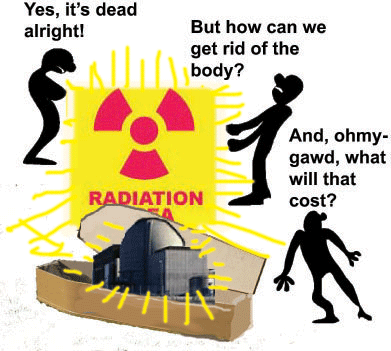 France’s EDF sets sights on $200 bln nuclear decommissioning market By Bate Felix and Benjamin Mallet PARIS, July 4 (Reuters) – EDF aims to snare a sizeable share of the global nuclear decommissioning market, worth an estimated 200 billion euros ($222 billion) over the next 15 years, by virtue of experience gained in dismantling its old reactors.
The French state-controlled utility is in the process of dismantling nine reactors and has 58 others in operation, supplying France with about 75 percent of its energy needs.
Worldwide, 110 reactors have been halted and will need to be safely dismantled, EDF executives said, adding that the company has a team of 800 experts in the complex process.
“Nuclear decommissioning is a very important market with opportunities for the international and local nuclear sector,” Dominique Miniere, executive director for EDF’s nuclear and thermal plants, told journalists in Paris……
Based on the completed decommissioning of reactors in the United States, EDF estimates that it will cost about 400 million euros to dismantle a 900 megawatt pressurised water reactor — a process that could take up to 15 years.
The company’s first dismantling of a nuclear reactor in France — the Chooz A reactor that ceased operating in 1991 — is expected to be completed in 2022. ($1 = 0.8974 euros) (Editing by David Goodman) http://af.reuters.com/article/energyOilNews/idAFL8N19Q3N4
Delay £18bn building of Hinkley nuclear station – EDF workers’ committee
 EDF workers’ committee expected to demand that nuclear power plant at Hinkley Point in Somerset is delayed http://www.thisismoney.co.uk/money/markets/article-3672592/EDF-workers-committee-expected-demand-nuclear-power-plant-Hinkley-Point-Somerset-delayed.html By CITY & FINANCE REPORTER FOR THE DAILY MAIL, 4 July 2016 EDF’S workers’ committee is expected to demand today that a nuclear power plant at Hinkley, Somerset, is delayed.
The energy firm has yet to make a decision on how to raise £18bn of funds needed for the power station, and has put off deciding until September to allow time to consult the unions.
The unions are obliged to deliver their opinion today on whether Hinkley should go ahead. But three of them issued a statement last week to say that Britain’s vote to leave the European Union added new elements of uncertainty.
It follows a legal action launched earlier this month in French courts by EDF’s Works Council, who asked for the project to be put off.
It is feared that if the unions do not support the project it could further delay Hinkley, which was due to be completed in 2017 but is currently expected to be finished by 2025.
Senior EDF managers want Hinkley nuclear project to be postponed
EDF Managers Tell UK MPs That Hinkley Point C Should Be Postponed http://www.nucnet.org/all-the-news/2016/06/20/edf-managers-tell-uk-mps-that-hinkley-point-c-should-be-postponed
Plans & Construction 20 Jun (NucNet): Senior managers at EDF have told British MPs that a final investment decision (FID) on the planned Hinkley Point C nuclear project should be delayed until problems including the reactor design and “multi-billion litigation” over the Olkiluoto-3 project in Finland have been resolved.
The letter from EDF managers to the UK parliament’s energy and climate change committee is a setback for the proposed £18bn (€23bn, $26bn) nuclear station in Somerset, England. The station is a flagship of the government’s energy policy and is intended to provide seven percent of Britain’s electricity from about 2025.
In April, the state-controlled French company said it was delaying the FID until September while it consulted with trade unions.
A letter dated 13 June and addressed to Angus MacNeil, the chairman of the committee, from the Fédération Nationale des Cadres Supérieurs de l’Énergie (FNCS) union, “advises to delay the FID until better upfront industrial visibility is evidenced”.
Outstanding problems highlighted by in the letter include:
– Areva NP, the designer of the European pressurised water reactor (EPR) planned for Hinkley Point, “is currently facing a difficult situation”.
– The French nuclear safety authority (ASN) may not approve operation of the Flamanville-3 EPR under construction in northwest France due to various anomalies with the reactor vessel bottom and the reactor vessel head.
– There may be “identical flaws” in an Areva EPR being built at Taishan-1 in China.
– Litigation between Areva and the Finnish energy group TVO over delays to the Olkiluoto-3 EPR remain unsettled.
– An EDF offer to purchase Areva expired on 31 March, leaving “governance uncertainties upon the implementation of the Hinkley Point C project”.
The letter says that on 25 May, ASN declared at an annual hearing in the French parliament that financial and economic challenges that both EDF and Areva are facing would be “time consuming”. The necessary reorganisations “would need long delays before a proper recovery happens” and ASN would prioritise regulatory oversight of the existing fleet rather than any new project.
According to the letter, ASN is concerned that while EDF is dedicating its efforts to new nuclear projects, the financing of safety improvements for the normal operation of the French nuclear fleet could be delayed or even given up.
The letter says “heavy evidence” still needs to be brought prior to further commitments, in order to make those commitments “gain robustness and reliability”.
On 7 June, three French workers unions sent a letter to energy minister Ségolène Royale asking for clarification about the “orientation” of the French nuclear industry.
Vincent de Rivaz, the chief executive officer of EDF’s UK subsidiary EDF Energy told MPs last month that he could not give a definite time for when the company will make the FID.
Mr de Rivaz was called to reappear before the committee after indicating at an appearance in March that the FID could be taken by early May. The committee asked him to explain why that had not happened.
The letter is online: http://bit.ly/1Uc8N0F
1 This Month

of the week – Shut Down Drone Warfare!


Tell the Ukrainian Government to Drop Prosecution of Peace Activist Yurii Sheliazhenko

Petition to revoke the licensing of the Near Surface Nuclear Disposal Facility (NSDF) at Chalk River. https://www.ourcommons.ca/petitions/en/Petition/Details?Petition=e-7247
To see nuclear-related stories in greater depth and intensity – go to https://nuclearinformation.wordpress.com
-
Archives
- April 2026 (114)
- March 2026 (251)
- February 2026 (268)
- January 2026 (308)
- December 2025 (358)
- November 2025 (359)
- October 2025 (376)
- September 2025 (257)
- August 2025 (319)
- July 2025 (230)
- June 2025 (348)
- May 2025 (261)
-
Categories
- 1
- 1 NUCLEAR ISSUES
- business and costs
- climate change
- culture and arts
- ENERGY
- environment
- health
- history
- indigenous issues
- Legal
- marketing of nuclear
- media
- opposition to nuclear
- PERSONAL STORIES
- politics
- politics international
- Religion and ethics
- safety
- secrets,lies and civil liberties
- spinbuster
- technology
- Uranium
- wastes
- weapons and war
- Women
- 2 WORLD
- ACTION
- AFRICA
- Atrocities
- AUSTRALIA
- Christina's notes
- Christina's themes
- culture and arts
- Events
- Fuk 2022
- Fuk 2023
- Fukushima 2017
- Fukushima 2018
- fukushima 2019
- Fukushima 2020
- Fukushima 2021
- general
- global warming
- Humour (God we need it)
- Nuclear
- RARE EARTHS
- Reference
- resources – print
- Resources -audiovicual
- Weekly Newsletter
- World
- World Nuclear
- YouTube
-
RSS
Entries RSS
Comments RSS
 nuclear-news