Franc e’s Nuclear Safety Authority (ASN) has doubts about EDF’s statements on financing of its decommissioning costs
Actu Environnement 12th July 2017 The Nuclear Safety Authority (ASN) considers that the EDF file concerning the financing of its decommissioning costs “does not provide sufficient
information to enable it to take a position on the completeness of the
assessment”.
It would like the electrician to explain his calculations and
reconsider certain assumptions. It also considers it necessary for EDF to
present the reactor-to-reactor decommissioning assumptions, rather than an
overall cost estimate extrapolated from the study of a site.
This is themain conclusion of an ASN opinion on the financing of long-term nuclear
loads by French operators published on Wednesday 12 July. This opinion
comes as the level of provisions made up by EDF to cover the dismantling of
its reactors is questioned.
In February, a report from the NationalAssembly estimated that the dismantling costs calculated by EDF revealed a”plausible underestimation”. MEPs criticized among other things “the
optimistic assumptions [and] a number of heavy expenses neglected”.
Unlikemost operators of nuclear installations, EDF does not present an
installation-by-facility assessment. ASN can not therefore analyze the
electrician’s file accurately. For the time being, EDF is relying on the
“DA09” study, which assesses future loads by extrapolating a dismantling
scenario for the four 900-megawatt reactors at the Dampierre (Loiret)
plant. An audit requested by the ministry in charge of energy validated the
method in 2015.
However, the ASN refuses to rule on the accuracy of this
figure since it did not have access to study DA09 or to auditing. In this
case, the Nuclear Constable does not, as a matter of principle, oppose an
assessment to the entire fleet of an assessment based on the dismantling of
a reactor, but it wishes to have access to the documents before making a
decision. Before validating EDF’s estimates, ASN wants to study precisely
two points: the hypotheses considered for the dismantling of the Dampierre
reactor and the extrapolation method at each reactor.
https://www.actu-environnement.com/ae/news/asn-refuse-valider-evaluation-finaniere-demantellement-edf-29383.php4
France’s EDF might have to shut down 17 nuclear reactors
 EDF May Have to Shut Up to 17 Reactors, Ecology Minister Says, Bloomberg, By Francois De Beaupuy, July 10, 2017,
-
Government plans to cut share of atomic power to 50% by 2025
-
Nuclear accounted for 72% of French electricity output in 2016
Electricite de France SA, the state-controlled operator of 58 nuclear reactors in France, may have to shut as many as 17 to fulfill government plans to reduce the share of atomic power in the country’s electricity output to 50 percent by 2025, Ecology Minister Nicolas Hulot said…….
While the government has pledged to boost renewables, it’s not yet evident how they would make up for the shutdown of almost a third of EDF’s reactors. The state would also face calls from the company to compensate it for potential loss of revenue and the cost of dismantling earlier than planned.
In January, EDF reached a compromise with the government in which the utility would receive 490 million euros ($559 million) and possible subsequent payments if the two reactors of the Fessenheim nuclear plant are taken offline.https://www.bloomberg.com/news/articles/2017-07-10/edf-may-have-to-shut-up-to-17-reactors-ecology-minister-says
Call for more transparency on steel anomalies in the reactor vessel at Flamanville
The steel anomalies in the reactor vessel of the EPR in Flamanville and
many steam generators have led to one of the most serious crises faced by
the French nuclear industry.
The report of the High Committee on Transparency and Information on Nuclear Safety (HCTISN) highlights the
absence of precise information from Areva and EdF on the serious problems
affecting the reactor vessel of the Flamanville EPR .
The finding would be the same for steam generators. ACRO, therefore calls for more transparency.
The association made an inventory of the available documentation and
reconstructed a chronology of the events on a dedicated website:
http://transparence-nucleaire.eu.org.
The international nuclear industry in financial meltdown
 Global Meltdown? Nuclear Power’s Annus Horribilis, Jim Green, New Matilda, 9 July 2017 https://newmatilda.com/2017/07/09/global-meltdown-nuclear-powers-annus-horribilis/
This year will go down with 1979 (Three Mile Island), 1986 (Chernobyl) and 2011 (Fukushima) as one of the nuclear industry’s worst ever ‒ and there’s still another six months to go, writes Dr Jim Green.
Two of the industry’s worst-ever years have been in the past decade and there will be many more bad years ahead as the trickle of closures of ageing reactors becomes a flood ‒ the International Energy Agency expects almost 200 reactor closures between 2014 and 2040. The likelihood of reactor start-ups matching closures over that time period has become vanishingly small.
In January, the World Nuclear Association anticipated 18 power reactor start-ups this year. The projection has been revised down to 14 and even that seems more than a stretch. There has only been one reactor start-up in the first half of the year according to the IAEA’s Power Reactor Information System, and two permanent reactor closures.
The number of power reactors under construction is on a downward trajectory ‒ 59 reactors are under construction as of May 2017, the first time since 2010 that the number has fallen below 60.
Pro-nuclear journalist Fred Pearce wrote on May 15: “Is the nuclear power industry in its death throes? Even some nuclear enthusiasts believe so. With the exception of China, most nations are moving away from nuclear ‒ existing power plants across the United States are being shut early; new reactor designs are falling foul of regulators, and public support remains in free fall. Now come the bankruptcies…. The industry is in crisis. It looks ever more like a 20th century industrial dinosaur, unloved by investors, the public, and policymakers alike. The crisis could prove terminal.”
Pro-nuclear lobby groups are warning about nuclear power’s “rapidly accelerating crisis“, a “crisis that threatens the death of nuclear energy in the West“, and noting that “the industry is on life support in the United States and other developed economies“.
United States
The most dramatic story this year has been the bankruptcy protection filing of US nuclear giant Westinghouse onMarch 29. Westinghouse’s parent company Toshiba states that there is “substantial doubt” about Toshiba’s “ability to continue as a going concern”. These nuclear industry giants have been brought to their knees by cost overruns ‒estimated at US$13 billion ‒ building four AP1000 power reactors in the U.S.
The nuclear debate in the US is firmly centred on attempts to extend the lifespan of ageing, uneconomic reactors with state bailouts. Financial bailouts by state governments in New York and Illinois are propping up ageing reactors, but a proposed bailout in Ohio is meeting stiff opposition. The fate of Westinghouse and its partially-built AP1000 reactors are much discussed, but there is no further discussion about new reactors ‒ other than to note that they won’t happen.
Six reactors have been shut down over the past five years in the US, and another handful will likely close in the next five years. How far and fast will nuclear fall? Exelon ‒ the leading nuclear power plant operator in the US ‒ claims that “economic and policy challenges threaten to close about half of America’s reactors” in the next two decades. According to pro-nuclear lobby group ‘Environmental Progress‘, almost one-quarter of US reactors are at high risk of closure by 2030, and almost three-quarters are at medium to high risk. In May, the US Energy Information Administration released an analysis projecting nuclear’s share of the nation’s electricity generating capacity will drop from 20 per cent to 11 per cent by 2050.
There are different views about how far and fast nuclear will fall in the US ‒ but fall it will. And there is no dispute that many plants are losing money. More than half in fact, racking up losses totalling about US$2.9 billion a year according to a recent analysis by Bloomberg New Energy Finance. And a separate Bloomberg report found that expanding state aid to money-losing reactors across the eastern US may leave consumers on the hook for as much as US$3.9 billion a year in higher power bills.
Japan
Fukushima clean-up and compensation cost estimates have doubled and doubled again and now stand at US$191 billion. An analysis by the Japan Institute for Economic Research estimates that the total costs for decommissioning, decontamination and compensation could be far higher at US$443‒620 billion.
Only five reactors are operating in Japan as of July 2017, compared to 54 before the March 2011 Fukushima disaster. The prospects for new reactors are bleak. Japan has given up on its Monju fast breeder reactor ‒ successive governments wasted US$10.6 billion on Monju and decommissioning will cost another US$2.7 billion.
As mentioned, Toshiba is facing an existential crisis due to the crippling debts of its subsidiary Westinghouse. Toshibaannounced on May 15 that it expects to report a consolidated net loss of US$8.4 billion for the 2016‒2017 financial year which ended March 31.
Hitachi is backing away from its plan to build two Advanced Boiling Water Reactors in Wylfa, Wales. Hitachi recentlysaid that if it cannot attract partners to invest in the project before construction is due to start in 2019, the project will be suspended.
Hitachi recently booked a massive loss on a failed investment in laser uranium enrichment technology in the US. A 12 May 2017 statement said the company had posted an impairment loss on affiliated companies’ common stock of US$1.66 billion for the fiscal year ended 31 March 2017, and “the major factor” was Hitachi’s exit from the laser enrichment project. Last year a commentator opined that “the way to make a small fortune in the uranium enrichment business in the US is to start with a large one.”
France
The French nuclear industry is in its “worst situation ever” according to former EDF director Gérard Magnin. France has 58 operable reactors and just one under construction.
French EPR reactors under construction in France and Finland are three times over budget ‒ the combined cost overruns for the two reactors amount to about US$14.5 billion.
Bloomberg noted in April 2015 that Areva’s EPR export ambitions are “in tatters“. Now Areva itself is in tatters and is in the process of a government-led restructure and another taxpayer-funded bailout. On March 1, Areva posted a €665 million net loss for 2016. Losses in the preceding five years exceeded €10 billion.
In February, EDF released its financial figures for 2016: earnings and income fell and EDF’s debt remained steady at €37.4 billion. EDF plans to sell €10 billion of assets by 2020 to rein in its debt, and to sack up to 7,000 staff. The French government provided EDF with €3 billion in extra capital in 2016 and will contribute €3 billion towards a €4 billioncapital raising this year. On March 8, shares in EDF hit an all-time low a day after the €4 billion capital raising was launched; the share price fell to €7.78, less than one-tenth of the high a decade ago.
Costs of between €50 billion and €100 billion will need to be spent by 2030 to meet new safety requirements for reactors in France and to extend their operating lives beyond 40 years.
EDF has set aside €23 billion to cover reactor decommissioning and waste management costs in France ‒ just over half of the €54 billion that EDF estimates will be required. A recent report by the French National Assembly’s Commission for Sustainable Development and Regional Development concluded that there is “obvious under-provisioning” and that decommissioning and waste management will take longer, be more challenging and cost much more than EDF anticipates.
In 2015, concerns about the integrity of some EPR pressure vessels were revealed, prompting investigations that are still ongoing. Last year, the scandal was magnified when the French Nuclear Safety Authority (ASN) announced that Areva had informed it of “irregularities in components produced at its Creusot Forge plant.” The problems concern documents attesting to the quality of parts manufactured at the site. At least 400 of the 10,000 quality documents reviewed by Areva contained anomalies. Work at the Creusot Forge foundry was suspended in the wake of the scandal and Areva is awaiting ASN approval to restart the foundry.
French environment and energy minister Nicolas Hulot said on June 12 that the government plans to close some nuclear reactors to reduce nuclear’s share of the country’s power mix. “We are going to close some nuclear reactors and it won’t be just a symbolic move,” he said.
India
Nuclear power accounts for just 3.4 percent of electricity supply in India and that figure will not rise significantly, if at all. In May, India’s Cabinet approved a plan to build 10 indigenous pressurized heavy water reactors (PHWR). That decision can be read as an acknowledgement that plans for six Westinghouse AP1000 reactors and six French EPR reactors are unlikely to eventuate.
The plan for 10 new PHWRs faces major challenges. Suvrat Raju and M.V. Ramana noted: “[N]uclear power will continue to be an expensive and relatively minor source of electricity for the foreseeable future…. The announcement about building 10 PHWRs fits a pattern, often seen with the current government, where it trumpets a routine decision to bolster its “bold” credentials. Most of the plants that were recently approved have been in the pipeline for years. Nevertheless, there is good reason to be sceptical of these plans given that similar plans to build large numbers of reactors have failed to meet their targets, often falling far short.”
South Africa
An extraordinary High Court judgement on April 26 ruled that much of South Africa’s nuclear new-build program is without legal foundation. The High Court set aside the Ministerial determination that South Africa required 9.6 gigawatts (GW) of new nuclear capacity, and found that numerous bilateral nuclear cooperation agreements were unconstitutional and unlawful. President Jacob Zuma is trying to revive the nuclear program, but it will most likely be shelved when Zuma leaves office in 2019 (if he isn’t removed earlier). Energy Minister Mmamoloko Kubayi said on June 21 that South Africa will review its nuclear plans as part of its response to economic recession.
South Korea
South Korea’s new President Moon Jae-in said on June 19 that his government will halt plans to build new nuclear power plants and will not extend the lifespan of existing plants beyond 40 years. President Moon said: “We will completely re-examine the existing policies on nuclear power. We will scrap the nuclear-centred polices and move toward a nuclear-free era. We will eliminate all plans to build new nuclear plants.”
Since the presidential election on May 9, the ageing Kori-1 reactor has been permanently shut down, work on two partially-built reactors (Shin Kori 5 and 6) has been suspended pending a review, and work on two planned reactors (Shin-Hanul 3 and 4) has been stopped.
Taiwan
Taiwan’s Cabinet reiterated on June 12 the government’s resolve to phase out nuclear power. The government remains committed to the goal of decommissioning the three operational nuclear power plants as scheduled and making Taiwan nuclear-free by 2025, Cabinet spokesperson Hsu Kuo-yung said.
UK
Tim Yeo, a former Conservative politician and now a nuclear industry lobbyist with New Nuclear Watch Europe, saidthe compounding problems facing nuclear developers in the UK “add up to something of a crisis for the UK’s nuclear new-build programme.”
The lobby group noted delays with the EPR reactor in Flamanville, France and the possibility that those delays would flow on to the two planned EPR reactors at Hinkley Point; the lack of investors for the proposed Advanced Boiling Water Reactors at Wylfa; the acknowledgement by the NuGen consortium that the plan for three AP1000 reactors at Moorside faces a “significant funding gap”; and the fact that the Hualong One technology which China General Nuclear Power Corporation hopes to deploy at Bradwell in Essex has yet to undergo its generic design assessment.
The only reactor project with any momentum in the UK is Hinkley Point, based on the French EPR reactor design. The head of one of Britain’s top utilities said on June 19 that Hinkley Point is likely to be the only nuclear project to go ahead in the UK. Alistair Phillips-Davies, chief executive officer of SSE, an energy supplier and former investor in new nuclear plants, said: “The bottom line in nuclear is that it looks like only Hinkley Point will get built and Flamanville needs to go well for that to happen.”
There is growing pressure for the obscenely expensive Hinkley Point project to be cancelled. The UK National Audit Office report released a damning report on June 23. The Audit Office said: “The Department for Business, Energy and Industrial Strategy’s deal for Hinkley Point C has locked consumers into a risky and expensive project with uncertain strategic and economic benefits… Today’s report finds that the Department has not sufficiently considered the costs and risks of its deal for consumers…. Delays have pushed back the nuclear power plant’s construction, and the expected cost of top-up payments under the Hinkley Point C’s contract for difference has increased from £6 billion to £30 billion.”
Writing in the Financial Times on May 26, Neil Collins said: “EDF, of course, is the contractor for that white elephant in the nuclear room, Hinkley Point. If this unproven design ever gets built and produces electricity, the UK consumer will be obliged to pay over twice the current market price for the output…. The UK’s energy market is in an unholy mess… Scrapping Hinkley Point would not solve all of [the problems], but it would be a start.”
And on it goes. Hinkley Point is one of the “great spending dinosaurs of the political dark ages” according to The Guardian. It is a “white elephant” according to an editorial in The Times.
EDF said on June 26 that it is conducting a “full review of the costs and schedule of the Hinkley Point C project” and the results will be disclosed “soon”. On July 3, EDF announced that the estimated cost of the two Hinkley reactors has risen by €2.5 billion (to €23.2 billion, or €30.4 billion including finance costs). In 2007, EDF was boasting that Britons would be using electricity from Hinkley to cook their Christmas turkeys in December 2017. But in its latestannouncement, EDF pushes back the 2025 start-up dates for the two Hinkley reactors by 9‒15 months.
Oliver Tickell and Ian Fairlie wrote an obituary for Britain’s nuclear renaissance in The Ecologist on May 18. Theyconcluded: “[T]he prospects for new nuclear power in the UK have never been gloomier. The only way new nuclear power stations will ever be built in the UK is with massive political and financial commitment from government. That commitment is clearly absent. So yes, this finally looks like the end of the UK’s ‘nuclear renaissance’.”
Switzerland
Voters in Switzerland supported a May 21 referendum on a package of energy policy measures including a ban on new nuclear power reactors. Thus Switzerland has opted for a gradual nuclear phase out and all reactors will probably be closed by the early 2030s, if not earlier.
Germany will close its last reactor much sooner than Switzerland, in 2022.
Sweden
Unit 1 of the Oskarshamn nuclear power plant in Sweden has been permanently shut down. Unit 2 at the same plant was permanently shut down in 2015. Ringhals 1 and 2 are expected to be shut down in 2019‒2020, after which Sweden will have just six operating power reactors. Switzerland, Germany and Taiwan have made deliberate decisions to phase out nuclear power; in Sweden, the phase out will be attritional.
Russia
Rosatom deputy general director Vyacheslav Pershukov said in mid-June that the world market for the construction of new nuclear power plants is shrinking, and the possibilities for building new large reactors abroad are almost exhausted. He said Rosatom expects to be able to find customers for new reactors until 2020‒2025 but “it will be hard to continue.”
China
With 36 power reactors and another 22 under construction, China is the only country with a significant nuclear expansion program. However nuclear growth could take a big hit in the event of economic downturn. And nuclear growth could be derailed by a serious accident, which is all the more likely because of China’s inadequate nuclear safety standards, inadequate regulation, lack of transparency, repression of whistleblowers, world’s worst insurance and liability arrangements, security risks, and widespread corruption.
Dr Jim Green is the national nuclear campaigner with Friends of the Earth, Australia, and editor of the World Information Service on Energy’s Nuclear Monitor newsletter.
France plans to cut nuclear power’s share of electricity from 75% to 50% by 2025
French ecology minister hopes to cut down on nuclear power by 2025, PARIS, July 6 (Xinhua) — French ecology minister Nicolas Hulot expressed his hopes on Thursday to meet the commitment of reducing the share of nuclear energy in the country’s electricity output by 2025.
Unveiling an action plan for the country’s energy transition, the environmental activist said cutting electricity generated by nuclear power to 50 percent by 2025 from the current 75 percent was France’s “objective.”
“I hope (the target) will be held. My wish is to engage irreversible trajectories and dynamics,” Hulot told reporters…….http://news.xinhuanet.com/english/2017-07/06/c_136423323.htm
Costly progress as EDF plans replacement of tank lid for Flamanville nuclear reactor
Journal de l’environement 28th June 2017 [Machine Translation] While acknowledging its weaknesses, the nuclear gendarme should authorize the entry into service of the Flamanville EPR
reactor at the end of next year.
In return, EDF will have to multiply the controls, some of which are impossible to achieve. And change the lid of
the reactor vessel “as soon as possible”.
The conference room of the Nuclear Safety Authority (ASN) was full on Wednesday afternoon. After
months of suspense, the regulator of the nuclear park was to return its “position” about the future of the flagship of the tricolor atomic industry: the Flamanville EPR.
In a few minutes, the case is dispatched. What do you expect from the ASN? Work will continue in Flamanville. If all
goes well, the third reactor is expected to start at the end of 2018. Prudente, EDF has ordered, from April, a Japanese blacksmith a new tank lid. In Pierre-Franck Chevet’s opinion, the machine should be ready to install in 2024, six years after the reactor is commissioned!
Cost: a hundred million euros. A drop of water, compared to the 10.5 billion already engulfed by EDF in the largest construction site in France.
http://www.journaldelenvironnement.net/article/epr-de-flamanville-une-decision-inaudible-de-l-asn,84091
Dangers of nuclear fissile materials transported by sea
 Robin Des Bois 29th June 2017, [Machine Translation] Next week, MOX fuel should be loaded at Cherbourg on
the Pacific Egret or Pacific Heron to Japan and the Takahama nuclear power
plant. The MOX contains 10% plutonium and 90% uranium.
This journey throughthe seas of the world of dangerous fissile materials induces tensions and
risks throughout the journey. The problem of safe havens in case of damage
or fire is still unresolved. The ability of Pacific Nuclear Transport
Ltd.’s small ships to withstand North Korean cyclones, tsunamis and
missiles is not demonstrated.
But it is the business as usual that continues for Areva and for a French nuclear industry without guard crazy
besides being penniless. Perpetuating small business as in the good old
days before Fukushima means avoiding questioning the reprocessing plant for
irradiated fuel and plutonium mining in La Hague, which the Nuclear Safety
Authority and the unions say Since 2 years that it is in a worrying state
in terms of safety.
Areva’s transports always give the marines of the whole
world the opportunity of exercises for the most underwater. Our first
advice is therefore aimed at fishermen and especially trawlers. They must
deviate widely from the convoy to eliminate any risk of hook with a
submarine, hypothesis more and more plausible to explain the sinking of the
Bugaled Breizh in January 2004, a few days before the departure of
Cherbourg of a cargo of waste Nuclear activities to Japan.
http://www.robindesbois.org/moxquitue/
France’s Nuclear Safety Authority (NSA) under unprecedented pressure from EDF and AREVA.
 Greenpeace 28th June 2017, The Nuclear Safety Authority (NSA) is under unprecedented pressure from EDF
and AREVA. This unprecedented situation shows that ASN’s decision is no longer limited to nuclear safety: it has become a political one.
What do EDF and AREVA want to do? Derogating from the most basic standards of nuclear safety so that the Flamanville EPR is put into operation despite its defective parts. Behind the authorization of this tank of the EPR, it
is indeed the survival of the French nuclear industry is at stake. Indeed, EDF and AREVA play a big part in the EPR in Flamanville.
The decisions that will be taken on this site will have far-reaching consequences for the future of the projects sold in the United Kingdom, Finland and China.
We appeal to the responsibility of Nicolas Hulot, Minister of Ecological and Solidarity Transition and in charge of nuclear safety. The ASN can no longer take a safety decision independently and cannot resist the pressure.
As for us French citizens, we do not have to pay the price of strategic and technical errors of EDF and AREVA. By putting an end to the Flamanville shipyard, Nicolas Hulot can still avoid it.
https://www.greenpeace.fr/nicolas-hulot-ne-laissez-pas-lasn-sacrifier-la-surete-pour-sauver-lindustrie-nucleaire/
Additional costs loom for Flamanville nuclear project: reactor lid might need replacement
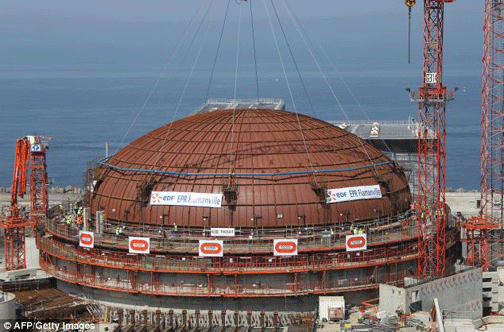 Le Monde 26th June 2017,[Machine Translation], EPR of Flamanville: a report warns EDF on the
reliability of the lid of the tank. The operator may have to quickly
replace this reactor masterpiece after commissioning, which is still
scheduled for the end of 2018.EDF executives have been overly optimistic,
obviously convinced that the future reactor tank of the Flamanville
(Manche) EPR reactor would pass without difficulty before the “judges” of
the Nuclear Safety Authority (ASN) and its armed wing, the Institute of
Radiation Protection and Nuclear Safety (IRSN).
The situation is ultimately more complex: it is not excluded that the plant operator must at least
change the lid of this tank, only a few years after the EPR has been put
into service. Meeting on Monday 26th and Tuesday 27th June, the 31 members
of the permanent group of experts for nuclear pressure equipment
(industrialists, associations …) took note of a long report (193 pages)
of the IRSN and the Direction des Equipment under ASN’s nuclear pressure,
which is very critical in some respects. If it does not question the future
of the powerful third generation reactor (1,650 MW), designed by Areva in
the 1990s, it puts an additional mortgage on a project that will already
cost 10.5 billion d ‘ Three times more than expected. http://www.lemonde.fr/economie/article/2017/06/26/un-feu-vert-sous-condition-attendu-pour-l-epr-de-flamanville_5151256_3234.html
Activists halted nuclear waste ship for several hours
Nuclear ship proceeds despite protests, Herald Sun ,Wolfgang Jung and Stephen Wolf, Deutsche Presse Agentur June 29, 2017 A transport ship loaded with highly radioactive nuclear waste has continued its journey along a German river after being halted by protesters.
Four activists from the German environmental group Robin Wood abseiled from a bridge over the Neckar river in the town of Bad Wimpfen in southwest Germany, unfurling a banner reading, “Prevent, don’t put off.”
The stunt halted for several hours the first-ever river transport of atomic waste in Germany while specially trained forces attempted to remove them from the bridge…….http://www.heraldsun.com.au/news/breaking-news/nuclear-ship-proceeds-despite-protests/news-story/baef982d1bccf91bafd6fe21e909e660
Flamanville nuclear reactor 3 likely to go ahead, despite weak spots in its steel
FT 28th June 2017, A group of experts at the French nuclear safety authority have cleared
EDF’s Flamanville 3 nuclear reactor to start as planned next year – despite weak spots in its steel. The group’s non-binding recommendation will be used by the safety authority, the ASN, to formulate a final ruling on October.
But the decision makes it likely the reactor will get the final green light. Completion of the next-generation reactor had been thrown into doubt after the discovery in 2015 of weak spots in the steel prompted an
extensive safety review by the ASN.
The stakes are high for French nuclear groups EDF and Areva because it would cost billions of euros to fix if the
ASN had ruled that the steel was too brittle. The sign off by the ASN is also a European Commission pre condition for approving EDF’s planned takeover of Areva’s reactor business. The group of experts did recommend,
however, that EDF put in place a new reactor cover by 2024. https://www.ft.com/content/7b401283-e91c-3612-9e21-2d1c8c45ed8d
French Nuclear regulator requires more inspections of Flamanville EPR reactor pressure vessel anomaly.
 ASN 28th June 2017, On 28th June 2017, ASN presented its position regarding the Flamanville EPR
reactor pressure vessel anomaly. ASN relied on the analysis of the files
transmitted by Areva NP and EDF, carried out by its nuclear pressure
equipment department and its technical support organisation IRSN, and on
the opinion of its Advisory Committee for nuclear pressure equipment.
On the basis of the technical analyses carried out, ASN considers that the
mechanical characteristics of the pressure vessel bottom head and closure
head are adequate with regard to the loadings to which these parts are
subjected, including accident situations.
However, the anomaly in the chemical composition of the steel entails a reduction in the margins with
respect to the fast fracture risk. ASN therefore considers that EDF must
implement additional periodic inspections to ensure that no flaws appear
subsequently. ASN observes that such inspections can be performed on the
vessel bottom head and therefore considers that they must be implemented.
However, the technical feasibility of similar inspections on the pressure
vessel closure head is not established. ASN therefore considers that the
use of the closure head must be limited in time. It notes that it would
take about seven years to manufacture a new closure head, which could thus
be available by the end of 2024. In these conditions, ASN considers that
the current closure head shall not be operated beyond that date.
http://www.french-nuclear-safety.fr/Information/News-releases/ASN-presents-its-position-regarding-the-Flamanville-EPR-reactor-vessel-anomaly
Flamanville nuclear reactor’s safety problems add to concerns about Britain’s similar nuclear projects
 Reuters 26th June 2017, The cover of the reactor vessel EDF is building in Flamanville, France, may not be able to function more than a few years unless the utility can do additional tests which so far it has not be able to, nuclear regulator ASN said in a report.
While the long-awaited report, a copy of which was obtained by Reuters, concludes the European Pressurized Reactor (EPR) is fit for service, EDF may have to replace its vessel cover soon after its
scheduled start-up in 2018. The requirement is a major blow for EDF, which
will have to start planning for a costly replacement of a key part before
the reactor even starts up.
The reputational damage could also add to concerns in Britain about its 18 billion pound ($23 billion) project to
build two similar EPR reactors in southwest England.
The French regulator had ordered a deep review of the Flamanville vessel following the discovery
in 2015 of carbon concentrations in the base and cover of the containment vessel, which make its steel more brittle. The report – led by the IRSN, the ASN’s technical arm – is being reviewed by a group of independent experts on Monday and Tuesday.
This autumn, ASN will partly base its final ruling on Flamanville on the experts’ recommendations. The ASN report
states that while the base of the vessel is fit for service despite the need for increased monitoring over its lifetime, manufacturer Areva NP has not been able to conduct sufficient tests on the cover as it is no longer accessible. These controls are indispensable in order to ensure the reactor’s safety over its 60-year lifetime, the report says.
http://uk.reuters.com/article/edf-flamanville-nuclear-idUKL8N1JN2OC
EDF braces for a multi-billion euro rise in costs at its Hinkley Point C nuclear site
 Telegraph 25th June 2017,EDF is bracing for a multi-billion euro rise in costs at its Hinkley Point C nuclear site after a fresh evaluation of the project revealed yet another
likely delay. An internal review of the troubled project by senior
executives at EDF’s French headquarters is expected to confirm fears that
the state-backed energy giant will not be able to deliver Hinkley on time
or in line with its £18bn budget.
The French newspaper Le Monde reported over the weekend that sources close to the review have said no one believes
it can be delivered by 2025. Instead, the start-up date is likely to be
2027 and pile a further £870m on to the construction costs of the £18bn
project. The review is being led by Jean-Michel Quilichini, the group’s
audit director, and is expected to be made public later this summer. The
latest delay is likely to fuel concerns that Government has locked energy
bill payers into “a high cost and risky deal” that could fail to deliver on
its economic promises.
http://www.telegraph.co.uk/business/2017/06/25/hinkley-nuclear-costs-climb-deadlines-slip/
Defects in pressure vessel of Flamanville nuclear reactor could stall EPR’s global nuclear industry
 France Info 22nd June 2017 [Machine Translation] Defects on the pressure vessel of the EPR of Flamanville: “EDF and Areva were not transparent,” denounces Greenpeace. Greenpeace believes that EDF and Areva have not sufficiently communicated on the defects of the pressure vessel of the EPR of Flamanville.
“The origin of the anomalies and the history of the design” have not been made\ public, denounces the association in particular. The NGO is based on a report to which it has had access and which is due to be published onThursday by the High Committee for Transparency and Information on Nuclear Safety (HCTISN) on anomalies in the Flamanville EPR tank ( Handle). The HCTISN is an expert committee on nuclear safety. It decided in June 2015 totake the matter of the anomalies on the tank of the EPR of Flamanville.
According to Greenpeace, the report states that EDF and Areva “did not explain to the public the origin of the anomalies and the history of the design and manufacture of the EPR reactor vessel.” The report also notes that “no alternative technical scenario has been made public, in the event of the rejection of the tank and its lid by the Nuclear Safety Agency
(ASN)”.
“Since the beginning of the case, EDF and Areva have put the ASN before the fait accompli: they refuse to communicate a plan B to force it to accept that the EPR starts with pieces veined,” explains Yannick Rousselet, in charge of Campaign for Greenpeace France. “The rejection of the tank by the ASN would trigger a ‘domino effect’ by questioning the
feasibility of all EPR projects sold by EDF and AREVA in the UK, China and inland, says Yannick Rousselet. Industrialists put an intolerable pressure on the ASN, making the future of the nuclear sector on its shoulders.” http://www.francetvinfo.fr/sante/environnement-et-sante/defauts-sur-la-cuve-de-lepr-de-flamanville-edf-et-areva-nont-pas-ete-transparents-denonce-greenpeace_2248675.html
1 This Month

of the week – Shut Down Drone Warfare!


Tell the Ukrainian Government to Drop Prosecution of Peace Activist Yurii Sheliazhenko

Petition to revoke the licensing of the Near Surface Nuclear Disposal Facility (NSDF) at Chalk River. https://www.ourcommons.ca/petitions/en/Petition/Details?Petition=e-7247
To see nuclear-related stories in greater depth and intensity – go to https://nuclearinformation.wordpress.com
-
Archives
- April 2026 (79)
- March 2026 (251)
- February 2026 (268)
- January 2026 (308)
- December 2025 (358)
- November 2025 (359)
- October 2025 (376)
- September 2025 (257)
- August 2025 (319)
- July 2025 (230)
- June 2025 (348)
- May 2025 (261)
-
Categories
- 1
- 1 NUCLEAR ISSUES
- business and costs
- climate change
- culture and arts
- ENERGY
- environment
- health
- history
- indigenous issues
- Legal
- marketing of nuclear
- media
- opposition to nuclear
- PERSONAL STORIES
- politics
- politics international
- Religion and ethics
- safety
- secrets,lies and civil liberties
- spinbuster
- technology
- Uranium
- wastes
- weapons and war
- Women
- 2 WORLD
- ACTION
- AFRICA
- Atrocities
- AUSTRALIA
- Christina's notes
- Christina's themes
- culture and arts
- Events
- Fuk 2022
- Fuk 2023
- Fukushima 2017
- Fukushima 2018
- fukushima 2019
- Fukushima 2020
- Fukushima 2021
- general
- global warming
- Humour (God we need it)
- Nuclear
- RARE EARTHS
- Reference
- resources – print
- Resources -audiovicual
- Weekly Newsletter
- World
- World Nuclear
- YouTube
-
RSS
Entries RSS
Comments RSS
 nuclear-news