France plans to phase out nuclear power without increasing carbon emissions
The centrist government of French President Emmanuel Macron has launched a year-long debate about energy policy before deciding in early 2019 on the future share of nuclear energy in France’s power production. It now stands at 75 percent.
To assist discussions, grid operator RTE has prepared scenarios for cutting nuclear energy’s share from 56 percent to 11 percent by 2035, and an additional scenario on reducing nuclear reliance to 50 percent by 2025.
Junior Energy and Environment Minister Sebastien Lecornu told Enerpresse the scenarios that would lead to the construction of new thermal power stations were held back.
“We are clear about what we want for the energy mix, the increase of carbon emissions is not an option for us,” he said.
France would not build more plants powered by coal or fuel oil, he said, but said the government would consider whether there was a role for gas, which has lower emissions than coal or other fossil fuels.
Lecornu’s office could not immediately be reached for comment.
Sustainable energy advocacy group NegaWatt said on Thursday the most ambitious scenarios for reducing nuclear reliance could be achieved without boosting CO2 emissions provided there was a stronger focus on energy efficiency and if the nuclear reactors had their lifespans’ extended a little beyond 40 years.
EDF wants to extend the lifespan of its reactors to 50 years, but will need approval of nuclear regulator ASN for each reactor. The ASN has said it will rule on the principle of lifespan extensions in 2021. Reporting by Geert De Clercq; Editing by Edmund Blair
Macron’s France weakening on plans to phase out nuclear power?
 France crimps debate on reducing reliance on nuclear: activists say https://www.reuters.com/article/us-france-nuclearpower/france-crimps-debate-on-reducing-reliance-on-nuclear-activists-say-idUSKBN1FE2MU, 26 Jan 18, Geert De Clercq PARIS (Reuters) – The French government is hampering discussion about how to reduce the country’s reliance on nuclear energy by limiting debate about more radical alternatives, renewable energy advocates said on Thursday.
France’s previous socialist government pledged to reduce the share of nuclear in power generation to 50 percent by 2025, from 75 percent today. President Emmanuel Macron promised to respect that pledge during his election campaign last year, but since taking office he has pushed the target back by a decade.
Macron now wants to set new targets in a multi-year energy plan that will be debated this year and presented in early 2019.
But renewable energy activists say that at some workshops earlier this month, the government blocked discussion of scenarios under which France would radically reduce its nuclear power capacity, instead focusing on more pro-nuclear scenarios.
Energy and Environment Minister Nicolas Hulot has denied that the government favored the most pro-nuclear scenarios, saying it merely eliminated the two most extreme scenarios and kept the “median” scenarios. He did not specify which scenarios had been eliminated.
Late last year, French grid operator RTE published four 2035 scenarios under which nuclear capacity would be reduced to various degrees from the current 63 gigawatt (GW).
Under the “Volt” scenario, nuclear capacity would be cut to 55 GW by closing just nine of state-owned utility EDF’s 58 nuclear reactors and leaving the share of nuclear in power production at 56 percent. The “Ampere” scenario would close 16 reactors and leave the share of nuclear at 46 percent.
Two more radical scenarios, “Watt” and “Hertz”, would close as many as 52 and 25 reactors respectively, with the Watt scenario cutting the share of nuclear to as little as 11 percent. The remaining power would come from renewables (71 percent) and gas (18 percent).
“The Watt and Hertz scenarios were eliminated from the presentations at the government’s request,” said Yves Marignac of NegaWatt, a group which advocates higher renewables use.
NegaWatt took part in two workshops to prepare the public debate on the issue. It was joined by several energy-focused NGOs, EDF, nuclear firm Orano, and lobby groups. The debates are supposed to lead to a first draft of a multi-year energy plan by summer and a final plan in early 2019. Its conclusions will be crucial for European power markets as they will determine how much nuclear baseload capacity remains available.
· A source involved with organizing the workshops confirmed the government had instructed RTE to withdraw two scenarios.
· “All scenarios were mentioned, but only two were reviewed in detail,” he said.
· A ministry spokeswoman said two scenarios had indeed been removed from the presentation but declined to give details.
· “It is inconceivable that these two scenarios would be withheld from public debate,” NegaWatt’s Thierry Salomon said.
· France has withheld key information on nuclear before.
· In the months before the parliament vote on the 2015 energy law, Hulot’s predecessor Segolene Royal barred publication of an environment agency ADEME report showing France could switch to 100 percent renewables without extra costs.
· “At least this time the information is public. But it looks like the government is putting the interests of the nuclear industry ahead of the energy policy debate,” Salomon said.
· > Link to ADEME report story: tinyurl.com/y84ow838</a Reporting by Geert De Clercq. Editing by Jane Merriman
With collapsed uranium market and nuclear stagnation, failed company AREVA rebrands itself

France’s Areva rebrands to Orano in dire uranium market https://www.reuters.com/article/us-areva-strategy/frances-areva-rebrands-to-orano-in-dire-uranium-market-idUSKBN1FC25H, Geert De Clercq, PARIS (Reuters) 23 Jan 18,– French uranium mining and nuclear fuel group Areva rebranded itself as Orano on Tuesday, closing the book on a years-long restructuring but still facing an uncertain future, with uranium prices at decade lows and the nuclear industry in the doldrums.
“We had to change our name – we are a new company with a different perimeter, focused on the fuel cycle,” Knoche said at a presentation of the new brand.
Orano refers to uranium, the core of the firm’s business, and its new circular yellow logo references the yellowcake uranium concentrate that it extracts from the ore.
To mark the change – and reduce real estate costs by 10 million euros (8.78 million pounds) a year – Orano will move out of its prestigious Paris headquarters, a distinctive black-slab skyscraper inspired by the monolith in Stanley Kubrick’s “2001: A Space Odyssey”.
Orano has net debt of close to 3 billion euros and by 2025 plans to invest about 2 billion euros in its plants and a similar amount in its mines, Knoche said.
The company aims to be cash-flow positive from this year, but Knoche said nothing about profit targets and admitted that market prices for uranium are too low to invest in new mines.
He said long-term contract prices for uranium were about $10 per pound higher than spot prices, but declined to say what price Orano needed to operate profitably in the long run.
Uranium prices are down 80 percent from a decade ago as Japan’s 2011 Fukushima disaster has led to a slowdown in reactor newbuilds and countries such as Germany abandon nuclear.
Knoche said Orano was banking on nuclear growth in Asia. He expects the firm to earn 30 percent of its turnover there by 2020, up from 20 percent last year.
Talks about selling a nuclear fuel reprocessing plant to China were “accelerating”, Knoche said, but would not give a deadline. Discussions about the project have been going on for a decade, while the price the firm hopes to get has fallen to around 10 billion euros from 15 billion euros.
With an order book worth nearly eight years of turnover and solid business in service and maintenance for a large part of the world’s more than 400 nuclear reactors, Orano faces the prospect of rebuilding a profitable operation.
“We will do it with humility. That is why the name is written in lower case,” Knoche said. Reporting by Geert De Clercq and Benjamin Mallet; Editing by Sudip Kar-Gupta and Dale Hudson
France’s costly and unsatisfactory efforts at dismantling nuclear reactors
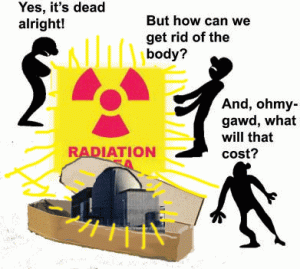
 Romandie 12th Jan 2018 [Machine Translation] Dismantling: in France, nuclear country, the task remains immense. EDF may well show international ambitions in terms of nuclear dismantling, the industry still has to prove itself in France, the world’s second largest producer of nuclear electricity, where the task remains immense and the delays numerous.
“We dismantle nine reactors in France We consider that our know-how can put us in a very good position to win real market share internationally,” assured AFP on Wednesday Sylvain Granger director of deconstruction projects at EDF. An ambition
“staggering” for Barbara Romagnan, former PS MP, author of a parliamentary report that highlighted in early 2017 the “underrated” costs and growing delays of these projects.
“None of these French reactors has yet been totally dismantled, even though they were closed between 1985 and 1997,”
she argues. Elsewhere in the world, seventeen reactor vessels (more than 100 MW) have been dismantled in the United States, Germany and Spain, according to the Institute for Radiation Protection and Safety (IRSN).
In Chooz, EDF’s most advanced site, located in the Ardennes, the dismantling of the tank, the ultimate and most delicate stage, began in 2017. But the cutting of the internal components of the tank was suspended after the contamination. in June, a Swedish employee from Westinghouse, to whom EDF subcontracted this operation, according to the French company. EDF
estimates at 79 billion euros the cost of dismantling all its reactors in France (including 18.5 billion spent fuel management), said Thursday the company that spoke in 2000 of 16 billion euros.
https://www.romandie.com/news/880085.rom
China unlikely to go ahead with AREVA’s nuclear reprocessing plan, despite Macron’s support
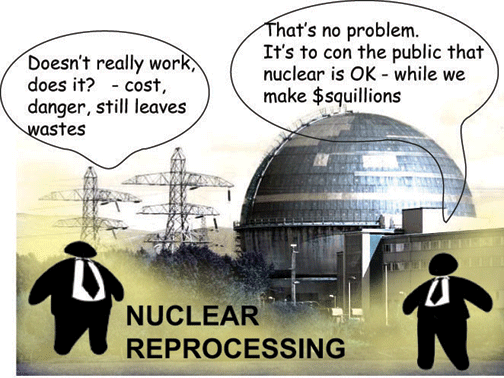 Reuters 11th Jan 2018, So close yet so far: China deal elusive for France’s Areva. A deal long
sought by French company Areva to build a $12-billion nuclear waste
reprocessing plant in China looks increasingly unlikely to go ahead despite
a visit to Beijing by President Emmanuel Macron meant to drum up business.
During Macron’s state visit this week, Areva and China National Nuclear
Corp (CNNC) signed a new “protocol agreement” to build the plant but,
not for the first time, no definitive contract was signed.
Since talks began more than a decade ago – when uranium prices UXXc1 were near record
highs – a series of non-committal French-Chinese memorandums of
understanding have been signed for building a reprocessing plant in China
modeled on state-owned Areva’s plant in La Hague, northern France.
The reprocessing of nuclear fuel waste involves separating plutonium from the
spent uranium and reusing it in “Mixed Oxide” (MOX) fuel at nuclear
power stations.
But the 2011 Fukushima nuclear disaster and competition
from renewable energy are weighing on the nuclear sector, and uranium
prices are down 80 percent from a decade ago, making the expensive and
dangerous recycling process less attractive. Chinese nuclear scientist Li
Ning, dean of Xiamen University’s College of Energy and a member of State
Nuclear Power Technology Corporation’s (SNPTC) expert committee, sees
“a fairly low probability” that China will sign a formal contract for
the project.
https://www.reuters.com/article/us-areva-china-nuclearpower-analysis/so-close-yet-so-far-china-deal-elusive-for-frances-areva-idUSKBN1F01RJ
The troubled and exorbitantly expensive history of the EPR nuclear reactor.
 Romandie 9th Jan 2018, [Machine translation] The EPR, the flagship of the French nuclear industry
with many setbacks. Paris – The EPR, to be launched for the first time in China in about six months, is a third-generation nuclear reactor designed to offer improved power and safety, but whose yards have accumulated setbacks in France and elsewhere. Finland.
Launched in 1992, this technology, touted as the flagship of the French nuclear industry, was co-developed by the French company Areva and German Siemens, within their joint venture Areva NP, which Siemens has since withdrawn. EDF has just taken control of this activity as part of the reorganization of the French nuclear industry orchestrated by the State.
The first project was launched in Olkiluoto (Finland) in 2005, on behalf of the TVO electrician, with Areva and Siemens directly prime contractors. But the setbacks and budget slippages have accumulated. TVO lamented an umpteenth delay in the commissioning of the EPR in October, which is now scheduled for May 2019. It was initially scheduled for 2009.
There is a dispute between TVO and Areva and Siemens, with each party blaming the delays on the other.
claiming billions in compensation. The case is under arbitration.
The second EPR, which has been under construction since 2007 in Flamanville (western France) has also accumulated setbacks, mainly due to anomalies discovered on the composition of the steel cover and bottom of the tank. The Nuclear Safety Authority (ASN) requires that the tank cover be replaced before the end of 2024. EDF, prime contractor, has postponed the commissioning of the reactor several times. The electrician plans to start the Flamanville EPR at the end of 2018, for commercial commissioning in
2019, when the initial schedule was for 2012.
Its cost has meanwhile more than tripled to 10.5 billion euros. Two other EPRs are under construction in Taishan (China), with a joint venture owned 51% by the Chinese state power company CGN, 30% by EDF and, since 2012, 19% by the electrical utility of
Guangdong province.
https://www.romandie.com/news/878943.rom
France’s nuclear company AREVA to join China National Nuclear Corp in nuclear reprocessing
 Areva to sign 10 bln euros China nuclear re-processing MoU -sourcehttps://www.reuters.com/article/china-france-areva/areva-to-sign-10-bln-euros-china-nuclear-re-processing-mou-source-idUSP6N1NF02R, Reuters Staff,
PARIS, Jan 9 (Reuters) – French power group Areva is set to sign a memorandum of understanding (MoU) for a Chinese nuclear re-processing deal worth about 10 billion euros ($11.9 billion), a source with knowledge of the matter said.
The deal with the China National Nuclear Corp (CNNC) was expected to be signed on Tuesday, during a state visit to China by French President Emmanuel Macron.
$1 = 0.8375 euros Reporting by Benjamin Mallet; Writing by Sudip Kar-Gupta; Editing by Leigh Thomas and Jean-Michel Belot
France phasing out nuclear power at home: happy to export it abroad
China, France sign deal to enhance cooperation on nuclear energy Xinhua | 2018-01-10 07:17 GUANGZHOU — A Chinese nuclear power operator signed an agreement Tuesday with a French energy organization to deepen cooperation on nuclear power technology.The deal, between China General Nuclear Power Corporation (CGN) and the French Alternative Energy and Atomic Energy Commission (CEA), focuses on areas such as nuclear reactor technology, advanced fuels and materials, and nuclear fuel cycles.
Under the agreement, CGN and CEA will deepen cooperation in the upstream and downstream nuclear power industry chain, including reactor life management and the concept design of the fourth-generation nuclear energy technology.
He Yu, chairman of CGN, said the new agreement will enhance bilateral exchanges in nuclear power technology and open new space for Sino-French nuclear power cooperation.
Founded in 1994, CGN is the largest nuclear power operator in China, with 39,000 employees worldwide. It focuses on the development of clean energies such as nuclear power, nuclear fuel, wind power and solar power.
The CEA is a key organization in research, development and innovation in France. Its main areas include defense and security, nuclear and renewable energy, and physical and life sciences.
http://www.chinadaily.com.cn/a/201801/10/WS5a554d97a3102e5b17371b35.html
France’s President Emmanuel Macron to save France’s nuclear export industry?
 Final negotiations for Areva reprocessing plant in China, Les Echos, Frédéric Schaeffer, Correspondant à Pékin, 26 Dec 17, Areva’s president was in Beijing on Thursday. Paris hopes to sign an agreement during Emmanuel Macron’s visit to China in early January. The contract would be around ten billion euros for Areva……
“There have been comprehensive discussions with many Chinese officials in France and French in Planned over 10 years. This project could be agreed upon during the visit of Emmanuel Macron early January in the Middle Kingdom. “We are accelerating the final negotiations in view of the President’s visit” ….”the visit of Emmanuel Macron will mark a key stage” – French nuclear officials
…. The stakes are crucial for New Areva, the agency resulting from the restructuring of the French nuclear industry and now refocused on the fuel cycle. This could be the key – with a contract of ten billion euros. …. CNNC originally chose the coastal city of Lianyungang to locate the plant. But that announcement had sparked violent protests last year, forcing a halt to preliminary work. Since then, CNNC and the government have examined several coastal sites but have been careful not to make their choice known.https://www.lesechos.fr/industrie-services/energie-environnement/0301060536871-ultimes-negociations-pour-lusine-de-retraitement-dareva-en-chine-2141002.php
France to study effects of nuclear testing on 21,000 nuclear test veterans
Ed. note. Incidentally, this is the period during which Professor Ernest Titterton managed to cancel testing of of radioactive fallout to the East coast of Australia
France to study nuclear test veterans, https://www.radionz.co.nz/international/pacific-news/347025/france-to-study-nuclear-test-veterans Reports from French Polynesia say the French government will launch an epidemiological study of 21,000 nuclear test veterans. According to Radio1 in Tahiti, the defence ministry will test all those whose exposure to radiation was measured between 1966 and 1996 – the period during which France tested 193 atomic bombs.
The study is to update the findings of two previous studies into mortality and morbidity.
The first found that by the end of 2008 more than 5,500 had died.
The study of the remaining 21,000 veterans is to help improve assessing their health care risks.
Survey finds strong support in France for renewable energy, not nuclear
 French people support energy transition, survey reveals, Energy Transition by Energiewende Team19 Dec 2017“……… It is often said that the French people strongly support nuclear energy as a jewel of the French industry. However, a survey commissioned by the French office of the Heinrich Boell Foundation and the French Think tank La Fabrique écologique, carried out by the research institute Harris Interactive, shows that the French people would rather like to pull up the anchor and set sail for a new model based on renewable energy.
Indeed, 91 % of interviewees consider the energy transition as “priority issue” (47%) or a “major issue” (44%). 63% see the energy transition as an opportunity rather than as a threat (11 %). But what should energy transition look like, according to them?
A clear preference for the development of renewable energy
The trend is very clear: 83 % of French people think France should prioritize investments in renewable energy. Only 12% of the interviewees prefer that investments go towards the modernization and life extension of nuclear power plants. 66 % of respondents come out against the construction of new nuclear power plants. It shows that the advertising and constantly repeated arguments that nuclear energy – often described as “clean energy” – is the only adequate solution when it comes to fighting climate change is not having the intended effect on French public opinion.
Also surprising is the fact that the actor in which the French people have the most confidence to lead the energy transition is neither the state (trusted by 49% of the interviewees) nor the energy producers and providers like the state owned EDF (trusted by only 46%). Rather, people trust citizen energy cooperatives (trusted by 78%), as well as NGOs and associations (trusted by 66 %).
A positive view of the Energiewende
Another salient point of the survey is the opinion of the French people about the German energy transition. Respondents perceived the German Energiewende much more positively than their economic and political elites……..
Over half of them see the Energiewende as “a good example for the energy transition.” Last but not least, the French people think France should work more closely with Europe (54%) and with Germany (51%) on energy issues……
The complete results of the survey (in French) are available here: Enquête “Le rapport des Francais à l’énergie” – Harris Interactive
In the press :
- FAZ: Die Franzosen wollen weniger Atomenergie
- Libération: Energie : les Français veulent plus de renouvelable et moins de nucléaire (französisch)
- Alternatives Economiques: Climat : la France est-elle vraiment exemplaire? (französisch) https://energytransition.org/2017/12/french-people-support-energy-transition-survey-reveals/?t=1&cn=ZmxleGlibGVfcmVjc18y&refsrc=email&iid=b0fd4fb85ba34dc690d233cf08200f82&uid=585629311&nid=244+293670920
EDF keen to market nuclear to Asia, demands tax-payer support to build new nuclear reactors
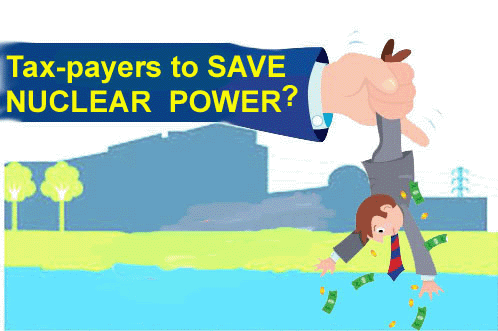 MEDIA-EDF says no new nuclear reactors in France without state support-Ouest France, https://www.reuters.com/article/edf-nuclearpower/media-edf-says-no-new-nuclear-reactors-in-france-without-state-support-ouest-france-idUSL8N1OF3EP Reporting by Geert de Clercq, Editing Dominique Vidalon,Reuters Staff, 15 Dec 17,
** French state-controlled utility EDF’s CEO Jean-Bernard Levy tells Ouest France daily that EDF can no longer build new nuclear reactors in France without state support.
Asked when EDF could build new reactors at home, Levy says “Henceforth, we cannot build new reactors without adequate regulation providing guaranteed income”. He said that Flamanville was launched at a time of high power prices and that now all power sources, nuclear as well as renewable, need to get the same visibility on sales prices.
** For its project to build two EPRs in Hinkley Point, Britain, EDF has obtained an EU-approved state-guaranteed price of 92.5 pounds per megawatt-hour over 35 years, which is way above current market prices.
** The centrist government of French President Emmanuel Macron is not talking about building new nuclear reactors, but about closing old reactors in order to reduce the share of nuclear energy in French power generation to 50 percent by around 2035 from 75 percent today.
** Asked when the first Areva-designed EPR reactor could start up, Levy said ”that should be in a few weeks in China. The start-up will be gradual, to make sure everything works well.
** Levy said EDF expects to get approval to charge nuclear fuel in its Flamanville reactor at the end of 2018. He said that once operational, Flamanville will be a good showcase to sell nuclear reactors in Asia.
The battle against climate change is being lost – Emmanuel Macron
 Emmanuel Macron says the world is losing the battle against climate change , ABC, The World Today By Connie Agius 13 Dec 17, French President Emmanuel Macron has told fellow world leaders that the battle against climate change is being lost.
Key points:
- Macron says 2015 Paris climate accord is in a fragile state since Trump pulled out in June
- Summit marks two years since accord was signed in Paris
- A dozen international projects were announced at the summit
Speaking at the One Planet Summit in Paris, Mr Macron said the 2015 Paris climate accord was in a fragile state after President Donald Trump pulled the US out in June.
“We’re not going fast enough, there lies the tragedy,” Mr Macron said.
“We’ve committed to limiting the temperature rise to 1.5 degrees Celsius, and if we carry on along this path, we’re heading towards 3 or 3.5.
“When I say that we’re losing the battle, I would like you to realise that of the countries represented here, 5, 10 or 15 of them won’t exist anymore in 50, 60 or 100 years.
“It’s as simple as that.”
Mr Macron emphasised that the need for action was now.
“The urgency is permanent and our generation’s challenge is to act, act faster and win this battle against time, and to put in place concrete measures that will change our countries, our societies, our economies.
“So that our children and maybe even ourselves can choose our future and not suffer through global warming.”……. http://www.abc.net.au/news/2017-12-13/we-are-losing-the-battle-french-president-tells-climate-summit/9254862
France faces a decade-long struggle to upgrade its nuclear power plants
Bloomberg 13th Dec 2017, France faces a decade-long struggle to upgrade its nuclear power plants, but for Natacha Piot, whose firm makes metal pipe supports for reactors, there’s little visibility beyond Christmas. She’s chief executive
officer of one of the dozens of subcontractors engaged in a 48 billion-euro ($56.4 billion) project to extend the life of Electricite de France SA’s aging atomic plants.
Like several of her peers, Piot is critical of how the state-run utility is managing the process. “I can’t afford to hire
because we don’t know what we’ll have to do in a month,” said Piot, CEO of CITA Production, based near the Saone River, north of the vineyards of Burgundy. “We’re overloaded until Christmas, but it’s a total haze for 2018. We’re in a permanent fog.”
EDF has cut earnings forecasts as longer-than-planned maintenance and refueling halts at its 58 reactors were
compounded by safety checks demanded by the nation’s nuclear watchdog. That means the utility expects nuclear-power generation to barely rebound this year, after a shortage of skilled workers at its contractors cut output by 7.9 percent to 384 terawatt-hours in 2016.
EDF will probably miss its nuclear output goals in 2017 and 2018, lowering earnings to the bottom of the company’s latest forecasts, Olly Jeffery, an analyst at RBC Capital Markets, wrote in a Dec. 6 note. “Delays could slip into 2019 as
well,” he said. As EDF wrestles to prolong the lifespan of reactors by at least an extra decade, CITA Production, the firm founded by Piot’s father in 1964, isn’t the only subcontractor struggling to keep up with the utility’s fast-changing requirements.
https://www.bloomberg.com/news/articles/2017-12-12/french-nuclear-delays-escalate-as-contractors-fumble-in-the-dark
Drones still buzz around France’s nuclear power plants!
 Liberation 5th Dec 2017, [Machine Translation] Drones still buzz around nuclear power plants. After
the autumn 2014 overflights, the authorities took technical and legislative
measures to put an end to them. These efforts only partially address this
new threat.
http://www.liberation.fr/france/2017/12/05/les-drones-bourdonnent-encore-autour-des-centrales-nucleaires_1614412
1 This Month



26 September – International Day for the Total Elimination of Nuclear Weapons


PLEASE OPPOSE HR 8255 AND S.3639 – bills would accelerate satellite deployment, with no environmental review or safeguards – https://ncstd5li.quorum.us/campaign/169331/
To see nuclear-related stories in greater depth and intensity – go to https://nuclearinformation.wordpress.com
-
Archives
- September 2026 (257)
- August 2026 (330)
- July 2026 (355)
- June 2026 (287)
- May 2026 (306)
- April 2026 (356)
- March 2026 (251)
- February 2026 (267)
- January 2026 (308)
- December 2025 (358)
- November 2025 (359)
- October 2025 (375)
-
Categories
- 1
- 1 NUCLEAR ISSUES
- business and costs
- climate change
- culture and arts
- ENERGY
- environment
- health
- history
- indigenous issues
- Legal
- marketing of nuclear
- media
- opposition to nuclear
- PERSONAL STORIES
- politics
- politics international
- Religion and ethics
- safety
- secrets,lies and civil liberties
- spinbuster
- technology
- Uranium
- wastes
- weapons and war
- Women
- 2 WORLD
- ACTION
- AFRICA
- Atrocities
- AUSTRALIA
- Christina's notes
- Christina's themes
- culture and arts
- Events
- Fuk 2022
- Fuk 2023
- Fukushima 2017
- Fukushima 2018
- fukushima 2019
- Fukushima 2020
- Fukushima 2021
- general
- global warming
- Humour (God we need it)
- Nuclear
- RARE EARTHS
- Reference
- resources – print
- Resources -audiovicual
- Weekly Newsletter
- World
- World Nuclear
- YouTube
-
RSS
Entries RSS
Comments RSS
 nuclear-news