EDF UK profits hit by fall in sterling and nuclear prices https://www.theguardian.com/business/2018/feb/16/edf-uk-profits-hit-by-fall-in-sterling-and-nuclear-prices, Rob Davies, 17 Feb 18 Pound’s decline against euro costs French firm €608m as home energy usage also dropsFrench state-owned energy firm EDF reported falling profits, including a downturn in the UK due to falling prices for nuclear power, improved energy efficiency among its household customers and the slide in the value of sterling since the Brexit vote
Profits in the UK division, which includes EDF Energy, slumped by a third to €1.035 (£920m) as sales dwindled by €579m to €8.68bn, partly because UK customers pay their bills in pounds but the company reports its results in euros.
EDF said the decline of the pound against the euro had cost it €608m.
The company has faced criticism over delays and the cost of its £20bn Hinkley Point C nuclear power plant. However, it has blamed a 12% fall in nuclear energy prices in the UK, where it is the market leader.
Revenues were depressed by lower home energy consumption among customers, with usage falling 1.9% due to “milder weather and rising energy efficiency”.
EDF, which is majority-owned by the French government, reported a 2.2% decline in overall revenues to €69.6bn, with profits down 16% to €13.7bn, excluding the impact of asset sales.
It said group results had declined due to lower prices in almost all of the regions where it operates and an exodus of nearly 1 million customers.
It was also affected by lower nuclear and hydroelectric output in its domestic market, where it is the dominant supplier with more than 85% market share.
It lost 960,000 customers, shaving €341m off profits, blaming the exodus on heightened competition, including in the UK.
Chief executive and chairman Jean-Bernard Levy said the group’s profitability in the face of a “difficult market context” was evidence of EDF’s financial strength, adding that he expects a “rebound” in 2018.
He said the company would launch an “unprecedented” ramp-up of renewable energy this year, as France looks to reduce nuclear’s share of power generation from 75% to 50% by 2025.
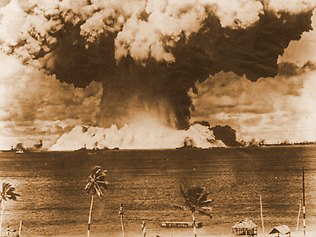
On February 13, 1960, France carried out its first nuclear test in Algeria’s southern Reggane region. According to official statistics, 17 nuclear tests were carried out in total over the next 6 years. The area remains affected, and local scientists say that radioactive contamination has caused genetic mutations and irreversibly changed the region.
There are no official statistics on the number of victims. The only figures can be found in the records kept by the French representative of the local church, which lists 42,000 victims of nuclear tests. Three years ago, the French Ministry of Defense issued a statement, putting the number at 27,000 people. The victims include French soldiers as well as local Algerians who lived in the surrounding areas.
However, these figures do not take into account the untimely deaths of the descendants of these people, who were affected by cancer and other nuclear radiation-related illnesses. To this day, the contaminated areas pose a danger to life and health.
A representative of the ‘Desert Detainees’ (a community of people who served sentences in prisons located in the desert regions of Algeria from 1992 to 1996), Nureddin Mauhub, said that many prisoners were exposed to radiation while serving their sentences in jails in the desert.
Nuclear engineer Ammar Mansuri told the newspaper Arabi al-Jadid, that in fact, there were more nuclear tests carried out in Algeria.
“France conducted 13 underground nuclear tests, 4 ground tests, 4 plutonium tests and 35 other tests,” he said.
According to him, the nuclear tests documentation was passed on to the Algerian government only 10 years ago.
Some of the documents are still classified. For these reasons, no systematic observations or studies have been conducted in the area in the past century. Therefore, no timely measures were taken to reduce the negative impact on the environment. It is difficult to say how the level of contamination has changed over the past decades and what to expect in the future.
The Algerian government claims that the contaminated area is more than 100 square km, according to the Al-Arabi al-Jadid website. However, problems aren’t limited to this exclusion zone. The desert winds carry contaminated particles to formally clean areas. There’s now a need to study the level of radiation in the desert to accurately determine the boundaries of the contaminated area.
On February 13, 2018, the Reporterre site revealed the new EDF project. In view of the prolongation of the operation of nuclear reactors and to unclog the four basins of the La Hague plant where used fuel is stored, the electrical firm wants to build a giant new “pool of deactivation” near the Belleville plant -sur-Loire (Cher). We strongly condemn this imposed, dangerous and expensive project. Rather than create a new trash, EDF must turn off the tap and dry up the production of unmanageable radioactive waste!
In France, spent fuel is stored in “deactivation pools” for the time needed to cool them (between 3 and 5 years). If each nuclear power plant has its own pool adjoining the reactor building, the La Hague plant (Manche) hosts 4 pools in which are immersed more than 10,000 tons of spent fuel, representing a hundred reactor cores waiting for a improbable “reprocessing”. Supposedly temporary, storage in these pools has been going on for 40 years. Consequences: the pools are full and the space is running out. Instead of starting a decline in spent fuel stocks by stopping the production of electricity from nuclear power, EDF is stubborn and plans to build an additional pool in Belleville-sur-Loire. But the experience of La Hague shows that the use of these pools goes hand in hand with disproportionate risks.
Vulnerable pools and potentially dramatic accidents The 4 cooling pools at the La Hague plant concentrate the largest volume of radioactivity in Europe. Belleville-sur-Loire could soon compete with this facility. Oversized, the giant basin that EDF plans to build in Belleville-sur-Loire could accommodate up to 8,000 tons of spent fuel, the equivalent of 93 cores of reactors.
This project is all the more worrying because EDF is never very concerned about the protection of the reactor deactivation pools it operates. Will the centralized Belleville pool be protected as recommended by nuclear safety authorities around the world since Fukushima? Nobody can say it. And the risk increases even if EDF chooses not to bunkerize the building that contains the pool, as is the case at the Orano factory in La Hague, where the basins are protected by a vulgar tin roof
… But even with a concrete hull, in the event of an accident, the amount of radioactivity released into the atmosphere would be incommensurate with the releases resulting from an accident in the core of a reactor: to concentrate in the same place such a quantity of radioactive material has intrinsic risks. And what about the dangers of transporting such large quantities of radioactive waste across France?
The Belleville-sur-Loire swimming pool project poses even more safety problems because it is supposed to house the assemblies of MOX – a mixture of uranium and plutonium oxides – a particular fuel that, when it is used, releases much more radioactivity than “normal” uranium assemblages. And since MOX can not be reprocessed or reused, temporary storage in this pool could well become permanent storage.
Finally, in normal operation, these pools are allowed to reject radioactivity. If a new bin of this kind were built, dangerous radioelements like tritium or krypton 85 would inevitably end up in the environment.
An opaque and expensive project EDF led this project with complete opacity. At the time Greenpeace submitted a report that points to the fragility and dangerousness of the 62 cooling pools scattered over the hex, EDF plans to build a 63rd, size XXL. Discussed on the sly, well protected from democratic choices and far from energy issues, the project was kept secret by EDF.
Once again, citizens and residents of the region are faced with a fait accompli. Still, the idea is in the pipes for a long time. Urged by ASN – which invited it in 2013 to “revise its spent fuel management and storage strategy, by proposing new storage methods” – EDF, to comply with the National Plan management of radioactive materials and waste, once again chose the worst option.For EDF and the promoters of the atom, the construction of such an installation is only one way of guaranteeing new outlets for a declining nuclear industry and of claiming to ensure the management of spent fuel for a new period.
The “Sortir du nucléaire” Network strongly denounces this project and, alongside the associations of the region, will resolutely oppose its implementation. In no case this pool is a “solution” to the problem of the accumulation of radioactive waste. In order not to generate new risks and to put the costs of a disproportionate installation on the citizens, the only solution is to dry up the production of this unmanageable waste. Press contacts: Martial CHATEAU: 06 45 30 74 66 Catherine FUMÉ: 06 62 84 13 88
Romandie 9th Feb 2018,[Machine Translation] EDF and the director of the Cruas-Meysse nuclear power plant (Ardèche) were sentenced on Friday by the Privas police court to fines of several thousand euros for nuclear waste management problems.
The French energy group has been sentenced to six fines of 1,000 euros and the director of the site to six fines of 500 euros suspended. The network
Outir du Nucléaire, initiator of the lawsuit, criticized EDF and its director for failing to meet several waste management obligations, citing the detection, on November 6, 2015, of nuclear waste in a waste container, conventionals that was about to leave the site. https://www.romandie.com/news/EDF-condamne-pour-sa-gestion-des-dechets-radioactifs-a-la-centrale-de-Cruas-Ardeche/889092.rom
Power within 30 yearsControlled thermonuclear fusion is moving so well that full-scale development could begin within five years, says Dr. David J. Rose….It might take 20 to 30 years beyond that before fusion could move into the power grid, though, he predicts. — Science News, February 17, 1968
Update
Governments and private-sector start-ups are still trying to wrangle thermonuclear fusion — the process that lights up stars and ignites hydrogen bombs — for clean energy, with limited progress (SN: 2/6/16, p. 18). One of the biggest ongoing projects is ITER in France, an international effort to build the first magnetic fusion reactor that pumps out more energy than it consumes. ITER plans to flip on the machine in 2025. Optimistic estimates put the first fusion power plants on the grid no sooner than 2040.
Le Monde 7th Feb 2018 [Machine Translation]Can France catch up in renewables? A laggard compared
to many of its neighbors, the Hexagon must redouble efforts if it wants to
achieve the goals it has set in terms of “green” energies. “Let’s
accelerate the growth of renewable energies in the face of the climate
emergency. The theme chosen for the 19th annual conference of the Union of
Renewable Energy (SER), Thursday, February 8 in Paris, summarizes the
situation of an economic sector in the middle of the ford. A laggard
compared to many of its neighbors, France must redouble its efforts if it
wants to achieve the goals it has set in terms of “green” energy. http://www.lemonde.fr/planete/article/2018/02/08/la-france-peut-elle-rattraper-son-retard-dans-les-renouvelables_5253487_3244.html
France to spend 37 bn euros on upgrading nuclear arsenal, Digital Journal, By Daphné BENOIT (AFP) , 8 Feb 18
France is planning a 37-billion-euro revamp of its nuclear arsenal over the next seven years, part of a sharp increase in defence spending aimed at allowing France to “hold its own” as a key power in Europe, the country’s defence chief said Thursday.
The upgrades to France’s land- and sea-based nuclear deterrent will be part of the nearly 300 billion euros ($370 billion) to be spent by 2025.
Le Monde 7th Feb 2018, [Machine Translation] Bure landfill: the impossible scientific proof of
safety. “The World” had access to the thesis of a researcher who studied
the management of uncertainties surrounding the storage of nuclear waste in
the Meuse.
It is an embarrassing document for the promoters of the
Industrial Center of geological storage (Cigeo) aiming to bury, in the clay
subsoil of the village of Bure, in the Meuse, the most dangerous French
nuclear waste.
It describes how the National Agency for the Management of
Radioactive Waste (Andra), unable to formally demonstrate the safety of
this facility for hundreds of thousands of years, dedicates its efforts to
convince the nuclear control authorities of the feasibility of such
storage. At a loss to present some of his results in a biased or incomplete
way. Beyond this public institution, under the tutelage of the ministries
in charge of energy, research and the environment, it is also the chain of
evaluation of nuclear safety in France that is questioned.
Europe1 5th Feb 2018, [Machine translation] French nuclear park: “What we saw is catastrophic and
very disturbing”. For Thierry Gadault, co-author of “Nucléaire Danger immédiat”, the authorities are silencing the reality of the state of the French nuclear fleet, most of whose reactors are about to exceed 40 years.
The French nuclear system has developed a culture of lies and concealment for more than 50 years. Thierry Gadault points out the worrying state according to him of the power stations of Fessenheim, Bugey, Saint-Laurent-of-Waters, Gravelines and Blayais, but also more recent structures.
“On the following generations of reactors, we see that there are problems in Civaux, Chouzé-sur-Loire and Flamanville”. For him, the Nuclear Safety Authority makes it harder to learn the true state of these structures. “It
is part of the French nuclear system that has developed a culture of lying and concealment for more than 50 years, which has resulted in information suppressed about what has happened around Chernobyl and about serious nuclear
accidents. which took place in Saint-Laurent-des Eaux We had serious nuclear accidents with the release of plutonium in the environment and in the Loire. http://www.europe1.fr/societe/parc-nucleaire-francais-ce-que-nous-avons-vu-est-catastrophique-et-tres-inquietant-356528
DD 3rd Feb 2018, Nuclear: the book that undermines the safety of French power plants. The JDD publishes preview extracts of Nuclear, immediate danger , a survey book that challenges the dogma of the safety and profitability of French power stations.
At the forefront of concerns: the alarming state of several tanks, which contain the heart of the reactors. “That’s it, we are there atthe age of 40. By 2028, 48 reactors [out of 58 in service in France] – those of the level of 900 MW and a part of the reactors of 1,300 MW – will reach this canonical age.
Since the mid-2000s, because of its financial difficulties that prevent it from investing in new means of production, EDF is asking for, calling for, even imposing, that all of its nuclear power stations be allowed to operate at the same time. beyond the age of forty, and prolonged by twenty years. […]
[Among the elements that will] determine the extension or the stop of the vats: do they have defects, of
origin or appeared with the time, which compromise the safety?
This is one of the biggest secrets of the nuclear industry in France. […] According to EDF, 10 tanks in operation have cracks that date from their manufacture. […] Tricastin, with its reactor 1, is the worst central of the country.
This reactor combines all the problems: defects under coating, no margin at break, and exceeding the fragility forecast at forty years! Not to mention the risk of catastrophic flooding in the event of an earthquake, as noted in September 2017 by the Nuclear Safety Authority (ASN), which has automatically stopped the operation of the four reactors of the plant while waiting for EDF finally, work to reinforce the dike of the Donzère-Mondragon canal. The plant is below the canal, 6 m below the water.
Pierre-Franck Chevet, the president of the ASN, told us’ that in the event of a strong earthquake we could go to a situation, with four simultaneous reactors merging, which potentially looks like a Fukushima type accident. EDF has found the immediate stoppage of the plant to carry out this unjustified work, I find it justified. ” http://www.lejdd.fr/societe/nucleaire-le-livre-qui-met-a-mal-la-surete-des-centrales-francaises-3564173
France Set to Become a European Offshore Wind Powerhouse by 2022 Bloomberg By Jeremy Hodges and Jess Shankleman,
WindEurope sees French turbine orders passing U.K., Germany
Offshore wind investments to recover after contracting in 2017
Europe’s wind-power industry expects new French offshore turbine installations to overtake the U.K. and Germany by 2022, boosting President Emmanuel Macron’s pledge to increase renewable energy.
Construction off the French coast is expected to ramp up from 2020 and turn the country in the fourth-biggest offshore wind generator with about 4.3 gigawatts capacity by 2030, according to the Brussels-based WindEurope industry group.
JDD 3rd Feb 2018, Nuclear: the book that undermines the safety of French power plants. The JDD publishes preview extracts of Nuclear, immediate danger , a survey book that challenges the dogma of the safety and profitability of French power stations.
At the forefront of concerns: the alarming state of severaltanks, which contain the heart of the reactors. “That’s it, we are there atthe age of 40. By 2028, 48 reactors [out of 58 in service in France] – those of the level of 900 MW and a part of the reactors of 1,300 MW – will reach this canonical age.
Since the mid-2000s, because of its financial difficulties that prevent it from investing in new means of production, EDF is asking for, calling for, even imposing, that all of its nuclear power stations be allowed to operate at the same time. beyond the age of forty, and prolonged by twenty years. […]
[Among the elements that will] determine the extension or the stop of the vats: do they have defects, of
origin or appeared with the time, which compromise the safety?
This is one of the biggest secrets of the nuclear industry in France. […] According to EDF, 10 tanks in operation have cracks that date from their manufacture. […] Tricastin, with its reactor 1, is the worst central of the country.
This reactor combines all the problems: defects under coating, no margin at break, and exceeding the fragility forecast at forty years! Not to mention the risk of catastrophic flooding in the event of an earthquake, as noted in September 2017 by the Nuclear Safety Authority (ASN), which has automatically stopped the operation of the four reactors of the plant while waiting for EDF finally, work to reinforce the dike of the Donzère-Mondragon canal. The plant is below the canal, 6 m below the water.
Pierre-Franck Chevet, the president of the ASN, told us’ that in the event of a strong earthquake we could go to a situation, with four simultaneous reactors merging, which potentially looks like a Fukushima type accident. EDF has found the immediate stoppage of the plant to carry out this unjustified work, I find it justified. ” http://www.lejdd.fr/societe/nucleaire-le-livre-qui-met-a-mal-la-surete-des-centrales-francaises-3564173
Le Parisien 3rd Feb 2018, [Machine Translation]EPR Flamanville: four questions on an industrial
disaster. Seven years late and a quote that has tripled in ten years: the
site of the EPR Flamanville Friday received the visit of Sébastien
Lecornu, Secretary of State Nicolas Hulot.
Started in April 2007, the EPR was to cost € 3.3 billion and enter service in 2012. Except that the site
has accumulated the setbacks, the highlight of which was in April 2015,
after the discovery by the ASN of a anomaly in the steel of the lid and
bottom of the reactor vessel. In June 2017, EDF obtained authorization from
the ASN to operate the tank, but confidence in EPR technology has been
eroded. The bill exploded: around € 11 billion. http://www.leparisien.fr/economie/epr-de-flamanville-quatre-questions-sur-une-catastrophe-industrielle-03-02-2018-7538637.php
Reuters 30th Jan 2018, French utility EDF has proposed to start shutting down some reactors from
2029 onwards as part of France’s long-term energy plan which aims to
reduce the share of atomic power in its electricity mix, said the head of
EDF’s nuclear power arm.
The government has started discussions with
non-governmental organisations (NGOs) and energy specialists and companies
over France’s future energy mix, and the first draft of the
“multi-annual energy plan” (PPE) is expected by the end of June.
Philippe Sasseigne – who heads up the nuclear power part of EDF – told
journalists that as part of that discussion, the company was proposing to
shut down more reactors from 2029. EDF, which operates France’s 58
nuclear reactors, will halt its Fessenhiem nuclear plant once it starts
production at the Flamanville 3 nuclear reactor under construction. https://af.reuters.com/article/commoditiesNews/idAFP6N1IH00N
Annick Girardin has told journalists in Tahiti that there will be an answer to the recently raised calls for such a study.Last week, a child psychiatrist, who had worked in French Polynesia for years, suggested that an independent investigation be carried out after noticing a high incidence of disturbed and deformed children among the off-spring of people exposed to radiation from the atmospheric tests.
Girardin has acknowledged the concerns, saying it has to be established how to deal with the question and to see if it is possible to work on it with other countries.
The minister has restated that the former president Francois Hollande recognised two years ago in Papeete the French legacy and assumed responsibility.
She has also launched a project in Papeete to build an institute of archives and documents related to the tests.
She has also frozen the sale of land in the city previously used by the navy for its command for it to be able to be used for a memorial site.The head of the nuclear test veteran’s organisation Roland Oldham is dismissive, saying this will only see the light of day once people are dead.
He has continued to urge Paris to compensate the nuclear test victims suffering from poor health.
Until 2009, France claimed its weapons tests were clean but then passed a law accepting compensation demands.
Hundreds of applications have been filed since but almost all have been thrown out.










 nuclear-news