French government considers changing focus of EDF from nuclear to renewables
FT 14th Nov 2017, France is considering changing the governance of state-owned utility EDF to
shift its focus from nuclear to renewable energy as Emmanuel Macron’s
government seeks to cut the country’s reliance on atomic power — the
backbone of its energy policy for five decades. Nicolas Hulot, energy and
environment minister, told the Financial Times the country’s largest
electricity producer needed to embrace a transition towards environmentally
friendly energy rather than “resist” it. The process may require
revisiting the structure of the company, in addition to a plan to close up
to 35 of the 58 nuclear reactors it operates across France within the next
15 years.
https://www.ft.com/content/132f512a-c89f-11e7-ab18-7a9fb7d6163e
Lobbyists scramble to market nuclear submarines to India
India Wants Second Nuclear Submarine From Russia. Lies By Lobbyists Erupt
Russian news portal Kommersant reported that the Indian Navy allowed a US technical crew into top secret compartments of India’s existing Russian-built nuclear submarine, the INS Chakra NDTV All India by Vishnu Som : November 10, 2017 NEW DELHI:
According to Kommersant, which referred to this as “an unprecedented scandal,” the incident “threatens to seriously complicate the negotiations both on the lease of the second nuclear submarine, and on other projects in the field of military-technical cooperation.”
The Chakra, an Akula-2 class submarine, widely considered among the world’s most sophisticated, has been leased by India for 10 years but all ownership rights reside with Russia.
Today, another Russian news portal, NEWS.ru, has debunked the account of the Kommersant and states that French lobbyists have an ulterior role in spreading misinformation to further their own chances of selling a nuclear-powered attack submarine to India. NEWS.ru quotes a source stating “there is complete confidence that the throw-in is organised by the lobbyists of France, and it’s pretty high quality.” According to this source, “In addition to the contract for the construction of non-nuclear boats such the Scorpene [now being inducted by the Indian Navy,] the French have a great desire to enter the Indian nuclear fleet.”
France, the article states, is also aggressively trying to participate in India’s programme to construct a second home-grown aircraft carrier. The first indigenous carrier, INS Vikrant is being built in Kochi using technology from a host of countries including Russia……..
At the time, the French newspaper Le Monde, quoting multiple sources had said that the leak of this data was driven by competition between the French designer of the Scorpene Class submarine and a German firm as they compete to win international orders. https://www.ndtv.com/india-news/not-true-that-us-officers-allowed-on-russian-submarine-in-vizag-sources-1773761
France still aims to reduce nuclear power, but postponing target for this
* France drops 2025 target for reducing share of nuclear
* Hulot says new target to be drawn up in coming year
* Greenpeace says Hulot giving in to nuclear lobby (Adds Hulot comments, background)
By Geert De Clercq and Michel Rose PARIS, Nov 7 (Reuters) – President Emmanuel Macron’s government on Tuesday postponed a long-held target to reduce the share of nuclear energy in France’s electricity generation.
Environment Minister Nicolas Hulot said it was not realistic to cut nuclear energy’s share in the power mix to 50 percent by 2025 from 75 percent now and said doing so in a hurry would increase France’s CO2 emissions, endanger the security of power supply and put jobs at risk.
He did not set a new deadline, but said that over the next year the government would draw up a “pluri-annual energy programme” to reach the 50 percent target “as soon as possible”.
“It will be difficult to maintain the target of reducing the share of nuclear to 50 percent by 2025,” Hulot told reporters following a cabinet meeting.
Hulot said that while the timing is delayed for now, in a year’s time the government would have a clear programme based on rational criteria to decide which reactors to close and when.
In 2015, the previous government of Socialist Francois Hollande had voted an energy transition law which set a target of reducing the share of nuclear in the power mix to 50 percent by 2025 from the current 75 percent. But Hollande had taken no concrete steps towards closing any reactors.
Centrist Macron, elected in May, had promised to respect this target and Hulot, France’s best-known environmentalist, said in July France might have to close up to 17 of its 58 reactors by 2025 to achieve the target.
Widely seen as the guardian of the Macron government’s green credentials, the popular Hulot – a former television documentary maker turned environmentalist – had in recent months repeatedly said France needed to close several nuclear plants.
But he received little public support from Macron, a strong supporter of nuclear, or Prime Minister Edouard Philippe, a former employee of state-owned reactor builder Areva.
Two weeks before the government was formed in mid-May, a source close to Macron told Reuters he was considering delaying the target for reducing France’s reliance on nuclear.
State-owned utility EDF, the world’s biggest operator of nuclear plants, has long said it made no sense to shut down functioning reactors and instead wanted to extend the lifespan of its nuclear fleet from 40 to at least 50 years.
EDF shares were up 1.2 percent after Hulot’s announcement, outperforming a flat French bourse.
EDF stock had plunged as much as 7 percent on the day Hulot was appointed environment minister on the expectation that he would push for less nuclear and more renewables. nL8N1IJ43S]
Hulot, who had made a failed bid to become the green candidate in the 2012 presidential election, had been courted by both Hollande and his conservative predecessor Nicolas Sarkozy to become environment minister.
Hulot told French daily Le Monde last month that he had given himself a year to see whether he could reform French energy and agricultural policies.
Greenpeace said Hulot had already shown weakness in fighting fossil fuel and was now jeopardising France’s energy transition.
“He should be a bulwark against the oil and nuclear lobbies,” the NGO said in a statement. (Reporting by Geert De Clercq and Michel Rose; Editing by Ingrid Melander and Edmund Blair)
French President agrees with Russia’s Putin on need to preserve the Iran nuclear deal

 Vladimir Putin and Emmanuel Macron team up to prevent NUCLEAR FALL-OUT
FEARS of a nuclear fall-out between Iran and the US has led to Vladimir Putin forming an unlikely alliance with France’s Emmanuel Macron. By DAN FALVEY Mr Putin teamed up with the French President to try and ease escalating tensions surrounding Iran’s nuclear capabilities. It comes as Donald Trump accused Iran of not upholding the Joint Comprehensive Plan of Action, also known as the Iran nuclear agreement, with the UK, US, Russia, France, China, and Germany in 2015 which aims to limit the country’s nuclear arsenal.
However, fears that the deal could collapse have increased in recent months after the US President threatened not to sign off on the agreement claiming that Iran had broken parts of the pact. Mr Putin and his French counterpart spoke on the phone yesterday to reaffirm their support for the implementation of the deal.
A press statement released by the Kremlin said the Russian leader and Mr Macron agreed on the importance that the deal went ahead.
It said: “The leaders spoke in favour of a thorough implementation of the Joint Comprehensive Plan of Action to resolve the situation around the Iranian nuclear program.” The Kremlin statement went on to say that it was “crucial” any attempts by one country to change the deal were ignored…….http://www.express.co.uk/news/world/874895/Vladimir-Putin-Emmanuel-Macron-Russia-France-War-Nuclear-Fallout-Iran-Donald-Trump
Series of incidents, with safety significance, at French nuclear power plant

 Sortir du Nucleaire 31st Oct 2017, France: Gravelines: Cooling problems and temperature rise, 4 incidents in
less than 3 weeks The plant operator has just declared 2 new incidents
significant for safety. These events, which took place on October 20 and
21, 2017, bring to 4 the number of level 1 events declared since the
beginning of the month and enrich a series that is worrying.
http://www.sortirdunucleaire.org/France-Gravelines-Problemes-de-refroidissement-et-montee-en-temperature-4-incidents-en-moins-de-3-semaines
AREVA’s new entity NewCo struggles with unprofitable uranium mine in Niger
Romandie 31st Oct 2017,[Machine translation] NewCo, Areva’s entity resulting from the
restructuring of the nuclear group refocused on the fuel cycle, has had to
depreciate some of its assets, particularly the uranium mine Imouraren in
Niger, according to a statement released Tuesday.
NewCo published Tuesday its accounts for a shortened eight-month period (from January 1 to August
31, 2017), a decision taken as part of the restructuring of the group and
the exit of this entity from the tax consolidation perimeter so far
constituted around Areva SA. Although the published financial results
cannot be compared to the previous year of 12 months, the group
nevertheless indicated that it had spent 256 million euros in new
impairments between 30 June and 31 August.
Among them, 210 million euros concern mining assets, including 178 million euros for the only Imouraren
mine in Niger. The exploitation of this gigantic mine has been in abeyance
for several years, for want of a favorable conjuncture in civilian nuclear
power. Areva had already depreciated this asset twice, in 2015 and 2016, by
respectively 194 and 316 million euros. The new impairment losses are
linked to “both the unfavorable change in the euro-dollar exchange rate and
the unfavorable change in market price expectations” (of uranium), the
group said.
France will detail at the end of 2018 how many nuclear reactors will close
France to decide by end 2018 how many nuclear plants to shut: minister PARIS (Reuters) 29 Oct 17, – France will detail at the end of 2018 how many nuclear reactors will close to meet a target on reducing atomic energy, Environment Minister Nicolas Hulot told French daily Le Monde on Saturday.
France aims to cut the share of atomic energy in power generation to 50 percent by 2025 from 75 percent now.
Nuclear plant closures represent a touchy topic, as the sector employs thousands of people and renewable energy alternatives struggle to grow fast enough to ensure energy needs are fulfilled.
According to France’s National Council of Industry, the nuclear sector supports about 220,000 jobs, directly and indirectly.
Hulot will lay out his so-called “green deal” on energy transition in the first half of 2018, he told Le Monde in an interview.
“In order to reduce to 50 percent the share of nuclear power, we will have to close a number of reactors,” he said, adding that he would detail the exact figure under a multi-year plan to be presented at end of 2018……https://www.reuters.com/article/us-france-nuclearpower/france-to-decide-by-end-2018-how-many-nuclear-plants-to-shut-minister-idUSKBN1CX0KP
France’s Nuclear Safety Authority (ASN) dithers on decision about continued operation of old reactors
La Tribune 27th Oct 2017,[Machine Translation] The postponement of the generic Nuclear Safety
Authority (ASN) opinion on the continued operation of certain reactors
beyond the age of 40, revealed on 24 October, could have serious
consequences for the implementation of the law. And,
beyond, on the image of nuclear power in the public opinion, and the
perception of the role of the State in terms of energy strategy.
http://www.latribune.fr/entreprises-finance/industrie/energie-environnement/nucleaire-la-trajectoire-energetique-francaise-se-complique-755755.html
Drop in earnings and nuclear output targets for French corporation EDF
EDF said it was revising its 2017 nuclear output target down to 383-387 terrawatt-hour (TWh), compared to a previous revised target of 385-392 TWh.
It also cut its 2017 EBITDA target down to 13.4-14.0 billion euros ($15.5 billion-$16.2 billion), compared to an earlier EBITDA target range from 13.7-14.3 billion euros previously…..http://www.reuters.com/article/france-nuclearpower-edf/french-power-group-edf-lowers-2017-earnings-and-nuclear-output-targets-idUSASM000FCW
Concern over condition of France’s aging nuclear reactors: 20 of the 58 currently shut down
Reporterre 23rd Oct 2017, [Machine Translation] To date, 20 reactors out of 58 of the French nuclear fleet are shut down. Many are expected to restart by the end of November, but their aging and general condition is worrying.
Reporterre takes stock with a map detailing the situation of each plant. Winter will be tough for
French nuclear power plants. This Monday, October 23, 20 of their reactors are stopped. Of these, at least 8 were put to rest because of a malfunction or a safety problem. On the others, many are currently undergoing maintenance that also seek to repair the anomalies that accumulate in recent years.
A situation highlighted by Reporterre in a map detailing the central location by central. Last malfunction, the Nuclear Safety Authority (ASN) unveiled in mid-October that the cooling pumps of 29 nuclear reactors were affected by significant corrosion. In case of earthquake or flood, the
pipes could yield. This is one of the causes of the Fukushima accident. According to the ASN, the renovation of the ducts was started immediately on all the reactors, but these will require more complete repairs before being totally secure.
https://reporterre.net/CARTE-EXCLUSIVE-Les-deux-tiers-du-parc-nucleaire-francais-en-panne-ou-a-l-arret
Electricite de France (EDF) keen to market nuclear power to Asia

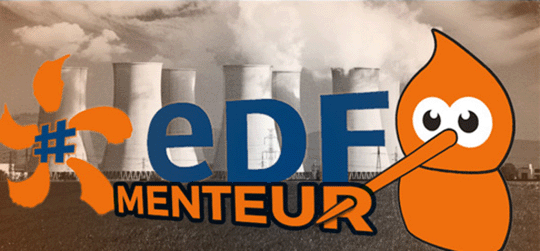 French nuclear giant EDF seeks business in Asia China and India loom large for the world’s largest nuclear power company, Nikkei Asian Review, TALLULAH LUTKIN and TOGO SHIRAISHI, Nikkei staff writers, 19 Oct 17, PARIS — The world’s largest nuclear power company, Electricite de France, believes nuclear power still has a role to play in the future, despite forecasts suggesting the market is in getting precarious. According to one senior EDF official, there are still plenty of opportunities in nuclear plant construction — especially in Asia — that can complement renewable power sources……
State-owned EDF is determined to play a role in the growth of the nuclear power industry worldwide…..
For future projects, EDF has its sights on China, where most of the world’s new reactors are currently being built…..
In India, EDF’s nuclear ambitions should benefit from a combination of a growing economy still reliant on coal, a lack of access to electricity for millions of people, and an existing nuclear program, Ursat said.
The company also plans to jointly develop a plant in Turkey in cooperation with Japan, using a new reactor design, the ATMEA1, developed by French multinational Areva and Mitsubishi Heavy Industries. EDF’s close partnership with Mitsubishi is an indication of the importance of the Japanese market, Ursat said.
EDF is in the process of acquiring part of Areva, which is being restructured to save it from bankruptcy. EDF will acquire Areva’s nuclear construction operations, renamed New NP, in December for between 1.25 billion and 1.875 billion euros. Mitsubishi Heavy Industries is taking a 19.5% stake in New NP.
Ursat acknowledges that the nuclear power industry faces hurdles. “One of the challenges facing new projects is cost overruns,” he said. Thus, New NP’s primary objective is to “make new projects profitable, stay on schedule and lower costs.”……..
Projections by the International Atomic Energy Agency do not fully support EDF’s optimism, and vary significantly depending on circumstances. In the upper-end scenario, nuclear electricity generating capacity could increase from 391 gigawatts in 2016 to 874GW in 2050 worldwide. In the lower-end scenario, it would decline until 2040 before rebounding to current levels in 2050. Only three reactor constructions were started in 2016, down from 15 in 2010.
Moreover, some developed countries have decided to partly phase out nuclear power. France has announced its intention to close up to 17 nuclear reactors. South Korea’s new president, Moon Jae-in, has vowed to cancel all plans for new nuclear power plants and “move toward a nuclear-free era,” something Germany is already pursuing. Both South Korea and Germany are looking to renewable sources as a replacement for nuclear power, rather than merely as a supplement.
Meanwhile, renewable energy sources are becoming more competitive. According to the International Energy Agency, auction prices for solar power will drop from over $150 per megawatt-hour in 2013 to $30 in 2020….. https://asia.nikkei.com/Business/Companies/French-nuclear-giant-EDF-seeks-business-in-Asia
100 employees evacuated from office of French nuclear station , due to mysterious package found
Valeurs 17th Oct 2017,[Machine Translation] Security. According to information from France Bleu,
around a hundred employees were evacuated on Monday 16 October after the
discovery of a suspect package at one of the offices of the Cruas-Meysse
nuclear power plant in the Ardèche.
https://www.valeursactuelles.com/societe/ardeche-une-centrale-nucleaire-evacuee-en-urgence-89799
Nuclear wastes – a divisive problem for the French, that could mean the end of the industry
“if we manage to stop it, it will mean the end of the industry. Regardless of how you look at it, nuclear power is an industry with no future.”
 What to do with nuclear waste? The question dividing France,https://www.equaltimes.org/what-to-do-with-nuclear-waste-the#.Wea2VY-CzGg , 17 Oct 17, On 15 August, an anti-nuclear campaigner almost lost his foot during a demonstration in Bure, in the east of France. One month later, on 20 September, police conducted several raids on premises housing activists in the village, including the emblematic “Maison de la résistance”, (House of Resistance), the nerve centre of the fight against the nuclear dump.
The small village of Bure, in the Meuse department, has crystallised the anti-nuclear campaign in France in recent months. In 1998, it was selected as the site for an Industrial Geological Storage Centre (Cigéo), where the plan is to progressively bury 85,000 cubic metres of highly radioactive long-lived waste in a bed of clay, 500 metres below ground, by means of operations expected to last 150 years.
The ANDRA (National Agency for Radioactive Waste Management), which is managing the project, is expected to apply to the IRSN (French Institute for Radioprotection and Nuclear Safety) for authorisation to build in 2019. Its application has been deferred on several occasions due to legal and technical setbacks, which could explain the growing hostility towards the anti-Cigéo activists.
In an open letter, the residents of Bure and the surrounding area recently denounced the “systematic strategy of tension and asphyxiation” launched by the state several months ago, a strategy “aimed at wearing us down and isolating us, like hunted beasts”.
The closer the project comes to the completion phase, the stronger the opposition, and the more the noose of repression is tightened around the anti-nuclear campaigners.
A far from satisfactory solution
The 54 nuclear reactors in France, the second largest producer of nuclear energy in the world, behind the United States, produce 12,000 to 15,000 cubic metres of radioactive waste every year. This includes both low level short-lived radioactive waste and much more toxic long-lived waste.
“The uranium industry, presented as a “virtuous cycle” by the nuclear lobby, actually conceals a chain of dirty, polluting and unmanageable fuel, from the mine to the waste disposal phase,” denounces the French anti-nuclear network Sortir du Nucléaire.
Whereas before, France used to dispose of its nuclear waste in repositories in the Atlantic Ocean, underground disposal now seems to be “the only management option”, says Matthieu Denis-Vienot, who is in charge of institutional dialogue at ANDRA, in an interview with Equal Times.
This agency was given the task, in 1979, of answering the insoluble question of how to manage this waste, which can be destroyed by no known chemical or mechanical means, and is extremely toxic.
“We have the technical capacity to store this waste in such a way that it is harmful neither to man nor to the environment, nor the object of malicious acts,” ensures Matthieu Denis-Vienot. “Our priority is therefore focused on confining this waste, because we want to act responsibly and not to leave this burden with future generations.”
This option, although it has been written into French law since 1991 and is in line with the advice of the International Atomic Energy Agency (IAEA), is far from satisfactory, according to some researchers.
“Whether the waste is thrown into the sea or buried in the ground, the principle behind it is the same: get rid of it, so we can forget about it, because we don’t know what to do with it,” argues Jean-Marie Brom, a physicist and researcher with the CNRS (National Centre for Scientific Research). “What I can tell you as a scientist, is that burying it is the only solution, but it is far from being a good one.”
At ANDRA, the response to this is: “It’s all well and good to say it’s a heresy, but now that it’s there, what can we do about it?”
And that is the final argument put forward to the anti-Cigéo movement by ANDRA. The waste to be buried in Bure is all that generated by 43 years of nuclear energy production.
For the time being, it is being kept at the storage and reprocessing plant in La Hague, in the Manche department of France, where it is vitrified and placed in containers. It is a valid precaution, given that although this waste only represents four per cent of the total, it accounts for 99 per cent of the radioactivity emitted. Moreover, it is the waste with the longest lifespan. It takes 24,440 years for plutonium, for example, to lose half of its radioactivity.
The other 96 per cent of the waste, which accounts for one per cent of radioactivity, is stored on the surface, in the main, at two other storage centres, a few dozen kilometres from Bure.
Anti-nuclear campaigners are outraged by the situation. “It is far too dangerous. Firstly, it means that for 100 years, two radioactive convoys will cross France every day to come to Bure. And secondly, the safety of the site cannot be guaranteed when such long lifespans are involved. What will happen if, one day, these 200,000 “parcels” resurface, whilst they are still radioactive?” asks Jean-Marc Fleury, president of Eodra, a group of elected officials from the Grand Est region who are opposed to the Cigéo project.
The response from ANDRA is that geologists have conducted research and have established that the clay subsoil in the Meuse department of France is a stable geological formation over time.
The IRSN (French Institute for Radiological Protection and Reactor Safety), in its report from July, pointed to a number of risks, such as fire, and whilst acknowledging that the project had reached “satisfactory technical maturity”, it concluded that ANDRA’s current waste disposal concept “did not provide sufficient safety guarantees”.
The anti-nuclear campaigners highlight the example of the United States’ WIPP facility, in New Mexico, where a fire led to the release of radioactive gas, or that of Asse, in Lower Saxony, Germany, where 126,000 barrels of radioactive waste have to be evacuated from an old salt mine being eroded by seepage.
All these countries, confronted with the same problem, are far from having found long-term solutions, and face the same criticisms from the anti-nuclear movement.
Future of nuclear industry at issue
For those opposed to the Cigéo project, it is an ethical issue. “Since we know that collective memory is relatively short, it is possible that in a thousand years, it might be forgotten that it there is radioactive waste in Bure and people will go through these areas, with all the risks that entails,” explains researcher Jean-Marie Brom. “How can we warn future generations that there is extremely dangerous waste here?”
A whole new dimension is added when taking into account the waste to come from the nine reactors due to be decommissioned. And all the more so given that this number is expected to rise, with the Energy Transition Law, which envisages reducing the share of nuclear power in the country’s energy mix from 72 to 50 per cent by 2025.
The waste resulting from this decommissioning will have to be stored somewhere.
Beyond the unresolvable waste issue, the fight against the Cigéo project is part of a wider case against the nuclear industry in general. In a context where Germany has announced plans to close all of its nuclear power plants by 2022 and where Italy no longer has nuclear power, France stands out as an exception in the eyes of the activists.
“What is at stake in Bure, is the future of nuclear power,” says Jean-Marc Fleury. “If the Cigéo is not built here, the nuclear industry will come to an end in the next ten years, because a project like this could never be implemented anywhere else, everyone is conscious of that. That’s why we are fighting: if we manage to stop it, it will mean the end of the industry. Regardless of how you look at it, nuclear power is an industry with no future.”
Matthieu Denis-Viennot of ANDRA is not convinced by this line of reasoning. “The Cigéo has to be left out of the debate for or against nuclear power. We may not have chosen to launch the nuclear industry in France, but the fact is that, today, electricity comes mainly from this resource. Given the staggering lifespan of this radioactive waste, we can always question whether such or such a decision is legitimate, but that should not, nevertheless, reinforce indecision.”
So far, Nicolas Hulot, France’s new minister for the ecological transition, has not taken a stand.
The anti-Cigéo groups have, however, repeatedly reminded him of the positions he has taken in the past, including this photo from October 2016 of him posing, and smiling, with a placard against the Cigéo project.
But it seems that the new minister, who has taken off his environmental activist’s hat, has a short memory and is in no hurry to stop the project.
29 French nuclear reactors at risk, warns France’s Nuclear Safety Authority (ASN).
29 French nuclear reactors vulnerable to natural disaster – safety watchdog
Another nine reactors at four nuclear sites are at “risk of partial loss,”which is ‘level 0’ according to the INES. The scale has 7 levels that describe the safety significance of nuclear and radiological events, with the highest level classified as a ‘major accident,’ and events from levels 1 to 3 classified as ‘incidents.’ Events without any safety significance are rated as Below Scale/Level 0.
The French company EDF, which operates the country’s nuclear reactors, said earlier that 20 reactors might not be able to withstand earthquakes, which could cause a collapse of their cooling systems, and nine reactors’ cooling systems could also be at risk.
The ASN said that thickness measurements of pipeline systems at the Belleville Nuclear Power Plant in May and June 2017 revealed the metal is too thin to resist an earthquake. After discovering the vulnerabilities, “a thickness measurement campaign” was carried out by EDF at potentially at risk nuclear facilities.
EDF said on October 11 that it was fixing pipe problems at 20 nuclear reactors to prevent the collapse of cooling systems, and the ASN is currently checking the progress.
Last week, Greenpeace activists staged a fireworks display on the premises of the Cattenom Nuclear Power Plant to highlight “security risks” at the facility. Four reactors at the site were included among reactors at risk level 2 by the ASN.
France operates 58 nuclear reactors with total capacity of 63.2 GWe. Concerns over seismic safety were among the reasons it was decided to shut down the Fessenheim plant by April 2020.
In 20 French cities, Greenpeace activists highlight the vulnerability of nuclear spent fuel pools
 Le Point 14th Oct 2017, [Machine Translation] Swimming caps on the head and installed in cardboard
pools symbolizing the “fragility of spent fuel storage pools”, Greenpeace
activists organized actions in about twenty cities Saturday to point the
finger at the safety of nuclear power plants.
“Greenpeace is calling for EDF to act and protect these pools with containment enclosures, as is the
norm for new reactors,” said AFP Chris Schneider, an NGO activist in Paris.
“They are next to the reactor and receive the fuel and they can be targeted
by acts of malice”, added another activist, Jacques Delor, in Bordeaux,
demanding their “bunkerization”.
These actions took place in about twenty cities, including Paris, Lyon, Bordeaux, Lille, Rennes and Strasbourg, each
carried out by a dozen activists. Yellow swimming caps marked with the
symbol of radioactivity and pool fries in hand, some were installed in
false cardboard basins cracked on which was written “Swimming pool
cardboard = nuclear accident” and “EDF, the love of risk”.
http://www.lepoint.fr/societe/piscines-en-carton-greenpeace-critique-la-securite-des-centrales-nucleaires-14-10-2017-2164546_23.php
1 This Month

of the week – Shut Down Drone Warfare!


Tell the Ukrainian Government to Drop Prosecution of Peace Activist Yurii Sheliazhenko

Petition to revoke the licensing of the Near Surface Nuclear Disposal Facility (NSDF) at Chalk River. https://www.ourcommons.ca/petitions/en/Petition/Details?Petition=e-7247
To see nuclear-related stories in greater depth and intensity – go to https://nuclearinformation.wordpress.com
-
Archives
- April 2026 (79)
- March 2026 (251)
- February 2026 (268)
- January 2026 (308)
- December 2025 (358)
- November 2025 (359)
- October 2025 (376)
- September 2025 (257)
- August 2025 (319)
- July 2025 (230)
- June 2025 (348)
- May 2025 (261)
-
Categories
- 1
- 1 NUCLEAR ISSUES
- business and costs
- climate change
- culture and arts
- ENERGY
- environment
- health
- history
- indigenous issues
- Legal
- marketing of nuclear
- media
- opposition to nuclear
- PERSONAL STORIES
- politics
- politics international
- Religion and ethics
- safety
- secrets,lies and civil liberties
- spinbuster
- technology
- Uranium
- wastes
- weapons and war
- Women
- 2 WORLD
- ACTION
- AFRICA
- Atrocities
- AUSTRALIA
- Christina's notes
- Christina's themes
- culture and arts
- Events
- Fuk 2022
- Fuk 2023
- Fukushima 2017
- Fukushima 2018
- fukushima 2019
- Fukushima 2020
- Fukushima 2021
- general
- global warming
- Humour (God we need it)
- Nuclear
- RARE EARTHS
- Reference
- resources – print
- Resources -audiovicual
- Weekly Newsletter
- World
- World Nuclear
- YouTube
-
RSS
Entries RSS
Comments RSS
 nuclear-news