Le Monde 7th Feb 2018 [Machine Translation]Can France catch up in renewables? A laggard compared
to many of its neighbors, the Hexagon must redouble efforts if it wants to
achieve the goals it has set in terms of “green” energies. “Let’s
accelerate the growth of renewable energies in the face of the climate
emergency. The theme chosen for the 19th annual conference of the Union of
Renewable Energy (SER), Thursday, February 8 in Paris, summarizes the
situation of an economic sector in the middle of the ford. A laggard
compared to many of its neighbors, France must redouble its efforts if it
wants to achieve the goals it has set in terms of “green” energy. http://www.lemonde.fr/planete/article/2018/02/08/la-france-peut-elle-rattraper-son-retard-dans-les-renouvelables_5253487_3244.html
France to spend 37 bn euros on upgrading nuclear arsenal, Digital Journal, By Daphné BENOIT (AFP) , 8 Feb 18
France is planning a 37-billion-euro revamp of its nuclear arsenal over the next seven years, part of a sharp increase in defence spending aimed at allowing France to “hold its own” as a key power in Europe, the country’s defence chief said Thursday.
The upgrades to France’s land- and sea-based nuclear deterrent will be part of the nearly 300 billion euros ($370 billion) to be spent by 2025.
Le Monde 7th Feb 2018, [Machine Translation] Bure landfill: the impossible scientific proof of
safety. “The World” had access to the thesis of a researcher who studied
the management of uncertainties surrounding the storage of nuclear waste in
the Meuse.
It is an embarrassing document for the promoters of the
Industrial Center of geological storage (Cigeo) aiming to bury, in the clay
subsoil of the village of Bure, in the Meuse, the most dangerous French
nuclear waste.
It describes how the National Agency for the Management of
Radioactive Waste (Andra), unable to formally demonstrate the safety of
this facility for hundreds of thousands of years, dedicates its efforts to
convince the nuclear control authorities of the feasibility of such
storage. At a loss to present some of his results in a biased or incomplete
way. Beyond this public institution, under the tutelage of the ministries
in charge of energy, research and the environment, it is also the chain of
evaluation of nuclear safety in France that is questioned.
Europe1 5th Feb 2018, [Machine translation] French nuclear park: “What we saw is catastrophic and
very disturbing”. For Thierry Gadault, co-author of “Nucléaire Danger immédiat”, the authorities are silencing the reality of the state of the French nuclear fleet, most of whose reactors are about to exceed 40 years.
The French nuclear system has developed a culture of lies and concealment for more than 50 years. Thierry Gadault points out the worrying state according to him of the power stations of Fessenheim, Bugey, Saint-Laurent-of-Waters, Gravelines and Blayais, but also more recent structures.
“On the following generations of reactors, we see that there are problems in Civaux, Chouzé-sur-Loire and Flamanville”. For him, the Nuclear Safety Authority makes it harder to learn the true state of these structures. “It
is part of the French nuclear system that has developed a culture of lying and concealment for more than 50 years, which has resulted in information suppressed about what has happened around Chernobyl and about serious nuclear
accidents. which took place in Saint-Laurent-des Eaux We had serious nuclear accidents with the release of plutonium in the environment and in the Loire. http://www.europe1.fr/societe/parc-nucleaire-francais-ce-que-nous-avons-vu-est-catastrophique-et-tres-inquietant-356528
DD 3rd Feb 2018, Nuclear: the book that undermines the safety of French power plants. The JDD publishes preview extracts of Nuclear, immediate danger , a survey book that challenges the dogma of the safety and profitability of French power stations.
At the forefront of concerns: the alarming state of several tanks, which contain the heart of the reactors. “That’s it, we are there atthe age of 40. By 2028, 48 reactors [out of 58 in service in France] – those of the level of 900 MW and a part of the reactors of 1,300 MW – will reach this canonical age.
Since the mid-2000s, because of its financial difficulties that prevent it from investing in new means of production, EDF is asking for, calling for, even imposing, that all of its nuclear power stations be allowed to operate at the same time. beyond the age of forty, and prolonged by twenty years. […]
[Among the elements that will] determine the extension or the stop of the vats: do they have defects, of
origin or appeared with the time, which compromise the safety?
This is one of the biggest secrets of the nuclear industry in France. […] According to EDF, 10 tanks in operation have cracks that date from their manufacture. […] Tricastin, with its reactor 1, is the worst central of the country.
This reactor combines all the problems: defects under coating, no margin at break, and exceeding the fragility forecast at forty years! Not to mention the risk of catastrophic flooding in the event of an earthquake, as noted in September 2017 by the Nuclear Safety Authority (ASN), which has automatically stopped the operation of the four reactors of the plant while waiting for EDF finally, work to reinforce the dike of the Donzère-Mondragon canal. The plant is below the canal, 6 m below the water.
Pierre-Franck Chevet, the president of the ASN, told us’ that in the event of a strong earthquake we could go to a situation, with four simultaneous reactors merging, which potentially looks like a Fukushima type accident. EDF has found the immediate stoppage of the plant to carry out this unjustified work, I find it justified. ” http://www.lejdd.fr/societe/nucleaire-le-livre-qui-met-a-mal-la-surete-des-centrales-francaises-3564173
France Set to Become a European Offshore Wind Powerhouse by 2022 Bloomberg By Jeremy Hodges and Jess Shankleman,
WindEurope sees French turbine orders passing U.K., Germany
Offshore wind investments to recover after contracting in 2017
Europe’s wind-power industry expects new French offshore turbine installations to overtake the U.K. and Germany by 2022, boosting President Emmanuel Macron’s pledge to increase renewable energy.
Construction off the French coast is expected to ramp up from 2020 and turn the country in the fourth-biggest offshore wind generator with about 4.3 gigawatts capacity by 2030, according to the Brussels-based WindEurope industry group.
JDD 3rd Feb 2018, Nuclear: the book that undermines the safety of French power plants. The JDD publishes preview extracts of Nuclear, immediate danger , a survey book that challenges the dogma of the safety and profitability of French power stations.
At the forefront of concerns: the alarming state of severaltanks, which contain the heart of the reactors. “That’s it, we are there atthe age of 40. By 2028, 48 reactors [out of 58 in service in France] – those of the level of 900 MW and a part of the reactors of 1,300 MW – will reach this canonical age.
Since the mid-2000s, because of its financial difficulties that prevent it from investing in new means of production, EDF is asking for, calling for, even imposing, that all of its nuclear power stations be allowed to operate at the same time. beyond the age of forty, and prolonged by twenty years. […]
[Among the elements that will] determine the extension or the stop of the vats: do they have defects, of
origin or appeared with the time, which compromise the safety?
This is one of the biggest secrets of the nuclear industry in France. […] According to EDF, 10 tanks in operation have cracks that date from their manufacture. […] Tricastin, with its reactor 1, is the worst central of the country.
This reactor combines all the problems: defects under coating, no margin at break, and exceeding the fragility forecast at forty years! Not to mention the risk of catastrophic flooding in the event of an earthquake, as noted in September 2017 by the Nuclear Safety Authority (ASN), which has automatically stopped the operation of the four reactors of the plant while waiting for EDF finally, work to reinforce the dike of the Donzère-Mondragon canal. The plant is below the canal, 6 m below the water.
Pierre-Franck Chevet, the president of the ASN, told us’ that in the event of a strong earthquake we could go to a situation, with four simultaneous reactors merging, which potentially looks like a Fukushima type accident. EDF has found the immediate stoppage of the plant to carry out this unjustified work, I find it justified. ” http://www.lejdd.fr/societe/nucleaire-le-livre-qui-met-a-mal-la-surete-des-centrales-francaises-3564173
Le Parisien 3rd Feb 2018, [Machine Translation]EPR Flamanville: four questions on an industrial
disaster. Seven years late and a quote that has tripled in ten years: the
site of the EPR Flamanville Friday received the visit of Sébastien
Lecornu, Secretary of State Nicolas Hulot.
Started in April 2007, the EPR was to cost € 3.3 billion and enter service in 2012. Except that the site
has accumulated the setbacks, the highlight of which was in April 2015,
after the discovery by the ASN of a anomaly in the steel of the lid and
bottom of the reactor vessel. In June 2017, EDF obtained authorization from
the ASN to operate the tank, but confidence in EPR technology has been
eroded. The bill exploded: around € 11 billion. http://www.leparisien.fr/economie/epr-de-flamanville-quatre-questions-sur-une-catastrophe-industrielle-03-02-2018-7538637.php
Reuters 30th Jan 2018, French utility EDF has proposed to start shutting down some reactors from
2029 onwards as part of France’s long-term energy plan which aims to
reduce the share of atomic power in its electricity mix, said the head of
EDF’s nuclear power arm.
The government has started discussions with
non-governmental organisations (NGOs) and energy specialists and companies
over France’s future energy mix, and the first draft of the
“multi-annual energy plan” (PPE) is expected by the end of June.
Philippe Sasseigne – who heads up the nuclear power part of EDF – told
journalists that as part of that discussion, the company was proposing to
shut down more reactors from 2029. EDF, which operates France’s 58
nuclear reactors, will halt its Fessenhiem nuclear plant once it starts
production at the Flamanville 3 nuclear reactor under construction. https://af.reuters.com/article/commoditiesNews/idAFP6N1IH00N
Annick Girardin has told journalists in Tahiti that there will be an answer to the recently raised calls for such a study.Last week, a child psychiatrist, who had worked in French Polynesia for years, suggested that an independent investigation be carried out after noticing a high incidence of disturbed and deformed children among the off-spring of people exposed to radiation from the atmospheric tests.
Girardin has acknowledged the concerns, saying it has to be established how to deal with the question and to see if it is possible to work on it with other countries.
The minister has restated that the former president Francois Hollande recognised two years ago in Papeete the French legacy and assumed responsibility.
She has also launched a project in Papeete to build an institute of archives and documents related to the tests.
She has also frozen the sale of land in the city previously used by the navy for its command for it to be able to be used for a memorial site.The head of the nuclear test veteran’s organisation Roland Oldham is dismissive, saying this will only see the light of day once people are dead.
He has continued to urge Paris to compensate the nuclear test victims suffering from poor health.
Until 2009, France claimed its weapons tests were clean but then passed a law accepting compensation demands.
Hundreds of applications have been filed since but almost all have been thrown out.
PARIS (Reuters) 27 Jan 18, – France will not increase carbon emissions as it reduces its reliance on nuclear energy in coming years, a junior minister told energy newsletter Enerpresse.
The centrist government of French President Emmanuel Macron has launched a year-long debate about energy policy before deciding in early 2019 on the future share of nuclear energy in France’s power production. It now stands at 75 percent.
To assist discussions, grid operator RTE has prepared scenarios for cutting nuclear energy’s share from 56 percent to 11 percent by 2035, and an additional scenario on reducing nuclear reliance to 50 percent by 2025.
Environment activists complain that the government has withheld scenarios cutting back nuclear capacity the most, when it held workshops this month to prepare for the public debate.
Junior Energy and Environment Minister Sebastien Lecornu told Enerpresse the scenarios that would lead to the construction of new thermal power stations were held back.
“We are clear about what we want for the energy mix, the increase of carbon emissions is not an option for us,” he said.
France would not build more plants powered by coal or fuel oil, he said, but said the government would consider whether there was a role for gas, which has lower emissions than coal or other fossil fuels.
Lecornu’s office could not immediately be reached for comment.
Sustainable energy advocacy group NegaWatt said on Thursday the most ambitious scenarios for reducing nuclear reliance could be achieved without boosting CO2 emissions provided there was a stronger focus on energy efficiency and if the nuclear reactors had their lifespans’ extended a little beyond 40 years.
The majority of EDF’s nuclear reactors were connected to the grid between 1980 and 1990. Closing them all promptly after 40 years, their scheduled lifespan, would cut so much capacity that France would have to build new gas plants to fill the gap.
EDF wants to extend the lifespan of its reactors to 50 years, but will need approval of nuclear regulator ASN for each reactor. The ASN has said it will rule on the principle of lifespan extensions in 2021. Reporting by Geert De Clercq; Editing by Edmund Blair
France’s previous socialist government pledged to reduce the share of nuclear in power generation to 50 percent by 2025, from 75 percent today. President Emmanuel Macron promised to respect that pledge during his election campaign last year, but since taking office he has pushed the target back by a decade.
Macron now wants to set new targets in a multi-year energy plan that will be debated this year and presented in early 2019.
But renewable energy activists say that at some workshops earlier this month, the government blocked discussion of scenarios under which France would radically reduce its nuclear power capacity, instead focusing on more pro-nuclear scenarios.
Energy and Environment Minister Nicolas Hulot has denied that the government favored the most pro-nuclear scenarios, saying it merely eliminated the two most extreme scenarios and kept the “median” scenarios. He did not specify which scenarios had been eliminated.
Late last year, French grid operator RTE published four 2035 scenarios under which nuclear capacity would be reduced to various degrees from the current 63 gigawatt (GW).
Under the “Volt” scenario, nuclear capacity would be cut to 55 GW by closing just nine of state-owned utility EDF’s 58 nuclear reactors and leaving the share of nuclear in power production at 56 percent. The “Ampere” scenario would close 16 reactors and leave the share of nuclear at 46 percent.
Two more radical scenarios, “Watt” and “Hertz”, would close as many as 52 and 25 reactors respectively, with the Watt scenario cutting the share of nuclear to as little as 11 percent. The remaining power would come from renewables (71 percent) and gas (18 percent).
“The Watt and Hertz scenarios were eliminated from the presentations at the government’s request,” said Yves Marignac of NegaWatt, a group which advocates higher renewables use.
NegaWatt took part in two workshops to prepare the public debate on the issue. It was joined by several energy-focused NGOs, EDF, nuclear firm Orano, and lobby groups. The debates are supposed to lead to a first draft of a multi-year energy plan by summer and a final plan in early 2019. Its conclusions will be crucial for European power markets as they will determine how much nuclear baseload capacity remains available.
· A source involved with organizing the workshops confirmed the government had instructed RTE to withdraw two scenarios.
· “All scenarios were mentioned, but only two were reviewed in detail,” he said.
· A ministry spokeswoman said two scenarios had indeed been removed from the presentation but declined to give details.
· “It is inconceivable that these two scenarios would be withheld from public debate,” NegaWatt’s Thierry Salomon said.
· France has withheld key information on nuclear before.
· In the months before the parliament vote on the 2015 energy law, Hulot’s predecessor Segolene Royal barred publication of an environment agency ADEME report showing France could switch to 100 percent renewables without extra costs.
· “At least this time the information is public. But it looks like the government is putting the interests of the nuclear industry ahead of the energy policy debate,” Salomon said.
Chief Executive Philippe Knoche said a new name and logo were necessary to start another chapter in the history of the state-owned company, which was split in two and recapitalized in 2017 after years of losses wiped out its equity.
“We had to change our name – we are a new company with a different perimeter, focused on the fuel cycle,” Knoche said at a presentation of the new brand.
Orano refers to uranium, the core of the firm’s business, and its new circular yellow logo references the yellowcake uranium concentrate that it extracts from the ore.
To mark the change – and reduce real estate costs by 10 million euros (8.78 million pounds) a year – Orano will move out of its prestigious Paris headquarters, a distinctive black-slab skyscraper inspired by the monolith in Stanley Kubrick’s “2001: A Space Odyssey”.
The move is part of a plan to cut costs by about 250 million euros in the 2018-2020 period. With its nuclear reactor building unit sold to fellow state-owned utility EDF last year, Orano goes back to being a pure nuclear fuel company, similar to its predecessor Cogema, before it was merged into Areva.
Orano has net debt of close to 3 billion euros and by 2025 plans to invest about 2 billion euros in its plants and a similar amount in its mines, Knoche said.
The company aims to be cash-flow positive from this year, but Knoche said nothing about profit targets and admitted that market prices for uranium are too low to invest in new mines.
He said long-term contract prices for uranium were about $10 per pound higher than spot prices, but declined to say what price Orano needed to operate profitably in the long run.
Uranium prices are down 80 percent from a decade ago as Japan’s 2011 Fukushima disaster has led to a slowdown in reactor newbuilds and countries such as Germany abandon nuclear.
Knoche said Orano was banking on nuclear growth in Asia. He expects the firm to earn 30 percent of its turnover there by 2020, up from 20 percent last year.
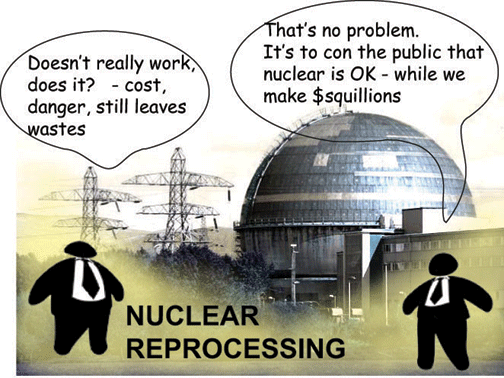
Talks about selling a nuclear fuel reprocessing plant to China were “accelerating”, Knoche said, but would not give a deadline. Discussions about the project have been going on for a decade, while the price the firm hopes to get has fallen to around 10 billion euros from 15 billion euros.
He said the reprocessing plant deal was not essential for Orano’s survival. This month, Finance Minister Bruno Le Maire said the operation could “save” the French nuclear industry.
With an order book worth nearly eight years of turnover and solid business in service and maintenance for a large part of the world’s more than 400 nuclear reactors, Orano faces the prospect of rebuilding a profitable operation.
“We will do it with humility. That is why the name is written in lower case,” Knoche said. Reporting by Geert De Clercq and Benjamin Mallet; Editing by Sudip Kar-Gupta and Dale Hudson
Romandie 12th Jan 2018 [Machine Translation] Dismantling: in France, nuclear country, the task remains immense. EDF may well show international ambitions in terms of nuclear dismantling, the industry still has to prove itself in France, the world’s second largest producer of nuclear electricity, where the task remains immense and the delays numerous.
“We dismantle nine reactors in France We consider that our know-how can put us in a very good position to win real market share internationally,” assured AFP on Wednesday Sylvain Granger director of deconstruction projects at EDF. An ambition
“staggering” for Barbara Romagnan, former PS MP, author of a parliamentary report that highlighted in early 2017 the “underrated” costs and growing delays of these projects.
“None of these French reactors has yet been totally dismantled, even though they were closed between 1985 and 1997,”
she argues. Elsewhere in the world, seventeen reactor vessels (more than 100 MW) have been dismantled in the United States, Germany and Spain, according to the Institute for Radiation Protection and Safety (IRSN).
In Chooz, EDF’s most advanced site, located in the Ardennes, the dismantling of the tank, the ultimate and most delicate stage, began in 2017. But the cutting of the internal components of the tank was suspended after the contamination. in June, a Swedish employee from Westinghouse, to whom EDF subcontracted this operation, according to the French company. EDF
estimates at 79 billion euros the cost of dismantling all its reactors in France (including 18.5 billion spent fuel management), said Thursday the company that spoke in 2000 of 16 billion euros. https://www.romandie.com/news/880085.rom
Reuters 11th Jan 2018,So close yet so far: China deal elusive for France’s Areva. A deal long
sought by French company Areva to build a $12-billion nuclear waste
reprocessing plant in China looks increasingly unlikely to go ahead despite
a visit to Beijing by President Emmanuel Macron meant to drum up business.
During Macron’s state visit this week, Areva and China National Nuclear
Corp (CNNC) signed a new “protocol agreement” to build the plant but,
not for the first time, no definitive contract was signed.
Since talks began more than a decade ago – when uranium prices UXXc1 were near record
highs – a series of non-committal French-Chinese memorandums of
understanding have been signed for building a reprocessing plant in China
modeled on state-owned Areva’s plant in La Hague, northern France.
The reprocessing of nuclear fuel waste involves separating plutonium from the
spent uranium and reusing it in “Mixed Oxide” (MOX) fuel at nuclear
power stations.
But the 2011 Fukushima nuclear disaster and competition
from renewable energy are weighing on the nuclear sector, and uranium
prices are down 80 percent from a decade ago, making the expensive and
dangerous recycling process less attractive. Chinese nuclear scientist Li
Ning, dean of Xiamen University’s College of Energy and a member of State
Nuclear Power Technology Corporation’s (SNPTC) expert committee, sees
“a fairly low probability” that China will sign a formal contract for
the project. https://www.reuters.com/article/us-areva-china-nuclearpower-analysis/so-close-yet-so-far-china-deal-elusive-for-frances-areva-idUSKBN1F01RJ









 nuclear-news