Le Monde 12th May 2018 [Machine Translation] Energy: “French stubbornness on the nuclear path is a
risky strategy”. The French choice for nuclear power is all the more dangerous because it is economically outpaced by other sources of energy, says economist Aurélien Saussay in a forum at the “World”. With the new
multiannual energy program (EPP), in public debate until June 30, France seems to have to renew its wishes for nuclear loyalty. The proponents of the status quo advance mostly economic arguments. Only nuclear electricity, flagship of French technology, would be able to meet our needs for a reasonable cost, while not emitting greenhouse gases.
The economic health of the sector is however not reassuring. Contrary to the hopes of a “renaissance” raised in 2007 at the launch of the EPR project in Flamanville, the past decade has proved disastrous for French and international nuclear power. Areva, which had designed and managed the EPR, was in a critical situation in 2016, after suffering a cumulative loss of 10 billion euros from 2011 to 2015. Only the injection of nearly 5 billion euros by the state and a drastic restructuring saved the company from bankruptcy.
Numerous reactor projects have been canceled in recent years in Brazil, South Africa and the United States. Main exception: China, with 20 reactors under construction and 60 more planned for the coming decade. The world’s first EPR commissioned will be located in southeastern China.
Apart from this Chinese specificity, how to explain the defeat, in France and abroad, of an industry promised to the most beautiful future only ten years ago? If “historic” nuclear power cost only € 0.04 / kWh, an EPR kWh
should exceed € 0.12. However, other technologies for generating electricity without greenhouse gas emissions, such as solar photovoltaic or wind, have followed an exactly opposite cost trajectory. In the case of solar, the fall is spectacular: some international projects have crossed the threshold of 0.04 € / kWh.
http://www.lemonde.fr/economie/article/2018/05/12/energie-l-entetement-francais-sur-la-voie-du-nucleaire-est-une-strategie-risquee_5297979_3234.html
May 14, 2018
Posted by Christina Macpherson |
ENERGY, France |
Leave a comment
https://abcnews.go.com/International/wireStory/macron-calls-friend-trump-angry-iran-nuclear-move-55124699
French President Emmanuel Macron has called his friend and ally U.S. President Donald Trump to say he’s very worried about tensions in the Middle East, after Trump’s decision to withdraw from the Iran nuclear accord.
Macron’s office said the two leaders spoke Saturday and the French leader expressed his “great concern about stability” in the region. Macron strongly opposes Trump’s pullout from the 2015 global deal curbing Iran’s nuclear activities. Hostilities between Iran and Israel have already escalated in recent days.
Macron and Trump also discussed trade issues. European governments are scrambling to save billions of dollars in trade with Iran that resumed thanks to the 2015 accord.
In addition, France and the EU are pressing Washington for exemption from Trump’s steel and aluminum tariffs.
May 14, 2018
Posted by Christina Macpherson |
France, politics international |
Leave a comment
150 padlocks disappear from ‘cursed’ French nuclear plant, Times UK, Adam Sage, Paris, 8 May 18, The French nuclear plant touted as a model for Britain’s new reactors was under scrutiny yesterday after 150 of the padlocks protecting its command-control computers disappeared.
Electricity of France (EDF), the state electricity group, filed a criminal lawsuit over the disappearance of the padlocks from cabinets containing the computer system at the plant under construction at Flamanville in northern France.
EDF is leading the £19.5 billion project to build two similar reactors at Hinkley Point in Somerset, which are expected to supply 7 per cent of Britain’s electricity.
The company said police were investigating the incident and that it had started an internal audit. None of the computers had been tampered with.
The reactor itself had a separate system, EDF said, which remained under lock… https://www.thetimes.co.uk/article/150-padlocks-disappear-from-cursed-french-nuclear-plant-htshx8gwf
May 9, 2018
Posted by Christina Macpherson |
France, secrets,lies and civil liberties |
Leave a comment
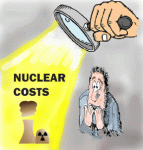

 Le Monde 5th May 2018 , Nuclear: EDF launches negotiations for two new EPRs in the United Kingdom.
According to our information, the French group is discussing with the British government to find a new way of financing to build reactors in Sizewell.
The possibility of sharing the cost of construction with British consumers on their electricity bills is thus under consideration. It would not necessarily be a direct payment, but rather a kind of bond that remains to be defined. For the time being, the British Ministry of Industry is simply saying that “new nuclear power plants have an important role to play
in the future of our low-carbon electricity production”.
To understand the current discussions, we have to go back to Hinkley Point. The two EPRs, whose construction in the West of England began at the end of 2016, must cost 19.6 billion pounds (22.2 billion euros), and that of the first must
start in 2025.
They are criticized from all sides. First on the side of EDF, which finances on its own funds two-thirds (the Chinese CGN brings the rest) and sees the English project plummet its balance sheet. Its chief financial officer resigned to oppose it in March 2016.
http://www.lemonde.fr/economie/article/2018/05/05/nucleaire-edf-lance-les-negociations-pour-deux-nouveaux-epr-au-royaume-uni_5294780_3234.html
May 7, 2018
Posted by Christina Macpherson |
France, politics international, UK |
Leave a comment

Reuters 3rd May 2018 , French uranium mining and nuclear fuel group Orano, formerly called Areva,
said it had signed a fuel reprocessing deal with Ukraine. Orano and the
Ukrainian utility EnergoAtom signed a contract for assessing the
feasibility of reprocessing services of spent fuel assemblies of Ukrainian
VVER-1000 nuclear reactors in Orano la Hague facility Orano said the
contract, signed in the presence of Oleksander Shavlakov, First
Vice-President of EnergoAtom and Pascal Aubret, Senior Executive Vice
President of Orano’s Recycling Business Unit, marks a new step towards
the treatment of Ukrainian used fuels VVER 1000 at the Orano la Hague site.
https://af.reuters.com/article/commoditiesNews/idAFFWN1SA18N
May 7, 2018
Posted by Christina Macpherson |
France, reprocessing, Ukraine |
1 Comment
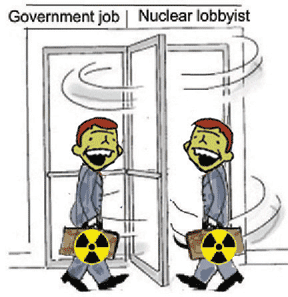 Liberation 2nd May 2018 , The practice of ” revolving doors” consisting of going back and forth
between public and private, without worrying too much about conflicts of
interest, is not the prerogative of the French elite and concerns all
sectors of the world. activity in Europe.
But according to a report to be published Wednesday by the group of Greens in the European Parliament, it
is particularly developed in France in the fossil and nuclear energy
industries. What explain a certain lack of voluntarism in terms of
ecological transition. This 82-page document entitled “Revolving Doors and
the Fossil Fuel Industry” , which Libération has procured, reviews the
“warm relations” that have developed in the main countries of the Union
between policy makers and large companies energy through these famous
revolving doors.
http://www.liberation.fr/france/2018/05/02/energie-les-portes-du-pouvoir-ouvertes-a-tous-les-vents-du-lobbying_1646907
May 4, 2018
Posted by Christina Macpherson |
France, secrets,lies and civil liberties |
Leave a comment
France’s Macron and Iran’s Rouhani agree to work on saving the 2015 Iran nuclear deal, CNBC, 29 Apr 18
May 2, 2018
Posted by Christina Macpherson |
France, Iran, politics international |
Leave a comment
World Nuclear News 27th April 2018 ,A statement of intent to strengthen cooperation on fast neutron
sodium-cooled reactors has been signed between the US Department of Energy
(DOE) and the French Alternative Energies and Atomic Energy Commission
(CEA). The partners have also a statement of intent to begin cooperation in
the field of artificial intelligence. The documents were signed yesterday
in Washington, DC, by US Energy Secretary Rick Perry and CEA’s new Chairman
François Jacq.
http://www.world-nuclear-news.org/NP-France-USA-to-enhance-cooperation-on-fast-reactors-2704184.html
April 30, 2018
Posted by Christina Macpherson |
France, technology, USA |
Leave a comment
Trump, Macron call for ‘new’ nuclear deal with Iran US President Donald Trump and French counterpart Emmanuel Macron called for a “new” deal with Iran Tuesday, looking beyond divisions over a landmark nuclear accord that now hangs in the balance. SBS News 25 Apr 18 Trump pilloried a three-year old agreement designed to curb Iran’s nuclear program as “insane” and “ridiculous”, despite European pleas for him not to walk away from the accord.
Instead, Trump eyed a “grand bargain” that would also limit Iran’s ballistic missile program and support for militant groups across the Middle East.
“I think we will have a great shot at doing a much bigger, maybe, deal,” said Trump, stressing that any new accord would have to be built on “solid foundations.”………
Macron, visiting Washington on a landmark state visit, admitted after meeting Trump that he did not know whether the US president would walk away from the nuclear deal when a May 12 decision deadline comes up.
“I can say that we have had very frank discussions on that, just the two of us,” Macron told a joint press conference with Trump at his side.
Putting on a brave face, he said he wished “for now to work on a new deal with Iran” of which the nuclear accord could be one part.
Trump — true to his background in reality TV — teased his looming decision.
…… Neither Trump nor Macron indicated what Iran would get in return for concessions on its ballistic programs or activities in the Middle East.Iran, meanwhile, has warned it will ramp up enrichment activities if Trump walks away from the accord, prompting Trump to issue a blunt warning.
“They’re not going to be restarting anything. If they restart it, they’re going to have big problems, bigger than they ever had before. And you can mark it down,” he said…….. https://www.sbs.com.au/news/trump-macron-call-for-new-nuclear-deal-with-iran
April 25, 2018
Posted by Christina Macpherson |
France, Iran, politics international, USA |
Leave a comment
FT 23rd April 2018 , Nick Butler: In the rapidly changing global energy environment nothing is
sacred, no business model is beyond challenge and no company is safe. The
latest business being forced to rethink and restructure is the French state
group Electricité de France.
EDF has become a symbol of technical weakness
and French decline. But, as with so much else in France since the arrival
of an ambitious president who feels no need to defend decisions of the
past, change is becoming possible.
For all its problems the company could be reborn as a successful player in the new energy economy. But where would
that leave nuclear power? The continuing transformation of the global
energy market is not just about climate change and the move to a lower
carbon economy. It is also about the advance of new technology, the
changing geography of the energy market in favour of Asia and, above all,
the move from a time of scarcity and energy insecurity to an age of plenty.
Nuclear costs remain too high, private investors sensibly run away from the
construction risks involved and, crucially, there are alternatives. Wind
and solar costs have fallen dramatically. In many markets they are now half
the cost per megawatt hour of large-scale new nuclear.
The prospect of commercially viable techniques of grid-level storage opens the way for an
even bigger shift. If the challenges of intermittency can be overcome and
the need for subsidies removed or much reduced, wind and solar can become
the natural economic choice for energy supply.
At last, EDF appears to be recognising reality. There is much discussion of the company being divided
in two, with the legacy nuclear assets held by the French government and
the rest of the business, including a major new division called EDF
Energies Nouvelle, being allowed to operate on proper commercial terms in
the open market, under new management.
The company is also pulling back from further investment in new nuclear. UK chief executive Simone Rossi has
for the first time talked about the possibility of the company dropping its
interest in the next prospective nuclear venture at Sizewell in Suffolk. To
go ahead, he said, would require a new financial deal.
In the absence of enthusiastic private investors that can only mean funding from the French
or British governments – and Mr Rossi should not hold his breath for that
given the state of public finances in both countries. If EDF steps out of
the new nuclear business, it will be the end of European involvement in the
sector. With nuclear power in the US also in real trouble that leaves
Japan, Korea and China as the main players. Such is the tough logic of
globalisation.
https://www.ft.com/content/39f30854-4001-11e8-803a-295c97e6fd0b
April 25, 2018
Posted by Christina Macpherson |
business and costs, France |
Leave a comment
Iran nuclear deal: Macron urges Trump to stick with 2015 accord http://www.bbc.com/news/world-middle-east-43858040, 23 Apr 18 French President Emmanuel Macron has urged his US counterpart, Donald Trump, to stick with the Iran nuclear deal, saying there is no better option.
He was speaking to Fox News ahead of a three-day state visit to the US starting on Monday.
Mr Trump has threatened to abandon the deal, which limits Iran’s nuclear programme in return for sanctions relief, unless it is toughened up.
He has until 12 May to decide whether to restore US sanctions against Iran.
Correspondents say such a move would effectively kill the landmark agreement between Iran and six major western powers.
The two leaders are expected to address the issue when Mr Trump hosts Mr Macron this week.
Mr Macron told Fox News he had no “plan B” for the deal if the US decided to restore sanctions, and said the US should stay in the agreement as long as there was no better option.
“Let’s present this framework because it’s better than the sort of North Korean-type situation.”
He said the two leaders had “a very special relationship” and he wanted to address ballistic missiles as part of the deal – a key demand of the US president – as well as work to contain Iran’s influence in the region.
President Trump is also demanding that signatories to the deal agree permanent restrictions on Iran’s uranium enrichment. Under the current deal they are set to expire in 2025.
He has put pressure on his European co-signatories to address these issues before the 12 May deadline, when he needs to decide whether to sign a waiver giving sanctions relief to Iran.
Under US law, passed during the Obama administration, the president needs to sign these waivers every 120-180 days acknowledging Iran’s compliance with the deal.
When Mr Trump signed the last one, in January, he said it was a “last chance” to change the accord, before the US withdraws.
Iran’s Foreign Minister Javad Zarif warned on Saturday that his country was prepared to resume its nuclear programme “at much greater speed”, if the US withdrew from the accord.
Mr Macron also appealed to the US president not to pull troops out of Syria after the final defeat of so-called Islamic State, saying that would “leave the floor” to Iran and Syria’s President Bashar al-Assad.
April 22, 2018
Posted by Christina Macpherson |
France, Iran, politics international, USA |
Leave a comment

Quiet no more, French village becomes centre of anti-nuclear protest, https://uk.reuters.com/article/uk-france-nuclearpower-waste/quiet-no-more-french-village-becomes-centre-of-anti-nuclear-protest-idUKKBN1HP1S7, Gilbert Reilhac, Lucien Libert BURE, France (Reuters) 19 Apr 18 – The 82 residents of the French village of Bure lived a quiet life until the government began testing the feasibility of storing nuclear waste there. Now Bure is rocked by protests as a final decision on the project looms.
For the past 20 years, French nuclear waste agency Andra has tested the stability of the clay of the northeastern village to see if it could hold radioactive waste for hundreds of thousands of years.
Andra is preparing a formal request for next year to build the 25 billion euro ($31 billion) facility to hold waste from the reactors of state-owned utility EDF.
French nuclear regulator ASN has already said the plan is sound and deep geological storage is the safest way to protect future generations from radioactive waste.
But a police van at the main square is testimony to rising tensions and demonstrations that have at times blocked the area where Andra wants to dig.
“Life will become unbearable here with the nuclear waste and all the demonstrators,” said Bure mayor Gerard Antoine, who breeds beef cattle.
Antoine approved the installation of Andra research facilities two decades ago but said he now regrets that decision and would say no if he were asked today.
Hundreds of demonstrators who built a camp nearby were kicked out by police in February but say they are there for the long run and will fight the project until the government changes its plans.
“We are heading straight for … a nuclear disaster, that’s why we’re against it,” said Jean-Marc Fleury, a local elected official with an environmentalist party.
Police are maintaining a heavy presence while protesters have regrouped in and around a house in the Bure village centre.
The future Cigeo site is designed to cover an area of 600 hectares and have 250 kilometres of underground galleries where nuclear waste would be buried in huge rust-proof cylinders.
DEEP BURIAL
Andra, which carried out research work via a research laboratory 500 metres underground, wants to start work on the site in 2022 and complete it by 2030.
“We’re not going to do deep burial of (nuclear) waste if we had any doubt that it would leak or contaminate the environment,” said Andra spokesman Mathieu Saint Louis.
“The ultimate goal with an underground installation such as this one is precisely to protect ourselves from the danger of (nuclear) waste.”
For now, spent fuel from French nuclear reactors is stored in pools next to the reactors before it is shipped to state-owned nuclear fuel group Orano’s recycling plant in La Hague, western France.
But La Hague is not designed for long-term storage and France does not have a solution 40 years after investing heavily in nuclear energy. Other countries that use nuclear power face the same problem.
The Bure site is designed so that nuclear waste could be retrieved for the first 100 years if scientists find a better solution than burying it. Otherwise, the underground galleries will be permanently sealed with concrete.
Anti-nuclear activists say deep geological storage does not offer perfect guarantees against radiation leakage in ground water. They want the waste moved to underground facilities that are just a few metres deep, to monitor it better. Writing by Geert De Clercq; Editing by Ingrid Melander and Matthew Mpoke Bigg
April 20, 2018
Posted by Christina Macpherson |
France, opposition to nuclear |
Leave a comment
France’s nuclear plans under pressure, Petroleum Economist, 17 Apr 18
Flaws found at a flagship reactor could curb EDF’s technology export ambitions
Piping weld issues reported at Électricité de France’s Flamanville nuclear reactor project last week threaten to delay similar reactor builds across Finland and the UK, eroding confidence in the technology’s future role in western Europe’s energy mix.
State-owned EDF admitted on 10 April that inspectors had found “quality deviations” on 150 welds in a system used to transport steam to turbines at the Flamanville European Pressurized Reactor (EPR), a third generation pressurised water reactor in northwestern France.
Those inspections were prompted by an initial finding in February that 38 of 66 weldings on a secondary cooling circuit were not in line with standards, which were passed on at the time to France’s Nuclear Safety Authority (ASN).
Because the ASN has already demanded that a study be completed into the initial problems by the second half of 2018, it’s likely the new discovery will exacerbate problems with the long-delayed plant’s timetable and costs—it is seven years behind schedule and €7bn ($8.6bn) over budget.
The impact of the substandard weldings will also likely be felt further afield, particularly on timings for other long-delayed EPRs that the firm is currently building: Hinkley Point C in the UK, and Olkiluoto 3 in Finland.
Construction of the first EPR in Olkiluoto started in 2005 and was initially set to be completed by 2009, but in October 2017, the project was again delayed to May 2019, when it is intended to become western Europe’s first new nuclear power station for 15 years. Meanwhile, construction is slated to start on the 3.2-gigawatt Hinkley Point C plant in Somerset, southwest England, in 2019. The plant was first proposed in 2008 and is expected to take at least a decade to bring online, at a cost of £20.3bn ($28bn).
“Repeated construction delays further undermine the credibility of nuclear power as a viable option for electricity generation in the context of urgency to combat climate change”, Mycle Schneider, lead author of the World Nuclear Industry Status Report, told Petroleum Economist. “Nuclear power turns out to be not only increasingly expensive, but far too slow to compete with other options.”
Fukushima in focus
Despite the delays, the need to ensure strict standards in a post-Fukushima environment was underlined by an incident last December at China’s Taishan1 reactor, which was constructed by China General Nuclear Power Corporation (GCN) with EDF. Taishan1’s deaerator, which removes oxygen and other gases from boiler feedwater circuits, cracked during performance testing due to defective welding.
Safety issues have loomed over nuclear power’s future in western Europe since the Fukushima accident in Japan in March 2011, when a 9.0-magnitude offshore earthquake triggered a 46-foot tsunami that hit the plant, leading to the leakage of radioactive materials and shutdown of the plant. ……..
On 31 March, the Belgian government confirmed that its future energy strategy included a plan to shut down all nuclear power plants by 2025, and Germany, Spain and Switzerland have also made plans to phase out nuclear power by the 2020s. Even President Emmanuel Macron’s French election campaign included a promise to cut nuclear power generation from 72% to 50%.
“In a strict commercial sense, nuclear power is a tough proposition in western Europe. Unlike emerging economies and regions, demand is flat in the continent,” said Jane Nakano, a senior energy analyst at the Center for Strategic and International Studies. “In mature markets it is tough to make a business case for massive projects that require huge upfront investment.” …….http://www.petroleum-economist.com/articles/low-carbon-energy/nuclear/2018/frances-nuclear-plans-under-pressure
April 18, 2018
Posted by Christina Macpherson |
business and costs, France |
Leave a comment
Alternatives Economiques 12th April 2018 , [Machine Translation]
EDF has just presented its long-term energy strategy
to the board of directors. While the cost of solar and wind energy is
falling every year – it is already half the price of new nuclear power –
Belgium confirms its exit from that it does not intend to close a
nuclear reactor, except those in Fessenhenuclear power in 2025 and that Portugal has covered in March more than 100% of its electricity needs by renewables ources, EDF defies its main shareholder, the State, and stubbornly in the nuclear everything.
The group confirms , before 2029, jeopardizing its
profitability and viability with surplus electricity that will drive down
sales prices for producers. The programs of control of the energy demand
and the development of renewable energies will lead to a mechanical
reduction of the share of the nuclear energy in the French energy mix”.
Faced with the risk of the “cliff effect”, with the end of life at the same
time many nuclear reactors built at the same time, But EDF does not hear it
that way. In financial difficulties with debt that has almost tripled in
ten years, gross operating surplus to the lowest since 2006 and a wall of
investment coming nearly 160 billion over ten years 1 , the company s
‘Heading into a suicidal strategy: prolonging nuclear reactors as much as
possible. There is no outlet for this generation of electricity while
consumption has been decreasing in France for several years and renewables
are developing? EDF invents the myth of massive exports to neighboring
countries! https://www.alternatives-economiques.fr/anne-bringault/edf-saborde-transition-energetique/000841
April 16, 2018
Posted by Christina Macpherson |
business and costs, France |
Leave a comment
Syria: US, British and French forces launch air strikes in response to chemical weapons attack,
US, British and French forces have pounded chemical weapons sites in Syria with air strikes in response to an alleged poison gas attack that killed dozens in the rebel-held town of Douma last week.
Key points:
- US, UK and France hit three chemical weapons sites in Syria
- US Defence Secretary says strikes were a “one-time shot”
- Strikes biggest intervention yet by Western powers against Assad regime
In a televised address to the nation, US President Donald Trump said the three nations had “marshalled their righteous power against barbarism and brutality”.
The strikes were the biggest intervention by Western powers against President Bashar al-Assad in the country’s seven-year-old civil war, which has pitted the US and its allies against Russia.
The Pentagon said the strikes targeted a research centre in Damascus, along with a chemical weapons storage facility and command post west of Homs……
British Prime Minister Theresa May said the strikes were not about intervening in a civil war nor were they about a regime change.
“We cannot allow the use of chemical weapons to become normalised within Syria, on the streets of the UK or anywhere else in our world,” Ms May said…….
Russia’s Defence Ministry said the majority of missiles fired during the attack were intercepted by Syrian air defence systems using Soviet-produced hardware, including the Buk missile system. http://www.abc.net.au/news/2018-04-14/us-to-strike-syria-in-response-to-chemical-weapons-attack/9658900
April 14, 2018
Posted by Christina Macpherson |
France, politics international, Russia, Syria, UK, weapons and war |
Leave a comment







 nuclear-news