Flamanville: decision to authorise the new reactor should be cancelled
 Global Chance 12th Sept 2018 [Machine translation] , Comment on the draft decision of the Nuclear Safety Authority authorizing the commissioning and use of the EPR reactor vessel of the Flamanville NPP (BNI No. 167) The Nuclear Safety Authority (ASN) has put into public consultation a draft decision authorizing the commissioning of the EPR reactor vessel under construction at Flamanville.
technical qualification was not respected for the substance and EPR tank lid and that the operators had not made the choice of the best technique for the realization of these two parts, considered in “rupture exclusion and therefore subject to strict requirements. Such a judgment should have led to the rejection of these documents and the decision to replace them.
normal procedure, through an “ad hoc” decree of the government of December 2015 authorizing a derogation in case of “particular difficulties” (these
being in this case economic and not safety). There is thus a perverse shift in the requirements of nuclear safety, confirmed by the fact that the tank
lid will have to be replaced at the latest in 2024. In these circumstances, we consider that the decision submitted for consultation is not acceptable
and must be canceled.
http://www.global-chance.org/Commentaire-sur-le-projet-de-decision-de-l-Autorite-de-surete-nucleaire-autorisant-la-mise-en-service-et-l-utilisation-de-la-cuve-du-reacteur-EPR-de-la-centrale-nucleaire-de-Flamanville-INB-No-167
Greenpeace taking court action over Orano [formerly Areva] and transport of Australian nuclear waste to Cherbourg, France

 Actu.fr 13th Sept 2018 Australian nuclear waste in Cherbourg: court hearing between Greenpeace and Orano postponed
  Greenpeace requested from the judge the summary of the Cherbourg contract between ANSTO and Orano [formerly Areva] . The case was postponed until 25 September.
Greenpeace was authorized, this Thursday, September 13, to file an interim complaint against Orano, to obtain a summary of the contract between Orano and the Australian Agency for Nuclear Science and Technology (ANSTO).
The ship is expected this Friday. In the framework of an agreement between France and Australia signed in November 2017, the nuclear waste was loaded on board a cargo ship, BBC Austria, – 236 spent fuel assemblies, reprocessed in four TN-MTR containers. It left Sydney on July 29, the ship is expected Friday, September 14 in Cherbourg. Disguised storage? Greenpeace questions the legality of this contract. It could actually be a disguised storage in France France…… https://actu.fr/normandie/cherbourg-en-cotentin_50129/dechets-nucleaires-australiens-cherbourg-laudience-entre-greenpeace-orano-reportee_18591884.html
France’s aging nuclear reactors. State owned corporation EDF plans to keep them going, despite France’s phaseout policy
Mediapart 12th Sept 2018 [Machine translation] Nuclear: these signs of aging that EDF would like to
make disappear.
More than a third of French nuclear reactors undergo an
excessive demand of their circuits. EDF monitors these phenomena but does
not repair them. However, the older the plants, the more these problems
increase.
Our revelations from internal documents obtained from a
whistleblower. In collaboration with the German site Correctiv. With a
capacity of 900 megawatts (MW), the 34 oldest reactors of the park begin to
exceed their 40 th year of use and therefore to undergo the examination.
To determine the conditions, an unprecedented consultation of the public has
just opened and will last until March 2019.
In 2015, the energy transition law for green growth marked the principle of reducing the proportion of
nuclear energy to 50% by 2025. But EDF, an 85% state-owned company, refuses
this deadline and plans to close no reactor before 2029, with the exception
of those of Fessenheim (Alsace), at the time when the EPR of Flamanville
(Manche) will enter into activity.
This position of negation of a law yet voted is tacitly supported by Édouard Philippe, who has just announced
that the multiannual energy programming (EPP) , expected document end of
October, will set the goal of a reduction to 50 % of electricity of nuclear
origin around 2035
https://www.mediapart.fr/journal/france/120918/nucleaire-ces-signes-de-vieillissement-qu-edf-voudrait-faire-disparaitre
French government to scrutinise nuclear costs: current European pressurized reactor (EPR) project not economic
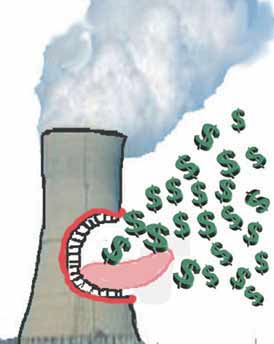 Reuters 10th Sept 2018 , France’s state-controlled EDF power utility needs to show a new
generation nuclear reactors work well, which is not for now the case, new
environment minister Francois de Rugy said in remarks published on Monday.
De Rugy signaled that any decision on whether to build more plants using
the European pressurized reactor (EPR) design would be based on economic
factors. The French government is expected to outline in late October a
plan to cut the share of nuclear energy in its electricity production to 50
percent from the current 75 percent, the highest level in the world. It has
already said it could take a decade more to get there than an initial
target of 2025.
https://www.reuters.com/article/us-france-nuclear-edf/edf-must-prove-nuclear-reactors-viable-french-minister-says-idUSKCN1LQ1HB
Despite glut of uranium fuel AREVA – now called Orano, to start a huge new uranium conversion plant
 Reuters 11th Sept 2018 , French nuclear group Orano on Monday inaugurated a 1.15 billion euro (1.02
billion pounds)uranium conversion plant despite huge global overcapacity
for nuclear reactor fuel. State-owned Orano’s new plant in Tricastin,
southern France, will account for a quarter of the world’s 60,000-tonne
annual uranium hexafluoride (UF6) production capacity when it fully ramps
up in 2021 and is set to have the industry’s lowest costs, the company
said. UF6, produced by combining “yellowcake” uranium ore concentrate
with fluorine, is a precursor of enriched uranium, which fuels the
world’s nuclear plants. Following the 2011 Fukushima disaster in Japan,
uranium prices are near decade lows as several countries reduced their
reliance on nuclear energy.
https://uk.reuters.com/article/uk-france-nuclearpower-enrichment/french-orano-opens-uranium-conversion-plant-despite-glut-idUKKCN1LQ2O9
Resignation of France’s environment Minister – he did not do a great deal to pull back nuclear power
French environment minister resigns https://beyondnuclearinternational.org/2018/08/29/french-environment-minister-resigns/Update: A newly leaked report examines the possibility of France building six new EPR reactors starting in 2025, after a prolonged period of inactivity in the industry. The report was ironically commissioned by Hulot and economy minister, Bruno Lemaire, and concludes that France “cannot stop building” reactors in order to maintain industrial know how and provide jobs, according to the newspaper, Les Echos, which broke the story. The report’s finding may have contributed to Hulot’s decision to resign. However, the notion that France would build six more EPRs was met with derision by nuclear critics who pointed out that the French nuclear industry has been unable to complete even one EPR in either France of Finland, where both projects are years behind schedule and massively over-budget.
France’s Environment Minister quits in protest about nuclear and climate policy
Popular French environment minister quits in blow to Macron, Laurence Frost, Geert De Clercq, PARIS (Reuters) 28 Aug 18 – French Environment Minister Nicolas Hulot resigned on Tuesday in frustration over sluggish progress on climate goals and nuclear energy policy, dealing a major blow to President Emmanuel Macron’s already tarnished green credentials.
Hulot, a former TV presenter and green activist who consistently scored high in opinion polls, quit during a live radio interview following what he called an “accumulation of disappointments”.
“I don’t want to lie to myself any more, or create the illusion that we’re facing up to these challenges,” Hulot said on France Inter. “I have therefore decided to leave the government.”
Hulot was among Macron’s first ministerial appointments following his May 2017 election victory. His inclusion helped to sustain a green image France had earned 18 months earlier by brokering the Paris Agreement to combat global greenhouse emissions.
But the centrist president has watered down a series of campaign pledges on the environment, including a commitment to cut the share of nuclear power in French electricity to 50 percent by 2025 and boost renewable energy.
Those policy shifts have been a repeated source of frustration for Hulot. Since a post-election honeymoon period, they have been accompanied by a sharp slide in Macron’s ratings, which touched new lows after his bodyguard was filmed assaulting demonstrators last month.
……. Greenpeace France director Jean-Francois Julliard said that while Macron had “made some fine speeches” and stood up to U.S. President Donald Trump on climate change, he had “never turned these words to concrete action” at home……..https://www.reuters.com/article/us-france-politics/popular-french-environment-minister-quits-in-blow-to-macron-idUSKCN1LD0K0
Increased danger for mountaineers, as climate change melts the French Alps
Climate change is melting the French Alps, say mountaineers
 Permafrost ‘cement’ is evaporating, making rocks unstable and prone to collapse with many trails now deemed too dangerous to use, Guardian, Simon Birch, 24 Aug 18, For the tourists thronging the streets and pavement cafes of Chamonix, the neck-craning view of Mont Blanc, the highest mountain in the Alps, is as dazzling as ever.
But the mountaineers who climb among the snowy peaks know that it is far from business as usual – due to a warming climate, the familiar landscape is rapidly changing.
“Global climate change has serious and directly observable consequences in high mountains,” says Vincent Neirinck from Mountain Wilderness, a campaign group that works to preserve mountain environments around the world.
One of the consequences of climate change is the ongoing retreat of glaciers. “In the Alps, the glacier surfaces have shrunk by half between 1900 and 2012 with a strong acceleration of the melting processes since the 1980s,” says Jacques Mourey, a climber and scientist who is researching the impact of climate change on the mountains above Chamonix.
The most dramatic demonstration of glacial retreat is shown by the Mer de Glace, the biggest glacier in France and one of Chamonix’s biggest tourist hotspots which would now be unrecognisable to the Edwardian tourists who first flocked there.
“The Mer de Glace is now melting at the rate of around 40 metres a year and has lost 80m in depth over the last 20 years alone,” says glaciologist Luc Moreau.
A stark consequence of the melting Mer de Glace is that 100m of ladders have now been bolted onto the newly exposed vertical rock walls for mountaineers to climb down onto the glacier.
Another key impact of climate change in the mountains is that it is leading to an increase in the number of rockfalls; more than 550 occurred in the Mont Blanc massif alone between 2007 and 2015.
Another key impact of climate change in the mountains is that it is leading to an increase in the number of rockfalls; more than 550 occurred in the Mont Blanc massif alone between 2007 and 2015……..https://www.theguardian.com/environment/2018/aug/24/climate-change-is-melting-the-french-alps-say-mountaineers
Hot weather continues to cause lower nuclear power production in France
 S&P Global 20th Aug 2018 , Delayed reactor returns slash French nuclear availability nearly 9 GW. Available nuclear
  power generating capacity in France fell sharply by almost 9 GW after EDF delayed the return of multiple nuclear plants, while high temperatures continued to restrict production at its Saint Alban power station, the operator said. This amounted to a total nuclear output loss of around 2.37 TWh, according to S&P Global Platts calculations.
same generating capacity on the other hand, was delayed by two days after it was taken off the grid on August 6. The 1.31-GW Golfech-2 reactor, which was taken off the grid for planned outage in May, is now expected to restart on Friday, extending the outage by four days. The restart of both 915-MW Cruas-4 and 1.495-GW Civaux-1, which was scheduled for Tuesday, was set to return on Friday and Saturday, respectively, EDF said.
With more hot weather coming,, France forced to more cuts to nuclear power production
French nuclear power supply cuts extended as hot weather lingers https://www.spglobal.com/platts/en/market-insights/latest-news/electric-power/080318-french-nuclear-power-supply-cuts-extended-as-hot-weather-lingers, AuthorAnuradha Ramanathan, EditorJeremy Lovell
HIGHLIGHTS
1,335 MW St Alban-1, 910 MW Bugey-2 offline until next Saturday
Reduced available capacity at St Alban-2, Bugey-3, Fessenheim-2
Prompt power price rally continues due to supply pressures
London — With France bracing for more hot to very hot weather in the coming week, nuclear power plant operator EDF said Friday it plans to halt production completely at two of its reactors near the river Rhone, water from which is used for cool them, and reduce available capacity at other units next week.
In its latest update on Friday, EDF said production capacity at the 1,335 MW St Alban-1 and 910 MW Bugey-2 reactors would drop to zero until Saturday next week, reducing capacity from Friday afternoon. The 910 MW Bugey-3 will also remain unavailable for power generation from late Friday but with an expected restart on Wednesday.
Out of the 1,335 MW St Alban-2 installed capacity, 950 MW will remain available to the market over the weekend, EDF said, while 600 MW will be available from its 880 MW Fessenheim-2 nuclear reactor over the weekend and until Monday midnight.
EDF, however, warned that the planning and duration of the unavailability due to environmental issues will be reassessed according to the weather forecast. These supply restriction warnings due to hot weather began late July at the onset of the heatwave which is currently covering Europe.
Furthermore, forecasters predict temperatures in France, Germany, Italy and Spain to stay above seasonal averages next week, with forecaster MeteoFrance expecting Portugal temperatures to hit 48 degrees Celsius over this weekend.
The hot weather and the resulting nuclear supply restrictions sent the prompt power prices in the wholesale market to winter levels as countries are ramping up the more expensive fossil fuel power plants, analysis shows.
French day-ahead baseload for Monday delivery was last heard trading at Eur66.50/MWh on the over-the-counter market, reaching a new summer high and the highest in more than five months, data showed.
–Anuradha Ramanathan, anuradha.ramanathan@spglobal.com Jeremy Lovell, jeremy.lovell@spglobal.com
France’s nuclear power stations affected by extreme heat – causing restricted output
S&P 24th July 2018 , France’s EDF expects nuclear-fired power production at its Bugey and
Saint-Alban power stations to be curtailed “due to extreme temperature forecast,” the utility said Tuesday. On grid operator RTE’s website, EDF said environmental issues are limiting “some” nuclear production availability in the country, starting Saturday. EDF did not give details on the exact impact of the output restrictions. The two nuclear power stations have a combined capacity of over 6 GW. Environmental issues have already resulted in weekend outages at EDF’s Bugey-3 reactor on the river Rhone.
Hot weather conditions previously have led to cooling water restrictions due to raised river temperatures. According to forecaster MeteoFrance, temperatures should remain above seasonal average, or around 2 degrees Celsius above norms over the weekend.
https://www.spglobal.com/platts/en/market-insights/latest-news/electric-power/072418-high-temperatures-to-cut-french-nuclear-production-edf
Creusot nuclear safety scandal continues with many more anomalies revealed
 Stop Penly 24th July 2018 , Creusot, the scandal continues and concerns a growing number of components.
On July 17, 2018, EDF published a note on the information provided to the safety authority concerning the nuclear equipment manufacturing files carried out at the Creusot plant, now under the control of the state energy
operator.
The verification of all the manufacturing files of these components reveals 1,775 anomalies and 449 non-compliances on the equipment of 46 of its operating nuclear reactors. With 94 anomalies and 19 nonconformities for 34 parts manufactured at Le Creusot, reactor 3 Bugey (Ain) seems to be the most affected.
http://stopeprpenly.org/?p=1161
Further delays, costs escalations, at EDF’s Flamanville European Pressurized Reactor (EPR)

FT 25th July 2018 , French power utility EDF has said there will be further delays and cost overruns at its flagship Flamanville nuclear site. In April, the company said that problems with the weldings at its Flamanville site might have an
impact on the costs and the schedule for starting the long-delayed nuclear reactor.
On Wednesday, the company said that out of the 148 inspected welds, 33 had quality deficiencies and would be repaired. As a result it had “adjusted the Flamanville EPR schedule and construction costs . . . The loading of nuclear fuel is now scheduled for the fourth quarter in 2019 and the target construction costs have been revised from €10.5bn to €10.9bn.”
The plant was already seven years late and €7bn over budget. The Flamanville plant in France is one of three being
built in Europe using the next-generation European Pressurized Reactor technology. The other two projects are the Olkiluoto project in Finland, which is more than a decade late, and the UK’s Hinkley Point, which is mired in controversy over the high cost of the project.
http://www.ft.com/content/1b2473c8-8fdd-11e8-b639-7680cedcc421
France’s Flamanville nuclear reactor: swelling costs, and more delays
New Economy 25th July 2018 The cost of EDF’s new Flamanville nuclear reactor has swelled to more
than three times the French state-owned utility’s original budget after
further issues were revealed in the construction process. EDF said target
construction costs had risen by €400m ($468m) to €10.9bn ($12.7bn).
Already seven years behind schedule, the project will now be delayed by
another year, with the loading of nuclear fuel not expected until the
fourth quarter of 2019. In April, EDF revealed that problems with the
weldings at its flagship nuclear site could impact the project’s costs
and timetable following an assessment by the French Nuclear Safety
Authority.
On July 25, EDF said 33 of 148 inspected welds were found to
have “quality deficiencies” and would be repaired: “EDF teams and
their industrial partners are fully mobilised and are continuing all other
assembly and testing activities at the Flamanville [European Pressurised
Reactor (EPR)], including the system performance tests.” France’s
Flamanville project is one of three EPRs currently being built across
Europe.
The third-generation technology has taken decades to develop and
aims to improve safety, as well as reduce costs. EDF is also building the
Olkiluoto 3 project in Finland and Hinkley Point C in the UK, both of which
are also behind schedule.
https://www.theneweconomy.com/energy/edf-reveals-further-cost-overruns-and-delays-to-its-flamanville-nuclear-reactor
France’s nuclear reactors limiting production, affected by extreme heat
High temperatures to cut French nuclear production: EDF https://www.spglobal.com/platts/en/market-insights/latest-news/electric-power/072418-high-temperatures-to-cut-french-nuclear-production-edf , Author Anuradha Ramanathan , Editor Maurice Geller London — France’s EDF expects nuclear-fired power production at its Bugey and Saint-Alban power stations to be curtailed “due to extreme temperature forecast,” the utility said Tuesday.
- Output fall likely at Bugey, Saint-Alban plants
- Production limitations to start from Saturday
- No details on capacity impact provided
On grid operator RTE’s website, EDF said environmental issues are limiting “some” nuclear production availability in the country, starting Saturday.
EDF did not give details on the exact impact of the output restrictions. The two nuclear power stations have a combined capacity of over 6 GW.
Environmental issues have already resulted in weekend outages at EDF’s Bugey-3 reactor on the river Rhone. Hot weather conditions previously have led to cooling water restrictions due to raised river temperatures.
According to forecaster MeteoFrance, temperatures should remain above seasonal average, or around 2 degrees Celsius above norms over the weekend.
–Anuradha Ramanathan, anuradha.ramanathan@spglobal.com
–Edited by Maurice Geller, maurice.geller@spglobal.com
1 This Month

of the week – Shut Down Drone Warfare!


Tell the Ukrainian Government to Drop Prosecution of Peace Activist Yurii Sheliazhenko

Petition to revoke the licensing of the Near Surface Nuclear Disposal Facility (NSDF) at Chalk River. https://www.ourcommons.ca/petitions/en/Petition/Details?Petition=e-7247
To see nuclear-related stories in greater depth and intensity – go to https://nuclearinformation.wordpress.com
-
Archives
- April 2026 (79)
- March 2026 (251)
- February 2026 (268)
- January 2026 (308)
- December 2025 (358)
- November 2025 (359)
- October 2025 (376)
- September 2025 (257)
- August 2025 (319)
- July 2025 (230)
- June 2025 (348)
- May 2025 (261)
-
Categories
- 1
- 1 NUCLEAR ISSUES
- business and costs
- climate change
- culture and arts
- ENERGY
- environment
- health
- history
- indigenous issues
- Legal
- marketing of nuclear
- media
- opposition to nuclear
- PERSONAL STORIES
- politics
- politics international
- Religion and ethics
- safety
- secrets,lies and civil liberties
- spinbuster
- technology
- Uranium
- wastes
- weapons and war
- Women
- 2 WORLD
- ACTION
- AFRICA
- Atrocities
- AUSTRALIA
- Christina's notes
- Christina's themes
- culture and arts
- Events
- Fuk 2022
- Fuk 2023
- Fukushima 2017
- Fukushima 2018
- fukushima 2019
- Fukushima 2020
- Fukushima 2021
- general
- global warming
- Humour (God we need it)
- Nuclear
- RARE EARTHS
- Reference
- resources – print
- Resources -audiovicual
- Weekly Newsletter
- World
- World Nuclear
- YouTube
-
RSS
Entries RSS
Comments RSS
 nuclear-news