by Tim Korso Most European states have taken a course to reduce to zero the use of nuclear plants since the disaster at the Japanese plant Fukushima in 2011 that led to the contamination of nearby land and sea.
Six (around 10% of the total amount) of nuclear reactors in France are using parts that had “manufacturing deviations” Electricite de France (EDF) SA, the country’s biggest power supplier reported. The irregularities were found in 16 steam generators used on nuclear power plants in Blayais, Bugey, Fessenheim, Dampierre-en-Burly, and Paluel. At the same time, EDF stated that the issue is not a pressing one and doesn’t require immediate attention.
The report comes in line with an ongoing programme of reactor checks in France following the discovery of carbon-content irregularities in the steel produced by Le Creusot Forge in 2016, which made the metal weaker than usual. The checks led to the temporary suspension of numerous reactors, and a spike in energy prices both in France and in nearby states due to the former’s need to import energy to cover the deficit.
Some European states have even announced their intention of completely phasing out the use of nuclear energy, gradually shutting down existing nuclear plants and aborting the construction of newer ones following the 2011 disaster at the Japanese plant Fukushima, which left significant patches of land and sea contaminated. The incident happened after the plant was hit by a powerful tsunami that knocked out its power and left reactors without cooling systems.
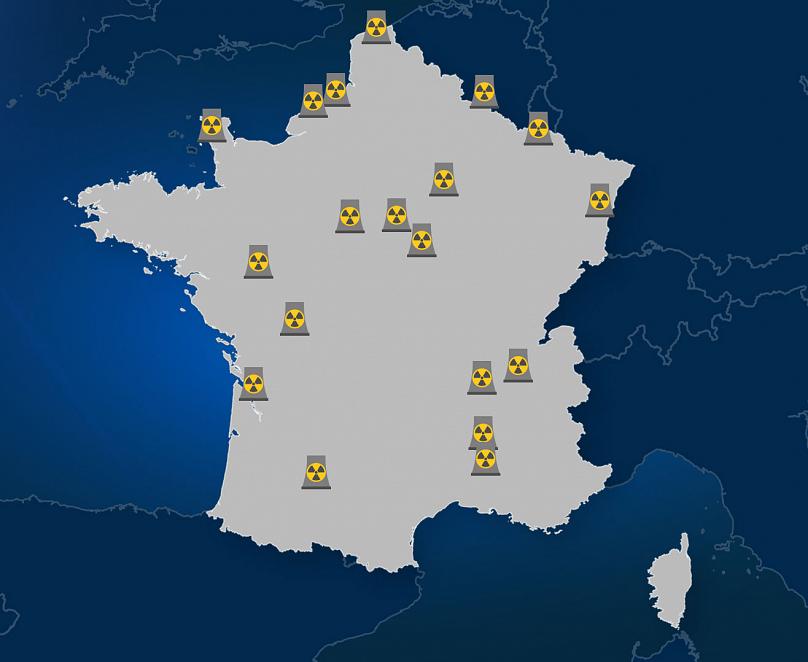
The country’s nuclear regulator agency ASN said on Tuesday people living within 10-20 kilometres from one of EDF’s 19 nuclear plants, as well as some 200,000 institutions including schools, will receive a letter in the incoming days informing them they can pick up the tablets from the nearest pharmacy.
Previously, France distributed iodine tablets to people living within a 10 kilometre radius from a nuclear plant but has now decided to widen the radius.
During nuclear accidents, radioactive iodine is released into the atmosphere that when inhaled or swallowed by the thyroid gland can cause cancer in later years.
When the thyroid gland is saturated with stable iodine, it no longer absorbs the radioactive iodine.
ASN said that in case of a nuclear accident, people should seek shelter in buildings and not go pick up their children from school.
France is the world’s most nuclear-reliant nation, with three-quarters of its electricity produced by state-owned EDF’s 58 nuclear reactors in 19 plants spread all over the country.
France flags welding fault at five or more EDF nuclear reactors, PARIS (Reuters) 13 Sept 19,– At least five nuclear reactors operated by French utility EDF might have problems with weldings on their steam generators, a fault which has raised fears of closures, France’s nuclear regulator was quoted as saying.
State-controlled EDF, whose shares were down 0.9% on Thursday, had said on Tuesday it had identified issues with weldings of some existing reactors, sparking a stock price fall of nearly 7%.
France has the world’s second-largest fleet of nuclear reactors behind the United States, but a spate of technical problems, coupled with hitches at reactors under construction, has tarnished EDF’s image as a leader in nuclear technology.
EDF has exported to China, Finland, South Africa and South Korea, with Britain also set to use its equipment.
“At least five nuclear reactors are affected by this problem,” Le Figaro newspaper quoted Bernard Doroszczuk, head of the ASN regulator, as saying.
“EDF has advised that in around a week it will give an exact number of facilities affected,” Doroszczuk added.
A spokesman for EDF said that there was no plan to shut down the reactors involved for the time being, but the situation could change and it would be for ASN to decide.
Electricite de France SA’s announcement that some of its nuclear reactors at home may contain substandard components is the latest setback in the country’s 40-year love affair with atomic energy.
France launched its nuclear program in the 1970s to reduce its dependence on fossil fuels as unprofitable coal mines progressively closed and Western economies were roiled by two consecutive oil shocks. EDF commissioned 58 reactors between 1978 and 2002, which has seen the country get more of its power from nuclear than any other nation. It also means it’s got an aging energy infrastructure, with its oldest plants embarking on large modernization programs to extend their lifecycle.
“The French nuclear fleet is now aging, meaning that some plants will have to be halted in the next 15 years,” said Marc-Antoine Eyl-Mazzega, director of the Center for Energy at the Institut Francais des Relations Internationales. “Some say that nuclear energy is very risky. Renewable energies come with tens of thousands of jobs, but France has been lagging behind.”
After commissioning its 58th reactor in 2002, EDF started building a new type of atomic plant in 2007. Its flagship Flamanville project in Western France was initially due be completed in 2012, though it’s been beset by construction problems.
EDF has also faced setbacks at its existing fleet of French reactors. In 2016, its main supplier Framatome disclosed anomalies in manufacturing records for large equipment, leading to prolonged halts at almost a third of the utility’s reactors. Tuesday’s announcement’s by EDF that some of its reactors may contain substandard components made by Framatome, now 75.5%-owned by EDF, is reigniting fears of prolonged shutdowns.
Given France gets three quarters of its energy generation from nuclear energy, the financial impact of disruption could be severe.
“There should be a significant uplift in French and Central European power prices based on likely future French nuclear outages, which could potentially mean EDF having to buy French generation output that it is short at a premium price,” Barclays Bank analysts Peter Crampton and Dominic Nash wrote in a note.
The stakes are high for the French nuclear industry, which employs about 220,000 people. President Emmanuel Macron has pledged to reduce nuclear output to 50% of France’s power mix in 2035 by shutting down 14 aging reactors to make room for renewables.
Even as the price of electricity stemming from wind and solar has sunk below that of new nuclear builds, the French president has asked EDF to prove by mid-2021 that it can build more competitively-priced nuclear plants, to provide large volumes of carbon-free power as a 100% renewable electricity system seems likely to remain out of reach for at least several decades.
It comes as state-controlled EDF struggles to fund the billions of euros needed each year to maintain its nuclear plants and build new ones within existing cash flows. It’s considering spinning off a minority stake in an entity that would include its power-distribution, renewables and energy-services businesses to raise funds.
RECORD HEAT WAVE LINKED TO CLIMATE CHANGE KILLED 1,500 PEOPLE IN FRANCE THIS SUMMER, NEWSWEEK, BY JASON LEMONON 9/8/19 HEAT WAVES THAT PLAGUED FRANCE THIS SUMMER LEFT SOME 1,500 PEOPLE DEAD, ACCORDING TO THE EUROPEAN NATION’S HEALTH MINISTER.
Agnes Buzyn explained on France Inter radio on Sunday that there had been at about 1,000 more deaths than normal during the summer months, with half of the deceased being 75 or older, the French newspaper Le Mondereported. In total, she said there were 18 exceptionally hot days recorded in France during June and July.
Although the number of deaths was high, Buzyn also pointed out that it was much lower than the 15,000 deaths that occurred during scorching summer heat wave back in 2003. The minister attributed the lower death toll in 2019 to a successful public awareness campaign.
“We have succeeded — thanks to prevention, thanks to workable messages the French population heeded — to reduce fatalities by a factor of 10,” she said, according to the Associated Press.
Paris, the French capital, experienced its hottest day ever recorded in July, with the temperature soaring above 108 degrees Fahrenheit. The previous record, documented in 1947, was just under 105 degrees.
Elsewhere in Europe, multiple countries recorded exceptionally hot summer temperatures as scientists pointed to the growing global impact of climate change.
In Germany, the temperature nearly hit 107 and in the Netherlands it narrowly surpassed 105 back in July. In Belgium, the temperature soared above 104, which was a new record as well. In fact, all three countries broke their hottest-ever recorded temperature records twice within 24 hours, British newspaper The Guardianreported at the time…….
“We must do everything we can to contribute to ease tensions with Iran and to ensure navigation safety,” French defense minister Florence Parly said during a joint press conference with U.S. Defense Secretary Mark Esper in Paris.
“We can only confirm our goal, which is to bring Iran to fully respect the Vienna deal,” Parly said.
Iran ramped up its nuclear activity in July in response to President Trump’s reinstatement of sanctions that were nixed during the nuclear deal made with Iran and world leaders in Vienna in 2015.
Iran has said it would come back into compliance with the pact if Europe helps the country work around the US sanctions to sell crude oil on the international marketplace.
Jim GreenNuclear Fuel Cycle Watch AustraliaThe World Nuclear Association noted in June 2019 that the development of a commercial fast reactor is no longer a high priority in France.
Indeed the Astrid project ‒ a planned demonstration fast reactor ‒ is in the process of being indefinitely postponed or abandoned altogether, Le Monde reported in August 2019: pre-project design studies will be completed then shelved; the 25-person unit coordinating the project has been disbanded; the project might be pursued in the second half of the 21st century according to CEA (while a CEA inside source told Le Monde that the project is “mort” (dead); Astrid has been removed from budget allocations; and the project lacks support from energy utility EDF.
One of the reasons the Astrid project has been cancelled (or deferred to the second half of the century) is belt-tightening in the wake of another failing project: the 100 MW Jules Horowitz materials testing reactor (JHR). The cost of JHR has increased from €500 million to €2.5 billion and will increase further before completion. Completion of JHR will be at least eight years behind schedule if the current completion date of 2022 is met (the planned five-year construction schedule has been pushed out to 13 years).
France drops plans to build sodium-cooled nuclear reactor. PARIS (Reuters) – France’s CEA nuclear agency has dropped plans to build a prototype sodium-cooled nuclear reactor, it said on Friday, after decades of research and hundreds of millions of euros in development costs.
Confirming a report in daily newspaper Le Monde, the state agency said it would finalize research in so-called “fourth generation” reactors in the ASTRID (Advanced Sodium Technological Reactor for Industrial Demonstration) project this year and is no longer planning to build a prototype in the short or medium term.
“In the current energy market situation, the perspective of industrial development of fourth-generation reactors is not planned before the second half of this century,” the CEA said.
In November last year the CEA had already said it was considering reducing ASTRID’s capacity to a 100-200 megawatt (MW) research model from the commercial-size 600 MW originally planned.
Le Monde quoted a CEA source as saying that the project is dead and that the agency is spending no more time or money on it.
Sodium-cooled fast-breeder reactors are one of several new designs that could succeed the pressurized water reactors (PWR) that drive most of the world’s nuclear plants. [tinyurl.com/y84d2hvc]
In theory, breeders could turn nuclear waste into fuel and make France self-sufficient in energy for decades, but uranium prices have been on a downward slope for a decade, undermining the economic rationale for fast-breeder technology.
There are also serious safety concerns about using sodium instead of water as a reactor coolant.
Since sodium remains liquid at high temperatures – instead of turning into steam – sodium reactors do not need the heavy pressurized hulls of PWRs. But sodium burns on contact with air and explodes when plunged into water.
An earlier French model was scrapped in the 1980s after encountering major technical problems.
The ASTRID project was granted a 652 million euro ($723 million) budget in 2010. By the end of 2017 investment in the project had reached 738 million euros, according to public auditor data quoted by Le Monde.
The CEA said a revised program would be proposed by the end of the year for research into fourth-generation reactors beyond 2020, in line with the government’s long-term energy strategy.
Le Monde 30th Aug 2019 The Flamanville EPR, a nightmare site for EDF.
The third-generation Normanreactor, scheduled to be launched in 2012, will not start until the end of 2022 due to faulty welds on the site. Launched in 2007, the third generation EPR reactor was initially to be connected to the electricity grid in 2012, and cost around 3.5 billion euros. In practice, it will not
start before the end of 2022, at the earliest, and the bill will rise to
more than 11 billion euros. An amount likely to be further revised upwards
depending on the work that remains to be done.
News1 29th Aug 2019The Astrid Fast Reactor Project is shut down by the Atomic EnergyCommission. A blow to the future of the sector. This was to be the nextstep in the development of the French nuclear industry, one that wouldallow it to project into the future, but which is likely never to see the
light of day. According to our information, the Astrid Fast Neutron Reactor
(RNR) project is being abandoned by the Atomic Energy and Alternative
Energies Commission (CEA), which is nevertheless at the origin.
Le Monde 29th Aug 2019 Astrid, the acronym for Advanced Sodium Technological Reactor for Industrial Demonstration, is a sodium-cooled fast reactor prototype project to be built at the Marcoule nuclear site in the Gard.
The objective of this new generation is to use depleted uranium and plutonium as fuel, in other words to reuse the radioactive materials from the electricity generation of the current nuclear fleet and largely stored at the La Hague site. (Channel), operated by Orano (formerly Areva).
France Is Still Cleaning Up Marie Curie’s Nuclear Waste, Her lab outside Paris, dubbed Chernobyl on the Seine, is still radioactive nearly a century after her death. Bloomberg Business Week , By Tara Patel, 28 Aug 19,
In 1933 nuclear physicist Marie Curie had outgrown her lab in the Latin Quarter in central Paris. To give her the space needed for the messy task of extracting radioactive elements such as radium from truckloads of ore, the University of Paris built a research center in Arcueil, a village south of the city. Today it’s grown into a crowded working-class suburb. And the dilapidated lab, set in an overgrown garden near a 17th century aqueduct, is sometimes called Chernobyl on the Seine.
No major accidents occurred at the lab, which closed in 1978. But it’s brimming with radioactivity that will be a health threat for millennia, and France’s nuclear watchdog has barred access to anyone not wearing protective clothing. The lab is surrounded by a concrete wall topped by barbed wire and surveillance cameras. Monitors constantly assess radiation, and local officials regularly test the river. “We’re proof that France has a serious nuclear waste problem,” says Arcueil Mayor Christian Métairie. “Our situation raises questions about whether the country is really equipped to handle it……. (subscribers only) https://www.bloomberg.com/news/articles/2019-08-28/france-is-still-cleaning-up-marie-curie-s-nuclear-waste
Iran’s Zarif: Nuclear talks with Macron were ‘productive’
Mohammad Javad Zarif says they could work with new French proposals, to save nuclear deal. https://www.aljazeera.com/news/2019/08/irans-zarif-nuclear-talks-macron-productive-190823161529602.htmlIran’s foreign minister has hailed “positive” talks with French President Emmanuel Macron, on salvaging the 2015 nuclear deal.Mohammad Javad Zarif says they could work with new French proposals, to save the nuclear deal.
Speaking to reporters after meeting Macron, Zarif says both countries have made suggestions on how to move forward after the United States pulled out of the nuclear deal last year.
Macron has previously said he will either try to soften the effect of the US sanctions or come up with a way to compensate the Iranian people.
Reuters 3rd Aug 2019 French utility EDF may curb power generation at its 3,000 megawatt Chooz nuclear reactor in the north of France due to the low flow rate of the
Meuse river which it uses to cool the two reactors at the plant. “Due to
flow forecasts of Meuse river, production restrictions are likely to affect
EDF’s nuclear generating fleet on Chooz production units starting
Thursday August 8,” the company said. EDF’s use of water from rivers as
coolant is regulated by law to protect plant and animal life. It is obliged
to reduce output during hot weather when water temperatures rise, or when
river levels are low.
22/07/2019 –PARIS (Reuters) – French utility EDF <EDF.PA> could prolong planned outages at its two Golfech nuclear reactors because of a heatwave expected across France this week, the power utility said on Monday.
EDF plans to halt production at the 1,300 megawatt (MW) Golfech 2 reactor from Tuesday until July 29 and will stop power generation at Golfech 1 on Wednesday until same day next week.
The utility had said on Friday that it could halt electricity generation at the 2,600 megawatt (MW) Golfech plant in southern France because of high temperatures forecast on the Garonne river, water from which is used to cool the reactors.
EDF said on Monday that the current forecast for the end of the outages was based on available temperature forecasts and that the outages at both reactors could be prolonged.
The company’s use of water from rivers to cool its reactors is regulated by law to protect plant and animal life. It is forced to cut output when water temperatures rise or when river levels and the flow rate are low.
Another spell of sizzling temperatures is expected in France and much of western Europe this week, the second heatwave this summer. A record temperature of 46 degrees Celsius (114.8 Fahrenheit) was set in southern France last month.
Separately, EDF delayed the restart of its 1,500 MW Chooz 2 nuclear reactor by a couple days to Aug. 1, saying that the planned maintenance outage could be extended because of the amount of work required for its second 10-year overhaul.
(Reporting by Bate Felix; Editing by David Goodman)
Greta Thunberg awarded first Normandy Freedom Prize
Teen climate activist Greta Thunberg wins France’s first Freedom Prize, SBS News, A 16-year-old Swedish climate champion has received the first Freedom Prize in France, and has urged people to recognise the link between climate change and “mass migration, famine and war.”
Swedish teen climate change activist Greta Thunberg, whose Friday school strikes protesting government inaction over climate change helped spark a worldwide movement, has received the first Freedom Prize in France.
Flanked by two WWII veterans who sponsor the prize, the 16-year-old accepted the award at a ceremony in the northwestern city of Caen, Normandy, on Sunday.
“This prize is not only for me,” Greta said. “This is for the whole Fridays for Future movement because this we have achieved together.”
She said she would donate the AU$28,000 prize money to four organisations working for climate justice and helping areas already affected by climate change.
The prize was awarded before an audience of several hundred people and in the presence of several D-Day veterans, including France’s Leon Gautier and US native American Charles Norman Shay.
Greta said she had spent an unforgettable day with Mr Shay on Omaha Beach, one of the sites of the 1944 Normandy landings that launched the Allied offensive that helped end World War II.
Paying tribute to their sacrifice, she said: “the least we can do to honour them is to stop destroying that same world that Charles, Leon and their friends and colleagues fought so hard to save for us.”
Mr Shay said that young people should be prepared to “defend what they believe in.”………
She said the “link between climate and ecological emergency and mass migration, famine and war was still not clear to many people” and urged change.










 nuclear-news