Unusually damaging Mw 4.9 earthquake near several French nuclear reactors
industrial region that hosts several operating nuclear power plants.
about 1 km. Here we use far-field seismological observations to
demonstrate that the rupture properties are consistent with those commonly
observed for large deeper earthquakes.
sensors in the fault vicinity, we perform numerical predictions of the
ground acceleration on a virtual array of near-fault stations. These
predictions are in agreement with independent quantitative estimations of
ground acceleration from in-situ observations of displaced objects. Both
numerical and in-situ analyses converge toward estimates of an exceptional
level of ground acceleration in the fault vicinity, that locally exceeded
gravity, and explain the unexpectedly significant damage.
French parliamentarians nominate Julian Assange for Nobel Peace Prize
 A Nobel Peace Prize for Julian Assange! https://melenchon.fr/2021/01/28/un-prix-nobel-de-la-paix-pour-julien-assange/ Thursday 28 January 2021, I decided to nominate journalist Julian Assange for the Nobel Peace Prize, as I have the power to do as a parliamentarian. Julian Assange is a hero of freedom. The WikiLeaks initiative has raised awareness of war crimes and serious human rights abuses. It is right that the peoples of the world express their gratitude to him.
- Several other rebellious parliamentarians will share this process with me. I thus continue my fight for Assange’s freedom. After going to see him in London in 2012, after having held a videoconference meeting with him in 2013, I asked for political asylum in France in 2019 then 2020. At the time, the Minister of Justice Dupont- Moretti made the same request. Julian Assange served France, including revealing the spying on three Presidents by the United States.
- I call on all French parliamentarians to in turn commit to having the Nobel Peace Prize awarded to Julian Assange.
Use of illegal workers at France’s Flamanville nuclear site.
Mediapart 14th Jan 2021, After having exhausted all possible remedies, Bouygues is definitively convicted of having used on a large scale undeclared employees on the site of the EPR of Flamanville (Manche).
In a judgment delivered Tuesday, January 12, the Court of Cassation rejected the requests of the
French public works giant and two of its satellites. Through them, Bouygueshad illegally employed at least 460 Romanian and Polish workers between 2008 and 2012, on this site of the new generation reactor, essential for EDF (owner of the site) and Areva (which ensures the construction).
Acrimed 29th Jan 2021
https://www.acrimed.org/EPR-de-Flamanville-la-condamnation-de-Bouygues
Should France extend the life of its oldest nuclear reactors?
Le Monde 22nd Jan 2021, Should France extend the life of its oldest nuclear reactors? It is the
will of the government and EDF, which postponed to 2035 the drop in the
share of atoms in electricity production. The Nuclear Safety Authority
(ASN) launched a consultation in December 2020 to regulate this possible
extension of the reactors . For Bernard Laponche, nuclear physicist, former
member of the Atomic Energy and Alternative Energies Commission and
co-founder of the association of scientists Global Chance, EDF does not
have the capacity to ensure these improvements necessary for safety on
time. He calls for the early closure of some reactors in order to continue
to ensure the proper functioning of others.
EDF collapses on the stock market amid difficult negotiations in Brussels.
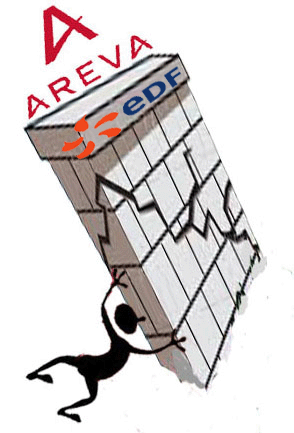 Le Monde 25th Jan 2021, EDF collapses on the stock market amid difficult negotiations in Brussels.
The French group is engaged in a vast reorganization project, contested by the company’s unions. EDF is the largest nuclear operator in Europe and one of the main electricity producers in the world, but a few lines were enough to make its value skid on the stock market on Monday January 25.
In an article published on the BFM Business website on Monday morning, the channel said that negotiations between Paris and Brussels on one of the key points of the French nuclear reform are failing. In a few minutes, the group’s action collapsed and lost up to 18% in the afternoon to close at -15%.
A day of tumbling stopped at the last minute by an intervention from Bercy, who did everything to deny the failure of the negotiations. To understand this dark day for the company, we must return to the very subject of negotiations. For months, France has been pleading with the
European Commission for a reform of the complex system which requires EDF to resell part of its production to its competitors. Set up in 2011, this mechanism called “regulated access to historic nuclear electricity” (Arenh) forces the energy company to resell a quarter of its nuclear
production at a fixed price – this tariff is set at 42 euros per megawatt hour.
Investigation of Algerians affected by France’s nuclear bomb tests
Le Monde 20th Jan 2021, At the heart of Franco-Algerian memory: the fight against those irradiated from the Sahara. This January 20, historian Benjamin Stora submits to the
President of the Republic, Emmanuel Macron, his report on Franco-Algerian memory. The nuclear tests carried out until 1966 in the Sahara are one of the disputes between the two countries. Investigation.
Serious shortcomings in the file on Bure (Meuse) underground nuclear waste storage
 Actu Environnement 19th Jan 2021, In a notice published on January 18, the Environmental Authority (Ae) points to serious shortcomings in the file of the underground radioactive waste storage center (Cigéo) in Bure (Meuse). The opinion relates more particularly to the “very detailed” environmental assessment carried out by Andra as part of the project’s declaration of public utility (DUP) file. T Actu Environnement 19th Jan 2021, In a notice published on January 18, the Environmental Authority (Ae) points to serious shortcomings in the file of the underground radioactive waste storage center (Cigéo) in Bure (Meuse). The opinion relates more particularly to the “very detailed” environmental assessment carried out by Andra as part of the project’s declaration of public utility (DUP) file. TThe DUP should make it possible to ensure the land control of the project on a surface of 665 hectares, allowing if necessary expropriations, to carry out the compliance of the town planning documents and to ” legitimize politically ” the realization of the project.
|
|
|
Radioactive releases from the Golfech nuclear power plant accumulate downstream
20minutes 19th Jan 2021, A study by Criirad, an independent laboratory, shows that radioactive releases from the Golfech nuclear power plant accumulate downstream in the
Garonne. The presence of tritium or carbon 14 in aquatic plants remains
below regulatory standards. For environmental protection associations, the
accumulation of this radioactive waste, whose longevity is important, poses
a problem.
The hidden costs of France’s old, past-their-use-by-date nuclear reactors
Ian Fairlie’s Blog 16th Jan 2021, In early 2019, four French EDF scientists wrote a 22 page report on load following in French nuclear reactors. The English version was first published on April 1 2020 but this has only recently been brought to my attention (ie mid Jan 2021).
This report is instructive and worrying, and requires careful reading. In essence, it discusses how French nuclear engineers have managed to retrofit and configure France’s reactors so that they can follow the diurnal loads increasingly required by France’s electricity needs.
It should be borne in mind that EDF’s 58 nuclear reactors are very old and past their sell-by dates. Most are between 30 and 40 years old with an average age of 33 years in 2018.
Some background is necessary to explain why this report was written. French reactors have been
operating since the 1980s. Since their gross output has usually exceeded French domestic requirements, especially at night, much is exported to France’s neighbours i.e. UK, Belgium, Netherlands, Germany, Italy and Spain.
Large amounts were until recently also sent to large pumped storage schemes in Switzerland at night. These transfers have been at a considerable financial loss to EDF and the French Treasury as the prices for such supplies are understood to be low. In addition, during the day, France imports significant amounts of electricity- mainly from the renewables in Germany.
https://www.ianfairlie.org/news/french-report-nuclear-power-plant-flexibility-at-edf/
France says Iran is building nuclear weapons capacity, urgent to revive 2015 deal
|
France says Iran is building nuclear weapons capacity, urgent to revive 2015 deal, ABC, 17 Jan 21, Iran is in the process of building up its nuclear weapons capacity and it is urgent that Tehran and Washington return to a 2015 nuclear agreement, France’s Foreign Minister Jean-Yves Le Drian has said.
Key points:
Iran has been accelerating its breaches of the nuclear deal and earlier this month started pressing ahead with plans to enrich uranium to 20 per cent fissile strength at its underground Fordow nuclear plant. That is the level Tehran achieved before striking the deal with world powers to contain its disputed nuclear ambitions. The Islamic Republic’s breaches of the nuclear agreement since President Donald Trump withdrew the United States in 2018 and subsequently imposed sanctions on Tehran may complicate efforts by president-elect Joe Biden, who takes office on January 20, to rejoin the pact………. https://www.abc.net.au/news/2021-01-17/french-minister-says-iran-is-building-nuclear-weapons-capacity/13064994 |
|
Government control over nuclear and radiation information; firing of sociologist Christine Fassert
 Le Monde 6th Jan 2021, Nuclear researchers worried after Fukushima specialist fired. The Institute for Radiation Protection and Nuclear Safety (IRSN) firmly denies having fired sociologist Christine Fassert because of the results of her work.
Is the independence of nuclear social science research weakened? After the dismissal of Christine Fassert by the Institute for Radiation Protection and Nuclear Safety (IRSN), a dozen French and foreign researchers are worried about a “resumption of control” over the production of nuclear knowledge, in a column in the World published Wednesday January 6.
France’s declining nuclear production
Les Echos 4th Jan 2021, Nuclear: EDF production at its lowest for nearly thirty years. The year
2020 was marked by extremely low nuclear production, very slightly above
335 TWh. The impact of the Covid-19 crisis on the maintenance of power
plants and the extent of the work already in progress explain this
situation, which should continue in 2021 and 2022.
Four organisations join in legal action aimed at stopping the Flamanville nuclear power project
 EPR DE FLAMANVILLE: FOUR ORGANIZATIONS SEEK JUSTICE TO SUSPEND ITS PARTIAL START-UP, TRANSPORT OF FUEL EPR DE FLAMANVILLE: FOUR ORGANIZATIONS SEEK JUSTICE TO SUSPEND ITS PARTIAL START-UP, TRANSPORT OF FUELAND RADIOACTIVE TESTS, http://crilan.fr/epr-de-flamanville-quatre-organisations-saisissent-la-justice-pour-suspendre-son-demarrage-partiel-le-transport-de-combustible-et-les-essais-radioactifs/ “Sortir du nuclear” Network, Greenpeace France, CRILAN, Stop EPR Ni at Penly Ni Ailleurs For the past two months, EDF has been authorized to deliver nuclear fuel to the Flamanville site and to conduct tests with radioactive gases on the facilities, although the state of the site absolutely does not justify it. On October 26, the first transport of enriched uranium was carried out from Romans-sur-Isère to Flamanville. Pending the judgment of the appeal, a summary suspension has also been introduced today to prevent any new deliveries and to minimize contamination of facilities that may never come into service.
The numerous anomalies and security flaws affecting the EPR site make partial commissioning unjustifiable. Greenpeace France and Mediapart revealed on Sunday December 6 that thousands of pages of confidential documents relating to the site’s security are in circulation outside EDF and its subcontractors. The partial commissioning of the EPR poses unnecessary risks to workers, the public and the environment. Moreover, EDF’s request for partial commissioning of the EPR dates from 2015. ASN had a maximum of two years to decide on this request, which it did not do. In this area, failure to reply from ASN equates to rejection and obliges EDF to submit a new request. This was not done: this is yet another demonstration of ASN’s lax attitude towards EDF. Finally, the environmental impact of this partial commissioning has not been examined. However, European Union law requires, when a project has been the subject of an impact study when a first authorization is issued, that the question of its updating be asked for each of the authorizations issued subsequently. . Taken together, the setbacks of the EPR demonstrate EDF’s industrial inability to carry out this project. At a time when the French government is considering the construction of new EPRs, the proof has been made that this option would be a dangerous and costly impasse. If Emmanuel Macron, who is scheduled to visit the Framatome plant in Le Creusot tomorrow, says he needs nuclear power, the planet does not need it. |
|
Botches and crisis in France’s nuclear energy system
|
Sueddeutsche Zeitung 7th Dec 2020, Group therapy with President. In the industrial forge in Le Creusot, components for nuclear power stations were tampered with. Now the French President wants to give the nuclear industry new impetus. Le Creusot, important components for France’s nuclear power plants and nuclear weapon systems are manufactured. In a country that gets 70 percent of its electricity from nuclear fission and believes in its status as a nuclear power, Le Creusot can see itself as a critical infrastructure. Emmanuel Macron is going there this Tuesday.
**************
The critical branch of the nuclear industry is itself in a critical condition after costly breakdowns and scandals. So the President wants to give encouragement to the industry that, after the Second World War, contributed more than any other to theFrench self-image.
**************
Macron will assure the top managers of the energy company EDF, the power plant builder Orano and the military shipyard Naval
Group, who have gathered in Le Creusot, that they are still “a trump card”, as it is called in Macron’s environment. And: the man who rules France’s nuclear button will announce the construction of a new nuclear submarine. **************
Nevertheless, French nuclear power is in crisis. A few days ago, the network operator RTE warned that electricity would be scarce in winter: Many of the 56 reactors in the country, which once knew an abundance of nuclear power, urgently need maintenance and are therefore shut down. The shutdown of the breakdown-prone power plant in Fessenheim, Alsace, in the summer, which was also carried out under pressure from Germany, is less significant. The shortage is exacerbated by the abandonment of coal-fired
electricity in recent years and the slow expansion of renewable energies. Macron wants to drive that forward. **************
At the same time, the life of the old nuclear power plant is to be extended – and up to six new, more powerful
reactors are likely to be built. Even if the prototype of these reactors, which is currently being built in Normandy, costs more than twelve billion euros instead of the originally estimated 3.5 billion euros. The botch in Le Creusot is also to blame for the rise in costs.https://www.sueddeutsche.de/wirtschaft/atomkraft-macron-frankreich-1.5140488 |
France and European Union have not yet agreed on nuclear reform
France yet to agree with EU over nuclear reform: official, By Gwénaëlle Barzic-PARIS (Reuters) 7 Dec 20, – France and the European Union are yet to reach a firm agreement over Paris’s plans for a reform of its nuclear industry, an Elysee presidential palace official said on Monday, amid talks that will entail a reorganisation of power group EDF.
The talks between France and the European Commission include the ARENH price mechanism under which competitors can get access to nuclear energy produced by EDF. Because EDF is a state-owned utility, the EU has a say on its reform on competition grounds.
The looming reform, which would see EDF’s nuclear business separated from others such as renewable energy, has already raised hackles among labour unions, fearful that a split will have consequences for jobs.
“There is not yet an agreement with the Commission on some of the key parametres,” an official with the Elysee presidential palace said, speaking ahead of President Emmanuel Macron’s visit to a nuclear equipment factory run by a EDF subsidiary Framatome on Tuesday.
The official said it was too soon to say when the new legislation on the nuclear sector could emerge.
France is due to cut its reliance on nuclear energy from 75% to 50% by 2035, but must also decide by 2023 whether to commission next generation EPR reactors.
The government will be seeking more information from EDF by the middle of next year about the cost, timeframe and feasibility of new projects, the Elysee official said.
1 This Month

of the week – Shut Down Drone Warfare!


Tell the Ukrainian Government to Drop Prosecution of Peace Activist Yurii Sheliazhenko

Petition to revoke the licensing of the Near Surface Nuclear Disposal Facility (NSDF) at Chalk River. https://www.ourcommons.ca/petitions/en/Petition/Details?Petition=e-7247
To see nuclear-related stories in greater depth and intensity – go to https://nuclearinformation.wordpress.com
-
Archives
- April 2026 (19)
- March 2026 (251)
- February 2026 (268)
- January 2026 (308)
- December 2025 (358)
- November 2025 (359)
- October 2025 (376)
- September 2025 (257)
- August 2025 (319)
- July 2025 (230)
- June 2025 (348)
- May 2025 (261)
-
Categories
- 1
- 1 NUCLEAR ISSUES
- business and costs
- climate change
- culture and arts
- ENERGY
- environment
- health
- history
- indigenous issues
- Legal
- marketing of nuclear
- media
- opposition to nuclear
- PERSONAL STORIES
- politics
- politics international
- Religion and ethics
- safety
- secrets,lies and civil liberties
- spinbuster
- technology
- Uranium
- wastes
- weapons and war
- Women
- 2 WORLD
- ACTION
- AFRICA
- Atrocities
- AUSTRALIA
- Christina's notes
- Christina's themes
- culture and arts
- Events
- Fuk 2022
- Fuk 2023
- Fukushima 2017
- Fukushima 2018
- fukushima 2019
- Fukushima 2020
- Fukushima 2021
- general
- global warming
- Humour (God we need it)
- Nuclear
- RARE EARTHS
- Reference
- resources – print
- Resources -audiovicual
- Weekly Newsletter
- World
- World Nuclear
- YouTube
-
RSS
Entries RSS
Comments RSS
 nuclear-news