France: questionable rush to start Flamanville nuclear reactor despite its defects
By a decree of August 30, 2021, EDF was authorized to operate the Flamanville EPR, under an extremely questionable consultation procedure. This is just one of the many administrative authorizations that the company
must still receive to commission the reactor, but this decision is nonetheless irresponsible. Even though the reactor is still affected by numerous defects, EDF continues its forced march to prepare for its start-up at all costs. We strongly denounce this irresponsible headlong rush.
Sortir du Nucleaire 9th Sept 2021
https://www.sortirdunucleaire.org/EPR-de-Flamanville-une-scandaleuse-autorisation-d
Protests as France sends latest shipment of used nuclear fuel to Japan
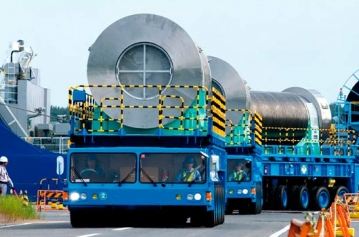
Protests as France sends latest nuclear shipment to Japan https://www.france24.com/en/live-news/20210908-protests-as-france-sends-latest-nuclear-shipment-to-japanActivists from environmental group Greenpeace protested against a shipment of reprocessed nuclear fuel that was set to leave France for Japan on Wednesday for use in a power plant.
The load of highly radioactive Mox, a mixture of reprocessed plutonium and uranium, was escorted by police from a plant near the port of Cherbourg to the dockyard in the early hours of the morning.
A handful of Greenpeace activists waved flags and signs with anti-nuclear logos as they camped out on Tuesday night to wait for the heavy-goods truck transporting the high-security cargo.The Mox from French nuclear technology group Orano is destined for a nuclear plant in Takahama in Japan and is the seventh such shipment from France since 1999.
Japan lacks facilities to process waste from its own nuclear reactors and sends most of it overseas, particularly to France.
The country is building a long-delayed reprocessing plant in Aomori in northern Japan.
“Orano and its partners have a longstanding experience in the transport of nuclear materials between Europe and Japan, in line with international regulations with the best safety and security records,” Orano said in a September 3 statement.
The fuel is being shipped by two specially designed ships from British company PNTL.
Chinon nuclear site again leaks coolants that turn into powerful greenhouse gases.
The Chinon nuclear site (Center – Val de Loire) declared in August 2021 to have exceeded the annual authorized limit for coolant leaks. 100 kilos in 1 year is the quantity of refrigerants that each EDF nuclear power plant has
the right to allow to evaporate in nature. Because at normal pressure, these liquids turn into powerful greenhouse gases.
This is equivalent to several thousand kilos of CO2 released into the atmosphere each year by EDF nuclear facilities, which have very high cooling needs. The manufacturer does not brag about it, but this limit is regularly exceeded.
Sortir du nucleaire 31st Aug 2021
An EDF employee contaminated in the Cruas-Meysse nuclear power plant.
An EDF employee contaminated in the Cruas-Meysse nuclear power plant. The
Nuclear Safety Authority classified the incident at level 2 (out of 7) on
the INES severity scale. This type of incident is quite rare, only a few
cases occur each year.
Le Monde 4th Sept 2021
No apology from France, as new report reveals the harm done to Pacific islands by atomic bomb tests

Although testing stopped more than two decades ago, its legacy lives on in French Polynesia’s politics, health, economy and environment,
“In every other Pacific Island, you have the same,” said Colombani, who also spent more than a decade working in French Polynesia’s tourism sector. “You have the postcard, but if you look beyond that, there’s something you cannot even imagine.”
New study on nuclear testing in French Polynesia reveals France’s ‘censorship and secrecy’ https://www.pri.org/stories/2021-08-06/new-study-nuclear-testing-french-polynesia-reveals-france-s-censorship-and
More than 400 claims have been filed against the French government for nuclear tests on French Polynesia between 1966 and 1996. Scientists say about 110,000 people have been affected by radioactive fallout. It’s been nearly two decades since France stopped testing nuclear weapons in French Polynesia.
But many across French Polynesia’s 118 islands and atolls across the central South Pacific were disappointed last month when President Emmanuel Macron, on his very first trip to the territory France has controlled since 1842, failed to apologize for the nearly 200 nuclear tests conducted between 1966 and 1996.
“Faced with dangerous powers in the concert of nations, I wish to say here that the nation owes a debt to French Polynesia,” Macron said in a July 27 speech. He went on to admit that the tests on the Mururoa and Fangataufa atolls were “not clean in any way” — but stopped short of an official apology.
Guillaume Colombani, who works for Radio Te Reo-o-Tefana, said while they weren’t expecting an apology, it was still devastating not to get one.
“So, when you do something wrong, whatever it is, if you go and see the people you have hurt and you say, ‘Listen, I’m sorry for what I’ve done,’” said Colombani, “it is easier for the community to say, ‘OK, we accept, here’s forgiveness,’ or ‘No, we don’t accept. You have to do something for us.’”
Colombani, 41, grew up in Tahiti during the last decades of the nuclear tests and said he remembers seeing images of blue lagoons turning white after bombs were set off. He can recount the hyper-polarization of the issue and the anti-nuclear demonstrations spurred across the Pacific.
Although testing stopped more than two decades ago, its legacy lives on in French Polynesia’s politics, health, economy and environment, he said.
Underestimated exposure levels
Scientists have long estimated some 110,000 people were affected by the radioactive fallout — many of them French Polynesians who worked at the testing sites. However, a study released earlier this year revealed that France underestimated the level of toxic exposure during the atmospheric tests that took place in the 1960s and ’70s.
The Mururoa Files was based on a two-year investigation of more than 2,000 declassified French state documents as well as various interviews conducted in French Polynesia.
“We found that they underestimated the level of exposure by factors of two to 10, depending on the tests and locations,” said Sebastien Philippe, a researcher and lecturer at the Princeton School of Public and International Affairs with the program on science and global security and co-author of the study.
That’s two to 10 times higher than the estimates given by France’s Atomic Energy Commission in a report produced nearly a decade after testing stopped. The findings compiled by Philippe and his team found, among other things, that one reason the estimates of radiation exposure were so low is that France did not take into account contaminated drinking water.
Ultimately, this systematic underestimation not only made it more difficult to link cases of cancer to the nuclear tests, but it also made it harder for victims to get compensated.
“The compensation process was scientifically broken, and I think the reason for that is the government really realized how much money it was going to cost them, and decided it would be easier to deal with this in court,” Philippe said.
More than 400 claims have been filed against the French government, but only about half have been settled in the last 10 years. Philippe said this was allowed to happen because of the French government’s “censorship and secrecy” surrounding the nuclear testing.
One upside of the release of this study, he said, was the French government’s commitment to open more government archives to the public — a commitment that President Macron made on his recent trip. The French government did not respond to The World’s request for comment about Macron’s trip.
Irreversible environmental damage
The underestimation of the radioactive fallout also made it difficult to fully understand the scope of irreversible environmental damage from the nuclear testing.
Keitapu Maamaatuaiahutapu, a physicist and climate scientist at the University of French Polynesia, said the destruction was particularly bad when the testing went underground in the mid-’70s and bombs were set off in boreholes drilled into the atolls.
These bombs had power “100 to 1,000 times more than the bomb dropped on Hiroshima,” he said.
Whole lagoons full of coral were decimated and fish populations were poisoned for years. Now, there’s also a concern that the atolls may break apart — a process being sped up by rising ocean levels due to climate change, he said.
“And the release of the radioactivity from those holes,” Maamaatuaiahutapu said. “Not only would that create [a] tsunami, but it would pollute the ocean.”
France continues to control all of the information about the damage caused by nuclear testing, including heavily guarding the test sites themselves, he said, so there might not be a way to tell when something might happen. Both the Mururoa and Fangataufa atolls are more than 700 miles away from the main island of Tahiti.
Maamaatuaiahutapu also said that he doesn’t believe that French Polynesia will never get an official apology from Paris, and that also creates political problems.
Experts said that French Polynesians who are loyal to France don’t want to criticize Paris, because it supports the territory with some $2 billion a year.
On the other hand, the independent movement, which both Maamaatuaiahutapu and Colombani are part of, supports every effort to hold France accountable, and to spread the word about nuclear tests across the Pacific — a place known mostly for its beauty.
“In every other Pacific Island, you have the same,” said Colombani, who also spent more than a decade working in French Polynesia’s tourism sector. “You have the postcard, but if you look beyond that, there’s something you cannot even imagine.”
France returns high level nuclear waste to Germany (What happens to it then?)
France signs billion-euro deal to return nuclear waste to Germany, https://www.rfi.fr/en/france/20210820-france-signs-billion-euro-deal-to-return-nuclear-waste-to-germanyThe French nuclear group Orano has signed a contract worth more than 1 billion euros to return high-level nuclear waste processed in France to Germany by the end of 2024.
Orano announced on Thursday that a “package of deals” between electricity companies PreussenElektra, RWE, ENBW and Vattenfall had formalised an in-principle agreement made in June by the French and German governments.
For 44 years German electricity companies have sent spent nuclear fuel to Normandy for recycling.
Train convoys carrying the waste were regularly blocked by environmental activists, some of whom chained themselves to the tracks.
Thorny issue
Under the agreement, which followed years of difficult negotiations, it is not medium-level German waste that will be returned, but high-level French waste from EDF power plants.
Orano said this meant it would take less volume and less time to send the same level of radioactive waste back to Germany.
“In terms of mass and radioactivity, this does not change anything,” Orano said in a statement, describing the deal as a “fairly common practice of equivalence”.
A single train of 100 containers carrying the spent nuclear fuel is to be transported from Orano’s plant in La Hague, Normandy, to Germany within the next three years.
Under French law, nuclear waste that enters France for processing cannot remain in the country.
However Germany does not have a solution for the long-term management and storage of radioactive material.
France’s oldest nuclear reactors allowed to operate for another decade
France’s oldest nuclear reactors allowed to operate for another decade https://www.rfi.fr/en/france/20210225-france-s-oldest-nuclear-reactors-allowed-to-operate-for-another-decade-edf by:Amanda Morrow
France’s Nuclear Safety Authority (ASN) has approved extending the lifetime of the country’s oldest nuclear reactors for a further 10 years. Electricity operator EDF will be in charge of improving the safety of the 900 MWe plants, which were intended to run for 40 years but will now run for 50.
The reactors in question are the oldest of the French fleet, having been commissioned in the early 1980s.
Approval for their continued service comes with several conditions, including that improvements be made to ensure that radioactivity remains confined in the event of an accident.
A first objective is to limit the impact of accidents, including serious ones such as a meltdown of the reactor core,” said ASN’s deputy director general Julien Collet.
Other concerns included protecting the plants against earthquakes, floods and extreme heat, as well as internal fire hazards.
The reactors in question are Bugey (Ain), Blayais (Gironde), Chinon (Indre-et-Loire), Cruas (Ardèche), Dampierre (Loiret), Gravelines (Nord), Saint-Laurent (Loir-et-Cher) and Tricastin (Drôme).
Staunch opposition
Following calls from environmental campaigners to shut down ageing nuclear reactors, France’s oldest plant, Fessenheim, was switched off last year.
However the evacuation of its combustible waste will continue until the summer of 2023, while the demolition of the site lay not be complete until 2040.
France derives nearly 70 percent of its electricity from nuclear power, a world record. It’s hoping to reduce this figure to 50 percent by 2035 to make more room for renewable energy.
The French nuclear complex — Macron’s love letter to the nuclear industry

Macron’s love letter to the nuclear industry
The French nuclear complex — Beyond Nuclear International The French nuclear complex https://beyondnuclearinternational.org/2021/08/15/the-french-nuclear-complex/
August 15, 2021 by beyondnuclearinternationa
The all too easy alliance between the civil and military sectors
From the Swiss Energy Foundation
...et sans nucléaire militaire, pas de nucléaire civile (“and without the military nuclear sector, no civilian nuclear sector”). These were the words of French head of state, Emmanuel Macron, during his visit at the end of the year to Le Creusot, a hotspot of the French nuclear industry. Indeed, the civil and military uses of nuclear energy were, are, and will remain, inextricably linked. This is exemplified by the French reactor research project NUWARD.
The year 2020 ended with a declaration of love from Emmanuel Macron to the French nuclear industry: “Our energy and ecological future depends on nuclear energy”. He added: “Our economic and industrial future depends on nuclear energy. ” Macron addressed these words in a well-received speech delivered at Le Creusot, Burgundy, the very heart of the nuclear industry. The industrial town of Le Creusot is an important production site for components for nuclear power plants as well as for nuclear weapons systems for military use.
The nuclear industry in crisis

However, the last few years have not been a time of joy for the French nuclear industry, but rather a time of crisis. To stay with Le Creusot: The reactor forge facility there, which among other things manufactures the safety-relevant components for nuclear power plants, drew attention to itself in 2016 with a series of irregularities: it emerged that, for years, there had been systematic forgeries. Faulty forged parts were produced. Instead of discarding the rejects, reports were falsified and quality assurance undermined. France’s new-build project, the Evolutionary Power Reactor (EPR), was also affected. The former showcase project sank steadily into a billion-dollar grave.
Along with the Le Creusot scandal, numerous other miscalculations and breakdowns cast a bad light on the French nuclear industry. The construction of the new EPR in Flamanville, as well as other construction projects abroad, made headlines with years of delays and cost explosions. The builder is the French quasi-state nuclear giant EDF. It did not want to bear the cost debacle alone, but also pointed the finger at EPR nuclear giant Areva. However, since 2018, Areva has ceased to exist.

To prevent bankruptcy, the state has virtually ransomed Areva by means of subsidies. The group was split into the state-owned company New Areva (now “Orano”), responsible for the fuel cycle business, and the reactor construction division Areva NP (now “Framatome”), which also includes the Le Creusot forge. Meanwhile, EDF, 80% of which is state-owned, is struggling with enormous debts —some 41 billion euros at the end of 2019, according to the French Ministry of Economy.
Nuclear DNA – French identity
So the task at hand is to shore up the once-radiant sector in crisis. And Macron’s assurances to Framatome and Co. came at the just right time. On the one hand, there are economic interests, as just explained with the problem child EDF, on the other hand, there is also the French identity and military capacity, founded on France’s nuclear power status. Since the post-war period, France’s self-image has been based to a large extent on the nuclear sector. In Le Creusot, Macron not only praised those present, he also announced the construction of a new aircraft carrier —nuclear-powered, of course.
The NUWARD project: an exemplary case

Among those present at Le Creusot, in addition to Framatome, were managers from EDF, Orano and the Naval Group defense contractor. All of the players are a hybrid of government and private funding, civilian and military exploitation interests. And with the exception of Orano, they are all involved in the new French Small Modular Reactor (SMR) project called NUWARD. The nuclear industry is pinning its hopes on “small modular reactors”.
The project for the French variant NUWARD started about ten years ago, when the contractors EDF, Naval Group (then DCNS), the state nuclear and energy research center CEA (Commissariat à l’énergie atomique et aux énergies alternatives) and the then Areva were commissioned with initial feasibility studies. TechnicAtome (formerly Areva TA), a specialist in marine nuclear propulsion systems, was also brought in for the pre-conceptual design. Finally, in September 2019, the partners presented their collaborative NUWARD project at the General Conference of the International Atomic Energy Agency in Vienna.
The parties involved emphasize the benefits of NUWARD as an export commodity in the global energy market: it is necessary to meet the increasing demand for energy in the context of rising population and climate policy challenges. To wit: Nuclear energy is again praised as a (supposedly) climate-friendly solution. The small NUWARD with a capacity of about 340 MW is intended as a complement to the EPR with a capacity of about 1700 MW.

But civilian applications are hardly ever the only ones. The new aircraft carrier, which is to replace the retired “de Gaulle” from 2038, will be nuclear-powered. The experts responsible for this are TechnicAtome and Naval Group. The new generation of French submarines, currently being developed under the so-called Barracuda program with the same stakeholders, also relies on nuclear propulsion. The suspicion is that TechnicAtome and Naval Group’s interests in NUWARD are aligned on this. According to ASAF, the French Army’s support association, the latter enjoys the opportunity to acquire knowledge that can later be applied in the military field.
From research to armament leader
A deeper look at the project partners involved and their activities shows that the mixture of civil-military engagement is by no means new. For example, the defense industry group Naval Group, the CEA and TechnicAtome are involved in the Barracuda project mentioned above. Naval Group itself, which calls itself the “European leader in naval defense”, is majority-owned by the French government and one-third by the defense contractor Thales Group (which in turn is about one-third owned by the government). In addition to its largely military projects, the group is also active in the civilian sector, as in the case of the EPR4 or through offshore wind energy projects.
Naval Group, meanwhile, is a 20% shareholder in TechnicAtome, whose core business is nuclear submarine propulsion. In addition, the corporation pursues civil nuclear activities. For example, it was responsible for safety systems at Hinkley Point (UK) at the EPR. TechnicAtome was spun off in the 1970s from the state research institute CEA, which remains a shareholder today, along with the state and EDF (itself 85% state-owned).
The CEA can be seen as a symbol of the interdependence of the military-civilian nuclear establishment. CEA, from the French acronym for Atomic Energy Commission, was founded after World War II and oversees all French nuclear research, both military and civilian. To this day, the research institution is wholly owned by the government. Of note are the unique privileges the CEA enjoys as a public agency: it is accountable for its decisions solely to the French president and is not subject to the same financial controls as other government agencies.
France Nucléaire – Quo vadis?
For the French head of state, abolishing the civil-military “double dimension” makes no sense at all. Rather, it illustrates the coherence between strategic autonomy and energy independence. And this is now being proudly presented in public again, as in Le Creusot.
It is therefore not only worthwhile for the French state to support the struggling civilian nuclear industry, but it seems almost imperative. It does so not only through share packages (see Areva). In addition, Macron is lobbying Brussels to give nuclear energy more prominence in the EU’s climate strategy, with the hope of receiving money from the Green New Deal pots. This would also help the enforcement of the planned national subsidies vis-à-vis the EU.
State aid en masse is thus intended to save civil nuclear power in France, because the French presidential palace cannot afford to — and will not — do away with the civilian part. As Macron revealed in his closing homage to nuclear power at Le Creusot: “Our strategic future, notre status de grande puissance, depends on nuclear energy”.
The original article in German, can be found here on the Swiss Energy Foundation (SES) website in its Focus France section. We are grateful to the SES for this translation.
France’s secrecy and censorship on the atomic bomb tests in the Pacific

New study on nuclear testing in French Polynesia reveals France’s ‘censorship and secrecy’ https://www.pri.org/stories/2021-08-06/new-study-nuclear-testing-french-polynesia-reveals-france-s-censorship-and
More than 400 claims have been filed against the French government for nuclear tests on French Polynesia between 1966 and 1996. Scientists say about 110,000 people have been affected by The WorldAugust 06, 2021 · 12:30 PM EDT
By Ashley Westerman It’s been nearly two decades since France stopped testing nuclear weapons in French Polynesia.
But many across French Polynesia’s 118 islands and atolls across the central South Pacific were disappointed last month when President Emmanuel Macron, on his very first trip to the territory France has controlled since 1842, failed to apologize for the nearly 200 nuclear tests conducted between 1966 and 1996.
“Faced with dangerous powers in the concert of nations, I wish to say here that the nation owes a debt to French Polynesia,” Macron said in a July 27 speech. He went on to admit that the tests on the Mururoa and Fangataufa atolls were “not clean in any way” — but stopped short of an official apology.
Guillaume Colombini, who works for Radio Te Reo-o-Tefana, said while they weren’t expecting an apology, it was still devastating not to get one.
“So, when you do something wrong, whatever it is, if you go and see the people you have hurt and you say, ‘Listen, I’m sorry for what I’ve done,’” said Colombini, “it is easier for the community to say, ‘OK, we accept, here’s forgiveness,’ or ‘No, we don’t accept. You have to do something for us.’”
Colombini, 41, grew up in Tahiti during the last decades of the nuclear tests and said he remembers seeing images of blue lagoons turning white after bombs were set off. He can recount the hyper-polarization of the issue and the anti-nuclear demonstrations spurred across the Pacific.
Although testing stopped more than two decades ago, its legacy lives on in French Polynesia’s politics, health, economy and environment, he said.
Underestimated exposure levels
Scientists have long estimated some 110,000 people were affected by the radioactive fallout — many of them French Polynesians who worked at the testing sites. However, a study released earlier this year revealed that France underestimated the level of toxic exposure during the atmospheric tests that took place in the 1960s and ’70s.
The Mururoa Files was based on a two-year investigation of more than 2,000 declassified French state documents as well as various interviews conducted in French Polynesia.
“We found that they underestimated the level of exposure by factors of two to 10, depending on the tests and locations,” said Sebastien Philippe, a researcher and lecturer at the Princeton School of Public and International Affairs with the program on science and global security and co-author of the study.
That’s two to 10 times higher than the estimates given by France’s Atomic Energy Commission in a report produced nearly a decade after testing stopped. The findings compiled by Philippe and his team found, among other things, that one reason the estimates of radiation exposure were so low is that France did not take into account contaminated drinking water.
Ultimately, this systematic underestimation not only made it more difficult to link cases of cancer to the nuclear tests, but it also made it harder for victims to get compensated.
“The compensation process was scientifically broken, and I think the reason for that is the government really realized how much money it was going to cost them, and decided it would be easier to deal with this in court,” Philippe said.
More than 400 claims have been filed against the French government, but only about half have been settled in the last 10 years. Philippe said this was allowed to happen because of the French government’s “censorship and secrecy” surrounding the nuclear testing.
One upside of the release of this study, he said, was the French government’s commitment to open more government archives to the public — a commitment that President Macron made on his recent trip. The French government did not respond to The World’s request for comment about Marcon’s trip.
The underestimation of the radioactive fallout also made it difficult to fully understand the scope of irreversible environmental damage from the nuclear testing.
Keitapu Maamaatuaiahutapu, a physicist and climate scientist at the University of French Polynesia, said the destruction was particularly bad when the testing went underground in the mid-’70s and bombs were set off in boreholes drilled into the atolls.
These bombs had power “100 to 1,000 times more than the bomb dropped on Hiroshima,” he said.
Whole lagoons full of coral were decimated and fish populations were poisoned for years. Now, there’s also a concern that the atolls may break apart — a process being sped up by rising ocean levels due to climate change, he said.
“And the release of the radioactivity from those holes,” Maamaatuaiahutapu said. “Not only would that create [a] tsunami, but it would pollute the ocean.”
France continues to control all of the information about the damage caused by nuclear testing, including heavily guarding the test sites themselves, he said, so there might not be a way to tell when something might happen. Both the Mururoa and Fangataufa atolls are more than 700 miles away from the main island of Tahiti.
Maamaatuaiahutapu also said that he doesn’t believe that French Polynesia will never get an official apology from Paris, and that also creates political problems.
Experts said that French Polynesians who are loyal to France don’t want to criticize Paris, because it supports the territory with some $2 billion a year.
On the other hand, the independent movement, which both Maamaatuaiahutapu and Colombini are part of, supports every effort to hold France accountable, and to spread the word about nuclear tests across the Pacific — a place known mostly for its beauty.
“In every other Pacific Island, you have the same,” said Colombini, who also spent more than a decade working in French Polynesia’s tourism sector. “You have the postcard, but if you look beyond that, there’s something you cannot even imagine.”
Framatome’s sub-standard nuclear fuel is threatening the survival of France’s nuclear company EDF
It is not only in China, in the world’s first operational EPR nuclearreactor, that the fuel produced by EDF’s subsidiary, Framatome, is a problem. In France, in the Ardennes, an unprecedented incident on the nuclear fleet has just occurred in a reactor and potentially concerns ten reactors, to varying degrees of severity.
This nuclear fuel that poisons the life of EDF
by Martin Leers, Le Journal de l’energie 2nd Aug 2021
Metal guards that enclose the reactor fuel, called cladding, deteriorate too quickly. A problem far from trivial: fuel cladding plays a key role in the safety of nuclear reactors. This “accelerated” corrosion appeared between 2020 and 2021 in one of the two reactors at the Chooz power plant. A fault which currently forces EDF to extend its shutdown since March 2021 and has therefore already cost it more than a hundred million euros.
But the stakes for EDF are much more important than a shutdown of a reactor. The “M5” alloy sheaths, which wear out prematurely in Chooz reactor n ° 2, are fitted to all EPR reactors in France, Finland and China, as well as dozens of other reactors in France and abroad.
Is there a link between this incident in France and that of the leaking ducts of the first EPR reactor in service in the world in Taishan (China)?
Why do these latest generation sheaths wear out prematurely?
A burning question for EDF, which is trying to convince the Nuclear Safety Authority (ASN) and the Institute for Radiation Protection and Nuclear Safety (IRSN) to reuse cladding with questionable reliability in reactors.
How did the problem come to be at the Chooz nuclear power plant?
When the Chooz reactor n ° 2 was shut down in February 2021 to reload the fuel, particles were discovered on the fuel assemblies and in the water of the primary circuit [1] . “Numerous white migrant bodies of a few millimeters were either collected by the anti-debris devices or remained on the assemblies”, explained EDF in an internal letter to ASN, dated July 7, 2021. An abnormal phenomenon . These particles are zirconium oxide which originates from the surface of the fuel cladding. [2] Their presence indicates that the sheaths are degrading. “The consequence of an abnormally high corrosion rate”, clarified EDF in the letter to ASN.
These particles are very friable and cannot cause a loss of tightness in the nuclear fuel, explained Karine Herviou, deputy director general of IRSN, to the Journal de l’énergie .
The fuel claddings are tubes more than 4 meters long and less than 1 centimeter in diameter, very thin (0.6 mm thick) in which the uranium pellets are stacked. These sheaths, commonly called rods, are brought together in assemblies, each made up of 264 sheaths. The core of Chooz nuclear reactor No. 2 contains 205 assemblies. In Chooz reactor n ° 2, the abnormal wear is only in the upper part of certain assemblies.
What consequences for the safety of the nuclear reactor could have the accelerated wear of the fuel rods?
The cladding plays an important role for reactor safety: they form the first barrier between nuclear fuel, containing very dangerous radioactive substances, and the environment. They must prevent radioactivity from spreading in the water circulating in the nuclear core. However, “damage to the surface of certain fuel cladding calls into question the demonstration of the integrity of the fuel in service”, considers ASN. This means that this incident calls into question the parameters which guarantee, in the eyes of ASN, the safety of the reactor in normal operation and during accident scenarios.
“Accelerated corrosion is likely to weaken the cladding and increase the risk of loss of integrity of the rods concerned during accidental transients and therefore lead to rupture of the first barrier”, explains EDF in the internal letter to ASN from July 7, 2021. But EDF does not consider this scenario plausible.
What are the causes of abnormal wear of the fuel rods?
EDF estimated on July 7 that “at this stage of the investigations, no single cause appears at the origin of the phenomenon of accelerated corrosion (…) which rather finds its explanation in a combination of several unfavorable factors”. But the M5 alloy from which the sheaths are made “seems to be the trigger,” notes EDF.
The iron content of the sheaths singled out
It is the low iron content of the cladding alloy which is partly responsible for their degradation. Two production batches for low iron content sheaths have been identified by EDF. The most damaged sheaths come from these lots, which EDF calls “hyper sensitive castings”. But until the February 2021 incident on Chooz reactor no.2, slight variations in iron in the cladding alloy were not considered to be a factor in the degradation of the fuel rods. The variable iron content of fuel cladding does not appear to have been perceived as a problem in France by the fuel assembly manufacturer, Framatome, or by the operator EDF, or by ASN and IRSN.
The sheaths which deteriorate are “in conformity” with the specifications
“The iron content of these batches is within the standards”, explains IRSN. “The products supplied by Framatome comply” with the specifications, “iron was not considered as a characteristic parameter for the behavior of the rods in the core. », Adds ASN.
Following the incident, EDF informed ASN that the iron content will be increased in the cladding which will be used in reactor No. 2 at Chooz from “cycle 20”. Not the next time the reactor is reloaded, but the next.
A “multifactorial” phenomenon
The iron content of pencils is not the only culprit. EDF puts forward other causes to explain the degradation of the fuel cladding. The temperature is higher at the top of the nuclear core in the most powerful reactors, those of 1450 MW, than in the less powerful reactors, those of 1300 MW. It is in this area that the cladding deteriorated in two 1,450 MWe reactors in France. What would happen if low iron cladding was introduced into EPR reactors, even more powerful than the 1450 MW reactors?
Another unfavorable element: the positioning of the fuel assemblies in the reactor vessel. “The corrosion rate depends on the place of an assembly in the reactor core during the first cycle”, particularly in the four most powerful reactors in the French fleet, explains EDF in an internal document. [3]
An unprecedented incident in France but not abroad
If this wear had never been observed in France, it had already occurred on three nuclear reactors in Brazil and Germany, two of which used the same M5 alloy. [4] As at the Chooz power station, the most worn cladding was the one with the lowest iron content. “The phenomenon of accelerated corrosion observed at the end of cycle 18 of Chooz B2 is comparable to other events in Konvoi reactors abroad”, notes EDF in the internal letter to ASN. Therefore, why was this incident not anticipated in France when the nuclear operators and institutions say they maintain a permanent dialogue on safety at the global level?
The nuclear safety experts from the German GRS institute have not been able to fully identify the causes of the corrosion of the cladding on German reactors, adds Karine Herviou of IRSN.
M5 alloy sheaths are fitted to all EPR reactors in France, Finland and China, as well as dozens of other reactors.
Designed to be more corrosion resistant than previous alloys and to improve nuclear fuel efficiency, the M5, manufactured by Framatome, is widely used in nuclear power worldwide.
“A large majority of reactors in France use assemblies with M5 cladding,” explains Karine Herviou of IRSN. Framatome claims its M5 sheaths are used in 96 nuclear reactors around the world, in a 2018 brochure .
The same cladding is used in the EPR reactors at Flamanville (Manche), Olkiluoto in Finland and Taishan in China. M5 alloy sheaths had many leakage problems in the 2000s, says a 2008 IRSN report:
“Between 2001 and 2008, around thirty fuel assembly leaks with M5 alloy cladding were detected. To date, EDF has identified three types of faults causing leaks in fuel rods with M5 alloy cladding. »Defects now corrected……………
10 nuclear reactors in France affected by the cladding defect discovered at the Chooz power plant
For the moment, ten nuclear reactors in France are directly or indirectly affected by the defect in the cladding discovered on the reactor n ° 2 at Chooz.
“To date, seven 1,300 MWe reactors and three 1,450 MWe reactors have at least one rod with a low iron content, in the core or in the management reserve,” ASN told the Journal de l’énergie .
But the inventory of potentially defective rods is still in progress, “even if it should not change”, added ASN. In addition to the two production batches for low iron content sheaths, EDF identified other batches of concern and informed ASN of them in an internal letter. How many ? Mystery.
“An inventory of the iron content of each of the rods of each of the assemblies present in the reactor or in reserve is being drawn up”, specifies ASN…………..
Is EDF’s priority to save fuel even if it means playing stunts with nuclear safety?
EDF is therefore forced to adapt the operation of the two reactors to the defective ducts with “compensatory” measures. EDF proposes that Chooz reactor no. 2 only operate at 92% of its power during its next cycle. For Chooz reactor n ° 1, the operator proposes to reduce load monitoring. [6] “Depending on the elements, EDF could be required, on reactors 1 of Chooz, 1 and 2 of Civaux and 3 of Cattenom to take compensatory measures (either to limit maneuverability or to operate at a drop in power)” , announces the operator in the internal letter of July 7, 2021 to ASN.
Measures that would have a financial impact. The aim, explains ASN, is “not to allow a reactor operating mode where this corrosion acceleration is possible”.
IRSN must deliver its opinion on EDF’s proposals in a few weeks, then ASN will decide.
Why does EDF not give up using potentially defective cladding in reactors? Is it about saving fuel even if it means doing acrobatics with nuclear safety?
Neither EDF nor Framatome answered questions from the Journal de l’énergie . https://journaldelenergie.com/nucleaire/combustible-nucleaire-empoisonne-edf/
The incident that caused the shutdown of the Taishan nuclear power plant occurs regularly in France
The incident that caused the shutdown of the Taishan nuclear power plant
occurs regularly in France. An expert will have to determine whether the
responsibility of the French fuel manufacturer, Framatome, is engaged in
the incident at the Chinese plant.
France TV info 3rd Aug 2021
French President acknowledges France’s debt to Polynesia, but no apology.
French President Emmanuel Macron said Tuesday that Paris owed “a debt” to
French Polynesia over nuclear tests conducted in the South Pacific
territory between 1966 and 1996, but stopped short of apologising.
Daily Mail 28th July 2021
Despite the rain, France’s nuclear reactors are still threatened by global heating.

Rhône production still threatened despite the rains. A heatwave and drought could still cause shutdowns of nuclear reactors along the Rhone by the fall, despite unprecedented rainfall in Western Europe in recent weeks which has replenished the flow of the river, said analysts Wednesday.
Montel 21st July 2021
https://www.montelnews.com/fr/news/1240314/-la-production-du-rhne-toujours-menace-malgr-les-pluies
A new problem for France’s nuclear company EDF threatens to further delay its plans for new model European Pressurised Reactor (EPR2)
EPR2**
In a discreetly published notice in March, the Institute for Radiation Protection and Nuclear Safety (IRSN) – the technical office of the Nuclear Safety Authority (ASN) – asks the State-owned company EDF to identify the origin of the vibrations affecting the circuit primary water from EPRs, already built or under construction.
And to find a solution to this problem, so that it does not reproduce on its new model of reactor, called EPR 2.
Passed under the radar, the news is yet another hard blow in a story with twists and turns. Indeed, EDF has to date no idea how to solve it.
Consequently, we can already anticipate new years of additional delay inthe development of a technology, supposedly easier to produce and therefore more competitive, on which the group led by Jean-Bernard Levy plays very heavily.
Blast 17th July 2021
Costly dismantling of France’s Brennilis nuclear power plant continues, 35 years after shutdown.
The dismantling of the Brennilis nuclear power plant, in the Monts
d’Arrée (Finistère) will be completed by 2040 and will have cost 850
million euros, the departmental council of Finistère said on Thursday.
These operations began over 35 years ago.
France Bleu 15th July 2021
1 This Month

of the week – Shut Down Drone Warfare!


Tell the Ukrainian Government to Drop Prosecution of Peace Activist Yurii Sheliazhenko

Petition to revoke the licensing of the Near Surface Nuclear Disposal Facility (NSDF) at Chalk River. https://www.ourcommons.ca/petitions/en/Petition/Details?Petition=e-7247
To see nuclear-related stories in greater depth and intensity – go to https://nuclearinformation.wordpress.com
-
Archives
- April 2026 (7)
- March 2026 (251)
- February 2026 (268)
- January 2026 (308)
- December 2025 (358)
- November 2025 (359)
- October 2025 (376)
- September 2025 (257)
- August 2025 (319)
- July 2025 (230)
- June 2025 (348)
- May 2025 (261)
-
Categories
- 1
- 1 NUCLEAR ISSUES
- business and costs
- climate change
- culture and arts
- ENERGY
- environment
- health
- history
- indigenous issues
- Legal
- marketing of nuclear
- media
- opposition to nuclear
- PERSONAL STORIES
- politics
- politics international
- Religion and ethics
- safety
- secrets,lies and civil liberties
- spinbuster
- technology
- Uranium
- wastes
- weapons and war
- Women
- 2 WORLD
- ACTION
- AFRICA
- Atrocities
- AUSTRALIA
- Christina's notes
- Christina's themes
- culture and arts
- Events
- Fuk 2022
- Fuk 2023
- Fukushima 2017
- Fukushima 2018
- fukushima 2019
- Fukushima 2020
- Fukushima 2021
- general
- global warming
- Humour (God we need it)
- Nuclear
- RARE EARTHS
- Reference
- resources – print
- Resources -audiovicual
- Weekly Newsletter
- World
- World Nuclear
- YouTube
-
RSS
Entries RSS
Comments RSS
 nuclear-news