EDF shares slide after faults found at nuclear plant
EDF shares slide after faults found at nuclear plant. Shares in EDF EDF.PA
plunged on Thursday after the French power giant found faults at a nuclear
power station and shut down another plant using the same kind of reactors,
leading it to cut its core profit goal for this year.
FT 16th Dec 2021
https://www.ft.com/content/430280fc-250d-4fc2-863c-a0b16a960018
To obtain authorisation to commission the Flamanville EPR nuclear reactor, EDF must get full infomation on the incident at the Taishan EPR reactor.
To obtain authorization to commission the Flamanville EPR, EDF will first have to shed light on the Taishan EPR 1 incident in China, the Nuclear Safety Authority (ASN) told Reporterre. Thursday, December 9. “ASN asked EDF to take account of the experience feedback from this event prior to the commissioning of the Flamanville EPR reactor.
To do this, EDF will either have to demonstrate that the Flamanville EPR is not affected, or propose
measures to prevent fuel degradation, “ASN wrote. “EDF is currently working in conjunction with the operator of Taishan (TNPJVC) and Framatome on the interpretation of the results of the checks on the fuel unloaded from the Taishan 1 reactor.
These analyzes aim to identify the phenomena that led to the rupture of the ducts. fuel and to determine whether the other EPR reactors are concerned, ”ASN added. The French nuclear gendarme says it has not obtained any information concerning the restart of Taishan 1 “which falls under the competence of its Chinese counterpart (NNSA)”.
Reporterre 13th Dec 2021
France’s Court of Audits demands information on the costs of future EPR nuclear reactors, and cost implications for waste management.

The Court of Auditors called on Monday to take into account the uncertainties surrounding the cost of future EPR2 nuclear reactors, and to foresee the implications for waste management, as President Macron
announced the launch of a new construction program. “Regarding the cost of future EPR 2, uncertainty ranges on construction costs should be systematically tested, given the lack of maturity of this new reactor”, note the magistrates in their conclusions.
Le Figaro 13th Dec 2021
Protesters denounce French push to label nuclear as sustainable energy
Protesters denounce French push to label nuclear as sustainable energyReuters PARIS, Dec 14 (Reuters) – Demonstrators unfurled a banner declaring “Gas & nuclear are not green” outside France’s foreign ministry on Tuesday in protest at a government drive to label nuclear energy and fossil gas as sectors for climate-friendly investment……………
Protesters denounce French push to label nuclear as sustainable energy, Reuters PARIS, Dec 14 (Reuters) – Demonstrators unfurled a banner declaring “Gas & nuclear are not green” outside France’s foreign ministry on Tuesday in protest at a government drive to label nuclear energy and fossil gas as sectors for climate-friendly investment……………
The European Union is preparing a rulebook on climate friendly investments, which from next year will define which activities can be labelled as green in sectors including transport and buildings.
The EU’s aim is to restrict the green investment label to climate-friendly activities, steer cash into low-carbon projects and stop companies or investors making unsubstantiated environmental claims.
The French government hopes that having the sustainable energy label could boost France’s struggling nuclear energy industry, which was bailed out by the state in 2017 following construction delays and cost overruns.
“By taking the lead of the toxic alliance between fossil gas and nuclear (energy) at a European level, Emmanuel Macron clearly sides with the polluters’ camp. Nuclear is not a green energy: it produces radioactive waste that piles up across the country”, said Nicolas Nace, a member of environmentalist group Greenpeace.
Finance Minister Bruno Le Maire said last month that one of the priorities of France’s six-month EU presidency, starting on Jan. 1, would be to include nuclear power in Europe’s sustainable finance taxonomy.
Some EU countries, including Germany, do not agree with this policy.
France generates about three quarters of its electricity in nuclear reactors operated by state-owned utility EDF. https://www.reuters.com/markets/commodities/protesters-denounce-french-push-label-nuclear-sustainable-energy-2021-12-14/
“Nuclear power has no future inFrance”.
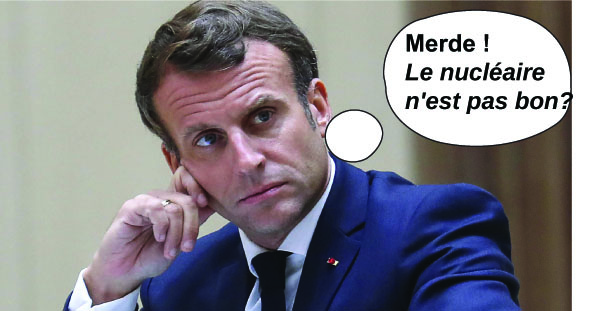
Thierry Gadault gave a conference on French nuclear power on December 3,
2021 in Orleans with a shocking title: “Nuclear power has no future in
France”. This independent journalist who has been investigating the atom
for ten years is the co-author of the book Nuclear, immediate danger (2018,
Flammarion) and the TV documentary Nuclear, the end of a myth broadcast on
Public Senate in 2018. He granted at Magcentre an exclusive interview.
Magcentre 8th Dec 2021
Inherent design flaw in EPRs (European Pressurised or Evolutionary Power Reactors) casts doubt on future of UK’s Hinkley and Sizewell nuclear projects.
The Nuclear Free Local Authorities network (NFLA) has been alarmed to
receive a French scientific report that a radioactive leak recently
reported by the operators of a Chinese nuclear power plant could signify a
potentially fatal design flaw in new reactors planned for the UK.
In June 2021, nuclear operator, Framatome, a subsidiary of French-state owned power
utility, EDF, reported a leak of radioactive gas at the Taishan 1 nuclear
power plant in China. It is still unclear what the cause was, but a rupture
of the uranium rods within the reactor core as a result of abnormal wear
and tear was suspected.
Now the French Commission for Independent Research
and Information on Radioactivity (Criirad) has reported to the French
Nuclear Safety Authority that a problem with the design of the vessel
causes early wear in the reactor, that this inherent design flaw is common
to all EPRs (for European Pressurised or Evolutionary Power Reactors), and
that the accident at Taishan ‘raises serious questions in terms of
nuclear safety and radiation protection, both for plant workers and for
residents.
Although French worries revolve around the future safety of the
Flammaville 3 EPR, the NFLA is also gravely concerned that the latest news
puts into question the future safety of EPRs planned for the UK. An EPR to
the same design is currently under construction at Hinkley Point C in
Somerset and there is a further proposed plant at Sizewell, Suffolk.
NFLA 7th Dec 2021
Nuclear power is a failure – former French Environment Minister

Yves Cochet: “The nuclear failure” Former Minister of the Environment. Against the recent projects announced by the President of the Republic for the revival of nuclear power in France, Yves Cochet, former Minister of the Environment, recalls how the history of this energy sector is marked by a
succession of setbacks.
Despite seventy years of nuclear energy research and development, nuclear energy remains a failure caused by a list of setbacks such that one is enough to destroy any prospect of lasting success. Nuclear power today only contributes 5% of global energy supply and 10% of electricity production, this share has been steadily declining for twenty-five years, while the share of renewable electricity has now surpassed that of nuclear power.
Le Monde 4th Dec 2021
https://www.lemonde.fr/idees/article/2021/12/04/yves-cochet-l-echec-du-nucleaire_6104683_3232.html
France joins the Small Nuclear Reactor frenzy, bringing out its odd version ”NAAREA”

French engineering group Assystem has signed a cooperation agreement with
newly-created French micro-reactor developer Naarea to build its
ultra-compact eXtra Small Modular Reactor (XSMR). Dassault Systèmes is to
supply Naarea with a cloud-based platform on which to virtually design the
1 to 40 MW molten salt reactor. Naarea expects the first units of XSMR to
be produced by 2030.
The company says its ultra-compact molten salt reactor uses “the untapped potential of used radioactive materials, and thorium, unused mining waste.” Naarea noted, “The current stocks of these two wastes will supply the energy needs of humanity for thousands of years, and reconcile humanity with its future.”
World Nuclear News 3rd Dec 2021
https://www.world-nuclear-news.org/Articles/Assystem-to-cooperate-with-Naarea-on-micro-reactor
France’s government in some confusion about when construction of new nuclear reactors will begin
After Emmanuel Macron’s announcements on the revival of the French nuclear fleet, the Senate on Tuesday organized a debate with the government on the “energy sovereignty” of the country.
Minister Emmanuelle Wargon was once again unclear about the uncertainties that reign around the
precise timetable for the construction of new reactors. Faced with questions from the Senate, Minister Emmanuelle Wargon attempted to clarify the government’s position, which is probably subject to final arbitration or simply to technological data that are not yet available:
“We will give preference to the high-power EPR technology proven in Europe and China, which is better suited to the French electricity transmission network. SMRs could have long-term advantages and would then complete the mix as a back-up technology in a second phase, after 2030, by 2040.”
Public Senat 17th Nov 2021
Costs of electricity from Flamanville nuclear power station will be three times higher than from the most competitive renewable sources

The production costs of nuclear electricity from the Flamanville EPR will be three times higher than those of the most competitive renewable sources, says Greenpeace in a report published Wednesday.
The environmental organization, which calls for a 100% renewable electricity mix by 2050-2060, highlights “a difference of the order of EUR 100 to 110 / MWh” between nuclear power from the pressurized European reactor (EPR ), the cost of which is estimated at EUR 164 / MWh, and ground-based photovoltaicand onshore wind power. It assesses the production of the historical park at EUR 72 / MWh, against EUR 52 / MWh according to EDF and EUR 48 / MWh according to the Energy Regulatory Commission (CRE).
Montel News 24th Nov 2021
Risk of lack of electricity: is EDF’s nuclear fleet properly managed?
Risk of lack of electricity: is EDF’s nuclear fleet properly managed? The
manager of the transmission of electricity RTE alerted Monday on the state
of “particular vigilance” of the electricity network this winter. The low
availability of nuclear power is questioned.
L’Express 24th Nov 2021
France’s Court of Auditors warns on the ”uncertainties” surrounding the future of nuclear power
The Court of Auditors alerted Thursday to the “uncertainties” weighing on
the ability to build a new nuclear park “within a reasonable time and at a
reasonable cost”, while President Macron has just decided to launch a new
program of EPR. The construction of new means of electricity production –
whether nuclear or renewable – “now calls for urgent decisions to guarantee
our supply by the decade 2040″, underline the magistrates in a thematic
note.
Boursama 18th Nov 2021
Radiation control organisation calls for significant reduction in toxic releases fro La Hague nuclear facility.
ASN consultation on discharges from the La Hague plants: Association pour le Contrôle de la Radioactivité dans l’Oues (ACRO) requests a significant reduction in toxic releases from La Hague.
The Nuclear Safety Authority (ASN) has made available for public consultation , for a period of 2 weeks only, its draft decisions modifying certain methods of water withdrawal and consumption, discharge and environmental monitoring, and certain environmental discharge limits for liquid and gaseous effluents from the La Hague plant.
Remember that these factories have the highest radioactive releases at sea in the world and that ACRO, as part of its citizen surveillance , detects them as far as Denmark. Let us also remember that France is committed, within the framework of the OSPAR conventionfor the protection of the North-East Atlantic, to reduce its discharges into the sea so as to bring, for radioactive substances, the levels in the environment to levels close to the background noise for natural substances and close to zero for those of artificial origin by 2020. This commitment made in 1998, in Sintra, Portugal, by the Member States of the OSPAR convention was confirmed at the following meetings in 2003 in Bremen and 2010 in Bergen. Since none of these waste reduction policy has been implemented, the 2020 deadline was quietly pushed 2050 on 1 st October 2021 . In addition, the 2021 commitment also includes a reduction in chemical discharges so as to obtain levels close to zero in 2050……………
Finally, it should be remembered that the ACRO had highlighted, in 2016, a substantial radioactive pollution in the Ru des Landes and Areva, now Orano, had undertaken to “take back and condition the land marked with americium 241 in the zone located to the north- west of the site. “ To date, no work has been undertaken.
ACRO 22nd Nov 2021
Consultation ASN relative aux rejets des usines de La Hague : l’ACRO demande une réduction significative
Manager at Tricastin NPP files complaint about safety issues and harrassment

In the midst of a debate on the revival of nuclear power, a whistleblower
throws a stone in the pond: a member of the management of the Tricastin
power station (Drôme), one of the oldest in the French fleet, has filed a
complaint against EDF concerning site safety, endangering others, the Labor
Code and harassment, as revealed by Le Monde.
Mediapart 24th Nov 2021
Tricastin nuclear power plant: cascading cover-ups.
Tricastin nuclear power plant: cascading cover-ups. In the case of the
whistleblower at the Tricastin power plant, which files a complaint against
EDF, new elements consulted by Mediapart reveal that the Nuclear Safety
Authority has long known about the problem. According to an internal
document, EDF lied and the safety authority also in its public
communication.
Mediapart 24th Nov 2021
1 This Month



26 September – International Day for the Total Elimination of Nuclear Weapons


PLEASE OPPOSE HR 8255 AND S.3639 – bills would accelerate satellite deployment, with no environmental review or safeguards – https://ncstd5li.quorum.us/campaign/169331/
To see nuclear-related stories in greater depth and intensity – go to https://nuclearinformation.wordpress.com
-
Archives
- September 2026 (219)
- August 2026 (330)
- July 2026 (355)
- June 2026 (287)
- May 2026 (306)
- April 2026 (356)
- March 2026 (251)
- February 2026 (267)
- January 2026 (308)
- December 2025 (358)
- November 2025 (359)
- October 2025 (375)
-
Categories
- 1
- 1 NUCLEAR ISSUES
- business and costs
- climate change
- culture and arts
- ENERGY
- environment
- health
- history
- indigenous issues
- Legal
- marketing of nuclear
- media
- opposition to nuclear
- PERSONAL STORIES
- politics
- politics international
- Religion and ethics
- safety
- secrets,lies and civil liberties
- spinbuster
- technology
- Uranium
- wastes
- weapons and war
- Women
- 2 WORLD
- ACTION
- AFRICA
- Atrocities
- AUSTRALIA
- Christina's notes
- Christina's themes
- culture and arts
- Events
- Fuk 2022
- Fuk 2023
- Fukushima 2017
- Fukushima 2018
- fukushima 2019
- Fukushima 2020
- Fukushima 2021
- general
- global warming
- Humour (God we need it)
- Nuclear
- RARE EARTHS
- Reference
- resources – print
- Resources -audiovicual
- Weekly Newsletter
- World
- World Nuclear
- YouTube
-
RSS
Entries RSS
Comments RSS
 nuclear-news