The French Négawatt program presents its 2022 scenario for getting France to fully renewable nuclear-free energy system

A nuclear-free future is possible, according to Négawatt. The Négawatt association presented its 2022 scenario for a France with fully renewable and nuclear-free electricity production by 2050. It hopes that its proposals, which are urgently to be implemented, will be taken up by the presidential candidates.
Energy consumption halved, electricity production 100% from renewable sources, 500,000 jobs created… This is what France could look like in 2050, if we are to believe the latest edition of the Négawatt scenario published on Tuesday 26 October .
The trajectory described by the eponymous association is not science fiction, assures its director, Stéphane Chatelin. Developed from detailed modeling of our energy system, this scenario shows that it is possible to achieve carbon
neutrality in 2050 without resorting to nuclear power. And proposes a concrete strategy to achieve it.
Reporterre 26th Oct 2021
Nuclear power is a divisive issue in France, leading up to the election.
Nuclear power, a surprise and divisive subject of the presidential
campaign. With the increase in energy prices and the climate emergency, the
future of the French nuclear fleet has become a central theme of the
electoral campaign. Six months before the ballot, the main candidates have
very disparate positions.
Les Echos 25th Oct 2021
Huge study on France’s energy system and scenarios for 2050 includes costs and environmental effects of nuclear and of renewables
Electricity: between nuclear and renewable energies, six scenarios for 2050. The national manager of the Electricity Transmission Network (RTE) published on Monday, October 25, a vast study aimed at defining the future of the French electricity system. It is an understatement to say that this work was expected, and that it will be commented on.
Launched in 2019 at the request of the government, this forward-looking exercise entitled “Energy Futures 2050”
sets out six scenarios that are supposed to make it possible to achieve carbon neutrality within thirty years, and therefore to fight against climate change. For the country’s future electricity production, the various trajectories range from a “100% renewable energy” option to another with another 50% nuclear.
Each time, RTE, majority-owned by EDF and Caisse des Dépôts, describes the technical feasibility conditions, but also the cost and expected impact for the environment and for society. In addition to this first report of some 600 pages, the full result of the modeling should be made public in early 2022.
Le Monde 25th Oct 2021
Close security on village where France’s nuclear waste inquiry commission works
The nuclear product burial project at Bure (Meuse) has been under study
for twenty years. Highly sensitive, this site is subject to several
controversies. The material will remain radioactive for several hundred
years.
The village of Soudron (Haute-Marne) is placed under close
surveillance. The small town of 40 inhabitants has almost as many
gendarmes, who came to ensure the safety of the public inquiry commission,
which collects the opinion of the inhabitants on the project of burying
radioactive waste 500 meters underground. A laboratory was built for the
occasion in a layer of clay, at great depth.
France TV 21st Oct 2021
France: public inquiry into disposal of nuclear waste
Cigeo project: the public inquiry into the burial of radioactive waste
ends. More than 3,000 contributions were collected, mainly on the digital
register, for this stage prior to a possible declaration of public utility.
The commission of inquiry is expected to report in December 2021.
Ouest France 23rd Oct 2021
France may have hidden agenda in promoting small nuclear reactors

“Countries that are clinging on to nuclear power are often nuclear weapon states — such as the UK, the US and France,” he explained, and pointed to a speech by Macron in December 2020.
“Without civil nuclear power, no military nuclear power; and without military nuclear power, no civil nuclear power,” the president had said
Do France’s plans for small nuclear reactors have hidden agenda? DW, 22 Oct 21,
Although France plans to invest in small modular nuclear reactors, experts doubt that this is ecologically and economically sensible. Yet it may be more about geopolitical strategy than energy.”…… A French law says the country will have to reduce its share of nuclear energy from currently roughly 70% — the highest in the world — to 50% in 2035, a goal President Emmanuel Macron has in the past called unrealistic.
But in pursuing small modular reactors (SMRs), some experts believe France may have a hidden agenda.
€1 billion planned investment
Recently, the president announced plans to invest in so-called small modular reactors (SMRs) “to lead the sector with groundbreaking innovations.” The new reactors are ostensibly to help France reduce its CO2 emissions.
The announcement came when Macron unveiled his France 2030 investment strategy of €30 billion ($35 billion) at the Elysee Palace.
“We have a decisive competitive advantage — our historical model, the existing nuclear power plants,” the president said during the ceremony.
The strategy allocates €8 billion to the development of hydrogen power and only €1 billion to SMRs, yet Macron declared the plans to develop the small plants “goal No. 1.”
The country’s SMRs will have a capacity of 50 megawatts to 500 MW each – considerably less than France’s current reactors with their capacity of up to 1,450 MW. SMRs are to be built in clusters to increase sites’ total capacity.
But nuclear champion France is not the frontrunner in the SMR race — the US is……
France’s first demonstration plant is only scheduled to be completed in 2030.
And yet, Nicolas Mazzucchi, of the Paris-based Foundation for Strategic Research, thinks the country could take the lead in the sector………
A discussion based on ‘hot air’
But Mycle Schneider thinks nuclear energy is inefficient in the fight against the climate emergency — “too expensive, too slow,” he says. He’s the editor of the annual World Nuclear Industry Status Report (WNISR), which assesses trends in the global nuclear power industry.
“Last year, more than 250 GW of renewable energy capacity has been added to the grid and only 0.4 GW of net nuclear capacity — nuclear power has become irrelevant,” he asserted.
Schneider says nuclear power plants only appear to be more reliable than renewables: “France’s nuclear reactors, on average, had to be switched off during one-third of the time in 2020, mostly due to maintenance, also as they now have been running for a long time, on average more than 35 years.”
“The discussion around SMRs is orchestrated hot air and has become hugely hyped,” he explained to DW.
He added that renewables had to be seen as a bouquet of different energies. Through demand response management, one type of energy could offset the temporary unavailability of the other. Environmentalists also often point out that construction of nuclear power plants has a significant carbon footprint.
“It takes ages to build new nuclear power plants,” Schneider added. French utility EDF and Siemens started to develop EPRs, a third-generation pressurised water reactor design, after the Chernobyl nuclear catastrophe in 1986, he explained. “And 35 years on, there’s still no EPR in Europe up and running.”
EDF is building a 1.6 GW EPR in Flamanville in northern France. But constructing the plant will exceed €11 billion, instead of the initially planned €3.3 billion, and the EPR is only scheduled to be completed next year — 10 years later than initially intended.
Nevertheless, President Macron could soon announce plans to build six additional EPRs in France.
Nuclear very capital-intensive
Such delays have Kenneth Gillingham, a professor of environmental and energy economics at Yale University in the US, wondering if investing in nuclear makes economic sense.
“The safety requirement for new nuclear plants are that strict, that constructing them becomes very costly and capital-intensive,” he told DW.
“I don’t really see why you would spend money on SMRs, especially as you don’t know if they will work in the end,” he said.
Philip Johnstone, a research fellow at the University of Sussex School of Business in southern England, thinks that SMRs turn the logic of economies of scale on its head.
Ulterior motives behind investment in SMRs
“We were told all along that building bigger nuclear plants would help us save money through the scale effect, and now it’s supposed to suddenly work the other way around?” Johnstone told DW.
He believes that France has other reasons for continuing to invest in nuclear energy.
“Countries that are clinging on to nuclear power are often nuclear weapon states — such as the UK, the US and France,” he explained, and pointed to a speech by Macron in December 2020.
“Without civil nuclear power, no military nuclear power; and without military nuclear power, no civil nuclear power,” the president had said, praising a sector that employs 220,000 people in France.
“The investment in SMRs seems first and foremost a strategic decision, even though it means wasting a lot of time and money,” Johnstone said.
Time and money that could instead be more effectively invested in climate protection.
According to the United Nations, global CO2 emissions will need to be reduced by more than 7% percent each year until 2030 — based on the year 2019 — to limit global warming to 1.5 degrees Celsius (2.7 degrees Fahrenheit). https://www.dw.com/en/do-frances-plans-for-small-nuclear-reactors-have-hidden-agenda/a-59585614
l’association négaWatt reports on planned closure of nuclear reactors, and carbon neutrality to be achieved by reducing energy consumption and by renewables.

Caution, efficiency and renewables: the negaWatt scenario for achieving carbon neutrality. The association presents the broad outlines of the 5th edition of its prospective work, which provides for the closure of the last nuclear reactor in 2045. No construction of a new nuclear reactor, energy consumption halved, electricity production 100% from renewable energies …
The fifth edition of the scenario of the negaWatt association will undoubtedly contribute to fueling the debate, more and more lively in the context of the presidential campaign, on the contours of the energy transition. Although the association, led by independent experts, will not publish its detailed report until October 26, it unveiled its broad outlines
on Wednesday October 20.
Le Monde 20th Oct 2021
The RTE (Electricity Transport Network) Energy Futures 2050 study shows that $100 renewables is feasible
The RTE (Electricity Transport Network) Energy Futures 2050 study, which
will be published on Monday, October 25, shows that it is possible to move
towards 100% renewable energy. We therefore have the choice and the study
of RTE, as well as the other recent scenarios, should allow a real
democratic debate on this issue.
Reseau Climate Action 20th Oct 2021
France’s Global Chance association recommend renewable energies, see nuclear power as unsustainable
Ten-year delays, unequal access, vulnerability … For the members of the
Global Chance association, chaired by the polytechnician Bernard Laponche,
nuclear energy is not up to the challenge of ecological transition. On the
contrary, they promote renewable energies, the sources of which are “in
essence local and sovereign”.
La Croix 18th Oct 2021
https://www.la-croix.com/Debats/Lenergie-nucleaire-repond-pas-defi-climatique-2021-10-18-1201181087
Flamanville nuclear power plant has exceeded the threshold for discharging a powerful greenhouse gas.
Flamanville nuclear power plant has exceeded the threshold for discharging
a powerful greenhouse gas. In nine months, the quantity of SF6, the most
powerful greenhouse gas, released by the Flamanville nuclear power plant in
La Manche, has already exceeded the annual declaration threshold. This
threshold was reached on September 27, 2021, as confirmed by EDF on
Thursday, October 14, 2021.
Ouest France 14th Oct 2021
Orano’s nuclear reprocessing problems at La Hague
Nuclear: the CGT denounces “a congestion” of rejects from Mox in Orano La
Hague. Due to recycling problems at the Marcoule plant, Orano La Hague has
to deal with scraps from Mox. A situation denounced by Greenpeace, but
under control according to Orano.
La Presse de la Manche 15th Oct 2021
French President Macron now goes for small nuclear reactors – with vision of an exporting bonanza
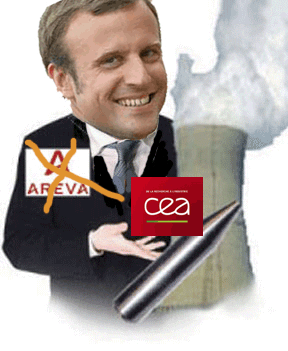
France unveils nuclear power overhaul – with an eye on China, French President Emmanuel Macron announced a shift to small modular nuclear reactors on Tuesday as he unveiled his €30 billion, five-year strategy to bolster France’s high-tech sectors, building on the country’s history as a pioneer of nuclear energy. France 24, 17 Oct 21,
Macron announced that the “number one priority” for his industrial strategy was for France to develop “innovative small-scale nuclear reactors” by 2030.
This marks a sea change in France’s approach to nuclear energy……………“The small modular reactors each generate less than 300 megawatts (MW) of energy; far less than most reactors currently in service, which tend to produce between 950 and 1300 MW, with some of them including the Flamanville plant [on the English Channel] capable of as much as 1600 MW,” said Giorgio Locatelli, an expert on the engineering of nuclear power stations at Milan Polytechnic.
……… In the grand sweep of the history of French nuclear power, the shift towards smaller reactors looks like a step back, Locatelli suggested, because France “started with small reactors in the 1960s before switching to larger ones to develop economies of scale”.However, this trend has now reached its limited, he continued. “Reactors like the one at Flamanville are not only very expensive, but also it’s a long and complex process to build them.” It takes billions to create such plants, and often it is difficult for governments to find investors willing to wait up to a decade before their returns start coming in.
Competition with China
Most countries lack the means to pull of these massive reactors, noted Nicolas Mazzucchi, an energy specialist at France’s Foundation for Strategic Research: “The financing models they require – not to mention the capacity to really mobilise a country’s savoir-faire in this domain – are increasingly rare, except in nations like Russia and China where energy companies have total state backing.”
Consequently, switching to small modular reactors is a strategic pivot to allow France to deal with competition from countries like China, which has increasingly big ambitions when it comes to nuclear power.
France’s change of approach could also allow it to win lucrative new markets. “By 2025, nearly a quarter of the world’s existing nuclear capacity will be exhausted because the reactors will have become too old,” Mazzucchi continued……………..
‘Lack of experience’………. The people in charge of reactors using cutting-edge technology “will have to justify their safety”, Herviou said. So far, the theoretical advantages of small modular reactors have not been confirmed in practice. Some 70 such reactors are currently in development throughout the world – and the vast majority of these projects are still in the early stages. “The main concern with this technology is the lack of a track record,” said Locatelli. What is more, he continued, nuclear power’s “chicken-and-egg problem is still there: Is it better to start building reactors first to win over buyers or is it best to find the investors first?” …………. https://www.france24.com/en/france/20211013-france-unveils-nuclear-power-overhaul-with-eye-on-china
There are Much More Powerful Greenhouse Gases than CO2 and EDF’s Nuclear Reactors are Spewing Them Out (Apart from Toxic Radioactive Emissions!!)

EdF finally admit that operational nuclear power station discharges of Sulfur hexafluoride gas make massive contributions to Global warming/Climate change Flamanville nuclear power plant has exceeded the threshold for discharging SF6. In nine months, the quantity of SF6, the most powerful greenhouse gas, released by the Flamanville nuclear power plant in La Manche, has already […]
There are Much More Powerful Greenhouse Gases than CO2 and EDF’s Nuclear Reactors are Spewing Them Out (Apart from Toxic Radioactive Emissions!!) — RADIATION FREE LAKELAND
There are Much More Powerful Greenhouse Gases than CO2 and EDF’s Nuclear Reactors are Spewing Them Out (Apart from Toxic Radioactive Emissions!!) https://mariannewildart.wordpress.com/2021/10/15/there-are-much-more-powerful-greenhouse-gases-than-co2-and-edfs-nuclear-reactors-are-spewing-them-out-apart-from-toxic-radioactive-emissions/
ON OCTOBER 15, 2021 BY MARIANNEWILDARTEdF finally admit that operational nuclear power station discharges of Sulfur hexafluoride gas make massive contributions to Global warming/Climate change
Flamanville nuclear power plant has exceeded the threshold for discharging SF6. In nine months, the quantity of SF6, the most powerful greenhouse gas, released by the Flamanville nuclear power plant in La Manche, has already exceeded the annual declaration threshold. This threshold was reached on September 27, 2021, as confirmed by EDF on Thursday, October 14, 2021.
The Flamanville nuclear power plant (Manche) declared a “significant environmental event” after having emitted a cumulative quantity of SF6, the most powerful greenhouse gas, above the declaration threshold, we learned from EdF on Thursday October 14th.
“On September 27, 2021, the cumulative annual quantity of SF6 gas emissions reached 100.37 kg, exceeding the declaration threshold of 100 kg,” said EDF in a press release posted on the plant’s website. SF6, targeted as early as 1997 by the Kyoto Protocol on the climate, has a warming potential 23,000 times that of CO2 and remains in the atmosphere for up to 3,000 years. It is the most potent of greenhouse gases, even though it represents a small part of it.
The campaign group Sortir du Nuclear criticized EdFs pollution, saying : “Letting 100 kg of this gas escape is like emitting more than 2 million kg of C02 into the atmosphere. In just nine months, the Flamanville site has already exceeded (the 100 kg threshold). And the year is not over. Each year, each of the 18 nuclear power plants in France has this right to pollution and thus actively contributes to global warming, not to mention refrigerant leaks.”
Sortir de Nuclear further states that until 2018, EDF did not report any of these emissions. Sulfur Hexafluoride (SF6) gas “is used to ensure the electrical isolation of high voltage equipment. On the Flamanville site, SF6 gas is used as insulation for the energy evacuation stations and the supply stations for auxiliary transformers “, stated EDF.
Ouest France 14th Oct 2021
https://www.ouest-france.fr/normandie/flamanville-50340/la-centrale-nucleaire-de-flamanville-a-depasse-le-seuil-de-rejet-d-un-puissant-gaz-a-effet-de-serre-4ef83064-2cdc-11ec-9285-f388b2ea32b0
Exposed: French nuclear companies dumping radioactive waste in Siberia. Activists call on EU not to count nuclear energy as sustainable .

“For the French nuclear industry to resume this kind of irresponsible overseas dumping is proof that there is no sustainable solution to the ever-growing problem of radioactive waste. Giving dangerous nuclear energy a green label in the EU taxonomy will make the waste problem worse, and actively divert investments away from real solutions like energy savings, energy storage and renewables.”
A key principle of the taxonomy is that any activity must “do no significant harm” to the environment in order to be included as “sustainable”. The European Commission will open a public consultation in the coming weeks on the issue of whether nuclear energy should be included in the taxonomy.
 |
|

Exposed: French nuclear companies dumping radioactive waste in Siberia https://www.greenpeace.org/eu-unit/issues/climate-energy/45879/french-nuclear-companies-exposed-dumping-radioactive-waste-siberia/?fbclid=IwAR0FmZuQKuuQgWaAPthDXShxwc1s7_3Q4zwARV0xR2yfZL2EnvGj0nU5xX4Greenpeace European Unit 12/10/2021 Activists call on EU not to count nuclear energy as sustainable
Paris / Brussels, 12 October 2021 – Greenpeace activists today laid fifteen metal drums featuring a radioactive symbol in front of the headquarters of Orano, a French nuclear fuel company, in protest against the dumping of French nuclear waste at an unsafe site in Seversk, Siberia. The protest comes as a new investigation by Greenpeace France has revealed that exports of nuclear waste to Russia have restarted after an eleven-year hiatus. [1]
New satellite images from Seversk show thousands of barrels lying outdoors exposed to the elements. The practice of exporting radioactive waste from the EU to a third country is subject to strict conditions, including the safety and proper management of the destination facility. [2]
The revelations that exports of French nuclear waste to Russia have restarted come shortly after ministers from ten EU countries, including France, wrote an op-ed in several European newspapers calling for the inclusion of nuclear energy in the EU’s guidelines for green investments, the “EU taxonomy”. [3]
Roger Spautz, nuclear campaigner at Greenpeace France and Luxembourg , said: “For the French nuclear industry to resume this kind of irresponsible overseas dumping is proof that there is no sustainable solution to the ever-growing problem of radioactive waste. Giving dangerous nuclear energy a green label in the EU taxonomy will make the waste problem worse, and actively divert investments away from real solutions like energy savings, energy storage and renewables.”
A key principle of the taxonomy is that any activity must “do no significant harm” to the environment in order to be included as “sustainable”. The European Commission will open a public consultation in the coming weeks on the issue of whether nuclear energy should be included in the taxonomy.
President Emmanuel Macron is also expected to announce funding today for so-called “small modular nuclear reactors” as part of his “France 2030” investment package.
Investigation
The investigation by Greenpeace France reveals that, in January and February 2021, the nuclear fuel company Orano shipped hundreds of tonnes of spent uranium to Rosatom, Russia’s state-owned nuclear energy firm.
Activists in the port of Le Havre, Normandy, witnessed the loading of radioactive material onto a ship bound for St. Petersburg. From there, the waste continued by train to a dumping facility in the city of Seversk, Siberia, formerly known as Tomsk-7. Greenpeace has seen no evidence that the management of the Seversk site has improved since 2010, when Orano (then named Areva) admitted that environmental concerns were a factor in its decision to cease exporting uranium there. [4]
Orano confirmed the new shipments in an email to Greenpeace France. EDF, France’s largest nuclear energy provider, also signed a similar deal with Rosatom in 2018, but does not appear to have carried out any such shipments yet. Both companies are largely owned by the French state.
Orano building 5km wall around its La Hague nuclear reprocessing station

Orano has started construction of a 5 km wall around its nuclear waste
reprocessing plant in La Hague (Manche), a site with the most radioactive
material in Europe, we learned Thursday from the business.
“Orano la Hague has initiated the construction of a new internal fence at the establishment
over nearly 5 km long which will encompass all the nuclear buildings,” the
site management told AFP. “The building will be masonry in the lower part
and fenced in the upper part”, specifies the company.
Le Figaro 14th Oct 2021
1 This Month

of the week – Shut Down Drone Warfare!


Tell the Ukrainian Government to Drop Prosecution of Peace Activist Yurii Sheliazhenko

Petition to revoke the licensing of the Near Surface Nuclear Disposal Facility (NSDF) at Chalk River. https://www.ourcommons.ca/petitions/en/Petition/Details?Petition=e-7247
To see nuclear-related stories in greater depth and intensity – go to https://nuclearinformation.wordpress.com
-
Archives
- April 2026 (7)
- March 2026 (251)
- February 2026 (268)
- January 2026 (308)
- December 2025 (358)
- November 2025 (359)
- October 2025 (376)
- September 2025 (257)
- August 2025 (319)
- July 2025 (230)
- June 2025 (348)
- May 2025 (261)
-
Categories
- 1
- 1 NUCLEAR ISSUES
- business and costs
- climate change
- culture and arts
- ENERGY
- environment
- health
- history
- indigenous issues
- Legal
- marketing of nuclear
- media
- opposition to nuclear
- PERSONAL STORIES
- politics
- politics international
- Religion and ethics
- safety
- secrets,lies and civil liberties
- spinbuster
- technology
- Uranium
- wastes
- weapons and war
- Women
- 2 WORLD
- ACTION
- AFRICA
- Atrocities
- AUSTRALIA
- Christina's notes
- Christina's themes
- culture and arts
- Events
- Fuk 2022
- Fuk 2023
- Fukushima 2017
- Fukushima 2018
- fukushima 2019
- Fukushima 2020
- Fukushima 2021
- general
- global warming
- Humour (God we need it)
- Nuclear
- RARE EARTHS
- Reference
- resources – print
- Resources -audiovicual
- Weekly Newsletter
- World
- World Nuclear
- YouTube
-
RSS
Entries RSS
Comments RSS
 nuclear-news