Non government organisations anxious about Tricastin nuclear station, and about historic law to protect whitleblowers
After Tricastin, we must “protect the whistleblowers and focus on the
alert and not on the messenger”. Three representatives of non-governmental
organizations recall, in a forum at “The World”, the importance of “the
historic law” that the National Assembly is about to vote on the protection
of whistleblowers. They are also calling for the opening of a parliamentary
inquiry into the facts relating to the Tricastin nuclear power plant.
Le Monde 15th Nov 2021
The degraded state of France’s nuclear fleet, and concealment of series of accidents.
French nuclear fleet: degraded condition, concealment of serial accidents
in nuclear power plants. The techno-industrial system includes major
accidents in its planning calculations – adapting to its disasters or
fighting to its end?
Ricochets 15th Nov 2021
French unions complicit with EDF in harrassments and other scandals
EDF, the grinding machine: “EDF holds the unions in its hands”. Number 2
in Force Ouvrière at EDF, Rémy Casabielhe has been one of the main
negotiators of the agreements in recent years within the company.
In his
interview with Blast, after the first stages of our investigation, the
union representative bluntly denounces the inaction of management, but also
of the unions, in the face of the problems of harassment, discrimination
and suicide.
And calls into question the agreements concluded for twenty
years, responsible for this phenomenon. Words that detonate and lift the
veil on a complicity that does not speak its name.
Blast 13th Nov 2021
EX manager sues EDF over safety concerns
A former manager at EDF’s Tricastin nuclear plant in southern France has
filed a complaint in a Paris court alleging the state-owned utility failed
to report or minimised safety concerns at the plant, Le Monde newspaper
reported on Friday.
The newspaper said the plaintiff, whom it did not name,
filed the lawsuit in early October at the Paris judicial court. It said the
plaintiff was also suing EDF for harassment, without detailing those
allegations. EDF declined to comment on the allegations, but said safety at
its nuclear sites was its priority. “Transparency and compliance with
regulations are strictly applied and respected at all sites”, it said.
Yahoo 12th Nov 2021
https://uk.finance.yahoo.com/news/ex-manager-sues-edf-over-123859453.html
France: public inquiry for the authorization to reprocess new fuels
**France – Reprocessing**
A public inquiry for the authorization to reprocess new fuels, particularly from foreign heavy water or MOX reactors, is open until
November 17, 2021. It is closely following another survey for the densification of the C D E swimming pools at La Hague in order to increase spent fuel storage capacity by 30%. Based on files with blackened lines, it only confirmed decisions already taken.
Crilan 12th Nov 2021
http://crilan.fr/densification-des-piscines-de-la-hague-mayak-en-cotentin-non-merci/
President Macron does not have the legal power to decide on new nuclear reactors – requires Parliamentary agreement
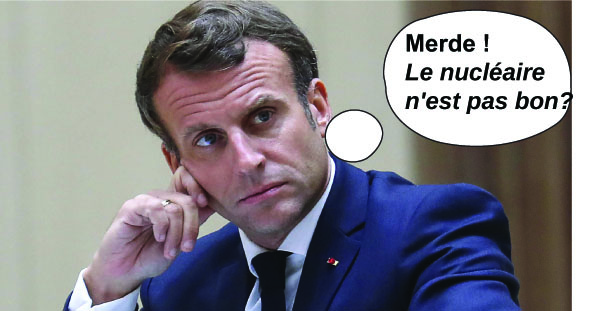
Emmanuel Macron does not have the legal power to decide on his own the order for new nuclear reactors, as he announced he wanted to do, Tuesday, November 9, denounces the former Minister of the Environment, former MEP and famous lawyer specializing in the ecology, Corinne Lepage.
The President of the Republic must first seize the Parliament in order to comply with the multiannual energy programming.
Ouest France 10th Nov 2021
President Macron boosts nuclear industry, but in reality, France’s prospects for new reactors are grim

“too expensive, too slow and too dangerous”.
“Announcing a nuclear revival and the construction of new reactors is totally disconnected from reality”
Macron boosts nuclear power plans to meet France’s net-zero ambitions, The Age, By Bevan Shields, November 10
”…………………in a shift, the French President on Tuesday night, Paris time (Wednesday morning AEDT) said the country would rededicate itself to atomic power.
“…………….we will for the first time in decades revive the construction of nuclear reactors in our country………….” Macron said.
He did not give details but the comments were seen as a reference to the expected green-lighting of as many as 14 next-generation nuclear plants proposed by grid operator RTE.
Macron made the announcement against the background of the COP26 climate summit in Glasgow, where new forms of electricity generation have been identified as a key issue in the fight against climate change, and an energy crisis in Europe triggered by falling gas supplies and an unusually calm summer and autumn which has affected the output of wind turbines.
While confidence in nuclear took a hit in France following the 2011 Fukushima disaster in Japan, it is still a relatively uncontroversial technology compared to other countries such as Australia, where some Coalition MPs are pushing Prime Minister Scott Morrison to explore its feasibility.
Macron sought to tie the new nuclear push to French innovation and national pride – key themes for the President as he enters a tough presidential election campaign in 2022.
His position is in stark contrast to Germany, where nuclear power is on course to be phased out by next year.
The vast majority of France’s nuclear facilities were built in the 1970s and 1980s. A third reactor is being added to a plant in Flamanville, in the Normandy region, but the project which started in 2007 has been plagued by cost overruns and huge delays.
Greenpeace France energy transition campaigner Nicolas Nace condemned Macron’s latest announcement and pointed to the Flamanville project to claim nuclear power was “too expensive, too slow and too dangerous”.
“Announcing a nuclear revival and the construction of new reactors as the nuclear industry is totally disconnected from reality,” Nace said.
A new nuclear facility being constructed in Somerset, England, has also been hit by delays and cost blowouts.
An International Energy Agency analysis released earlier this month found global nuclear capacity would reach 582 gigawatts by 2040 – well below the 730 gigawatts needed to achieve net zero emissions.
“This gap widens even further after 2040, so long-term operation of the existing nuclear fleet and a near-doubling of the annual rate of capacity additions are required,” the report said.
“While some of this additional nuclear capacity will not come online until the late 2030s, policy decisions are required now to put nuclear back on track.”
About 20 gigawatts of new nuclear capacity need to be added each year between now and 2050 to achieve carbon neutrality – a rate of construction is comparable with the pre-Fukushima period. https://www.smh.com.au/world/europe/macron-backs-nuclear-power-to-meet-france-s-net-zero-ambitions-20211110-p597kk.html
Anxieties in Pays de la Loire over plan for small nuclear reactor.
With her proposal to host a mini-power plant, the president of Pays de la Loire is reviving local tensions around nuclear power. The idea of setting up an SMR on the site of the Cordemais coal-fired power station launched by
Christelle Mor Anglais, President of Les Républicains in the Pays de la Loire region, is causing concern.
Le Monde 6th Nov 2021
Is it green, or forever toxic? France’s radioactive waste crisis. Nuclear rift at climate talks
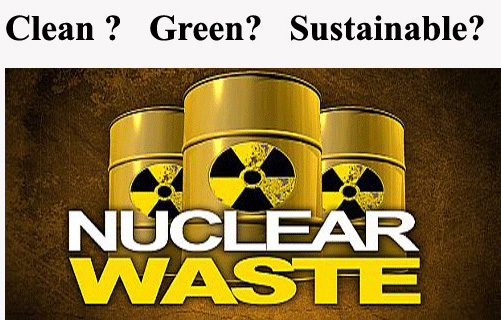
Is it green, or forever toxic? Nuclear rift at climate talks
By ANGELA CHARLTON, 4 Nov 21, SOULAINES-DHUYS, France (AP) — Deep in a French forest of oaks, birches and pines, a steady stream of trucks carries a silent reminder of nuclear energy’s often invisible cost: canisters of radioactive waste, heading into storage for the next 300 years.
As negotiators plot out how to fuel the world while also reducing carbon emissions at climate talks in Scotland, nuclear power is a central sticking point. Critics decry its mammoth price tag, the disproportionate damage caused by nuclear accidents, and radioactive leftovers that remain deadly for thousands of years.
……… Many governments are pushing to enshrine nuclear energy in climate plans being hashed out at the conference in Glasgow, known as COP26. The European Union, meanwhile, is debating whether to label nuclear energy as officially “green” — a decision that will steer billions of euros of investment for years to come. That has implications worldwide, as the EU policy could set a standard that other economies follow.
But what about all that waste? Reactors worldwide produce thousands of tons of highly radioactive detritus per year, on top of what has already been left by decades of harnessing the atom to electrify homes and factories around the world.
Germany is leading the pack of countries, mainly within the EU, standing firmly against labeling nuclear as “green.” …..
nowhere in the world is as reliant on nuclear reactors as France, which is at the forefront of the pro-nuclear push at the European and global level. And it’s among leading players in the nuclear waste industry, recycling or reprocessing material from around the world.
South of the World War I battlefields of Verdun, trucks bearing radioactivity warning stickers pull into a waste storage site near the village of Soulaines-Dhuys. They’re repeatedly checked, wiped and scanned for leaks. Their cargo — compacted waste stuffed into concrete or steel cylinders — is stacked by robotic cranes in warehouses that are then filled with gravel and sealed with more concrete.
……….. The storage units hold 90% of France’s low- to medium-activity radioactive waste, including tools, clothing and other material linked to reactor operation and maintenance. The site is designed to last at least 300 years after the last shipment arrives, when the radioactivity of its contents is forecast to be no higher than levels found in nature.
For longer-life waste — mainly used nuclear fuel, which remains potentially deadly for tens of thousands of years — France is laying the groundwork for a permanent, deep-earth repository beneath corn and wheat fields outside the nearby stone-house hamlet of Bure.
Some 500 meters (yards) below the surface, workers carry out tests on the clay and granite, carve tunnels and seek to prove that the long-term storage plan is the safest solution for future generations. Similar sites are under development or study in other countries, too.
If the repository wins French regulatory approval, it would hold some 85,000 metric tons (94,000 tons) of the most radioactive waste produced “from the beginning of the nuclear era until the end of existing nuclear facilities,” said Audrey Guillemenet, geologist and spokesperson for the underground lab.
“We can’t leave this waste in storage sites on the surface,” where it is now, she said. “That is secure, but not sustainable.”
The 25 billion euro ($29 billion) cost of the proposed repository is already built into budgeting by French utilities, Guillemenet said. But that’s just one piece of the staggering cost of building and operating nuclear plants, and one of the reasons that opposition abounds.
All around Bure, street signs are replaced with graffiti reading “Nuclear is Over,” and activists camp out at the town’s main intersection.
Greenpeace accuses the French nuclear industry of fobbing off waste on other countries and covering up problems at nuclear facilities, which industry officials deny. Activists staged a protest last week in the port of Dunkirk, as reprocessed uranium was being loaded onto a ship for St. Petersburg, demanding an end to nuclear energy and more research into solutions for existing waste.
…….. The current energy crunch is giving nuclear advocates another argument. With oil and gas costs driving an energy price crisis across Europe and beyond, French President Emmanuel Macron has trumpeted “European renewables and, of course, European nuclear.”
The waste, meanwhile, isn’t going away.
To make radioactive garbage dumps less worrying to local residents, Andra organizes school visits; one site even hosts an escape game. Waste storage researchers are readying for all kinds of potential future threats — revolution, extreme weather, even the next Ice Age, Guillemenet said.
Whatever happens in Glasgow, “whether we decide to go on with the nuclear energy or not,” she said, “we will need to find a solution for the management of that nuclear waste” that humankind has already produced. https://apnews.com/article/climate-science-business-environment-accidents-b334c5cddc50c620d53674a5b32518dd
French nuclear company pressing President Macron to declare nuclear power strategy
Macron’s Nuclear Power Strategy Will Be Clear by Year End, Ecology Minister Says, Bloomberg, By Francois De Beaupuy and Ania Nussbaum, 27 October 2021,
- Final decision on plants seen after next April’s election
- EDF wants construction of plants to start as soon as possible
French President Emmanuel Macron will probably say by the end of the year whether he supports the construction of new nuclear plants as part of the country’s plan to achieve carbon neutrality by 2050, Ecology Minister Barbara Pompili said…….
“The president will probably express his preference and his orientation on the scenarios before the end of the year,” Pompili told reporters in Paris Tuesday. Still, there wouldn’t be a final decision before next April’s presidential elections, she said.
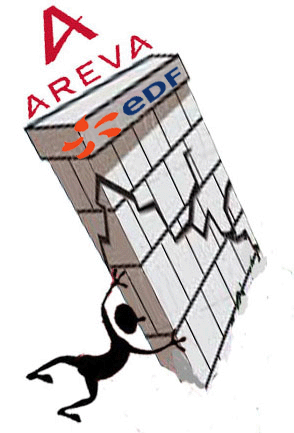
The French atomic industry, led by state-controlled Electricite de France SA, is urging the government to start constructing nuclear plants as soon as possible. That’s because most of EDF’s 56 existing reactors — which provide more than two-thirds of France’s electricity — are due to be shut by 2050 or earlier.
A report on the cost of new nuclear plants will be published in coming weeks, Pompili said. Damaging delays, cost overruns and technical failings have afflicted the country’s nuclear sector in recent years, raising questions about EDF’s ability to build new plants on budget. ……
The government will help EDF and its partners develop small modular nuclear reactors by 2030, Macron said earlier this month. https://www.bloomberg.com/news/articles/2021-10-26/macron-will-probably-announce-nuclear-power-strategy-by-year-end
A year after damaged by fire, French nuclear submarine has been repaired
The French Navy’s damaged nuclear sub is out at sea once more, By Vivienne Machi 3 Nov 21, STUTTGART, Germany — The French Navy’s nuclear submarine Perle has returned to sea following just about a year of work to repair its fire-damaged body and splice it together with a second boat.
In late October, the 26-year-old nuclear attack submarine departed Cherbourg Naval Base, where it has been undergoing repairs by manufacturer Naval Group since October 2020, and returned to the service’s main base in Toulon, French Ministry of Defense spokesman Hervé Grandjean told reporters.
The nuclear attack submarine caught fire while undergoing maintenance in June 2020 in Toulon, and burned for 14 hours. The fore of the submarine suffered the most damage, while the aft of the ship, which houses the nuclear power plant and propulsion, was left intact…………….. https://www.defensenews.com/digital-show-dailies/feindef/2021/11/03/the-french-navys-damaged-nuclear-sub-is-out-at-sea-once-more/
A close shave in 1999 with a flood at France’s Blayais nuclear power plant
“Sensitive affairs”. “Tcherno-Blaye”: the scenario of a French Chernobyl?
What happened at the end of December 1999, during the “storm of the
century”, at the Blayais nuclear power plant in Gironde? Incident under
control or disaster scenario narrowly avoided? That evening, in any case,
one of the jewels of the French nuclear fleet found itself … with its
feet in the water. A flood that could have led to the worst: the meltdown
of a reactor, with its dramatic consequences .
France Info TV 1st Nov 2021
A damning new confidential report on France’s future nuclear reactor plans.

| Nuclear. A damning confidential report on future EPRs. It is a real bomb that has just published the information site “Context” about the new generation of nuclear power plants EDF. These EPR2 that Emmanuel Macron is about to order. “Context” has obtained a confidential report from the government which expresses serious doubts about the design, feasibility, cost and timeframe of what should constitute the new wave of French nuclear power plants. Bercy and EDF make no comment. Ouest France 29th Oct 2021 https://www.ouest-france.fr/environnement/nucleaire/nucleaire-un-rapport-confidentiel-accablant-sur-les-futurs-epr-b54a63b8-37d7-11ec-9832-1d0e4716a307 |
France’s failing EDF nuclear company hopes to save itself by marketing small nuclear reactors
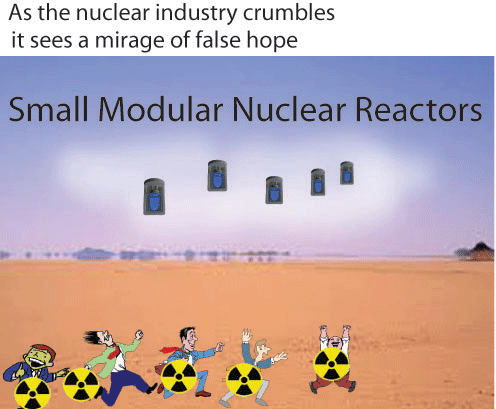
France will act as the shop window for exports of the new SMR technology — billed to be less powerful but easier to produce and run than conventional reactors — with EDF expected to begin building its first “Nuward” reactor in nine years
France’s nuclear drive offers chance of redemption for EDF
New commitments boost state-controlled utility but path ahead remains uncertain , Anna Gross and Sarah White in Paris Ft.com, 31 Oct 21, As the French government signals a future where nuclear power will play an integral rolein achieving carbon neutrality for the country by 2050 [ed. that is a spurious claim] , its state-controlled energy giant EDF remains encumbered by its past. Positioned at the heart of the nuclear debate in France and Europe, EDF struggles under a debt-laden balance sheet and a reputation for being unable to make novel nuclear technologies on time and on budget. But now President Emmanuel Macron has extended an olive branch and seemingly cleared a path for it to expand internationally and attract much-needed investment.
………..Created in 1946 by General Charles de Gaulle, EDF holds emotional power in France, Europe’s last bastion of nuclear power, and is linked with the nation’s industrial past and future. For years it was unclear if Macron, under pressure to move away from nuclear power towards renewables, would give the green light to new reactors long called for by EDF. Shortly after coming to power, Macron committed to reducing nuclear’s share of France’s electricity production from 75 to 50 per cent by 2035.
However, ambitious European climate goals, which hinge on pivoting to forms of energy that emit less carbon than fossil fuels, have put the spotlight on nuclear again and handed France an opportunity to assert its dominance in the field.
For EDF, thawing state tensions and confirmation of France’s desire for a nuclear future bring increased visibility to ensure it can keep training and hiring the people it will need and attract investment. That will be no small task for a company saddled with €41bn of debt and a colossal maintenance and investment programme to fund. UBS estimates a total investment requirement of more than €100bn for it to secure a 20-year life extension for 80 per cent of its nuclear fleet.
If approved, any government subsidies to fund six new reactors — estimated in leaked documents in 2019 to cost around €47bn — and the final price of the nuclear power produced by them, will ultimately be given the green light by Brussels. The cost of this funding could also be influenced by whether or not the EU includes nuclear energy in its taxonomy on “green finance”, making it a more attractive investment prospect. That decision has been delayed indefinitely because of infighting in the EU.
“Whether we can get financing at a low rate or super high rates completely changes the final cost. That’s the real subject, behind the gross number,” said Ursat. EDF faces other hurdles too, including the failure to reach a compromise with Brussels over the restructuring of the utility that would have allowed it to raise the regulated price at which it sells nuclear energy and ringfence some of its activities. It also needs to show it can deliver on its next-generation European Pressurised Reactor (EPR) technology, which it is planning to sell to India, Poland and the Czech Republic.
EPR reactors under construction in Europe — including Flamanville in France and Hinkley Point in the UK — are billions over budget and years behind schedule. The company’s previous chief financial officer quit over concerns about strains Hinkley Point was putting on EDF’s balance sheet.
These setbacks have led some investors and analysts to question EDF’s strategy and growth in the risky and costly field of nuclear power, were it not more than 80 per cent owned by the French government.
“The new reactor at Flamanville is not up and running yet, and some will want to see that project completed before France commits to more reactors with the same design,” said Sam Arie, an analyst at UBS. “From an investor point of view, is there interest in new nuclear projects? Not really.” However, recent soaring energy prices coupled with stringent climate goals seemed to have turned the tide in EDF’s favour. ……….
France will act as the shop window for exports of the new SMR technology — billed to be less powerful but easier to produce and run than conventional reactors — with EDF expected to begin building its first “Nuward” reactor in nine years. …….. https://www.ft.com/content/a1c95212-c122-4a29-8952-14a346381b91
Doubts that the Flamanville nuclear reactor will start on the planned date
IRSN expresses doubts about the start date of the EPR. The Nuclear Safety
Authority (ASN) must take a position on an opinion from IRSN expressing
doubts about the commissioning of the Flamanville EPR on the planned date
of 2023, has said to Montel. This IRSN opinion is currently being
analyzed within ASN.
Montel 27th Oct 2021
https://www.montelnews.com/fr/news/1268065/lirsn-met-des-doutes-sur-la-date-de-dmarrage-de-lepr
1 This Month

of the week – Shut Down Drone Warfare!


Tell the Ukrainian Government to Drop Prosecution of Peace Activist Yurii Sheliazhenko

Petition to revoke the licensing of the Near Surface Nuclear Disposal Facility (NSDF) at Chalk River. https://www.ourcommons.ca/petitions/en/Petition/Details?Petition=e-7247
To see nuclear-related stories in greater depth and intensity – go to https://nuclearinformation.wordpress.com
-
Archives
- April 2026 (7)
- March 2026 (251)
- February 2026 (268)
- January 2026 (308)
- December 2025 (358)
- November 2025 (359)
- October 2025 (376)
- September 2025 (257)
- August 2025 (319)
- July 2025 (230)
- June 2025 (348)
- May 2025 (261)
-
Categories
- 1
- 1 NUCLEAR ISSUES
- business and costs
- climate change
- culture and arts
- ENERGY
- environment
- health
- history
- indigenous issues
- Legal
- marketing of nuclear
- media
- opposition to nuclear
- PERSONAL STORIES
- politics
- politics international
- Religion and ethics
- safety
- secrets,lies and civil liberties
- spinbuster
- technology
- Uranium
- wastes
- weapons and war
- Women
- 2 WORLD
- ACTION
- AFRICA
- Atrocities
- AUSTRALIA
- Christina's notes
- Christina's themes
- culture and arts
- Events
- Fuk 2022
- Fuk 2023
- Fukushima 2017
- Fukushima 2018
- fukushima 2019
- Fukushima 2020
- Fukushima 2021
- general
- global warming
- Humour (God we need it)
- Nuclear
- RARE EARTHS
- Reference
- resources – print
- Resources -audiovicual
- Weekly Newsletter
- World
- World Nuclear
- YouTube
-
RSS
Entries RSS
Comments RSS
 nuclear-news