France’s nuclear company EDF fined a measly 300 million euros for its decades of deception and misuse of its position
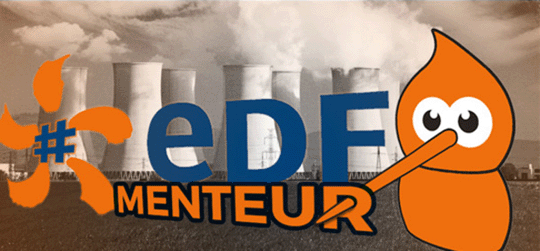
The French Competition Authority imposes a fine of 300 million euros on
EDF. The organization accuses the French company of abuse of a dominant
position and illegal collection of its customers’ data.
No less than seventeen years of anti-competitive practice. EDF was fined 300 million
euros by the Competition Authority for having misused its position as a
historical player in electricity since the opening of the market to
competition for companies in 2004, until 2021. The company does not
dispute the facts and has benefited from a negotiated procedure allowing
it to reduce the pain.
According to the law, a fine for this type of
practice could have cost it up to 10% of its annual worldwide turnover,
that is to say 7.6 billion, specifies in its decision the Authority of the
competition.
Le Figaro 22nd Feb 2022
Limitless power arriving too late: Why fusion won’t help us decarbonise — RenewEconomy

A limitless, clean source of baseload power might be within reach – without the nuclear waste of traditional fission nuclear plants. That’s good, right? Not quite. The post Limitless power arriving too late: Why fusion won’t help us decarbonise appeared first on RenewEconomy.
Limitless power arriving too late: Why fusion won’t help us decarbonise — RenewEconomy
| I first heard the standard joke about fusion as an undergraduate physics student in the 1960s: Fusion power is 50 years away – and probably always will be. More than 50 years later, we still don’t have fusion. That’s because of the huge experimental challenges in recreating a miniature sun on earth. Still, real progress is being made. This month, UK fusion researchers managed to double previous records of producing energy. Last year, American scientists came close to ignition, the tantalising moment where fusion puts more energy out than it needs to start the reaction. And small, fast-moving fusion startups are making progress using different techniques. A limitless, clean source of baseload power might be within reach – without the nuclear waste of traditional fission nuclear plants. That’s good, right? Not quite. While we’re closer than ever to making commercial fusion viable, this new power source simply won’t get here in time to do the heavy lifting of decarbonisation. We are racing the clock to limit damage from climate change. Luckily, we already have the technologies we need to decarbonise. On the megaproject front, the next step is the International Thermonuclear Experimental Reactor (ITER) being built in southern France. Far too big for any one country, this is a joint effort by countries including USA, Russia, China, the UK and EU member countries. The project is enormous, with a vessel ten times the size of the UK reactor and around 5,000 technical experts, scientists and engineers working on it. Famously, the project’s largest magnet is strong enough to lift an aircraft carrier. Even this enormous project is only expected to produce slightly more power than it uses – around 500 megawatts. The first experiments are expected by 2025. To me, this illustrates how far away commercial fusion really is. Renew Economy 25th Feb 2022https://reneweconomy.com.au/limitless-power-arriving-too-late-why-fusion-wont-help-us-decarbonise/ |
French government to subsidise EDF nuclear power company by another €2.1bn, to prop up its failing share price
The French government is to inject about €2.1bn (£1.75bn) into
state-controlled energy group EDF to ease the financial pain inflicted by
nuclear reactors going offline and the state making the firm supply power
below market prices. The finance minister, Bruno Le Maire, said the capital
injection would be made via a rights issue, announced by EDF on Friday,
aimed at raising €2.5bn to plug holes in the company’s balance sheet.
EDF said the combined effect of having to sell power at below-market prices
and the nuclear outages were likely to knock an estimated €19bn off its
forecast core profits in 2022. Its shares fell 2%, extending a slide in
which the company’s stock has dropped 19.3% in value since the start of
this year.
Guardian 18th Feb 2022
No end in sight as the French nuclear industry reduces its output
There may be no end in sight for the European power crunch this year, even
after the winter season ends. Low nuclear power generation in France, a
major producer and exporter of nuclear-powered electricity in Europe, could
send power prices on the continent higher in the spring.
France gets more
than 70 percent of its total electricity from nuclear power generation and
is a major exporter of electricity, including to the UK. France’s EDF
stopped two nuclear power plants at the end of last year after finding a
fault at one during routine maintenance.
This brought the total number of
nuclear plants out of operation in December to four, which accounted for 13
percent of the current power availability in France.
Last week, EDF revised down both its 2022 and 2023 nuclear output estimates. As part of its
control program on the French nuclear fleet, EDF revised its 2022 nuclear
output estimate from 300 – 330 TWh to 295 – 315 TWh, the company said
on February 7.
Days later, EDF revised down its 2023 French nuclear output
estimate from 340 – 370 TWh to 300-330 TWh, to reflect a heavy industrial
program with 44 reactor outages for maintenance and inspection, including 6
ten-year inspections, plus 2 scheduled outages starting in 2022 that will
continue into 2023.
Another reason for the nuclear output downgrade is “the
continuation of the control and repair programme on the pipes potentially
affected by the stress corrosion phenomenon, which is still ongoing,” EDF
said.
Oil Price 17th Feb 2022
French utility EDF will check auxiliary cooling circuits, or RRAs, at its 56 domestic reactors, after faults found
French utility EDF will check auxiliary cooling circuits, or RRAs, at its 56 domestic reactors, it confirmed on Tuesday. “We will gradually look at other circuits including the RRA circuit. The [French nuclear safety authority] ASN is being regularly informed of the results of the checks and
expert assessments,” a spokesman for the state-owned firm told Montel.
The comments came in the wake of a Montel report on Monday that EDF had uncovered potential issues with the RRAs, which are used for depressurising the cooling water in the primary circuit of a reactor in the event of an emergency shutdown of the unit. The spokesman declined to say why the utility was checking other circuits, as well as the RRAs.
Montel 15th Feb 2022
https://www.montelnews.com/news/1299687/edf-confirms-new-safety-checks-on-french-reactors
As presidential elections approach in France, only the far right and communists support nuclear power
Then 24 , 11 Feb 22,
Ecologist Yannick Jadot, who regularly affirms his ambition to develop wind power and other renewable energies in France, castigated the recent commitments made by Emmanuel Macron to develop the country’s nuclear fleet.
Ecologist Yannick Jadot, who regularly affirms his ambition to develop wind power and other renewable energies in France, castigated the recent commitments made by Emmanuel Macron to develop the country’s nuclear fleet.

During his appearance on February 11 on the air of BFMTV, the Greens presidential candidate, Yannick Jadot, stormed against Emmanuel Macron’s recent commitments in the nuclear field, in particular after his announcement of the commissioning, from 2035, six new “EPR 2” type nuclear reactors, to which is added the study for eight more for the end of the 2040s.
President Macron locks the French for a century in nuclear power
“It does nothing for the climate, it does nothing for the French […] for the years to come”, notably protested the environmentalist MEP before adding: “President Macron locks the French for a century in nuclear power.”
Yannick Jadot then praised the virtues of a German energy model (where the share of wind power in electricity production exceeded 20% in 2021), which he describes as particularly prolific in terms of employment to better castigate the decision of the Head of State by invoking “dictators” and “the far right”: “Big companies, like small and large democracies, are investing in renewable energies. Unfortunately, only dictators, and in France the extreme right, still support nuclear power.
After having advocated a reduction in the share of nuclear power in French electricity production from 75% to 50% by 2025 – a reduction in the context of which the closure of the Fessenheim power station (Haut-Rhin) took place –, Emmanuel Macron made a 180 degree turn on the subject in the second part of his mandate, now showing himself in favor of a revival of the national nuclear fleet.
Visiting Belfort on February 10, he thus expressed his desire to “extend” the life of “all the nuclear reactors that can be extended”. “If the first extensions beyond forty years have been successfully carried out since 2017, I ask EDF to study the conditions for extension beyond fifty years”, he said, among other things..
…………… With the approach of the presidential election, the nuclear sector is particularly acclaimed on the right of the French political spectrum. On the left, its future is mainly praised by the communist candidate Fabien Roussel while Jean-Luc Mélenchon undertakes to get the country out of this source of energy as quickly as possible. https://then24.com/2022/02/11/for-jadot-only-dictators-and-in-france-the-far-right-support-nuclear-power/
Macron promises 52 billion euros for 6 new EPR nuclear reactors – but this ”nuclear renaissance” is far from certain
Building at least 6 new generation EPRs, a challenge for the nuclear industry. It will be a “renaissance of French nuclear power”, promised Emmanuel Macron, but the construction of at least six new EPRs represents a real challenge for a weakened sector, which remains on the bitter failure of Flamanville.
The president announced Thursday in Belfort six new generation EPR2 reactors, with a first commissioning by 2035. To this is added the study for eight more copies. The investment will be “52 billion euros for 6 new EPR reactors, plus studies on eight possible new reactors, plus research on modular reactors”, quantified Friday the Minister of the Economy, Bruno Le Maire.
“It is an intention but there are a certain number of important stages which will take five years”, underlined Valérie Faudon, the general delegate of the French Company of nuclear energy (SFEN). Before even starting work for an EPR, it is indeed necessary to organize a public inquiry on the first site envisaged, that of Penly (Seine-Maritime) and to obtain a certain number of administrative
authorizations. Emmanuel Macron thus envisages a start of construction in 2028. “The deadline of 2028 that he drew is not impossible to meet but is already in itself optimistic vis-à-vis the various stages to be crossed”,judges Yves Marignac , nuclear expert from the NégaWatt association.
Connaissance des energies 11th Feb 2022
French government supressed, postponed, distributing report that recommended no new EPR nuclear reactors

Nuclear: the government has postponed the dissemination of an official report contradicting Emmanuel Macron. Mediapart has obtained a report from Ademe, the public agency for ecological transition, according to which there is no need to build new EPR reactors.
But the government postponed the distribution of this report: the President of the Republic was going to
announce contrary projects.
Mediapart 11th Feb 2022
Macron goes for a new nuclear renaissance, despite the industry’s woes in France

France to build up to 14 new nuclear reactors by 2050, says Macron. French president says ‘renaissance’ of atomic energy industry will help end country’s reliance on fossil fuels, Guardian, Angelique Chrisafis in Paris 11 Feb 22, Emmanuel Macron has announced a “renaissance” for the French nuclear industry with a vast programme to build as many as 14 new reactors, arguing that it would help end the country’s reliance on fossil fuels and make France carbon neutral by 2050.
“What our country needs … is the rebirth of France’s nuclear industry,” Macron said in a speech in the eastern industrial town of Belfort, in which he lauded the country’s technological prowess.
The centrist French president, who is expected to announce his campaign for re-election this month, is conscious of a growing debate about energy ahead of this spring’s presidential vote as costs to consumers rise. Environmental issues are also a growing concern among French voters.
….. recent attempts to build new-generation reactors to replace older models have become mired in cost overruns and delays.
Presidential candidates on the right have supported more nuclear power plants saying France should have “sovereignty” over its electricity, while detractors on the left have warned of the cost and complexity of building new reactors. Environmentalists have raised safety concerns over radioactive waste that remains deadly for tens of thousands of years.
……… He also announced a major acceleration in the development of solar and offshore wind power. He said France had no choice but to rely on renewables and nuclearand that the country would also have to consume significantly less energy in the next decades.
He said he would seek to extend the lives of all existing French nuclear plants where it was safe to do so.
The announcement comes at a difficult time for debt-laden, state-controlled energy provider, EDF, which faces delays and budget overuns on new nuclear plants in France and Britain, and corrosion problems in some of its ageing reactors.
Macron announced the construction of at least six new reactors by EDF by 2050, with an option for another eight.
His recent focus on nuclear power marks a policy shift from the start of his presidency, when he had promised to reduce its share in France’s energy mix.
The French government lobbied hard and successfully to get the European Commission to label nuclear power “green” this month in a landmark review which means it can attract funding as a climate-friendly power source.
The Green presidential candidate, Yannick Jadot, said it was a moral imperative to progressively end France’s dependence on nuclear to protect the climate and French people’s safety. He said Macron’s project was backward-looking and would condemn France to a kind of “energy and industrial obsolescence”. https://www.theguardian.com/world/2022/feb/10/france-to-build-up-to-14-new-nuclear-reactors-by-2050-says-macron
Macron pledged to close down over a dozen nuclear plants, but now he’s done a U-turn
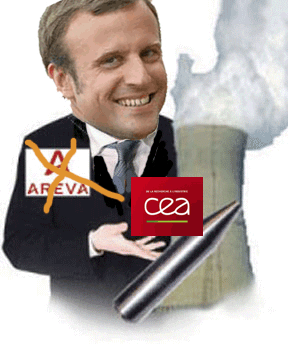
Mr Macron’s decision to extend the lifespan of existing plants marked a U-turn on an earlier pledge to close more than a dozen of EDF’s 56 reactors by 2035. Nuclear safety still divides Europe following Japan’s Fukushima disaster.
Independent 10th Feb 2022
EDF predicts more cuts in nuclear output, as repairs needed for defects in reactors
Electricite de France SA said Friday that it had cut its nuclear output
estimates in France for 2023, adding to concerns after defects had led to
output revisions for 2022. The French energy company said next year’s
output would between 300 and 330 terawatt hours, compared with 340-370 TWh
under previous estimates.
Earlier this week, EDF cut its 2022 output
expectations for the second time, after it found defects at five reactors
at its Civaux and Penly sites. The estimate for 2023 takes into account the
continuation of the control-and-repair program on “pipes potentially
affected by stress corrosion,” EDF said.
Market Watch 11th Feb 2022
https://www.marketwatch.com/story/edf-cuts-2023-french-nuclear-output-estimates-271644567491
President Macron asssures France’s EDF of tens of billions of euros in public financing for new nuclear reactors
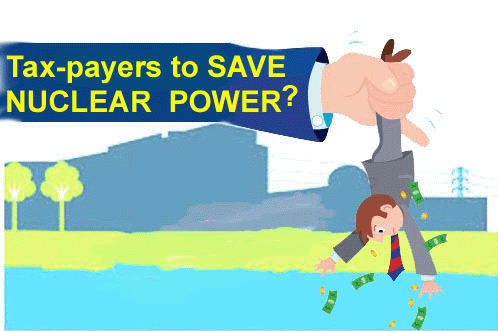
French Finance Minister Bruno Le Maire told C News TV on Friday that he was sure that EDF’s (EDF.PA) difficulties would “disappear” after France announced plans to build at least six new nuclear reactors in the decades to come.
President Emmanuel Macron said on Thursday that the new plants would be built and operated by state-controlled energy provider EDF and that tens of billions of euros in public financing would be mobilized tofinance the projects and safeguard EDF’s finances.
Reuters 11th Feb 2022
The nuclear power dilemma: where to put the lethal waste?

The nuclear power dilemma: where to put the lethal waste
France is exploring new ways to dispose of radioactive materials but public opposition is as fierce as ever, Ft.com Anna Gross in Chooz and Sarah White in Bure 6 Feb 22,
Every morning, Benoit Gannaz places a small black device in his breast pocket to make sure his work is not killing him. Like every worker at the Chooz A nuclear power facility in northern France, he carries a detector that measures ionising radiation levels at all times. The reactor was turned off more than three decades ago and the most hazardous materials removed soon after, but nobody here is taking any chances — least of all the project manager overseeing the challenging and lengthy process of decommissioning Chooz A. Gannaz’s job is to ensure the remaining hazardous materials on site are removed and stored away safely now that the lifecycle of the reactor is at an end. ………….
…………….. as momentum grows for a new generation of nuclear power plants in Europe and elsewhere, there is little discussion of the huge costs and complexity of dismantling the plants at the end of their approximately 50-year lifespan. And nobody has yet given a satisfactory answer to the question of what to do with thousands of metric tonnes of high-level nuclear waste, some of which can remain radioactive, and thereby lethal, for up to 300,000 years.
A quarter-million metric tonnes of spent fuel rods are believed to be spread across 14 countries worldwide, mostly collected in cooling pools at closed-down nuclear plants, as engineers and waste specialists puzzle over how to dispose of them permanently. Many believe these are sitting ducks for terrorist organisations and that they could potentially cause catastrophic spills or fires. The cost of maintaining these sites can be extraordinary, and last for decades. Sellafield in the UK, for example, contains the largest stock of untreated nuclear waste on earth, including 140 tonnes of plutonium. Though the plant was shut down in 2003, it remains the biggest private employer in Cumbria. More than 10,000 people continue to undertake a colossally expensive clean-up that is expected to take more than 100 years and cost above £90bn.
“Nowhere in the world has anyone managed to create a place where we can bury extremely nasty nuclear waste forever,” says Denis Florin, partner at Lavoisier Conseil, an energy-focused management consultancy in Paris. “We cannot go on using nuclear without being adult about the waste, without accepting we need to find a permanent solution.” With the Chooz A reactor, France is attempting to do just that — and in the process create a prototype for how decommissioning could be done more efficiently. If it succeeds, it could help convince environmentalists that nuclear power has a part to play in creating a greener planet. But there is still a heavy dose of popular opposition to the best option there is on the table for the waste: burying it.
The legacy of a spent reactor The challenge with cleaning up Chooz A is not so much the site itself as the materials once contained within. The facility was shut in 1991, and within three years 99.9 per cent of the most highly radioactive materials had been evacuated to a specialist plant 620km away in La Hague, in the north-west of France. According to French law, the most highly radioactive elements of a plant, the fuel and the rods, should be removed as quickly as possible once the plant has been shut down — in stark contrast to policy in most other parts of the world, where the most hazardous products are handled last.
Decommissioning a reactor
Click on the numbers to see the process in sequence (Interactive graphic on original)
Some of these products have since been recycled. In a process pioneered by France, many of the uranium, plutonium and fission chemicals have been reprocessed into new fuel at the La Hague site, while waste chemicals that cannot be reused have been vitrified, or turned into glass, for short-term storage in shallow sites underground. Though EDF says the 23,000 tonnes of spent fuel it has reprocessed at La Hague are enough to power France’s nuclear fleet for 14 years, critics point to the fact that the fuel can only be reused once and the process itself creates yet more radioactive waste, without providing a long-term solution.
The dismantling of the rest of Chooz A began in 2007, after it received legal permission from the state, and is due to be completed by 2024, at a total cost of €500mn. But the most hazardous waste removed from the site will remain radioactive for centuries to come, and perhaps millennia. “Only a state or a religion will live as long as the waste, and maybe not even them,” says Florin. Countries have toyed with ejecting such waste into space or burying it deep under the seabed, but these ideas were eventually deemed either impossible or too dangerous. Only one long-term solution is broadly considered safe and feasible: deep geological repositories, where radioactive material can be stored several hundred metres below ground in formations of clay, rock salt and granite that have not moved for millions of years.
But no one has yet managed to do it. The US has come close; it pumped $15bn into a project to bury waste beneath Yucca Mountain in Nevada, but the initiative was eventually abandoned in the face of intense and sustained public backlash. Similar opposition from local communities has dogged attempts to find burial sites in Germany, the UK and Japan. Some countries have earmarked provisional sites to try again. After a decades-long planning and negotiation process with a remote island community, Finland will bury its radioactive waste in copper tubes in a tomb 1,400 feet below the granite bedrock in Olkiluoto island. The burial site is expected to begin operation in 2023.
France has identified its own site, just outside Bure, 300km east of Paris, in which radioactive waste might be entombed. Consisting of a research centre sitting above a web of tunnels and vaults almost 500 metres below ground, the Cigeo project has so far cost €2.5bn and involved 25 years of research.
The French government is due to decide this year whether to declare the site officially viable as a storage option, setting in motion another sequence of construction and authorisation stages that would lead to the first toxic samples being deposited between 2035 and 2040. The ambition is to seal all the tunnels irreversibly from 2150, with residues encased in blocks of cement or steel within the ultimate barrier — a subterranean layer of clay with the ideal properties to entrap any material that eventually seeps out. This seeping material should lose its radioactive qualities within the 100,000 years it would take them to permeate other strata,,,………………https://www.ft.com/content/246dad82-c107-4886-9be2-e3b3c4c4f315?segmentid=acee4131-99c2-09d3-a635-873e61754ec6
France is exploring new ways to dispose of radioactive materials but public opposition is as fierce as ever

“There may be a price [communities] are willing to accept in order to stomach the waste and its risks, but we don’t know what that price is yet,” … “If it’s high enough, it will ultimately add to the cost of disposal.” Local authorities have poured millions of euros of subsidies and compensation into the area to support the project
The nuclear power dilemma: where to put the lethal waste
France is exploring new ways to dispose of radioactive materials but public opposition is as fierce as ever, Ft.com Anna Gross in Chooz and Sarah White in Bure 6 FEB 22,
”………………….Resistance is fissile Cigeo has attracted the same kind of vocal opposition found at other potential burial sites. And, as a result Bure, a village of fewer than 100 inhabitants, has become a battleground where protesters have regularly clashed with police over the future of the site. Demonstrators have set up a “house of resistance” in Bure that has become a magnet for anti-nuclear protesters around the country. The former barn is equipped with a projection room, mattresses to welcome guests and a cosy communal kitchen.
Campaigners say the Bure site has become representative of a broader cause. “Beyond the waste, it’s nuclear production above all else that worries us,” says a 29-year-old jurist who gave his name as Antoine, one of a handful of campaigners manning the fort on a snowy February morning. “It’s a supposedly low carbon source of energy, but you’ve got to build the reactors . . . it is such a dangerous and destructive solution.” Yet the state holds that the undeniable risks of nuclear energy are outweighed by its potential benefits as a cost-effective way of cutting CO2 emissions. According to a report last year from French grid operator RTE, France’s cheapest way to reach carbon neutrality by 2050 would involve building 14 new reactors. Under the scenarios RTE presented, if France built no new nuclear reactors and relied exclusively on expanding renewables and extending the lifespan of existing nuclear, this would cost €10bn more per year than other options including new reactors, with the cost of decommissioning factored into the final bill.
But that may not factor in the costs of convincing French citizens to host such facilities in their backyards. Bure resident Anne-Marie Henn, a retiree, says the project has forced her and her artist husband Jacques to give up on their dream of creating a painting atelier in an annex to their home. “We’d like to leave, but our house isn’t worth anything any more,” she says. Ed Lyman, senior global security scientist with the Union of Concerned Scientists, who has spent decades researching nuclear power safety, says the science behind burying waste is robust, and the dangers of corrosion or leakage minimal. But there remain real risks for the public, he says, such as accidents happening when materials are transported to the site.
“There may be a price [communities] are willing to accept in order to stomach the waste and its risks, but we don’t know what that price is yet,” he adds. “If it’s high enough, it will ultimately add to the cost of disposal.” Local authorities have poured millions of euros of subsidies and compensation into the area to support the project and residents. In Bure, that has translated into snazzy lampposts lining every street alongside the barns and stone houses; households have also got fibre optic internet connections and sanitation networks have been improved. “We’ve got to deal with this crap,” Henn says. “At the very least we can benefit a bit from [subsidies].”
But the concerns of many communities go way beyond immediate dangers to more existential questions: how can we ensure that not just our children and grandchildren, but people living thousands of years in the future have the knowledge and understanding to handle it responsibly? And how can we be sure that the storage containers we have developed now will stand the test of time? “What we’ll be getting here is the really dangerous core of the waste,” Henn says, adding that it was “the generations to come” that worried her.
Andra, the French state agency responsible for nuclear waste management, is considering ways to warn future generations of what lies below Bure — perhaps by inscribing microscopic information on a hard disk of sapphire, designed to withstand erosion, should the site be forgotten. “Even if we lose our collective memory, the storage site will be safe,” says spokesperson Audrey Guillemenet. If these kinds of innovations fail to impress French lawmakers and the site does not win approval, that leaves the government with a problem that goes far beyond the billions spent on construction. “Some 50 per cent of the [nuclear] waste destined to come here eventually already exists,” says Guillemenet. Forget the next generation of power plants; the decades-old materials Gannaz and his predecessors have removed from Chooz A are a problem that needs a solution. If it is not Bure, then what is it? https://www.ft.com/content/246dad82-c107-4886-9be2-e3b3c4c4f315?segmentid=acee4131-99c2-09d3-a635-873e61754ec6
French nuclear capacity low in February, need for vigilance remains
French nuclear capacity low in February, need for vigilance remains – RTE Nasdaq, Forrest Crellin Reuters PARIS, Feb 4 (Reuters) – French power grid operator RTE said France’s nuclear capacity in February was expected to remain around the relatively low level recorded last winter, but there was little risk to power supply as mild weather was expected in the coming weeks.
The current maintenance schedule now allows between nine and 13 reactors to be shut down during the month of February depending on the week, either for standard maintenance or following identification of additional corrosion defects, RTE said…………
In January, the nuclear fleet reached its lowest level ever with an average of around 48 GW of available capacity for the month………
State-controlled power group EDF EDF.PA and the French nuclear safety authority ASN are expected to implement a strategy to control the corrosion that took five nuclear reactors offline, which will have consequences in terms of supply beyond this winter, added the RTE.
The effect of the outages will be reported in coming seasonal analyses and balance sheet forecasts, RTE said.
The outages at the five reactors that were taken offline following the detection of welding faults were extended in mid-January……… https://www.nasdaq.com/articles/french-nuclear-capacity-low-in-february-need-for-vigilance-remains-rte-0
1 This Month



Shut down the radiation-damaged Heysham nuclear reactors now
To see nuclear-related stories in greater depth and intensity – go to https://nuclearinformation.wordpress.com

Say No to NASA’s Reckless Nuclear Reactor on the Moon
Say No to NASA’s Reckless Nuclear Reactor on the Moon
-
Archives
- October 2026 (256)
- September 2026 (339)
- August 2026 (330)
- July 2026 (355)
- June 2026 (287)
- May 2026 (306)
- April 2026 (356)
- March 2026 (251)
- February 2026 (267)
- January 2026 (308)
- December 2025 (358)
- November 2025 (359)
-
Categories
- 1
- 1 NUCLEAR ISSUES
- business and costs
- climate change
- culture and arts
- ENERGY
- environment
- health
- history
- indigenous issues
- Legal
- marketing of nuclear
- media
- opposition to nuclear
- PERSONAL STORIES
- politics
- politics international
- Religion and ethics
- safety
- secrets,lies and civil liberties
- spinbuster
- technology
- Uranium
- wastes
- weapons and war
- Women
- 2 WORLD
- ACTION
- AFRICA
- Atrocities
- AUSTRALIA
- Christina's notes
- Christina's themes
- culture and arts
- Events
- Fuk 2022
- Fuk 2023
- Fukushima 2017
- Fukushima 2018
- fukushima 2019
- Fukushima 2020
- Fukushima 2021
- general
- global warming
- Humour (God we need it)
- Nuclear
- RARE EARTHS
- Reference
- resources – print
- Resources -audiovicual
- Weekly Newsletter
- World
- World Nuclear
- YouTube
-
RSS
Entries RSS
Comments RSS

