Greenpeace claims French resumption of nuclear trade with Russia
Environmental campaign group Greenpeace hit out at the resumption of nuclear trade between France and Russia during its war with Ukraine after activists observed the loading of a tanker in northern France with reprocessed uranium bound for Russia.
RFI 18/11/2025
Greenpeace published video that it said its activists shot on Saturday of around 10 containers with radioactive labels going onto a cargo ship in Dunkirk.
The Panamanian-registered ship, the Mikhail Dudin, is regularly used to carry enriched or natural uranium from France to St Petersburg, according to Greenpeace.
Saturday’s consignment was the first of reprocessed uranium to be observed for three years, it added.
“The resumption of this trade once again shows France’s dependence on Russia,” Pauline Boyer, the head of Greenpeace France’s nuclear campaign, told RFI.
The images released by Greenpeace came two days ahead of a meeting in Paris between the French president, Emmanuel Macron and his Ukrainian counterpart, Volodymyr Zelensky, to discuss Ukraine’s air defence systems.
“Despite the French government’s commitments to support Ukraine — which is, fortunately, the case — on the other hand, there is ongoing collaboration with Rosatom, the Russian nuclear company, which is indirectly contributing to the financing of the war.”
…………………………..”It is outrageous that French nuclear companies — EDF, Orano, Framatome — continue to collaborate with Rosatom.”
French state-controlled energy giant Electricité de France (EDF) signed a 600-million-euro deal in 2018 with a Rosatom subsidiary, Tenex, for the recycling of reprocessed uranium.
These operations have not been affected by international sanctions over the Ukraine war.
Rosatom has the only facility in the world – at Seversk in Siberia – capable of carrying out key parts of the conversion of reprocessed uranium to enriched reprocessed uranium……………..
Only about 10 percent of the reenriched uranium sent back to France by Russia is used at its Cruas nuclear power plant, in southern France, the only one in the country that can use enriched reprocessed uranium, according to Greenpeace.
France’s energy ministry and EDF have yet to respond publicly to questions on the consignment or trade.
Top politicians in France ordered EDF chiefs to halt uranium trade with Rosatom in 2022 when Greenpeace France revealed the contracts in the wake of Russia’s invasion of Ukraine……
https://www.rfi.fr/en/france/20251118-greenpeace-claims-french-resumption-of-nuclear-trade-with-russia
EDF boss vows to speed up nuclear projects and narrow gap to Asian peers
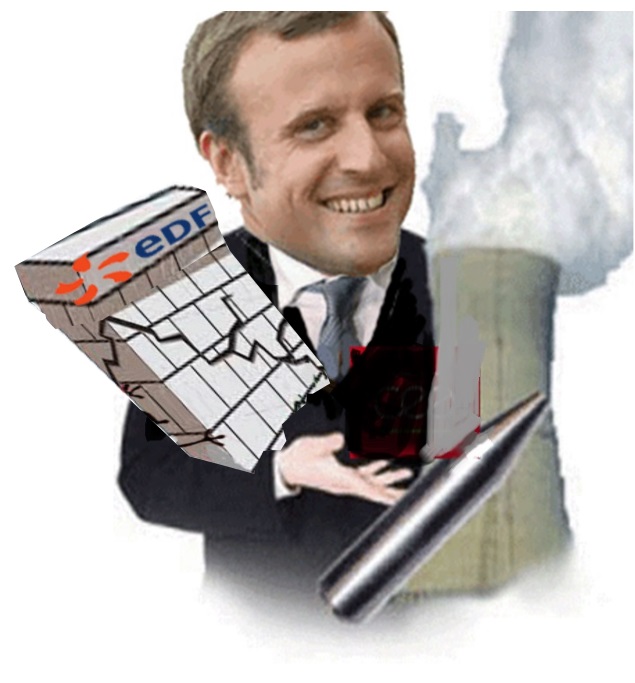
EDF’s new boss has vowed to speed up the delivery of new nuclear reactors in an increasingly competitive market, after costly overshoots in the past weighed on the French energy group.
The company wants to use the
development of the UK’s Sizewell C nuclear power station to show that huge reactors capable of powering millions of homes can be delivered at speed, in the hope that this will help it attract private funding and compete with more efficient rivals, including those from Asia.
Bernard Fontana, chief executive, said the state-owned group remained “open to international markets” and hoped to export more of its designs beyond the projects it is undertaking in the UK and France. EDF has been tasked with
delivering at least six new French reactors from 2038 onwards and is due to deliver two for the £38bn Sizewell C project in the middle to late 2030s.
Fontana’s push for efficiency comes as EDF, weighed down by a net debt of €50bn, needs to finance €30bn of investments annually over the next five years, including on maintaining current sites, according to estimates by France’s budget watchdog. EDF operates 57 French reactors.
FT 9th Nov 2025, https://www.ft.com/content/cc39da49-6ebf-40e2-bfbe-296ee2596ce9
Can France’s nuclear legacy weather climate change?

The delicate-looking water primrose, an invasive aquatic plant with golden, daisy-like flowers,brought unit 4 at the 3.6 GW Cruas nuclear power plant in southern France to a grinding halt.
In recent years, extreme heat, droughts and warmer
rivers have repeatedly disrupted operations, forcing EDF to reduce output
or shut down reactors at sites along the Garonne and the Rhone. During the
record 2022 heatwave, the government even issued exceptional exemptions so several plants could temporarily exceed environmental discharge limits to avoid potential blackouts.
What’s driving the concern?
River temperatures regularly reaching regulatory thresholds; More frequent
droughts limiting cooling water; Increased ecological pressure on already
stressed river basins; Data showing production cuts clustering in summer
when demand is highest.
France’s Court of Auditors and climate agencies
warn that such shutdowns could become three to four times more common by 2050. EDF says annual impacts remain small overall, but seasonal risks are rising. With an ageing fleet and new reactors planned, the question is how resilient France’s nuclear system can remain in a rapidly warming climate
Montel News 30th Oct 2025, https://montelnews.com/news/2e2e5374-e4ef-433a-ac00-1f2d049478c0/can-france-s-nuclear-legacy-weather-climate-change-2
“It is unacceptable that the EDF tariff reform is being adopted quietly, to the detriment of the users”
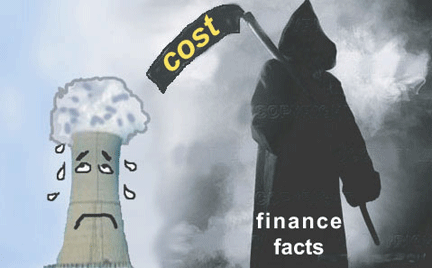
With electricity bills reaching record highs and 7 million people facing
energy poverty, it’s time to acknowledge the failure of a model. Twenty
years of brutal energy sector liberalization have failed to bring about
either lower prices or the investment promised by private operators in
exchange for regulated access to historical nuclear electricity (ARENH).
Created in 2011 to allow alternative suppliers to purchase EDF’s nuclear
production at a fixed and highly advantageous price, this mechanism was
supposed to generate sustainably competitive offers. On the contrary, it
has led to instability, private rent-seeking, industrial fragmentation, and
debt for EDF.
Le Monde 29th Oct 2025,
https://www.lemonde.fr/idees/article/2025/10/29/il-est-inacceptable-que-la-reforme-des-tarifs-d-edf-soit-adoptee-discretement-au-detriment-des-usagers_6650111_3232.html
Furious French fairies challenge nuclear plans.
Frogtifa is just catching on in Portland, but French protesters have used street theatre for years. This summer’s anti-nuclear actions were no exception, reports Reseau sortir du nucléaire
Editor’s note: In her forthcoming book — No To Nuclear. Why Nuclear Power Destroys Lives, Derails Climate Progress and Provokes War — to be published by Pluto Press next March, Linda Pentz Gunter describes the creative resistance of French protesters, including the anti-nuclear movement. “The French anti-nuclear movement,” she writes, “has engaged in protests that deliver considerable numbers, abundant creativity — and sometimes a lot of useful tractors as well. France also has a long theatrical tradition, and French anti-nuclear activists have invariably embraced that as well. They understand that street theater is an attention-getter. They also know it makes protesting a lot more fun.” The chapter features the “goat ZAD” mobilized by the Piscine Nucléaire Stop collective. Since then, they have “escalated,” as sortir du nucléaire describes in this article.
From July 18 to 20, 2025, in La Hague, “HARO” made its grand debut: three days of meetings and mobilization around nuclear waste and local communities. Nearly a thousand people from the Cotentin region and elsewhere responded to the call of the Piscine Nucléaire Stop collective to participate in round tables, workshops, concerts, screenings, hikes, and, of course, the big demonstration by the Fées furieuses (Furious Fairies). The event took place in a festive atmosphere of determination.
The name of the event set the tone: derived from Norman customary law, the interjection “Haro” was used to demand justice, even in the face of powerful oppressors. In the Cotentin Peninsula, it is Orano [owner of the La Hague reprocessing facility] that is attempting to impose its Aval du Futur mega-project.
The event, located on the La Hague plateau in a field lent by local farmers committed to the anti-nuclear cause, offered a breathtaking view of the Orano plant, when the fog didn’t interfere with the festivities. The typical La Hague weather did not discourage participants who had come from all over France to take part in meetings against waste, nuclear power, and the nuclear chain, with an intersectional approach………………………………………………………………………………..
The packed program then continued throughout the weekend: between round tables on feminist anti-nuclear struggles, discussions on ways of living in contaminated areas, workshops on the legacy of decolonial struggles, the manufacture of radio transceivers, etc., there was something for everyone.
As for the cooperative village [established for the events], it was as varied as the program itself: local and national associations committed to the anti-nuclear cause or installation projects such as Atomic Marney, social struggle associations such as France Palestine Solidarité (Cherbourg branch), citizen laboratories, bookstores, and collectives from other environmental struggles, such as local committees of Soulèvements de la Terre.
The most courageous, who wanted to venture outside the meeting site, sometimes in pouring rain, were able to take part in the Randos Radieuses (Radiant Walks)…………………………………………………………..
Within this cultural program, the fight against Cigéo [the French nuclear waste entity] was highlighted with the screening of a film recounting ten years of struggle: Vivre et lutter à Bure entre 2015 et 2025 (Living and Fighting in Bure between 2015 and 2025), the documentary Les Bombes atomiques (The Atomic Bombs), which recounts a feminist highlight of the struggle in Bure, and the film Après les Nuages (After the Clouds) by the collective Les Scotcheuses
The highlight of the weekend was a demonstration on Saturday afternoon against Aval du Futur and, more broadly, the ever-increasing nuclearization of the region. In keeping with its offbeat and militant approach, the Piscine Nucléaire Stop collective decided to draw on the local legend of the little fairies and their method of collective self-defense armed with heather and gorse to confront an offense: the paving over of the last remaining primary moors on the La Hague plateau and the accumulation of nuclear waste by Orano.
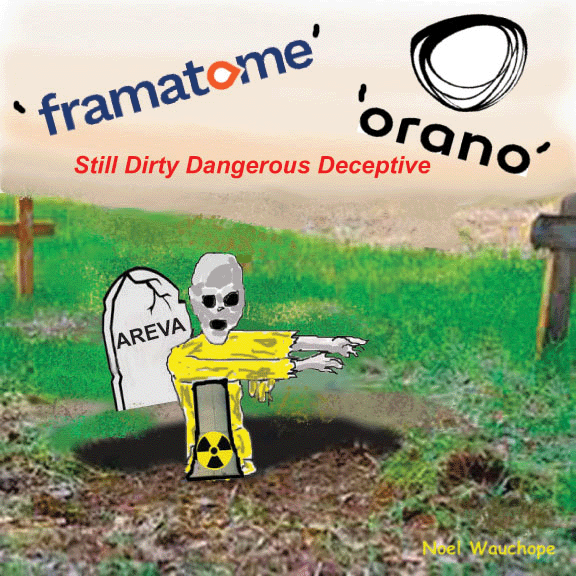
A thousand people gathered to march against Orano’s project. The procession left the camp in sunny weather and headed for the village of Vauville, accompanied by a police presence and a helicopter dispatched for the weekend.
In a family atmosphere, the demonstrators and little fairies danced to the sounds of the Planète Boum Boum collective, chanted slogans concocted for the occasion, and sang to the tune of a summer camp song: “In my beautiful Cotentin, there will be no MOX, no swimming pools either, and no concrete either.”
The links between the struggles in Bure and La Hague were strengthened during this event, culminating in a concert by the Bure-based band Les Free’meuses, during which the audience was moved by their latest cover of Les Demoiselles de Rochefort: “We are twin struggles… “
In various ways throughout the weekend, activists from the east and west reiterated that “we don’t want radioactive waste dumps in La Hague, Bure, or anywhere else!”
The weekend ended with an evening concert and a final HARO as a cry of convergence of struggles to support social and environmental struggles as well as the struggle of the Palestinian people.
This article was first published in French by the Reseau sortir du nucléaire, a national network of French anti-nuclear organizations.
2
Livret A: Will part of French savings soon be used to finance nuclear power?
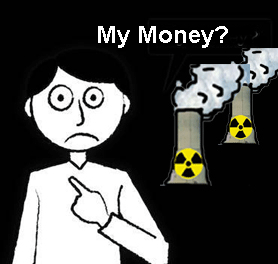
Traditionally, the money in the Livret A savings account is intended to support social housing and local public infrastructure.
This announcement comes as the government seeks to diversify funding sources for a nuclear program estimated at colossal sums
Le Monde De L’Energie 13th Oct 2025
This is a historic turning point for French public savings. The Caisse des Dépôts et Consignations (CDC) has confirmed that a portion of the funds from the Livret A savings account could be used to finance the construction of new EPR nuclear reactors. This unprecedented move symbolizes the rapprochement between public finance, industrial strategy, and national energy sovereignty.
An unprecedented agreement between the State, EDF and the Caisse des Dépôts
Traditionally, the money in the Livret A savings account is intended to support social housing and local public infrastructure. But on Thursday, October 10, CDC CEO Olivier Sichel announced a major development: “We have reached an agreement with Bercy and EDF on using the Savings Fund.” This statement, made to the Association of Economic and Financial Journalists, marks the first official confirmation of the Livret A’s involvement in financing the French nuclear program.
This shift, both energy-related and financial, is part of the government’s desire to revive civil nuclear power. The state plans to build six new EPR reactors by 2038, at a total cost estimated at less than €100 billion, according to estimates by former Energy Minister Marc Ferracci.
A crucial step: the Brussels agreement
Before the transaction can become a reality, one key step remains: European approval. “The French government will present its proposal to Brussels to obtain approval for the overall financial model,” Olivier Sichel explained. The stakes are as much legal as they are political: the European Commission will have to verify that this financing scheme does not violate competition or state aid rules.
The Brussels agreement will make it possible to secure access to part of the Savings Fund, funded by French savings, while guaranteeing that investments remain safe and profitable for depositors.
A treasure of 400 billion euros at the nation’s disposal
The Caisse des Dépôts currently manages approximately €400 billion in regulated savings, collected in particular through the Livret A (Livret A), the Livret de développement durable et solidaire (LDDS) (Sustainable and Solidarity Savings Account), and the Livret d’épargne populaire (LEP) (People’s Savings Account). Just over half of these funds are already allocated to long-term loans to finance social housing or regional policies.
The remainder, invested in financial assets, could now contribute to financing the country’s energy infrastructure, including new nuclear reactors. “Nuclear power is obviously part of our energy sovereignty,” explained Olivier Sichel, adding that this direction aims to strengthen France’s capacity to produce stable, carbon-free electricity.
This announcement comes as the government seeks to diversify funding sources for a nuclear program estimated at colossal sums, in a context of constrained budgets and strong tension on the energy markets…………………………………..
this development is already raising questions. Some social housing stakeholders fear that this shift will reduce the funds available for their projects. ………….
Asked about financial risks, Olivier Sichel also warned of the tensions threatening global markets, particularly in the technology sector. “The colossal investments in artificial intelligence are drawing parallels with the internet bubble of the late 1990s,” he warned, urging caution.
A major turning point for public investment policy
By linking popular savings to the country’s energy strategy, the government and the Caisse des Dépôts are redefining the role of the Livret A savings account in the French economy. This investment, held by more than 55 million French people, is becoming not only a social financing tool, but also a pillar of industrial and energy recovery.
If Brussels gives the green light, France will usher in a new era: one in which every euro placed in a Livret A savings account could, indirectly, contribute to fueling the nation’s future nuclear reactors. …… https://www.lemondedelenergie.com/livret-une-partie-de-lepargne-des-francais-bientot-mobilisee-pour-financer-le-nucleaire/2025/10/13/
Gravelines: the Safety Expertise Department of ASNR’ damning opinion calls into question the EPR2
October 16, 2025, https://www.greenpeace.fr/espace-presse/gravelines-lavis-accablant-de-lasnr-remet-en-cause-les-epr2/
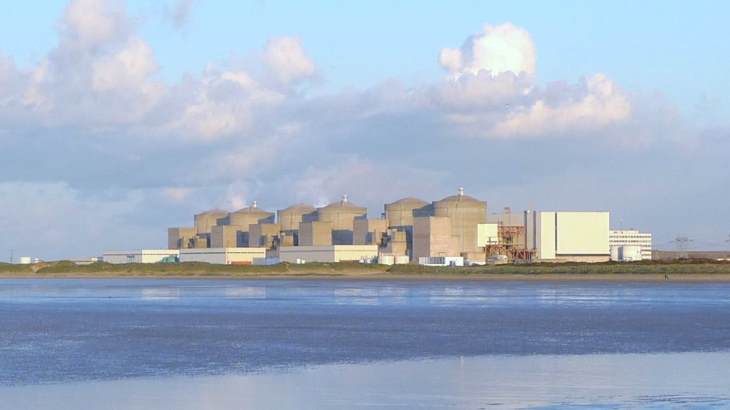
The Safety Expertise Department of ASNR, the nuclear safety and radiation protection authority, has just published a damning expert opinion on EDF’s project for the Gravelines power plant.
In addition to the already identified risks of submersion and flooding of the power plant, there is now the risk of soil settlement and liquefaction. The soil, which is designed to support the weight of the new EPR2 reactors, has “poor mechanical characteristics,” posing an unprecedented technical challenge regarding the robustness of the foundations over time and in the face of seismic hazards that could compromise nuclear safety.
“ This relentless opinion from the ASNR is further proof that the criteria for choosing sites for the construction of new EPR2 reactors are largely questionable. After underestimating the climate risks, EDF is underestimating the risk of building such a dangerous infrastructure on such unsuitable ground ,” emphasizes Pauline Boyer, nuclear campaigner for Greenpeace France. “This demonstrates once again the haste of EDF, which is rushing headlong into its plans to build new reactors in Gravelines. ”
A relentless opinion
In this opinion dated July 23, the ASNR severely rejects EDF’s copy of its first study of ground reinforcement on the Gravelines site, considering that the approach adopted by EDF is not sufficiently robust , ordering it to clarify the safety issues relating to ground reinforcement, to conduct new studies and to set up a monitoring system over time.
The opinion considers that the planned reinforcement of the ground at the Gravelines site constitutes “ a major technical challenge ” and that the system proposed by EDF is “of unprecedented scale, of great complexity and without representative feedback in France and internationally”.
A hard blow for EDF
The Gravelines nuclear power plant, built on a polder, is supposed to accommodate two new reactors (EPR2) as part of the nuclear recovery plan.
A year ago, Greenpeace published a report which, through mapping work projecting the rise in water levels in the Gravelines area until the end of the reactors’ lifespan, demonstrated that in 2100 and 2120, the entire Gravelines power plant site could be temporarily below sea level.
“The project to build new EPR2 reactors in Gravelines, EDF’s “seaside sandcastle,” is already sinking into quicksand. It’s time for EDF to make the most sensible decision: stop trying to build reactors at all costs, especially on such a vulnerable and unsuitable site, and invest this money in its renewable energy sector,” adds Pauline Boyer.
The difficulties and uncertainties of this nuclear construction project overlap, at the heart of an area accumulating risks (submersion, flooding, unsuitability of the soil, extreme climatic events, etc.). The 11-meter platform on which the EPR2 would be perched in an attempt to protect them from the risks of submersion and flooding (which Greenpeace always questions) makes the task even more difficult.
After the setbacks with the concrete intended for the construction of the future EPR2 in Penly, this is yet another example of EDF’s amateurism in wanting to build EPR2s in unsuitable areas without first carrying out a robust risk analysis.
Flamanville EPR: EDF anticipates limited power until 2031.
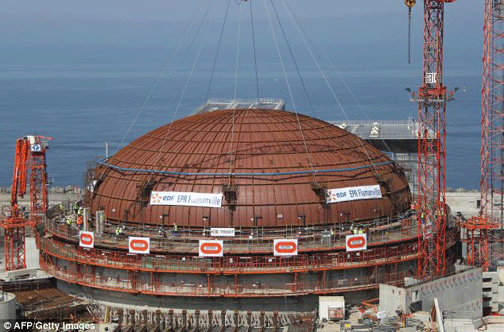
Flamanville EPR: EDF anticipates limited power until 2031. EDF has
informed the energy regulator that it has selected a final electrical power
output lower than that officially communicated. The reason: the hypothesis
of a deteriorated performance of the Normandy reactor, leading to a
restriction of its electricity production.
These are just five short lines
in a document of over 200 pages. But they are very important. In its report
on the cost of nuclear power, published Tuesday, September 30, the Energy
Regulatory Commission (CRE) addresses the issue of the electrical power of
the Flamanville 3 EPR, the restart of which was recently postponed until
mid-October, after numerous delays since its shutdown last June following a
leak in a primary circuit protection valve.
The energy regulator explains
that the production of Flamanville 3 is difficult to predict due to the
level of uncertainty over the timetable for the continuation of reactor
tests. Above all, it specifies that in terms of “the final nominal
electrical power of the EPR, EDF declared to the CRE a power 35 megawatts
(MW) lower than the power declared in the public data framework . “
La Tribune 7th Oct 2025, https://www.latribune.fr/article/entreprises-finance/energie-environnement/10816924410568/epr-de-flamanville-edf-anticipe-une-puissance-bridee-jusquen-2031
EDF Weighs Edison IPO To Boost Nuclear Expansion Funding

Since being fully renationalized in 2023, EDF has been under pressure from President Emmanuel Macron’s government to finance up to six new EPR2 reactors and extend the life of the existing fleet. That program could require more than €60 billion through the 2030s, prompting asset reviews that include potential divestments in renewables and non-core foreign units, the Financial Times reported.
By Charles Kennedy – Oct 08, 2025, https://oilprice.com/Latest-Energy-News/World-News/EDF-Weighs-Edison-IPO-To-Boost-Nuclear-Expansio
French state utility EDF is in talks with banks about a potential initial public offering of its Italian subsidiary Edison, according to sources cited by Reuters, in a move that could unlock billions in capital as EDF ramps up financing for its nuclear revival at home.
EDF has begun sounding out major European lenders including BNP Paribas and Société Générale to assess investor appetite for a Milan listing that would value Edison between €7 billion and €10 billion ($8-11 billion). The group would likely retain a controlling stake while selling a minority portion to the public or strategic investors, according to the Reuters report. Sources told the news agency that the discussions remain preliminary, with a formal mandate expected by the end of October.
Edison, which was fully acquired by EDF in 2012, remains one of Italy’s largest integrated energy companies, operating power generation, retail, and gas units with annual revenue of about €15 billion and EBITDA near €1.7 billion. Its CEO, Nicola Monti, said in September that the company was prepared for a market return if EDF gave it the green light, according to Reuters.
The IPO would fit EDF’s broader capital rotation strategy.
Since being fully renationalized in 2023, EDF has been under pressure from President Emmanuel Macron’s government to finance up to six new EPR2 reactors and extend the life of the existing fleet. That program could require more than €60 billion through the 2030s, prompting asset reviews that include potential divestments in renewables and non-core foreign units, the Financial Times reported.
Bloomberg reported in early September that an Edison relisting could gauge investor appetite for European power assets, as utilities face volatile wholesale electricity prices across the continent.
Edison’s partial flotation would be similar to moves by other European energy peers such as Eni and Iberdrola, which spun off renewables and downstream assets to attract capital while retaining strategic control. A Milan listing would also test investor confidence in Europe’s liberalized power markets at a time of rising grid costs and renewed nuclear investment.
Bloomberg reported in early September that an Edison relisting could gauge investor appetite for European power assets, as utilities face volatile wholesale electricity prices across the continent.
Edison’s partial flotation would be similar to moves by other European energy peers such as Eni and Iberdrola, which spun off renewables and downstream assets to attract capital while retaining strategic control. A Milan listing would also test investor confidence in Europe’s liberalized power markets at a time of rising grid costs and renewed nuclear investment.
Flamanville fiasco: EDF blamed by the Nuclear Safety Authority

The French Nuclear Safety and Radiation Protection Authority (ASNR) has severely
criticised the crisis management at the EPR in Flamanville (Manche), which
has been shut down since 19 June due to a valve problem.
On 20 August, the inspectors subjected EDF teams to an unannounced exercise of “deployment of a local crisis means” (MLC), i.e. the replacement of one element of the
electrical panel with another to resupply batteries in the event of a total
loss of power supplies. As a result, the operator was unable to carry out
this operation, which was essential to avoid an accident.
In its follow-up
letter, the ASNR points to a “range of interventions that are not precise
enough”, agents “forced to question themselves on numerous occasions” and a
training follow-up deemed “perfectible”. Even more serious, some crisis
equipment requested by the inspectors could not be presented. “The
organisation of the Flamanville EPR in terms of crisis management and means
appears insufficient”, concludes the nuclear watchdog, an extremely rare
assessment in its usually measured vocabulary.
” I don’t remember such an
observation,” Guy Vastel, of the Association for the Control of
Radioactivity in the West (Acro), told Ouest-France. Yannick Rousselet,
from Greenpeace, believes that “nothing is right” in this report. EDF, for
its part, announced an “action plan” and assured that the findings “do not
call into question the availability of crisis resources or the site’s
ability to manage an emergency”.
Reporterre 10th Sept 2025,
https://reporterre.net/Fiasco-de-Flamanville-EDF-blamee-par-l-Autorite-de-surete-nucleaire
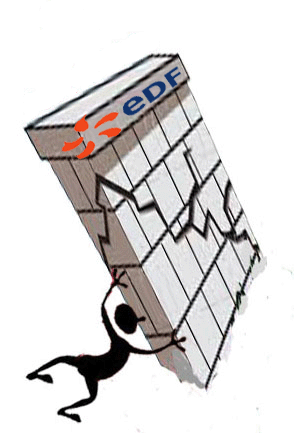
While EDF must invest 460 billion euros over 15 years, its economic model is taking on water.
P.La. with AFP, BFMTV 23rd Sept 2025 https://www.bfmtv.com/economie/entreprises/energie/alors-qu-edf-doit-investir-460-milliards-d-euros-en-15-ans-son-modele-economique-prend-l-eau_AD-202509240079.html
The Court of Auditors has issued a warning about the economic situation of the French energy company, now 100% state-owned. A wall of investment is looming to maintain and renew the group’s nuclear fleet.
The French Court of Auditors is concerned about the financial prospects of the public energy company EDF, calling for “a clear distribution of the financial effort” between the State, EDF and customers, in a report addressed to the Finance Committee of the National Assembly and consulted on Tuesday, September 24.
In this report, first revealed by the media
Contexte , the institution responsible for monitoring the proper use of public funds observes that EDF is “faced with significant uncertainties over its long-term financing capacity”, while it faces investment needs reaching 460 billion euros between 2025 and 2040.
In this context, “EDF’s financing model should, in order to preserve a sustainable financial trajectory for the group, be defined based on a clear distribution of the financial effort between the State, now the sole shareholder, EDF and the end customers,” the magistrates believe.
In detail, EDF plans to allocate 90 billion euros to the maintenance and extension of the existing nuclear fleet, 115 billion euros for the construction of 14 EPR 2 (including 75 for the first six), 15 billion euros for the hydraulic fleet and more than 100 billion euros for the Enedis network, manager of the electricity distribution network.
No more hazards
At the same time, EDF’s profitability will be more exposed “to the vagaries of changes in electricity market prices”, with the end of the regulated system known as Arenh , planned for the end of 2025. EDF intends to replace this system with medium and long-term contracts with electricity suppliers and companies, including high-energy industrial ones.
The Court of Auditors also notes that EDF’s ability to invest will be conditioned “by the operational performance of the nuclear fleet and the success of extending its lifespan.”
The body then recommends “setting, prior to the final investment decision on the EPR2 program, the terms of risk sharing between the State and EDF.” EDF’s final estimate for its EPR2 program should be known at the end of the year.
The Court of Auditors also calls for clarification of the dividend policy that will be applied to EDF and recommends that the group “conduct a strategic review of investments, holdings and subsidiaries.”
Total or partial sales of holdings and subsidiaries would constitute “a financing lever for the group’s investment program,” particularly “in the most unfavorable price scenarios,” argue the magistrates of the Court of Auditors.
EDF: Court of Auditors warns of a model running out of steam.
Debt, deteriorating profitability, investments: in a report submitted to the National Assembly, the Court warns against the sustainability of EDF’s economic model and calls on the State to clarify its choices.
By Géraldine Woessner, 09/23/2025
With rising debt, declining profitability, and €460 billion of investments to finance by 2040,
EDF will not be able to carry out the energy transition alone, the Court of Auditors warns in essence in a report commissioned by the National Assembly’s Finance Committee, which is to be presented to MPs this Wednesday.
Le Point 23rd Sept 2025, https://www.lepoint.fr/societe/edf-la-cour-des-comptes-alerte-sur-un-modele-a-bout-de-souffle-23-09-2025-2599408_23.php
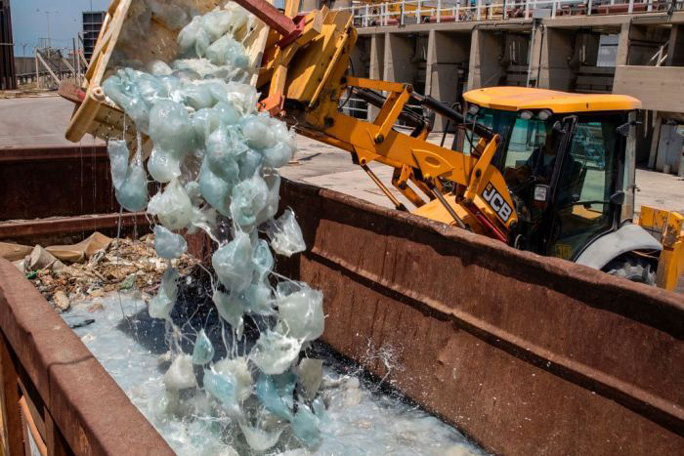
Jellyfish Force another French Nuclear Reactor to Shut Down
By Charles Kennedy – Sep 04, 2025,
https://oilprice.com/Latest-Energy-News/World-News/Jellyfish-Force-another-French-Nuclear-Reactor-to-Shut-Down.html
For a second time in three weeks, a swarm of jellyfish has forced the closure of a nuclear reactor in France in another curious incident in which jellyfish entered the filters of the water cooling systems.
The Paluel nuclear power plant in Normandy, northern France, saw its electricity generation nearly halve by 2.4 gigawatts (GW) out of a total 5.2-GW capacity, due to the presence of jellyfish that have entered the filtering system, French operator EDF said on Thursday, as carried by Reuters.
One of four reactors at Paluel was shut down while power output at another reactor was curtailed to prevent further disruption due to the jellyfish swarm.
oday’s incident at Paluel occurred just over three weeks after a jellyfish swarm clogged the cooling system of the Gravelines nuclear power plant near Dunkerque and Calais. As a result, four of six units at one of France’s largest nuclear power plants automatically switched off, while the remaining two units were already shut down for planned maintenance. Gravelines has six reactors, each with a capacity of 900 megawatts (MW).
At the time, France’s EDF said there was “no impact on the safety of the facilities, the safety of personnel, or the environment.”
Reactors at the Gravelines power plant are cooled from a canal linked to the North Sea, where jellyfish are swarming near the coast during hot weather and warm waters.
Global warming can worsen the jellyfish problem in waters cooling reactors close to seas, scientists have warned.
In recent years, heatwaves and too hot waters in rivers have disrupted France’s nuclear power generation, too.
France’s nuclear power generation accounts for around 70% of its electricity mix, and when its reactors are fully operational, it is a net exporter of electricity to other European countries.
But in 2022 and 2023, EDF was forced to curb power generation at some nuclear plants as heatwaves raised the temperatures of rivers. The power plant operator had to limit electricity output because of environmental regulations for using river water for cooling nuclear reactors.
NFLAs join nuclear test appeal to French and Algerian Governments
On the UN International Day against Nuclear Tests (29 August), the
UK/Ireland Nuclear Free Local Authorities have joined French, Algerian and
global partners in appealing to the French and Algerian Governments for
justice for the victims of French nuclear tests in North Africa.
NFLA 29th Aug 2025 https://www.nuclearpolicy.info/news/nflas-join-nuclear-test-appeal-to-french-and-algerian-governments/
“We gave for France… now that’s enough”: La Hague residents reject Orano’s nuclear pools project
by Marie du Mesnil-Adelée, 08/31/2025, https://france3-regions.franceinfo.fr/normandie/manche/cherbourg-cotentin/on-a-donne-pour-la-france-maintenant-ca-suffit-des-habitants-de-la-hague-rejettent-le-projet-des-piscines-nucleaires-d-orano-3205250.html
“It’s never too late to say: we don’t want it.” Gathered at a public meeting, residents of La Hague spoke out against the “Downstream of the Future” project at the Orano site. A project that includes the installation of three new nuclear pools for storing spent fuel.
An extraordinary nuclear project in La Hague
An extraordinary nuclear project at La Hague, presented by Orano as “the largest industrial project in the world”, costing several tens of billions of euros, “Downstream of the Future” (that’s its name), plans the construction of three new nuclear pools for storing spent fuel and also new workshops and factories on the La Hague site by 2040-2050.
How is this project received by residents?
How is this project being received by residents? In his documentary “Encore de l’énergie” broadcast on Thursday, September 4 on France 3 Normandie and france.tv, Laurent Pannier filmed a public meeting.
Yannick Rousselet, a nuclear expert for Greenpeace, spoke: ” There was no consultation . We would like to debate the appropriateness, the justification of something like this. Today is good. We have given for France, for the nuclear industry and that’s enough. Let’s stop, let’s move on. We want our future to be shaped differently. I think it’s never too late to say we don’t want it.”
A resident adds: “I find it a bit easy for Orano to be able to do whatever they want in terms of construction, however they want, while all the residents of La Hague, as soon as they want to have a window transformed, put in a veranda, do anything, they can’t do anything.”
And a third:
“Today we only have 4 or 5 small hectares of moorland left. It’s more than a relic now, it’s become a symbol. People are saying to us: well, since there’s more than that left, we’re going to remove it and I think that’s a real shame.”
The words are powerful. But the room is far from full… Here, as elsewhere, nuclear power divides. And
those who oppose it are a minority.
Anti-nuclear activists of yesterday and today
In April 2006, the city of Cherbourg held its largest demonstration since the Liberation. Twenty years after Chernobyl, 30,000 activists gathered to protest the proposed construction of a new reactor in Flamanville, the EPR.
Yet, fifteen years later, despite construction delays, despite the additional costs, despite the Fukushima disaster, distrust of nuclear energy has virtually disappeared. Environmental movements are divided between pro- and anti-nuclear supporters. And the announcement of the revival of nuclear power in France, particularly in Normandy, has been generally welcomed by the population.
Laurent Pannier’s new documentary explores this reversal. What happened to the former activists? Is there a new generation? In the face of climate change, is nuclear power a necessary evil?
“Encore de l’énergie” by Laurent Pannier, a documentary to watch this Thursday, September 4 at 10:55 p.m. on France 3 Normandie and on france.tv , for one month.
1 This Month

of the week – Shut Down Drone Warfare!


Tell the Ukrainian Government to Drop Prosecution of Peace Activist Yurii Sheliazhenko

Petition to revoke the licensing of the Near Surface Nuclear Disposal Facility (NSDF) at Chalk River. https://www.ourcommons.ca/petitions/en/Petition/Details?Petition=e-7247
To see nuclear-related stories in greater depth and intensity – go to https://nuclearinformation.wordpress.com
-
Archives
- March 2026 (237)
- February 2026 (268)
- January 2026 (308)
- December 2025 (358)
- November 2025 (359)
- October 2025 (376)
- September 2025 (257)
- August 2025 (319)
- July 2025 (230)
- June 2025 (348)
- May 2025 (261)
- April 2025 (305)
-
Categories
- 1
- 1 NUCLEAR ISSUES
- business and costs
- climate change
- culture and arts
- ENERGY
- environment
- health
- history
- indigenous issues
- Legal
- marketing of nuclear
- media
- opposition to nuclear
- PERSONAL STORIES
- politics
- politics international
- Religion and ethics
- safety
- secrets,lies and civil liberties
- spinbuster
- technology
- Uranium
- wastes
- weapons and war
- Women
- 2 WORLD
- ACTION
- AFRICA
- Atrocities
- AUSTRALIA
- Christina's notes
- Christina's themes
- culture and arts
- Events
- Fuk 2022
- Fuk 2023
- Fukushima 2017
- Fukushima 2018
- fukushima 2019
- Fukushima 2020
- Fukushima 2021
- general
- global warming
- Humour (God we need it)
- Nuclear
- RARE EARTHS
- Reference
- resources – print
- Resources -audiovicual
- Weekly Newsletter
- World
- World Nuclear
- YouTube
-
RSS
Entries RSS
Comments RSS
 nuclear-news