Nuclear reactor that operated for only 9 years will take many (expensive) decades to decommission .
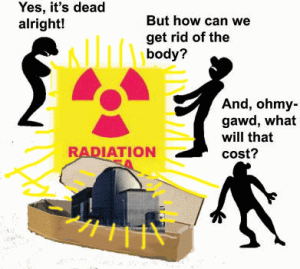
Complete dismantling of experimental French reactor to proceed.
1WNN, 0 October 2023
EDF has been authorised to begin the third and final phase of the decommissioning of the Brennilis nuclear power plant in the Monts d’Arée in Brittany, France. The plant is a unique 75 MWe gas-cooled heavy water reactor that operated between 1972 and 1981.
The first phase of the plant’s decommissioning – the removal of all fuel and the dewatering of its systems – was completed in 1992. The second phase – the dismantling of equipment and all buildings (with the exception of the reactor building) – was completed in 2005.
On 26 September, EDF obtained the “complete dismantling” decree, signed by the Minister of Energy Transition, which makes it possible to launch the dismantling of the reactor, the cleaning up of the civil engineering, the demolition of the reactor building and the final rehabilitation of the Brennilis site………..
The final deconstruction of Brennilis is a complex operation,” noted Cédric Lewandowski, director of the nuclear and thermal fleet at EDF, on LinkedIn. “Indeed, this prototype, unique in France, using heavy water reactor technology, is contained in a concrete cube measuring 20 metres on each side and 1.5 metres thick. Inside, the equipment to be dismantled is tightly packed into a very cramped space.
“To carry out this work on time and to guarantee the protection of personnel, the EDF Deconstruction and Waste Projects Department (DP2D) is working with its industrial partners on innovative tele-operation and robotics solutions.”
The dismantling of the reactor’s peripheral circuits, entrusted by DP2D to Onet Technologies and Cyclife Engineering, will begin later this year.
French tax-payers up for €20bn or more per year, in mountain of costs to keep nuclear fleet going.
Investments in France’s EDF could top €20bn per year, minister says. #nuclear #nuclear-free #anti-nuclear #No#nukes
EURACTIV.com with Reuters Sep 29, 2023
French power giant EDF’s future investments could exceed €20 billion
per year, Agnès Pannier-Runacher, the country’s energy transition
minister, said on Thursday (28 September), adding that the exact level was
the subject of discussion.
The state-owned utility is facing a mountain of
investment needs to maintain its nuclear fleet as well as build new
reactors and renewable power production. EDF CEO Luc Rémont had previously
put the investments at €25 billion. “What we are talking about … for
EDF is investments which could reach … more than €20 billion per
year,” Pannier-Runacher said at a nuclear conference organised by the
Organisation for Economic Co-operation and Development (OECD).
“There is a discussion about whether it is 20 (billion) or whether it is more,” she
added. The French government has previously announced a plan to build at
least six new model nuclear reactors, which Pannier-Runacher said would
cost about €3 billion per year in investments.
Euractiv 29th Sept 2023 https://www.euractiv.com/section/electricity/news/investments-in-frances-edf-could-top-e20bn-per-year-minister-says/
France attempts to pressure Australia to stop engaging with UN nuclear weapons ban treaty

https://www.icanw.org/france_pressures_australia_to_stop_engaging_with_un_nuclear_weapons_ban_treaty 2 Oct 23 #nuclear #anti-nuclear #Nuclear-Free #NoNukes
Recent statements by a French diplomat to “the Australian” newspaper criticizing Australia’s decision to observe the UN Treaty on the Prohibition of Nuclear Weapons (TPNW) reveal the panicked efforts by nuclear-armed states to undermine the treaty as support for the ban continues to grow. It also shows a European state with a dark colonial legacy continuing to exert pressure on the Pacific – an area heavily impacted by French nuclear testing – instead of respecting national sovereignty.
On 2 October an article in “the Australian” newspaper cited an unnamed French diplomat claiming that Australia’s support for the Treaty on the Prohibition of Nuclear Weapons “undermines the primacy of the Nuclear Non-Proliferation Treaty (NPT)” and “is contradictory with Australia’s ambition to reinforce its partnership with NATO.”
Both of these statements are not only hamfisted attempts at pressuring the Australian government away from the TPNW, they are also factually incorrect: The TPNW was carefully crafted to reinforce, complement, and build on the NPT, which obligates its parties – including France – to negotiate further legal measures to achieve nuclear disarmament under Article VI, and NATO members face no legal barrier to joining the treaty, so long as they commit not to engage in or support any nuclear-weapon-related activities. Moreover, several NATO partners are already TPNW parties (Austria, Ireland, Kazakhstan, Malta, Mongolia, New Zealand) or signatories (Algeria, Colombia).
These declarations show France’s mounting concern over the growing support for the TPNW. The statements themselves are no surprise, as France has stridently protested the TPNW ever since it was adopted at the UN in 2017 with the backing of 122 states. France insists it has a legitimate right under the NPT to possess nuclear weapons, while ignoring its commitments to pursue negotiations in good faith for nuclear disarmament under the same treaty. What is new is the fact that this pressure is being exerted publicly, and on a state that is largely seen as an ally on security issues. Previously, France has limited this kind of pressure for formerly colonised states, particularly in Africa.
Australia’s growing support for the TPNW
The Australian Labor Party, which has been in power since May 2022, adopted a resolution in 2018 committing it to sign and ratify the TPNW in government. This was moved by Anthony Albanese, who now serves as prime minister and has been a vocal supporter of the TPNW. He said at the time: “Our commitment to sign and ratify the nuclear weapon ban treaty in government is Labor at its best.” Labor reaffirmed this position in 2021 and most recently on 18 August 2023. The government also has confirmed its intention to observe the treaty’s upcoming meeting of states parties in New York (2MSP) and is evaluating whether to sign and ratify the treaty.
This is an encouraging step, but ICAN’s Executive Director, former Labor MP Melissa Parke, has criticised the government’s delay in ratifying the treaty: “It’s not enough to keep promising to sign the treaty without acting. We want to see the Prime Minister put pen to paper, without delay. Labor’s commitment on nuclear disarmament and non-proliferation will be hollow if Australia fails to do so.”
Speaking to the revelation that French diplomats are exerting pressure on Australia to consider, she said: “Our two countries have never seen eye to eye on nuclear weapons. France shouldn’t be lecturing Australia on nuclear policy. We can make our own decisions, in our own interests – and for the global common good.”
France’s unresolved nuclear legacy in the Pacific
From 1966 to 1996, France tested 193 nuclear weapons in Maohi Nui/French Polynesia, a Self Governing Territory of France in the Pacific. In 1974, Australia famously took France to the International Court of Justice in a bid to force an end to its atmospheric nuclear testing in the Pacific, as the impacts of nuclear weapons are not contained by national borders. Yet France only ended its Pacific nuclear test explosions once it was confident it had developed non-explosive testing methods sufficiently for new weapons development, and it refuses to acknowledge and address the catastrophic legacy of its nuclear tests to this day.This legacy is also a subject of hot debate at the national level in France. On 28 September, only days before France’s criticisms of Australia, the assembly of French Polynesia unanimously adopted a resolution supporting the TPNW, highlighting the region’s history as the site of numerous French nuclear tests. The resolution underscores the TPNW as a humanitarian disarmament treaty and emphasises the deep concerns of the French Polynesian population regarding this issue. While French Polynesia cannot currently access the assistance and rehabilitation outlined in Articles 6 and 7 of the TPNW due to France’s non-ratification, it sends a resounding message in favour of the treaty to Paris.
Greenpeace disrupts nuclear power meeting in Paris
MURIEL BOSELLI, Paris 28 Sept 2023
(Montel) Greenpeace disrupted early on Thursday the opening of a two-day international nuclear meeting in Paris to denounce the “promotion of nuclear power whatever the cost”, it said.
Anti-nuclear activists held up banners reading “Nuclear energy: cli…… (Subscribers only) https://www.montelnews.com/news/1524798/greenpeace-disrupts-nuclear-power-meeting-in-paris
France’s nuclear power sector is not delivering

Euractiv, By Philippe Girard, Sep 26, 2023
The dominant player in France’s energy sector, Electricité de France (EDF), must leave room for smaller energy providers who offer an innovative alternative to the national nuclear energy champion model, writes Philippe Girard.
Philippe Girard is CEO of E-Pango and an expert in energy and electricity markets.
As the International Energy Agency has recently warned, Europe could face a very difficult winter this year despite coping impressively with the challenges of sky-high natural gas prices that followed Russia’s full-scale invasion of Ukraine.
Surprisingly, France needs to prepare to face another energy crisis this winter.
France’s nuclear energy sector has been hailed as the best in Europe, if not the world, for decades. France’s once robust nuclear sector, responsible for 70% of its energy production, should have positioned the country as a dominant force in Europe’s energy landscape.
However, in 2022, France was forced to import electricity from Germany, Spain and the UK when a significant proportion of France’s nuclear reactors had to close for unscheduled maintenance. How did this happen?
Many analysts attribute France’s current energy crisis to a combination of external factors such as the COVID-19 pandemic, climate change, inconsistent government policies and plain bad luck. Yet, pinning this crisis on these factors alone would be a mistake.
The story behind France’s energy sector turmoil is intimately linked to the machine behind it all, Electricité de France (EDF), the state-controlled energy company. Years of poor decision-making and mismanagement have eroded the country’s nuclear advantage, resulting in France importing energy rather than exporting it……………………………………………………………………….
In a landscape dominated by EDF, its responsibility must be questioned. By the end of 2022, EDF’s debts had reached a staggering €64.5 billion, making it one of the most heavily indebted companies globally. The full acquisition of EDF by the French State in 2023 was crucial for the company’s survival. Presently, the French government needs to boost EDF’s revenues without imposing higher electricity expenses on consumers. At the same time, it must navigate the delicate path of avoiding prosecution by the European Commission for potential infringements related to illegal state aid and distortion of competition.
The importance of preventing one dominant player from having a quasi-monopoly on non-intermittent capacity cannot be understated. In the case of EDF, it has negatively impacted the European and UK electricity markets.
Considering the turmoil caused by EDF and its place within the French energy ecosystem, ending EDF’s monopoly on the energy sector by diversifying energy providers and embracing innovation should be the way forward. Smaller energy providers offer an innovative alternative to the national champion model.
Consumers will have much to gain from introducing competition in France’s electricity market. https://www.euractiv.com/section/energy-environment/opinion/frances-nuclear-power-sector-is-not-delivering/
Solar energy boost for France
CNR is leading a consortium in the development of “Ombrières
PHotovoltaïquE grand LIneAire”, a solar shading project along the
ViaRhôna cycling route in southern France’s Caderousse department,
alongside the Rhône River.
The pilot project aims to evaluate the
integration of a PV facility into the landscape and assess its energy
performance. The project partners include French cable supplier Nexans,
Schneider Electric, railway operator SNCF, and the SuperGrid Institute.
The PV system will span 900 meters in length and have an installed capacity of
900 kW. It will consist of 30 shaded structures with west-east oriented
solar panels. The consortium will conduct tests on the system’s overall
architecture and the equipment needed for transporting medium voltage
direct current (MVDC) electricity to the delivery point. Construction and
testing are scheduled for the 2025-28 period, following a three-year phase
of engineering studies, research and development (R&D), and prototyping.
PV Magazine 13th Sept 2023
https://www.pv-magazine.com/2023/09/13/french-consortium-plans-900-kw-solar-cycling-path/
French nuclear cartel fined €31m
French watchdog issues 31 million euros fine against companies working on
nuclear dismantling. France’s antitrust watchdog on Thursday issued total
fines amounting to 31 million euros ($33.17 million) against six companies
for having engaged in cartel practices linked to the dismantling of a
nuclear site in Marcoule, southern France.
Reuters 7th Sept 2023
Construction Index 11th Sept 2023
https://www.theconstructionindex.co.uk/news/view/french-cartel-fined-31m
The Bugey and Saint-Alban sites could reduce their production due to the heat.
The nuclear reactors at the Bugey (Ain) and Saint-Alban (Isère) power station could reduce their production this weekend, due to the expected high temperatures and the warming of the waters of the Rhône.
PRETENDING NUCLEAR IS NOT INTERMITTENT IS POINTLESS – REPORTS EVERY YEAR SINCE 2015 IN FRANCE 
This report highlights how nuclear energy systems are becoming more intermittent due to the planet’s warming and increasing CO2 levels.
Here’s an analysis of the key points:
- Impact of High Temperatures on Nuclear Power Production: The report discusses how nuclear power production at the Bugey and Saint-Alban sites in France may be reduced due to expected high temperatures. High temperatures can have several adverse effects on nuclear power plants, such as reducing the efficiency of cooling systems and potentially exceeding safety thresholds.
- Warming Waters of the Rhône River: The report also mentions that the warming of the Rhône River’s waters is a contributing factor. Nuclear power plants often use nearby bodies of water for cooling purposes. As the planet warms, these water sources may become warmer, making it more challenging to cool the reactors effectively. This can lead to production restrictions and reduced output.
- Environmental Constraints and Low Demand: The report mentions previous instances in July and August when the Bugey nuclear reactor had to be shut down due to a combination of “environmental constraints and low demand for electricity.” This suggests that the intermittency of nuclear energy is not solely related to climate conditions but also demand fluctuations.
- Specific Thresholds for Cooling Water: The report explains that nuclear power plants have specific temperature rise and flow thresholds for the water they use for cooling. These thresholds are in place to protect the local fauna and flora. However, exceptionally high temperatures, as expected with climate change, can bring the cooling water close to or exceed these limits, necessitating production adjustments.
- EDF’s Response to Climate Change: EDF, the company operating these nuclear power plants, has been adjusting its production to respect thermal discharge limits in response to climate change, droughts, and heat waves. This adaptation reflects the broader trend in the energy industry as it grapples with the consequences of global warming.
- Long-term Climate Trends: The report mentions that EDF has observed restrictions on production increasing by 0.3% per year for around twenty years due to climatic reasons. This illustrates the gradual and long-term impact of climate change on the operability of nuclear power plants.
source
https://c.leprogres.fr/…/chaleur-les-sites-du-bugey-et…
Vinci and Bouygues among six firms fined €31m for bid rigging in nuclear work
KHI By Neil Gerrard08 September 2023
France’s competition watchdog, Autorité de la Concurrence, has fined six companies a total of €31 million for bid rigging relating to tenders for work at a nuclear site in the country.
Nuvia Process (a subsidiary of Vinci Group), ENDEL (formerly and Engie subsidiary), Bouygues Construction Expertises (BCEN), SNEF and SPIE Nucléaire are all subject to the penalties.
The Autorité granted a sixth company, ONET Group, leniency and it has received an exemption from financial penalties.
The fines come after dawn raids at the companies prompted by suspicions of anticompetitive practices when it came to tendering for work at the French Alternative Energies and Atomic Energy Commission’s (CEA) Marcoule nuclear site in the Gard region……………………………………………………………………………………………………
In a statement, the Autorité said, “These practices are among the most serious breaches of competition rules, as they aim to remove the advantages that consumers and the public entity are entitled to expect from a competitive economy, and instead benefit the perpetrators.
“Disrupting the normal course of tendering procedures by hindering the free market pricing process and misleading the public authority as to the reality and extent of competition between tenderers, is detrimental to the sector in which such practices take place, and constitutes a serious breach of economic public policy.”
Nuvia’s penalty amounted to €13.9 million, while Endel received a fine of €11 million and BCEN a fine of €6.2 million.
SNEF and SPIE Nucléaire received lesser fines of €20,000 and €10,000 respectively.
The Autorité said it applied a mark-up to Nuvia, Endel and BCEN as they are all part of conglomerates. It also took into account the “repeated nature” of the offences committed by the Vinci and Bouygues groups. https://www.khl.com/news/vinci-and-bouygues-among-six-firms-fined-31m-for-bid-rigging-in-nuclear-work/8031517.article
French energy regulator: Nuclear alone not enough for carbon neutrality
“renewable energies to be brought on stream as quickly as possible, as there will be no new reactors in operation by 2035” to meet the need to decarbonise the energy mix.
By Clara Bauer-Babef and Paul Messad | EURACTIV.fr 27 Aug 23 https://www.euractiv.com/section/politics/news/french-energy-regulator-nuclear-alone-not-enough-for-carbon-neutrality/
If France is to achieve carbon neutrality by 2050, it must integrate renewables into its energy mix, according to the head of the country’s energy regulator, RTE, who believes nuclear power alone will not be enough.
As part of its EU targets, France has pledged to become carbon neutral by 2050 and contribute to the bloc’s efforts to cut greenhouse gases by 55% by 2030.
“To achieve carbon neutrality by 2050, nuclear power alone will not be enough,” said Xavier Piechaczyk, Chairman of RTE, on France Inter radio on Saturday.
Instead, France needs to diversify further its energy mix, which is currently 40% nuclear, 28% oil, 16% natural gas, 14% renewables and 2% coal, according to the French Ministry for Ecological Transition.
All the more so as “energy consumption will fall, but electricity consumption will rise to replace fossil fuels”, with a 25% increase in decarbonised electricity, writes RTE in its reference report on the French energy mix in 2050.
As such, Piechaczyk calls for “renewable energies to be brought on stream as quickly as possible, as there will be no new reactors in operation by 2035” to meet the need to decarbonise the energy mix.
France plans to build six new small nuclear reactors (EPR), although these will not be operational until 2035. Construction for the first reactor is only set to start in 2027.
“France is struck by a pathology, which is to spend its time arguing between nuclear versus renewable: it’s not the first question to be asked”, Piechaczyk said.
Piechaczyk referred in particular to the conflict between the radical left and ecologists, who are opposed to nuclear power, and the presidential majority and the right, supported by the Communists, who favour the development of nuclear power.
(Paul Messad & Clara Bauer-Babef | EURACTIV.fr)
France heatwave curbs cooling water supply to St Alban nuclear plant
PARIS, Aug 23 (Reuters) – A heatwave curbing the availability of cooling water has prompted a production warning from operator EDF for the Saint Alban nuclear power plant on the Rhone river in eastern France for Aug. 26-27.
Similar warnings have been issued this summer at plants including those at Bugey and Tricastin, which are also on the Rhone……………………….more https://www.reuters.com/world/europe/france-heatwave-curbs-cooling-water-supply-st-alban-nuclear-plant-2023-08-23/
French Winter Power Twice as Pricey as Germany’s on Nuclear Woes
By Todd Gillespie, April 19, 2023 https://www.bloomberg.com/news/articles/2023-04-19/french-winter-power-twice-as-pricey-as-germany-s-on-nuclear-woes?leadSource=uverify%20wall#xj4y7vzkg
France’s weakened nuclear power output means the cost of its electricity for next winter is more than twice as expensive as Germany’s, as concerns over the health of the country’s reactors persist.
The “massive” gap of nearly €250 ($273) per megawatt-hour between French and German prices is because traders are pricing in more risk as they await updates on Electricite de France SA’s struggles with its aging atomic fleet, according to analysts at Engie SA’s EnergyScan. “No participants want to risk being short next winter,” they wrote.
French power for the first quarter of 2024 is trading at €416 per megawatt-hour, more than double Germany’s rate of €169. Normally a power exporter, France’s atomic generation has been gradually returning to service but still remains below historical averages.
France, which relies on nuclear energy for most of its electricity, is expected to remain heavily dependent on power imports during the winter months to meet its demand. Meanwhile, Germany closed its last nuclear plants Saturday after years of political tension over phasing out the technology, but is still very reliant on polluting coal-fired power.
French nuclear availability was at 62% on Wednesday, according to data compiled by Bloomberg. Nuclear output on Wednesday was above its level for this time last year after weeks of historic lows.
— With assistance by Josefine Fokuhl and Francois De Beaupuy
French nuclear watchdog ASN issues first lifespan extension to 40-year-old reactor
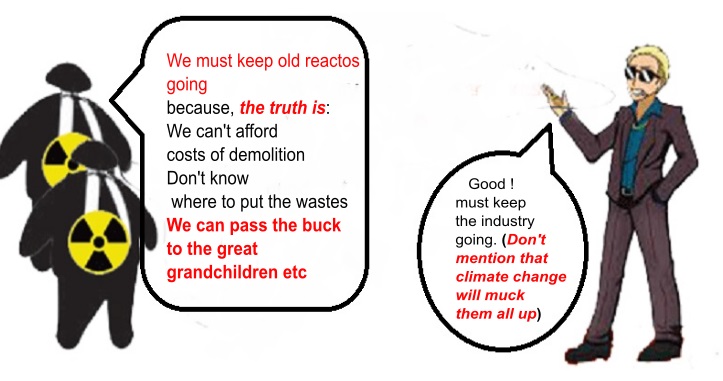
French nuclear watchdog ASN issued a decision allowing for the continued
operation of state-owned utility EDF’s Tricastin 1 nuclear reactor in
southern France, the first lifetime extension granted to a French reactor
after 40 years of operation.
In a decision published on Aug. 10 and seen by
Reuters on Tuesday, ASN granted the reactor an extension until its next
review, so for another ten years. Some 32 of France’s fleet of 56 reactors
are up for their fourth ten-yearly inspection this decade, leaving French
energy production reliant on securing a swathe of reactor extensions for
another ten years.
Reuters 22nd Aug 2023
EDF Warns of French Nuclear Output Cuts in Weekend Heat Wave
Bloomberg, By Francois De Beaupuy, August 22, 2023
Electricite de France SA will probably have to reduce nuclear output over the coming weekend as a heat wave affecting a large part of the country warms rivers used for cooling some of its reactors.
Due to the high temperatures forecast on Rhone river, production restrictions are likely to affect production at its Tricastin power plant — where two of its four 900-megawatt reactors are already………….(Subscribers only) more https://www.bloomberg.com/news/articles/2023-08-21/edf-warns-of-french-nuclear-output-cuts-in-weekend-heat-wave#xj4y7vzkg
French cruise ship makes rendezvous with Russian nuclear icebreaker near North Pole
Barents Observer, By Atle Staalesen August 20, 2023
The meeting between the two vessels took place in remote Arctic waters not far from the North Pole.
Video made by passengers onboard the 50 Let Pobedy and shared on social media shows the two vessels trading greetings and sailing side by side through thick sea-ice.
The Russian nuclear-powered icebreaker is on the way to the North Pole as part of an expedition for students. Shortly after its meeting with the tourist ship, it encountered also two other ships currently sailing in the area. According to ship operator Rosatom, the 50 Let Pobedy met with Arctic research station Severny Polyus, as well as research ship Akademik Tryoshnikov.
The latter ship had sailed all the way from St.Petersburg with new crew and equipment for the drifting station that is on a two-year expedition across the ice.
The Le Commandant Charcot is the new vessel built for cruise ship operator Ponant. It is classified as icebreaker and can make independent voyages to the North Pole. In 2021, it was first hybrid-electric luxury cruise ship to make it to the North Pole.
The ship set out on a 16-days expedition from Reykjavik in early August. It sails to the geographic North Pole and ends up in Longyearbyen, Svalbard.
It is not a voyage for the regular man and woman. The starting price per person is €31,485…………………………………………… https://thebarentsobserver.com/en/arctic/2023/08/french-cruise-ship-makes-rendezvous-russian-nuclear-icebreaker-near-north-pole
1 This Month



Shut down the radiation-damaged Heysham nuclear reactors now
To see nuclear-related stories in greater depth and intensity – go to https://nuclearinformation.wordpress.com

Say No to NASA’s Reckless Nuclear Reactor on the Moon
Say No to NASA’s Reckless Nuclear Reactor on the Moon
-
Archives
- October 2026 (256)
- September 2026 (339)
- August 2026 (330)
- July 2026 (355)
- June 2026 (287)
- May 2026 (306)
- April 2026 (356)
- March 2026 (251)
- February 2026 (267)
- January 2026 (308)
- December 2025 (358)
- November 2025 (359)
-
Categories
- 1
- 1 NUCLEAR ISSUES
- business and costs
- climate change
- culture and arts
- ENERGY
- environment
- health
- history
- indigenous issues
- Legal
- marketing of nuclear
- media
- opposition to nuclear
- PERSONAL STORIES
- politics
- politics international
- Religion and ethics
- safety
- secrets,lies and civil liberties
- spinbuster
- technology
- Uranium
- wastes
- weapons and war
- Women
- 2 WORLD
- ACTION
- AFRICA
- Atrocities
- AUSTRALIA
- Christina's notes
- Christina's themes
- culture and arts
- Events
- Fuk 2022
- Fuk 2023
- Fukushima 2017
- Fukushima 2018
- fukushima 2019
- Fukushima 2020
- Fukushima 2021
- general
- global warming
- Humour (God we need it)
- Nuclear
- RARE EARTHS
- Reference
- resources – print
- Resources -audiovicual
- Weekly Newsletter
- World
- World Nuclear
- YouTube
-
RSS
Entries RSS
Comments RSS

