World’s Largest Fusion Project Is in Big Trouble, New Documents Reveal

The ITER project formally began in 2006, when its international partners agreed to fund an estimated €5 billion (then $6.3 billion), 10-year plan that would have seen ITER come online in 2016. The most recent official cost estimate stands at more than €20 billion ($22 billion), with ITER nominally turning on scarcely two years from now. Documents recently obtained via a lawsuit, however, imply that these figures are woefully outdated: ITER is not just facing several years’ worth of additional delays but also a growing internal recognition that the project’s remaining technical challenges are poised to send budgets spiraling even further out of control and successful operation ever further into the future.
With each passing decade, this record-breaking monument to big international science looks less and less like a cathedral—and more like a mausoleum.
The International Thermonuclear Experimental Reactor (ITER) is already billions of dollars over budget and decades behind schedule. Not even its leaders can say how much more money and time it will take to complete
By Charles Seife on June 15, 2023. https://www.scientificamerican.com/article/worlds-largest-fusion-project-is-in-big-trouble-new-documents-reveal/?fbclid=IwAR3siLk4iSD43-SE6sBStfYeTIl9YNeZ5QcLz27JgQwMd85DcYV7kUmciw8
It could be a new world record, although no one involved wants to talk about it. In the south of France, a collaboration among 35 countries has been birthing one of the largest and most ambitious scientific experiments ever conceived: the giant fusion power machine known as the International Thermonuclear Experimental Reactor (ITER).
But the only record ITER seems certain to set doesn’t involve “burning” plasma at temperatures 10 times higher than that of the sun’s core, keeping this “artificial star” ablaze and generating net energy for seconds at a time or any of fusion energy’s other spectacular and myriad prerequisites. Instead ITER is on the verge of a record-setting disaster as accumulated schedule slips and budget overruns threaten to make it the most delayed—and most cost-inflated—science project in history.
ITER is supposed to help humanity achieve the dream of a world powered not by fossil fuels but by fusion energy, the same process that makes the stars shine. Conceived in the mid-1980s, the machine, when completed, will essentially be a giant, high-tech, doughnut-shaped vessel—known as a tokamak—that will contain hydrogen raised to such high temperatures that it will become ionized, forming a plasma rather than a gas. Powerful magnetic and electric fields flowing from and through the tokamak will girdle and heat the plasma cloud so that the atoms inside will collide and fuse together, releasing immense amounts of energy. But this feat is easier said than done.
Since the 1950s fusion machines have grown bigger and more powerful, but none has ever gotten anywhere near what would be needed to put this panacea energy source on the electric grid. ITER is the biggest, most powerful fusion device ever devised, and its designers have intended it to be the machine that will finally show that fusion power plants can really be built.
The ITER project formally began in 2006, when its international partners agreed to fund an estimated €5 billion (then $6.3 billion), 10-year plan that would have seen ITER come online in 2016. The most recent official cost estimate stands at more than €20 billion ($22 billion), with ITER nominally turning on scarcely two years from now. Documents recently obtained via a lawsuit, however, imply that these figures are woefully outdated: ITER is not just facing several years’ worth of additional delays but also a growing internal recognition that the project’s remaining technical challenges are poised to send budgets spiraling even further out of control and successful operation ever further into the future.
The documents, drafted a year ago for a private meeting of the ITER Council, ITER’s governing body, show that at the time, the project was bracing for a three-year delay—a doubling of internal estimates prepared just six months earlier. And in the year since those documents were written, the already grim news out of ITER has unfortunately only gotten worse. Yet no one within the ITER Organization has been able to provide estimates of the additional delays, much less the extra expenses expected to result from them. Nor has anyone at the U.S. Department of Energy, which is in charge of the nation’s contributions to ITER, been able to do so. When contacted for this story, DOE officials did not respond to any questions by the time of publication.
The problems leading to these latest projected delays were several years in the making. The ITER Organization was extremely slow to let on that anything was wrong, however. As late as early July 2022, ITER’s website announced that the machine was expected to turn on as scheduled in December 2025. Afterward that date bore an asterisk clarifying that it would be revised. Now the date has disappeared from the website altogether. ITER leaders seldom let slip that anything was awry either. In February 2017 ITER’s then director general, the late Bernard Bigot, discussed its progress with DOE representatives. “ITER is really moving forward,” he said. “We are working day and night…. The progress is on schedule.” The timeline he presented implied that everything was on track. Construction of the ITER complex’s foundation, which incorporates an earthquake protection system with hundreds of tremor-dampening rubber- and metal-laminated plates, should have been almost complete. From there, assembly of the reactor itself was planned to begin in 2018. At the time of Bigot’s remarks, two of its major pieces—a massive magnetic coil to wrap around the doughnutlike tokamak and a large section of the vacuum vessel that makes up the tokamak’s walls—were supposed to be ready to ship within the month and by the end of the year, respectively. Instead the coil would take almost three more years to complete, as would the vessel sector. The pieces were completed in January and April 2020, respectively. In fact, a large proportion of the big components of the machine were behind schedule by a year or two years or even more. Soon ITER’s official start of assembly was bumped from 2018 to 2020.
Then, in early 2020, the COVID pandemic struck, slowing manufacturing and shipping of machine components.
Continue readingSafety issues for 9 French nuclear reactors make their lifetime extension doubtful

Up to nine French nuclear reactors (9 GW) may not be suitable for lifetime
extensions beyond their 50-year operating stint due to safety issues, said
the country’s ASN nuclear regulator.
The safety body – which would make a
final decision by late 2026 on plans by operator EDF to extend the lives of
as many if the country’s 56 reactors to 60 years or more – was particularly
concerned about certain pipe bends in the primary circuit of five reactors,
it added in a report late on Wednesday.
The reactors were Blayais 3,
Dampierre 4, St Laurent 2, Tricastin 4 (around 900 MW each), and Paluel 2
(1.3 GW). Meanwhile, in southeastern France, the 3.7 GW Cruas nuclear plant
could also be shut down if a fault line was discovered where the unit was
sited, said the ASN. Investigations were underway following an earthquake
that occurred 15km away in November 2019.
Montel News 15th June 2023
https://www.montelnews.com/news/1505270/9-french-reactors-may-not-be-suitable-for-extensions–asn
French nuclear watchdog specifies questions for EDF reactor life extensions

June 15, 2023, https://www.reuters.com/business/energy/french-nuclear-watchdog-specifies-questions-edf-reactor-life-extensions-2023-06-14/
PARIS, June 14 (Reuters) – French nuclear operator EDF (EDF.PA) will have to assess several technical challenges during the review period for a lifespan extension to 60 years for its nuclear fleet, watchdog ASN said in a press release on Wednesday.
ASN is asking the French power giant to address the mechanical resistance of certain portions of the main pipes of the primary circuit for several reactors and analyze feedback from an earthquake around the Cruas plant in 2019.
Other factors, such as the expected effects of climate change and the operation of facilities for the different stages of the fuel lifecycle, will also need to be addressed, the press release said.
EDF said the group was currently looking into the questions raised by the watchdog and was confident in its ability to meet the safety conditions necessary for the continued operation of all its reactors past 50 years.
Particular attention is being paid to the four Cruas reactors near a geological fault, and the conclusion may lead to a specific approach for the extension of these reactors, the group said.
The piping components ASN are concerned with are difficult to adjust or fix, as they connect the primary circuit to the reactor vessel, exposing workers to high doses of radiation.
EDF said it was working on automating a mechanical process in case an intervention is needed.
Reporting by Forrest Crellin and Benjamin Mallet; Editing by Mark Porter and Mark Potter
France says nuclear power is ‘non-negotiable’

EURACTIV.com with AFP 9 June 23
French nuclear power is “an absolute red line” and non-negotiable, Finance Minister Bruno Le Maire said Thursday (8 June), following Franco-German disagreements over the role of nuclear energy in Europe.
Nuclear-reliant Paris has already irked Berlin by insisting on giving nuclear energy a starring role in European plans to produce more green technology in Europe.
“Nuclear power is an absolute red line for France, and France will not relinquish any of the competitive advantages linked to nuclear energy”, Le Maire insisted as he closed the annual conference of the French Electricity Union.
France’s 56 ageing reactors normally provide some 70% of France’s electricity needs.
“French nuclear power is non-negotiable and will never be negotiable. We will have to live with it, and we are convinced that it is not only in France’s interest, but also in the interest of the European continent”, he added.
Spat over EU’s renewable energy directive
Earlier, at the same meeting, German state secretary for economic affairs and climate action Stefan Wenzel acknowledged that France and Germany “often have different approaches in energy policy, especially concerning nuclear energy”
Germany “respects diverging choices for other fossil fuel energy sources by other member states as France that may similarly contribute to achieve climate neutrality,” he added.
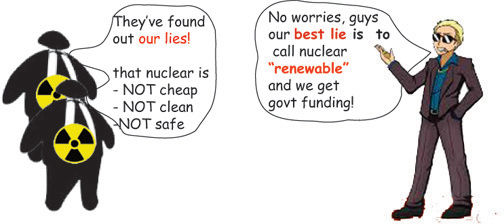
However “what we cannot accept is when nuclear energy is defined as renewable, or low-carbon hydrogen is equated with green hydrogen”.
Agreement on the EU’s revised renewable energy directive was delayed last month as France requested further “guarantees” to limit the share of renewable hydrogen production for countries that already have significant amounts of low-carbon hydrogen derived from nuclear power…………………… https://www.euractiv.com/section/energy-environment/news/france-says-nuclear-power-is-non-negotiable/
France fully nationalises debt-laden nuclear power group EDF, after its record loss last year
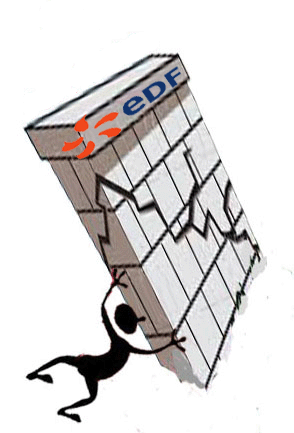
EDF quits Paris stock exchange after full nationalisation. French nuclear
power group EDF (EDF.PA) returns to full state ownership on Thursday with
its de-listing from the Paris stock exchange after it suffered a record
loss last year and saw nuclear output fall to a 34-year low.
The government launched a buyout for the 16% stake it did not already own in EDF in late
2022, stumping up around 10 billion euros ($10.9 billion) to take full
control of the debt-laden operator of Europe’s largest fleet of nuclear
power plants.
Reuters 8th June 2023
https://www.reuters.com/business/energy/french-utility-giant-edfs-history-2022-07-08
France’s triple dependence on nuclear fuel .
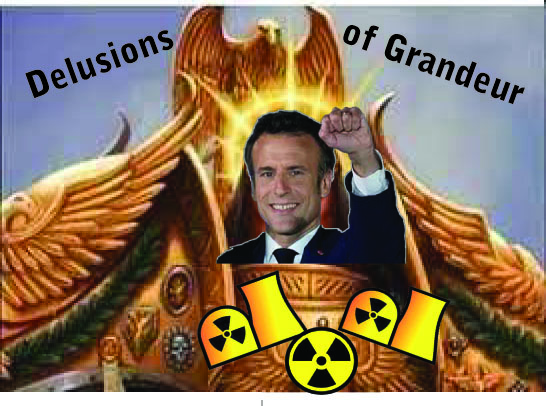
the main argument of this policy is “national energy independence”, moreover making a misleading shortcut from energy to electricity and from it nuclear power, an imaginary symbol of supposed independence.
Tuesday, May 30, 2023, by Bernard Laponche , Jean-Claude Zerbib, m https://www.global-chance.org/IMG/pdf/gc_la_triple_de_pendance_mai_2023_v2.pdf
Introduction
With 56 reactors spread over 18 EDF nuclear power plants, approximately 70% of electricity production in France is ensured by the use of nuclear energy, thanks to the production of heat by the combination of fission and chain reaction in reactors.
This situation makes France the most “nuclearized” country in the world in proportion to its population and the third in level of production after the United States and China, which are much more populous.
The program of reactors currently in operation (including the two Fessenheim reactors being dismantled) was launched in the early 1970s and reinforced by the “Messmer Program” of 1974, on the occasion of the first “oil shock”, inaugurating the “all-electric-all-nuclear” policy which continued until the construction of the Flamanville EPR in 2007, which has still not started.
The current government places itself in this line by advocating the extension of the duration of operation of the current reactors and the construction of a certain number of reactors of the EPR2 sector, heir to the EPR.
As at the time, and although times have changed, the main argument of this policy is “national energy independence”, moreover making a misleading shortcut from energy to electricity and from it nuclear power, an imaginary symbol of supposed independence. Let us admit, however, that the design and construction of the reactors are “national”, although much equipment is imported, the fact remains that the design is essentially that of the enriched uranium and pressurized water reactors of Westinghouse origin, and that the “francization” carried out at the beginning of the 1980s now raises a lot of questions, in particular with the discovery of cracks caused by corrosion under stress or thermal fatigue, which plague a certain number of reactors, including the most recent ones.
On the other hand, independence is far from being acquired on the side of the “nuclear fuel” which “boils the pot”. Indeed, natural uranium, the raw material for fission, has been completely imported for several decades. The suppliers are numerous but, among the main ones, Kazakhstan, Niger, Uzbekistan, Australia, Canada, three present geopolitical risks. But, we are told, since France has an enrichment plant, a reprocessing plant and fuel fabrication plants, we could rest easy.
The reality is much more complex.
On the other hand, independence is far from being acquired on the side of the “nuclear fuel” which “boils the pot”. Indeed, natural uranium, the raw material for fission, has been completely imported for several decades. The suppliers are numerous but, among the main ones, Kazakhstan, Niger, Uzbekistan, Australia, Canada, three present geopolitical risks. But, we are told, since France has an enrichment plant, a reprocessing plant and fuel fabrication plants, we could rest easy.
The reality is much more complex.
The purpose of this article is to assess:
- The tonnages of uranium which are delivered directly to France by the producing country, in the form of yellow cake and then undergo all the transformations, up to being put into the form of assemblies;
- The tonnages of natural uranium transiting through a third country, to arrive in France in the form of enriched uranium, gaseous or solid, or even fuel assemblies produced abroad;
- EDF’s depleted uranium enrichment operations in Russia;
- EDF and Orano’s reprocessing uranium enrichment operations in Russia.
- Manufacture of fuel assemblies, partly carried out abroad.
Thus will be established the triple dependence, total or partial, in the supply of natural uranium, in the enrichment of natural uranium, depleted uranium and reprocessed uranium and, in the manufacture of fuel assemblies.
This article is dedicated to the memory of André Guillemette, member of Global Chance and ACRO, expert in issues related to the reprocessing of irradiated fuels and the plutonium industry, author of several articles on these subjects, in particular in collaboration with Jean-Claude Zerbib, published on the Global Chance website ( www.global-chance.org ).
To read the full text https://www.global-chance.org/IMG/pdf/gc_la_triple_de_pendance_mai_2023_v2.pdf—
French defense minister opposes American takeover of nuclear firm
Economy ministry makes the final ruling.
BY GIORGIO LEALI, MAY 24, 2023 https://www.politico.eu/article/french-defense-ministry-to-block-american-takeover-of-nuclear-firm/
PARIS — France’s defense minister Sébastien Lecornu said he would veto the takeover of nuclear-submarine parts supplier Segault by American industrial machinery giant Flowserve.
“The defense ministry will veto the loss of operational control over company Segault,” Lecornu told French lawmakers Tuesday evening. “I never announced it publicly, but it’s done,” he said.
“For us it’s simple: we don’t want Segault to be controlled by an American company,” said an official from the defense ministry who was not authorized to be named.
France’s economy ministry, which has the final word on the file, was however quick to stress that no decision had been made. “The foreign investment screening procedure is ongoing,” said a French economy ministry spokesperson, declining to comment on the potential outcome.
While the defense ministry participates in the decision-making, the French economy ministry makes the final ruling.
France-based Segault is currently owned by Canada’s industrial valves group Velan, which is being bought by American industrial machinery giant Flowserve. If the deal goes through, Segault would become American-controlled, raising concerns in Paris’ halls of power that Washington would then have access to strategic French technology.
Paris last month confirmed that it was looking for a French buyer, as the file turned into a test of France’s industrial sovereignty ambitions.
Segault supplies components for nuclear-propelled submarines built by state-owned shipbuilder Naval Group and also makes industrial valves that are used on France’s flagship Charles de Gaulle aircraft carrier.
Global heating is predicted to trigger more nuclear outages in France every year.

extreme heat and droughts amid
climate change could impact nuclear plants, which use water to cool down.
EDF expects to lose 1.5% of its nuclear output, or about 5 TWh, annually
by 2050 due to the impact of global warming based on an average production
of 400 TWh, an executive said on Tuesday.
This compares with a current
average loss of nuclear power output caused by global warming of 0.3%, or
1.2 TWh, Cecile Laugier, head of environment at EDF’s nuclear branch,
told reporters. This echoes a report released in March by France’s Court
of Auditors, which said global warming could trigger three to four times
more outages than today. Increased risk of extreme heat and droughts amid
climate change could impact nuclear plants, which use water to cool down.
Montel 16th May 2023
https://www.montelnews.com/news/1499729/heat-to-cause-15-yearly-nuclear-output-loss-by-2050–edf
France to speed up nuclear power deployment
By Davide Basso | EURACTIV.fr 17 May 23
A bill to speed up the construction of new nuclear reactors was approved by the French parliament on Tuesday (16 May), with the government hailing it as an environmental step forward.
Lawmakers on Tuesday validated the bill to accelerate the construction of new nuclear reactors. The compromise text struck between the National Assembly and the Senate was voted by 339 votes to 399.
MPs from the majority (Renaissance, Horizons, Modem), the independents (LIOT), the right (Les Républicains) and the extreme right (Rassemblement national) voted in favour of the text, in addition to a dozen communist MPs.
Among the opponents, the Greens, the radical left (La France insoumise) and a handful of Communists voted “against” while the Socialists abstained.
Once it comes into force, the new law will speed up the construction of new nuclear reactors by simplifying the required administrative procedures and planning documents. The Energy Transition Ministry expects future construction times to be reduced by at least two years.
In addition, a 50% cap on nuclear power’s share of France’s electricity mix was removed. The text also provides for tightening the penalties for those who illegally enter a nuclear power plant, now set at a maximum of two years imprisonment.
….. Environmental NGOs denounced “a law that is disconnected from ecological and climatic imperatives”. Greenpeace, in particular, questioned “the slowness of the construction of nuclear reactors”, as well as “the safety” and “the conflicts of water use” that are to be expected………………. https://www.euractiv.com/section/politics/news/france-to-speed-up-nuclear-power-deployment/
Nuclear power and the technocratic system are not compatible with democracy: France’s group in Grenoble that fights this system
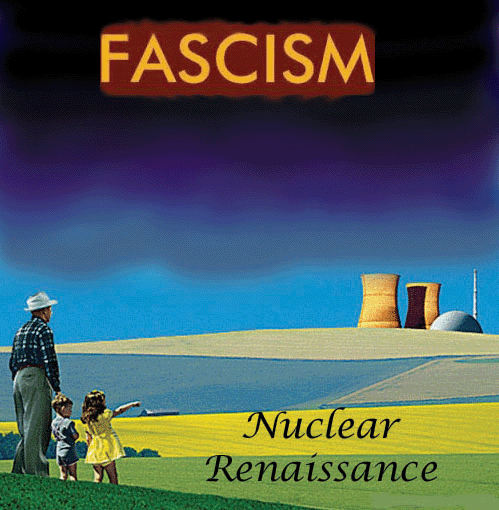
The nuclear renaissance is a repeat of the fiasco of 1974. Published in La Relève et La Peste, Text prepared by Laurie Debove, January 30, 2023, Translation by Dennis Riches
Translator’s introduction
This interview published in January 2023 has a message for Oliver Stone and all the other cheerleaders of a nuclear renaissance. Oliver Stone’s new film Nuclear Now is just a rehash of Nuclear Then. The discussion below illustrates that there is nothing new about the nuclear renaissance being promoted as a solution to global warming and fossil fuel shortages caused by war. Anti-nuclear arguments were valid then and they still are now, and there isn’t really anything new to add to them. ……………………..
Introduction
The government is doing everything to revive the nuclear industry in France at a rapid pace, to the detriment of the public debate underway until February 27, a debate which is supposed to take account of the opinion of the population on this subject. To get a historical and technological perspective on this issue, we interviewed two people from Grenoble who belong to “Pièces et main d’oeuvre.” They have been active in the fight against nuclear power since the 1970s. We met in a Grenoble café, and in the text below their answers have been edited and compiled into one common voice.
LR&LP: Could you introduce yourselves and your organization?
“……………………………………………..We produce ideas and participate in demonstrations because we believe that ideas can change and transform the course of the world, that they can oppose technology.
LR&LP: What led you to look at nuclear, and what are the biggest pitfalls you found?
“………………………………Throughout the 1940s, 50s and 60s, a divisive critique of nuclear power developed……………………. it was at this time that US President Eisenhower launched the program “Atoms for Peace,” saying that the atom can also have a civilian application in the form of nuclear power plants and research. It therefore proposed technology transfers from the United States to more than twenty countries that wanted to manufacture reactors.
……………. The moment we manufacture nuclear power, we manufacture the consequences of nuclear power and especially its waste.
As we supply the whole of society with nuclear power, we must maintain a scientific clergy of nucleocrats because it is a very complicated and dangerous technology, and on the other hand we must protect these nuclear power plants, mineral mines, transport, and waste with a dedicated militia because we do not want it to fall into the wrong hands.
With the civilian atom, there is therefore an entire electro-totalitarian society that is being set up with a state apparatus, a police, and a particular political organization. No more dreams and utopias of self-management or anarchy. Nuclear waste cannot be managed by just anyone. There is a ratchet effect in it where there is no turning back…………………………………………………………..
LR&LP: Here we are in 2022, and the Autorité de Sureté du Nucléaire (Nuclear Safety Authority) has launched an alert on the failures of the French nuclear fleet. Having seen both the establishment and the evolution of this fleet, was this predictable, and what do you think of the French nuclear recovery plan, imposed by the government, while we see that the [nuclear power plant] EPR of Flamanville has ten billion euros of additional cost as well as twelve years of delay in its construction?
P.M.O: That nuclear power plants wear out, like all factories, is a banality. The life cycle of a nuclear power plant is 100 years on average, from the time construction starts to the time it is decommissioned. Nuclear power costs a fortune, but no matter how much cheap French electricity is promoted, it is a lie. Over time, the state has financed EDF less so we have maintained the plants less. We have fewer trained specialists, and the private sector has not taken over of the cost.
Today we are witnessing a repeat of what happened in 1974 after the Yom Kippur War, when Arab countries punished the West by tripling oil prices. We did not have oil, but nuclear was an alternative, so Pompidou, Giscard d’Estaing and the Prime Minister at the time, Messmer, launched a plan to nuclearize France to compensate for the deficit in oil imports. The uranium came from Niger. We had the skills because the CEA existed since 1945 [for the bomb program]. EDF placed the orders and they manufactured nuclear power plants at a rapid rate.
It is striking to observe how Pierre Messmer’s speech on TV in 1974 and Emmanuel Macron’s speech in Belfort in 2021 are like twins! The recovery is justified by a drop in supplies: at the time the cause was the Arab countries and today it is the Russia-Ukraine conflict.
In the same way, there was an increase in demand at the time because people were forced to equip themselves with electric household appliances, and today it is the means of electric transport and gadgets like smartphones that create this additional demand. On the one hand, industry creates the demand and therefore the problem, and on the other hand it comes with the solution that the population cannot refuse.
The surprise is that we re-apply the same old methods with the same old arguments. It is a headlong rush to ignore the current disaster. We cannot have such a demand for electricity. It is neither sustainable nor reasonable.
……………..There is also the denial of the poisoning of the environment with radioactivity. We live in a world where radioactivity is anthropogenic. Physics teaches us that this is not going away. We could have anticipated all this.
………………………………………………….. a technocratic class developed. In the same way that technology has become the real politics of our time, the real ruling class of our time is technocracy: the class that has produced and is the product of technology (engineers, business leaders, some elected officials).
………… These people are keeping citizens in ignorance. The elected official will then surround himself with scientific advisors that he cannot control since he does not know how to solve their equations.
……….. The basic citizen has integrated this and understood that he does not understand anything, or not much. The citizen therefore relies on those who know.
…………………the technocratic system and technology have the power to change the world, yet it is not compatible with participatory democracy.
LR&LP: However, a public debate has been launched to ask citizens for their opinion. In your opinion, can participating in this public debate allow the French population to regain control over the decisions made on energy production in France? If not, what should everyone do for an informed debate on nuclear technology?
P.M.O: Public debates are like the bullfighter’s cape. The authorities know very well that there will be rants, foghorns, banners, and they find it very good since then the protest is confined to the “public debate”. Chantal Jouanno, the president of the National Commission for Public Debate (CNDP) said the banners are welcome in 2022 because of a precedent in the history of French public debate…………………………………………………………..
A yes or no outcome will have no impact. Sociologists themselves have defined public debate by saying “involvement is enforced acceptance.” For us, participation is therefore accepting, as we have written about extensively. To believe that they will take into account the opinion of citizens on such a vast social project is illusory.
The only real public inquiry on nuclear power ended in a fiasco. That was in Plogoff. The Bretons there refused the public inquiry and fought for weeks against the police. Every evening, hundreds of people gathered to throw stones and slurry because, for them, every form of pseudo-consultation was a smokescreen. This explains why there has never been a nuclear power plant built in Plogoff while they have been built everywhere else.
LR&LP: Power is in the hands of technocrats. “Participation is enforced acceptance.” Therefore, how can a citizen regain an influence in energy production?
“………………………………………………………..The only force likely to turn the tide would be a collective realization that it is not sustainable to continue to consume so much energy, physically and materially, because of entropy and its effects. We would then have to decide to get rid of this energy-intensive and material-intensive lifestyle, and give up certain habits, but it remains an abstract goal.
The problem is that people do not necessarily demand democracy. They are like passengers on a train who, of course, don’t want to be able to drive it. Most people just want a society that works. The question is how.
Further reading
The latest book published by Pièces et Main d’oeuvre:
Technocracy: The Ruling Class of the Technological Age https://dennisriches.wordpress.com/2023/05/14/the-nuclear-renaissance-is-a-repeat-of-the-fiasco-of-1974/
France’s government postpones its nuclear safety reform indefinitely.
The merger of ASN and IRSN will not be examined by a joint committee during the
examination of the nuclear acceleration law on May 4th. The OPECST is
invited to discuss the future of this controversial merger. Game over for
the nuclear safety reform project. Announced by the government at the
beginning of February, the merger of the Nuclear Safety Authority, in
charge of civil nuclear safety, and the Institute for Radiation Protection
and Nuclear Safety (IRSN), in charge of nuclear safety expertise “is
withdrawn,” said the office of Energy Minister Agnès Pannier Runacher on
Friday.
Les Echos 28th April 2023
France and Russia have “a win-win partnership” on the nuclear industry

France to Work With Russia on Hungarian Nuclear Project Despite EU Criticism
France’s energy transition ministry has permitted Framatome, a nuclear energy subsidiary of Électricité de France (EDF), to contribute to the construction of two reactors at the Hungarian Paks-2 nuclear power plant alongside Russian state-run nuclear bigwig Rosatom, according to a report by French news outlet Le Monde on April 27.
………… The said project has been contentious among some EU members, owing to the bloc’s sanctions against Russia.
…………………………. Last month, Hungarian Foreign Minister Péter Szijjártó disclosed that Hungary might increase the contributions of Framatome in the project, after encountering roadblocks with Germany’s Siemens Energy, in the context of Ukraine-linked sanctions and Germany’s reduction of nuclear power as an energy source. Both companies had been contracted to provide control systems for new reactors at Paks-2 as part of a French-German consortium.
“Since the German government is blocking for political reasons the contractual participation of Siemens Energy, we wish to rely more on the French,” said Szijjártó ……………………………………..
Unveiled in 2014 under an agreement between Hungary and Russia, the Paks-2 project aimed to construct two new nuclear reactors by Rosatom and a Russian state loan to bankroll most of the project……..
In wake of the Russo-Ukraine conflict, anti-Russian observers and policymakers saw Framatome’s participation in the setting up of two nuclear reactors in Hungary led by the Russian state-owned group Rosatom as an ill-advised move.
……. , “to date, European sanctions [against Russia] do not target the nuclear industry,” the French ministry said.
………………………… The EU and Ukraine have been mounting pressure on France to fully sever relations with Russia’s atomic sector amid rounds of sanctions against Moscow, ramping up scrutiny of France’s links with Rosatom.
Collaboration with Rosatom has been a hot-button issue among France and other EU countries dependent on Russia for nuclear fuel. While 2022 saw the suspension of a great deal of commercial cooperation, some French state-controlled companies continue to maintain some ties with Rosatom.
…………………………………… Rosatom called the Franco-Russian alliance “a win-win partnership” that is “a driver of development both in the field of nuclear energy and scientific projects.”
……. French companies provide technology to Rosatom whenever the Russian behemoth constructs a nuclear plant abroad, with Rosatom usually spending up to €1 billion per project, encompassing command and control systems from Framatome, Faudon revealed.
……….. Apart from France, the United States also purchased $830 million of enriched uranium from Russia last year. Reactors in Bulgaria, the Czech Republic, Finland, Slovakia, and Hungary obtain fuel from Russia as well…………………………………….more https://thenewamerican.com/france-to-work-with-russia-on-hungarian-nuclear-project-despite-eu-criticism/
“We won’t be scapegoats!” — French opposition to nuclear waste dumping

“This land is our land.” French goats bleat against nuclear fuel pool threat
“We won’t be scapegoats!” — Beyond Nuclear International
Contrary to popular propaganda, nuclear reprocessing is not recycling. This has never been more evident than in the current crisis at La Hague, where the irradiated fuel pools are now full to capacity. Part of the reason is the country’s insistence on producing mixed-oxide reactor fuel from the plutonium and uranium separated at La Hague. So much of it has proven defective, that is has been returned to La Hague, filling up the fuel pools.
opposing French plans to extend the licenses of current reactors and to build new ones with, as they point out, absolutely no consideration of what will happen to the radioactive waste.
A new tongue-in-cheek rebellion has risen in France, but the cause is deadly serious
By Linda Pentz Gunter, https://beyondnuclearinternational.org/2023/04/30/we-wont-be-scapegoats/
In France, civil disobedience and defiance of authority — and authoritarianism — is in the national DNA. We have seen it most recently in the demonstrations against the raising of the retirement age, and against proposed agricultural reservoirs known as mega-basins. Before that it was the “yellow vests”, angered at a rise in fuel prices. Further back came the Resistance during World War II, and even further back, of course, the Revolution of 1789.
The French anti-nuclear movement is no exception and has engaged in protests that deliver considerable numbers and abundant creativity — and sometimes a lot of useful tractors as well.
It’s no surprise then to learn that such continued defiance has now spread: to goats.
Before continuing, it’s necessary to explain what a ZAD is. In French, it stands for Zone À Défendre (zone to defend.) ZADs are usually occupations or blocades created by citizens protecting something they deem precious from development or destruction. There are scores of ZADs across France, deemed illegal by French authorities. ZADs have sometimes won, most notably at Notre-Dame-des-Landes, where an unpopular airport project was stopped.
But raids on ZADs can sometimes turn violent, and authorities can over-react as they did in February 2018 at Bure, when 500 gendarmes went in to remove just 15 anti-nuclear activists occupying and attempting to protect the forested site targeted to become the country’s high-level radioactive waste dump.
Dressed in riot gear, the gendarmes used bulldozers, trucks, helicopters, drones and chainsaws to confront the occupiers, self-described “owls” who had been living in tree houses and lookout towers for the past 18 months.
Now, activists around the La Hague nuclear reprocessing site on the northern Cherbourg peninsula, have redefined the ZAD acronym to stand for Zone À Déchets (Waste Zone), and specifically radioactive waste.
Contrary to popular propaganda, nuclear reprocessing is not recycling. This has never been more evident than in the current crisis at La Hague, where the irradiated fuel pools are now full to capacity. Part of the reason is the country’s insistence on producing mixed-oxide reactor fuel from the plutonium and uranium separated at La Hague. So much of it has proven defective, that is has been returned to La Hague, filling up the fuel pools.
A slowdown in reprocessing due to technical failures has also hastened the overcrowding of La Hague’s four spent fuel pools with excess irradiated fuel rods. These pools risk saturation by 2030 and the French safety authority has criticized La Hague owner, Orano’s suggestion that it could pack the pools more densely as this raises safety risks.
The owner of the French nuclear fleet, EDF, is responsible for managing the waste fuel their reactors produce. Its solution to the overcrowding at La Hague is to build a new fuel pool at the site, at a cost of $1.37 billion.
And that has locals up in arms — and hooves.
Normandy, the province in which La Hague is located, is strongly agricultural. Cows — and dairy products — abound. As do goats. While those still domesticated produce cheese, there is also a significant and famous wild goat population, known as les chèvres des fossés, that ranges freely on the coastal cliffs.
Accordingly, a new La Hague opposition group, Piscine Nucléaire Stop (Stop the Nuclear Fuel Pool), found a way to communicate the threat a new fuel would pose to agriculture and the environment by recruiting some goats to their cause.
In an amusing action that was posted on Facebook and was covered in the press, the activists placed an array of artistic — and realistic — cut-out goats at an intersection in the town of Jobourg, one of the communities that would be affected by the health and environmental risks of a new nuclear fuel pool. The town gives its name to the famous wild Jobourg goats and has erected a statue in their honor.
Then the goats put out their own statement. It read:
“We nanny and billy goats of Jobourg, claim our right to decide the fate of our land, and affirm today our opposition to the EDF spent fuel storage pool project.
Continue readingFrance to participate in Russian Rosatom’s Hungary nuclear power plant project.
Hungary: France ready to participate in Russian Rosatom’s nuclear power
plant project. The executive gave the green light to Framatome to take part
in the construction of two new reactors at the Paks power plant, arguing
that the nuclear industry is not targeted by international sanctions
against Russia.
Le Monde 27th April 2023.
EDF Q1 revenues rise but nuclear output declines
PARIS, April 28 (Reuters) more https://www.reuters.com/business/energy/edf-says-q1-revenues-rise-nuclear-output-down-2023-04-28/ Reporting by Benjamin Mallet, editing by Silvia Aloisi – French nuclear power giant EDF (EDF.PA) said first-quarter like-for-like sales rose by 34.6% to 47.8 billion euros ($52.64 billion) thanks to higher electricity and gas prices, though it reported a fall in nuclear output due to reactor outages and strikes in France.
Reporting by Benjamin Mallet, editing by Silvia Aloisi
“This decrease is explained by a lower nuclear fleet availability, mainly due to outages for the controls and repairs on the pipes affected by the stress corrosion phenomenon, and to the impacts of social movements,” EDF said in a statement.
The group, which is in the process of being fully nationalised, confirmed its estimate of nuclear output in France for 2023 in a range of 300-330TWh.
Nuclear production fell to a 34-year low last year due to a record number of reactor outages at EDF, turning France into a net importer of electricity for the first time since 1980.
1 This Month

of the week – Shut Down Drone Warfare!


Tell the Ukrainian Government to Drop Prosecution of Peace Activist Yurii Sheliazhenko

Petition to revoke the licensing of the Near Surface Nuclear Disposal Facility (NSDF) at Chalk River. https://www.ourcommons.ca/petitions/en/Petition/Details?Petition=e-7247
To see nuclear-related stories in greater depth and intensity – go to https://nuclearinformation.wordpress.com
-
Archives
- March 2026 (244)
- February 2026 (268)
- January 2026 (308)
- December 2025 (358)
- November 2025 (359)
- October 2025 (376)
- September 2025 (257)
- August 2025 (319)
- July 2025 (230)
- June 2025 (348)
- May 2025 (261)
- April 2025 (305)
-
Categories
- 1
- 1 NUCLEAR ISSUES
- business and costs
- climate change
- culture and arts
- ENERGY
- environment
- health
- history
- indigenous issues
- Legal
- marketing of nuclear
- media
- opposition to nuclear
- PERSONAL STORIES
- politics
- politics international
- Religion and ethics
- safety
- secrets,lies and civil liberties
- spinbuster
- technology
- Uranium
- wastes
- weapons and war
- Women
- 2 WORLD
- ACTION
- AFRICA
- Atrocities
- AUSTRALIA
- Christina's notes
- Christina's themes
- culture and arts
- Events
- Fuk 2022
- Fuk 2023
- Fukushima 2017
- Fukushima 2018
- fukushima 2019
- Fukushima 2020
- Fukushima 2021
- general
- global warming
- Humour (God we need it)
- Nuclear
- RARE EARTHS
- Reference
- resources – print
- Resources -audiovicual
- Weekly Newsletter
- World
- World Nuclear
- YouTube
-
RSS
Entries RSS
Comments RSS
 nuclear-news