Macron slams ‘unacceptable’ Israeli attacks on Lebanon
The French president stressed that the Jewish state’s military operation violates international law and will not enhance its security.
20 Mar, 2026, https://www.rt.com/news/635660-macron-condemns-israel-lebanon-attacks/
Israel’s ongoing military operation in Lebanon violates international law, French President Emmanuel Macron has said.
Speaking at a European Council press conference in Brussels on Thursday, Macron also criticized the attacks on Israel being carried out by Lebanese-based militant movement Hezbollah, which has vowed to avenge the US-Israeli killing of Iranian Supreme Leader Ali Khamenei.
Macron rejected the notion that a third party could resolve the conflict with the Iran-linked group through force, emphasizing that only Lebanese authorities have the legitimacy to address the issue.
“We don’t think that the fight against Hezbollah and the removal of its weapons can be carried out by a third power,” Macron told reporters. “We believe that Israel’s ground military operation and bombardments are inappropriate and even unacceptable in terms of international law and the interests of both the Lebanese and Israel’s long-term security.”
Macron also pointed out that Israel has conducted similar operations in Lebanon for years without ever producing the “expected results.”
The French leader’s comments come as Israel has expanded its military campaign against Hezbollah following the US-Israeli strikes on Iran that began late last month. The Israel Defense Forces announced “limited and targeted ground operations against key Hezbollah strongholds” earlier this week, escalating cross-border hostilities that have already claimed hundreds of lives.
Lebanese authorities report that Israeli strikes have killed over 880 people over the past two weeks, with more than 2,000 injured and over 1 million displaced. The strikes have targeted residential districts, a UN peacekeeping position, and a Russian cultural center in the southern city of Nabatieh.
On Thursday, RT correspondent Steve Sweeney and his cameraman Ali Rida Sbeity were also injured in what appeared to be a deliberate Israeli airstrike on their filming position, despite them wearing clearly labeled press uniforms.
Moscow has condemned Israel over the strike, with Russian Foreign Ministry spokeswoman Maria Zakharova stressing that the attack on journalists wearing press markings “cannot be called accidental given the killing of two hundred journalists in Gaza.”
Macron names next $11.5 billion nuclear-powered aircraft carrier ‘France Libre’ as a symbol of independence

“a symbol of national independence“?
At $11.5 billion, it looks more like capture of the French government by the nuclear lobby
French President Emmanuel Macron on Wednesday named France´s next
nuclear-powered aircraft carrier the France Libre (“Free France”), framing
it as a symbol of national independence and a push to strengthen the
country´s naval forces, whose presence in the Middle-East region has been
significant since the start of the Iran war. Macron unveiled the warship´s
name during a visit to the shipyard in the Western town of Indret, where
its two nuclear reactors are to be built. The France Libre, which is to
enter service in 2038, will have a capacity for 30 Rafale fighter jets and
2,000 sailors, for an estimated cost of 10 billion euros ($11.5 billion).
Daily Mail 18th March 2026, https://www.dailymail.co.uk/wires/ap/article-15658609/Macron-names-nuclear-powered-aircraft-carrier-France-Libre-symbol-independence.html
France officially enters Nuclear Arms Race

4 March 2026
In what can only be called a worst case scenario, the burgeoning nuclear arms race has officially broken its bounds and will now include the world’s fourth largest nuclear superpower, France. (Counting only nuclear weapons actively deployed, France ranks third, behind the US and Russia, as less than 5% of China’s nuclear stockpile is actually deployed.)
Without offering precise numbers, French President Emmanuel Macron announced on Monday that France would increase its nuclear stockpile, currently estimated to include 290 nuclear warheads.
Macron also announced plans to build a second nuclear-powered aircraft carrier that would, like the currently deployed Charles de Gaulle, be capable of launching nuclear armed Rafale fighter jets.
In addition, Macron announced that some nuclear-capable Rafale jets might be temporarily deployed to allied European countries, naming Britain, Germany, Poland, the Netherlands, Belgium, Greece, Sweden, and Denmark. This move expands France’s “nuclear umbrella” and places intermediate range missiles closer to Russia; it also positions France to replace US nuclear-armed aircraft currently deployed in three of those countries (Germany, Belgium, and The Netherlands) in the case of US withdrawal from NATO.
France, like the US, Russia, China, and Great Britain, is a signatory to the Treaty on the Nonproliferation of Nuclear Weapons. That Treaty requires nuclear-armed states to pursue “in good faith” a cessation of the arms race and complete nuclear disarmament “at an early date.” Since the signing of that Treaty more than fifty years ago, the US and Russia have intermittently engaged in negotiations leading to reductions in stockpile size, but both have also maintained nuclear arsenals with more than 3,500 warheads and show no signs of attempting a full disarmament campaign.
That reality, along with the consistent refusal of the nuclear powers to provide required reports to the United Nations about efforts to comply with NPT obligations, led non-nuclear nations to adopt the Treaty on the Prohibition of Nuclear Weapons in 2017. The TPNW entered into force in January 2021 and now has the support of a majority of global states.
The United States government has been dismissive of the TPNW, denouncing it when it was being negotiated in 2017 and ignoring it since then. The government’s attempt to pretend the Treaty does not exist has been abetted by US mainstream media that resolutely refuses to mention the TPNW even in articles exploring the current status of the nuclear threat that include hand-wringing about the failure of arms control efforts.
That same mainstream media has, in recent months, begun to speak of the new global nuclear arms race—something OREPA has been warning about for more than a decade. Fifteen years ago, we pointed out that US investment in “modernization” of its nuclear capabilities, including building new bomb plants like the Uranium Processing Factility in Oak Ridge, was pushing the world toward a new nuclear arms race.
Unfortunately, our prescience has since been validated. Today, as mainstream media used words like “verge” and “brink” to talk about the nuclear arms race, some media with deeper knowledge describe the situation more accurately. The Bulletin of Atomic Scientists, for instance, has stated that we are in a full-blown global nuclear arms race.
Until Macron’s announcement, that global nuclear arms race was considered to be between the US, Russia, and China. But as the illusion of the old “rules-based” world order collapses, nuclear weapons are once again being deployed as viable threats and, potentially, the beginning of the end for planet Earth.
Macron’s Monday speech did follow one long-standing rule of the nuclear establishment—never mention the human cost of nuclear weapons. Any conversation that includes the damage done to human beings, men, women, children, families, by nuclear weapons production, testing, use, and threat of use; or that mentions the trillions of dollars being spend on these weapons of mass destruction while hundreds of millions of people go hungry and lack health care and shelter; or that accounts for massive environmental damage at mines, processing, production, and testing sites around the world; or that warns of the effects of nuclear winter in the event of a nuclear exchange—would undermine if not erase arguments that nuclear weapons have a role in providing security in any rational, human sense.
As victims of nuclear weapons, the hibakusha, survivors of Hiroshima and Nagasaki, winners of the 2024 Nobel Peace Prize, courageously share their witness, telling the story of the worst day of their lives, the unimaginable horror of the devastation, death, and destruction wrought by bombs that, by today’s standards, are tiny. Their conclusion is the only one that makes sense—nuclear weapons must never be used again, and the only way to guarantee that is to abolish them altogether.
There exists today a path to nuclear disarmament, and it is not the path laid out by Emmanual Macron. It is the Treaty on the Prohibition of Nuclear Weapons, the only hope we have of avoiding a nuclear holocaust. As then-director of the International Campaign to Abolish Nuclear Weapons, Beatrice Fihn, said in accepting the 2017 Nobel Peace Prize: “There are only two possible outcomes to the story of nuclear weapons. Either we do away with them, or they will do away with us.”
Macron plans to deploy nuclear weapons to Britain
French president announces dramatic increase in arsenal and says allies could host its aircraft.
Henry Samuel in Paris. James Crisp, 02 March 2026
French nuclear-armed jets could be stationed in Britain and other allied European countries after Emmanuel Macron unveiled a dramatic expansion of France’s deterrence doctrine…
The French president also used the symbolic
setting of Île Longue, the country’s Atlantic nuclear fortress in
Brittany, to announce the first increase in its nuclear warhead stockpile
since the 1990s.
Telegraph 2nd March 2026,
https://www.telegraph.co.uk/news/2026/03/02/macron-plan-nuclear-weapons-britain/
France to increase its number of nuclear warheads, Macron says – as it happened
French president says deterrent needs to be ‘strengthened’ in recognition of new challenges
Jakub Krupa, 3 Mar 26,
https://www.theguardian.com/world/live/2026/mar/02/eu-response-middle-east-conflict-evacuate-citizens-europe-live-latest-news
- French president Emmanuel Macron has said France would increase the number of nuclear warheads and allow for temporary deployment of its nuclear-armed aircraft to allied countries for exercises as part of its new nuclear strategy seeking to “Europeanise” its deterrence programme (15:29, 15:50).
- In a major speech at the nuclear submarines Navy base of Île Longue, Macron said Belgium, Denmark, Germany, Greece, Sweden, the Netherlands, Poland, and the United Kingdom are expected to be involved in the programme, with London and Berlin playing particularly important roles (15:47, 16:00).
- Several EU leaders confirmed their plans to engage with France on the details of the programme (16:44, 16:51, 17:04).
- The president repeated his warnings that Europe needed to urgently step up its defence posture to respond to new, emerging threats and disintegration of rules on the use of nuclear weapons
France arrests activists blocking ship over alleged Russia uranium links
Police arrested four Greenpeace activists on Monday for blocking a cargo ship in France that they alleged was transporting uranium from Russia for the country’s nuclear power plants.
By:RFI, 02/03/2026 ,
https://www.rfi.fr/en/france/20260302-france-arrests-activists-blocking-ship-over-alleged-russia-uranium-links-ukraine-war
Around 20 protestors carrying signs reading “Stop toxic contracts” and “Solidarity with Ukrainians”, blockaded the Mikhail Dudin at the northern port of Dunkirk early on Monday morning, to prevent it from unloading its cargo, a journalist from French news agency AFP observed.
French authorities then arrested four individuals, Dunkirk police told AFP, adding that the blockade was lifted around 9am local time.
Greenpeace has repeatedly accused France of maintaining ties with Russia’s state-owned energy company, Rosatom, despite President Vladimir Putin’s war in Ukraine.
Activists, some on kayaks, had impeded the ship while a large banner stretched across the lock read, “Uranium: EDF loves Putin” – a jab at the French state-owned energy giant.
In 2018, France’s EDF signed a 600-million-euro deal with a Rosatom subsidiary, Tenex, for reprocessed uranium from French nuclear power plants to be sent to Russia to be converted and then re-enriched before being reused in power production.
Rosatom has the only facility in the world – in Seversk in Siberia – capable of carrying out key parts of the conversion of reprocessed uranium to enriched reprocessed uranium.
“This trade, which indirectly fuels Putin’s war, must stop,” said Pauline Boyer, an energy campaigner for Greenpeace France on Monday.
The environment group alleges it has “on numerous occasions” observed the Mikhail Dudin unloading Russian natural and enriched uranium in France.
An AFP analysis of Global Fishing Watch tracking data shows the Mikhail Dudin has made more than 20 round trips between Dunkirk and the Russian ports of Vistino, Ust-Luga and Saint Petersburg since Russia’s full-scale invasion of Ukraine began on 24 February, 2022.
The Baltiyskiy-202 – another vessel that Greenpeace alleges has transported uranium between France and Russia – has completed more than 15 round trips during the same period.
Both sail under the Panamanian flag and are owned by companies registered in Hong Kong, according to the International Maritime Organisation’s register.
EDF did not immediately respond to AFP’s request for comment.
In 2022, France ordered EDF to halt its uranium trade with Rosatom when Greenpeace first revealed the contracts in the wake of Russia’s invasion.
But in March 2024, Jean-Michel Quilichini, head of the nuclear fuel division at EDF, said the company planned to continue to “honour” its 2018 contract.
France in March 2024 said it was “seriously” looking at the possibility of building its own conversion facility to produce enriched reprocessed uranium.
AFP analysis of French customs data shows that in 2025, France imported at least 112 tonnes of enriched uranium and its compounds from Russia, accounting for a quarter of total purchases by volume – a level stable compared to 2024.
These imports however fell significantly between 2022 and 2024.
“Selling a dream”: the French nuclear start-up that ran aground

Naarea’s unravelling provides cautionary tale for dozens of small reactor
developers racing to bring designs to fruition.
In December 2023 the founder of French nuclear start-up Naarea gathered employees and investors
in Paris for a black-tie dinner and dance at which it revealed a large
model of the mini reactor it hoped would revolutionise the world of energy.
The gala capped an ebullient year for the group after it scored €10mn in
public subsidies and encapsulated the verve of its chief executive Jean-Luc
Alexandre, according to people who know him and a person who attended the
party.
Then came a cash squeeze and a brutal unravelling. The six-year-old
company, which had pledged to start rolling out reactors by the start of
the next decade, is now a step away from a court-managed liquidation.
The downfall of Naarea — “Nuclear Abundant Affordable Resourceful Energy
for All” — comes as more than 100 nuclear ventures around the world
race to bring their designs for small reactors to fruition. Yet the
technical challenges of some projects, and the huge funding many will need
to withstand years without revenues, are becoming increasingly apparent.
Earlier experiments with microreactors were largely abandoned in the 1970s
as the atomic energy industry sought economies of scale by moving towards
much bigger plants, including in France, home to Europe’s biggest fleet of
57 nuclear power stations.
FT 26th Feb 2026, https://www.ft.com/content/a782639d-1ac1-4252-a7ef-e8052925bbce
Nuclear power: EDF assesses the cost of reactor modulation for the first time (but its calculation is incomplete)
The overcapacity in electricity production in France for the past two years has forced EDF to modulate the output of its nuclear, hydroelectric, and thermal power plants twice as much. A partial estimate (based solely on the nuclear fleet) puts the annual additional cost at 50 million euros.
L’Usine Nouvelle 17th Feb 2026
EDF’s nuclear power plants are designed for this very purpose. When electricity production significantly exceeds consumption, the 57 reactors are capable of reducing their output by 80% in half an hour, then increasing it again. This is called modulation. This feature is used by the grid operator for frequency balancing, but also by EDF to optimize its production based on market prices, or to conserve fuel. The problem is that this modulation, when too frequent, impacts the equipment in the secondary circuit and its maintenance.
However, for the past two years, the system… (Subscribers only) https://www.usinenouvelle.com/energie/nucleaire-edf-evalue-pour-la-premiere-fois-le-cout-de-la-modulation-des-reacteurs-mais-son-calcul-est-incomplet.7K7BKP26AJBU3IDU2U6UMN2WAA.html
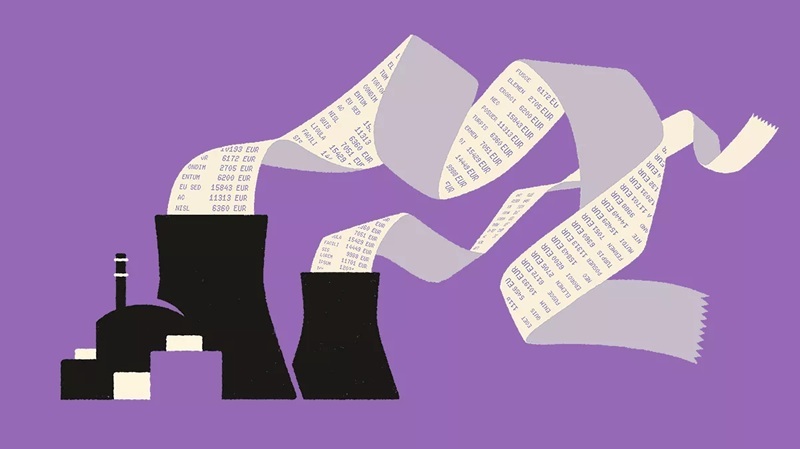
Investigation: France’s future nuclear reactors could cost three times more than expected.
February 10, 2026 –Antoine de Ravignan
While the new multi-year energy program favors nuclear power, our investigation reveals that the final bill for the EPR2 reactor program could reach nearly 250 billion euros.
“EDF presents its provisional estimate for the EPR2 program at 72.8 billion euros,” read a press release from the group on December 18 .
The final cost estimate for the construction of the first series of six French
-made nuclear reactors at the Penly (Seine-Maritime), Gravelines (Nord), and Bugey (Ain) sites, of the EPR2 type (approximately 1,650 megawatts of power), is expected this spring. EDF and its shareholder, the French State, hope for a final investment decision by the end of the year.
But four years after Emmanuel Macron
announced this program , its cost remains completely unclear. And far from dispelling this uncertainty, EDF’s communication strategy is creating a triple smokescreen. Is this meant to conceal the true final bill?…………………………….. [subscribers only] https://www.alternatives-economiques.fr/nucleaire-enquete-sur-le-vrai-cout-des-futurs-epr/00117632
German Chancellor urging France to beef up ‘Europe’s nuclear deterrent”
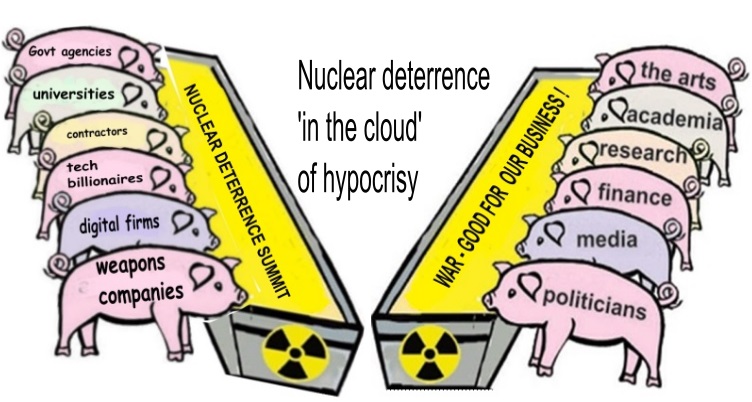
German Chancellor Friedrich Merz has initiated talks with France on
strengthening Europe’s nuclear deterrent as he urged the continent to
bolster its defences and “repair” strained relations with the US. The
discussions, centred on the possibility of Germany joining France’s
nuclear umbrella, underline mounting anxiety in Europe over an expected
reduction in the US military presence on the continent, as Russia’s
full-scale war on Ukraine enters its fifth year.
FT 13th Feb 2026,
https://www.ft.com/content/6ea334ce-9c6e-4415-8710-acc6ac939799
66 years after France’s first nuclear test in Algeria, justice is still denied.

ICAN 13 Feb 26, https://www.icanw.org/66_years_after_first_french_nuclear_test_in_algeria
On 13 February 1960, France detonated a nuclear weapon over the deserts of Algeria. It was the first of what were eventually 17 nuclear detonations across two sites. Four of these took place while Algeria’s fight for independence was still raging. To this day, communities harmed by the development of France’s nuclear weapons arsenal are seeking recognition, compensation and redress.
ICAN joins other organisations in a joint statement on the anniversary of France’s first nuclear detonations in Algeria, “66 Years Since the First French Nuclear Explosion in Algeria … No Truth Without Transparency, No Justice Without Reparation”
The statement recognises efforts to address the legacy of harm from French nuclear testing through parliamentary debates in both Algeria and France. The explosions exposed nearby communities, soldiers and workers to dangerous levels of radiation and left a long-lasting toxic legacy in the environment.
In France, steps are being taken to revise the compensation framework in order to make it fairer for victims of the tests in Algeria and French Polynesia, alongside calls to strengthen transparency and accountability.
In Algeria, the People’s National Assembly addressed this issue for the first time in February 2025 through a parliamentary session that resulted in 13 recommendations calling for enhanced transparency, justice for nuclear victims, the transmission of memory, and the development of research on health and environmental impacts. ICAN France, the Observatoire des armaments and the Heinroch Böll stiftung published The Waste From French Nuclear Tests in Algeria: Radioactivity Under the Sand to provide more information on the environmental legacy of French testing in the region.
The statement further calls on the French government to provide sustained technical and financial support for health monitoring and environmental remediation programs. It calls on the Algerian government to protect public health in affected areas through a national program of monitoring, early screening, and medical care, and to ensure that populations receive accurate information in national and local languages, with particular attention to vulnerable groups. Today, people in Algeria are still living with cancers, contaminated lands, and intergenerational health problems linked to those tests.
France is urged to sign and both countries are encouraged to ratify the Treaty on the Prohibition of Nuclear Weapons (TPNW).
ICAN’s dedicated nuclear testing impacts website hosts stories of those who worked near the test sites in Algeria, as well as more detailed information on the tests carried out by France.
French nuclear modulation to rise 11% to 35 TWh – Kpler
France’s nuclear power modulation – ramping reactors up and down to meet
demand and optimise fuel usage – will likely increase by 11% to 35 TWh this
year, up from 31.5 TWh in 2025, Kpler power analyst Alessandro Armenia said
on Thursday.
Montel 5th Feb 2026, https://montelnews.com/news/0ce52b4f-c919-4c3a-abdf-1ee5a3b67f5f/french-nuclear-modulation-to-rise-11-to-35-twh-kpler
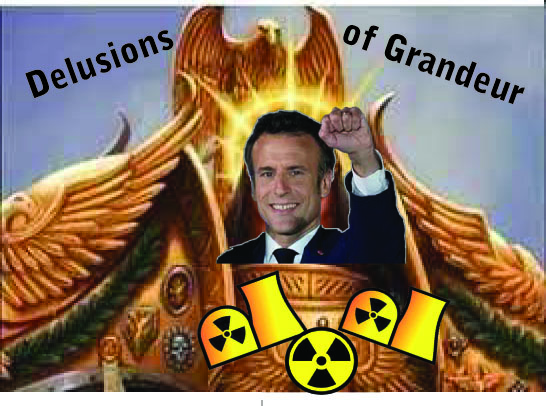
France slashes renewable energy targets, expands nuclear power with new law
FRANCE 24, 12/02/2026 https://www.france24.com/en/france/20260212-france-slashes-renewable-energy-targets-favour-of-nuclear-power-new-energy-law
France is this week set to pass by decree a new energy law slashing the country’s renewable energy targets and massively expanding nuclear power production. The law change comes as a relief for state-run electricity provider EDF, which had been mandated to close some of its nuclear plants and is struggling to compete with price pressure from European solar and wind power producers.
France set out a new energy law after years of wrangling on Thursday which slashes its wind and solar power targets and drops a mandate for state-run firm EDF to shutter nuclear plants.
“We need to stop our internal family squabbling. We need both nuclear and renewables,” Finance Minister Roland Lescure told reporters.
The law, to be pushed through by decree on Friday after almost three years of bitter disagreement among lawmakers, also reverses a previous legal mandate to shut 14 reactors.
That was a 2017 campaign promise of President Emmanuel Macron, who later changed course, backing nuclear expansion with a plan for at least six new reactors.
The move to pare back renewables should help shield EDF, which operates a fleet of 57 reactors, as power demand grows more slowly than expected over the next decade. The company is struggling to remain competitive as abundant wind and solar in Europe have pushed down power prices and forced reactors to lower output.
The new 10-year framework, known as the PPE, aims for EDF to produce 420 terawatt-hours of power from its existing fleet in 2035, a 5 percent increase.
“Nuclear is the backbone of our electricity system,” said Lescure, adding that a first new reactor should be inaugurated by 2038.
EDF CEO Bernard Fontana welcomed the proposal, saying it would allow the company to advance toward its objectives. The law had triggered fierce debate among lawmakers pitting support for renewable subsidies against financing new nuclear at a time when France is struggling with high debt. The PPE also governs wind and solar tenders, and a decision on the matter is expected to be welcomed by the wind industry, which has struggled amid uncertainty over the plans and delayed tenders.
Still, wind and solar targets were lowered, to 105-135 gigawatts (GW) of installed capacity by 2035 from drafts that had called for 133-163 GW.
“If this PPE is more than two years late on paper, it’s at least a decade behind in its vision of an energy transition,” Greenpeace France said in a statement.
It lowers France’s 2035 target for installed offshore wind capacity to 15 GW from 18 GW the government had submitted for consultation in 2024.
The target for onshore wind capacity drops to 35-40 GW from the 45 GW previously communicated.
Solar capacity will be 55-80 GW by 2035, the report added, down from a previous forecast of 75-100 GW. The law calls for France to consume 60 percent of its own energy from decarbonised electricity by 2030, shifting from 60 percent of energy from fossil fuels currently, and up to 70 percent from decarbonised electricity by 2035.
The new law is unlikely to lead to lower prices for end-users, said Emeric de Vigan, managing director of energy consultancy 42 Advisors, adding this could keep them from switching to electricity from oil and gas-based fuels.
Collapsing Empire: US Bows To African Revolutionaries
Kit Klarenberg, Global Delinquents, Feb 09, 2026
On February 2nd, the BBC published an extraordinary report on how the Trump administration “has declared a stark policy shift” towards Burkina Faso, Mali and Niger, the governments of which have sought to eradicate all ties to Western imperial powers, and forged the Alliance of Sahel States (AES). The independent bloc is a revolutionary enterprise, with the prospect further countries will follow its members’ lead. Washington is under no illusions about the new geopolitical realities unfolding in Africa.
The British state broadcaster records how Nick Checker, State Department African Affairs chief, is due to visit Mali to convey US “respect” for the country’s “sovereignty”, and chart a “new course” in relations, moving “past policy missteps.” Checker will also express optimism about future collaboration with AES, “on shared security and economic interests.” This is an absolutely unprecedented development. After military coups deposed the elected presidents of all three countries 2020 – 2023, the trio became Western pariahs.
France and the US initially aimed to isolate and undermine the military governments, halting “cooperation” projects in numerous fields. Meanwhile, the Economic Community of West African States, a neocolonial union of which all three were members, first imposed severe sanctions on Burkina Faso, Mali, and Niger, before its combined armed forces prepared to outright invade the latter in summer 2023. The three countries didn’t budge, and in fact welcomed Western isolation, forging new international partnerships and strengthening their ties. ECOWAS military action never came to pass.
In January 2025, the trio seceded from the union and created AES. Western-funded, London-based Amani Africa branded the move “the most significant crisis in West Africa’s regional integration since the founding of ECOWAS in 1975,” claiming it dealt “a significant blow to African…cooperation architecture.” Meanwhile, Burkina Faso’s leader Capt Ibrahim Traoré has become a media hate figure. A disparaging May 2025 Financial Times profile slammed him as a cynical opportunist leading a “Russia-backed junta”, and his supporters a “cult”.
As the BBC unwittingly explains, such antipathy towards Traoré stems from establishing himself “as a standard-bearer in resisting ‘imperialism’ and ‘neocolonialism’.” Via “vigorous social media promotion, he has gained huge support for this stance and personal popularity among young people across the continent and beyond,” ever since seizing office in September 2022. Far from just talk, Traoré and his fellow AES “junta” leaders have systematically neutralised malign Western influence locally, while pursuing left-wing economic policies for the good of their populations.
France and the US have proven markedly powerless to hamper, let alone reverse, this seismic progress…………………………………………………………………………………………………………………………………………………………………………………………………………………………. https://www.kitklarenberg.com/p/collapsing-empire-us-bows-to-african
France must start to plan nuclear closures – safety chief
Muriel Boselli, 27 Jan 2026
(Montel) France must plan now for the closure of some nuclear reactors or face investment barriers “that would be impossible to overcome” in replacing them, the head of the ASNR nuclear safety authority said on Tuesday…………………………(registered readers only)…………….. https://montelnews.com/news/4dfe0284-3e2b-4c92-804f-56a79bdfea31/france-must-start-to-plan-nuclear-closures-safety-chief
1 This Month

of the week – Shut Down Drone Warfare!


Tell the Ukrainian Government to Drop Prosecution of Peace Activist Yurii Sheliazhenko

Petition to revoke the licensing of the Near Surface Nuclear Disposal Facility (NSDF) at Chalk River. https://www.ourcommons.ca/petitions/en/Petition/Details?Petition=e-7247
To see nuclear-related stories in greater depth and intensity – go to https://nuclearinformation.wordpress.com
-
Archives
- March 2026 (237)
- February 2026 (268)
- January 2026 (308)
- December 2025 (358)
- November 2025 (359)
- October 2025 (376)
- September 2025 (257)
- August 2025 (319)
- July 2025 (230)
- June 2025 (348)
- May 2025 (261)
- April 2025 (305)
-
Categories
- 1
- 1 NUCLEAR ISSUES
- business and costs
- climate change
- culture and arts
- ENERGY
- environment
- health
- history
- indigenous issues
- Legal
- marketing of nuclear
- media
- opposition to nuclear
- PERSONAL STORIES
- politics
- politics international
- Religion and ethics
- safety
- secrets,lies and civil liberties
- spinbuster
- technology
- Uranium
- wastes
- weapons and war
- Women
- 2 WORLD
- ACTION
- AFRICA
- Atrocities
- AUSTRALIA
- Christina's notes
- Christina's themes
- culture and arts
- Events
- Fuk 2022
- Fuk 2023
- Fukushima 2017
- Fukushima 2018
- fukushima 2019
- Fukushima 2020
- Fukushima 2021
- general
- global warming
- Humour (God we need it)
- Nuclear
- RARE EARTHS
- Reference
- resources – print
- Resources -audiovicual
- Weekly Newsletter
- World
- World Nuclear
- YouTube
-
RSS
Entries RSS
Comments RSS
 nuclear-news