Finland ready to grasp a nuclear marketing opportunity in South Australia

 Finland’s Onkalo nuclear waste disposal facility want to export the technology to South Australia, The Advertiser Daniel Wills, Helsinki, Finland, The Advertiser September 21, 2016 OPERATORS of the world’s most advanced nuclear disposal facility want to export the technology to South Australia and form an alliance to help the state develop its own commercial facility to take waste from around the world.
At a briefing with Premier Jay Weatherill at Finland’s Onkalo nuclear waste disposal facility, Posiva Solutions Oy managing director Mika Pohjonen said his company would be willing to licence intellectual property and engineering solutions to SA if it were to proceed with expanding the local nuclear industry.
Posiva is a joint venture owned by two of Finland’s biggest energy companies — Teollisuuden Voima Oyj and Fortum Power and Heat. It is set to become the first organisation in the world to bury a canister of spent nuclear fuel when they begin inserting them into the bedrock from 2020. Mr Pohjonen said SA could hope to move from site selection to burying canisters within about 15 years, less than half the time taken by Finland, because the Scandinavians had already undertaken the slow work of proving the technology………
The Onkalo disposal site is about 10 times smaller than that conceived by SA’s Nuclear Fuel Cycle Royal Commission.……
Mr Weatherill will by the end of the year declare a formal State Government position to Parliament on expansion of the industry………
“The next major step is a threshold question about whether we maintain our prohibition against a facility for spent fuel or whether we take a step to explore it further.”- Mr Weatherill said ….

The miserable and ongoing history of EDF’s unfinished nuclear reactors in Flamanville and Olkiluoto
The £18bn Hinkley gamble: Nuclear deal will cost every UK family an extra £1,000 as May signs off on the plans to protect Britain’s national security
- Prime Minister approved plans after restricting influence of Chinese state
- Britain will guarantee EDF £92.50 per megawatt hour, up on current market price of £38.91
- Tory MP Zac Goldsmith said the plant would generate ‘most expensive energy in the history of energy generation’
By JASON GROVES DEPUTY POLITICAL EDITOR FOR THE DAILY MAIL, 16 Sept 16 “……..Construction at the site near Cherbourg began in 2007, with a scheduled completion date of 2012. But within a year, cracks were found in the concrete base and a quarter of the welds in the reactor’s secondary steel lining were found to be defective.
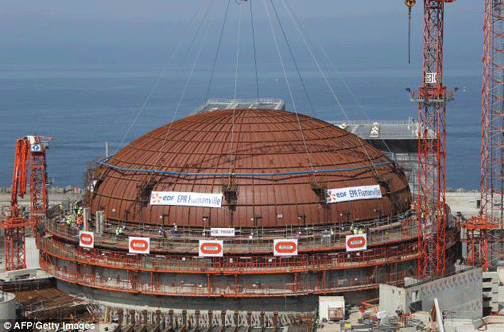
Inspections also revealed holes in concrete pillars and faults in buildings where nuclear fuel is to be stored.
A report by France’s nuclear safety authority in 2011 recorded 13 incidents of sub-standard safety measures. In 2013, a welder fell to his death. Then last year defects were discovered in safety valves in the cooling system.
Chillingly, this was similar to a problem that led to the Three Mile Island nuclear plant accident in Pennsylvania in 1979, which before Chernobyl was the world’s worst nuclear accident, and resulted in $1billion (£750million) of clean-up costs.
It was also in 2015 that Flamanville suffered a potentially killer-blow.
Tests on the steel used to construct the base and lid of the nuclear reactor vessel showed that too much carbon had been used, leading to weaknesses in the structure.
Professor Steve Thomas, of the University of Greenwich, said that if this led to the reactor failing, there would be no warning. ‘It will fail catastrophically and allow its radioactive contents into the environment,’ he said.
For their part, EDF and its project partner – the majority French state-owned company Areva, which makes nuclear reactors – have been forced to make more tests on the steel.
At the time the faults were found, the Financial Times said: ‘The scale of the risks to EDF if those tests identify a serious problem is hard to exaggerate.’
Whatever the findings of these new tests, Flamanville’s opening date – which has already been put back six years – is still nowhere in sight.
Professor Thomas warns that if it has to be rebuilt, the process could take up to five years, adding: ‘That might be prohibitively expensive and the whole plant could be abandoned.’
All this assumes that government-owned EDF doesn’t go bust in the meantime – which is a possibility.
In March, the company’s finance director Thomas Piquemal resigned, saying that taking on Hinkley as a project risked driving the firm to bankruptcy. Problems were compounded by the fact that Areva has had to be bailed out by the French government, with an injection of £3.4billion of public money in April. Inevitably, the European Commission has launched an investigation into this rescue package to check it did not ‘unduly distort competition’.
For some time, Areva – which is 87 per cent owned by the state – had been struggling with a downturn in the nuclear industry and has suffered big financial losses on its projects.
Once the pride of France, the reactor designer saw its credit rating downgraded last year, and in February it reported a €2billion (£1.7billion) net loss for 2015.
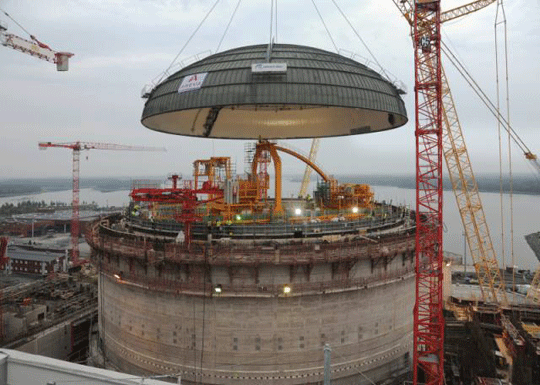
The project been subject to lawsuits, technology failure, construction errors and a bitter row between participant companies that has been described as ‘one of the biggest conflicts in the history of the construction sector’.
Work began on the EPR in 2005 and was scheduled to be completed in 2009. But from early on, problems emerged.
The concrete base on which the plant was to be built proved to be faulty, and had to be taken up and relaid. Then there was a problem with the electronic control systems.
Because it is absolutely vital that engineers can manage the temperature inside the reactor, a new nuclear plant must have two parallel control systems in case one fails.
The problem at Olkiluoto was that the two systems were too similar – meaning that if something caused the first one to shut down, there was a big risk that the second one would also close down.
The issue took five years to resolve – with the result that the power station is not expected to open until 2018 at the earliest.
Not surprisingly, the Finnish government has cancelled an option to buy a second reactor.http://www.dailymail.co.uk/news/article-3791895/The-18bn-Hinkley-gamble-nuclear-deal-cost-UK-family-extra-1-000-signs-plans-protect-Britain-s-national-security.html
Serious safety problems at Finland’s Fennovoima nuclear project
Economic Affairs minister: Fennovoima nuclear project safety severely lacking http://yle.fi/uutiset/economic_affairs_minister_fennovoima_nuclear_project_safety_severely_lacking/9157634, 10 Sept 16
The Fennovoima nuclear power plant project has to develop its safety culture if it wants to secure a building permit, says Minister of Economic Affairs Olli Rehn. The Fennovoima nuclear power plant project faces severe problems in its safety culture, according to Minister of Economic Affairs Olli Rehn.
Rehn met with the top echelon of the Radiation and Nuclear Safety Authority (STUK) to talk about safety and other issues relating to the Fennovoima project. Rehn says that the project is seriously lacking in its attention to project management and subcontractor resourcing.
“Big changes have to be made this autumn if the project’s credibility is to be regained,” Rehn told Yle.
On Wednesday Yle reported that Fennovoima has not delivered the planning documents for the Russian-backed plant within the time frame agreed upon with STUK.
Rehn stressed that Fennovoima’s safety concerns have to be fully in hand before any building permit can be issued.
Rehn spoke with the STUK top brass on Friday about the booted chief of main Fennovoima owner Voimaosakeyhtiö SF. The company fired its manager after he had brought up safety concerns with STUK.
“I consider it very serious that problems of this magnitude have arisen in Fennovoima,” Rehn says. “It is now the company’s duty to solve them and reinstitute trust in the project.”
Sovereignty of Finland threatened by Fennovoima’s nuclear power plant project – Report
Report: Fennovoima’s nuclear power project could undermine sovereignty of Finland, Helsinki Times, 01 SEPTEMBER 2016 Fennovoima’s nuclear power plant project in Pyhäjoki, Northern Ostrobothnia, is a high priority for Russia and threatens to undermine the national sovereignty of Finland, warns the Finnish Institute of International Affairs.
“Russia’s way of geo-economically utilising energy political dependencies is already undermining the national sovereignty of especially smaller target countries,” its researchers say in a newly-published analysis of changes in the foreign policy of Russia and their implications for Finland.
What say you, the National Coalition,” asks Niinistö.
Emma Kari (Greens) has similarly expressed her concerns that faith in nuclear energy has jeopardised the security of Finland.
“The Finnish Institute of Foreign Affairs’ report states explicitly that the nuclear power plant project of Rosatom in Pyhäjoki is under the manual control of [Russian President Vladimir] Putin. Rosatom’s nuclear power plant is a tool to exercise power politics, increase our dependence of Russia and erode the position and security of Finland,” she writes on Facebook.
The National Coalition, she adds, pushed the project through the Finnish Parliament irrespective of such concerns.
“The project is of such importance that even after Finnish companies abandoned it, Fortum, a state-owned energy utility, was strong-armed into participating in order to grant Putin’s power plant the Nordic Ecolabel,” she slams.
“It is now clear that the project is not in the best interests of this country.”…….http://www.helsinkitimes.fi/finland/finland-news/domestic/14199-report-fennovoima-s-nuclear-power-project-could-undermine-sovereignty-of-finland.html
Safety problems at Fennovoima nuclear power firm revealed by audit
 Safety audit flags shortcomings by Fennovoima nuclear power firm, Yle Uutiset, 16.8.2016
An audit by radiation and nuclear safety watchdog STUK has highlighted possible deficiencies by the Fennovoima power company as it prepares to build a nuclear power plant in Pyhäjoki, western Finland. Yle obtained a copy of the STUK audit, in which workers complained of poor management, workplace discrimination, and a tendency to downplay safety issues. Fennovoima has denied the allegations.
A report by Finland’s Radiation and Nuclear Safety Authority STUK has flagged employee concerns over the quality of management at the Finnish-Russian nuclear power firm Fennovoima. Workers interviewed for the audit claimed to have been put under pressure, sidelined, or even “smoked out” for drawing attention to safety concerns or questionable practices.
The findings were detailed in a safety audit that STUK began in late autumn last year and which is still ongoing. Fennovoima needs a clean bill of health from the audit to qualify for a construction permit in 2018. The company hopes to complete the nuclear power plant in 2024.
In an initial report that it completed in December, STUK expressed concerns about whether or not safety was a priority for Fennovoima, and whether or not the company’s management team had adequate experience in the nuclear energy sector………
Signature changes, amateur managementThe employee survey responses also revealed suspicions that the company had changed the signatures on documents relating to nuclear safety. The report indicated that “some documents” had been approved by changing signatures, if the original experts had not agreed to sign off on them. According to STUK several respondents corroborated this claim…….
STUK: Audit report not publicYle called on STUK to provide a copy of the shortcomings flagged in the report it drew up last December. However the nuclear safety watchdog refused to hand it over, saying that the audit was still ongoing…….http://yle.fi/uutiset/safety_audit_flags_shortcomings_by_fennovoima_nuclear_power_firm/9099368
Finland failed to be transparent on nuclear waste burial, unlike Sweden
The foremost reason is that as the project was being discussed with the public, SKB’s research was found to be incomplete and, in certain cases, inaccurate.
When, in 2011, Sweden’s SKB first applied for a license to build the Forsmark repository, the KBS-3 project documentation was published, which made it possible to give the project a review that would be independent from the nuclear industry’s own evaluation.
In February 2016, a special expert group appointed by the government, called the Swedish National Council for Nuclear Waste (Kärnavfallsrådet), published a 167-page report entitled “Nuclear Waste State-of-the-Art Report 2016: Risks, uncertainties and future challenges.” Among other things, it identifies the repository project’s risks and uncertainties having to do with earthquake impacts, with the long-term prospects of financing and monitoring the site’s condition, and with the health effects of low doses of radiation.
Finland has no such expert body. The concept of the repository, under construction in Euroajoki municipality, is criticized by many Finnish scientists, but the government is not taking notice and is likewise ignoring the scientific objections coming from its neighbor Sweden.
 When haste makes risky waste: Public involvement in radioactive and nuclear waste management in Sweden and Finland – How did it happen that in Sweden, the country that developed the technology for deep geological disposal of radioactive waste, construction of a such a repository – a first of its kind in the world – has been suspended for recognized risks and uncertainties, whereas Finland, which has copied the Swedish approach, is moving full speed ahead with building one? Bellona has looked for the answer on a fact-finding visit of the two countries. Bellona August 9, 2016 by Andrei Ozharovsky, translated by Maria Kaminskaya
“……..Out of sight, out of mind?
The deep geological disposal concept was first suggested over 40 years ago to solve the problem of spent nuclear fuel, the nuclear industry’s most dangerous byproduct. To a certain degree, this was a continuation of the “bury and forget about it” principle, applied to the less radioactive and thus less dangerous waste – radioactive waste. But where radioactive waste could be placed in shallow trench-type reservoirs or semi-buried near-surface concrete vaults, for nuclear waste, disposal facilities – repositories or burial sites – were proposed for construction in rock formations at a depth of several hundred meters. To date, no such deep geological repository has been created anywhere in the world. Continue reading
Finland concerned about the uncertain state of France’s nuclear industry
 Finns deeply worried about French nuclear industry Ft.com Richard Milne, Nordic Correspondent , 14 June 16
One of the main international customers for a much-delayed and costly nuclear reactor has expressed deep worries over the future of France’s atomic industry amid signs of political wrangling.
Finland’s TVO was the first customer for French nuclear group Areva’s European Pressurised Reactor technology — due to also be used at the UK’s controversial Hinkley Point power station — but the project has been beset by large cost overruns and a delay of almost a decade.
The two companies had been in negotiations in recent weeks to resolve multibillion-euro legal claims by both parties, as well as pave the way for the sale of a majority stake in Areva’s nuclear reactor business to French utility EDF.
But the sudden breakdown of those talks has rattled TVO, which operates some of Finland’s nuclear power plants. Jarmo Tanhua, chief executive, told the Financial Times of his big concerns about the future of France’s nuclear industry.
“We are afraid of what is happening. One thing is we don’t really understand why we don’t proceed with the negotiations. Our understanding is that it has something to do with the restructuring in France or the politics,” he said.
Mr Tanhua added that his biggest fear was that the French could decide to run down “some parts of the industry or some know-how”, particularly in its EPR technology.
World’s costliest nuclear tomb in Finland
Finland to bury nuclear waste for 100,000 years in world’s costliest tomb ABC News 7 June 16 Deep underground on a lush green island, Finland is preparing to bury its highly-radioactive nuclear waste for 100,000 years — sealing it up and maybe even throwing away the key.
Tiny Olkiluoto island, off Finland’s west coast, will become home to the world’s costliest and longest-lasting burial ground, a network of tunnels called Onkalo — Finnish for “The Hollow”.

Countries have been wrestling with what to do with nuclear power’s dangerous by-products since the first plants were built in the 1950s.
Most nations keep the waste above ground in temporary storage facilities, but Onkalo is the first attempt to bury it for good.
Starting in 2020, Finland plans to stow around 5,000 tonnes of nuclear waste in the tunnels, more than 420 metres below the Earth’s surface.
Already home to one of Finland’s two nuclear power plants, Olkiluoto is now the site of a tunnelling project set to cost up to 3.5 billion euros ($5.3 billion) to build and operate until the 2120s, when the vaults will be sealed for good……
At present, Onkalo consists of a twisting five-kilometre tunnel with three shafts for staff and ventilation. Eventually the nuclear warren will stretch 42 kilometres….
Spent nuclear rods will be placed in iron casts, then sealed into thick copper canisters and lowered into the tunnels.
Each capsule will be surrounded with a buffer made of bentonite, a type of clay that will protect them from any shuddering in the surrounding rock and help stop water from seeping in.
Clay blocks and more bentonite will fill the tunnels before they are sealed up.
The method was developed in Sweden where a similar project is under way, and Posiva insists it is safe.
But opponents of nuclear power, such as Greenpeace, have raised concern about potential radioactive leaks.
“Nuclear waste has already been created and therefore something has to be done about it,” said the environmental group’s Finnish spokesman Juha Aromaa.
“But certain unsolved risk factors need to be investigated further.”
Looking 100,000 years into the future
Environmental groups are questioning the risks of the ambitious nuclear waste storage plan
Planning the nuclear graveyard involves asking the impossible — how can we know what this little island will be like in 100,000 years? And who will be living there?
To put the timeframe into perspective: 100,000 years ago Finland was partly covered by ice, Neanderthals were roaming Europe and Homo Sapiens were starting to move from Africa to the Middle East……..http://www.abc.net.au/news/2016-06-08/finns-to-bury-nuclear-waste-in-world’s-costliest-tomb/7488588
Finland’s Fennovoima nuclear station dependent on Russia for all the finance
“……the extraordinary problems at Olkiluoto have cast doubts over Finland’s ability to manage such projects, while Fennovoima was hit by a farcical hunt for European investors for Hanhikivi.
Worries about Russian involvement almost brought down the previous Finnish coalition government. The Green party left the administration, accusing its former partners, some of whom are still in power, of pursuing a policy of “Finlandisation” — an extremely loaded term locally meaning the accommodation of Russian views in Finnish policy. …..
The deal is also of huge importance to Rosatom and its international ambitions to play a leading role in any revival of nuclear power outside the former Soviet Union…..” Finland raises its bet on nuclear power, Ft.com 5 June 16
Standard & Poor’slowers the credit rating of the Finnish firm Teollisuuden Voima Oyj (TVO)
 Credit ratings agencies downgrade nuclear power company TVO, YLE, 24 May 16
One of the big three credit ratings agencies operating on the world stage, Standard & Poor’s, has lowered the credit rating of the Finnish firm Teollisuuden Voima Oyj (TVO) from BBB-/A-3 to BB+/B.
The nuclear power company is owned by a consortium of power and industrial companies in Finland, the largest shareholders being the energy firms Pohjolan Voima and Fortum…….
Construction of a third TVO plant unit, Olkiluoto 3, has been plagued with problems from the start and is now seven years behind schedule. TVO has several pending disputes with the unit’s suppliers. In 2012, TVO submitted a claim and defence to the International Chamber of Commerce for damages due to delays……
In July 2010 the Finnish Parliament ratified a decision-in-principle from the government concerning TVO’s application to construct a fourth plant unit, Olkiluoto 4. In September 2014, the government however rejected TVO’s application to have the validity of the decision-in-principle extended. http://yle.fi/uutiset/credit_ratings_agencies_downgrade_nuclear_power_company_tvo/8902267
Police clear Finland’s anti-nuclear plant protest camp
30 Apr 16, Police have cleared protesters from the site of a proposed nuclear power plant at Pyhäjoki on the north-west coast after demonstrations took a violent turn on Thursday….http://yle.fi/uutiset/police_clear_anti-nuclear_plant_protest_camp/8849910
Finnish-Russian nuclear site broken into by protestors
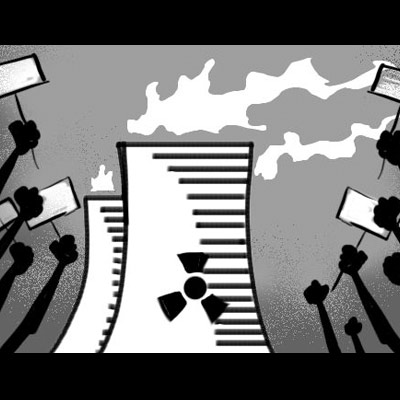 Apr 26, 2016 Protesters break into Finnish-Russian nuclear site, Reuters, Anti-nuclear protesters broke in to a construction site on Tuesday for a nuclear reactor to be supplied by Russia’s state-owned nuclear firm Rosatom, choosing the 30th anniversary of the Chernobyl disaster for their demonstration…….
 with anyone with that kind of history,” Venla Simonen from the Stop Fennovoima protest group told Reuters by telephone…….
The Chernobyl disaster increased radiation levels in Finland, putting nuclear Finnish plant projects on ice for a decade.
This latest project has raised concerns and resistance from many Finns as the plant is set to forge deeper energy ties between EU state Finland and its former ruler Russia despite East-West tensions over the Ukraine crisis.
Rosatom has a 34 percent stake in the 7 billion euro ($7.9 billion) project. It will supply the reactor and also handle the project’s financing.
Fennovoima struggled to find local investors to fulfill an ownership condition set by the Finnish government, but utility Fortum last year signed up in a surprise move, prompting questions of political pressure from both countries involved…….http://www.reuters.com/article/us-finland-fennovoima-protests-idUSKCN0XN1TH
Operating licence for Olkiluoto 3 nuclear reactor applied for by TVO
Finland’s TVO applies for delayed Olkiluoto nuclear plant licence http://uk.reuters.com/article/finland-nuclearpower-idUKL5N17H192 Apr 14, 2016
Finnish utility Teollisuuden Voima (TVO) has applied for an operating licence for its much-delayed Olkiluoto 3 nuclear reactor, saying it is on track to start production in late 2018.
“This is a significant milestone. The project is moving from installations to tests,” project manager Jouni Silvennoinen said in a statement on Thursday.
It was originally due to start operation in 2009, and TVO has traded blame for the delay with the plant’s supplier consortium Areva-Siemens , with both demanding billions of euros from each other in an ongoing arbitration at the International Chamber of Commerce. (Reporting by Jussi Rosendahl; Editing by Alexander Smith)
Fennovoima not permitted to store its radioactive trash at Onkalo disposal site
 Fennovoima still looking for final nuclear waste disposal site http://yle.fi/uutiset/fennovoima_still_looking_for_final_nuclear_waste_disposal_site/8795028. 7 Apr 16
The nuclear waste management company Posiva has remained steadfast in its refusal to allow waste from the planned Fennovoima nuclear power plant to be stored in its Onkalo disposal site in south-western Finland. The company had indicated that it would not accommodate Fennovoima’s nuclear waste even before the Pyhäjoki project got off the ground.
Nuclear waste management company Posiva said that it has not changed its mind about allowing spent fuel from the Fennovoima nuclear power plant in Pyhäjoki to be stored in its Onkalo waste facility being built further south on the west coast.
Posiva has said that the subterranean cave is reserved for use only by joint owners Teollisuuden Voima, TVO, which operates a series of reactors at the Olkiluoto nuclear power plant in Eurajoki, western Finland, and energy giant Fortum, which operates its own nuclear power facilities in Loviisa, southern Finland. The latter also has a six-percent stake in the controversial Fennovoima project.
Posiva chief executive Janne Mokka said that the spent nuclear fuel depository and its surrounding areas have been reserved only for waste generated by TVO and Fortum.
Fennovoima has expressed the hope that possible waste from its Pyhäjoki nuclear facility could be accommodated in the Posiva cave.
However Posiva CEO Mokka said that the firm had so far mainly discussed how it could pass on the expertise earned from the Posiva deep geological depository to the Pyhäjoki project.
Disposal plan to be filed with ministry officials
Posiva began working on the depository in 2004, but only received a final green light for the project in November last year. It is to begin operations sometime in the early 2020s.
Fennovoima is currently planning a final waste disposal plan that is due to be lodged with the Ministry of Employment and the Economy in a few months.
However if the company cannot reach an agreement with Posiva, it will have to present ministry officials with an environmental impact assessment as part of alternative disposal plan.
Steadfast refusal from Posiva
Fennovoima has remained tight-lipped about possible cooperation with Posiva, but would only say that the matter is being discussed. A Fennovoima spokesperson said that the company is currently preparing a report into a waste disposal facility with the help of internal consultants.
Back in 2012, Posiva had already indicated that it would not accept waste from any other nuclear facility apart from that produced by its owners, TVO and Fortum. The Eurajoki subterranean disposal site is the world’s first permanent deep storage facility.
Spent fuel from the Fortum and TVO plants will have to be stored for 40-60 years before it cools enough to be stored underground. As the oldest Finnish reactors have been in operation since the late 1970s, some of their waste will soon be old enough for encapsulation.
40-year, €3.3bn project
The facility, which has been planned since 1983, is intended to keep the waste safe for some 100,000 years. The companies have estimated the price tag for the entire project at 3.3 billion euros.
Posiva’s initial refusal to host the waste from the Fennovoima project came just as Finland’s Supreme Administrative Court overturned appeals to block the project’s progress.
The motions were filed by one private individual and a number of environmental protection organisations seeking to block construction at two sites under consideration, one at Simo and the other at Pyhäjoki, both in the northwest.
The project has otherwise been beset by setbacks and controversy, but infrastructure work began in September last year.
Under Finnish law, all waste from nuclear facilities must be permanently stored in Finland.
Russia funding and building new nuclear power station in Finland
 Russian nuclear corporation to start construction of Hanhikivi NPP in Finland in 2017 http://tass.ru/en/economy/864293 NOVO-OGAREVO, March 22. /TASS/. Construction of the Hanhikivi 1 nuclear power plant in Finland to be implemented by the Russian nuclear corporation Rosatom will start in 2017. Such information is contained in materials for the working visit of Finland’s President Sauli Niinisto to Moscow.
The power plant is expected to start generating electric power in 2024.
In December 2013, Rusatom Overseas [Rosatom’s subsidiary – TASS] and Finnish Fennovoima signed the contract for construction of Hanhikivi-1 nuclear power plant. Along with the construction contract, a ten-year fuel contract was signed with Russia’s company TVEL.
Russia’s revenues from the Hanhikivi-1 nuclear power plant project will amount to €17.5 bln , head of Rosatom Sergey Kiriyenko said earlier. Of this amount only taxes to the federal budget will exceed €3 bln, he added.
According to Finnish media, the project’s cost will reach €6-7 bln, of which €1.6 bln will be invested by Fennovoima and the rest by Rosatom. The commissioning of the new nuclear power plant is scheduled for 2024.
Rusatom Overseas is to supply 1,200Mt reactor for Hakhikivi-1.
1 This Month
23-25 October – on Zoom – World BEYOND War’s annual global conferenc


Shut down the radiation-damaged Heysham nuclear reactors now
To see nuclear-related stories in greater depth and intensity – go to https://nuclearinformation.wordpress.com

Say No to NASA’s Reckless Nuclear Reactor on the Moon
Say No to NASA’s Reckless Nuclear Reactor on the Moon

-
Archives
- October 2026 (247)
- September 2026 (339)
- August 2026 (330)
- July 2026 (355)
- June 2026 (287)
- May 2026 (306)
- April 2026 (356)
- March 2026 (251)
- February 2026 (267)
- January 2026 (308)
- December 2025 (358)
- November 2025 (359)
-
Categories
- 1
- 1 NUCLEAR ISSUES
- business and costs
- climate change
- culture and arts
- ENERGY
- environment
- health
- history
- indigenous issues
- Legal
- marketing of nuclear
- media
- opposition to nuclear
- PERSONAL STORIES
- politics
- politics international
- Religion and ethics
- safety
- secrets,lies and civil liberties
- spinbuster
- technology
- Uranium
- wastes
- weapons and war
- Women
- 2 WORLD
- ACTION
- AFRICA
- Atrocities
- AUSTRALIA
- Christina's notes
- Christina's themes
- culture and arts
- Events
- Fuk 2022
- Fuk 2023
- Fukushima 2017
- Fukushima 2018
- fukushima 2019
- Fukushima 2020
- Fukushima 2021
- general
- global warming
- Humour (God we need it)
- Nuclear
- RARE EARTHS
- Reference
- resources – print
- Resources -audiovicual
- Weekly Newsletter
- World
- World Nuclear
- YouTube
-
RSS
Entries RSS
Comments RSS

