Belarus opens nuclear plant opposed by neighboring Lithuania
The president of Belarus has formally opened the country’s first nuclear power plant over the objections of neighboring Lithuania, abc News ByThe Associated Press, 8 November 2020, KYIV, Ukraine — Belarusian President Alexander Lukashenko on Saturday formally opened the country’s first nuclear power plant, a project sharply criticized by neighboring Lithuania……
In line with a law banning electricity imports from Belarus once the nuclear plant started up, Lithuania’s Litgrid power operator cut the inflow of electricity from Belarus when the plant began producing electricity on Tuesday…….
Belarus suffered severe damage from the 1986 Chernobyl nuclear disaster, which spewed radioactive fallout from a plant in then-Soviet Ukraine across large areas of Europe. That painful legacy has fueled opposition to the nuclear plant project in Belarus.
Andrei Sannikov, a prominent opposition figure who was imprisoned for 16 months after running against Lukashenko in the 2010 presidential election, tweeted Saturday that the plant constitutes a “geopolitical weapon” against the European Union.
Lithuania closed its sole Soviet-built nuclear power plant in 2009. In recent weeks, Lithuanian authorities have handed out free iodine pills to residents living near the Belarus border. Iodine can help reduce radiation buildup in the thyroid in case of a leak at the nuclear plant. https://abcnews.go.com/International/wireStory/belarus-opens-nuclear-plant-opposed-neighboring-lithuania-74073929
Europe still without a final disposal solution for its most dangerous nuclear waste
Le Monde 4th Nov 2020, Europe still without a final disposal solution for its most dangerous
nuclear waste. The first edition of the World Report on Nuclear Waste,
published Wednesday in its French version, provides elements of comparison
of management methods in different countries.
Anxieties, memories of Chernobyl, as Belarus launches new nuclear power station
|
Chernobyl fears as Belarus launches new nuclear power station: Lithuania distributes iodine tablets to 500,000 close to border over safety concerns
Daily Mail, RACHAEL BUNYAN FOR MAILONLINE and AFP , 4 Nov 20, Belarus today launched its controversial Russia-built nuclear power station despite safety concerns from neighbouring Baltic states three decades after the Chernobyl nuclear disaster. Lithuania’s Foreign Minister Linas Linkevicius criticised the launch saying it had gone ahead despite unresolved safety issues The government in the Lithuanian capital, Vilnius, has also offered free iodine tablets to around half a million people living close to the Belarus border to help protect them from radiation in case of an accident The Astravets nuclear power plant, Belarus’s first nuclear station, is just 30 miles away from Vilnius. ……… Lithuania’s Foreign Minister Linas Linkevicius criticised the launch saying it had gone ahead despite unresolved safety issues and described the energy project as ‘geopolitical’. The EU and the international community ‘simply cannot stay indifferent to such cynical ignorance,’ Linkevicius wrote on Twitter. Lithuania said it had immediately stopped electricity imports from Belarus and neighbouring Latvia said it had also blocked imports of energy generated at the plant.…….. https://www.dailymail.co.uk/news/article-8909665/Chernobyl-fears-Belarus-launches-new-nuclear-power-station-despite-safety-concerns.html |
|
Belarus postpones launch of nuclear reactor
Radio Free Europe 9th Oct 2020, Belarus says it has postponed the full launch of the first reactor at its
Astravets nuclear power plant by two years to 2022. The plant, located near
the Lithuanian border, was scheduled to be launched on October 6 until the
cabinet order on October 9. Built by the Russian state firm Rosatom and
financed by Moscow with a $10 billion loan, the project is opposed by
neighboring EU member Lithuania, whose capital, Vilnius, is just 50
kilometers away. Lithuania, Latvia, and Estonia are moving to a full
decoupling from their Soviet-era common power system by 2025.
Safety of Belarus nuclear power station in question after IAEA report
Deficiencies discovered during IAEA INIR mission in Belarus may cause negative impact on safety of Belarusian NPP, Vates, 08/27/2020 International Atomic Energy Agency (IAEA) conducted the Integrated Nuclear Infrastructure Review (INIR) Phase 3 mission from 24 February to 4 March 2020 in the Republic of Belarus and recently published the report with 7 recommendations and 6 suggestions.
The mission evaluated the development status in the areas linked to Belarus nuclear infrastructure such as regulatory framework, nuclear safety, radioactive waste management, financial and human resources, nuclear security in order to commission and operate the first nuclear power plant (hereinafter – NPP).
The report emphasizes, that Belarus needs to further develop its legal and regulatory framework of nuclear energy, to assure regulatory body independence in cooperation with technical support organizations, to ensure sufficient funds for decommissioning and radioactive waste management, to allocate responsibility for establishing the radioactive waste management organization, to ensure reliable restart of the grid system in the event of total collapse once the NPP is in operation, to finalize all necessary programmes for starting operation, to ensure long term arrangements for maintenance of Belarusian NPP and to ensure capacity and competence of operating organisation.
Recommendations and suggestions concerning improvement of nuclear energy infrastructure are related to:
– deficiencies in legal and regulatory framework of nuclear safety;
– assurance of independence of regulatory body;
– deficiencies in implementing Integrated Management Systems of regulatory body and operating organization;
– ensuring readiness to restart of the grid system in the event of total collapse once the NPP is in operation;
– assurance of Belarussian NPP maintenance after the warranty period;
– deficiencies in the readiness of the physical security system in the operating organization;
– deficiencies in establishing responsibilities in the area of the radioactive waste management;
– international obligations (Belarus has not yet joined the Amendment to the Convention of Physical Protection of Nuclear Material and not ratified Protocol Additional to IAEA for the Application of Safeguards).
In VATESI experts’ opinion, not implementation of recommendations and suggestions, indicated in the report, may cause negative impact on safety of the Belarusian NPP during its commissioning and consequent operation…… http://www.vatesi.lt/index.php?id=551&L=1&tx_news_pi1[news]=882&tx_news_pi1[controller]=News&tx_news_pi1[action]=detail&cHash=e3cdcce90fb55e6650c0eb887e2cce12
Lithuania standing firm against sales of electricity from Belarus’ new nuclear power station
|
Lithuania spurns Baltic presidents’ meeting amid nuclear power rift KURESSAARE, Saaremaa, Estonia (Reuters) 25 June 20, – Lithuanian President Gitanas Nauseda refused to attend a planned meeting with his Estonian and Latvian counterparts on Thursday, saying he did so after the countries failed to agree to ban electricity purchases from a new nuclear power plant in Belarus. Lithuania has a law banning all Belarusian power sales after the power plant gets operational. The Estonian president’s office, which hosted the meeting, said that Nauseda, who is dealing with a reshuffle of his team, “decided to stay home at the last minute due to internal affairs”. Lithuania wants all the three countries to sign up to banning sales of Belarusian electricity after the nuclear plant comes online, binning an earlier draft agreement that only pledged to help keep the energy from being sold in Lithuania……. Lithuania sees the nuclear power plant, built by Russia’s Atomstroyexport near its capital and financed by Moscow with a $10 billion loan, as threat to its safety and national security, something Belarus disagrees with. “The President’s opinion is that negotiations should be finished first,” Nauseda’s spokesman told Reuters in a statement.https://www.reuters.com/article/us-baltics-energy-belarus/lithuania-spurns-baltic-presidents-meeting-amid-nuclear-power-rift-idUSKBN23W27C |
|
|
Lithuania, Belarus sign nuclear incident notification agreement
|
Lithuania, Belarus sign nuclear incident notification agreement
Source: Xinhua| 2020-05-26 01:02:32|Editor: huaxia VILNIUS, May 25 — The nuclear safety authorities of Lithuania and Belarus signed an agreement on early notification of a nuclear accident and on the exchange of important nuclear safety information, Lithuania’s State Nuclear Power Safety Inspectorate (VATESI) announced here on Monday.
In order to protect the public by minimizing the potential radiation-related risks and consequences, the two authorities agreed to exchange key information immediately after a nuclear incident or when the monitoring systems indicate a radiation dose-rate level that could be hazardous to the public health, said a VATESI press release. ….. Lithuania’s authorities have regularly raised questions about the environmental and nuclear safety of the Ostrovets nuclear power plant in Belarus…..http://www.xinhuanet.com/english/2020-05/26/c_139087159.htm |
|
Belarus to get a new nuclear reactor along with $10 billion debt to Russia
In January, Lithuanian Energy Minister Zygimantas Vaiciunas told RFE/RL that the Belarusian plant is “a threat to our national security, public health, and environment.”
“The key question is the site selection, which was done politically — geopolitically,” Vaiciunas told RFE/RL.
Plans for the nuclear plant were unveiled by Belarusian President Alyaksandr Lukashenka in 2008 when Minsk received a $10 billion loan from Moscow for the project.
The general contractor for the Belarusian nuclear power plant building is Atomstroiexport, an affiliate of Russia’s state-owned Rosatom. Based on reporting by TASS, ONT, and RFE/RL correspondent Matthew Luxmoore
Belarus to swap gas dependence on Moscow for nuclear dependence on Moscow
|
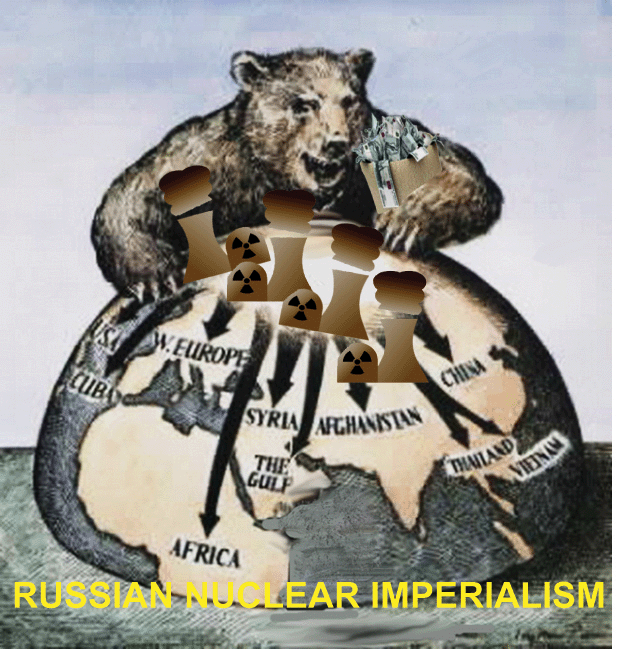
Belarus to swap gas dependence on Moscow for nuclear dependence on Moscow https://bellona.org/news/nuclear-issues/2020-03-belarus-to-swap-gas-dependence-on-moscow-for-nuclear-dependence-on-moscowA nuclear power plant built to lessen Belarus’s dependence on Moscow for natural gas – but constructed and lavishly financed by Russia’s state nuclear corporation Rosatom – is due to begin operation later this year, officials in the Belarus capital of Minsk have said. March 24, 2020 by Charles Digges
A nuclear power plant built to lessen Belarus’s dependence on Moscow for natural gas – but constructed and lavishly financed by Russia’s state nuclear corporation Rosatom – is due to begin operation later this year, officials in the Belarus capital of Minsk have said. The plant will feature two VVER-1200 reactors – the second of which will come online next year – that will together generate some 2.4 gigawatts of power in the cloistered post-Soviet dictatorship on Russia’s western border. The International Atomic Energy Agency found that the plant largely fulfilled general safety guidelines and issued a number of recommendations for improvement. Others have raised alarm over potential safety issues. GlobalData quoted energy and nuclear policy analyst Mycle Schneider as warning: “Neighboring countries have voiced concern over the lack of review of some serious safety concerns, and Lithuania has transmitted an official note to the European Council.” Since its inception in the early 2000s, the Belarus nuclear power plant, in Ostrovets near the border of Lithuania, has been fraught with difficulties. Environmentalists who oppose the plant are routinely harassed and stifled and in some cases kicked out of the country. Neighboring Lithuania, once seen as a promising potential market when construction began, is now so opposed to the plant that its parliament outlawed purchasing any electricity it produces and has sent envoys to other countries encouraging them to do the same. Poland and the Ukraine have also spoken out against the plant. Each of these groups have called attention to the mishaps that have plagued the plant during its construction, including an incident in 2016 when technicians inadvertently dropped a 330-ton reactor pressure vessel – which houses the core – from a crane. A replacement unit sent to the site was accidentally run into a column at a railway station when it arrived. But the plant also illustrates an energy conundrum facing many European countries. While a number of nations in the old Soviet orbit seek to diversify their energy supplies away from Russian natural gas, Rosatom is more than willing to step into the vacuum left by that shift. By offering huge loans to build and supply nuclear power plants, Rosatom can keep customers financially and technically beholden to Moscow for as long as 50 years. With other kinds of power infrastructure, a contractor builds a facility and leaves it to be operated by the country where it stands. Not so with nuclear power plants, where foreign government customers, like Belarus, remain dependent on Rosatom – and thus the Russian state – for fuel, know-how and eventual decommissioning works. That geopolitical strategy is not lost on Lithuania, whose prime minister recently told the New York Times that: “The [Ostrovets} nuclear plant is an example of Russia’s desire to keep states along its borders in its orbit at all costs – it helps them preserve more influence.” The policy is has broad implications. Rosatom has convinced dozens of countries to sign memorandums of understanding on all manner of nuclear services, from research and training facilities to nuclear power plant construction. As a result, Rosatom says that its portfolio of foreign projects has swelled to more than $200 billion. But that figure invites skepticism. Many of the counties Rosatom counts toward that figure – like Ethiopia, Algeria, Nigeria, Sudan and Rwanda – won’t be ready to support nuclear power on their grids for decades. Others where Rosatom builds are already underway – like India’ Kudankulam, Iran’s Bushehr and China’s Tianwan – are already familiar with Rosatom’s typical cost overruns and delays. Furthermore, a deep dig into Rosatom’s claimed income by the Russian environmental group Ecodefence revealed that business wasn’t going quite as indicated. A report by the group, published last year, detailed a number of cases where the corporation misstated the worth of its overseas reactor construction projects, and inflated their worth by several billion dollars. Still, the corporation is an ambitious and successful presence on the international market. According to one study, cited by the New York Times, Rosatom has sold more nuclear technology abroad since 1999 than the United States, France, China, South Korea and Japan combined. Rosatom’s approach to marketing its reactors is distinct from its western competitors because it offers to finance, build and operate the plants that it builds abroad. These generous terms come thanks to the enormous state subsidies Rosatom receives – and which it can then funnel into loans that boost its profits on paper. The Belarus plant, for instance, comes thanks to a $10 million line of credit from Rosatom. Hungary, a member of the EU, became another customer when it took an $11 billion loan to build its Paks II in 2016. Rosatom also won a $30 billion contract for four reactors in Egypt, and another big nuclear plant deal in Turkey. While it’s tempting to see a strategy afoot in Rosatom’s foreign projects, the Kremlin insists it’s just business. President Vladimir Putin has publicly distanced himself from mixing politics with foreign commerce. |
|
Estonia, Latvia and Lithuania oppose energy imports from a Belarusian nuclear power plant
|
Emerging Europe 13th Feb 2020. Estonia, Latvia and Lithuania are joining forces to oppose energy imports from a Belarusian nuclear power plant (NPP) Lithuania has declared a national security threat. The governments of the three Baltic nations have announced that they will sign a declaration of intent to oppose electricity purchases from Russian-built NPP at Astravets near the Lithuanian border.
We are pleased to be moving closer to a common position,”
Lithuania’s prime minister Saulius Skvernelis told reporters, adding that the three Baltic nations and the European Commission will work on finding “an appropriate mechanism controlling the origin of electricity entering our networks from third countries”.https://emerging-europe.com/news/baltic-states-will-not-buy-energy-from-belarus-npp/ |
|
Anxiety in Belarus and Lithuania, over new Chernobyl-style nuclear power station
|
They may not tell you the whole truth’: Fears of another Chernobyl as Russian-built atomic power station set to open in Belarus, Independent, 20 Jan 2020 Three decades after world’s worst nuclear disaster, the country most affected by the fall out is set to open its first nuclear plant. But as Oliver Carroll finds out, not everyone is pleased It was when the tree fellers arrived in early 2009 with their bulldozers that Nikolai Ulasevich, a local activist, knew the game was up. There might not have been a published order to build an atomic power station in the fields overlooking his homestead in the village of Vornyany – but a decision had clearly been made. In authoritarian Belarus those decisions rarely have a reverse gear. In the years that followed, Ulasevich watched as the gigantic cooling towers and system blocks of Belarus’s first nuclear power station took shape. Construction, which was led by the Russian state nuclear agency Rosatom, would be far from straightforward. A string of incidents delayed its opening, but the first reactor is finally due to go online early 2020. To say the construction of the Belarusian nuclear plant has been controversial would be to trivialise the history of these lands. Chernobyl lies only seven miles from Belarus’s southern border, and the nuclear accident, still the world’s worst, has left the deepest of scars locally. The direction of the wind in spring 1986 – and the Soviet authorities’ decision to avoid major harm in Moscow – meant Belarus suffered more than any other region in the union. At the moment that the radioactive clouds moved towards the capital, air force pilots were ordered to chase down the toxic clouds and seed them with jets of silver iodide. Much of the southernmost region of Homel remains seriously contaminated, with elevated oncology levels as a result. Any local over 50 can recall what they were doing on those dry, spring-summer days. They talk about the tiredness; the strange, dryness of the mouth; the rumours that it might be a good idea to take iodine, but the lack of reliable information. They will also tell you about a cloud of secrecy almost as harmful as the black cumulus masses that had their radioactive bowels emptied over southern Belarus. …….. “The thought of what happened back in 1986 can’t fail to make you anxious about what may happen. You know they may not tell you the whole truth.” Lithuania, the European nation that borders Belarus just 10 miles west of Astravets, is bitterly opposed to the nuclear plant. It says it has not been properly consulted and claims the plant breaches post-Fukushima distance guidelines – in particular, a recommendation that nuclear power stations should not be built closer than 100km of major conurbations. The new nuclear plant lies just 30 miles east of the Lithuanian capital, Vilnius. The Lithuanians say they are preparing for any eventuality: from stockpiling iodine tablets to opening up nuclear bunkers and issuing survival notes to their citizens. In October, authorities ran a major preparedness operation, imitating a disaster response to a nuclear meltdown. The drills were knowingly hyperbolic. But several reported incidents do give pause for thought. From what we know, the reactor vessel in Belarus has already been involved in at least two accidents. The first was in July 2016, when it was apparently dropped from a crane during installation. Belarusian authorities took weeks to admit a “minor” incident. Five months later, a replacement reactor vessel collided with a railway pylon while being transported. At least five workers have died in construction accidents. There was at least one fire incident in the control room. The outside world would likely have stayed little the wiser were it not for the opposition activist Ulasevich monitoring from his modest home, which he shares with his wife, a few chickens and sheep, three miles away from the new power station. He said he found out about the dropped reactor vessel in conversation with a local construction worker. “He swore that he saw it break free of ropes at a height of two or three metres,” he says. ……. Yury Voronezhtsev, the man who led the official Soviet official response to Chernobyl, says he could not believe any statement that the plant was “safe”. “I don’t believe that our Belarusian construction workers are any better than the Soviet ones,” he tells The Independent. “We have the same people, and the same systems………. https://www.independent.co.uk/news/world/europe/chernobyl-belarus-nuclear-power-station-atomic-vornyany-rosatom-ostrovets-astravets-a9271811.html
|
|
Belarus’ forgotten children – victims of Chernobyl’s nuclear radiation
Kevin Barry in Chernobyl: ‘Misha is an example of what happens when a country is on its knees’ Irish Examiner, August 05, 2019
In 2000 the Irish Examiner sent Kevin Barry, now longlisted for the Booker Prize for his novel Night Boat to Tangier, to Chernobyl. Here we reproduce what he reported

Misha photographed by Eugene Kolzov at the No 1 orphanage in Minsk.Misha, aged seven, is the victim of not one but many sicknesses. His physical disorders, as can be plainly seen, are many and various.
But Misha is the victim of another ailment too, a kind of compassion deficiency.
Chernobyl isn’t fashionable these days, it’s been around so long now. April 26, 1986 seems a long time in the way-distant past. After the initial blurt of paranoia and charitable outreach, the fickle gaze of public interest quickly flicked from the incident at Reactor No 4 to fresher horrors.
Misha, then, has been shuffled way back in the compassion pack. He has fallen behind the other ravaged children who sombrely people the planet’s trouble spots, in places like Mozambique and Ethiopia.
He’s competing with Rwanda and Chechnya. And it’s beginning to tell Misha’s illness is a direct consequence of the Chernobyl explosion.
The radioactive danger in Belarus is not so much in the air now as in the food chain. Professor Yuri Bandashevsky, a dissident scientist, told the Irish Examiner this week that the mutations caused by radiation in children like Misha have by now entered the gene pool and thus the effects of the ‘86 explosion can stretch to infinity.
After criticising the state’s alleged misspending of research money for Chernobyl, Professor Bandashevsky recently found himself banged up in jail for five months, bound at the feet.
Which isn’t the sort of thing that bodes well for the likes of Misha. Some aid continues to filter through. This week, a convoy run by the Chernobyl Children’s Project has been on a drive through Belarus, dispensing almost £2 million in food and medicines.
One of the institutions the orphanage supports is Novinki, a children’s asylum on the outskirts of Minsk. Such is its Dickensian squalor, its actual existence was long denied by the state. This is where you’ll find little Misha.
Project leader Adi Roche says she has known the child since he was a baby, but has been stunned at his deterioration since she last visited in December.
After finding him emaciated and dying this week, the project has placed a Dublin nurse and a local Chernobyl nurse on 24-hour care alert with Misha, an attempt to make whatever is left of his life as painless as possible
“We don’t know how long Misha will live, or if he will live, but we are morally obliged to do everything in our power to attempt saving his life,” said Ms Roche last night.
“‘He is not the only child in Belarus suffering as horrifically as this. he’s just one of many.” she added. “‘These children are the victims of 14 years of neglect by the international community.”’
Many children in Belarus consigned to mental asylums have no mentaI handicap. “All orphaned children with any kind of disability are put into mental asylums if they live beyond the age of four,” she said.
Meanwhile, staffed by1,000 workers, the Chernobyl plant continues operate a couple of kilometres inside the Ukraine border.
The authorities say it will close this year. The concrete sarcophagus built to contain contamination from the reactor has 200 holes and counting.
Orphans of the nuclear age
Kevin Barry, in Chernobyl, finds a land and its people scarred by a disaster from which they may never recover.
Chernobyl at this time of year is beautiful, the borderlands of the Ukraine and Belarus a pastoral and idyllic place. Vast swardes of rich woodland are full of babbling brooks and twittering songbirds, every way you turn, there’s a postcard vista to please even the most jaded eyes.
The locals, however, are edgy. The President of Belarus, Alaksandr Lukashenko — aka ‘Batska’ (‘The Father’) — has decreed that the farmlands here–abouts are now safe to plant and he’s threatening to fly overhead and make sure the workers are toiling.
If not, he says, there will be trouble. Big trouble.
The notion of Batska in an airplane is enough to prompt sleepless nights for those who remain in the Purple Zone, the area most contaminated by the accident in 1986 at Smelter No 4 of the nuclear plant that lies inside the Ukranian border.
In a tragedy of happenstance, because there was a stiff northerly gusting that day, Belarus took the brunt of the damage and because radioactivity is most lethal when it attacks developing human systems, children have borne most of the pain.
But for these children, the most serious ailment is not the thyroid cancer or the leukaemia or the heart trouble or the kidney failure or the various disorders of colon and spleen prompted by Chernobyl.
The greatest danger is the compassion-fatigue. 1986 seems a long time ago now and the incident at Smelter No 4 is no longer swaddled in the necessary event-glamour or crisis-chatter.
When the evening news is an atrocity exhibition, when daily there are hellish dispatches from Mozambique, Ethiopia and Chechnya, the Belarussians fall ever further back in the line.
The foreign correspondents have long since moved on elsewhere. The story of a child developing thyroid cancer over a period of years doesn’t conform neatly with the sound-byte culture.
By this stage, the Belarussians have had enough. A condition of mass denial exists in the country and a native of the village Solchechy in the Purple Zone says that up to around 1993, everybody fretted and freaked out but then they decided, well, to hell with it.
“The mess got to be too much,” she says.
We don’t think about it now. Life is life and we try to get on with it.
This is easier said than done in Belarus. The country’s economy is shot — agriculture was its mainstay and since Chernobyl, the income from farming has been negligible. Almost 30% of the country’s annual turnover goes to the clean-up operation.
Belarus remains the most Soviet of states. There are thickly-piled layers bureaucracy and this tangle of demented protocol regulations and petty restrictions is amorphic, constantly shape-shifting.
The natives have had to develop a stoic acceptance of a hard frustrating life…….. https://www.irishexaminer.com/breakingnews/views/analysis/kevin-barry-in-chernobyl-misha-is-an-example-of-what-happens-when-a-country-is-on-its-knees-941735.html
Belarus nuclear physicist warns on the unsafety of new nuclear plant
Nuclear physicist about Chernobyl / ENG subs
Professor Heorhi F. Lepin, a physicist, co-chairman of the public association ‘Scientists For A Nuclear-Free Belarus’, who took part in the rectification of the consequences of the Chernobyl disaster, warns the Belarusians against launching the nuclear power plant in Astravets. https://belsat.eu/en/?p=1108658
According to him, the site chosen is no good and even dangerous – once an earthquake happened on the spot; there is an intersection of crust fractures. However, President Alyaksandr Lukashenka called the scientists who are critical of nuclear-power engineering and particularly the Astravets NPP ‘undercover bandits’ and ‘enemies of the people’, Lepin stressed. The Belarusian NPP with two VVER-1200 reactors with a total capacity of 2,400 MW is being built according to the Russian project near Astravets in the Hrodna region. The first power unit is scheduled to be commissioned in 2019, the second one — in 2020. Subscribe to our channels:
1 This Month

of the week – Shut Down Drone Warfare!


Tell the Ukrainian Government to Drop Prosecution of Peace Activist Yurii Sheliazhenko

Petition to revoke the licensing of the Near Surface Nuclear Disposal Facility (NSDF) at Chalk River. https://www.ourcommons.ca/petitions/en/Petition/Details?Petition=e-7247
To see nuclear-related stories in greater depth and intensity – go to https://nuclearinformation.wordpress.com
-
Archives
- April 2026 (44)
- March 2026 (251)
- February 2026 (268)
- January 2026 (308)
- December 2025 (358)
- November 2025 (359)
- October 2025 (376)
- September 2025 (257)
- August 2025 (319)
- July 2025 (230)
- June 2025 (348)
- May 2025 (261)
-
Categories
- 1
- 1 NUCLEAR ISSUES
- business and costs
- climate change
- culture and arts
- ENERGY
- environment
- health
- history
- indigenous issues
- Legal
- marketing of nuclear
- media
- opposition to nuclear
- PERSONAL STORIES
- politics
- politics international
- Religion and ethics
- safety
- secrets,lies and civil liberties
- spinbuster
- technology
- Uranium
- wastes
- weapons and war
- Women
- 2 WORLD
- ACTION
- AFRICA
- Atrocities
- AUSTRALIA
- Christina's notes
- Christina's themes
- culture and arts
- Events
- Fuk 2022
- Fuk 2023
- Fukushima 2017
- Fukushima 2018
- fukushima 2019
- Fukushima 2020
- Fukushima 2021
- general
- global warming
- Humour (God we need it)
- Nuclear
- RARE EARTHS
- Reference
- resources – print
- Resources -audiovicual
- Weekly Newsletter
- World
- World Nuclear
- YouTube
-
RSS
Entries RSS
Comments RSS
 nuclear-news