Australian Nuclear Science and Technology Organisation (ANSTO)-a law unto itself, joins with China to make new nuclear reactors
 Australia is back in the nuclear game, Independent Australia, By Noel Wauchope | 24 March 2019, One of Australia’s chief advocates for nuclear power Dr Adi Paterson, CEO of Australian Nuclear Science and Technology Organisation, (ANSTO), has done it again.
This time in China, he quietly signed Australia up to spend taxpayers’ money on developing a new nuclear gimmick — the Thorium Molten Salt Reactor (TMSR).
This new nuclear reactor does not physically exist and there is no market for it. So its development depends on government funding.
Proponents claim that this nuclear reactor would be better and cheaper than the existing (very expensive) pressurised water reactors, but this claim has been refuted. The TMSR has been described by analyst Oliver Tickell as not “green”, not “viable” and not likely. More recently, the plan has been criticised as, among other things, just too expensive — not feasible as a profitable commercial energy source.
Paterson’s trip to China and his signing up to this agreement received no Parliamentary discussion and no public information. The news just appeared in a relatively obscure engineering journal.
The public remains unaware of this.
In 2017, we learned through the Senate Committee process that Dr Paterson had, in June 2016, signed Australia up to the Framework Agreement for International Collaboration on Research and Development of Generation IV Nuclear Energy Systems (also accessible by Parliament Hansard Economics Legislation Committee 30/05/2017).
This was in advance of any Parliamentary discussion and despite Australia’s law prohibiting nuclear power development. Paterson’s decision was later rubber-stamped by a Senate Committee……..
Dr Paterson was then obviously supremely confident in his ability to make pro-nuclear decisions for Australia.
Nothing seems to have changed in Paterson’s confidence levels about making decisions on behalf of Australia.
Interestingly, Bill Gates has abandoned his nuclear co-operation with China. His company TerraPower was to develop Generation IV nuclear reactors. Gates decided to pull out of this because the Trump Administration, led by the Energy Department, announced in October that it was implementing measures to prevent China’s illegal diversion of U.S. civil nuclear technology for military or other unauthorised purposes.
Apparently, these considerations have not weighed heavily on the Australian Parliament.
Is this because the Parliament doesn’t know anything about Dr Paterson’s trip to China and his agreement for Australia to partner with the Shanghai Institute of Applied Physics (SINAP) in developing Thorium Molten Salt Reactors? https://independentaustralia.net/environment/environment-display/australia-is-back-in-the-nuclear-game,12488#.XJWdhxDqitc.twitter
150,000 climate strikers at 60 locations across Australia in schoolchildren’s pprotest
Students strike to demand climate action | ABC News
Climate strikes attract 150,000 supporters, https://www.sbs.com.au/news/climate-strikes-attract-150-000-supporters, 16 Mar 19, About 150,000 people took part in climate strikes across the country on Friday, with students planning more rallies if their demands for more action aren’t met. About 150,000 students, parents and activists have taken to the streets to protest over the federal government’s inaction on climate change.
Strikes were held across the country on Friday at 60 locations, as part of a global effort to shine a light on climate change.
The protests were estimated to be 10 times the size of those held in November. The students have three demands: stop the Adani coal mine in central Queensland, no new coal or gas, and 100 per cent renewables by 2030.
More strikes will be planned if the students don’t see the action they want from the government.
“If the politicians are just going to throw our futures away there’s nothing we can do but be out here and say: we’re not going to let you do that,” 15-year-old Olivia Boddington told AAP at a climate strike in Canberra.
“We’re not going to just go away.”
Huge crowds gathered across the country on Friday, including at Sydney’s Town Hall Square, outside Melbourne’s Old Treasury Building and in Brisbane’s CBD.
The movement was inspired by Swedish teen Greta Thunberg, who has been striking for climate action since last August.
The 16-year-old’s activism has earned her a Nobel Peace Prize nomination.
Senior cabinet minister Christopher Pyne criticised the students for striking, saying the move will damage their education.
However, Labor national president Wayne Swan defended student activism.
Scotland’s First Minister refused to meet Australian Aboriginal nuclear waste protestor – for political reasons
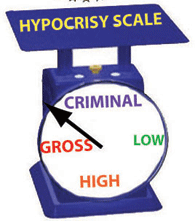
 Gaffe reveals why Sturgeon refused to meet nuclear waste protestor https://theferret.scot/sturgeon-nuclear-waste-protestor/ James McEnaney on March 14, 2019 The Scottish Government has mistakenly revealed that Nicola Sturgeon refused to meet an Aboriginal nuclear waste protestor in an attempt to avoid political damage – not because she was too busy, as her officials said.
 Internal emails uncovered by The Ferret reveal that the First Minister was advised to turn down a request for a meeting in 2018 so as not to become a “focus for criticism”. But officials said the public reason given for her refusal would be “on the standard basis of diary pressures”.
Campaigners reacted with sadness, saying that the Scottish Government’s “ears are closed”. The government stressed that it had “very limited scope” to address the issues raised.
Nuclear fuel was sent from an Australian research reactor to Dounreay on the north coast of Scotland for reprocessing in the 1990s. The resulting radioactive waste, amounting to 51 cemented drums, was originally due to be returned to Australia for disposal.
But under the terms of a waste substitution deal in 2014, Scottish and UK governments agreed that the drums should stay at Dounreay. Instead, the plan is to send four containers of “radiologically equivalent” waste to Australia from the Sellafield nuclear complex in Cumbria.
Two sites have been identified for a planned store for the waste in south Australia – Wallerberdina Station, near Hawker, and Kimber – both of which face opposition from indigenous communities. The Ferret reported in February that Scottish ministers had been advised that they had powers to prevent the waste being exported to protect human rights.
Revealingthe horror of white Australia’s massacres of Aboriginal people
|
As the toll of Australia’s frontier brutality keeps climbing, truth telling is long overdue, The myth of benign, peaceful settlement persists today – even as historians reveal a far more sinister picture• The Killing Times: the massacres of Aboriginal people Australia must confront
• A massacre map of the frontier wars – interactive Guardian by Paul Daley, 4 Mar 19 “………… The Australian Museum estimates that pre-European invasion in 1788, about 750,000 Indigenous people (representing some 700 language groups) inhabited the continent that would become Australia. This figure may well be an underestimate. Little over a century later, by federation in 1901, the Aboriginal and Torres Strait Island population had diminished to some 117,000. Black-white warfare and organised massacres, no matter how you define them, with police, British soldiers, native police, militia and raiding parties as the perpetrators, accounted for many tens of thousands of deaths. Individual acts of violence – including shootings, poisonings, torture and illegal incarceration – killed many more. Battle wounds, starvation (owing to the depletion of traditional hunting grounds) and disease – all of which can also be directly linked to invasion and frontier conflict – killed countless others. Yet the historiographic confect of benign, peaceful settlement and the unexplained “passing” or “extinction” of the “natives” pervaded well into the 1960s, replete with the deception that very few Aboriginal people died violently during pastoral and urban expansion and dispossession. Things began to change with the emergence of a new, more inquisitive, less empire-centric cohort of historians and writers who, not content with the Anglophile colonial trope of terra nullius and benevolence to the Indigenes, began to commit truth to the page……….. In the 1970s and 1980s a number of historians – among them Henry Reynolds, Marilyn Lake and Richard Broome – began focusing on frontier violence, using the colonial records, newspaper archives and family histories (including generational oral accounts of killings). Reynolds is acknowledged as the first Australian historian to make a calculated continental estimate of the number of Aboriginal and Torres Strait Islanders who died violently in Australian frontier conflict. In his 1981 book, The Other Side of the Frontier, and after at least a decade’s research Reynolds estimated the figure at about 20,000………. Reynolds speaks of the significance of Evans and Ørsted-Jensen’s research on the numbers of killings in colonial Queensland. Based on an extrapolation of native police documentation, they estimated (conservatively) that as many as 60,000 Aboriginal people died in frontier violence in Queensland alone. The national implications of the figure are profound; the wars that raged across this continent from 1788 did, it seem, claim more Indigenous lives than 62,000 Australian service personnel who died in the first world war………… https://www.theguardian.com/australia-news/2019/mar/04/as-the-toll-of-australias-frontier-brutality-keeps-climbing-truth-telling-is-long-overdue |
|
Australia’s Dept of Industry kept terrorist and other dangers secret from communities selected to host nuclear wastes

Risk of terrorism at radioactive waste site kept secret from residents near earmarked sites, Jade Gailberger, Federal Political Reporter, The Advertiser February 24,
The risk of terrorist activity at a radioactive waste site, including the removal of drums for use in a “dirty bomb”, has been kept secret from residents near two sites earmarked for a new national dump.
As the communities of Hawker and Kimba remain divided on the site selection for a new waste site, documents obtained under Freedom of Information laws reveal the Defence Department identified a potential risk of terrorist activity at a dump at Woomera.
The revelation has cemented the security concerns of residents, who say they have been ignored by Government officials.
The now closed Koolymilka dump, situated on Defence land at Woomera, was licensed for temporary radioactive waste storage but has not taken new material since 2010.
An emergency response plan for the site, which still houses waste that is anticipated to be transferred to a national facility, details scenarios that may affect it including:
-
- TERRORISTS removing drums to make a “dirty bomb”.
- MISSILE and aircraft strikes, fire, flood or a storm in Woomera that could damage the building and cause contamination if drums ruptured.
- CIVILIAN protest activity.
Defence has said it has no responsibility to inform the public of the risks because the new waste dump is an Industry Department project.
Kimba farmer Peter Woolford, who is opposed to radioactive waste storage on agricultural land, said security, terrorism and fire concerns at a national site had been raised but “fobbed off” by officials who claimed it “would be safe”.
“The (Industry) Department continually says it is going to be open and transparent but you have to obtain FOI documents to get the full story,” he said. “It’s an issue that the department should be … explaining.”
Centre Alliance Senator Rex Patrick said communities had been denied information needed to make an informed decision about a dump in their region.
At a Senate estimates hearing last week, Mr Patrick asked if the Industry Department had briefed the communities about potential terrorism. Industry Minister Matt Canavan said: “I have never been provided with any advice that this is at all a risk … this has never been raised as an issue”.
The Industry Department said the new dump would pose “no security or safety risk to the community” and “significant detail” on safety and security had been made public.
The Australian Nuclear Science and Technology Organisation said 14 of 45 jobs at the new dump would be security.
Scottish Ministers have the power to halt nuclear waste dumping near Aboriginal land in South Australia
Scottish ministers can stop nuclear waste dump, say advisers, The Ferret, 19 Feb 19, Scottish ministers have the power to halt plans to dump nuclear waste on Aboriginal land in Australia which could breach human rights, according to government advisors.
Documents obtained by The Ferret reveal that expert advice sought by ministers stated that the Scottish Government could prevent the export of radioactive waste from the UK under a swap arrangement involving the Dounreay nuclear complex in Caithness.
The revelations have prompted campaigners to call for the Scottish Government to step in and stop the waste dumping, which they see as a potential desecration of sacred Aboriginal lands in south Australia.
The Scottish Government and its regulator, the Scottish Environment Protection Agency (Sepa), have insisted that regulating the waste shipment is not their responsibility – but Sepa’s former chief executive says this is wrong.
Nuclear fuel was sent from an Australian research reactor to Dounreay for reprocessing in the 1990s. The resulting radioactive waste, amounting to 51 cemented drums, was originally due to be returned to Australia for disposal.
But under the terms of a waste substitution deal in 2014, Scottish and UK governments agreed that the drums should stay at Dounreay because of the difficulties of transporting them around the globe……
Peter Roche, an anti-nuclear campaigner and member of Nuclear Waste Advisory Associates, pointed out that environmentalists were opposed to nuclear waste being transported around the world. “It should be stored in above
ground stores on the site where it is produced,” he said. “And should certainly not be sent back to Australia if it is likely to pose a potential risk to the rights of Aboriginal communities near the two proposed storage sites in Australia.” He added: “The Scottish Government should accept that it bears some responsibility for this waste and tell the UK government
to halt the proposed shipment.” https://theferret.scot/scottish-government-australian-nuclear-waste/
What the planet needs from men
Brisbane Times, by Elizabeth Farrelly, 15 Feb 19…………women aren’t the only victims. Nature too bears the brunt. The world is being shoved off a cliff not by masculinity’s strength but by its terrifying fragility.Fragile masculinity is fear pressurised into rage; fear of losing control – of liberated femininity, of mysterious nature, of a world bucking its traces, of chaos. The anger is a desperate attempt to reinstate that control, illusory as it may always have been.
We [in Australia] have just endured a series of 40-plus days across much of the country, last month was the hottest on record. We joke. Thirty-six is the new normal, haha. I gaze with cold-envy at Antarctica, minus 29. But see this for what it is. This is the will-to-dominance: fragile masculinity in action.
Yet we continue to beat nature into submission, as if striving to make the world hotter and weather events more extreme. Other countries reduce emissions. Germany pledges to close its remaining coal-fired power plants in 30 years. Australia could match that. Both UNSW and the CSIRO with Energy Networks Australia argue that renewables could easily supply most or all of our future energy needs. Instead, we become the developed world’s only deforestation hotspot, expected to clear-fell a further 3 million hectares in 15 years.
The Darling Basin Royal Commission finds “gross maladministration” and “negligence” in our governments’ wilful ignorance of climate change. Even the courts, bless them, have started to disallow coal mines for their climate impact. Yet the government response is, well, nothing, actually. Minister Littleproud mentions “learnings” from the Darling but still our noble leaders favour irrigators, build motorways, approve new mines, deny climate science and ease the path to public subsidies for one the biggest coal mines on earth as though it’s all fine.
It’s not fine. This is domestic violence. This planet is our home and they thrash around in it yelling, intimidating, wrecking the joint. Like violent husbands they get all remorseful and beg forgiveness only to do it all again. Why? Because we’ve always thrashed nature, and nature has always coped. As a bloke once said to me: “You don’t want me to shout and get possessive? But I’ve always treated women like this.”
Stoically, the planet has housed and nourished us, tolerated us. But it can’t last. A dominance relationship is never sustainable, human-to-human or human-to-nature. Winning? To win this battle is to lose. The era of collaboration is here………….
It’s when people “stitch their self-worth to being all-powerful” that things go bad. An equal-status relationship – with a partner or with nature – requires listening, empathy, the antidote to shame.
We talk as though “traditional masculinity” were the enemy, as though we want men to evolve into something more like women. But that’s wrong.
What we need is not faux-women but nobler, more confident men. The man-heroes of the future, if we’re to have one, won’t be the brutes and sociopaths. They won’t be the cruel and the thoughtless, the boat-stoppers and coal-brandishers. They’ll be those who hold power but refuse to exploit it, renowned as much for their kindness as their exploits. Literally, gentlemen.
Male anger is leading us over a cliff. If men can find the strength to be truly vulnerable, they deserve to lead. If not, if they persist in this fragile rage, it’ll be up to Rosie the Riveter to save the day. Why? Because there is no spare room to sleep in. https://www.brisbanetimes.com.au/national/what-the-planet-needs-from-men-20190214-p50xrq.html
Mental health issues in Kimba, a small Australian agricultural town, because government plans a nuclear waste dump there

Nuclear waste site selection process triggers mental health concerns, business boycotts and division, FOI documents reveal, ABC North and West By Gary-Jon Lysaght 13 Feb 19, (FOI documents are attached on the original) Freedom of Information (FOI) documents reveal the Federal Government has been aware of potential mental health issues, from as early as 2017, caused by the search for a site to store the nation’s nuclear waste.The Federal Government is currently considering two sites at Kimba and one near Hawker for a facility that would permanently store low-level waste and temporarily store medium-level waste.
Kimba, a small town on South Australia’s Eyre Peninsula, has been divided on whether to support or oppose the facility. Some residents believe the facility could help bring much-needed business to the rural town, while others suggest it could damage the region’s agricultural reputation.
“Many of the opposed group have raised the issue of mental health in submissions and direct discussions,” the FOI documents, written in 2017, said.
They believe mental health issues are arising in Kimba due to the stress of being in this process.
“These issues have been raised with the Kimba doctor and counsellor.”
Centre Alliance Senator Rex Patrick obtained the Freedom of Information documents and hoped the concerns were a catalyst for change.
“In my view, that creates a very strong obligation for the Government to act,” he said.
“They’ve clearly known about this issue since 2017 and it is now time to ask the minister exactly what he is doing in relation to that.”……. https://www.abc.net.au/news/2019-02-13/foi-documents-show-kimba-divided-over-nuclear-waste-site/10807462
Climate change exacerbates extreme weather, in North and South hemispheres
|
Extreme weather shatters records around the world https://edition.cnn.com/2019/02/01/weather/extreme-weather-us-uk-australia-gbr-intl/index.html, By Kara Fox, CNN, February 2, 2019 US cities as cold as the Arctic. An Australian inferno. The UK covered in snow.
It’s only one month into 2019 and meteorologists are already talking in superlatives as extreme weather patterns have brought cities and towns across the globe to a standstill.
 Thermometer on snow shows low temperatures – zero. Low temperatures in degrees Celsius and fahrenheit. Cold winter weather – zero celsius thirty two farenheit. In the United States this week, some 200 million Americans experienced a historic deep freeze that saw temperatures plummet below -32 degrees Celsius (-26 Fahrenheit), killed at least 23 people and led to the cancellation of more than 2,300 flights. On Thursday, temperatures in 11 states in the continental US saw temperatures lower than the one recorded in Utqiagvik, Alaska’s northernmost city, situated north of the Arctic Circle.
Authorities in some of the hardest-hit cities such as Minneapolis and Chicago implored residents to stay indoors to prevent frostbite — in one Chicago hospital, doctors treated 50 frostbite victims; some may lose an arm or a leg.
Across the pond, the United Kingdom recorded record lows this week as frosty weather pounded parts of England, Scotland and Wales.
On Thursday, residents in Braemar in northeast Scotland experienced -14.4 C (6.1 F), according to the UK’s national weather service, the Met Office. This was the lowest temperature recorded in the UK since 2012.
Heavy snow has created roadblocks for travelers across the country. Some flights at London’s Heathrow Airport were canceled Friday; passengers were stuck on snow-covered runways at airports in Manchester and Liverpool earlier in the week.
Hundreds of schools across parts of England and Wales closed Friday, with the Met Office continuing to warn of treacherous driving conditions in some southern parts of the country.
In the southwestern county of Cornwall Thursday night, more than 100 motorists ended up abandoning their cars on a major highway blanketed in snow and walking to a pub, where they spent the night.
Parts of France also came under a weather warning after heavy snow fall, Météo France, the national meteorological service, warned earlier this week.
 But as parts of the US and Europe saw record lows, Australia’s Bureau of Meteorology announced it had been the country’s hottest January on record. But as parts of the US and Europe saw record lows, Australia’s Bureau of Meteorology announced it had been the country’s hottest January on record.The “unprecedented” heat wave that burned its way through all of the country’s melted roads, saw infrastructure fail and killed thousands of animals.
In the Northern Territory, the bodies of dozens of wild horses were found strewn along a dried-up water hole. In Victoria, more than 2,000 flying foxes died from heat stress, in what local media described as a “nightmare” event. Similar mass flying fox deaths have been recorded in the states of New South Wales and Queensland.
In the southern state of Tasmania, dozens of bushfires broke out, destroying homes and wilderness as hundreds of firefighters sought to get the blazes under control.
On January 24, residents in the southern city of Adelaide experienced the hottest day on record for their city, with temperatures peaking at 46.6 C (116 F).
Throughout the country, health warnings have been issued, advising people to stay indoors during the hottest part of the day, minimize physical activity and keep hydrated.
While the current heat continues to cause problems for Australians now, scientists warn that without coordinated action on climate change, heat waves will become more likely.
“Climate change is making heat waves more likely but any individual event is effectively a weather phenomenon,” Ben Webber, lecturer in climate science in the Climatic Research Unit at the UK’s University of East Anglia, told CNN.
“We can try and mitigate against the worst effects of climate change by reducing carbon emissions, that’s really the best thing to do — but obviously that requires global action. So individuals can help, but it has to be a big global action to be effective,” he said.
“That comes back to what politicians have been trying to agree on … and that’s why these extreme events are part of the motivation for striving to limit global mean temperatures’ rise to less than 2 degrees (Celsius) or possibly to 1.5 degrees against current levels,” Webber said. While we can’t control the weather, he added, we can adapt to and minimize the impact that extreme weather can have on us.
That comes down to having the necessary infrastructure in place to deal with the extremes, he said.
CNN’s Gianluca Mezzofiore contributed to this report.
|
|
Sydney, Australia, to host major climate conference for women in 2020
 Sydney wins bid to host major climate conference for women in 2020, Brisbane Times, https://www.brisbanetimes.com.au/environment/climate-change/sydney-wins-bid-to-host-major-climate-conference-for-women-in-2020-20190203-p50vd2.html, By Peter Hannam 3 February 2019 Hundreds of climate leaders are expected to flock to Sydney next year after the City of Sydney won its bid to host a global conference for women.
The C40 group, representing 94 cities home to more than 700 million people, has selected Sydney to host its Women4Climate Conference in April 2020.
Lord Mayor Clover Moore said cities are responsible for a “staggering 75 to 80
per cent” of the world’s greenhouse gas emissions, making action in cities to cut carbon pollution crucial.
“Many of the world’s biggest cities are setting ambitious targets and policies to reduce
greenhouse gas emissions, proving effective action on climate change and strong
economic growth are compatible,” Cr Moore said.
“Shamefully, our own national government has a history of wilful negligence and Australian
politicians, both state and federal, are presiding over a climate disaster.”
Polling, including by the Lowy Institute, suggest concern about climate change is at the highest level since the end of the Millennium Drought.
Those numbers may well rise after a summer of extremes, from mass fish kills on the Darling River, raging fires in Tasmania, extensive flooding in Queensland and record heat for Australia in December and January.
The Women4Climate aims to empower young female leaders to take action to protect the environment, with a focus on mentoring, research and technology.
Sydney Council is expected to endorse the proposal to host next year’s conference when it votes on the city’s budget on February 11, with Cr Moore’s Independent Team set to use its majority to support the plan.
Australian Labor Party stands firm against nuclear industry development

 Excerpt from radio interview, MARK BUTLER MP SHADOW MINISTER FOR CLIMATE CHANGE AND ENERGY
E&OE TRANSCRIPT, RADIO INTERVIEW, ABC RN BREAKFAST, 22 JANUARY 2019
KELLY: You’re listening to RN Breakfast; our guest is the Shadow Climate and Energy Minister, Mark Butler. Mark Butler, Tanya Constable who is the Chief Executive of the Minerals Council of Australia is today proposing in news.compapers that nuclear energy be allowed to be developed as a zero emissions fuel. She says Australia will only be catching up with the rest of the world, there are new technologies in this area ready to be deployable, they produce zero emissions and thirty other countries around the world use them. Is Labor prepared to exercise or even consider that option?
BUTLER: No, this is not a technology that has any opportunity for Australia. There are legal barriers to it, which we reindorsed at our National Conference just before Christmas as Labor Party policy. Where nuclear power is being explored, new nuclear power plants around the developed world in particular, for example the UK, it is extraordinarily expensive power as well. Rather than focus on these sorts of technologies that really are of no practical use to Australia, we want to focus on renewable energy which is going to bring down emissions, bring down power prices, and power thousands and thousands of jobs.
Scotland kow tows to UK and Australian govts – rejects courageous Aboriginal appeal against nuclear waste transport
Last ditch aborigine appeal to Scotland to stop nuclear waste transfers to Australia, https://www.heraldscotland.com/news/17391290.last-ditch-aborigine-appeal-to-scotland-to-stop-nuclear-waste-transfers-to-australia/?ref=fbshr&fbclid=IwAR3r2Lqdv0V66rc7I8PrKJme4mkAsIx2Wtd5bv-Vy_XeT1i3GOgi_Mr By Martin Williams @MWilliamsHT 29 Jan 19, SOME of the Aborigines who live in and around a sacred burial place in South Australia can still remember the clouds of poison that were the result of Britain’s nuclear bomb tests in the 1950s.
Australia bakes as record temperatures nudge 50C
 ‘It’s like hell here’: Australia bakes as record temperatures nudge 50C , Fears rise for homeless and vulnerable people as communities brace for another week of relentless hot weather , Guardian, Naaman Zhou, @naamanzhou, Sun 20 Jan 2019
It was 48.9C last Tuesday in Port Augusta, South Australia, an old harbour city that now harvests solar power. Michelle Coles, the owner of the local cinema, took off her shoes at night to test the concrete before letting the dogs out. “People tend to stay at home,” she said. “They don’t walk around when it’s like this.”It’s easy to see why: in the middle of the day it takes seconds to blister a dog’s paw or child’s foot. In Mildura, in northern Victoria, last week gardeners burned their hands when they picked up their tools, which had been left in the sun at 46C. Fish were dying in the rivers.
Almost every day last week a new heat record was broken in Australia. They spread out, unrelenting, across the country, with records broken for all kinds of reasons – as if the statistics were finding an infinite series of ways to say that it was hot.
The community of Noona – population 14 – reached the highest minimum ever recorded overnight in Australia – 35.9C was the coldest it got, at 7am on Friday. It was 45C by noon.
A record fell on Tuesday in Meekatharra in Western Australia – the highest minimum there ever recorded (33C). Another fell on Wednesday, 2,000 miles away, in Albury, New South Wales – their hottest day (45.6C).
It was 45C or higher for four consecutive days in Broken Hill – another record – and more than 40C for the same time period in Canberra, the nation’s capital. Nine records fell across NSW on Wednesday alone. Back in Port Augusta, Tuesday was the highest temperature since records began in 1962………..
In South Australia, they declared a “code red” across Adelaide, the state capital. Homelessness services were working overtime and the Red Cross started calling round a list of 750 people who were deemed especially vulnerable
At the Australian Open in Melbourne, only the sea breeze kept the temperature below 40C. At Adelaide’s Tour Down Under, a bike race, it was 41C.
On Monday last week the hottest spot in New South Wales was Menindee, a river town that feeds the country’s largest water system, the Murray-Darling basin. It was 45C. It climbed to 47C on Wednesday, and by Thursday the fish were gasping.
Australia’s native Murray cod can live for decades under normal conditions, growing all the while. The oldest are a metre long, with heavy white bellies that have to be held with both hands. Last week, hundreds died, choked of oxygen due to an algal bloom that fed and grew in the heat, and collapsed when temperatures dipped.
Blue-green algae flourishes in hot, slow-moving water. Then, when temperatures inevitably drop, the algae dies and becomes a food source for bacteria, who multiply and starve the river of oxygen. The fish rise to the surface.
The mass fish death has reignited a debate over water management in the region, where cotton farmers upstream have been accused of taking more water than they should.
The heat is not the root cause, the locals stress. But the five punishing days settling over the river have not made it better. Last Thursday the cod were up near the surface and struggling. On Friday, it was 45C again. In Menindee, the locals believe the fish kill will happen again, with temperatures in the 40s expected to continue into this week. The water will be running hot……….https://www.theguardian.com/australia-news/2019/jan/19/australia-swelters-as-relentless-hot-weather-smashes-records
When it comes to heat, Australia is now a climate change leader
 The world’s 15 hottest sites on Tuesday were all in Australia, Brisbane Times, By Peter Hannam16 January 2019 Australia was home to all 15 of the world’s hottest temperatures on Tuesday, a feat it may well repeat on Wednesday and beyond as a huge swath of the nation bakes in 45-degree-plus heat………According to the El Dorado Weather site, the warmest 15 places on the planet in the past 24 hours were all in Australia. These ranged from Tarcoola in inland South Australia, which reached 49.1 degrees, to Yulara in the Northern Territory at 46.1 degrees in 15th slot…… The world’s 15 hottest sites on Tuesday were all in Australia, Brisbane Times, By Peter Hannam16 January 2019 Australia was home to all 15 of the world’s hottest temperatures on Tuesday, a feat it may well repeat on Wednesday and beyond as a huge swath of the nation bakes in 45-degree-plus heat………According to the El Dorado Weather site, the warmest 15 places on the planet in the past 24 hours were all in Australia. These ranged from Tarcoola in inland South Australia, which reached 49.1 degrees, to Yulara in the Northern Territory at 46.1 degrees in 15th slot……
50 degrees?Jacob Cronje, a senior meteorologist with Weatherzone, said he “wouldn’t be shocked” by a 50-degree reading during the current spell, given the scale and intensity of the heat. Certainly the duration of this event and the spatial extent of the heatwave across the southern half of Australia seems to be quite significant,” he said……. The Bureau of Meteorology and the CSIRO’s State of the Climate report identified rising temperatures as among the clearest indications of climate change in Australia.
Globally, last year was the world’s fourth-hottest year, according to the Japan Meteorological Agency. All of the five warmest years on record have happened since 2014, the agency reported this week. https://www.brisbanetimes.com.au/environment/weather/the-world-s-15-hottest-sites-were-all-in-australia-amid-significant-heatwave-20190116-p50rmr.html
|
|

Australian govt to impose dangerous nuclear dump, despite State law prohibiting this
ANSTO nuclear waste to compromise safety and security in  SA, https://www.foe.org.au/ansto_nuclear_waste_to_compromise_safety_and_security_in_sa David Noonan, 17 Jan 19 The federal government intends shipments of irradiated nuclear fuel waste to be imposed through Whyalla or Port Pirie to go onto indefinite above-ground storage at a nuclear dump site at either Kimba or Hawker ‒ all of which is illegal under state law in South Australia.
Two shipments of reprocessed nuclear waste ‒ arising from the reprocessing of fuel irradiated in research reactors operated by the Australian Nuclear Science and Technology Organisation (ANSTO) ‒ are intended in the first two years of nuclear store operations in SA. A shipment is due from Sellafield in UK in the early 2020s, and ANSTO plans a shipment of nuclear waste that was reprocessed in France then shipped to ANSTO’s Lucas Heights site (south of Sydney) in 2015.
 Some 100 B-Double truckloads of federal government Intermediate Level Wastes (ILW) ‒ predominantly ANSTO waste from Lucas Heights ‒ are also to be trucked into SA in the first four years of nuclear store operations in SA.
SA communities face decades of potential accident and terrorist risks and impacts from ongoing ANSTO nuclear waste transports, with all of the next 40 years of ANSTO reactor waste also to be shipped and trucked to SA for indefinite above-ground storage.
 The federal nuclear regulator, the Australian Radiation Protection and Nuclear Safety Agency (ARPANSA), states that nuclear fuel wastes and other ILW require radiation shielding and require isolation from the environment for over 10,000 years. Yet the current plan is to store this waste in SA in a fancy shed for indefinite storage described as “interim” and as “long term above-ground storage (approximately 100 years)”.
After 60 years, ANSTO still has no nuclear waste disposal capacity, while ANSTO’s nuclear waste production is set to increase to more than double waste stockpiles over the next 40 years.
The government’s April 2018 ‘Australian Radioactive Waste Management Framework’1 reports total ILW at 1,770 cubic metres (m3), with 95% by volume arising as federal government wastes.
 The federal government plans to produce a further 1,960 m3 of ILW over next 40 years, with 95% (1,850 m3) arising from ANSTO’s reactor operations – all to be trucked into SA for indefinite above-ground storage at either Kimba or Hawker.
All of these federal government nuclear waste plans face serious obstacles and community opposition. They are illegal under state law in SA; are in breach of formal advice of the Nuclear Safety Committee to the federal regulator ARPANSA2; and do not represent International Best Practice.
The import, transport, storage and disposal of ANSTO nuclear fuel wastes were prohibited by the SA Liberal government in 2000; then in 2002‒03 the incoming SA Labor government extended the legislation to cover other radioactive wastes. Yet the federal Coalition government intends to override state law to impose nuclear wastes onto South Aistralia.
Advice provided to the CEO of ARPANSA by ARPANSA’s ‘Nuclear Safety Committee’ in Nov. 2013 states that:
“International best practice points to the need to have in place a policy and infrastructure for final management and ultimate disposal of waste before activities generating waste commence.”
“[T]he dual handling and transport process associated with interim storage does not represent international best practice”
“Dual handling also has implications for security.”
More recently, in Nov. 2016, the Nuclear Safety Committee advised the CEO of ARPANSA on the “ongoing requirement to clearly and effectively engage all stakeholders, including those along transport routes” and the Committee said that such engagement is “essential”.3
However, in an arrogant, flawed process, the federal government named port cities in SA as required ports to take shipments of nuclear waste in a report4 posted on the internet but failed to even inform the targeted communities and their local councils.
The story broke on Southern Cross TV on Aug. 6. The next day the ABC quoted Port Pirie’s Mayor saying Council was “blind-sided” by the federal government position to potentially require Port Pirie as a nuclear waste port. On Aug. 9 the story ran on p.1 of the Whyalla News, with the Whyalla Mayor saying Council won’t accept this.
Communities in Whyalla or Port Pirie ‒ and in Port Augusta which was named on a number of potential required nuclear waste transport routes ‒ face “complete shutdown” in transport of nuclear wastes through their cities but have been excluded from having a say by this federal government.
The federal Coalition government must stop this untenable nuclear waste threat to compromise safety and security in SA and accept extended storage of ANSTO nuclear fuel waste and ILW at Lucas Heights.
As the alternate federal government, the ALP is yet to say what they may do if elected in 2019.
More information: www.nuclear.foe.org.au/noonan
References:….
- www.radioactivewaste.gov.au/sites/prod.radioactivewaste/files/files/Australian%20Radioactive%20Waste%20Management%20Framework.pdf
- www.arpansa.gov.au/sites/default/files/legacy/pubs/nsc/nsc_iwsadvice.pdf
- www.arpansa.gov.au/sites/default/files/legacy/pubs/nsc/nrwmf-stakeholder-engagement.rtf
- https://prod-radioactivewaste.industry.slicedtech.com.au/sites/prod.radioactivewaste/files/60565376_NRWMF%20Site%20Characterisation%20Technical%20Report_Wallerberdina_20.07.2018_FINAL_Optimized.pdf
Published in Chain Reaction #134, December 2018. National magazine of Friends of the Earth Australia. www.foe.org.au/chain_reaction
1 This Month
22 June – Virtual Event –Climate Change: New Data, New Debate

Monday, June 22, 2026 2:30 p.m. – 3:15 p.m. CT
YouTube. Register here

Protect Sazan Island from the Trump family! https://secure.avaaz.org/campaign/en/protect_sazan_island_from_the_trump_family_loc/?bqFCVab&v=174511&cl=22707147157&_checksum=5e9dde668860e8231c33699735e16a1fbf22ab2cb01da50c999fe8732b9775ef&utm_source=email&utm_medium=blast_email&utm_campaign=174511
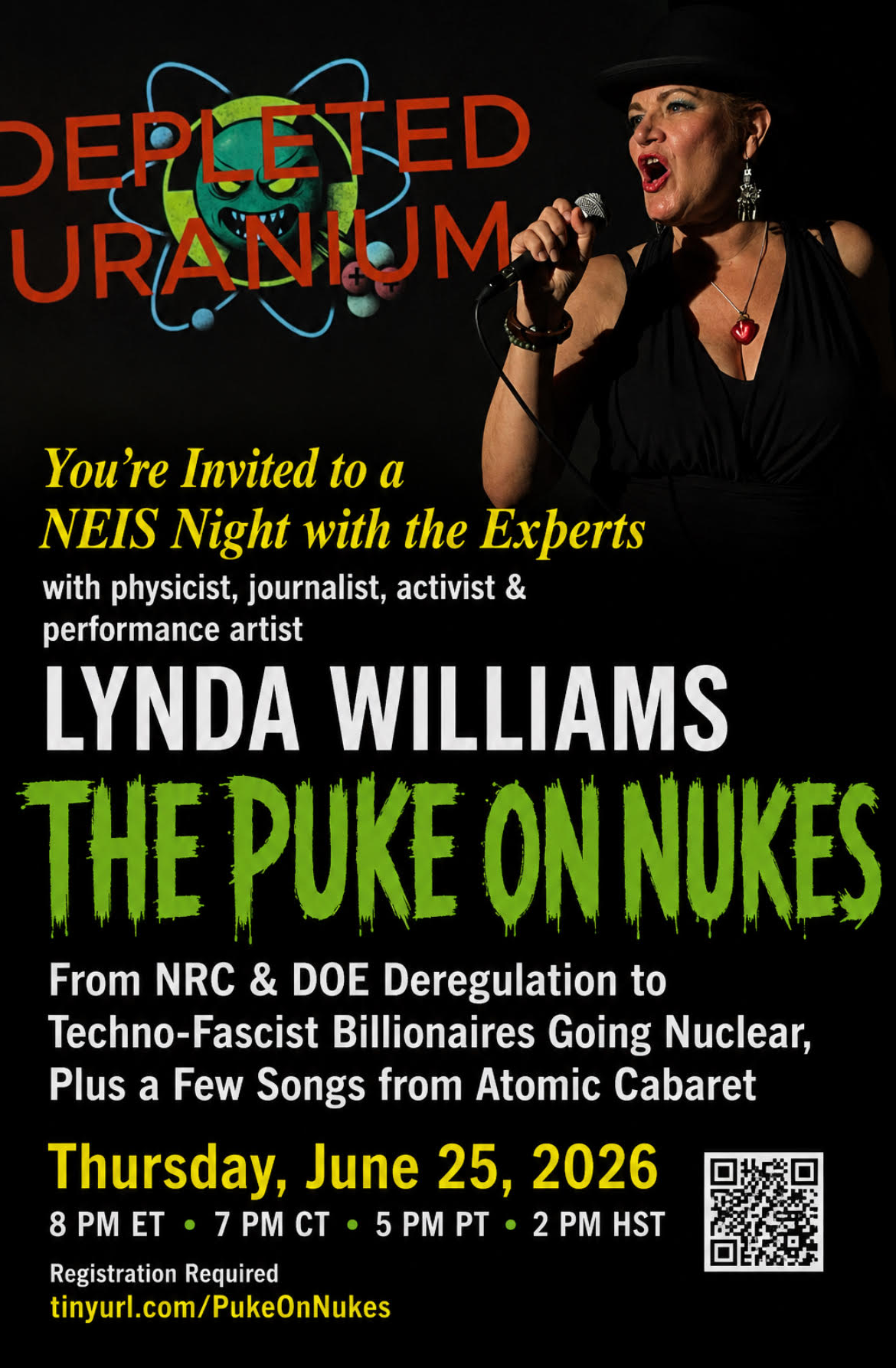
25 June- THE PUKE ON NUKES
Thursday, June 25, 2026
7pm Central Time (8pm ET, 6pm MT, 5pm PT) UTC – 5
From NRC & DOE Deregulation to Techno-Fascist Billionaires Going Nuclear, Plus a Few Songs from Atomic Cabaret REGISTER
26 June – Radiation Trainwreck at the NRC / Join the Protect Better Campaign – https://us02web.zoom.us/meeting/register/4ZlZ5_qLSHGiLSCg8FF6Bg#/registration


Cuba Is Not a Failed State – It Is a Besieged State
PETITION: “Global Appeal to Endorse Palestinian Right of Return of Refugees”
To see nuclear-related stories in greater depth and intensity – go to https://nuclearinformation.wordpress.com
-
Archives
- June 2026 (162)
- May 2026 (306)
- April 2026 (356)
- March 2026 (251)
- February 2026 (268)
- January 2026 (308)
- December 2025 (358)
- November 2025 (359)
- October 2025 (376)
- September 2025 (257)
- August 2025 (319)
- July 2025 (230)
-
Categories
- 1
- 1 NUCLEAR ISSUES
- business and costs
- climate change
- culture and arts
- ENERGY
- environment
- health
- history
- indigenous issues
- Legal
- marketing of nuclear
- media
- opposition to nuclear
- PERSONAL STORIES
- politics
- politics international
- Religion and ethics
- safety
- secrets,lies and civil liberties
- spinbuster
- technology
- Uranium
- wastes
- weapons and war
- Women
- 2 WORLD
- ACTION
- AFRICA
- Atrocities
- AUSTRALIA
- Christina's notes
- Christina's themes
- culture and arts
- Events
- Fuk 2022
- Fuk 2023
- Fukushima 2017
- Fukushima 2018
- fukushima 2019
- Fukushima 2020
- Fukushima 2021
- general
- global warming
- Humour (God we need it)
- Nuclear
- RARE EARTHS
- Reference
- resources – print
- Resources -audiovicual
- Weekly Newsletter
- World
- World Nuclear
- YouTube
-
RSS
Entries RSS
Comments RSS
 nuclear-news