Food items from five Japanese prefectures from which imports are banned had made their way into Taiwan with the help of false labels
 Minister of Health and Welfare Chiang Been-huang yesterday said that Taiwan is within its rights to tighten regulations on imported Japanese foodstuffs.
Japan’s WTO case a bad recipe: officials
Amid reports that Japan could challenge Taiwan’s decision to tighten regulations on imported Japanese foodstuffs at the WTO, Minister of Health and Welfare Chiang Been-huang (蔣丙煌) yesterday said that Taiwan is within its rights to take such an action.
“The new measure will be enforced as scheduled [tomorrow]. Even if Japan plans to file a case with the WTO, our action will stand up to scrutiny,” Chiang said.
“The ministry will continue to communicate with Japan and help it understand why it was necessary to tighten regulations,” he said, adding that the measures “will benefit both sides.”
The new measures were adopted after it was discovered in March that food items from five Japanese prefectures from which imports are banned had made their way into Taiwan with the help of false labels, Chiang said.
Food products from Fukushima, Ibaraki, Tochigi, Gunma and Chiba prefectures have been banned in Taiwan since those areas were suspected of radiation contamination the Fukushima Dai-ichi nuclear power plant disaster in March 2011.
Under the new laws, importers of Japanese food products would be required to present certificates of origin to prove that the items did not originate in the five prefectures.
For imports such as tea, baby food, and dairy and aquatic products, radiation inspection certificates are also to be required.
How measures are enforced remains to be seen, as the Food and Drug Administration (FDA) had not received any certificates of origin issued by official Japanese agencies or authorized bodies as of yesterday, Chiang said.
Japan has also not supplied a list of its inspection organizations, he said.
The FDA has inspected more than 8,000 shipments of Japanese food so far this year, agency statistics showed.
If related documents are not presented before tomorrow, items such as tea from Shizuoka and some aquatic and dairy products would not be allowed into Taiwan, officials said.
Japanese Minister of Agriculture, Forestry and Fisheries Yoshimasa Hayashi on Tuesday said that Japan has demanded that Taiwan retract its decision, but has yet to see any tangible progress, and that Japan has not ruled out taking the case to the WTO.
Association of East Asian Relations chairman Lee Chia-chin (李嘉進) said that he would advise Japan not to threaten to take the case to the WTO.
With such friendly bilateral relations between the two sides, he said: “We can talk about everything, but taking the case to the WTO could sour bilateral ties.”
Lee added that Taiwan is a major consumer of Japanese agricultural products and can certainly ask Japan to heed its food safety concerns.
“Once Japan has fully investigated the false labeling, Taiwan will certainly feel less pressure to impose stricter regulations,” Lee said.
Meanwhile, the Ministry of Foreign Affairs yesterday confirmed that Takeo Hiranuma, a senior Japanese lawmaker and head of the Japan-Republic of China Diet Members’ Consultative Council, recently canceled a scheduled visit to Taiwan, but said that the move was not related to conflict over the planned regulations.
Ministry spokesperson Anna Kao (高安) said that Hiranuma postponed his planned visit because he was concerned that Typhoon Noul might cause travel disruptions on his way home.
Kao made the remarks in response to a report by the Chinese-language Liberty Times (the Taipei Times’ sister newspaper) yesterday saying that Hiranuma was scheduled to arrive on Tuesday, but that he canceled the trip after he was told by the ministry that his visit would not change the government’s decision to implement the rules this week.(Additional reporting by Shih Hsiu-chuan)
Source: Taipei Times
http://news.ltn.com.tw/news/focus/breakingnews/1316706
Taiwan suspends entire food import from Japan as of May 15, 2015.
【台湾、日本からの食品輸入すべて停止 協議物別れで15日から実施】
FOOD FIGHT? With Taipei’s new regulations on Japanese food imports set to go into effect tomorrow, questions regarding the enforcement of such rules remain unanswered
Taiwan suspends entire food import from Japan as of May 15, 2015.
Taiwan has banned food import from 5 prefectures since the accident in 2011.(Fukushima, Ibaraki, Tochigi, Gunma, Chiba)
Both countries could not reach an agreement on Taiwan’s tightened restriction over Japanese imported food –
1, origin of product to be labeled on all imported food products
2. radiation test result to be attached to 800 food products in 3 categories (baby foods, seafood, tea) from specified area (like Tokyo or Shizuoka) due to the “HIGH RISK” of contamination – and Taiwan decided to stop importing any food from Japan.
台湾当局が東京電力福島第1原発事故後に導入した日本の食品に対する輸入規制を強化する問題で、日台双方の窓口機関による協議が13日、台北市内で行われた。関係者によると協議は物別れに終わり、15日から日本からの食品輸入が全て停止することが確実になった。
協 議には、日本側から農林水産省や経済産業省の課長級も出席した。台湾は震災以降、福島など5県の食品の輸入を禁じており、(1)日本から出荷される全ての 食品に都道府県別の産地証明(2)東京都や静岡県など特定地域の水産品、茶類、乳幼児食品など3分類800品目超の「高リスク産品」に放射線検査証明-の 添付をそれぞれ求めている。
http://www.sankei.com/world/news/150514/wor1505140010-n1.html
Taiwan FDA test resutls 2011-2014
http://www.fda.gov.tw/upload/133/Content/2013111914051840175.pdf
Revised US FDA alert
http://www.accessdata.fda.gov/cms_ia/importalert_621.html
As Taiwan’s radioactive trash accumulates, opposition grows to the export of nuclear waste
irresponsible to ship potentially hazardous plutonium and uranium to other countries, possibly causing environmental damage or landing the material in the hands of terrorists.
Opponents of nuclear power are now asking that Taiwan not send nuclear waste overseas.
 Opposition Mounts as Taiwan Plans to Ship Nuclear Waste Offshore VOA News, Ralph Jennings May 08, 2015 TAIPEI— Taiwanese officials want to ship the island’s nuclear waste offshore as spent fuel accumulates at two older power plants, but the plan faces opposition from activists and the legislature, putting it on hold.
The two oldest of Taiwan’s three nuclear power plants are running out of space for spent fuel. The build-up of waste prompted government-run Taiwan Power Company to call in February for bids from companies overseas capable of removing the fuel, neutralizing radioactive material and helping to dispose what’s left. Firms in France, Japan, Russia and Britain are technically able to do the work, though none had tendered bids.
A month later the power company retracted its call for bids to process 1,200 bundles of spent fuel because parliament declined to approve a $367 million disposal budget. Taiwan Power spokesman Lin Te-fu said the company will try to persuade legislators again to allocate the money or risk a storage crisis at the island’s first nuclear plant……..
While some legislators believe the overseas disposal cost is too high, leaders in Taiwan’s popular movement against nuclear power cite other risks. They call it irresponsible to ship potentially hazardous plutonium and uranium to other countries, possibly causing environmental damage or landing the material in the hands of terrorists. Taiwan-based Green Citizens Action Alliance researcher Hsu Shih-ya fears the waste would contaminate foreign soil.
Hsu said the kind of disposal method proposed would cause a high level of radiation pollution surrounding the treatment plants. She said her group does not want Taiwan’s pollution to be transferred to other countries, which would be a very immoral matter.
Opposition to Taiwan’s nuclear power crested last year after more than 200,000 activists marched in the streets, leading the government later to call off plans to open a $9.3 billion fourth plant. …..
Opponents of nuclear power are now asking that Taiwan not send nuclear waste overseas. Hsu Hsin-hsin, spokeswoman for the Central Taiwan Antinuclear Action Alliance, said the plan would cost too much without answering calls to end nuclear power……. http://www.voanews.com/content/opposition-mounts-as-taiwan-plans-to-ship-nuclear-waste-offshore/2759529.html
An exciting solar energy idea – still at the dream stage?
THIS STUNNING HIGH-RISE HYDROPONIC FARM GENERATES RENEWABLE ENERGY AND REPRESENTS NEW HOPE FOR BIG CITIES ACROSS THE GLOBE [ good pics] by Rachel Oakley in Exhale on Friday 8 May 2015 To make Earth a greener place, Aprilli Design Studio got its designers together to create an incredible ecological system known as the Urban Skyfarm, for a site right in the heart of downtown Seoul.
This is not your average eco-friendly building. It’s so much more.
The Urban Skyfarm isn’t office space or apartments, but rather a complete ‘living machine’ that filters water and air, provides vegetables and herbs for the community, and produces renewable energy at the same time.
There are four major components to the Urban Skyfarm: the root, trunk, branch, and leaves.
The root section provides space for a market or public activities. The trunk can be used as a community garden space for residents. The trunk is also divided into eight individual branches (the leaf portions), which each support farming decks which are suspended from each branch by trusses and tension cables. These farming decks are spread out to receive maximum sunlight throughout the day.
Now, if that wasn’t enough, listen to this: the high rise farming system plans to operate on renewable solar and wind energy alone. Meaning, it operates completely on its own energy, and indeed provides energy to the grid…….http://www.techly.com.au/2015/05/08/this-stunning-high-rise-hydroponic-farm-generates-renewable-energy-and-represents-new-hope-for-big-cities-across-the-globe/
Taiwan’s nuclear waste storage problem may cause early retirement of nuclear reactor
Nuclear generator may be retired early: Taipower CNA April 13, 2015 TAIPEI--The state-owned Taiwan  Power Co. (Taipower, 台電) warned Sunday that the No. 1 generator at the country’s first nuclear power plant may have to go offline sooner than expected because of limited storage space for spent nuclear fuel. On Feb. 17, Taipower issued an invitation for foreign companies to tender for the reprocessing of spent nuclear fuel from Taiwan’s first and second nuclear power plants but withdrew the request on April 2 amid a budget controversy.
Taipower had allocated NT$11.257 billion (US$360 million) for the overseas reprocessing of 1,200 clusters of spent fuel rods, 300 of which were to be shipped out by the end of the year.
But lawmakers failed to approve the budget in March, saying that Taipower and the Ministry of Economic Affairs were trying to initiate a bidding process with foreign companies without legislative oversight and were accessing the nation’s nuclear back-end management fund before the establishment of legal guidelines for its use……..
Taipower said that if the fuel storage problem is not resolved in time, the No. 1 generator would have to go offline in mid-2016, ahead of the decommissioning of the first nuclear power plant in New Taipei City, which is scheduled to begin in 2018 and be completed by 2023.
The generator, in fact, has been down since last December due to a component failure, and the Atomic Energy Council has not yet given approval for it to be put back online……..
Several civic groups, including Mom Loves Taiwan and Green Citizens’ Action Alliance, have lodged strong protests against Taipower’s proposed reprocessing of nuclear fuel.
The groups have said is “absurd” to consider sending fuel rods overseas for reprocessing since Taiwan should be phasing out nuclear power.http://www.chinapost.com.tw/taiwan/national/national-news/2015/04/13/433515/Nuclear-generator.htm
Anti nuclear protest: 45,000 people march in Taiwan
45,000 people join anti-nuclear rallies in Taiwan, Straits Times, MAR 14, 2015 TAIPEI (AFP) – Thousands of people took to the streets in Taiwan on Saturday to call for the island to scrap its use of nuclear energy and to voice opposition to controversial plans to ship nuclear waste abroad, organisers said.
Protesters in central Taipei waved placards and dressed in T-shirts emblazoned with slogans including “Goodbye to nuclear energy” and “We don’t need nuclear power”, just days after Japan marked the fourth anniversary of an undersea earthquake which triggered a massive tsunami and nuclear disaster.
Taiwan’s government has faced growing public pressure over its unpopular nuclear energy facilities……….
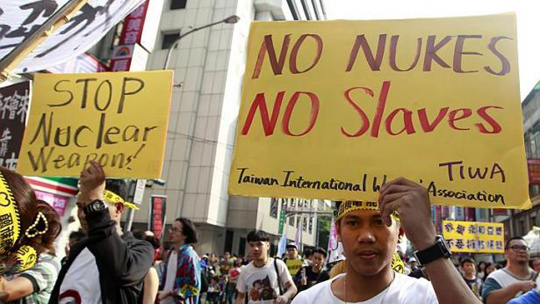
We urge the government to reform its energy policy and focus on green energy and saving energy,” said one of the rally’s organisers Tsui Shu-hsin.
“Politicians should listen to the voices of the people… so Taiwan can become nuclear-free.” The government says that Taiwan will run out of energy if it ditches nuclear power, which currently supplies about 20 per cent of the island’s electricity.
The Taipei rally drew around 30,000 people, while two other rallies held simultaneously across the island had a combined turnout of 15,000, according to estimates by organisers. Police estimates were not immediately available.
Organisers were also collecting signatures in a bid to stop a plan by the state-run Taiwan Power Co to process its nuclear waste abroad, which they said was aimed at extending the operations of two plants which are approaching capacity.
The plants, which currently store the spent fuel rods, were launched in 1978 and 1981 and will each be decommissioned once they have been operational for 40 years.
“Taiwan is earthquake-prone like Japan and it is smaller so nuclear facilities are much closer to our homes,” said Wu Bor-chyun, a banker who was living in Japan at the time of the 2011 nuclear accident.
“Nuclear power is not safe and it is very costly. Taiwan should heed the lessons in Japan.”http://www.straitstimes.com/news/asia/east-asia/story/45000-people-join-anti-nuclear-rallies-taiwan-20150314#sthash.Y0GCWbnB.dpuf
Tawian has serious problems in its nuclear waste management

 Questions raised over nuclear waste management, Taipei Times By Tang Chia-ling / Staff reporter 9 Mar 15 The Atomic Energy Council (AEC) has detected greater-than-class-C (GTCC) nuclear waste at the nuclear-waste storage facility on Orchid Island (Lanyu, 蘭嶼) in Taitung County, despite the facility being designed for only low-radioactive materials, raising questions over the management of nuclear waste.
The council originally ordered Taiwan Power Co (Taipower, 台電) to introduce new rules on nuclear-waste classification by the end of last year, after it discovered the GTCC nuclear waste on the outlying island.
However, Taipower has failed to meet the deadline due to technical difficulties in compiling a nuclear-waste inventory, so the deadline has been extended, the council said.
According to the US Nuclear Regulatory Commission classification system, nuclear waste with a concentration of cesium-137 or strontium-90 greater than 4,600 and 7,000 curies per cubic meter respectively, or with a concentration of nickel-63 greater than 700 curies per cubic meter, is considered GTCC waste.
Citing a report by the Institute of Energy Research, Yang Mu-huo (楊木火), adviser to Democratic Progressive Party (DPP) Legislator Chen Ou-po (陳歐珀), said GTCC waste is mainly made up of components of decommissioned nuclear reactors and resins derived during the maintenance of nuclear power plants.
Class B nuclear waste is required to be stored in containers for 300 years, while class C waste needs to be stored for 500 years. GTCC waste is generally unacceptable for near-ground storage and requires a special disposal plan, the report shows.
Yang questioned why storage canisters designed for storage of up to 100 years had been used for the waste on Orchid Island and why authorities did not propose a special disposal plan for the GTCC materials……..http://www.taipeitimes.com/News/front/archives/2015/03/09/2003613111
March 14 in Taiwan – anti nuclear marches in Taipei, Kaohsiung and Tainan
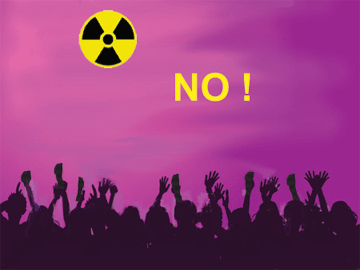 Anti-nuclear protest march scheduled for March 14 Central News Agency By Zoe Wei and Evelyn Kao
2015-03-01 Taipei, A national anti-nuclear alliance calling for energy reforms is set to hold a protest march around Taiwan on March 14 to mark the fourth anniversary of Japan‘s Fukushima nuclear disaster in 2011. Stop Nukes Now , formed by 126 anti-nuclear organizations, announced that the march will take place simultaneously in Taipei, Kaohsiung and Tainan to convey people’s hope for the government to abolish nuclear power and reform Taiwan’s energy network.
Taiwanese petition against nuclear-waste reprocessing
Activists petition against nuclear-waste reprocessing http://www.taipeitimes.com/News/taiwan/archives/2015/02/25/2003612205 By Tang Chia-ling Anti-nuclear group Mom Loves Taiwan has launched a petition against state-run Taiwan Power Co’s (Taipower) call for bids to reprocess about 1,200 bundles of spent fuel rods from the Jinshan and Guosheng nuclear power plants, which Taipower announced on Tuesday last week, one day before Lunar New Year’s Eve.
Taipower has obtained a budget of NT$11.25 billion (US$353 million) to deliver 480 and 720 bundles of spent fuel rods from the Jinshan Nuclear Power Plant, in New Taipei City’s Shihmen District (石門), and the Guosheng Nuclear Power Plant, in New Taipei City’s Wanli District (萬里), respectively overseas for reprocessing. The reprocessing is to be implemented over four years, with the first batch scheduled to be shipped by the end of this year.
The campaign, dubbed “Help Taiwan & Save The World!! Stop Taipower’s Nuclear Fuel Reprocessing Project,” had gathered about 270 signatures as of press time last night. Many signatories are from Japan, where the Fukushima Dai-Ichi nuclear power plant disaster took place in 2011.
The organization hopes to obtain 500,000 signatures and present them to Premier Mao Chi-kuo (毛治國) in the hope that the government will block the project.
Mom Loves Taiwan chief executive Yang Shun-mei (楊順美) said shipping highly radioactive nuclear waste overseas to be reprocessed only means that the waste will be shipped back to Taiwan 20 years later.
She said that nuclear waste reprocessing is a dying industry and that the French-based firm Areva, which is on the brink of bankruptcy, is a case in point.
She said that Avera is reportedly the company to which Taipower plans to send its fuel rods for reprocessing. She said the move would salvage the company from insolvency at the cost of polluting the environment, while bolstering nuclear arms production, and above all, no one would responsible for overseeing the reprocessing operations.
Taiwan Environmental Protection Union member Gloria Hsu (徐光蓉) said that Taipower did not inform the public of the actual cost of nuclear-waste reprocessing and that time and again it has requested more funds from the legislature shortly after its budget has been passed.She added that it did this while constructing the Fourth Nuclear Power Plant.
Anti nuclear activists challenge pro nuclear Taiwan government
Nuclear backers, critics clash at public meeting, Taipei Times By Sean Lin / Staff reporter 22 Dec 14 Anti-nuclear energy activists clashed with their pro-nuclear counterparts on Saturday at an event in Taipei held to gather public opinions in preparation for next month’s energy conference.
The conference is set to focus on identifying alternative energy sources after the construction of the Fourth Nuclear Power Plant in New Taipei City’s Gongliao District (貢寮) was suspended over widespread protests about the safety risks of the facility.The wide divide among advocates and critics of nuclear energy became clear soon after the northern preliminary meeting began……………
Taoyuan Local Union director-general Pan Chung-cheng (潘忠政) said he suspects that the Atomic Energy Council has mobilized many state-sponsored and pro-nuclear academics and members of related groups to attend the meetings because the public generally opposes nuclear energy.
“The government can work with academics and provide all these scientific facts about the benefits of nuclear power, but at the end of the day, the decision as to whether to adopt nuclear energy should be decided by the public,” he said.
“I do not think they really understand how people feel about nuclear energy and their actions are a violation of democratic values,” he said.http://www.taipeitimes.com/News/taiwan/archives/2014/12/22/2003607328
Taiwan to demand certificates for Japanese food imports
Oct 31, 2014
TAIPEI – Taiwanese authorities are considering requiring production area certificates for all food imports from Japan and radiation check certificates for some, according to informed sources.
The authorities plan to implement the new policy in 2015 after gauging public opinion.
Following the nuclear accident at the Fukushima No. 1 power plant caused by the March 2011 earthquake and tsunami, Taiwan banned imports of food products from five prefectures, including Ibaraki, Tochigi and Chiba.
In addition, radiation checks have been conducted on vegetables, fruit and fisheries products imported from Japan.
Production area certificates are currently not required.
Under the envisioned policy, Taiwan would require production area certificates for all food imports from Japan and radiation check certificates by the Japanese government for those subject to current radiation checks and certain other products, such as tea and biscuits.
Consumer groups in Taiwan have been calling for stronger regulations on Japanese food imports.
Source: Japan Times
Green tea from Japan to be tested for radiation
 2014/10/29
Taipei, Oct. 29 (CNA) Sweets, cookies and teas and tea products imported from Japan into Taiwan will be subject to tests for radioactive substances beginning next year, the acting Food and Drug Administration (FDA) director-general said Wednesday.
Chiang Yu-mei said that under the proposed measure, importers of the Japan-made items will not be able to apply for the necessary imported food inspections unless the products come with radiation examination certificates from the Japanese government.
The new measure is expected to take effect next year, Chiang said in response to a post by Democratic Progressive Party Legislator Lin Shu-fen on her Facebook page that criticized the government for not checking Japanese green tea products for radioactive substances.
In the post dated Oct. 29, Lin questioned the surge in green tea drinks imported from Japan into Taiwan over the past three years even though green tea leaves in Japan had tested positive for radioactive substances since the Fukushima nuclear disaster in 2011.
“Do you know that since the Fukushima disaster, imports of Japanese green tea have increased dramatically? Do you know that Japanese green tea has often tested positive for radiation?” Lin asked in her post.
In defending Taiwan’s practices on Japanese food imports, the FDA has repeadly stressed that Taiwan suspended imports of food items from five Japanese prefectures near the Daiichi Nuclear Power Plant days after the facility suffered a meltdown in March 2011.
The temporary ban, imposed on foods from Fukushima, Ibaraki, Tochigi, Gunma and Chiba prefectures, remains in effect today, the agency said.
In addition, batch-by-batch inspections for radioactive substances have been enforced on eight major types of foods produced in other parts of Japan since then, the FDA said
The tests cover fresh and chilled vegetables and fruits, frozen vegetables and fruits, live and chilled fishery products, frozen fishery products, dairy products, products for infants, mineral water or other types of drinking water, and seaweed, it said.
(By Chen Ching-fang and Elizabeth Hsu)
Source: Focus Taiwan
Anti nuclear movement in Taiwan is now mainstream
Taiwan’s nuclear power plants are magnets for protesters Ralph Jennings The Christian Science Monitor July 28, 2014 “……The anti-nuclear movement in Taiwan, once a fringe movement, is going mainstream. President Ma Ying-jeou’s government promised to freeze construction on the island’s fourth nuclear power plant this April, after tens of thousands turned out to protest in Taipei. The temporary freeze takes effect this month.Nearly 59 percent of people polled in April by Taiwan’s Commonwealth magazine, a politics and economics publication, said they wanted the fourth nuclear power plant stopped because they fear a disaster akin to Japan’s 2011 Fukushima earthquake and reactor meltdown. Like Japan, Taiwan sits in a highly seismic area.
Taiwan’s nuclear dilemma – a return to authoritarian past?
Taiwan’s Nuclear Future and Authoritarian Past The intense debate in Taiwan over nuclear power has echoes of a less democratic past. The Diplomat, By Brent Crane May 21, 2014 Last August, chaos erupted in Taiwanese parliament. Opposing lawmakers thrust hard-clenched fists at one another while fervent activists tossed opened water-bottles from the stands like Molotov cocktails. Politicians and otherwise civilized men wrestled like teenage boys on the floor amid shouts, screams and camera flashes.
The Legislative Yuan had initially assembled to discuss the conditions of a national referendum deciding the fate of Taiwan’s fourth nuclear power plant in Gongliao, New Taipei City. The controversial plant, known ominously throughout the country as Nuke 4, remains a rallying cry for opponents of one of Taiwan’s most charged political subjects: nuclear power. The debate has been energized in recent weeks after former opposition party leader and staunch nuclear energy opponent Lin Yi-hsiung went on hunger-strike in protest of the government’s unwillingness to make concessions with Taiwan’s antinuclear lobby. On the surface, the conflict appears rather black-and-white: it’s the safety-conscious, environmentalists and academics versus the pragmatic economists and government bureaucrats. But the nuclear power debate in Taiwan is about much more than just safety and economics. It’s about reconciling Taiwan’s autocratic past with its democratic present……….
On the Taiwanese political front today, only reunification is as hotly debated as nuclear energy. The antinuclear camp, which polls suggest finds support from up to 70 percent of the 23 million Taiwanese, advocates full denuclearization of the island. Simply put, their biggest beef with nuclear power in Taiwan is that it poses too great a safety risk. The disaster at Japan’s Fukushima Daiichi Nuclear Power Plant in 2011 represents the type of nightmare scenario that antinuclear activists conjure up when they denounce the energy source. After all, Taiwan is highly prone to typhoons, tsunamis and earthquakes. In late September 1999, for instance, a 7.9 magnitude earthquake killed 2,415 people in central Taiwan, injuring more then 11,000. Last September, Typhoon Usagi left Taiwan with 35 dead and with more than $4.33 billion in damages. The list goes on. And Taiwan’s compact size ensures that any plant destruction or malfunction on the scale of the Fukushima fiasco would be disastrous for the island, whose densely packed urban centers are never too far from any of the country’s four plants.
Yet despite the risks, the ruling KMT party remains firmly pro-nuclear, and has proven resilient in weathering the antinuclear storm. ……In true Jeffersonian fashion, the electorate, though hollering at an often unresponsive government, are demanding that their voices be heard. And with the ebb and flow of the youth-led Sunflower Movement, a government accountability project akin to Occupy Wall Street, Taiwan’s political atmosphere has been particularly energized lately………
Opposition to Nuke 4 has galvanized tens of thousands of Taiwanese to hold demonstrations throughout the country in recent years. Clearly, the anti-nuclear camp is no longer a fringe element. On the contrary, opposition to nuclear power has become a household inclination, with some studies showing 55 percent to 70 percent of the population anti-nuclear………
Of course, shifting an entire country from autocracy to democracy is no easy task. But Taiwan’s nuclear energy debate is a reminder that its transition isn’t yet wholly complete. http://thediplomat.com/2014/05/taiwans-nuclear-future-and-authoritarian-past/
Taiwan’s growing problem of nuclear radioactive waste

the only sane thing is to stop making the stuff
Taiwan in talks with China, France for nuclear waste deals Global Post 12 May 14, Taiwan has been talking with China and France over the possibility of managing the island’s radioactive nuclear waste, Taiwanese officials said Monday.
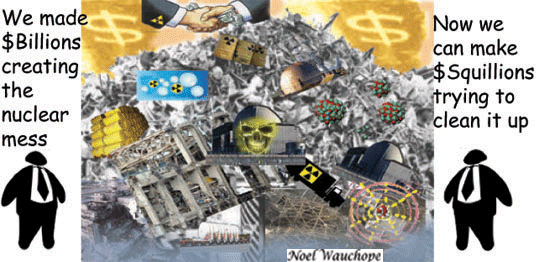
Hwang Jung-chiou, chairman of the state-owned electric power utility Taiwan Power Co. (Taipower), told Kyodo News that they have been in contact with France with the intention of sending shiploads of spent fuel rods there for reprocessing, adding that Taiwan has obtained consent from the United States. A civil nuclear agreement between Taiwan and the United States, renewed in December last year, allows the transfer of nuclear waste from Taiwan to France and other countries or destinations agreed upon by Taipei and Washington for storage and reprocessing.
Hwang made the remarks after the construction of an interim dry storage facility for spent fuel rods his company plans to build in New Taipei City hit a snag.
The water pools at the First Nuclear Power Plant in Chinshan, 41 kilometers away from the capital Taipei, are nearing full capacity.
Taipower is building an above-ground facility at the reactor site for storing the used fuel before a deep geological disposal site is available.
Taipower’s plan is to begin building the final repository in 2044 and commence operation in 2055.
However, local opposition to the interim facility has forced the New Taipei City government to hold off from giving a green light to the proposal……..
Apart from talking with France on reprocessing high-level radioactive waste, Hwang said they are also talking with China over the possibility of disposing low-level nuclear waste there.
Taipower began to ship low-level radioactive nuclear waste to an underground storage site on Orchid Island off Taiwan’s southeastern coast three years after Taiwan’s first nuclear power plant came online in 1979.
Over 97,000 barrels of such waste were shipped to the island, which is home to some 4,000 Tao Aboriginal people, before they began to disintegrate in 1992, leading to efforts to replace the eroded containers with new ones beginning in 1996.
While Orchid Island is a temporary disposal facility, the Ministry of Economic Affairs has announced that Wuciou Island in the Kinmen archipelago, near the coast of mainland China, and Daren Township of Taitung County in eastern Taiwan have been chosen as possible sites of permanent storage.
However, strong opposition has made the two local governments reluctant to hold regional referendums on the issue. http://www.globalpost.com/dispatch/news/kyodo-news-international/140512/taiwan-talks-china-france-nuclear-waste-deals
1 This Month

of the week – Shut Down Drone Warfare!


Tell the Ukrainian Government to Drop Prosecution of Peace Activist Yurii Sheliazhenko

Petition to revoke the licensing of the Near Surface Nuclear Disposal Facility (NSDF) at Chalk River. https://www.ourcommons.ca/petitions/en/Petition/Details?Petition=e-7247
To see nuclear-related stories in greater depth and intensity – go to https://nuclearinformation.wordpress.com
-
Archives
- March 2026 (244)
- February 2026 (268)
- January 2026 (308)
- December 2025 (358)
- November 2025 (359)
- October 2025 (376)
- September 2025 (257)
- August 2025 (319)
- July 2025 (230)
- June 2025 (348)
- May 2025 (261)
- April 2025 (305)
-
Categories
- 1
- 1 NUCLEAR ISSUES
- business and costs
- climate change
- culture and arts
- ENERGY
- environment
- health
- history
- indigenous issues
- Legal
- marketing of nuclear
- media
- opposition to nuclear
- PERSONAL STORIES
- politics
- politics international
- Religion and ethics
- safety
- secrets,lies and civil liberties
- spinbuster
- technology
- Uranium
- wastes
- weapons and war
- Women
- 2 WORLD
- ACTION
- AFRICA
- Atrocities
- AUSTRALIA
- Christina's notes
- Christina's themes
- culture and arts
- Events
- Fuk 2022
- Fuk 2023
- Fukushima 2017
- Fukushima 2018
- fukushima 2019
- Fukushima 2020
- Fukushima 2021
- general
- global warming
- Humour (God we need it)
- Nuclear
- RARE EARTHS
- Reference
- resources – print
- Resources -audiovicual
- Weekly Newsletter
- World
- World Nuclear
- YouTube
-
RSS
Entries RSS
Comments RSS
 nuclear-news