Tritium is what makes nuclear reactors so dangerous, not only in Fukushima but also in S. Korea
 http://english.hani.co.kr/arti/english_edition/e_editorial/967441.html By Kim Eun-hyoung, editorial writer, Oct.27,2020
Tritium exists in the natural world, but only in negligible amounts. It’s typically produced during the fission process inside nuclear reactors. Tritium is part of the coolant that lowers the temperature in the reactor core, which is heated by fission.
The contaminated water at the Fukushima reactor that the Japanese government seeks to release into the ocean contains tritium at levels that are 10 times higher than levels permitted by the South Korean government. That has terrified people not only in Japan but also in Korea.
The Japanese government says that the contaminated water doesn’t present a problem because it will be decontaminated through Tokyo Electric Power Company’s advanced liquid processing system (ALPS), before release. But the tricky part about releasing the contaminated water is tritium, which can’t be removed by ALPS because of the strong chemical bond it forms with water.
But Fukushima isn’t the only place affected by the risk of tritium. Heavy-water reactors are cooled with heavy water (deuterium oxide, 2H2O) instead of ordinary drinking water, producing a greater amount of tritium. There are four heavy-water reactors at Korea’s Wolsong plant, including Wolsong-1, which has been in the news recently after government auditors questioned a report about its economic viability, the justification given for shutting the reactor down earlier than planned.
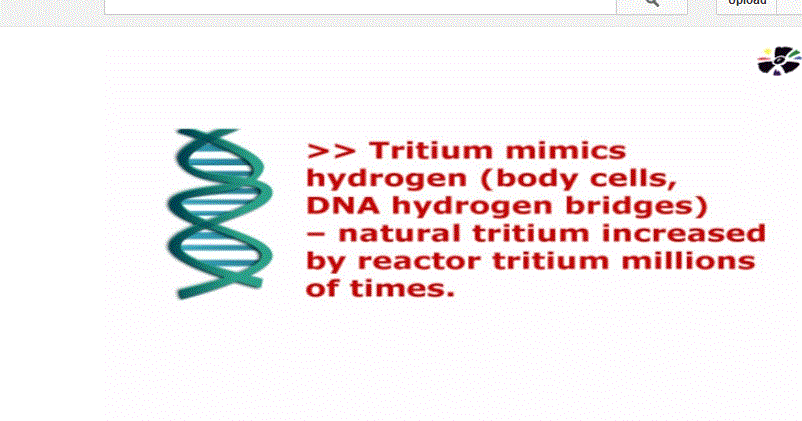
Tritium is regarded as a low-risk radioactive substance, causing less harm than other types of radiation. For one thing, the radiation emitted by tritium is so weak that it can’t penetrate the outer layer of the skin. And even when it is absorbed by the body, its biological half-life — the time required for half the substance to leave the body — is only 12 days.
Even now, Wolsong-2, Wolsong-3, and Wolsong-4 account for 40% of the tritium released by all of Korea’s nuclear stations. Rates of thyroid cancer among women who live near the Wolsong nuclear plant are 2.5 times higher than in other areas, which some think is linked to tritium contamination. The question of nuclear power safety affects Korea in the same way as it affects Japan. It would be foolish and contradictory to view Japanese nuclear plants through the lens of safety and Korean nuclear plants through the lens of economic viability.
But such safety observations only apply to a single dose of radiation, such as an X-ray, and the actual risk depends on the intensity of exposure. That has led various countries to develop strict safety standards for the substance. The European Committee on Radiation Risk warns that internal radiation exposure can cause mutations that could lead to cancer.
South Korea to end dependence on coal, switch to renewables
|
Guardian 28th Oct 2020, South Korea’s president, Moon Jae-in, has declared that the country will
go carbon neutral by 2050, bringing it into line with other major economies. In a policy speech in the national assembly on Wednesday, Moon said South Korea, one of the world’s most fossil fuel-reliant economies, would “actively respond” to the climate emergency “with the international community and achieve carbon neutrality by 2050”. He vowed to end its dependence on coal and replace it with renewables as part of its Green New Deal, a multibillion-dollar plan to invest in green infrastructure, clean energy and electric vehicles. |
|
South Korea says no use of nuclear weapons in joint operational plans with U.S
|
South Korea says no use of nuclear weapons in joint operational plans with U.S. The Chronicle Herald,
Hyonhee Shin, 16 Sep 20, SEOUL (Reuters) – South Korea said on Tuesday none of its joint military action plans with the United States include any use of nuclear weapons, after a book by a U.S. journalist sparked debate over whether scenarios of a full-blown war with North Korea would entail a nuclear attack from either side.
In his new book, titled “Rage,” Washington Post associate editor Bob Woodward wrote that the United States had devised plans for a possible armed clash with North Korea, such as “the U.S. response to an attack that could include the use of 80 nuclear weapons.” The book was based on multiple interviews with U.S. President Donald Trump. The passage fueled debate in South Korea over whether it meant Washington or Pyongyang would detonate 80 bombs against each other. Seoul’s defense ministry said on Tuesday its joint operational plans (OPLAN) with the United States did not include any use of nuclear weapons, reiterating the view of the presidential office. A presidential official said on Monday there must not be another war on the peninsula and any use of force cannot be implemented without South Korea’s consent. “I can say clearly that the use of a nuclear weapon does not exist in our OPLANs, and it is impossible to use military force without our agreement,” the official told reporters…………. https://www.thechronicleherald.ca/news/world/south-korea-says-no-use-of-nuclear-weapons-in-joint-operational-plans-with-us-497135/ |
|
South Korea’s nuclear reactors affected by Typhoon Haishen: 2 reactors stopped
|
Typhoon Haishen interrupts operations of nuclear reactors on southeast coast, http://www.koreaherald.com/view.php?ud=20200907000785, By Yonhap Sept 7, 2020 South Korea’s state-run nuclear plant operator said Monday that the operations of two of its reactors on the country’s southeastern coast were interrupted due to Typhoon Haishen, which is currently passing the country.
“The turbines were automatically stopped due to a malfunction in the reactors’ cable facilities due to the typhoon,” the Korea Hydro & Nuclear Power Co., which operates Wolsong Nuclear Power Plant, said in a statement. There has been no radiation exposure or other safety issues despite the disruptions at the No. 2 and No. 3 reactors, it added. “We plan to carry out more investigation and take necessary measures,” the company said. Typhoon Haishen, the season’s 10th typhoon, has brought the country under its influence with heavy rains and strong winds, the weather agency said. The Korea Meteorological Administration (KMA) said the typhoon arrived some 30 kilometers southwest of Ulsan at around 9 a.m., slightly changing its course westward. It was forecast to escape to waters northeast of Gangneung, Gangwon Province, at around 2 p.m. (Yonhap)
|
|
|
South Korea adviser calls for ‘six-party security summit’ to discuss North Korea nuclear issue
Moon’s adviser calls for ‘six-party security summit’ to discuss N.K. nuclear issue, Korea Herald, By Yonhap, 4 Sept 20, SEOUL (Yonhap) —A special security adviser to President Moon Jae-in on Friday suggested reviving the six-party talks on North Korea’s nuclear program in the form of a six-way summit, saying the issue is not a matter only between Washington and Pyongyang.
Moon Chung-in, special adviser for diplomatic and security affairs, made the remark during a security forum hosted by the Korea Institute for National Unification, stressing the importance of a “top-down approach” in efforts to resolve the issue.
“We need to revise the six-party talks that we failed in the past and we need to hold a ‘six-party security summit’ so that the leaders can discuss the issue of security and come up with an agreement on common security,” he said.
A Pakistan threat of nuclear war with India
 Pakistan minister Sheikh Rasheed Ahmed threatens India with nuclear war, Scroll, Ahmed said Pakistan would opt for a nuclear conflict because the Indian Army was far superior in conventional weapons. Scroll In 21 Aug 20 Pakistan minister Sheikh Rasheed Ahmed threatens India with nuclear war, Scroll, Ahmed said Pakistan would opt for a nuclear conflict because the Indian Army was far superior in conventional weapons. Scroll In 21 Aug 20
Pakistan Railway Minister Sheikh Rasheed Ahmed on Thursday threatened India with nuclear war. Speaking to Samaa TV, he said if India attacks Pakistan, it will descend into an “atomic war”. Ahmed said the Pakistan Army was far inferior to India’s in conventional weaponry, and would therefore have to use a nuclear bomb. “This will be a bloody, last and atomic war,” he said. “Our [nuclear] weapon will be very calculated, miniature and perfect, and will target India while protecting the lives of Muslims.” Ahmed claimed that Pakistan now has nuclear weapons that can reach Assam. “Pakistan does not possess enough conventional weapons, so India knows that [in a war], whatever will happen, will happen.” ………. The Pakistani minister’s views are a departure from Prime Minister Imran Khan’s opinion about a war between New Delhi and Islamabad. Khan has stated on two separate occasions that a war between the two nuclear-armed countries would not end well. https://scroll.in/latest/971015/pakistan-minister-sheikh-rasheed-ahmed-threatens-india-with-nuclear-war |
|
Is South Korea’s nuclear industry a model for others to follow?
 Jim Green, Nuclear Monitor #844, 25 May 2017, https://www.wiseinternational.org/nuclear-monitor/844/south-koreas-nuclear-industry-model-others-follow
As the nuclear power crisis has unfolded in recent months ‒ engulfing major nuclear companies and utilities in the US, Japan and France ‒ South Korea’s nuclear industry has been held up as a model for others to follow. US nuclear lobbyist Michael Shellenberger, for example, explains ‘why Korea won’: “Korea is winning the global competition to build new nuclear plants against China and Russia despite being a fraction of the size, at just 50 million people, and energy-poor. It has done so through focus: standard design, standard construction of plants, standard operation and standard regulation.”1
But South Korea’s nuclear industry is scandal-plagued, it hasn’t won any bids to build reactors overseas since 2009, and it is more than a stretch to describe it as “world class” as nuclear advocate Rod Adams would have you believe.2 Public and political support has been in freefall over the past five years because of the Fukushima disaster and a domestic nuclear corruption scandal (see the following article in this issue of the Nuclear Monitor). In the coming years, nuclear power’s contribution to domestic electricity supply is likely to decline and there is little likelihood that an export industry will flourish. Moreover, with public support for the nuclear industry in freefall, the government has little hope of achieving its aim of securing a site for a high-level nuclear waste repository by 2028.
Korea Times noted on April 21 that every major candidate in South Korea’s presidential election promised to stop building new nuclear reactors and to close down older ones.3 The winner of the May 9 presidential election, Moon Jae-in, who stood as the candidate of the Democratic Party of Korea, is a former human rights lawyer. World Nuclear News reported that Moon was one of seven presidential candidates who signed an agreement in March for a “common policy” to phase out nuclear power.4 During the election campaign, Moon said he would scrap plans for new reactors ‒ including Shin Kori units 5 and 6 ‒ while immediately closing the Wolsong-1 reactor.4 (In February 2017, the Seoul Administrative Court ordered the Nuclear Safety and Security Commission to cancel its decision to extend the lifespan of Wolsong-1 because legal procedures had not been followed in the decision-making process.) Moon also said he would block lifespan extensions for the older reactors at the Kori plant5 ‒ the four Kori reactors were grid-connected between 1977 and 1985. Continue reading
South Korea risk of power disruption, as nuclear spent fuel builds up, with storage shortage
 Wolseong reactors at risk of shutdown due to spent nuclear fuel storage shortage, Pulse News, By Oh Chan-jong and Choi Mira 2020.05.22 South Korean nuclear reactors responsible for nearly a quarter of the country’s power supply at cheap price could undergo disruption due to shortage of space to store spent nuclear fuel.
Failure to begin construction to add storage facilities within 100 days would lead to total shutdown of the Wolseong 2, 3 and 4 reactors that each can generate 700 megawatts of power, equivalent to the anticipated capacity of a solar farm that the government plans to build in Saemangeum with an investment of 10 trillion won ($8.09 billion). The Wolseong 1 reactor was already unplugged last year…….. https://pulsenews.co.kr/view.php?year=2020&no=525749
South Korea, Germany to bolster ties in transition towards renewable energy
S. Korea, Germany to bolster ties in transition towards renewable energy
The cooperation came as a follow-up to an agreement reached by Industry Minister Sung Yun-mo and German counterpart Peter Altmaier in Berlin last year, in which they vowed to bolster cooperation in the energy segment.
Seoul and Berlin will especially focus efforts on cooperating deeper on their shift towards renewable energy, while phasing out nuclear energy…….
The two countries are both making efforts to reduce their coal-based power generation as well, with Germany planning to break away from the resource by 2038. South Korea also vowed to “significantly reduce” its consumption of coal. https://en.yna.co.kr/view/AEN20200512003700320?fbclid=IwAR1RpCGPA8_id6MKRdp3q4xHlK6-BjaQOf5lbJL5TIhbKP6kHqekyrZmMagcolin@yna.co.kr
Satellite images reveal North Korean leader Kim Jong-un’s new nuclear facility
|
Satellite images reveal North Korean leader Kim Jong-un’s new nuclear facility, DNA India 10 May 20, The United States think tank has earlier stated that North Korea is almost finished with the making of a ballistic missile facility having the capacity to test-fire intercontinental ballistic missiles.
Satellite images have revealed North Korean leader Kim Jong-un’s massive nuclear facility outside the capital Pyongyang He is planning to stockpile on his nuclear weapons after nuclear talks between the North Korean dictator and US President Donald Trump last year broke down.,,,,,, Satellite images have revealed North Korean leader Kim Jong-un’s massive nuclear facility outside the capital Pyongyang He is planning to stockpile on his nuclear weapons after nuclear talks between the North Korean dictator and US President Donald Trump last year broke down…… According to the report, the construction for the ‘previously undisclosed facility’ started in mid-2016 which is capacious enough to house all known North Korean ballistic missiles, their associated launchers, and support vehicles. ….https://www.dnaindia.com/world/report-satellite-images-reveal-north-korean-leader-kim-jong-un-s-new-nuclear-facility-2824299 |
|
South Korea sticking to its policy of phasing out nuclear power, switching to renewables
Seoul keeps to plan of weaning the country off nuclear fuel, expand renewables to 40%, Pulse, By Oh Chan-jong and Lee Eun-joo 8 May 20, South Korea on Friday kept its plan to phase out of nuclear fuel intact despite snowballing losses at state utility firms as the result, with a goal to replace energy sourcing with renewables to 40 percent by 2034 through retiring aged fossil and nuclear powered stations.
According to the ninth long-term plan announced by a working group under the Ministry of Trade Industry and Energy on Friday, the government plans to close all coal-fired power plants whose 30 years of operational years expire by 2034 and replace the fuel with liquefied natural gas (LNG). It will also reduce the number of nuclear power stations to 17 units by 2034 after a peak at 26 units in 2024.
Under the plan, the government will reduce dependence on nuclear and fossil fuel from current 46.3 percent to 24.8 percent by 2034 while expand dependence on renewables from 15.1 percent to 40 percent.
Renewable energy will take up 40 percent of total power supply by 2034, up from 15.1 percent. In addition to the closing down of 10 coal-fired plants as announced during the previous roadmap, 14 additional units will shut down by 2030. The government expected to be able to reach its goal announced in July, 2018, to reduce domestic greenhouse gas emissions by 32.5 percent by 2030.
South Korea’s government dismissed rumours about North Korean leader Kim Jong Un being gravely ill
 North Korean leader Kim Jong-un health rumours dismissed by South Korean intelligence, ABC News, 27 Apr 20, South Korea’s Government has dismissed rumours that North Korean leader Kim Jong-un is in a fragile condition, as speculation about his health intensifies amid the North’s silence on his whereabouts.
Unification Minister Kim Yeon-chul told a closed-door forum in Seoul that South Korea had “enough intelligence to confidently say that there are no unusual developments” in rival North Korea that would back up speculation about Mr Kim’s health, his ministry said.
The minister did not reveal what specific intelligence led to that conclusion, but stressed that it was reached after a thorough analysis.
His comments are a reiteration of earlier South Korean statements that Mr Kim appeared to be handling state affairs normally and that no unusual activities had been detected in North Korea.
Those comments, however, failed to dispel the rumours about Mr Kim, partly because past outside intelligence reports on developments in North Korea have sometimes turned out to be wrong. …..
As the absolute leader of a country with a nuclear weapons program, Mr Kim’s health is a matter of intense interest both regionally and globally.
If something were to happen to him, it could lead to instability in North Korea. Mr Kim hasn’t publicly anointed a successor, and that has prompted questions about who would take control of North Korea if he is gravely ill or dies…..
serious unrest could occur if a power struggle erupts between those supporting the Kim dynasty and those who want non-Kim rule…….. https://www.abc.net.au/news/2020-04-28/kim-jong-un-health-rumours-south-korea-intelligence/12191504
The Carbon Brief Profile: South Korea
 COUNTRY PROFILES 6 April 2020 The Carbon Brief Profile: South Korea, 6 Apr 20,
As part of its series on how key emitters are responding to climate change, Carbon Brief looks at South Korea’s attempts to balance its high-emitting industries with its “green”aspirations.
the nation has drawn criticism for not always matching its green-growth rhetoric with action. Proposed phaseouts of coal and nuclear have been prompted primarily by concerns about air pollution and safety,as opposed to climate.
With an election approaching, many environmental groups joined together to call for more action from the major parties, which they claimed have prepared virtually “no countermeasures” against climate change.
In March, a group of Korean youth activists sued the government over its climate framework, which they deemed insufficient to meet the nation’s Paris Agreement targets.
According to a 2019 study by the Pew Research Centre, South Koreans place climate change highest in their list of potential national threats…….. Recent polling suggests 77% of voters would vote for political parties promising to respond to the threat of climate change in the general election……
This year, nations are expected – though not strictly required – under the Paris Agreement to come forward with updated plans that scale up the ambition of their original target. South Korea has yet to indicate whether it intends to meet this expectation. …….
Finally, South Korea is home to the Green Climate Fund (GCF), a UN body based in the “international business district” of Songdo, near the north-western city of Incheon. The fund is the main mechanism set up for mobilising $100bn every year “by 2020” from richer countries to finance climate mitigation and adaptation in the developing world…….
‘Green growth’ policies
In keeping with South Korea’s rapid industrialisation over the past few decades, the nation’s approach to climate and energy is best summarised by the principle of “green growth”.
Upon the inauguration of President Lee Myung-bak in 2008, he made it clear his overarching philosophy would be based on clean-energy technologies and environmentally friendly development in order to fuel long-term economic growth. In a speech at the time, he said:
“If we make up our minds before others and take action, we will be able to lead green growth and take the initiative in creating a new civilisation.”
This was reflected in the flagship Framework Act on Low Carbon, Green Growth (pdf), which was passed in 2009 and provided the legislative framework for emissions targets and renewable energy expansion, as well as the basis for a carbon trading system.
A five-year plan implemented the same year saw South Korea commit 2% of its GDP through to 2013 to invest in the green economy, which included investing in renewable energy, smart grids and green homes.
According to the World Bank, this focus on green investment is partly credited with the nation’s early recovery from the global financial crisis…….
there are concerns that this system still does not make it attractive enough for private entities to invest in renewables, with insufficient subsidies for solar and wind while coal is still being incentivised .
Another issue with the current Korean system concerns the electricity grid, with renewable energy facilities facing delays in being connected due to inadequate substations.
The government-owned KEPCO controls the grid and has a monopoly on electricity generation. The International Energy Agency (IEA) has identified restructuring of KEPCO as a key recommendation for energy reform.
There are also concerns in South Korea that expanding renewable capacity only benefits foreign companies that already dominate these markets. Earlier this year, the Ministry of Trade, Industry and Energy issued a press release reassuring people that reports of Chinese companies dominating the Korean solar market were “not true”.
Despite all these issues, the SFOC has identified the “biggest problem” facing renewable expansion as conflicts arising with local communities, when trying to construct new renewable facilities in their vicinity.
Conservatives politicians and news outlets, often with a pro-nuclear slant, have been blamed for “tarnishing” the reputation of renewables by stating that solar projects in particular are the cause of “environmental destruction”. According to SFOC:
“As a result, there is an increasing number of local governments autonomously establishing ordinances and rules restricting the sites for solar PV and wind power.”
Nuclear
Around a quarter of South Korea’s electricity comes from its 24 nuclear reactors, placing it “among the world’s most prominent nuclear energy countries”, according to the World Nuclear Association. Its nuclear power output is the fifth largest in the world…….
However, the nation has been shaken by two events that have, ultimately, left the future of South Korea’s
First came the Fukushima nuclear disaster in 2011. Most reactors in South Korea are located close nuclear energy looking highly uncertain.together, often near major population centres, and the accident in neighbouring Japan galvanised anti-nuclear movements across the country who feared a similar event closer to home.
The impact of the disaster on South Korea is reflected in the country’s NDC, which states:
“Given the decreased level of public acceptance following the Fukushima accident, there are now limits to the extent that Korea can make use of nuclear energy, one of the major mitigation measures available to it.”
Next, the industry was hit by a major scandal in which 100 people were indicted for corruption after fake safety certificates were issued at nuclear facilities.
This “mafia-style behaviour”, as one government official put it, led to several reactors being shut down so that cabling could be replaced after it emerged it had received certification through the corrupt operation.
The culmination of this was President Moon and his Democratic Party coming to power in 2017 with a pledge to phase out nuclear energy in South Korea.
While new reactors are still being constructed, Moon said they would not extend the operation of ageing reactors which will be decommissioned in the 2020s and 2030s. This is in line with “deliberative polling” conducted by the government to give a sense of the Korean population’s views on nuclear energy.
Analysis by SFOC found that South Korean public financial institutions have provided around $17bn (£13.7bn) of financial support for coal-power projects since 2008, around half of which was for schemes overseas.The group concludes that without this “easily available financing…such proliferation of coal-fired power plants would not have been possible”.
Another report by Carbon Tracker questions the economic viability of South Korean coal power, identifying the country as having “the highest stranded asset risk in the world” due to market structures which effectively guarantee high returns for coal.
It concludes that South Korea “risks losing the low-carbon technology race” by remaining committed to coal. A newer report from the thinktank says it is already cheaper to invest in new renewables than build new coal in South Korea and it will be cheaper to invest in new renewables than to operate existing coal in 2022. ………
https://www.carbonbrief.org/the-carbon-brief-profile-south-korea
South Korea taking measures to ensure that its Olympic team gets radiation-free food
 South Korea team to bring radiation detectors to Tokyo Olympics over ‘contamination fears’, Independent 4 Dec 19,
Committee claim food may be compromised despite lifting of Fukushima-related restrictions, Ju-min Park,
Japan has posted data to show the country is safe from Fukushima radiation and many countries have lifted Fukushima-related food restrictions.
The Korea Sports & Olympic Committee (Ksoc) plans to ship red pepper paste, a key ingredient in Korean dishes, and other foods, and check for radiation in meat and vegetables that can only be sourced locally due to stringent quarantine rules, a Ksoc meals plan report shows.
Apparently, ingredients and food will be transported from South Korea as much as possible, possibly including canned food,” Shin Dong-keun, a ruling Democratic Party member of the parliamentary sports committee who was recently briefed by Ksoc, told Reuters in an interview.
“For this Olympic games, food is our team’s main focus so they can provide safe meals for the athletes to erase radiation worries, as opposed to in the past, food was meant to play the supplementary role of helping with their morale.”
Ksoc plans to arrange local Korean restaurants to prepare meals for baseball and softball players competing in Fukushima, as shipping boxed lunches from Tokyo is not feasible, it said in the “2020 Tokyo Summer Olympics Meals Support Centre Plan”.
“These Korean restaurants should only handle food confirmed as radiation free.”…….
Radiation Hot Spots
Greenpeace said on Wednesday that radiation hot spots have been found at the J-Village sports facility in Fukushima where the Tokyo 2020 Olympic torch relay will begin.
South Korea has stepped up demands for a Japanese response to concerns food produced in the Fukushima area and nearby sea could be contaminated by radiation from the Fukushima plant…….
The official said South Korea was preparing a separate meals plan due to concerns from the public and politicians over food safety, unlike the United States and Australia whose athletes will mainly eat food provided by the host country, Japan. ……
The South Korean Olympic committee plan to purchase radiation detecting equipment by February and station an inspector at its own cafeteria in Tokyo during the games to check contamination levels, according to the Ksoc report.
The budget for the Tokyo Olympics meals service is earmarked at 1.7 billion won (£1.2bn), which includes twice the amount of money for buying and shipping ingredients than previous games, according to the committee. https://www.independent.co.uk/news/world/asia/tokyo-2020-olympics-south-korea-radiation-fukushima-nuclear-disaster-a9232291.html
South Korea’s safety concerns about Fukushima water release
 South Korea Nuclear Regulator Wants Information on Radioactive Fukushima Water Release, By Reuters, 20 Nov. SEOUL — Japan’s reluctance to disclose information about the release of radioactive water from its damaged Fukushima nuclear plant is hampering neighboring countries’ efforts to minimize the impact, the head of South Korea’s nuclear safety agency said on Wednesday.
Since the 2011 earthquake and tsunami caused a meltdown at some of the reactors the Fukushima plant, owner Tokyo Electric Power Co (Tepco) has been storing radioactive water in tanks at the site from the cooling pipes used to keep the fuel cores from melting. The utility will run out of space for the water in 2022.
Japan has not yet decided how to deal with the contaminated water, but its environment minister said in September that radioactive water would have to be released from the site into the Pacific Ocean.
“We have been raising Japan’s radioactive water issue to the international community to minimize the impact … but as Japan hasn’t disclosed any specific plan and process we would need more details to run simulations and study,” Uhm Jae-sik, chairman of the Nuclear Safety and Security Commission, told Reuters.
In addition to the Fukushima crisis, safety concerns about nuclear energy have increased in South Korea following a 2012 scandal over the supply of faulty reactors parts with forged documents, prompting a series of shutdowns of nuclear reactors.
South Korea, the world’s fifth-largest user of nuclear power, targets a long-term phase out of atomic power to allay public concerns.
“Regardless of the government’s energy policy change, our primary goal is ensuring the safety of nuclear power,” Uhm said.
South Korea operates 25 nuclear reactors, which generate about a third of the country’s total electricity. Of the 25 reactors, 10 are offline for maintenance, according to the website of Korea Hydro & Nuclear Power.
(Reporting By Jane Chung; Editing by Christian Schmollinger) https://www.nytimes.com/reuters/2019/11/20/world/asia/20reuters-southkorea-nuclear.html
1 This Month
10 March A LIVE WEBINAR THE REAL EFFECTS OF NUCLEAR POWER
What the Industry Isn’t Telling Us
1:00 PM Mountain, 2 pm Central, 3 pm Eastern. Live on the Keepers of the Water Facebook page



18 March Webinar @ 1 PM EST: An Assessment of SMR Projects: The Case of Canada
register for the zoom:
https://us02web.zoom.us/webinar/register/WN_o8BIIOUvQ2ONJR1nta65DQ#/registration


of the week – STOP SMALL MODULAR REACTORS IN CANADA
To see nuclear-related stories in greater depth and intensity – go to https://nuclearinformation.wordpress.com
-
Archives
- March 2026 (105)
- February 2026 (268)
- January 2026 (308)
- December 2025 (358)
- November 2025 (359)
- October 2025 (376)
- September 2025 (258)
- August 2025 (319)
- July 2025 (230)
- June 2025 (348)
- May 2025 (261)
- April 2025 (305)
-
Categories
- 1
- 1 NUCLEAR ISSUES
- business and costs
- climate change
- culture and arts
- ENERGY
- environment
- health
- history
- indigenous issues
- Legal
- marketing of nuclear
- media
- opposition to nuclear
- PERSONAL STORIES
- politics
- politics international
- Religion and ethics
- safety
- secrets,lies and civil liberties
- spinbuster
- technology
- Uranium
- wastes
- weapons and war
- Women
- 2 WORLD
- ACTION
- AFRICA
- Atrocities
- AUSTRALIA
- Christina's notes
- Christina's themes
- culture and arts
- Events
- Fuk 2022
- Fuk 2023
- Fukushima 2017
- Fukushima 2018
- fukushima 2019
- Fukushima 2020
- Fukushima 2021
- general
- global warming
- Humour (God we need it)
- Nuclear
- RARE EARTHS
- Reference
- resources – print
- Resources -audiovicual
- Weekly Newsletter
- World
- World Nuclear
- YouTube
-
RSS
Entries RSS
Comments RSS
 nuclear-news