South Korea (and U.S.) has a permanent war economy.
The only real jobs investment by Washington these days is going toward weapons of war.
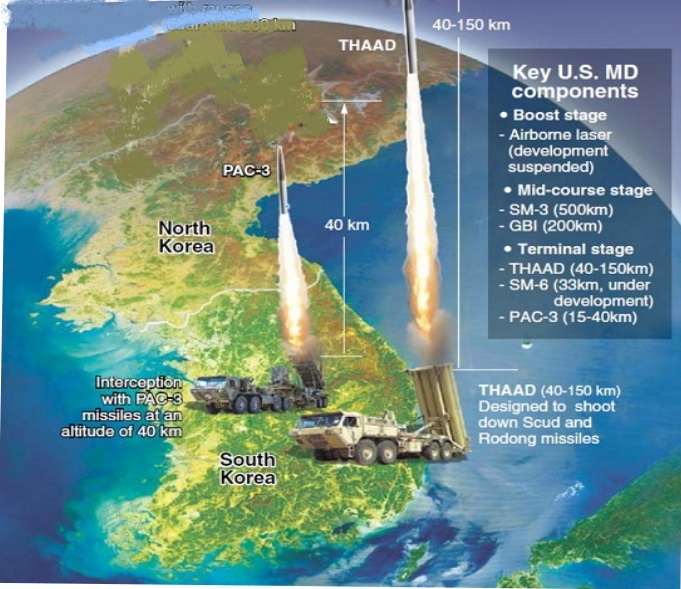
South Korea is now being flooded with so-called ‘missile defense’ systems.
Bruce Gagnon – coordinator of the Global Network Against Weapons & Nuclear Power in Space
https://space4peace.blogspot.com/2024/03/south-korea-and-us-has-permanent-war.html
Yesterday was the last day of my space issues speaking tour across South Korea.
I had two meetings in the afternoon before my final talk in the evening in Seoul.
The first was a meeting with two representatives from SPARK (Solidarity for Peace and Reunification of Korea) which was formed to organize for national self-determination, peace and disarmament, and the reunification of the two East Asian Korean nations.
SPARK is now working on holding an ‘International People’s Tribunal to hold the U.S. accountable for dropping Atomic bombs’ in New York City in 2026 (date not yet set). The event aims to highlight the bombing of Hiroshima and Nagasaki in 1945 from the perspective of Korean A-bomb victims (an oppressed ethnic group) in Japan who are usually the forgotten victims. The goal of the tribunal will be to contribute to the realization of a nuclear-free Korean Peninsula and world, free from the threat and use of nuclear weapons.
I agreed that the Global Network would help in every way possible to make the event a success. (Let me know if your group would be interested in co-sponsoring this tribunal.)
Next on the schedule was a dinner meeting with Dr. Kang-Ho Song and other members of the organization called The Frontiers. Dr. Song was a major supporting activist in Gangjeong on Jeju Island during the long campaign to oppose the Navy base that was forced upon the 500 year old fishing/farming village by the United States. Dr. Song went to jail three times (the longest sentence was more than a year) for his non-violent protests against the base.
The Frontiers recently has become quite active supporting Japanese controlled islanders who are opposing the deployment of offensive missiles being aimed at China. They have made sailboat trips to the string of islands (including Okinawa and Taiwan) to build inter-island solidarity. In their literature The Frontiers states: ‘We sail with the hope of driving out war, military training, and bases from this sea and creating a sea of co-existence and peace where humanity and all sea creatures can live together.’
Last presentation
My last talk was attended by 55 people. I’m told that even for Seoul that is a good turnout as similar peace talks these days are lucky to draw 30 people.
It was fun to see several old friends show up who I know from my many visits to Jeju Island since 2009. The talk went well (my voice which these days occasionally gets shaky has held up throughout this trip) and there was a healthy question and answer period.
One woman approached me after the talk and said that ‘South Korea’s economy is not good for the people, we are becoming a permanent war economy’. I responded that it is the same in the United States these days as well.
In fact just this morning I received an email that in my home state of Maine Governor Mills, U.S. Senators Susan Collins and Angus King, and U.S. Representative Chellie Pingree will participate in the unveiling of the Maine Defense Industry Alliance (MDIA) at the York County Community College (YCCC) Instructional Site in Sanford. The MDIA is a newly established non-profit coalition of Maine defense companies, state agencies, community colleges and universities, and other vocational training organizations. The partnership was created to attract and train thousands of new employees for critical jobs in Maine’s defense industrial base.
This is a perfect example of what a permanent war economy looks like. The only real jobs investment by Washington these days is going toward weapons of war. In the case of Maine, the so-called leaders want expanded Pentagon funding for more Aegis destroyers at Bath Iron Works shipyard. They also want hypersonics testing at a former US air base in the northern part of the state (Loring). And they want a rocket launch center near Acadia national park that would hoist mini-satellites for the US Space Force to help fill up Lower Earth Orbit (LEO) before China and Russia can put significant numbers of satellites there.
South Korea is now being flooded with so-called ‘missile defense’ systems. They are on-board Navy Aegis destroyers which are consistently ported on Jeju Island. They are the THAAD and PAC-3 systems deployed at several bases throughout the ROK. And the US is deploying these same ‘shields’ in Guam, Japan/Okinawa, Taiwan, Philippines, and other locations in the region.
U.S. bases in the ROK are expanding and held more than 200 days last year of US-ROK war games right along the border of North Korea.
Alternative media
As a result of my talks during this tour there are already articles and interviews by people who came to hear me speak and quickly moved to share what they learned. Here are three examples and I am told there will be more to come.
- A woman named Oh Hyun-hwa in Daejeong gave a local radio interview. https://www.youtube.com/watch?v=iJfcAvmL8uo
- Anti-War Peace Activist Concerned Jeju seems to be turning into a big South Korea-U.S. military base. Article by Kim Soon-ae. https://www.ohmynews.com/NWS_Web/View/at_pg.aspx?CNTN_CD=A0003004637
- Space industry erodes the space, the commons, and destroys the future.Article by Kim Na-hee. https://www.ohmynews.com/NWS_Web/View/at_pg.aspx?CNTN_CD=A0003005816
Touring South Korea to support opposition to US space warfare plans
Organizing notes, Bruce Gagnon, 19 Feb 24
https://space4peace.blogspot.com/2024/02/touring-south-korea-to-support.html
I’ve just landed in South Korea (ROK) where I will be on a speaking tour around the country for the next 10 days.
I was invited to come and talk about Washington’s push to entrap South Korea into the Pentagon’s space technology strategy aimed at North Korea, China and Russia.
Already at the US Osan AFB in South Korea the Space Force has set up operations with the ROK client state.
The US has pushed the right-wing Seoul government to massively expand their spending on military space tech. With the current US national debt now at $35 trillion, Washington can’t afford to pay for its expensive and ambitious plans to ‘control and dominate’ space. Thus the #1 job of the Pentagon and State Department is to get the allies to help pay for the space warfare infrastructure.
Currently the ROK government is building space R & D centers, satellite production facilities, new airfields likely to test hypersonic missiles and expanding ‘missile defense’ deployment sites.
One key goal the US has is to use ROK satellite production and launch facilities to hoist mini-satellites into Lower Earth Orbit (LEO) to help fill up the already crowded orbits before China and Russia can get there. Eyes and ears in LEO give a nation a decisive advantage in full scale war making.
Late last year the US hosted a big space industry conference in the capital city of Seoul in order to cement this expanding space warfare relationship. Dangling the promise of ‘lots of high-tech jobs’ the US has drawn the ROK into the trap.
The problem for the ROK (like all of Washington’s allies participating in this space warfare operation) is that they will have little to no input into how and when this Star Wars program will be used. Even though ROK will help pay for it (and host many of the bases) the Pentagon will remain in charge of the ‘tip of the spear’. Once becoming a colony of the US war machine, a nation loses their right to be full partners.
One sad thing about all of this is how Jeju Island (just off the southern tip of the Korean peninsula) is becoming further militarized via this new space tech operation.
Late last year the US hosted a big space industry conference in the capital city of Seoul in order to cement this expanding space warfare relationship. Dangling the promise of ‘lots of high-tech jobs’ the US has drawn the ROK into the trap.
The problem for the ROK (like all of Washington’s allies participating in this space warfare operation) is that they will have little to no input into how and when this Star Wars program will be used. Even though ROK will help pay for it (and host many of the bases) the Pentagon will remain in charge of the ‘tip of the spear’. Once becoming a colony of the US war machine, a nation loses their right to be full partners.
One sad thing about all of this is how Jeju Island (just off the southern tip of the Korean peninsula) is becoming further militarized via this new space tech operation.
South Korea’s nuclear mafia

Japan’s corrupt ‘nuclear village’ gave us the Fukushima disaster and there’s every reason to be concerned about South Korea’s corrupt ‘nuclear mafia’.
JIM GREEN, FEB 18, 2024, Substack,
Zion Lights’ latest substack post is a vacuous puff-piece about South Korea’s nuclear power industry. Therefore I’ve copied below a few articles I wrote for Nuclear Monitor about South Korea’s corrupt and dangerous nuclear industry.
Literally everything in Lights’ post could have been lifted from a nuclear industry promotional piece. Just one thing caught my eye: the three countries with the best record for building reactors relatively quickly are Japan, South Korea and China according to a table included in Lights’ post. Those three countries all have seriously corrupt nuclear industries. Correlation, causation, coincidence?
Lights is a British nuclear power advocate who previously worked for self-confessed liar, climate denier and MAGA lunatic Michael Shellenberger. You can read more about Lights here, Shellenberger here, and you can read Extinction Rebellion’s important statement about both of them here.
This is an excerpt from a 2017 Nuclear Monitor article, with some light editing to update the content.
In 2009, a KEPCO-led consortium won the contract to build four power reactors in the United Arab Emirates. In 2010, boosted by the UAE contract, South Korea’s Ministry of Trade, Industry, and Energy set a target of winning contracts to build 80 power reactors overseas by 2030, and in 2015 KEPCO had a target of winning overseas contracts for six reactors by 2020.6 But all those targets have come to absolutely nothing ‒ KEPCO and KHNP haven’t won any reactor construction contracts since the 2009 UAE contract.
South Korea has signed nuclear cooperation agreements with at least 27 countries8 but those agreements aren’t leading to reactor contracts……………………………………………………………………
Nuclear corruption and the partial reform of South Korea’s nuclear mafia
The corrupt behavior of Japan’s ‘nuclear village’ ‒ and the very existence of the nuclear village ‒ were root causes of the March 2011 Fukushima disaster and a string of earlier accidents.1 In the aftermath of the Fukushima disaster, academic Richard Tanter identified a worldwide pattern of nuclear corruption:2
“During the eighteen months from the beginning of 2012 to mid- 2013, major corruption incidents occurred in the nuclear power industry in every country currently seeking to export nuclear reactors: the United States, Canada, Japan, South Korea, Russia, France, and China. A number of other countries that operate or plan to have nuclear power plants also had major corruption cases, including Lithuania, Bulgaria, and Pakistan; moreover, serious allegations of corruption were raised in Egypt, India, Jordan, Nigeria, Slovakia, South Africa, and Taiwan.
“In the Korean case, systemic nuclear industry corruption was found; in Canada, deep corporate corruption within the largest nuclear engineering corporation was one matter, and bribery of nuclear technology consuming countries’ senior ministers was another. In Russia, the issue was persistent, deep seated, and widespread corruption in state-owned and private nuclear industry companies, with profound implications for the safety of Russian nuclear industry exports.
…………………………………………………………………………………………….. Corruption scandals are partly responsible for the massive downgrading of South Korea’s nuclear power ambitions.21 A detailed article on the scandals by Philip Andrews-Speed from the National University of Singapore has recently been published in the Journal of World Energy Law & Business.22 Importantly, Andrews-Speed notes that the problems only partially been resolved.
……………………………………………………………
, a much broader pattern of corruption began to come to light:
“Investigations of 101 companies revealed a wide range of illegal activities including bribery, overpaying, preferential treatment and favouritism, limiting competition in bidding, accepting parts with fraudulent or even no certificate, and collusion by parties in the falsification of testing reports.”
An investigation by the Korea Institute for Nuclear Safety showed that 2,114 test reports had been falsified by material suppliers and equipment manufacturers; that a further 62 equipment qualification documents (environmental and seismic qualification) were falsified between 1996 and 2012; and that a further 3,408 test reports and 53 qualification reports could not be verified or were unclear.22,23 Over 7,000 reactor parts were replaced in the aftermath of the scandal.23
Andrews-Speed details the corruption that probably had the greatest consequences for reactor safety:22………………… https://jimkgreen1.substack.com/p/south-koreas-nuclear-mafia
Breakthrough research unveils effects of ionizing radiation on cellular DNA

Feb 14 2024The Korea Advanced Institute of Science and Technology (KAIST)
Recent release of the waste water from Japan’s Fukushima nuclear disaster stirred apprehension regarding the health implications of radiation exposure. Classified as a Group 1 carcinogen, ionizing radiation has long been associated with various cancers and genetic disorders, as evidenced by survivors and descendants of atomic bombings and the Chernobyl disaster. Despite much smaller amount, we remain consistently exposed to low levels of radiation in everyday life and medical procedures.
Radiation, whether in the form of high-energy particles or electromagnetic waves, is conventionally known to break our cellular DNA, leading to cancer and genetic disorders. Yet, our understanding of the quantitative and qualitative mutational impacts of ionizing radiation has been incomplete.
On the 14th, Professor Young Seok Ju and his research team from KAIST, in collaboration with Dr. Tae Gen Son from the Dongnam Institute of Radiological and Medical Science, and Professors Kyung Su Kim and Ji Hyun Chang from Seoul National University, unveiled a breakthrough. Their study, led by joint first authors Drs. Jeonghwan Youk, Hyun Woo Kwon, Eunji Kim and Tae-Woo Kim, titled “Quantitative and qualitative mutational impact of ionizing radiation on normal cells,” was published in Cell Genomics.
Employing meticulous techniques, the research team comprehensively analyzed the whole-genome sequences of cells pre- and post-radiation exposure, pinpointing radiation-induced DNA mutations. Experiments involving cells from different organs of humans and mice exposed to varying radiation doses revealed mutation patterns correlating with exposure levels.
Notably, exposure to 1 Gray (Gy) of radiation resulted in on average 14 mutations in every post-exposure cell. Unlike other carcinogens, radiation-induced mutations primarily comprised short base deletions and a set of structural variations including inversions, translocations, and various complex genomic rearrangements. (Figure 3) Interestingly, experiments subjecting cells to low radiation dose rate over 100 days demonstrated that mutation quantities, under equivalent total radiation doses, mirrored those of high-dose exposure. ……………………………………….. more https://www.news-medical.net/news/20240214/Breakthrough-research-unveils-effects-of-ionizing-radiation-on-cellular-DNA.aspx
American weapons company Lockheed Martin scores again with sale of more F-35s to South Korea

3rd January 2024 – 16:30 GMT | by Norbert Neumann in London
South Korea has formalised its plans to expand its fleet of Lockheed Martin F-35A Lightning II fifth-generation fighter aircraft
South Korea has signed a letter of acceptance (LOA) to acquire an additional 20 Lockheed Martin F-35A Lightning II fifth-generation fighter aircraft. The Defense Acquisition Program Administration (DAPA) said on 1 January that the LOA was signed in December………. (Subscribers only) more https://www.shephardmedia.com/news/air-warfare/south-korea-to-enhance-air-force-with-more-f-35a-fighters/
Would A Nuclear Weapon Make South Korea Safer?
By Emma Sandifer, 4 Dec 23, https://armscontrolcenter.org/would-a-nuclear-weapon-make-south-korea-safer/—
The question of whether a nuclear deterrent might be necessary for South Korea has experienced a resurgence over the past few years, becoming a “mainstream feature of South Korea’s national security discourse”. With recent escalation in the pace of North Korea’s nuclear provocation, China’s aggressive buildup of its nuclear arsenal, and waning confidence in the U.S. commitment to extended deterrence, the public perception in South Korea has reflected a sense of increased vulnerability. Consequently, public polling in January of this year found that 71 percent of South Koreans support the return of nuclear weapons to their country — even if it means engaging in indigenous development. In 2023, South Korean President Yoon Suk-yeol spoke openly, for the first time, of the perceived need to either redeploy American non-strategic nuclear weapons on the Korean Peninsula or build their own. The reality is that it is not in South Korea’s national interest to have a nuclear weapon — politically, militarily or economically.
Despite this, the debate on the Peninsula is real and the country’s legitimate security concerns should be considered. With the North making regular threats, the trepidations of South Koreans are understandable and the need to take measures to reduce the threat from the North clear, but it remains questionable if nuclear weapons would serve such a purpose. More likely, a South Korean nuclear weapon would serve to fuel a destabilizing arms race in Asia and could actually undermine South Korea’s negotiating position vis-a-vis North Korea.
Politically, a nuclear weapon would not make South Korea safer. As an active member of multiple non-proliferation agreements including the Nuclear Non-Proliferation Treaty (NPT) and the 1992 Joint Declaration on the Denuclearization of the Korean Peninsula, South Korea uses these agreements to condemn North Korea’s proliferation and mobilize international support against the nuclear activities of its adversary. South Korea’s own proliferation would jeopardize its ability to do so as well as damage its standing in the international community and its relationship with its primary security ally, the United States.
Militarily, a nuclear weapon would not make South Korea safer. The ROK already has the conventional capabilities needed to strike any target in North Korea through the use of short-range ballistic missiles and precision strike weapons, has recently committed $81 billion toward strengthening its pre-existing defense capabilities, and has established a strategic command to oversee its “three-axis” defense system. Nuclear weapons would add little while increasing paranoia north of the DMZ.
To reinforce reliability of the U.S. commitment to extended deterrence, Presidents Joe Biden and Yoon announced the Washington Declaration in early 2023, as well as the creation of the bilateral Nuclear Consultative Group. In early November, the two countries updated their Tailored Deterrence Strategy agreement for the first time in a decade to reflect their “ironclad” commitment to collective security underscored by the symbolic deployment of major U.S. military assets to the country, such as a nuclear ballistic missile submarine and a nuclear capable B-52 bomber. South Korea is not only conventionally capable of deterring a nuclear attack by North Korea, but it is also protected by a renewed commitment to extended deterrence by the United States, making the development of a nuclear weapon redundant and escalatory.
Economically, a nuclear weapon would not make South Korea safer. A withdrawal from the NPT would bring an array of potential sanctions with the ability to cause real economic damage. Even if the impact of these sanctions is mitigated by allies to protect regional security interests, the impact of potential Chinese sanctions would be severe. Moreover, this withdrawal would impact international cooperation with Seoul’s nuclear energy program, an economic and energy priority.
Thus, although a nuclear weapon might make South Koreans feel safer, at least temporarily, it would not make the country any more secure. Conversely, creation of a nuclear weapon will undermine South Korean efforts to protect itself against a North Korean threat. Instead, the legitimate security concerns voiced by South Koreans could be addressed by strengthening conventional capabilities as well as engaging with international arms control efforts and dialogue across the DMZ. Such measures would do more to promote confidence among Korean citizens than engaging in a destabilizing arms race.
Closer to nuclear plant than ever, latest Korean quake renews calls to retire aging reactors

A 4.0 magnitude earthquake struck Gyeongju at dawn on Thursday only 10 km from a nuclear plant.
A shallow, magnitude 4.0 earthquake hit the city of Gyeongju in North Gyeongsang Province at 4:55 am on Thursday. It was the second biggest quake Korea has seen this year, following a 4.5 magnitude quake that occurred 52 km off the coast of Donghae, Gangwon Province, on May 15. The Gyeongju quake is the biggest to strike on land in Korea this year.
As the quake occurred not too far from the city’s Wolsong nuclear power plant, critics of nuclear power are becoming more vocal about safety concerns. Many are calling for the immediate decommissioning of aging nuclear power plants at a time when operators are trying to extend their lifespans.
Gyeongju saw a much larger quake of 5.8 magnitude in September 2016, the largest to be recorded in the area, but the recent quake’s epicenter was a mere 10.1 km away from the Wolsong nuclear plant, while the 2016 quake’s epicenter was 27 km away from the plant.
…………………………….. A study published by the Ministry of the Interior and Safety on faults in the southeastern region (North and South Gyeongsang provinces, Busan, Ulsan) revealed 14 active faults that have the potential to produce an earthquake of 6.5 magnitude or larger. The study was published in early 2023. Based on earthquake magnitude and proximity, five of these 14 faults were judged to have the potential to affect the structural integrity of the Wolsong plant. These faults are referred to as “faults for consideration in seismic design.”
Among the 16 nuclear plants operating in regions along the southeastern coast, only Shinkori nuclear power plants unit Nos. 3-6, which were built relatively recently, were designed to withstand an earthquake of 6.5 magnitude or larger (0.3 g).
Joint Action of Gyeongju Citizens Opposing Nuclear Power, a local anti-nuclear power activist group, released a statement that opposes attempts to extend the lifespan of the already aging Wolsong power plant……….
“The Wolsong nuclear power plant’s construction was based on faulty inspections of the geological integrity of the ground and surrounding region. Its earthquake-resistance designs are subpar, and today’s earthquake only magnifies our concerns about the plant’s safety,” the statement said
.“The South Korean government must begin the processing of shutting down Wolsong power plant units 2,3 and 4, as they are exposed to the risks of active faults,” the statement continued……………. https://english.hani.co.kr/arti/english_edition/e_national/1118764.html
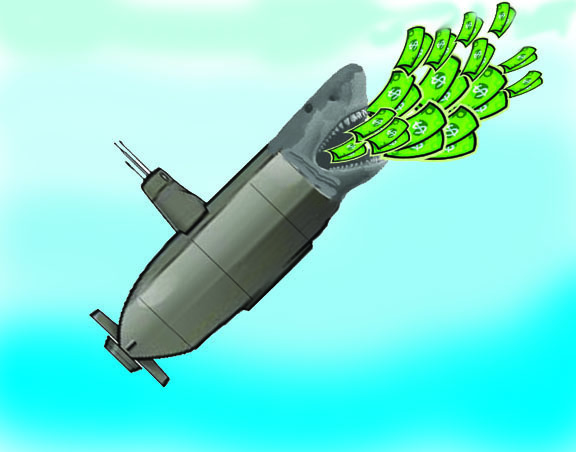
South Korea does not need nuclear subs
The Hill BY DOV S. ZAKHEIM, OPINION CONTRIBUTOR – 11/24/23
South Korea is again debating whether to develop and build a nuclear-powered submarine.
During a National Assembly confirmation hearing that took place last week, Admiral Kim Myung-Soo, the nominee for chairman of South Korea’s Joint Chiefs of Staff, responded positively to a question about the utility of nuclear-powered submarines, stating that “those capabilities are needed.” He noted, however, that the current U.S.-Korean nuclear agreement restricts the use of nuclear materials for military purposes.
Nevertheless, there appears to be a growing sentiment on the part of both of South Korea’s leading parties and the general public in favor of Seoul acquiring nuclear-powered boats. The government should resist the temptation to do so.
In theory, South Korea could avoid America’s restrictions by turning to France to help it develop or acquire a nuclear-powered submarine. France could help South Korea develop its own nuclear-powered sub, much as Paris has assisted Brazil with its own nuclear-powered submarine program.
However, there are many reasons why Seoul should not imitate the Brazilians and forge ahead with its own program. To begin with, it was only in April of this year that President Biden and South Korean president Yoon Suk Yeol reached an agreement that not only calls for greater consultation on nuclear matters between the two countries, in the form of a newly created nuclear consultative group, but also provides for an enhanced American nuclear presence around the peninsula to deter North Korean aggression…………………………………………………..
In any event, it is not clear how Seoul could afford to undertake a nuclear-submarine program unless it were to dramatically increase its defense spending beyond current levels…………………………………
…………………… Lastly, there are good operational reasons why South Korea should continue to acquire conventionally powered submarines rather than nuclear powered boats. The waters around the Korean peninsula are relatively shallow, which favors the employment of quiet conventional subs. South Korea now operates seven Son–Won II–class diesel-electric submarines, powered by a hybrid diesel‐electric/fuel cell with air-independent propulsion technology. These subs are extremely quiet; they can travel up to 20 knots when submerged and remain under water for seven weeks. They are perfectly suited for operations around the Korean Peninsula.
The South is currently planning both to upgrade the Son-Won II for about $100 million per boat and is proceeding with a new Son-Won III class at about $900 million per submarine. In other words, the country could acquire three state-of-the-art conventional submarines for less than the cost of one nuclear-powered sub.
The costs, the technologies, and operational realities all weigh against South Korea acquiring nuclear-powered submarines. If that were not enough, America’s recent commitment to bolster the nuclear umbrella that it has long provided to South Korea and that is so critical to its deterrent should settle the argument once and for all.
Dov S. Zakheim is a senior adviser at the Center for Strategic and International Studies and vice chairman of the board for the Foreign Policy Research Institute. He was undersecretary of Defense (comptroller) and chief financial officer for the Department of Defense from 2001 to 2004 and a deputy undersecretary of Defense from 1985 to 1987. https://thehill.com/opinion/international/4324038-south-korea-does-not-need-nuclear-subs/
South Korea will expand the number of spots for water testing amid concerns over the release of nuclear waste from Japan’s crippled Fukushima power plant.
Seoul plans to raise the number of testing spots to nearly 250 next year, said South Korean Oceans Minister Cho Seung-hwan.
About a month ahead of Tokyo’s release of treated radioactive water from the Fukushima plant in August, South Korea had begun “emergency radiation tests on samples from a total of 75 coastal locations in the east, west and south of South Korea, as well as the waters off the southern island of Jeju,” Seoul-based Yonhap News reported on Monday.
“We chose the spots, as they are expected to have the released waters first given the sea current. We will add more locations to the list, particularly in the East Sea, to further ensure safety,” said Cho, after visiting a test spot off the southern port city of Busan last week.
Seoul is also conducting radiation tests on 33 points from more distant areas, the minister said.
Tokyo began releasing the nuclear waste on Aug. 24, triggering a sharp reaction from China and opposition parties in South Korea.
Beijing has imposed a blanket ban on imports of seafood from Japan.
Today, the Chinese Embassy in Tokyo refuted claims that Beijing had “refused to join” the International Atomic Energy Agency’s international monitoring mechanism.
Early this month, Seoul warned it will take Japan to the UN if Tokyo does not follow its original plan about releasing the treated radioactive water from its crippled Fukushima nuclear power plant.
The warning came after Seoul called for a discussion on the potential impacts on the marine environment while Japan ignored the call https://www.aa.com.tr/en/asia-pacific/south-korea-to-expand-water-testing-amid-concerns-over-japan-s-nuclear-waste/2994594
South Korea: Mass protests continue against Fukushima nuclear waste dumping
South Korea Peter Boyle, Denise Yoon , September 6, 2023
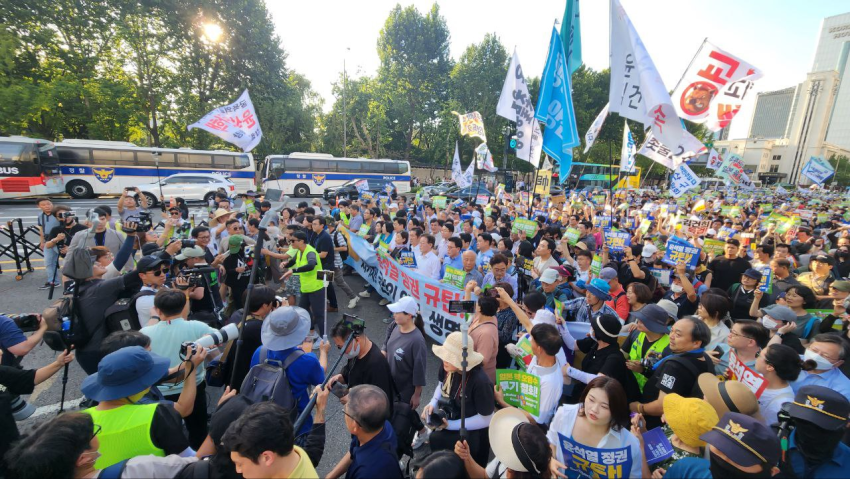
The biggest of the global protests against Japan’s dumping of radioactive wastewater from the Fukushima nuclear power plant into the Pacific Ocean — which began on August 25 — have been in Seoul, the capital of South Korea. Green Left‘s Peter Boyle spoke to Denise Yoon, a key organiser of the movement.
Since August 26, we have had two big national rallies in Seoul and around 50,000 people have gathered at each.
About half of the demonstrators are members of four opposition parties: the Democratic Party, the Justice Party, the Progressive Party and the Basic Income Party. The rest are from religious and civil society groups, including environmental and consumer organisations, parents organisations, justice and democracy activists and human right defenders.
According to a public poll by the Seoul city government in August, around 80% of citizens oppose Japan’s ocean dumping of nuclear wastewater and condemn the Korean government’s support of Japan without appropriate regard for Korean people’s safety from ocean pollution.
People think the Korean government has failed to explain scientifically, environmentally and economically why they claim that the Fukushima wastewater is not a big deal. They also distrust the International Atomic Energy Authority’s report because its conclusion [supporting Japan’s dumping] is based on deficient data and evidence.
Due to the Korean government’s very active promotion of Japan’s unilateral decision to commence dumping, many Korean people are getting very angry at the government. Polls show that President Yoon Suk Yeol now has a disapproval rate of 58% and this is influenced not only by the Fukushima issue, but also by government incompetence on other issues.
This is why we were able to hold these two big rallies.
We will organise a national rally every Saturday in September and expect more people will join the protest.
We will hold the 4th National Candlelight Rally in Gwanghwamun Plaza and we expect more than 50,000 people to join in for speeches, bands and cultural performances. Global solidarity messages will be shared. This rally will call on Japan to stop the dumping and it will demand that the Korean government prohibit the import of marine products from Japan.
South Koreans worry about Fukushima water: more disapprove of President Yoon
A majority of South Koreans are worried about Japan’s discharge of treated
radioactive water from the Fukushima nuclear plant into the sea despite
efforts by their government to allay fears, a poll published on Friday
showed.
Japan says the water from the wrecked nuclear power plant is safe
and it began releasing it into the Pacific on Aug. 24 despite objections at
home and abroad, particularly from China, Japan’s biggest trade partner,
which banned Japanese seafood.
The South Korean government, however, has
said it sees no scientific problem with the water release, though stressing
it does not approve of it, and banning the import of seafood from waters
off Fukushima, north of Tokyo. President Yoon Suk Yeol has led a campaign
to ease public concern and encourage consumption of seafood. On Thursday,
he visited a major fisheries market to shop and have lunch. Despite such
efforts, South Korean environmental groups and many members of the public
are alarmed and Yoon’s disapproval rating has risen to the highest in
months, a Gallup Korea poll of 1,002 people showed.
Reuters 1st Sept 2023
Fukushima water release poses test for Japan-South Korea unity
TOKYO/SEOUL – Japan Times , BY TIM KELLY, SAKURA MURAKAMI AND HYONHEE SHIN
REUTERS 18 Aug 23
U.S. President Joe Biden wants to lock in friendly ties between Japan and South Korea at a summit on Friday, but their readiness to shelve grievances will be tested when Tokyo begins pumping water from its wrecked Fukushima nuclear plant into the sea.
Japan already delayed the release to avoid stirring up political opposition in South Korea before President Yoon Suk-yeol joins Prime Minister Fumio Kishida for a meeting with Biden at the Camp David retreat on Friday, four officials in Japan and South Korea said.
The dumping of radioactive water may happen days after the summit, which the United States is billing as a “historical” trilateral meeting that will deliver a “bold counter” to regional rival China.
That puts less domestic political pressure on Yoon, said one of the officials, who asked not to be identified because of the sensitivity of the issue.
Washington needs its Asian allies to work together because they see the military power balance in East Asia, including around Taiwan, shifting in China’s favor.
…………………….. Even if Fukushima fades as an issue, the risk of bad blood remains real. As relations soured in 2019, for example, Moon nearly scrapped a critical intelligence-sharing deal with Japan, reversing the decision at the last minute under U.S. pressure.
By accepting an International Atomic Energy Agency (IAEA) report last month that greenlit Japan’s Fukushima water release, Yoon could encourage fresh dissent that China will try to amplify, analysts say.
“There is certainly some possibility that Yoon will come under pressure over this, particularly if there is data that shows that the water is more dangerous than we otherwise thought,” said Christopher Johnstone, a former East Asia director of Biden’s National Security Council who is now with the Center for Strategic and International Studies.
Japan says it will remove most radioactive elements from the water except for tritium, a hydrogen isotope that must be diluted because it is difficult to filter.

U.S. Secretary of State Antony Blinken on Tuesday expressed satisfaction with Japan’s plans.
………………….a Gallup poll in late June showed that 78% of South Koreans worry about potential contamination of the ocean and seafood…………………………
more https://www.japantimes.co.jp/news/2023/08/18/japan/politics/south-korea-fukushima-radioactive-water/
South Korea’s opposition party to file UN complaint against Japan over nuclear waste
Democratic Party plans to visit Tokyo to oppose release of treated water from crippled Fukushima nuclear plant
Esra Tekin |14.08.2023 -ISTANBUL, https://www.aa.com.tr/en/asia-pacific/south-koreas-opposition-party-to-file-un-complaint-against-japan-over-nuclear-waste/2967294
South Korea’s main opposition party announced on Monday its intention to lodge a formal grievance with the United Nations Human Rights Council (UNHRC) in the upcoming week, regarding Japan’s proposed strategy to release water from the Fukushima site.
According to representative Woo Won-shik, who leads the Democratic Party (DP) committee that opposes Tokyo’s proposal to discharge treated water from the damaged Fukushima nuclear plant into the ocean, the complaint will be formally submitted on Thursday, Seoul-based Yonhap News reported.
The DP asserts that the planned release, set to start as soon as late August, breaches several international agreements and lacks verified scientific safeguards.
The UNHRC assesses grievances originating from individuals, entities, or nations pertaining to instances of ongoing and severe human rights transgressions.
Alongside submitting the complaint, the DP intends to collect signatures from roughly 1.5 million citizens and deliver them to the office of the president.
Furthermore, DP members are making preparations for a visit to Japan by the end of this month to express their opposition to Tokyo’s scheme, subsequent to two prior visits made in April and July.
Japan is expected to release treated nuclear waste from the crippled Fukushima nuclear power plant this month or early next month.
Japan’s water discharge plan, announced in April 2021, faced significant criticism from China, South Korea, North Korea, Taiwan, and international organizations, including the UN.
The US supported the proposal, following years of discussions on dealing with over 1 million tons of water stored at the Fukushima nuclear complex since the 2011 disaster.
In South Korea, activists march against Tokyo’s waste plan
Hundreds of people in South Korean took to the streets of Seoul on Saturday
to protest against Japan’s contentious plan to release treated nuclear
wastewater into the Pacific Ocean. Tokyo is set to release the water from
the tsunami-hit Fukushima nuclear plant later this month. It has been
approved by the UN nuclear watchdog, and a South Korean assessment found it
meets international standards. But protesters fear marine life will be
destroyed and seafood contaminated. Marching in central Seoul, they held
signs reading “Protect the Pacific Ocean” and “Nuclear Power? No Thanks!”.
BBC 12th Aug 2023
Another Washington declaration: U.S. nuclear weapons on the Korean Peninsula
Foreign Policy Research Institute, Joseph Su 9 Aug 23
- On July 18, the USS Kentucky docked in South Korea, marking the first visit by a potentially nuclear-armed US submarine since the 1980s on the heels of North Korean missile launches.
- After North Korea conducted a record amount of missile tests in 2022, South Korea has become increasingly worried about the nuclear threat and sought further nuclear security guarantees with the United States, signing the Washington Declaration to increase deployments of US strategic assets on the peninsula.……….
Sending Kentucky to Korea
On July 18, 2023, the USS Kentucky, an Ohio-class ballistic missile submarine, docked in Busan, South Korea. The USS Kentucky is one of 14 Ohio-class submarines tasked with conducting nuclear deterrence patrols and carries up to 20 Trident II D5 nuclear-armed ballistic missiles. This visit marks the first port call by a nuclear-capable submarine since the 1980s and the 1991 decision to withdraw US nuclear forces from the Korean Peninsula.
…………………………………………………. The USS Kentucky is an Ohio-class submarine that joined the fleet in 1983 and continues to carry the United States’ nuclear forces at sea. Equipped with 20 launch tubes for the Trident II D5 missile which carries on average four nuclear warheads per missile, a single Ohio submarine could carry a nuclear payload 1,100 times more powerful than the two bombs combined that were dropped in 1945, even abiding by treaty limitations………………………………………………………………………………………………………………………………………………………………………………. https://www.fpri.org/article/2023/08/another-washington-declaration-us-nuclear-weapons-on-the-korean-peninsula/
1 This Month
10 March A LIVE WEBINAR THE REAL EFFECTS OF NUCLEAR POWER
What the Industry Isn’t Telling Us
1:00 PM Mountain, 2 pm Central, 3 pm Eastern. Live on the Keepers of the Water Facebook page



18 March Webinar @ 1 PM EST: An Assessment of SMR Projects: The Case of Canada
register for the zoom:
https://us02web.zoom.us/webinar/register/WN_o8BIIOUvQ2ONJR1nta65DQ#/registration


of the week – STOP SMALL MODULAR REACTORS IN CANADA
To see nuclear-related stories in greater depth and intensity – go to https://nuclearinformation.wordpress.com
-
Archives
- March 2026 (99)
- February 2026 (268)
- January 2026 (308)
- December 2025 (358)
- November 2025 (359)
- October 2025 (376)
- September 2025 (258)
- August 2025 (319)
- July 2025 (230)
- June 2025 (348)
- May 2025 (261)
- April 2025 (305)
-
Categories
- 1
- 1 NUCLEAR ISSUES
- business and costs
- climate change
- culture and arts
- ENERGY
- environment
- health
- history
- indigenous issues
- Legal
- marketing of nuclear
- media
- opposition to nuclear
- PERSONAL STORIES
- politics
- politics international
- Religion and ethics
- safety
- secrets,lies and civil liberties
- spinbuster
- technology
- Uranium
- wastes
- weapons and war
- Women
- 2 WORLD
- ACTION
- AFRICA
- Atrocities
- AUSTRALIA
- Christina's notes
- Christina's themes
- culture and arts
- Events
- Fuk 2022
- Fuk 2023
- Fukushima 2017
- Fukushima 2018
- fukushima 2019
- Fukushima 2020
- Fukushima 2021
- general
- global warming
- Humour (God we need it)
- Nuclear
- RARE EARTHS
- Reference
- resources – print
- Resources -audiovicual
- Weekly Newsletter
- World
- World Nuclear
- YouTube
-
RSS
Entries RSS
Comments RSS
 nuclear-news