Another example of corruption in the nuclear industry

 Another Nuke Scandal: Theft and Bribery After a blackout-and-coverup episode recently, another development is emerging that could deepen distrust in South Korea’s nuclear industry: a corruption scandal. WSJ, April 27, 2012,
Prosecutors in Ulsan and Busan on Thursday announced the arrest of six nuclear industry executives and an equipment broker on corruption charges. The prosecutors allege the officials received bribes up to 100 million won ($88,100) each in return for providing business favors to a Korean manufacturer.
In one case, an official is alleged to have secretly handed over a sealing unit part made by French Areva, along with its specification, to a local manufacturer in return for 80 million won. The manufacturer produced a copy and sold it to four nuclear power plants…… The
arrests came less than two months after officials were caught trying to cover up a blackout at the Gori-1 nuclear plant, the oldest nuclear facility in the country. A power failure, if persisted long enough, could be lead to a serious problem like a nuclear fuel meltdown. KHNP CEO Kim Jong-shin stepped down earlier this month due to the incident. Seven other officials were relieved of their duties.
Jan Vande Putte, a nuclear expert at Greenpeace International, said in a statement Friday that the latest case is “a clear indication that the Korean nuclear industry is out of control.”
http://blogs.wsj.com/korearealtime/2012/04/27/another-nuke-scandal-theft-and-bribery/?mod=google_news_blog
Secrecy over nuclear problem, opposition to nuclear in Korea
Korea Hydro didn’t report the blackout and deleted it from its records before an outside inquiry discovered it, the committee said last month. The government is investigating why the incident wasn’t reported immediately, ….
Almost 80 percent of respondents opposed extending the life of older reactors in a February poll of 1,100 people by the Korean Federation for Environmental Movement.
Nuclear Halt in South Korea Seen Boosting Coal: Energy Markets, Bloomberg News By Sangim Han and Yuriy Humber on April 13, 2012 “…..Korea Electric Power Corp. (KEP) (KEP), the nation’s electricity monopoly, says it may boost coal purchases to replace nuclear power generation if the Kori 1 reactor remains shut and the government fails to extend the lifespan of a second reactor.
Kori 1 was closed for safety checks on March 13, five weeks after a power failure caused the temperature of its core to rise. The operating permit for Wolsong 1 expires in November…… Korea Hydro & Nuclear Power Co., a unit of Korea Electric that operates the Kori plant, announced its power failure on March 12, a day after the first anniversary of Fukushima. A 12- minute power loss occurred on Feb. 9 and sent the core temperature to 58.3 degrees Celsius (137 degrees Fahrenheit) from 36.9 degrees, according to the Nuclear Safety and Security Commission. Continue reading
Democracy losing out in South Korea, as govt stifles anti nuclear voices
nuclear energy is not considered a safe, clean or sustainable energy source by the UN’s Intergovernmental Panel on Climate Change. It is, therefore, not included in the UN’s Clean Development Mechanism.
the government declared it would spend an additional 10 billion won to promote nuclear energy
Greenpeace will continue to reach out to the people of Korea, despite the fovernment’s attempt to quash public debate and discontent over its nuclear plans
 Nuclear Power and Democracy Don’t Mix , HUFFINGTON POST, 3 April 12, Kumi NaidooExecutive Director, Greenpeace International,On Monday South Korea deported three senior Greenpeace staff, known for their role in our campaign
against that country’s nuclear expansion plans. This is just the latest proof that nuclear power and democracy do not mix. It’s the latest attack on freedom of speech from an industry forged in the furnace of military secrecy, which has over the last 60 years left in
it’s a wake a legacy of lies, cover-ups and broken promises.
What is it the industry and its government sponsors fear? What do they hope to achieve by excluding peaceful people from Greenpeace? What do they have to hide? What is it that they do not wish the people of Korea to hear?…. Continue reading
South Korea deported anti nuclear Greenpeace staff
 Greenpeace deportation. Korea Herald, 3 April 12, It was unnecessary and excessive for the immigration authorities to bar the entry of three Greenpeace staff at Incheon International Airport on Monday and send them back to Hong Kong. An Immigration Service officer said the three members of a four-man group were detained at the airport at the request of a relevant government office which cited “national interest reasons.” Continue reading
Seoul: agreements on non-nuclear medical isotopes the only bright spot
waste and spent fuel which are stored on an interim basis in pools of water or in casks are of the greatest concern
agreement between the U.S., France, Belgium, and the Netherlands was made to produce medical isotopes without the use of HEU by 2015.
Korea’s Nuclear Summit a Damp Squib, Asia Sentinel by Lee Byong-chul, 30 MARCH 2012 Little of significance despite the presence of the world’s most powerful leaders The Nuclear Security Summit held on March 26-27 in Seoul, has turned out to be a half-baked extravaganza that produced little of significance except for proclaiming the lofty goal of a nuclear-free world vision – while one of the world’s nuclear outlaws lurked just 65 km to the north, rattling rockets in the face of the world’s most powerful leaders. Continue reading
South Korea keen to sell nuclear reactors to India
S Korea offers nuke reactors to India TNN | Mar 26, 2012,“…..South Korea has offered to build nuclear reactors in India and sought land for the project. …. A joint statement said, “The two leaders proposed that the concerned agencies of both countries study the possible cooperation in future space activities, including launching a nano-satellite developed by Korean students on an Indian launch vehicle.”…. http://timesofindia.indiatimes.com/india/South-Korea-offers-India-nuke-reactors/articleshow/12408369.cms
Most South Koreans against nuclear power – a growing election issue
 Nuclear issue creeps up agenda for April election The Korea Herald, 2012-03-18 In an increasingly volatile race for parliament, nuclear power is creeping up the political agenda as opposition lawmakers seek to exploit growing safety jitters to retake power in next month’s vote.
Concerns about the safety of the nuclear industry are rife after news broke last week that plant operators had attempted to cover up a power cut at a reactor in Busan for over a month. Continue reading
South Koreans becoming unsure of nuclear power safety
SK Sees Nuclear Plant Jitters Ahead Of Summit, WSJ, March 16, 2012, A little over a week before South Korea hosts the 50-nation Nuclear Security Summit, the government is trying to reassure the public over the safety of nuclear power following a blackout at a nuclear plant on the south coast and a public backlash about alleged cover-up attempts by officials. Continue reading
A dangerous hoax to make money from a false nuclear rumour
 South Korea Police Arrest 6 for Spreading N. Korea Nuclear Accident Rumors Bloomberg, By Saeromi Shin and Sangwon Yoon – Feb 20, 2012 South Korean police arrested six people for spreading false rumors about a North Korean nuclear reactor explosion on Jan. 6 to manipulate the stock market.
The six, including two office workers and a university student, conspired to circulate rumors through instant-messaging that a light-water reactor exploded in North Korea and radiation had leaked, the National Police Agency said in a statement posted on its website today. They made 61 million won ($54,314) in profits from spreading rumors to move financial markets, according to the police. … http://www.bloomberg.com/news/2012-02-21/six-arrested-in-s-korea-over-nuclear-rumors.html
South Korea’s nuclear program falters, as public opposition increases
 the reactor has had 51 malfunctions since it went online, “due to flaws in machinery and components, including radiation leaks, coolant leaks and reactor shutdowns,”
South Korea to boost nuclear power? SEOUL, Feb. 20 (UPI) — South Korea’s plans to boost nuclear power face increasing resistance from civic and environmental groups, post Fukushima, the Japanese reactor site hit by an earthquake and tsunami last year… Continue reading
BRICs – Brazil, Russia, China, India, all nuclear prospects looking dodgy
China is looking much less committed to nuclear power than it was a year ago.
The reality is that China needs nuclear power much less than the nuclear industry needs China.
 Prospects for Nuclear Power in 2012 Source: Platts – a leading global provider of energy, metals and petrochemicals information. London, 30 January 2012 “….BRICs [Brazil, Russia, India and China] + South Korea China has dominated new nuclear plant orders in the past few years, accounting for 25 out of the 38 reactors on which construction started worldwide between 2008-2010. Six of these units were for Gen III+ designs, four AP1000s and two EPRs. Almost all the others used a design imported from France in the 1980s, which in turn had been licensed from Westinghouse in the early 1970s. This design, the CPR1000, is showing its age and there was an expectation, even before Fukushima, that the AP1000 would replace it. This would have been a huge boost to the AP1000, giving it the volume of orders that might have allowed costs to come down and for teething problems to be solved. The EPR, by contrast, appears to have no prospect of further orders in China.
However, there were signs that the strain of the rapid pace of construction was beginning to show. In 2011, no new starts were made, compared with ten in 2010. Fukusima explains this to a degree, but some might have been expected in the first three months of 2011 before disaster struck. The reason behind the slowdown is the high cost of the AP1000. The large Chinese utilities appear to be looking at other options.
There is now talk of pursuing indigenous advanced designs developed from the CPR1000 as well as Small Modular Reactors. China has always been adept at convincing nuclear suppliers that there was a great future for their particular technology in China.
It is unclear whether talk of SMRs and new advanced designs will go any further. Continue reading
Growth of anti-nuclear movement in Asia
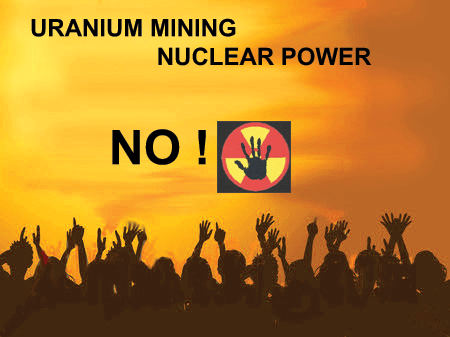 Anti-nuclear movement growing in Asia Though nuclear power still has a strong foothold in Asia, anti-nuclear sentiment and protest are growing from Mongolia to South Korea to Taiwan and even – in modest ways – in China. Christian Science Monitor, By Winifred Bird, January 27, 2012 YOKOHAMA, JAPAN
Heonseok Lee has a simple way of describing how public sentiment toward nuclear power has changed in South Korea since the disaster at Japan’s Fukushima Daiichi nuclear power plant last March 11. “Before 3/11, I’d post an article criticizing the nuclear power industry, and right away there’d be hundreds of really nasty comments. After 3/11, there’ll still be a few dozen. But not hundreds,” says Lee, a full-time anti-nuclear activist in one of the world’s most pro-nuclear countries.
Though nuclear power still has a strong foothold throughout the region, and public opinion is
 mixed, activists across Asia have anecdotes like this to show that anti-nuclear sentiment and protest are slowly growing from Mongolia, to South Korea to Taiwan and even – in modest ways – to China.
This month, activists from Japan and South Korea announced plans for a new East Asian civil society network to promote renewable energy and oppose nuclear power. Continue reading
Stiff opposition in South Korea to new nuclear power plants
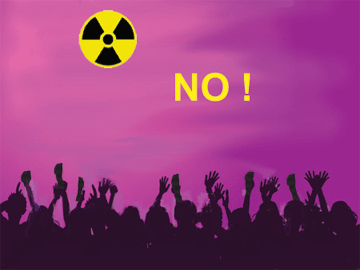 New nuclear plants face public backlash, Korea Herald, By Shin Hyon-hee, 27 Dec 11 2011 Civic groups, environmentalists, residents stage protests, voicing safety concerns The government’s plan to install new nuclear reactors in the country’s eastern shore faces stiff opposition from residents, stoking safety concerns in the aftermath of a Japanese disaster.
Last week, the government picked two candidate sites for nuclear power plants –Yeongdeok in North Gyeongsang Province and Samcheok in Gangwon Province. The decision will be finalized by late next year after on-site inspections and environmental surveys.
On Monday, civic groups, religious organizations, environmentalists and residents staged a mass rally in downtown Seoul and the two regions, calling to scrap the country’s atomic energy policy.
“The government’s latest site selection completely neglects a global anti-nuclear trend that has been reigning supreme since the Fukushima meltdown in March,” Green Korea United, one of the country’s major environmental groups, said in a statement. In Samcheok, Gangwon
Province Gov. Choi Moon-soon added fuel to the flame by expressing his regret over the announcement. “It’s hard to understand the government is pushing ahead with its nuclear expansion program at a time when there is no national consensus and public understanding of the safety of the plan,” he said. ..
..Among the imminent issues is the storage of spent radioactive fuel rods that will run of space in 2016. The ministry plans to host a public forum in the first half of next year to discuss how to take care of such obsolete equipment, Hong said….http://www.koreaherald.com/business/Detail.jsp?newsMLId=20111226000732
Wind power growing in importance in South Korea
South Korea’s drive for renewable energy By Lucy Williamson, BBC News,1 Dec 11 South Korea “…..Wind power is becoming increasingly important to South Korea – not just as a way to help meet ambitious targets on greenhouse gas emissions, but also as a way to boost the economy.
“Green Growth” has been a key national strategy since President Lee Myung-bak took office four years ago……..South Korea is relatively late to the green technology market. Europe is the established leader in wind turbines – and even China is judged to be steaming ahead.
Korea completed its first wind farm five years ago. Spread across a beautiful series of hills in Gangwon Province, near the country’s eastern coast, the wind farm produces an impressive 240MW per year….. http://www.bbc.co.uk/news/business-15984399
South Korea’s radiation hotspot – from Japan, or from China?
 The Institute of Nuclear Safety has previously reported that cesium-137 has been detected over the past 10 years in South Korea’s air and soil when so-called yellow dust blows in from China .
Radiation Hot Spot Detected in South Korean Pavement,Voice of America , November 3rd, 2011 South Korea’s Institute of Nuclear Safety says it has discovered a patch of pavement in Seoul is emitting radiation at levels 10 times higher than normal. Continue reading
1 This Month


Website of the Week

New book – https://www.amazon.com/dp/1923372157?utm_source=substack&utm_medium=email
Now until to February 10, 2026 Radioactive waste storage in France: the debate is finally open! How to participate?
-
Archives
- January 2026 (127)
- December 2025 (358)
- November 2025 (359)
- October 2025 (377)
- September 2025 (258)
- August 2025 (319)
- July 2025 (230)
- June 2025 (348)
- May 2025 (261)
- April 2025 (305)
- March 2025 (319)
- February 2025 (234)
-
Categories
- 1
- 1 NUCLEAR ISSUES
- business and costs
- climate change
- culture and arts
- ENERGY
- environment
- health
- history
- indigenous issues
- Legal
- marketing of nuclear
- media
- opposition to nuclear
- PERSONAL STORIES
- politics
- politics international
- Religion and ethics
- safety
- secrets,lies and civil liberties
- spinbuster
- technology
- Uranium
- wastes
- weapons and war
- Women
- 2 WORLD
- ACTION
- AFRICA
- Atrocities
- AUSTRALIA
- Christina's notes
- Christina's themes
- culture and arts
- Events
- Fuk 2022
- Fuk 2023
- Fukushima 2017
- Fukushima 2018
- fukushima 2019
- Fukushima 2020
- Fukushima 2021
- general
- global warming
- Humour (God we need it)
- Nuclear
- RARE EARTHS
- Reference
- resources – print
- Resources -audiovicual
- Weekly Newsletter
- World
- World Nuclear
- YouTube
-
RSS
Entries RSS
Comments RSS
 nuclear-news