Anti nuclear protest, by thousands, in South Korea
 Thousands protest at S. Korean nuclear complex
 Bangkok Post: 16/11/2012 AMOnline news: Asia Thousands of villagers staged a protest outside one of South Korea’s largest nuclear power plants Thursday, voicing growing public concern over safety standards after a series of scares and scandals. Continue reading
South Korea’s nuclear export industry at risk, as nuclear scandal widens
South Korea has its own nuclear challenge, Kearney Hub, 12 Nov 12 “….The Republic of Korea’s government has shut down several nuclear reactors after the discovery that safety certificates had been forged for some parts …. ,
public anxiety and criticism has spread rapidly — understandable after the Fukushima nuclear accident when the March 2011 tsunami and earthquake struck Japan. Moreover, South Korea has given high priority to developing a global nuclear export industry.
Several years ago, Korean firms won a $20 billion contract to build four nuclear reactors in the United Arab Emirates. South Korea plans to build 80 nuclear power reactors worldwide, worth an estimated $400 billion, by 2030. This would place the country on a
par with Russia and just behind France — the world leader in nuclear power export. U.S. government officials describe nuclear power as a foreign-trade high priority, along with automobiles, semiconductors and shipbuilding.
The unfolding Korean nuclear scandal doubtless will have regional and global impact. Today, any major production disruption in principal industries has immediate ripple effects. ….
South Korea’s problem occurs at a bad time. Last May, a Beijing summit brought together government officials from China, Japan and Korea to negotiate a new free-trade agreement and sign an initial accord on Promotion, Facilitation and Protection of Investment. …
Cracks in nuclear facility add to South Korea’s nuclear scandal problem
Cracks at South Korean nuclear plant raise fresh safety concerns By K.J. Kwon, CNN November 9, 2012 Seoul, South Korea (CNN) –– Tiny cracks have been found in tunnels at a nuclear plant in South Korea, increasing concerns about nuclear safety in the country following a recentscandal involving the use of unverified parts.
The reactor where the cracks were found will remain offline for weeks as regulators investigate the problem, putting extra strain on South Korea’s already stretched power supply going into the winter months…… the news could hurt South Korea’s efforts to export its
nuclear power technology to other countries.
The problems at the South Korean reactors come amid increased scrutiny of nuclear power worldwide following the crisis at the Fukushima Daiichi nuclear plant in Japan during the aftermath of the earthquake and tsunami that hit the country in March 2011.
http://edition.cnn.com/2012/11/09/world/asia/south-korea-nuclear-reactor/index.html
South Korea’s nuclear industry scandal widens
 Eight companies submitted 60 false certificates to cover more than 7,000 parts used in the two reactors between 2003 and 2012, and Economy Minister Hong Suk-woo told parliament that most of the documents, which purported to come from certifying body UCI, were
forgeries
South Korea widens nuclear lapses probe; KEPCO chief resigns By Meeyoung Cho and Somang Yang SEOUL Nov 7, 2012 (Reuters) – South Korea widened a probe into how thousands of parts for its nuclear reactors were supplied using forged safety documents, with regulators set to inspect all 23 of the country’s facilities – a move that could test public support for the industry and threaten billions of dollars worth of exports.
Two reactors remained shut on Wednesday, and five others are closed for maintenance, or through other glitches, raising the prospect of winter power shortages…..
Kim Joong-kyum, president and CEO of power utility Korea Electric Power Corp (KEPCO), which owns the operator of the nation’s nuclear plants, tendered his resignation for what KEPCO officials said were “personal reasons”. Continue reading
South Korea’s tarnished nuclear reputation with 60 forged safety certificates
 KHNP, fully owned by state-run utility Korea Electric Power Corp (KEPCO), reported eight firms that supplied parts had forged 60 certificates to cover 7,682 items between 2003 and 2012, the ministry and the company officials said.
South Korea widens nuclear investigation, risks power cuts By Meeyoung Cho SEOUL Nov 6, 2012 (Reuters) – South Korea’s main nuclear power supervisor extended an investigation into forged safety certificates for reactor components to three more facilities on Tuesday, a day after shutting down two reactors……
in the aftermath of the Fukushima nuclear accident in Japan, there were concerns the discovery could tarnish the image of the country’s nuclear program. Continue reading
The UNsafety of South Korea’s nuclear power plants
 Nuclear safety concerns growing Korea Times. Experts stress system overhaul necessary to avoid disaster By Park Si-soo, 8 Oct 12, With nuclear reactors shutting down repeatedly month after month, there is growing concern over whether the nation’s atomic power plant management system has a structural problem that could lead to disaster. Continue reading
South Korea – civil liberties disappearing, in the interests of nuclear industry
 South Korea can’t deny the risks of nuclear power forever http://www.greenpeace.org/international/en/news/Blogs/nuclear-reaction/nuclear-south-korea-risks/blog/42486/
by Jan Beranek – October 8, 2012 I am at a detention centre at South Korea’s airport, quickly writing these few words as best I can on a mobile phone. Together with my colleague, Dr. Rianne Teule, I have been denied entry to South Korea.
We have done nothing wrong. That is, unless you agree with the government in Seoul that exposing the risks of nuclear power and calling for better protection of people from radiation is wrong. Continue reading
S. Korea urges U.S. to allow ‘peaceful’ nuclear enrichment SEOUL, Sept. 17 (Yonhap) –– South Korea called for the United States to approve it undertaking “peaceful” enrichment of uranium and reprocessing of spent nuclear fuel, a government think tank said Monday, as little progress has been made in bilateral negotiations to revise the countries’ nuclear accord.
Under a 1974 accord with the U.S., South Korea is banned from enriching uranium or reprocessing spent nuclear fuel. The allies have held five rounds of formal negotiations since 2010 to rewrite the bilateral nuclear cooperation treaty, which expires in 2014…..
Some nonproliferation experts say pyroprocessing is not significantly different from reprocessing, and pyroprocessed plutonium could be quickly turned into weapons-grade material….. http://english.yonhapnews.co.kr/national/2012/09/17/38/0301000000AEN20120917002600315F.HTML
New fast Lithium Ion Battery for electric cars
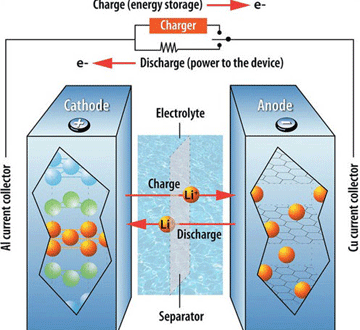 New Korean Lithium Ion Battery for EVs Charges in Under 1 Minute http://www.greenoptimistic.com/2012/08/21/korean-lithium-ion-carbonized-battery/?utm_source=feedburner&utm_medium=email&utm_campaign=Feed%3A+TheGreenOptimistic+%28The+Green+Optimistic%29#.UDbvH8FlT4Y By Ovidiu Sandru August 21, 2012 A new lithium ion battery developed in Korea could make those long waiting times for an electric car to charge become history. A team of researchers at the Ulsan National Institute of Science and Technology (UNIST) claim they can build a battery that can charge in less than a minute, 30 to 120 times faster than a classic Li-Ion battery. Continue reading
Seoul restarts aged nuclear reactor despite safety concerns
Korea Times, 7 Aug 12 The government decided Monday to restart an aged nuclear reactor that recently underwent months-long scrutiny over its safety, amid looming signs of a power shortage due to a record heat wave.
Operation of the Reactor-1 at Gori Nuclear Power Plant in Busan was
resumed earlier in the day with the reactor expected to reach its full
generation capacity on Friday, according to the Ministry of Knowledge
Economy….. The 578-megawatt reactor, located some 450 kilometers
southeast of Seoul, was manually shut down on March 12 after the Hydro
& Nuclear Power Co. belatedly reported a major safety breach during a
regular maintenance check the previous month, when the reactor, along
with its backup generator, temporarily lost power….. the reactor had
remained shut down amid widespread public concerns over safety of the
reactor whose initial 30-year lifespan ran out but was extended by 10
years in 2008….
http://www.koreatimes.co.kr/www/news/biz/2012/08/123_116740.html
Concern growing about poor safety of South Korea’s nuclear reactors
Nuclear reactor shut down for safety reasons, Aug.1,2012 Incident at Younggwang plant the latest in a long string of nuclear troubles, The Hanyoreh, By Noh Hyung-woong, staff reporter Reactor 6 at Younggwang Nuclear Power Plant in South Jeolla province was shut down again on July 30 due to a malfunctioning reactor rod….
The repeated problems with Younggwang reactor 6 have residents in the area nervous. Reactor 6 first broke down during a 2002 trial run. Since then, it has gone out of action 9 times in past 10 years.
Among those cases, some were trivial, due to lightning strikes and a mistake on operation. But in Dec. 2008, the reactor was stopped because warning signals appeared, indicating the reactor rod was in the wrong position.
Yang-yi Won-young director of Common Action for Nuke Free Society said, “The reactor rod is the last line of defense against a serious accident. It was fortunate that the reactor was shut down in time. If it hadn‘t been, it would have created a terrible disaster.”
Some brought up the problem of Korean-style pressurized light water reactors, citing their frequent breakdowns. “The reactors that recently broke down, including reactor 6 at the Younggwang plant, are localized as Korean style,” said Professor Suh Kune-yull at the
Nuclear Engineering Dept. of Seoul National University. “It seems that their electronic circuits and other components fail frequently.”…..
more and more people raised the questions of the safety of nuclear power plants. In particular, the Younggwang accident happened while MKE has been moving to restart Kori Nuclear reactor No.1…… http://english.hani.co.kr/arti/english_edition/e_business/545178.html
USA rejects South Korea’s push to enrich uranium
Samore says no need for S. Korea to enrich uranium By Lee Chi-dong WASHINGTON, July 23 (Yonhap) — Gary Samore, President Barack Obama’s top aide for nonproliferation, said Monday that the U.S. sees no need for South Korea to enrich uranium, a stance against Seoul’s goals. Continue reading
Japanese seafood products banned in South Korea, due to radiation risks
South Korea Bans Imports of 35 Japanese Seafood Products VOA, June 27th, 2012 South Korea has placed a temporary import ban on 35 Japanese seafood products because of fears of lingering radiation contamination from last year’s devastating nuclear disaster.
Seoul’s Ministry of Food, Agriculture, Forestry, and Fisheries says the ban is a temporary measure meant to protect South Korean citizens from products originating from the waters near the Fukushima nuclear power plant…….. The items banned Wednesday by South Korea include several types of flatfish, clams and sea urchins, products that are already prohibited from sale in Japan. With the latest move, Seoul now prohibits a total of 64 Japanese seafood items from entering South Korea. http://blogs.voanews.com/breaking-news/2012/06/27/south-korea-bans-imports-of-35-japanese-seafood-products/
Damaged South Korean nuclear reactor to shut down for 2 years
Uljin Nuclear Reactor Faces 2-Year Shutdown The Chosunilbo, 10 May 12, Additional faults have been detected in the No. 4 reactor at the Uljin Nuclear Power Plant, which has been undergoing repairs, and a complete shutdown now seems inevitable……..
Korea Hydro and Nuclear Power Corporation has found that damage in the No. 4 reactor, where operations were halted due to defects in the machine that condensates steam from the turbine, is more serious than expected and tentatively decided to replace the steam generator.
Replacing it will take one or two years, so the reactor will not operate until at least next summer. It generates 1 million kW, or the capacity of two thermal power stations. …
http://english.chosun.com/site/data/html_dir/2012/05/10/2012051001397.html
South Korea’s push to export nuclear technology hampered by corruption scandal
 Lee’s nuclear push meets obstacle Korea Times, 4 may 12, By Kang Hyun-kyung President Lee Myung-bak’s drive to win nuclear deals abroad has met an unexpected, formidable challenge from within as a state-run nuclear operator has been embroiled in malfunctions and corruption cases. Continue reading
1 This Month


Website of the Week

New book – https://www.amazon.com/dp/1923372157?utm_source=substack&utm_medium=email
Now until to February 10, 2026 Radioactive waste storage in France: the debate is finally open! How to participate?
-
Archives
- January 2026 (127)
- December 2025 (358)
- November 2025 (359)
- October 2025 (377)
- September 2025 (258)
- August 2025 (319)
- July 2025 (230)
- June 2025 (348)
- May 2025 (261)
- April 2025 (305)
- March 2025 (319)
- February 2025 (234)
-
Categories
- 1
- 1 NUCLEAR ISSUES
- business and costs
- climate change
- culture and arts
- ENERGY
- environment
- health
- history
- indigenous issues
- Legal
- marketing of nuclear
- media
- opposition to nuclear
- PERSONAL STORIES
- politics
- politics international
- Religion and ethics
- safety
- secrets,lies and civil liberties
- spinbuster
- technology
- Uranium
- wastes
- weapons and war
- Women
- 2 WORLD
- ACTION
- AFRICA
- Atrocities
- AUSTRALIA
- Christina's notes
- Christina's themes
- culture and arts
- Events
- Fuk 2022
- Fuk 2023
- Fukushima 2017
- Fukushima 2018
- fukushima 2019
- Fukushima 2020
- Fukushima 2021
- general
- global warming
- Humour (God we need it)
- Nuclear
- RARE EARTHS
- Reference
- resources – print
- Resources -audiovicual
- Weekly Newsletter
- World
- World Nuclear
- YouTube
-
RSS
Entries RSS
Comments RSS
 nuclear-news