South Korea wants China’s help to investigate hacking attempts on nuclear power company
 Korea calls on China for help following hack attempt on nuclear power company IP address used in the hack traced to city on China-North Korea border. Ars Technica by John Timmer – Dec 24 2014
Last week, Korea Hydro and Nuclear Power, which runs South Korea’s 23 nuclear plants, suffered a security breach in which personnel records, public health monitoring data, and reactor designs were obtained from the company’s systems and posted online. The attacker, which linked to the materials on an anti-nuclear activist site, also threatened to release further information unless three of the company’s plants were shut down by tomorrow.
Now, Korean investigators have identified a Chinese IP address as the source of the attacks and are asking the Chinese government for assistance in the investigation.
According to a report in The Korea Times, the attacks were routed through three different VPN service providers in the US, Japan, and Korea. By obtaining these records, the initial IP address that launched the attack were traced to the city of Shenyang, which is on the China-North Korea border.An article from Australia’s ABC indicates that this city hosts one end of North Korea’s main Internet connection to the outside world, which was severed earlier this week.
A number of sources confirm that South Korea has asked for China’s assistance in the matter and quote an unnamed official as saying the country isn’t pointing the finger at its neighbor: “There is a possibility that the IP addresses in China are not the final source but used in a routing.” But suspicion isn’t directed at China itself; rather, it’s suspected that North Korean agents were using the Chinese city for their activities……..http://arstechnica.com/security/2014/12/korea-calls-on-china-for-help-following-theft-from-nuclear-power-company/
Hacker got into South Korea’s nuclear plant computers
 South Korea nuclear plant hit by hacker, Lance Whitney , c/net 23 Dec 14 The hacking comes in the wake of increased tension and trouble from North Korea, though the source has not been confirmed. Computers at a nuclear power plant in South Korea have been compromised by a hacker, but the plant’s operator says no critical data has been leaked.
The hacker was able to access blueprints, floor maps and other information on the plant, the South Korean Yonhap News Agency reported Sunday. Using a Twitter account called “president of anti-nuclear reactor group,” the hacker has released a total of four postings of the leaked data since December 15, each one revealing internal designs and manuals of the Gori-2 and Wolsong-1 nuclear reactors run by Korea Hydro and Nuclear Power Co. (KHNP), Yonhap added. The hacker has threatened to leak further information unless the reactors are shut down…………..
Government officials looking into the incident were able to trace the hacker’s IP address to a PC located in a specific location, Yonhap said. Investigators have been sent to the location as well as to the plant’s reactors to probe further. http://www.cnet.com/au/news/south-korea-nuclear-plant-hit-by-hackers/
South Korea’s nuclear waste problem
Dealing with nuclear waste in South Korea The Korea Herald/Asia News Network December 21, 2014,The much awaited nuclear waste facility in Gyeongju will begin operations next year following final approval by the Nuclear Safety and Security Commission last week. The Wolseong Low and Intermediate-Level Radioactive Waste Disposal Center, consisting of six silos some 80 meters underground, can hold up to 100,000 barrels of radioactive waste.
A second-phase construction is underway to add a 125,000-barrel holding unit to the site, which is designed to store 800,000 barrels of nuclear waste over the next 60 years before it is sealed off.
A total of 23 nuclear reactors are responsible for about one-third of all power generated in Korea and produce 2,300 barrels of low- and intermediate-level radioactive waste each year.
The country’s first low- and intermediate-level radioactive repository was realized some 28 years after the country started looking for a site. Gyeongju, North Gyeongsang Province, was selected in 2005 after votes in four candidate cities. Almost 90 percent of voters in Gyeongju approved of the facility.
To win over communities that did not want a hazardous waste facility in their midst, the government promised 300 billion won in community support. The local community would also receive annual fees in addition to the initial grant.
The Gyeongju facility is just the first step. The country has yet to draw up a plan for dealing with the growing piles of spent nuclear fuel rods. Some 750 tonnes of spent fuel are produced each year by the country’s 23 nuclear power reactors.
Currently, spent fuel rods are stored temporarily on the reactor site pending the building of a centralized storage facility. About 13,250 tonnes were stored in different nuclear reactor sites as of end-2013 and it is estimated that the sites will become full incrementally between 2016 and 2038.
The Public Engagement Commission of 15 nuclear experts, academics, city council members and a representative of an environmental watchdog group was formed last year to engage the public in discussions about the spent nuclear fuel issues so that their opinions could be incorporated into policy decisions. The Ministry of Trade, Industry and Energy is expected to draw up a plan for disposing of spent fuel based on recommendations by the commission.
So far, the commission has released an interim report suggesting that a permanent disposal facility must be completed by 2055. It has not said where it could be built or what type of storage could be employed. The commission, in the meantime, has extended its mandate to June 2015.
The Gyeongju site for low- and intermediate-level radioactive waste took 28 years to complete. A facility for the more hazardous spent fuel rods will be much more controversial. Hence, the building of a permanent storage site for spent nuclear fuel rods is an urgent matter that requires immediate government attention…….http://www.chinapost.com.tw/commentary/the-china-post/special-to-the-china-post/2014/12/21/424512/Dealing-with.htm
Ineffective parts in 14 South Korean nuclear reactors
|
’14 reactors have ineffective parts’ http://www.koreatimes.co.kr/www/news/nation/2014/12/116_169248.html
|
Yet another safety bungle in South Korea’s nuclear power
 Bungling Nuclear Safety – Fire at Kori Nuclear Power Plant Goes Undetected for Over an Hour Employees couldn’t hear audio alarm, couldn’t see visual alarm, Business Korea, 19 NOVEMBER 2014 Jung Yeon-jin
A fire occurred in the nuclear fuel storage facilities of the Kori Nuclear Power Plant located in Kijang County, Busan City, but none of the workers was aware of it for over an hour.
According to the Korea Hydro & Nuclear Power Corporation, the fire occurred at 4:26 p.m., Nov. 11, at Kori Power Plant Unit 4, burning up a waste dryer along with some gloves and towels. It is assumed that the dryer overheated and started the fire while drying wet gloves……….
Power Plant Attempts to Cover Up Reactor Shutdown
But this fire is only the latest incident at the Kori Nuclear Power Station this year.
This past summer was a busy time for Kori Nuclear Power Plant, as Unit 2 was shut off because of heavy rainfall. On Aug. 25, a localized torrential downpour of over 100 mm per hour in Busan City resulted in rainwater infiltrating one of its annexes, and the corporation had to close the facilities.
At that time, the corporation covered up the incident by saying, “We shut down the facilities just in case, and this has nothing to do with the safety of the power station.” However, the Nuclear Safety and Security Commission’s following report read, “The manual shutdown of the reactor was because of the malfunctioning of four of the circulation water pumps, attributable to the heavy rain.”
Poor security of South Korea’s nuclear power system
Making a mess of nuclear safety, Korea JoongAng Daily Nov 05,2014The ministry conducted security checks on power stations across the nation following online media reports about the leak in September. It found that staff shared their log-in IDs and passwords for the internal computer system with subcontracted employees of radioactive waste management companies. Night shift staff should have escorted these people from outside during their work, but instead they gave their security codes away simply because they were lazy………
South Korea monitors products, very aware of nuclear radiation from Japan
 South Koreans Still Fear Radiation From Japan WSJ, 17 Oct 14 More than three years have passed since the nuclear disaster in Fukushima, Japan, but some South Koreans are still leery over possible radioactive contamination from their neighbor.
Environmental activists and residents of Changwon, a city on South Korea’s southeastern coast, staged a rally Tuesday in front of a steel company to protest its import of scrap steel from Japan through a nearby port of Masan.
The protesters demanded local steel companies stop importing Japanese steel for recycling through seaports that aren’t equipped with radioactive detection devices, such as Masan.
“A case in August, in which imports of scrap steel from Japan were found to contain radioactive material and sent back to Japan clearly shows we’re exposed to a real risk,” said Park Jong-kwon, chairman of the Masan Changwon Jinhae Korea Federation of Environmental Movements.
Mr. Park said his group will continue to demand the government divert such imports to other ports until Masan has a radiation detection system.
Concerns have heightened after the Seoul government in August found some imported scrap metal from Japan bore traces of radiation and ordered the importer to return the items to Japan.
The protest in Changwon followed similar complaints earlier this week by a civic group in another port city of Gunsan, southwest of Seoul, that the country should stop steel imports from Japan.
The Nuclear Safety and Security Commission said Aug. 11 that it had returned some steel scrap imported from Japan due to radiation contamination, the first returned shipment since Seoul heightened nuclear safety checks in 2012………
One of Korea’s industries hit hardest by Japan’s latest nuclear disaster was seafood as domestic sales of marine products plummeted following leaks of radioactive water from the Fukushima Daiichi nuclear power plant in 2011.
Since September last year, the Seoul government has blocked all fishery imports from prefectures surrounding the Fukushima plant. http://blogs.wsj.com/korearealtime/2014/10/15/south-koreans-still-fear-radiation-from-japan/
No solution in sight, to South Korea’s mounting tonnes of radioactive trash
 As Nuclear Waste Piles Up, South Korea Faces Storage Crisis, Scientific American, 14 Oct 14 Among the usual commercials for beer, noodles and cars on South Korean TV, one item stands in marked contrast. By Meeyoung Cho SEOUL (Reuters) – Among the usual commercials for beer, noodles and cars on South Korean TV, one item stands in marked contrast.
A short film by a government advisory body carries a stark message: the nation faces a crisis over storing its spent nuclear fuel after running reactors for decades.
The world’s fifth-largest user of nuclear power has around 70 percent, or nearly 9,000 tonnes, of its used fuel stacked in temporary storage pools originally intended to hold it for five or six years, with some sites due to fill by the end of 2016.
It plans to cram those sites with more fuel than they were originally intended to hold while it looks for a permanent solution, suggesting little has been learned from the Fukushima disaster in neighboring Japan.
In the Fukushima crisis in 2011, the storage of large amounts of spent nuclear fuel in elevated pools posed a threat of massive radioactive release on top of meltdowns at three reactors. Spent fuel rods heated up after a quake knocked out water-cooling pumps, underlining the dangers of holding troves of radioactive material in relatively exposed cooling ponds.
“We cannot keep stacking waste while dragging our feet,” said Park Ji-young, director of the science and technology unit at respected think tank the Asan Institute for Policy Studies.
“If we fail to reach a conclusion (on how to manage spent fuel), it would be time to debate if we should stop nuclear power generation.” With South Koreans still spooked by Fukushima and a scandal at home over fake safety certificates for nuclear equipment, the commission has its work cut out to come up with more than a temporary fix to the storage crunch in a report due by year-end………..
OUT OF FAVOR
A permanent solution remains elusive, Continue reading
South Korea desperately buying time, as another 750 tonnes add yearly to its nuclear waste stack

it’s really stupid to just keep on making the stuff
As Nuclear Waste Piles Up, South Korea Faces Storage Crisis, Scientific American, 14 Oct 14“……….The 23 nuclear reactors in Asia’s fourth-biggest economy add a total of 750 tonnes of spent fuel every year to the 13,300 tonnes that filled 71 percent of its wet and dry storage capacity as of last year, according to reactor operator Korea Hydro and Nuclear Power Co Ltd, owned by state-run Korea Electric Power Corp.
That means storage could fill by 2021, with some pools in danger of reaching capacity by the end of 2016.
Seoul hopes to win time by stacking spent fuel more densely in those concrete-covered pools next to reactor buildings, and by moving waste to pools at 11 new power plants that are set to be built by 2024.
But experts warn that leaving spent fuel in water could be fraught with danger, even in a country that is not anywhere near as seismically active as Japan. They note that the buildings that house pools are typically not as strong as those that hold reactors, which have steel vessels inside concrete domes.
“Spent fuel in a concrete building next to reactor buildings is vulnerable to missile or other attacks from the outside,” said one expert, who declined to be identified due to the sensitivity of the matter.
He said that stacking fuel more densely would compound any risk as it would reduce air circulation.
“Air circulation helps lower chances of spent fuel meltdown if water drains or water-cooling pumps are broken when hit by natural disaster or terror attack.”http://www.scientificamerican.com/article/as-nuclear-waste-piles-up-south-korea-faces-storage-crisis/
South Korea’s nuclear unsafety – 684 Accidents and Failures over 37 Years
Korean Nuclear Power Plants Exposed to 1,843 Hacks over Five Years– Business Korea 10 OCTOBER 2014The number of hacking attempts against nuclear power plants in Korea was found to have reached 1,843 during the last five years. Experts are calling for special cybersecurity measures for nuclear power stations under the circumstances…..684 Accidents and Failures over 37 Years
With the situation as it is, the general public’s concerns over aging nuclear power plants as well as hacking attempts are on the rise. The total number of nuclear power generation accidents and breakdowns in Korea has reached 684 since the commercial operation of Gori 1 back in 1978. Out of those, 130 have happened in the oldest facility.
“The government is just repeating that nuclear power generation is a safe way of power supply,” Democratic United Party lawmaker Moon Byung-ho explained, continuing, “However, it would be well advised to reexamine its safety, security, sustainability, and economic advantages by taking this as an opportunity and shutting down the oldest nuclear power stations for a paradigm shift.” http://www.businesskorea.co.kr/article/6718/security-unawareness-korean-nuclear-power-plants-exposed-1843-hacks-over-five-years#sthash.iaBiCo9G.dpuf
City of Samcheok, South Korea, votes NO to nuclear power
 South Korean town votes no to nuclear plant WP, By Associated Press October 9 SEOUL, South Korea — Voters in a South Korean city have rejected plans to build a nuclear power plant in a referendum the government says has no legal effect.
Thursday’s vote in Samcheok, on South Korea’s east coast, went as expected following this year’s election of a mayor who wants the government to scrap nuclear plant……..“I will persuade the national government based on this result,” the Samcheok mayor, Kim Yang-ho, told Yonhap News Agency. “I hope the government’s policy will reflect Samcheok citizens’ real opinion.”……..
Some 85 percent of the 28,867 residents who cast ballots said no, according to a volunteer committee set up to administer the referendum after election authorities refused. Out of 42,488 who registered to take part, turnout was 68 percent……http://www.washingtonpost.com/world/asia_pacific/south-korean-town-votes-no-to-nuclear-plant/2014/10/09/1d3d23ce-5023-11e4-877c-335b53ffe736_story.html
Looks like global warming is stopping nuclear power, rather than the other way round
Heavy Rain in South Korea Kills Five, Shuts Nuclear Plant Officials Say Five People Still Missing WSJ, By
JEYUP S. KWAAK 25 Aug 14, SEOUL-Heavy rainfall on Monday killed at least five people and shut down a nuclear reactor in South Korea, pushing the country’s populous southeast region to a near-standstill. …… A 650-megawatt nuclear reactor in Busan, about 330 kilometers (204 miles) southeast of Seoul, was also suspended on Monday after rising water flowed into the facilities, the national nuclear-power-plant operator Korea Hydro & Nuclear Power Co. Ltd said. The reactor remained shut down as of Tuesday morning…….http://online.wsj.com/articles/heavy-rain-in-south-korea-kills-five-shuts-nuclear-plant-1409023982
South Korea – getting “full up” with nuclear radioactive trash
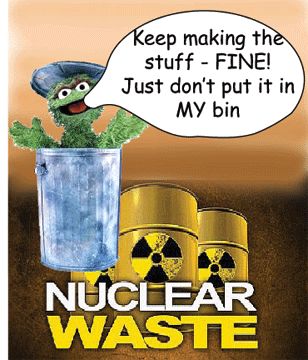
they must just stop making this trash!
South Korea running out of space for nuclear waste http://www.abc.net.au/news/2014-08-18/south-korea-running-out-of-space-for-nuclear-waste/5679626 South Korea is running out of space to store its spent nuclear fuel, with some of its storage facilities set to reach capacity by 2016, according to an independent body that advises the government on nuclear issues.
A Public Engagement Commission, consisting of nuclear experts, professors, and officials, was set up in October 2013 to take account of public opinion on spent nuclear fuel issues and feed into policy decisions.
Commission chairman Hong Doo-seung says it is urgent to find more storage sites for spent fuel.
“We will have to stop nuclear power generation if we fail to find additional temporary space, Continue reading
South Korea’s preparation for pre-emptive nuclear strike against North Korea
 FROM THE POPE TO WAR GAMES IN SOUTH KOREA ORGANISING NOTES, BRUCE GAGNON , AUGUST 19, 2014
Global Network board member Sung-hee Choi, long time activist on Jeju Island, wrote today:
Recently, Pope Francis has visited Korea from Aug. 14 to 18. He left us many moving messages of peace and justice, but the South Korean (ROK) conservative Park Geun-Hye government started the World-biggest war exercise Ulji Freedom Guardian (In government drill, about 480,000 personnel join. In military drill, about 50,000 Korean soldiers and 30,000 US soldiers) started along with the United States on his leaving day. It ends on Aug. 21.
The exercise targets North Korea and the strategy includes preemptive nuclear strike against her. The exercise will be a passage for the US to push for the US-Japan-ROK trilateral military alliance and Missile Defense system. http://space4peace.blogspot.com.au/2014/08/from-pope-to-war-games-in-south-korea.html
Radiation-polluted steel returned to Japan from South Korea
South Korea to return 20 kg Japanese steel scrap due to radiation contamination Aug 11, 2014 By Meeyoung Cho SEOUL (Reuters) – South Korea plans to return some steel scrap imported from Japan due to radiation contamination, the first returned shipment since Seoul heightened nuclear safety checks in 2012, the country’s nuclear watchdog said in a statement on Monday.
The Nuclear Safety and Security Commission detected caesium 137 at a higher than allowed level in 20 kilogrammes of steel scrap out of a total 20 tonnes imported earlier this month, said a spokeswoman at the agency…….http://af.reuters.com/article/worldNews/idAFKBN0GB0IA20140811
1 This Month

26 September – International Day for the Total Elimination of Nuclear Weapons


PLEASE OPPOSE HR 8255 AND S.3639 – bills would accelerate satellite deployment, with no environmental review or safeguards – https://ncstd5li.quorum.us/campaign/169331/
To see nuclear-related stories in greater depth and intensity – go to https://nuclearinformation.wordpress.com
-
Archives
- September 2026 (206)
- August 2026 (330)
- July 2026 (355)
- June 2026 (287)
- May 2026 (306)
- April 2026 (356)
- March 2026 (251)
- February 2026 (267)
- January 2026 (308)
- December 2025 (358)
- November 2025 (359)
- October 2025 (375)
-
Categories
- 1
- 1 NUCLEAR ISSUES
- business and costs
- climate change
- culture and arts
- ENERGY
- environment
- health
- history
- indigenous issues
- Legal
- marketing of nuclear
- media
- opposition to nuclear
- PERSONAL STORIES
- politics
- politics international
- Religion and ethics
- safety
- secrets,lies and civil liberties
- spinbuster
- technology
- Uranium
- wastes
- weapons and war
- Women
- 2 WORLD
- ACTION
- AFRICA
- Atrocities
- AUSTRALIA
- Christina's notes
- Christina's themes
- culture and arts
- Events
- Fuk 2022
- Fuk 2023
- Fukushima 2017
- Fukushima 2018
- fukushima 2019
- Fukushima 2020
- Fukushima 2021
- general
- global warming
- Humour (God we need it)
- Nuclear
- RARE EARTHS
- Reference
- resources – print
- Resources -audiovicual
- Weekly Newsletter
- World
- World Nuclear
- YouTube
-
RSS
Entries RSS
Comments RSS
 nuclear-news