Nuclear blackmail – South Korean computer hacker demands money

 Hacker demands money to withhold information on S. Korean nuclear reactors Korea Times, SEJONG, March 12 (Yonhap) — A hacker who had posted inside information on South Korea’s nuclear power plants made a fresh threat Thursday, demanding money in exchange for not handing over sensitive information to third countries.
Using an account under the name of the president of an anti-nuclear group in Hawaii, the hacker posted additional files on Twitter, which reportedly included documents concerning the country’s indigenous advanced power reactor 1400.
“Need money. Only need to meet some demands… Many countries from Northern Europe, Southeast Asia and South America are saying they will buy nuclear reactor information. Fear selling the entire information will undermine President Park (Geun-hye)’s efforts to export nuclear reactors,” the posting said.
The hacker did not say how much money he wanted but warned that South Korea will end up losing much more if it tries to save a few hundreds of millions of dollars…….The latest posting marked the sixth of its kind since Dec. 15…….
In the latest posting, the hacker “congratulated” the KHNP for finding 7,000 viruses but claimed 9,000 more were awaiting his or her order.
The information released Thursday reportedly included the transcript of a telephone conversation between President Park and the U.N. chief, Ban Ki-moon, on Jan. 1. http://www.koreatimesus.com/hacker-demands-money-to-withhold-information-on-s-korean-nuclear-reactors/
South Korea marketing nuclear reactors to Saudi Arabia
 Saudi Arabia, South Korea sign MOU on nuclear power Wed Mar 4, 2015 Reuters) – Saudi Arabia and South Korea have signed a memorandum of understanding (MOU) to cooperate on the development of nuclear energy, Saudi state news agency SPA said, building on a deal signed in 2011.
South Korean President Park Geun-hye met with Saudi Arabia’s King Salman on Tuesday in Riyadh during an official visit, SPA said.
The MOU calls for South Korean firms to help build at least two small-to-medium sized nuclear reactors in Saudi Arabia, the South Korean presidential office said in a statement.
“If the two units go ahead, the cost of the contract will be (near) $2 billion,” the statement said……http://www.reuters.com/article/2015/03/04/saudi-south-korea-nuclear-idUSL5N0W61GM20150304
Overriding public protests, South Korea renews license of second-oldest nuclear plant,
 South Korea renews license of second-oldest nuclear plant, Japan Times, 28 Feb15 SEOUL – The South Korean nuclear regulator said Friday it renewed the operating license of the country’s second-oldest nuclear power plant until 2022, overriding the objections of residents and anti-nuclear groups.
The Nuclear Safety and Security Commission said that seven of nine commissioners voted to restart the Wolsong No. 1 reactor located in Gyeongju city, 275 kilometers (170 miles) south of Seoul……..
South Koreans were sharply divided over the fate of the Wolsong No. 1 plant that had operated for 30 years until its license expired in 2012. Residents of Gyeongju and members of environmental groups staged protests near the nuclear watchdog’s office when the commissioners discussed the restart in three meetings since January.
The decision to restart Wolsong No. 1 could galvanize opponents and residents living in the areas of current and future plants, said Suh Kune-yull, nuclear engineering professor at Seoul National University.
“I think there could be a backlash to the nuclear energy industry,” Suh said. “It will become increasingly difficult to extend the life span of other nuclear plants or to build new ones.”…….
Opponents of the Wolsong restart said the plant failed to meet the latest safety standards that came into effect after the reactor first went into operation, and that residents near the power plant want it shut down. …..http://www.japantimes.co.jp/news/2015/02/27/asia-pacific/south-korea-renews-license-of-second-oldest-nuclear-plant/#.VPDfBXyUcnk
Nuclear power is a hot political issue in South Korea
The main opposition New Politics Alliance for Democracy, which has more than 40% of the seats in the national parliament, has taken a negative stance on the use of nuclear power. In 2013, the alliance specified a “zero-nuclear” goal in its basic policy.
If the nuclear commission overturns the judgment about the safety of the Wolsong reactor, opposition parties and civic groups will certainly gather momentum.
 Debate heats up over aging nuclear reactor http://asia.nikkei.com/print/article/76444 KENTARO OGURA, Nikkei staff writer EOUL — Nuclear power is generating intense debate in South Korea.
At the center of the storm is the Wolsong No. 1 nuclear reactor in the city of Gyeongju, which is now offline as it reached the end of its 30-year design life. Some say it should be allowed to resume operations.
If its restart is not approved, the reactor will become the first such facility in South Korea to be decommissioned.
The Nuclear Safety and Security Commission has already delayed a decision on the issue twice — on Jan. 15 and Feb. 12. Attention is now focused on the South Korean nuclear watchdog’s next meeting, scheduled for Feb. 26.
The nuclear commission is acting on an application for an extension of the nuclear reactor’s operational life span, which was filed by Korea Hydro & Nuclear Power, a subsidiary of Korea Electric Power.
Mixed results Continue reading
Safety concerns may close South Korea’s Wolsong No.1 reactor
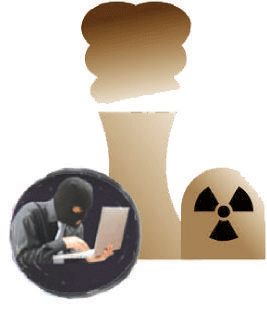 Hacking of Korea’s nuclear operator raises risk of aging reactor closures Yahoo News By Meeyoung Cho SEOUL (Reuters) 12 Jan 15, – The hacking of South Korea’s nuclear operator means the country’s second-oldest reactor may be shut permanently due to safety concerns, said several nuclear watchdog commissioners, raising the risk that other aging reactors may also be closed.
“The operator failed to prevent it (the hack) and they don’t know how much data has been leaked. If the old reactor is still allowed to continue to run, it will just hike risks,” said Kim Hye-jung, one of the nine commissioners who will this month review an application to restart the Wolsong No.1 reactor.
The future of Wolsong No.1, shut in 2012 after reaching its 30-year lifespan, is seen as critical to the fate of other reactors, including the oldest Kori No.1 which had its lifespan extended by 10 years to 2017………
Even those commissioners who deem the reactor safe think that other issues such as public pressure will likely influence their decision, which is expected in February at the earliest.
Concerns over nuclear power have grown since the Fukushima disaster in Japan in 2011 and revelations in 2012 of fake certificates for reactor parts in South Korea.
(Additional reporting by Sohee Kim and Brian Kim; Editing by Henning Gloystein and Michael Perry) http://news.yahoo.com/hacking-koreas-nuclear-operator-raises-risk-aging-reactor-070014531–finance.html
Computer worm uploaded into South Korean Nuclear Plants
 Hackers Uploaded a Worm to South Korean Nuclear Plants Adam Clark Estes http://gizmodo.com/hackers-uploaded-a-worm-to-south-korean-nuclear-plants-1676378891 30 Dec 14 Here’s a scary thing that happened: South Korean authorities found evidence that a worm was recently removed from devices connected to nuclear power facilities. The news comes a little over a week after the country’s nuclear plant operator received warnings on Twitter that its network had been compromised. Thankfully, the reactor controls were not infected.
The specific details of the low-risk worm remain unclear. South Korea’s Energy Ministry says that the malware probably ended up on the nuclear power facilities through an unauthorized USB device. The reactor controls of Korea Hydro and Nuclear Power (KHNP), the state-run utility affected, are not connected to any external networks. However, somewhat surprisingly, Energy Minister Yoon Sang-jick told parliament that the worm was not connected to the other hacking incidents, a claim that “[drew] skepticism from some lawmakers,” according to Reuters. Either way, the worm and them hacks do not reflect well on the state of South Korea’s cybersecurity.
This is an especially worrisome attack in South Korea, since a third of the country’s power comes from nuclear reactors. Authorities have not ruled out the possibility that North Korea is to blame, and KHCP is beefing up its cybersecurity staff from 53 to 70. That still seems like a small number of people to guard 23 nuclear reactors, huh? [Reuters]
Three South Korean workers died after accident at nuclear plant construction site
The accident at the construction site in the southeastern city of Ulsan came as the state-run Korea Hydro and Nuclear Power Co was on high alert over a series of threats by hackers who claim they can disable the control systems of its plants.
South Korea wants China’s help to investigate hacking attempts on nuclear power company
Korea calls on China for help following hack attempt on nuclear power company IP address used in the hack traced to city on China-North Korea border. Ars Technica by John Timmer – Dec 24 2014
Last week, Korea Hydro and Nuclear Power, which runs South Korea’s 23 nuclear plants, suffered a security breach in which personnel records, public health monitoring data, and reactor designs were obtained from the company’s systems and posted online. The attacker, which linked to the materials on an anti-nuclear activist site, also threatened to release further information unless three of the company’s plants were shut down by tomorrow.
Now, Korean investigators have identified a Chinese IP address as the source of the attacks and are asking the Chinese government for assistance in the investigation.
According to a report in The Korea Times, the attacks were routed through three different VPN service providers in the US, Japan, and Korea. By obtaining these records, the initial IP address that launched the attack were traced to the city of Shenyang, which is on the China-North Korea border.An article from Australia’s ABC indicates that this city hosts one end of North Korea’s main Internet connection to the outside world, which was severed earlier this week.
A number of sources confirm that South Korea has asked for China’s assistance in the matter and quote an unnamed official as saying the country isn’t pointing the finger at its neighbor: “There is a possibility that the IP addresses in China are not the final source but used in a routing.” But suspicion isn’t directed at China itself; rather, it’s suspected that North Korean agents were using the Chinese city for their activities……..http://arstechnica.com/security/2014/12/korea-calls-on-china-for-help-following-theft-from-nuclear-power-company/
Hacker got into South Korea’s nuclear plant computers
 South Korea nuclear plant hit by hacker, Lance Whitney , c/net 23 Dec 14 The hacking comes in the wake of increased tension and trouble from North Korea, though the source has not been confirmed. Computers at a nuclear power plant in South Korea have been compromised by a hacker, but the plant’s operator says no critical data has been leaked.
The hacker was able to access blueprints, floor maps and other information on the plant, the South Korean Yonhap News Agency reported Sunday. Using a Twitter account called “president of anti-nuclear reactor group,” the hacker has released a total of four postings of the leaked data since December 15, each one revealing internal designs and manuals of the Gori-2 and Wolsong-1 nuclear reactors run by Korea Hydro and Nuclear Power Co. (KHNP), Yonhap added. The hacker has threatened to leak further information unless the reactors are shut down…………..
Government officials looking into the incident were able to trace the hacker’s IP address to a PC located in a specific location, Yonhap said. Investigators have been sent to the location as well as to the plant’s reactors to probe further. http://www.cnet.com/au/news/south-korea-nuclear-plant-hit-by-hackers/
South Korea’s nuclear waste problem
Dealing with nuclear waste in South Korea The Korea Herald/Asia News Network December 21, 2014,The much awaited nuclear waste facility in Gyeongju will begin operations next year following final approval by the Nuclear Safety and Security Commission last week. The Wolseong Low and Intermediate-Level Radioactive Waste Disposal Center, consisting of six silos some 80 meters underground, can hold up to 100,000 barrels of radioactive waste.
A second-phase construction is underway to add a 125,000-barrel holding unit to the site, which is designed to store 800,000 barrels of nuclear waste over the next 60 years before it is sealed off.
A total of 23 nuclear reactors are responsible for about one-third of all power generated in Korea and produce 2,300 barrels of low- and intermediate-level radioactive waste each year.
The country’s first low- and intermediate-level radioactive repository was realized some 28 years after the country started looking for a site. Gyeongju, North Gyeongsang Province, was selected in 2005 after votes in four candidate cities. Almost 90 percent of voters in Gyeongju approved of the facility.
To win over communities that did not want a hazardous waste facility in their midst, the government promised 300 billion won in community support. The local community would also receive annual fees in addition to the initial grant.
The Gyeongju facility is just the first step. The country has yet to draw up a plan for dealing with the growing piles of spent nuclear fuel rods. Some 750 tonnes of spent fuel are produced each year by the country’s 23 nuclear power reactors.
Currently, spent fuel rods are stored temporarily on the reactor site pending the building of a centralized storage facility. About 13,250 tonnes were stored in different nuclear reactor sites as of end-2013 and it is estimated that the sites will become full incrementally between 2016 and 2038.
The Public Engagement Commission of 15 nuclear experts, academics, city council members and a representative of an environmental watchdog group was formed last year to engage the public in discussions about the spent nuclear fuel issues so that their opinions could be incorporated into policy decisions. The Ministry of Trade, Industry and Energy is expected to draw up a plan for disposing of spent fuel based on recommendations by the commission.
So far, the commission has released an interim report suggesting that a permanent disposal facility must be completed by 2055. It has not said where it could be built or what type of storage could be employed. The commission, in the meantime, has extended its mandate to June 2015.
The Gyeongju site for low- and intermediate-level radioactive waste took 28 years to complete. A facility for the more hazardous spent fuel rods will be much more controversial. Hence, the building of a permanent storage site for spent nuclear fuel rods is an urgent matter that requires immediate government attention…….http://www.chinapost.com.tw/commentary/the-china-post/special-to-the-china-post/2014/12/21/424512/Dealing-with.htm
Ineffective parts in 14 South Korean nuclear reactors
|
’14 reactors have ineffective parts’ http://www.koreatimes.co.kr/www/news/nation/2014/12/116_169248.html
|
Yet another safety bungle in South Korea’s nuclear power
Bungling Nuclear Safety – Fire at Kori Nuclear Power Plant Goes Undetected for Over an Hour Employees couldn’t hear audio alarm, couldn’t see visual alarm, Business Korea, 19 NOVEMBER 2014 Jung Yeon-jinA fire occurred in the nuclear fuel storage facilities of the Kori Nuclear Power Plant located in Kijang County, Busan City, but none of the workers was aware of it for over an hour.
According to the Korea Hydro & Nuclear Power Corporation, the fire occurred at 4:26 p.m., Nov. 11, at Kori Power Plant Unit 4, burning up a waste dryer along with some gloves and towels. It is assumed that the dryer overheated and started the fire while drying wet gloves……….
Power Plant Attempts to Cover Up Reactor Shutdown
But this fire is only the latest incident at the Kori Nuclear Power Station this year.
This past summer was a busy time for Kori Nuclear Power Plant, as Unit 2 was shut off because of heavy rainfall. On Aug. 25, a localized torrential downpour of over 100 mm per hour in Busan City resulted in rainwater infiltrating one of its annexes, and the corporation had to close the facilities.
At that time, the corporation covered up the incident by saying, “We shut down the facilities just in case, and this has nothing to do with the safety of the power station.” However, the Nuclear Safety and Security Commission’s following report read, “The manual shutdown of the reactor was because of the malfunctioning of four of the circulation water pumps, attributable to the heavy rain.”
Poor security of South Korea’s nuclear power system
Making a mess of nuclear safety, Korea JoongAng Daily Nov 05,2014The ministry conducted security checks on power stations across the nation following online media reports about the leak in September. It found that staff shared their log-in IDs and passwords for the internal computer system with subcontracted employees of radioactive waste management companies. Night shift staff should have escorted these people from outside during their work, but instead they gave their security codes away simply because they were lazy………
South Korea monitors products, very aware of nuclear radiation from Japan
 South Koreans Still Fear Radiation From Japan WSJ, 17 Oct 14 More than three years have passed since the nuclear disaster in Fukushima, Japan, but some South Koreans are still leery over possible radioactive contamination from their neighbor.
Environmental activists and residents of Changwon, a city on South Korea’s southeastern coast, staged a rally Tuesday in front of a steel company to protest its import of scrap steel from Japan through a nearby port of Masan.
The protesters demanded local steel companies stop importing Japanese steel for recycling through seaports that aren’t equipped with radioactive detection devices, such as Masan.
“A case in August, in which imports of scrap steel from Japan were found to contain radioactive material and sent back to Japan clearly shows we’re exposed to a real risk,” said Park Jong-kwon, chairman of the Masan Changwon Jinhae Korea Federation of Environmental Movements.
Mr. Park said his group will continue to demand the government divert such imports to other ports until Masan has a radiation detection system.
Concerns have heightened after the Seoul government in August found some imported scrap metal from Japan bore traces of radiation and ordered the importer to return the items to Japan.
The protest in Changwon followed similar complaints earlier this week by a civic group in another port city of Gunsan, southwest of Seoul, that the country should stop steel imports from Japan.
The Nuclear Safety and Security Commission said Aug. 11 that it had returned some steel scrap imported from Japan due to radiation contamination, the first returned shipment since Seoul heightened nuclear safety checks in 2012………
One of Korea’s industries hit hardest by Japan’s latest nuclear disaster was seafood as domestic sales of marine products plummeted following leaks of radioactive water from the Fukushima Daiichi nuclear power plant in 2011.
Since September last year, the Seoul government has blocked all fishery imports from prefectures surrounding the Fukushima plant. http://blogs.wsj.com/korearealtime/2014/10/15/south-koreans-still-fear-radiation-from-japan/
No solution in sight, to South Korea’s mounting tonnes of radioactive trash
 As Nuclear Waste Piles Up, South Korea Faces Storage Crisis, Scientific American, 14 Oct 14 Among the usual commercials for beer, noodles and cars on South Korean TV, one item stands in marked contrast. By Meeyoung Cho SEOUL (Reuters) – Among the usual commercials for beer, noodles and cars on South Korean TV, one item stands in marked contrast.
A short film by a government advisory body carries a stark message: the nation faces a crisis over storing its spent nuclear fuel after running reactors for decades.
The world’s fifth-largest user of nuclear power has around 70 percent, or nearly 9,000 tonnes, of its used fuel stacked in temporary storage pools originally intended to hold it for five or six years, with some sites due to fill by the end of 2016.
It plans to cram those sites with more fuel than they were originally intended to hold while it looks for a permanent solution, suggesting little has been learned from the Fukushima disaster in neighboring Japan.
In the Fukushima crisis in 2011, the storage of large amounts of spent nuclear fuel in elevated pools posed a threat of massive radioactive release on top of meltdowns at three reactors. Spent fuel rods heated up after a quake knocked out water-cooling pumps, underlining the dangers of holding troves of radioactive material in relatively exposed cooling ponds.
“We cannot keep stacking waste while dragging our feet,” said Park Ji-young, director of the science and technology unit at respected think tank the Asan Institute for Policy Studies.
“If we fail to reach a conclusion (on how to manage spent fuel), it would be time to debate if we should stop nuclear power generation.” With South Koreans still spooked by Fukushima and a scandal at home over fake safety certificates for nuclear equipment, the commission has its work cut out to come up with more than a temporary fix to the storage crunch in a report due by year-end………..
OUT OF FAVOR
A permanent solution remains elusive, Continue reading
1 This Month

Website of the Week

New book – https://www.amazon.com/dp/1923372157?utm_source=substack&utm_medium=email
Now until to February 10, 2026 Radioactive waste storage in France: the debate is finally open! How to participate?
-
Archives
- January 2026 (127)
- December 2025 (358)
- November 2025 (359)
- October 2025 (377)
- September 2025 (258)
- August 2025 (319)
- July 2025 (230)
- June 2025 (348)
- May 2025 (261)
- April 2025 (305)
- March 2025 (319)
- February 2025 (234)
-
Categories
- 1
- 1 NUCLEAR ISSUES
- business and costs
- climate change
- culture and arts
- ENERGY
- environment
- health
- history
- indigenous issues
- Legal
- marketing of nuclear
- media
- opposition to nuclear
- PERSONAL STORIES
- politics
- politics international
- Religion and ethics
- safety
- secrets,lies and civil liberties
- spinbuster
- technology
- Uranium
- wastes
- weapons and war
- Women
- 2 WORLD
- ACTION
- AFRICA
- Atrocities
- AUSTRALIA
- Christina's notes
- Christina's themes
- culture and arts
- Events
- Fuk 2022
- Fuk 2023
- Fukushima 2017
- Fukushima 2018
- fukushima 2019
- Fukushima 2020
- Fukushima 2021
- general
- global warming
- Humour (God we need it)
- Nuclear
- RARE EARTHS
- Reference
- resources – print
- Resources -audiovicual
- Weekly Newsletter
- World
- World Nuclear
- YouTube
-
RSS
Entries RSS
Comments RSS
 nuclear-news