Moon urges U.S., North to talk, Korea JoonGang Daily 19 Feb 18
That is the key to a summit in Pyongyang, Blue House maintains President Moon Jae-in said Saturday it is premature to talk about an inter-Korean summit, making clear that Washington and Pyongyang have to get closer to talking before that can take place.
“Anticipations are high, but I think it is too impetuous,” Moon said when a reporter asked if he will hold a summit with North Korean leader Kim Jong-un. “It’s like the old Korean saying that you are looking for hot water from a well.”
Kim sent his younger sister Kim Yo-jong to South Korea as a special envoy and she delivered an invitation to Moon on Feb. 10 to visit Pyongyang. Moon has yet to formally accept. Moon told his North Korean visitor: “Let’s create the environment for that to be able to happen.” …..
Moon said he is satisfied that various goals he set for the Olympics are being achieved. “One of the most important goals was prompting peace through the PyeongChang Olympics,” he said. “North Korea’s participation successfully eased tensions on the peninsula and the inter-Korean team and joint cheerleading impressed the world.
“Because inter-Korean talks made significant accomplishments, I have expectations for more improvement,” Moon said.
“Consensus is growing that dialogue between the United States and North Korea is necessary,” he said. “We are expecting that the ongoing talks between the two Koreas will lead to talks between the United States and the North and eventually denuclearization talks.”……..
Moon’s attempt to arrange a meeting between chief delegates of the United States and North Korea on the sidelines of the Olympics’ opening ceremony failed very publicly, with U.S. Vice President Mike Pence refusing to engage with the North Korean visitors at a reception and in the viewing box of the opening ceremony. But U.S. officials are increasingly indicating their willingness to talk to the North………http://koreajoongangdaily.joins.com/news/article/article.aspx?aid=3044665
South Korea official floats idea of co-hosting Asian Games with North, SBS News 18 Feb 18
PYEONGCHANG, South Korea (Reuters) – A South Korean province is considering a proposal to co-host the 2021 Asian Winter Games with North Korea in a bid to strengthen inter-Korean ties, South Korea’s Yonhap News Agency said on Saturday, quoting provincial governor Choi Moon-soon.
Gangwon province, host for the current 2018 Pyeongchang Winter Olympics, is considering the idea also as a way of making further use of Olympics venues, Choi was quoted as saying.
North Korea is participating in the Pyeongchang Games at the invitation of the South, which is using them to help ease tensions between the two countries, still technically at war.
The host city for the 2021 event has not been decided yet.
After meeting with South Korean Vice Unification Minister Chun Hae-sung in Seoul, Joseph Yun also told reporters that he sees the resumed inter-Korean talks and easing tensions after the North’s decision to join the upcoming Winter Olympics as a “good opportunity” for denuclearization efforts.
“We want to open dialogue with North Korea, we want to have a credible dialogue, a dialogue that could lead steps towards denuclearization,” he said. “That is our goal and of course President Moon has also emphasized that goal too.”
Lessons of Seoul Games’ triumph over terror 30 years ago, NBC News, 28 Jan 18 byERIK ORTIZ, South Korea offering an olive branch. North Korea striking a defiant tone. And the world waiting to see if tensions rattling the Korean Peninsula could undermine an Olympic Games, with calamitous consequences.
That was the backdrop 30 years ago as South Korea prepared to host its first Olympics in the summer of 1988.
In some ways, the fears then are reverberating today — with potentially even more at stake because of North Korea’s nuclear ambitions.
But this year, as snow-capped PyeongChang — just 50 miles from the border with the North — prepares to host the Winter Olympics next month, foreign policy analysts say the lessons of the Seoul Games could show the region how to move closer to not only a trouble-free event, but a path to permanent peace.
The 1988 Games were “a major missed opportunity for South Korea,” said Sergey Radchenko, a global fellow at the Woodrow Wilson Center for International Scholars in Washington who has studied North Korea’s role in the Olympics. “They missed the opportunity to engage with the North.”
So what’s different this time around?
High-level talks between the North and South this month led to an agreement to not only have their Olympic athletes march together for the first time since the 2006 Winter Games in Torino, Italy, but to form their first unified Olympic team.
North Korea Wins Olympics Trip, But Discord Remains Over Nuclear Weapons, By David Tweed and Kanga Kong, Bloomberg,
South Korea talks stumble over call for denuclearization
Both sides agree on North Korea participating in Olympics
………as the day wore on, and South Korea proposed talks on ending North Korea’s nuclear weapons program, the mood appeared to sour. Ri issued a “strong complaint” that Seoul dared to even raise the possibility of denuclearization at such an early stage. The subject is likely to arise again Wednesday when South Korean President Moon Jae-in holds a press briefing.
North Korea’s participation in the Winter Games starting Feb. 9 brings potential benefits to the troubled Korean peninsula, which has been divided for more than 70 years. Kim Jong Un gets the opportunity to ease the global pressure on his isolated regime, while Moon can bet on a more peaceful Olympics and claim a victory in his push for dialogue.
But the long-term dilemma remains: North Korea sees its nuclear weapons — and the ability to use them against the U.S. — as the only thing protecting against an American invasion. At the same time, U.S. President Donald Trump views Kim’s rapidly expanding nuclear arsenal as an intolerable threat, one that must be eradicated by war if necessary.
North and South Korean ties linked to resolving nuclear issue: Moon Jae-in, SBS News 2 Jan 18, South Korean President Moon Jae-in says the improvement of inter-Korean relations is linked to resolving North Korea’s nuclear programme, a day after the North offered talks with Seoul but was steadfast on its nuclear ambitions.
“The improvement of relations between North and South Korea cannot go separately with resolving North Korea’s nuclear programme, so the foreign ministry should coordinate closely with allies and the international community regarding this,” Moon said in opening remarks at a cabinet meeting on Tuesday.
Moon’s comments contrasted with those of North Korean leader Kim Jong Un, who said on Monday that Seoul should stop asking foreign countries for help in improving ties between the two Koreas.
“This shows the Moon administration is looking at the situation from a very realistic, rational point of view,” said Jeong Yeung-tae, head of the Institute of North Korea Studies in Seoul.
“It also shows resolving North Korea’s nuclear issue has a bigger priority (than improving inter-Korean relations).”RELATED
‘The nuclear button is always on my table’: North Korea leader Kim Jong-un’s warning
Moon’s comments came after a New Year’s Day speech by Kim who said he was “open to dialogue” with Seoul, and for North Korean athletes to possibly take part in the Winter Games, but steadfastly declared North Korea a nuclear power.
he South Korean president requested the ministries of unification and sports to swiftly create measures to help North Korea participate in the upcoming Pyeongchang Winter Olympics.
Politicians and decision-makers in South Korea are torn about a plan to
continue construction of two nuclear power plants, following a major
earthquake. The magnitude 5.4 earthquake in early November reignited public
concern about whether the country can still be considered a seismic safe
zone. Now a 500-strong panel of experts is due to report. http://www.aljazeera.com/news/2017/12/south-korea-concerns-raised-safety-nuclear-plants-171226071506379.html
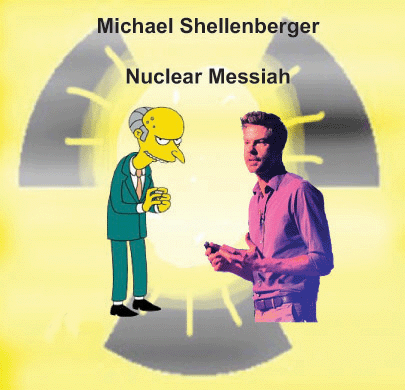
Exposing the misinformation of Michael Shellenberger and ‘Environmental Progress’, Nuclear Monitor Issue: #853 4689 30/10/2017, Jim Green ‒ Nuclear Monitor editor, and national nuclear campaigner with Friends of the Earth Australia
Michael Shellenberger’s pro-nuclear lobby group ‘Environmental Progress’ (EP) is celebrating the decision to proceed with two partially-built reactors in South Korea. A citizens jury appointed by the government voted almost 60% in favor of completing the reactors. President Moon Jae-in said the government would allow construction of the reactors to proceed but “we will completely stop all plans for the construction of new nuclear reactors.”1
It’s doubtful that Shellenberger’s California-based organization could have significantly swayed the citizens jury in South Korea, but EP was very active in the debate and presumably had some effect in shifting opinions. Here is a summary of the work EP carried out in South Korea this year:2
EP published a 62-page pro-nuclear report ‒ ‘The High Cost of Fear: Understanding the Costs and Causes of South Korea’s Proposed Nuclear Energy Phase-Out’.3
Shellenberger visited South Korea four times between April and October 2017, giving speeches, holding press conferences on collaborating with nuclear advocates. He claims that dozens of media outlets reported on EP’s visits, that a press conference in Seoul was “packed”4, and that he enjoyed “a crush of media attention”.5
EP sent a sign-on letter to South Korean President Moon Jae-in in July 2017 and another in August 2017.
In October, EP wrote to the citizens jury tasked with deciding the fate of the two partially-built reactors (Shin Kori 5 and 6).6
EP produced a video promoting nuclear power in South Korea.
Shellenberger has been talking and writing about his bizarre plan to bring peace to the Korean Peninsula by supporting the development of nuclear power in North Korea.
And, according to Shellenberger, EP countered the “lies” of Friends of the Earth (FOE) and Greenpeace in “two investigative pieces and three separate open letters to President Moon and the citizens jury that were signed by climate scientists and environmentalists from around the world.”6
EP’s campaign has involved a blizzard of misinformation and relentless, dishonest attacks against environment groups, particularly Friends of the Earth (FOE) and Greenpeace. Shellenberger claims4 that the “greatest coup” of the two groups was the “Hollywood-style anti-nuclear disaster movie” called Pandora7 which was released last year and has been watched by millions, mostly on Netflix. But FOE and Greenpeace had nothing to do with the production of the Pandora film!……..
The funding of the Pandora film isn’t an important issue but it neatly illustrates Shellenberger’s M.O. of relentless repetition of falsehoods in the hope that some mud sticks…..
Shellenberger himself featured in the dishonest and wildly inaccurate ‘Pandora’s Promise’ film a few years ago………
Nuclear power and weapons proliferation
Shellenberger states: “One of FOE-Greenpeace’s biggest lies about nuclear energy is that it leads to weapons. Korea demonstrates that the opposite is true: North Korea has a nuclear bomb and no nuclear energy, while South Korea has nuclear energy and no bomb.”4
In fact, the connections between nuclear power (and associated industries such as enrichment and reprocessing) and weapons proliferation are well understood and there are countless real-world examples demonstrating the risks.26
Prominent nuclear lobbyists are now openly talking about the connections between nuclear power (and related industries) and weapons production in order to boost the case for further subsidies to support the ‘civil’ nuclear industry, particularly in the US.27 It seems Shellenberger didn’t get the memo.
As for Shellenberger’s claims about proliferation on the Korean peninsula, he ignores the fact that North Korea uses what is calls an ‘experimental power reactor’ (based on the UK Magnox power reactor design) to produce plutonium for weapons.28 He ignores the fact that North Korea acquired enrichment technology from Pakistan’s A.Q. Khan network, who stole the blueprints from URENCO, the consortium that provides enrichment services for the nuclear power industry.28 He ignores the fact that North Korea’s reprocessing plant is based on the design of the Eurochemic plant in Belgium, which provided reprocessing services for the nuclear power industry.28
North Korea is in ‘final stages of nuclear weaponisation’, says South Korea, The Independent16 Dec 2017, South Korea’s vice foreign minister issued an urgent plea about the threat from Pyongyang, warning the United Nations Security Council that North Korea was “in the final stages of nuclear weaponization”.
“It will fundamentally alter the security landscape in the region and beyond” if the North is able to equip a missile with a nuclear warhead, Cho Hyun warned.
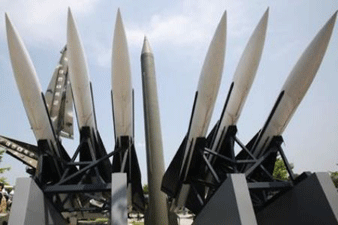
In the past few months, North Korea has rattled the world with a series of weapons tests. It detonated a hydrogen bomb and has launched multiple ballistic missiles, saying after the latest firing that it now has the capability to attack the US mainland and had devised a missile capable of carrying “super-large heavy nuclear warhead”.
The late-November launch soared higher than any previous test, US Secretary of Defence James Mattis said, and illustrated North Korea’s determination to build missiles that can “threaten everywhere in the world”.
Continuing to defy international warnings, a top North Korean official said escalating pressure from the global community shows America is “terrified” by North Korea‘s nuclear capabilities.
The nation’s ambassador to the United Nations, Ja Song Nam, called a meeting of the UN Security Council a “desperate measure plotted by the US” in response to North Korea’s displays of military might.
The latest joint training operation practised infiltrating North Korea and removing nuclear weapons in the event of war.
According to South Korea news agency Yonhap the “Warrior Strike” exercise held at Camp Stanley involved hundreds of troops from both sides and ran from Tuesday to Friday.
Camp Stanley is an army camp located north of Seoul and has around 5000 soldiers.
The display comes as North Korea’s neighbours China and Russia also carried out an antimissile drill in Beijing last week. The joint five-day drill, which finished on Saturday, included servicemen from both militaries and was headed by top brass in the Russian and Chinese air force, Newsweek reported.
The latest joint exercise between Washington and Seoul follow joint aerial drills Vigilant Ace in South Korea earlier this month.
The five-day drill was meant to improve the allies’ wartime capabilities and preparedness, according to South Korea’s defence ministry said.
The Vigilant Ace exercises, which lasted five days, involved more than 230 warplanes and 12,000 soldiers from both sides.
United States troops also used the hi-tech F-35 Lightning IIs and F-22 Raptors.
South Korea is a key US ally in the region and relies on US military assistance for security against the North.
Troops from the two countries routinely train together, each time prompting outbursts from Pyongyang.
Meanwhile Russia warned against fresh preconditions for any potential US and North Korea talks. Deputy foreign minister Sergei Ryabkov on Saturday warned of a risk of escalation after Washington toughened its stance on North Korea nuclear talks and US President Donald Trump accused Moscow of failing to help.
“It’s sad that this powerful element of demands for further pressure on Pyongyang has once again appeared in the American position,” he told RIA Novosti news agency.
“It’s high time to stop this race of threats, pressure, blackmail and presentation of preconditions and shift to a real search for a political solution.”
Mr Ryabkov said that both Pyongyang and Washington are now putting forward preconditions for talks and there is a “risk of uncontrolled escalation”.
His comments came one day after US Secretary of State Rex Tillerson backed away from an earlier offer of unconditional talks to end the stand-off with Pyongyang following White House pressure.
Moon calls for ‘overwhelming’ military capability against North Korea, Korea Herald, jasonyeo@heraldcorp.com By Yeo Jun-suk : Dec 8, 2017 -President Moon Jae-in urged the military to secure “overwhelming” capability to fend off North Korea’s growing military threat on Friday as South Korea’s Defense Ministry warned against another strategic provocations following its latest missile launch.
The president also called for an “early and swift” transfer of wartime operational control from the United States to South Korea, suggesting the military should secure capability to lead combined operations in the event of contingency on the Korean Peninsula.
“Based on a robust South Korea-US alliance, we have to work swiftly to meet the conditions for wartime operational control,” said the president during a lunch meeting with some 150 military commanders at the presidential office of Cheong Wa Dae in Seoul.
“Given that North Korea’s missile and nuclear threat has been accelerating at a faster pace than before, the military’s role is more important than ever. You are our last line of defense against North Korea’s nuclear weapons and missile threats,” he added. ……http://www.koreaherald.com/view.php?ud=20171208050060
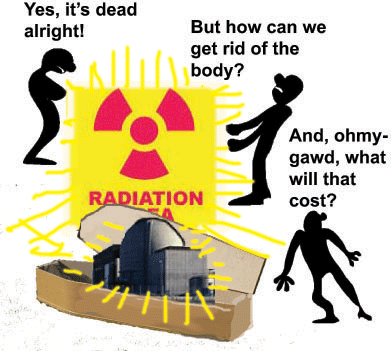
S. Korea strives to build up nuclear decommissioning industry, By Kim Eun-jung SEOUL, Dec. 8 (Yonhap) —South Korea will ramp up efforts to develop technologies related to nuclear decommissioning as the country’s oldest reactor is undergoing the lengthy, costly process of being dismantled, the energy ministry said Friday.
The Ministry of Trade, Industry and Energy launched a consultative body composed of state-run utilities, construction companies and research institutes to put concerted efforts toward developing the nation’s nuclear decommissioning industry,
The ministry said it aims to develop technologies needed to dismantle nuclear reactors by 2021 that will make such sites free of radioactive hazards and establish a research institute to pave the way for entering the global market by 2030…….
A total of 11 reactors will be retired one by one by 2030 as their operational life cycles expire as the government said it won’t extend their operation.
As part of the nuclear phase-out plan, the government is also pushing for an early closure of Wolsong-1, now the nation’s oldest operating reactor, as soon as possible.
Bomb shelter boss ‘wants North Korea to launch nuclear attack’ to help sell new ‘high street bunkers’Mirror UK, 30 Nov 17 British bunker experts have been working alongside a Korean company on making the world’s toughest shelters to prepare for nuclear war A bomb shelter boss ‘wants North Korea to launch a nuclear attack’ to help sell ‘high street bunkers’.
The bunkers have been built to withstand a nuclear attack, by Kim Jong-un are now being sold on Seoul’s high street.
British bunker experts Castellex have been working alongside the Korean company Chumdan Bunker System on making the world’s toughest shelters to prepare for nuclear war.
A ‘bunker showroom’ has now been opened in downtown Seoul, in the same shopping area where people are buying clothes and cosmetics. CBS owner Go Wan Hyeok says that demand from ‘petrified’ locals for affordable bunkers led him to set up in the busy retail district of Jangan-Dong – and wants to branch out to Europe and the UK within five years.
He said: “I’m wishing that he presses the button and shoots the bomb!
Carlisle News and Star 30th Nov 2017,The British and Korean governments have agreed to greater collaboration onnuclear developments, fuelling speculation that a Korean company is about
to invest in West Cumbria’s Moorside power station.
Greg Clark, the secretary of state for business, energy and industrial strategy, and Paik
Un-gyu, South Korean minister of trade, industry and energy, signed a
Memorandum of Understanding on Monday in London. It promises greater
collaboration in both the construction and decommissioning of nuclear power
stations.
The signing appears to have only been reported by World Nuclear
News and Business Korea websites. State-run Korea Electric Power
Corporation (Kepco) has revealed it is in “working-level” talks to buy
a stake in NuGen – which plans to build three new reactions in West
Cumbria to provide seven per cent of the UK’s electricity needs.








 nuclear-news