India–Pakistan nuclear escalation: where could it lead? India says its ‘no first use’ nuclear policy could change. Nature examines what that means for the country’s fraught relationship with Pakistan. Nature Priyanka Pulla 29 Aug 19, Nuclear tensions are escalating between south Asia’s two superpowers — India and Pakistan — following the Indian defence minister’s announcement earlier this month that India may revoke its current commitment to only use nuclear weapons in retaliation for a nuclear attack, known as ‘no first use’.
Some experts watching the situation have told Naturethat the risk of a conflict between the two countries has never been greater since they both tested nuclear weapons in 1998………
What is no first use and who else has adopted it?
Of the world’s eight declared nuclear-weapons states, only China and India have an unambiguous no first use nuclear weapons policy. This is a commitment only to use nuclear weapons in response to a nuclear attack and never in retaliation for one using conventional weapons. Such a policy also includes comprehensive protocols in which activating nuclear weapons would only ever be a last resort.
India tested its first nuclear weapon in 1974 and the government committed to no first use in 2003, five years after conducting a second set of nuclear-weapons tests on 11 and 13 May 1998. The intention in declaring no first use was partly to help defuse tensions with its neighbour, which had responded to India’s second test with its own nuclear tests the same month.
Over the past two decades, Pakistan has amassed 150–160 nuclear missiles, to India’s 130–140, according to the Stockholm International Peace Research Institute. Both countries, moreover, have advanced nuclear weapons, as well as ballistics research and development programmes.
Why doesn’t Pakistan have a no first use policy?
According to Feroz Hassan Khan, who teaches security studies at the Naval Postgraduate School in Monterey, California, if Pakistan were to adopt the same policy, that would negate its reason for developing nuclear weapons in the first place……..https://www.nature.com/articles/d41586-019-02578-5
Indian defence minister Rajnath Singh on Friday said India could review its nuclear no first use policy
The UN Security Council on Friday said India and Pakistan should sort out their differences bilaterallyNew Delhi: Pakistan army spokesman Asif Ghafoor on Saturday described Kashmir as a “nuclear flashpoint”, a day after defence minister Rajnath Singh said India could review its nuclear no first use policy.
Ghafoor’s comment, quoted by news reports, could be seen as another attempt by Pakistan to internationalise the Kashmir dispute between the two countries and invite offers of mediation. Western nations have always been wary of tensions flaring up between the two countries that have nuclear weapons.
In his remarks on Saturday, Ghafoor also said Pakistan was ready to repulse any Indian attack, the news reports said.
On Friday, during a visit to Pokhran, defence minister Rajnath Singh said, “Till today, our nuclear policy is ‘No First Use’. What happens in future depends on the circumstances,” media reports said quoting the minister who was at an event in Pokhran, the site of India’s nuclear tests in 1998.
The comments followed heightened tensions between India and Pakistan after the Indian government revoked Article 370that gave special status to Jammu and Kashmir. Pakistan had condemned the move.
In a tweet, Rajnath Singh added, “Pokhran is the area which witnessed Atal Ji’s firm resolve to make India a nuclear power and yet remain firmly committed to the doctrine of ‘No First Use’. India has strictly adhered to this doctrine. What happens in future depends on the circumstances.”
Hair-Trigger Nuclear Alert Over Kashmir, Common Dreams, India and Pakistan, where people starve in the streets, waste billions on military spending because of the Kashmir dispute. Now some of India’s extreme Hindu nationalists warn they want to reabsorb Pakistan, Bangladesh, and even Sri Lanka into Mother India. by Eric Margolis 11 Aug 19
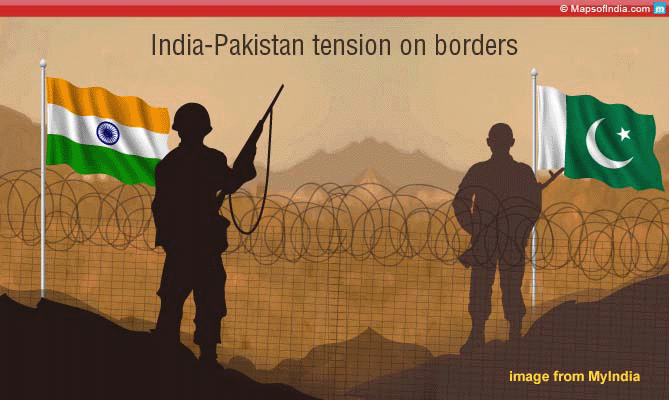
Two of the world’s most important powers, India and Pakistan, are locked into an extremely dangerous confrontation over the bitterly disputed Himalayan mountain state of Kashmir. Both are nuclear armed.
Kashmir has been a flashpoint since Imperial Britain divided India in 1947. India and Pakistan have fought numerous wars and conflicts over majority Muslim Kashmir. China controls a big chunk of northern Kashmir known as Aksai Chin.
In 1949, the UN mandated a referendum to determine if Kashmiris wanted to join Pakistan or India. Not surprisingly, India refused to hold the vote. But there are some Kashmiris who want an independent state, though a majority seek to join Pakistan……
What makes this confrontation so dangerous is that both sides have important tactical and nuclear forces arrayed against one another. These are mostly short/medium-ranged nuclear tipped missiles, and air-delivered nuclear bombs. Strategic nuclear weapons back up these tactical forces. A nuclear exchange, even a limited one, could kill millions, pollute much of Asia’s ground water, and spread radioactive dust around the globe – including to North America. ….https://www.commondreams.org/views/2019/08/11/hair-trigger-nuclear-alert-over-kashmir
Kashmir crisis: Will nuclear-armed Pakistan go to war with India again? Telegraph UK Ben Farmer, islamabad
8 AUGUST 2019 Pakistan has downgraded diplomatic ties with India and suspended trade with its neighbour as the political row over the disputed territory of Kashmir escalates.
Kashmir, nexus of conflict between nuclear antagonists India and Pakistan, faces crackdown, plunges into fear, By Douglas Perry | The Oregonian/OregonLive, 5 Aug 19, India and Pakistan have fought two wars and engaged in countless cross-border military skirmishes over Kashmir.
Now India has plunged the mountainous region into fear by revoking Kashmir’s constitutionally mandated “special privileges.” The federal government in Delhi sent in thousands of troops over the weekend, and Kashmiri political leaders have been put under house arrest. Internet service to the area has been cut off or restricted…..
The crackdown did not come as a surprise: The Delhi government ordered tourists out of the Himalayan region last week, warning of a possible terrorist attack.
Kashmir has been claimed by both Hindu-majority India and Muslim-majority Pakistan — and administered by India — since the two countries won their independence shortly after World War II. Great Britain partitioned its colony on the Indian subcontinent in 1947 before pulling out, sparking widespread violence. “Under the partition plan provided by the Indian Independence Act,” the BBC notes, “Kashmir was free to accede to India or Pakistan” — and the region’s maharaja at the time chose India, even though the population is predominantly Muslim. This led to a two-year war between India and Pakistan, with another one erupting in 1965.
ISLAMABAD — VOICE OF AMERICA, 24 May 19,Pakistan says it has successfully conducted a “training launch” of a ballistic missile capable of carrying both nuclear and conventional warheads up to 1,500 kilometers.
The move came amid Pakistan’s heightened military tensions with neighboring rival India, and it is seen by observers as part of the efforts Islamabad is making to keep pace with New Delhi’s massive investments in military hardware and advancements…….
Pakistan has already test-fired the Shaheen-III nuclear-capable missile with a range of up to 1,700 miles, enabling it to strike all corners of India and reach deep into the Middle East, including Israel.
Thursday’s missile launch came a day after Pakistani Foreign Minister Shah Mehmood Qureshi spoke briefly with his Indian counterpart, Sushma Swaraj, on the sidelines of a meeting of the Shanghai Cooperation Organization member states in Kyrgyzstan. Following what he said was an informal interaction with Swaraj, Qureshi said he conveyed Pakistan’s readiness to engage in a dialogue with India to resolve all bilateral matters through negotiations.
“We want to live like good neighbors and settle our outstanding issues through talks,” he said.
Indian Prime Minister Narendra Modi announced in March the country had shot down a satellite in low orbit, making it the fourth country, after the United States, China and Russia, to have used an anti-satellite weapon.
Islamabad had criticized the move as a “matter of grave concern” and a militarization of space by New Delhi.
In the backdrop of India’s recent anti-satellite tests, Pakistan announced Wednesday it has signed a joint document with Russia on no-first placement of weapons in outer space. An official statement said the two countries have agreed to “make all possible efforts to prevent outer space from becoming an arena for military confrontation and to ensure security in our space activities.”
Analysts estimate that both the South Asian rivals possess about 100 nuclear warheads each.
WILL INDIA AND PAKISTAN BE ABLE TO STEP BACK FROM NUCLEAR DANGER? Arms Control Wonk, by Michael Krepon | May 13, 2019 Dark clouds are gathering. The Trump administration seems headed toward pre-emptive strikes against Iran. This progression began when Donald Trump walked away from the deal struck by President Obama, the European Union, Russia and China freezing advances in Iran’s nuclear weapon-related activities. Next, not unexpectedly, was Tehran’s threat to get back in the business of serious uranium enrichment in response to the U.S. walk out and Europe’s likely inability to circumvent Washington’s secondary sanctions. If Tehran follows through or if there is another prompt, the following step in this progression would be to set back Iran’s nuclear program several years by bombing the hell out of it. Conciliators be damned: Cue to the mission accomplished banners and drop the confetti.
……After two inept performances at summit meetings, it is evident that Trump and Secretary of State Mike Pompeo are out of their element trying to negotiate deals to reduce nuclear dangers. Young Mr. Kim is now back to firing missiles, which is the way he negotiates.
Compared to U.S.-Iran and U.S.-North Korean relations, the ill-will between India and Pakistan seems more manageable. Can these nuclear-armed neighbors take constructive steps away from periodic crises and confrontation? The smart money bets no, and cynics are usually right. Those who have tried to break the cycle of enduring enmity on the subcontinent have not been rewarded. A succession of Indian Prime Ministers, including the incumbent, have been burned by making gestures to improve relations with Pakistan. An act of violence has followed, usually perpetrated by militants with ties to Pakistan, making Indian leaders look foolish for trying. ……..
The nuclear competition between India and Pakistan is accelerating with the introduction of new ballistic and cruise missiles, along with missiles carrying multiple warheads. India is implementing plans to deploy missile defenses, even though Pakistan has already taken steps to defeat them. Nuclear weapons are heading to sea, where command and control will be more challenging.
Nuclear doctrines are evolving. Both countries are falling victim to the counterforce compulsion — a disease that infects nuclear-armed states when the size of their arsenals exceeds the number of cities to be targeted. Minimum deterrence evolves into war-fighting strategies when stockpiles permit the targeting of military, air and naval bases, missile deployment areas and other strategic facilities. This is a recipe for an open-ended nuclear competition, requiring even more fissile material production. India and Pakistan won’t go as deep into this morass as the United States and the Soviet Union, but they’ll go deeper than Great Britain and France……..
If India’s new government has the wisdom to try once more to move away from confrontation, there is no shortage of confidence-building and nuclear risk-reduction measures to pursue. Every Indian and Pakistani diplomat worth his or her salt can quickly identify a half-dozen worthwhile measures that would not diminish security while helping to place time and space before another clash. If enough time and space are added, there may not be another clash.
The Stimson Center has added to the list of creative confidence-building and nuclear risk-reduction measures. Stimson has gathered rising talent and veteran analysts from India, Pakistan and the United States to propose pragmatic, novel approaches to improve ties. The result is the latest book from Stimson’s South Asia Program, Off Ramps from Confrontation in Southern Asia, freely available for downloading here. We’ve assembled eighteen interesting ideas, including collaborative environmental protection by Sameer Ali, joint initiatives on the humanitarian impact of nuclear weapons by Arka Biswas and Saira Bano, the creation of communication links between National and Nuclear Command Authorities by Harry Hannah, an expanded missile flight-test notification regime by Frank O’Donnell, and modernizing the nuclear non-attack agreement by Toby Dalton.
Ben Brown 29/04/2019 By CCN.com: As India and Pakistan continue to throw nuclear threats back and forth, a senior Indian government official tasked with diplomacy in external affairs has dampened any hopes for peace between the two nations.
India’s minister of state for external affairs V.K Singh said this weekend that India and Pakistan will never be friends:
“A country which has been triggering proxy wars against India besides being a terrorist hub can never be treated as a friend. Treating Pakistan as a friend will be the biggest weakness of India.”
INDIA AND PAKISTAN: MONTHS OF NUCLEAR TENSION
The statement comes after months of tension between the two nuclear neighbors. The military posturing reached a peak last week when India’s prime minister Narendra Modi threatened Pakistan with the “mother of nuclear bombs.”
The military aggression first flared in February when Pakistan-based terrorist group JeM killed 40 Indians. India responded with airstrikes over the border and a series of aggressive military action followed on both sides.
PAKISTAN’S F-16 FIGHTER JET AGGRESSION: A VIOLATION OF US TERMS?
The United States has also been dragged into the ongoing conflict between India and Pakistan, but the Trump administration remains firmly on the sidelines. The US has refused to comment on Pakistan’s possible violation of US terms.
In February 2019, Pakistan shot down an Indian jet and captured its pilot. India claims this aggressive action was carried out by a Pakistani F-16 fighter jet, sold to Islamabad by the United States.
If India’s claims are true, it may be a violation of international terms. According to the US arms agreement, Pakistan is only permitted to use the F-16 fighter jets defensively.
Pakistan maintains it did not use the F-16 in the dogfight and, despite India’s claim that it shot down a Pakistani F-16 in the clash, a US count found that all jets were present and correct. India, however, submitted some evidence in the form of call-signs and weaponry used which are associated with Pakistani F-16s.
US STAYS ON THE SIDELINES
This weekend, the US refused to share any information with India about the possible violation of terms. Speaking to the Indian Express, an unnamed official said it was a matter solely for the US and Pakistan:
“Soon after we were informed by the Indian side about Pakistan using F-16 aircraft on Feb 27, we informed the Indians that we will not be sharing any information on the subject as it is a bilateral matter between the US and Pakistan.”
Pakistan maintains it did not use the F-16 in the dogfight and, despite India’s claim that it shot down a Pakistani F-16 in the clash, a US count found that all jets were present and correct. India, however, submitted some evidence in the form of call-signs and weaponry used which are associated with Pakistani F-16s.
The official said it was a strictly unbiased position and it would do the same if the tables were turned:
“If a third country tomorrow wants information about the C130 or C17 or Apaches that the IAF [Indian Air Force] uses, our answer would be the same. It is a bilateral matter between India and the US.”
PEACE IN THE INDIAN SUB-CONTINENT?Pakistan is on a mission to dispel fears of conflict, but not everyone is convinced. The country invited a handful of journalists to learn about Islamabad’s desire for peace, summed up by this Reuters commentary:
“Pakistan says it is tired of conflict, opposed to extremism, open for peace talks and clamping down on corruption. It also insists it is run by politicians, with the military partnering rather than dominating.”
But with constant military posturing from both Pakistan and India, the peaceful rhetoric doesn’t quite match the nuclear grandstanding.
–‘Don’t test our resolve’: Pakistan warns India against mentioning its nuclear power lightly https://scroll.in/latest/921739/dont-test-our-resolve-pakistan-warns-india-against-mentioning-its-nuclear-power-lightly– 29 Apr 19, Pakistan’s military spokesperson Major General Asif Ghafoor reiterated Pakistan’s denial of India’s claim that it was responsible for the attack in Pulwama. Pakistan on Monday warned India against testing its military’s resolve and said that it was capable of protecting its citizens. Pakistan’s military spokesperson Major General Asif Ghafoor accused India of relying on false claims about the Pulwama attack in India and the Indian Air Force’s air strike in Balakot.The military spokesperson urged India to be a more responsible nuclear power. “In your [Indian] rhetoric, you keep using nuclear power as a threat,” Ghafoor said. “Nuclear powers are not a threat, they are a weapon of deterrence that should not be mentioned lightly…Do not test our resolve.”
Ghafoor was referring to Prime Minister Narendra Modi’s remark earlier this month that India’s nuclear weapons are “not meant for Diwali”. Modi had received criticism from several quarters for that statement.
Ghafoor denied that it was responsible for the attack in Pulwama that killed 40 Indian security personnel. “We told them we were not involved,” Ghafoor told reporters at a press conference. “India then violated our airspace, we then gave the ultimatum that we will respond when we see fit. Two months have passed since and India has told countless lies on the matter. We have not responded to the lies, not because we can’t, but because we don’t want to retaliate.”
Ghafoor reiterated that Pakistan had incurred no damage from India’s air strike in Balakot. He said hiding the downing of a plane is impossible in today’s day and age.
“International media came to Pakistan, we told them that they should go to the place and see for themselves what had happened. India had said that 300 people had died in their attack [in Balakot]. Then they said that they had used a small-scale missile that bore a tiny hole in the ceiling of the building and then exploded inside. We again offered to show your own [Indian] media the site,” he said.
Report on Modi’s remark on nuclear weapons sent to EC, says election official in Barmer https://scroll.in/latest/921705/report-on-modis-remark-on-nuclear-weapons-sent-to-ec-says-district-election-officialThe prime minister had warned Pakistan at the rally last week, saying India’s nuclear weapons are ‘not meant for Diwali’.Election authorities in Barmer district of Rajasthan on Monday said they have submitted a factual report to the Election Commission after looking into the Congress’ allegation that Prime Minister Narendra Modi had “brazenly violated” the poll code by repeatedly invoking the armed forces at an rally in the district on April 21, PTI reported.
At the rally, Modi had said that India does not get scared of Pakistan’s nuclear strike threats anymore. “Every other day they used to say, ‘We have nuclear button, we have nuclear button’,” the prime minister had said. “What do we have then? Have we kept it for Diwali?”
Following the complaint by the Congress the following day, the Election Commission had sought a report on the prime minister’s address. “The report has been forwarded with the copy of PM’s speech as per the direction of the commission,” said district election officer Himanshu Gupta.
This is not the first instance of the ruling party invoking the armed forces during the campaign for these Lok Sabha elections. On April 18, the Election Commission warned Union Minister for Minority Affairs Mukhtar Abbas Naqvi for referring to the defence forces as “Modi ji ki Sena [Narendra Modi’s Army]” and asked him to be careful in the future. This came a few days after a warning was issued to Uttar Pradesh Chief Minister Adityanath for making the same remark.
Apart from the Opposition parties, military veterans have also complained about such speeches made by BJP leaders. On April 12, more than 150 veterans of the Indian armed forces wrote to President Ram Nath Kovind, urging him to stop the politicisation of the military during election campaigns. The letter urged Kovind to “take all necessary steps to urgently direct all political parties that they must forthwith desist from using the military, military uniforms or symbols, and any actions by military formations or personnel, for political purposes or to further their political agendas”.
The Election Commission has issued multiple advisories asking political parties not to indulge in political propaganda involving the defence forces.
India Pakistan CONFLICT: Imran Khan issues India nuclear WARNING – ‘no one can predict’
PAKISTAN’S Prime Minister Imran Khan issued a dire warning to his neighbouring country as he branded India’s attack on his “nuclear-armed” country as “irresponsible” and warned Pakistan “would have no choice” but to strike back in the future.
By ALESSANDRA SCOTTO DI SANTOLO, Express UK , Wed, Apr 10, 2019 Speaking to the BBC, Imran Khan called on his Indian counterpart to come to a peaceful dialogue over the “oppression of Kashmir” and claimed the number one priority for the two nations should be tackling poverty. He said: “Surely the number one task of the two governments should be: how are we going to reduce poverty? And the way we reduce poverty is by settling our differences through dialogue.
“And there is only one difference, which is Kashmir. It has to be settled.
“The Kashmir issue cannot keep on boiling like it is because anything happening in Kashmir – through a reaction to the oppression which is taking place in Kashmir – it would be palmed off n Pakistan.
“We would be blamed and tensions would rise as they have risen in the past.
“So if we can settle Kashmir, the benefits of peace are tremendous in the subcontinent.”
South Asia’s nuclear-armed neighbors pull back from the abyss…barely
India and Pakistan have created the most perilous place on Earth. Salon DILIP HIRO, APRIL 7, 2019 This piece originally appeared on TomDispatch.
It’s still the most dangerous border on Earth. Yet compared to the recent tweets of President Donald Trump, it remains a marginal news story. That doesn’t for a moment diminish the chance that the globe’s first (and possibly ultimate) nuclear conflagration could break out along that 480-mile border known as the Line of Control (and, given the history that surrounds it, that phrase should indeed be capitalized). The casus belli would undoubtedly be the more than seven-decades-old clash between India and Pakistan over the contested territory of Kashmir. Like a volcano, this unresolved dispute rumbles periodically — as it did only weeks ago — threatening to spew its white-hot lava to devastating effect not just in the region but potentially globally as well.
The trigger for renewed rumbling is always a sensational terrorist attack by a Pakistani militant group on an Indian target. That propels the India’s leadership to a moral high ground. From there, bitter condemnations of Pakistan are coupled with the promise of airstrikes on the training camps of the culprit terrorist organizations operating from the Pakistan-controlled part of Kashmir. As a result, the already simmering relations between the two nuclear-armed neighbors are quickly raised to a boiling point. This, in turn, prompts the United States to intervene and pressure Pakistan to shut down those violent jihadist groups. To placate Washington, the Pakistani government goes through the ritual of issuing banning orders on those groups, but in practice, any change is minimal.
And in the background always lurks the possibility that a war between the two neighbors could lead to a devastating nuclear exchange. Which means that it’s time to examine how and why, by arraying hundreds of thousands of troops along that Line of Control, India and Pakistan have created the most perilous place on Earth.
South Asia’s Overlooked Nuclear Crisis, While few were watching, India and Pakistan may have just narrowly avoided a nuclear confrontation. The Nation, By Dilip Hiro 5 Apr 19,It’s still the most dangerous border on Earth. Yet compared to the recent tweets of President Donald Trump, it remains a marginal news story. That doesn’t for a moment diminish the chance that the globe’s first (and possibly ultimate) nuclear conflagration could break out along that 480-mile border known as the Line of Control (and, given the history that surrounds it, that phrase should indeed be capitalized). The casus belli would undoubtedly be the more than seven-decades-old clash between India and Pakistan over the contested territory of Kashmir. Like a volcano, this unresolved dispute rumbles periodically—as it did only weeks ago—threatening to spew its white-hot lava to devastating effect not just in the region but potentially globally as well.
The trigger for renewed rumbling is always a sensational terrorist attack by a Pakistani militant group on an Indian target. That propels India’s leadership to a moral high ground. From there, bitter condemnations of Pakistan are coupled with the promise of airstrikes on the training camps of the culprit terrorist organizations operating from the Pakistan-controlled part of Kashmir. As a result, the already simmering relations between the two nuclear-armed neighbors are quickly raised to a boiling point. This, in turn, prompts the United States to intervene and pressure Pakistan to shut down those violent jihadist groups. To placate Washington, the Pakistani government goes through the ritual of issuing banning orders on those groups, but in practice, any change is minimal.
And in the background always lurks the possibility that a war between the two neighbors could lead to a devastating nuclear exchange. Which means that it’s time to examine how and why, by arraying hundreds of thousands of troops along that Line of Control, India and Pakistan have created the most perilous place on Earth.
HOW IT ALL BEGAN
The Kashmir dispute began with the birth of the kicking twins—Hindu-majority India and Muslim-majority Pakistan—as independent countries. They emerged from the belly of the dying British Raj in August 1947. The princely states in British India were given the option of joining either of the new nations. The dithering Hindu ruler of Muslim-majority Jammu and Kashmir (its full title) finally signed a legally binding instrument of accession with New Delhi after his realm was invaded by armed tribal raiders from Pakistan. This document offered that state’s citizens the chance to choose between the two countries once peace had been restored. This has not happened so far and there is no credible prospect that it will………..
while India has long been in a nuclear arms race with Pakistan, it is no longer sticking to the same race course. In late March, Modi announced that India recently launched a rocket successfully shooting down one of its satellites. This creates the possibility that, in a future nuclear war with Pakistan, it could preemptively “blind” the Pakistanis by destroying their space-based communication and surveillance satellites. A race of another kind could be in the offing.
The central motive that drove Pakistan to develop its nuclear arsenal, however, remains unchanged. It was the only way Islamabad could deter New Delhi from defeating it in a war waged with conventional weapons……….
AMN By News Desk2019-03-17 Tensions between the two nuclear-armed Asian powers escalated last month, after an incursion into Pakistani territory in Kashmir by Indian Air Force warplanes to strike at Jihadist militants led to skirmishes in the air and small arms and artillery fire along the shaky Line of Control border.
Major combat units of the Indian Navy including the INS Vikramaditya aircraft carrier-led battle group, nuclear submarines “and scores of other ships, submarines and aircraft” were quickly shifted from exercises to operational deployment as tensions between New Delhi and Islamabad escalated, India’s Ministry of Defence revealed in a statement Sunday……..
Earlier Sunday, sources speaking to Reuters reportedly said that India and Pakistan had threatened to lob nuclear missiles at each other during the crisis and that only US officials’ intervention helped to defuse what may have well turned into a much deadlier conflict. ……
Japan TimesBY JAMES STAVRIDIS, BLOOMBERG, MAR 11, 2019 NEW YORK –While India and Pakistan seem to have stopped bombing one another, the causes behind the cross-border tensions aren’t going away any time soon. The two nations are nuclear-armed; have large conventional armed forces; have had four serious wars since they became independent in 1947; and have enormous cultural and religious antipathy. This is a prescription for a disaster, and yet the confrontation is flying below the international radar — well below North Korea, Brexit, China-U.S. trade confrontations, Iran and even the “yellow vests” of France. A full-blown war in Kashmir is a very real possibility……….
The most recent crisis was set off in mid-February when a Pakistani terrorist group, Jaish-e-Mohammad, detonated a suicide bomb in Indian-controlled Kashmir, killing 40 Indian soldiers. ………
The fragile cease-fire in place for two decades is fraying. Partly this is the result of domestic politics in India:……..
Most worrisome, of course, are the significant nuclear arsenals of the combatants. Each has roughly 150 missiles, although only India has a submarine-based ballistic missile capability and thus a true nuclear triad (land, air and sea). Pakistan is developing sea-launched cruise missiles to counter that Indian threat. India has adopted a “no first use” doctrine, although Pakistan — which has smaller conventional forces and thus potentially the need for a more ambiguous doctrine — has not made an equivalent pledge.






 nuclear-news