No need for nuclear arsenal once Kashmir issue is resolved: Pakistan PM
, Business Standard, 20 June 21
Pakistan’s nuclear arsenal is “simply a deterrent” to protect the country and there will no longer be any need for it once the Kashmir issue is resolved, Prime Minister Imran Khan has said
Pakistan’s nuclear arsenal is “simply a deterrent” to protect the country and there will no longer be any need for it once the Kashmir issue is resolved, Prime Minister Imran Khan has said as he asserted that if the Americans have the resolve and the will, the issue can be sorted out.
Pakistan has 165 nuclear warheads as of January this year and it appears to be expanding its nuclear arsenals, a study by Stockholm International Peace Research Institute (SIPRI) said last week. Pakistan had 160 nuclear warheads as of January last year, it said.”I don’t know where they’ve come up with this. Pakistan’s nuclear arsenal is simply a deterrent, to protect ourselves,” Prime Minister Khan said during an interview with the news programme Axios on HBO, which was reported by Dawn online.
Khan said that he was “not sure” whether it was growing. “As far as I know, it’s not an offensive thing. Any country which has a neighbour seven times its size would be worried.
He was responding to a question by the interviewer who asked, “Intelligence analysts say Pakistan has the fastest growing nuclear arsenal anywhere in the world. Why?”
Khan went on to say that he was “completely against nuclear arms”.
“I always have been. We’ve had three wars against India and ever since we have had a nuclear deterrent, there has been no war between the two countries. We’ve had border skirmishes but we’ve never faced war.
“The moment there is a settlement on Kashmir, the two neighbours would live as civilised people. We will not need to have nuclear deterrents,” the cricketer-turned-politician said.
To another question, Khan said that the US had a big responsibility when it came to Kashmir.
“If the Americans have the resolve and the will, [the Kashmir issue] can be sorted out,” he said.,,,,,,,, https://www.business-standard.com/article/current-affairs/no-need-for-nuclear-arsenal-once-kashmir-issue-is-resolved-pakistan-pm-121062101422_1.html
Pakistan expresses deep concern over the seizure of nuclear explosive material in India
Pakistan Expresses Deep Concern Over The Seizure Of Nuclear Explosive Material In India, https://eurasiantimes.com/pakistan-expresses-deep-concern-over-the-seizure-of-nuclear-explosive-material-in-india/ ByEurAsian Times DeskMay 8, 2021
Pakistan has expressed deep concern over the seizure of natural uranium in the Indian state of Maharashtra. Uranium is used in several areas, including nuclear explosives.
A tweet by Pakistan’s Foreign Office read – We have noted with serious concern reports about the seizure of more than 7 Kg natural uranium from unauthorized persons in India. Security of nuclear materials should be the top priority for all countries, and there is a need for a thorough investigation of the matter.
Earlier, Indian authorities seized around seven kilograms of natural uranium and arrested two people in Maharashtra (the capital of India’s financial hub – Mumbai) for “illegally possessing” the highly radioactive substance.
“We had received information that one person identified as Jigar Pandya was going to illegally sell pieces of Uranium substance, a trap was laid and he was arrested,” the Maharashtra police said. “Investigation into the case revealed that another person identified as Abu Tahir gave him these pieces of Uranium.”
The police said a huge quantity of substance was recovered when Tahir was apprehended.
The case was registered after a report from the Bhabha Atomic Research Centre in Mumbai authenticated the seized material is highly radioactive. “A report was received that the substance is natural uranium. It’s highly radioactive and dangerous to human life,” the police said.
It is the second time in India that such a highly radioactive material has been seized by police in recent years. In 2016, police seized around nine kg of depleted uranium in the Thane area of Maharashtra.
China sets out to control the world nuclear industry, – Pakistan, UK, and beyond
Nikkei Asian Review 9th May 2021, Nick Butler: On Mar. 11, Pakistan inaugurated its most recent and largest civil nuclear power project with the opening of the 1.1-gigawatt plant in Karachi, doubling the capacity of Pakistan’s four existing nuclear facilities. A second similar unit is due to come online in the coming months. The event marked a significant step for Pakistan which needs additional capacity from all sources to bolster its existing inadequate power supplies. But even more important was the fact that the plant was built and will be operated by the state-owned China National Nuclear Corp. (CNNC), one of the companies leading Beijing’s drive to join the very short list of countries with the capability to build and operate civil nuclear power projects around the world. The development of China’s nuclear industry over the last decade has been remarkable. With over 30 new reactors commissioned and another 16 under construction, China is now the main source of growth for nuclear power across the world. China’s objective is to create a closed cycle, self-reliant nuclear industry within China from the processing of uranium to produce fuel for the reactors through to construction and management of the operating plants. This is being achieved through the adaptation of international technology, in particular from Westinghouse into new Chinese designed reactors. In the process, the Chinese nuclear industry will reduce or eliminate the role of the foreign companies whose capabilities established the first wave of development. The other part of the Chinese strategy is to create an export industry, with the plan focused on a range of countries lacking resources of their own and, in most cases, also lacking the technical skills to develop their own indigenous nuclear skills. The leading Chinese nuclear company, the China General Nuclear Power Group (CGN), formerly the China Guangdong Nuclear Power Group, joined the French state company Electricite de France (EDF) in the U.K. in funding a third of the Hinkley Point project. Their aim was to secure the opportunity to go on to build, own and operate a Chinese reactor in Britain, beginning with a new plant at Bradwell in Essex. China, by pursuing its industrial aspirations, is creating a set of relationships and alliances, making full use of the fact that power supplies are crucial for the day-to-day operations of economic life. In the modern world, this is the way in which empires are built. https://asia.nikkei.com/Opinion/What-China-s-rapidly-expanding-nuclear-industry-means-for-the-West |
In India’s pandemic nightmare, India and Pakistan need to invest in health, not nuclear weapons.

Oxygen is more important than uranium, DW, 1 May 21, India and Pakistan can afford to buy weapons and test ballistic missiles, but they can’t cope with the COVID crisis. DW’s Shamil Shams says it is time for both to invest in public health and focus less on warmongering.
Dr. Mubarak Ali, a progressive Pakistani historian, recently wrote on social media that the mishandling of the coronavirus pandemic in India and Pakistan proves that “oxygen is more important than uranium.”
Both India and Pakistan are grappling with an acute public health crisis brought on by coronavirus. India lacks oxygen for COVID patients, and Pakistan can’t afford to buy vaccines.
However, both nuclear-armed states continue to devote a large chunk of their national budgets to military spending.
The pandemic situation in India is nightmarish. During the week following April 18, India reported 2.24 million new cases, the highest number recorded by any country in a seven-day period since the pandemic began.
India also logged 16,257 deaths, almost double the 8,588 deaths recorded the previous week, according to Health Ministry data. Since the start of the pandemic last year, India has registered over 17.6 million COVID cases and almost 200,000 related deaths.
This “second wave” is particularly lethal and has exposed the fragility of India’s health infrastructure. Hospitals are overwhelmed with COVID patients, and there aren’t enough places to cremate or bury the dead.
The situation is Pakistan is getting worse by the day. Infections and deaths are surging.
As of Tuesday, April 27, Pakistan has recorded almost 805,000 COVID cases and 17,329 deaths. Experts say the actual numbers are likely much higher.
The vaccine rollout has been quite slow in Pakistan because the government doesn’t have the funding to purchase doses. China and other countries have donated a few million vaccine doses, but it is not enough to vaccinate a country of 220 million people.
Stubborn arrogance
Yet, the ruling classes in India and Pakistan are not ready to reevaluate their public spending policies.
For over 70 years since both countries gained independence from British rule, India and Pakistan have invested more in defense than in the wellbeing of their people.
Their militaries have thrived, even as a large segment of their populations have fallen below the poverty line.
This is what happens when a developing county prioritizes security-based national spending. India and Pakistan have the latest tanks and fighter jets, yet their hospitals lack ICU beds and ventilators………
Misplaced priorities
Even the world’s most developed health care systems have been pushed to the edge by the coronavirus pandemic. And for developing countries, the pandemic has demonstrated the necessity of a functional health care system for prosperity.
Powerful militaries and massive defense budgets cannot fight a virus.
Therefore, India and Pakistan can no longer justify supporting a nuclear arsenal while their populations suffer due to a lack of medicines, oxygen cylinders and hospitals.
The rulers of the two nations must put an end to their warmongering and resolve their disputes politically and diplomatically. The best way to deal with COVID – and potential pandemics in the future – is through regional cooperation.
The way many Pakistanis have offered support to Indians during their health crisis is proof that the two nations can overcome many challenges if they help each other.
The pandemic has demonstrated that if the arch-rival south Asian neighbors don’t move toward reconciliation and peace, their economies are bound to collapse in the long run, and even their mighty armies will not be able to stop it. https://www.dw.com/en/opinion-oxygen-is-more-important-than-uranium/a-57350243?fbclid=IwAR3Cwkkmbw2jocuXnqY6MpWWHOnWzy182c0WUa1XIkWRvAntNSlZS2t4CVY
Pakistan test-fires nuclear-capable surface-to-surface ballistic missile
The missile is capable of carrying nuclear and conventional warheads to a range of 2,750 kms, the statement said.
ISLAMABAD: Pakistan said on Wednesday that it successfully test-fired a nuclear-capable surface-to-surface ballistic missile which can strike targets up to 2,750 kilometres. …… https://www.newindianexpress.com/world/2021/jan/20/pakistan-test-fires-nuclear-capable-surface-to-surface-ballistic-missile-2252773.html
Near to flaspoint – disputes between India, Pakistan,China
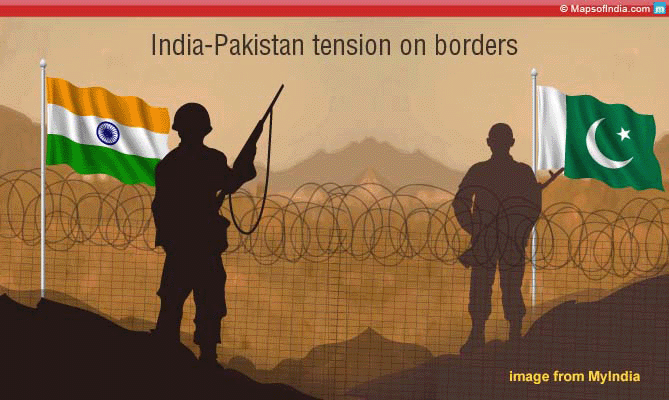 Tensions between 3 nuclear-armed powers are rising toward the boiling point ABBY POKRAKA, RESPONSIBLE STATECRAFT Tensions between 3 nuclear-armed powers are rising toward the boiling point ABBY POKRAKA, RESPONSIBLE STATECRAFT
SEP 30, 2020,
For decades, India and Pakistan have clashed over Kashmir, the mountainous region both countries claim. But to make matters more complicated, China has a stake in the area, too. The Aksai Chin region — located between Kashmir and Tibet — is under Chinese control and has been a source of conflict between India and China since 1962.
The borderlands between these three nuclear-armed states is increasingly a flashpoint for conflict. The international community ignores these growing challenges at its peril and should be looking for ways to help manage potential crises in the region. And while the United States can play a role, in this particular instance, direct US involvement is probably not the best way forward…………. China was drawn into a dispute between India and Pakistan when India revoked Kashmir’s autonomy in August 2019 and wanted to incorporate parts of “Xinjiang and Tibet into its Ladakh union territory,” which China believes violates its dominion due to its occupation of Tibet. It appears that over the last year the situation in Kashmir has not gotten better. ……It seems clear that after decades of poor relations, the tensions in this part of the world may reach a boiling point. Finding a solution to these half-century conflicts seems daunting, but it is necessary. While many nations have fought throughout history, a conflict between nuclear-armed states carries an unbearable risk of escalation. To start, these countries can take small steps to stabilise the security of the region and pave the way for better relations. Starting a dialogue, bilateral or trilateral, can improve communication in the longer term, which can help reduce the likelihood of conflict. Establishing crisis communications was an important step the United States and the Soviet Union took in the wake of the Cuban Missile Crisis, and de-escalation practices the two countries implemented in the early 1960s remained in place through the end of the Cold War. A third party could help facilitate regional discussions. Given its history in the region, the United States might have seemed like a good option for such facilitation, but that is not the case at this time……. This week, President Trump took aim at China before the United Nations, blaming it for the global COVID pandemic. At this point, there is no reason China would see the United States as a desirable mediator for any regional conflict…… friction among China, India, and Pakistan continues to grow. The only way to diffuse the tension and prevent destructive escalation is through diplomacy. Other countries need to step up and work to reduce the hostilities. Make no mistake, a large-scale, regional conflict among nuclear-armed states would have global consequences. https://www.businessinsider.com.au/httpsresponsiblestatecraftorg20200925india-china-pakistan-three-nuclear-powers-hurtling-towards-the-boiling-point-2020-9 |
|
Tsunami risk for nuclear reactors on coastlines of India and Pakistan
Nuclear plants in Arabian Sea face tsunami risk https://phys.org/news/2020-09-nuclear-arabian-sea-tsunami.html, by SciDev.Net, 21 Sep 20, A major tsunami in the northern Arabian Sea could severely impact the coastlines of India and Pakistan, which are studded with sensitive installations including several nuclear plants, says the author of a new study.
“A magnitude 9 earthquake is a possibility in the Makran subduction zone and consequent high tsunami waves,” says C.P. Rajendran, lead author of the study, which was published this September in Pure and Applied Geophysics.
“Our study is a step towards understanding the tsunami hazards of the northern Arabian Sea,” says Rajendran. “The entire northern Arabian Sea region, with its critical facilities, including nuclear power stations, needs to take this danger into consideration in hazard perceptions.”
Atomic power stations functioning along the Arabian Sea include Tarapur (1,400 megawatts) in India’s Maharashtra state, Kaiga (being expanded to 2,200 megawatts) in Karnataka state and Karachi in Pakistan (also being expanded to 2,200 megawatts). A mega nuclear power plant coming up at Jaitapur, Maharashtra will generate 9,900 megawatts, while another project at Mithi Virdi in Gujarat may be shelved because of public opposition.
Nuclear power plants are located along coasts because their enormous cooling needs can be taken care of easily and cheaply by making using abundant seawater.
“Siting nuclear reactors in areas prone to natural disasters is not very wise,” says M.V. Ramana, Simons Chair in Disarmament, Global and Human Security and Director, Liu Institute for Global Issues, University of British Columbia, tells SciDev.Net. “In principle, one could add safety systems to lower the risk of accidents—a very high sea wall, for instance. Such safety systems, however, add to the cost of nuclear plants and make them even more uncompetitive when compared with other ways of generating electricity.”
“All nuclear plants can be subject to severe accidents due to purely internal causes, but natural disasters like earthquakes, tsunamis, hurricanes, and storm surges make accidents more likely because they cause stresses on the reactor that could lead to some failures while simultaneously disabling one or more safety systems,” says Ramana, who has worked extensively on nuclear energy.
Rajendran and his team embarked on the study after noticing that, compared to peninsular India’s eastern coast, tsunami hazards on the west coast were under-recognized. This despite the 8.1 magnitude earthquake that occurred in the Makran subduction zone in 1945.
The study relies on historical reports of a major disturbance that struck the coast of western India in 1524 that was recorded by a Portuguese fleet off Dabhol and the Gulf of Cambay, and corroborated by geological evidence and radiocarbon dating of seashells transported inland which are preserved in a dune complex at Kelshi village near Dabhol.
Modeling carried out by the team produced results suggesting that the high impact in Kelshi could have been generated by a magnitude 9 earthquake sourced in the Makran subduction zone during the 1508 —1681 period, says Rajendran. Subduction zones occur where one tectonic plate slides over another, releasing seismic energy.
As per radiocarbon dating of the shells, the inundation may have occurred during 1432—1681 and overlaps the historical reports of major sea disturbances in 1524 that were recorded by a Portuguese fleet of 14 ships led by Vasco da Gama, the man who discovered the sea-route between India and Europe.
A future mega-tsunami originating in the Makran subduction zone could not only devastate the coasts of Iran, Pakistan and Oman but also the west coast of India, says Rajendran, adding that alternate offshore quake sources are yet to be identified in the Arabian Sea.
The larger Indian Ocean features another tectonically active tsunamigenic source—in the Andaman-Sumatra region where the devastating 2004 Asian tsunami occurred. “The next tsunami, after our experience in 2004, will likely be on the west coast,” says Rajendran.
The 2004 tsunami claimed more than 250,000 lives and devastated the beaches of Indonesia, Thailand and Sri Lanka, and claimed lives as far away as Yemen, Somalia and South Africa. Significantly, an atomic power plant at Kalpakkam, on the coast of India’s south-eastern, Tamil Nadu state, was flooded.
Earlier studies, such as the one published in 2013 in Geophysical Research Letters, have indicated that tsunamis, similar in magnitude to the one caused by the 2004 Sumatra earthquake, could occur at the Makran subduction zone where the Arabian plate is subducting beneath the Eurasian plate by about 1.5 inches per year.
According to the 2013 study, the Makran is a wide-potential seismogenic zone that may be capable of generating a very significant (greater than 8.5 in magnitude) tsunamigenic earthquake that poses risks to the coastlines of Pakistan, Iran, Oman, and India.
Vinod Menon, a founder member of India’s National Disaster Management Authority tells SciDev.Net that the new study “raises pertinent questions on the seismic and tsunamigenic risks from a potential rupture of the Makran subduction zone.”
“The tsunami risk and vulnerability of the west coast has not received adequate attention in spite of a history of occurrence in the past as curated by the authors as well as previous studies,” says Menon, who adds that it is worth noting that there are far more sensitive installations around the northern Arabian Sea than in the Andaman-Sumatra region.
Ramana says that such studies serve as a warning against the risks and costs of setting up nuclear power plants in seismically vulnerable areas. “A decade after the 2011 disaster in Fukushima, the prefecture retains radioactive hotspots and the cost of clean-up has been variously estimated to range between US$20 billion and US$600 billion.”
Why the nuclear whistleblower exposing AQ Khan was ignored
The CIA’s failure to stop him in 1975 “was the first monumental error”, Robert Einhorn, who worked on nonproliferation in the Clinton and Obama administrations, told Frantz and Collins. The Americans asked the Dutch “to inform them fully but not take any action”, Lubbers recalled, laughing. He said he “found it a bit strange”, but also thought, “‘OK, it’s American business.’ We didn’t feel . . . safeguarding the world against nuclear proliferation as a Dutch responsibility.” The business of the Netherlands was business. The CIA would watch Khan for decades.
Nuclear war between India and Pakistan very unlikely
|
‘Very dim chances of India, Pakistan nuclear war’
2 neighbors became nuclear power in May 1998 triggering new arms race in region, AA, Aamir Latif |15.05.2020 KARACHI, PakistanPakistan’s top nuclear scientist sees “very dim” chances of a nuclear war with neighboring India despite mounting tensions between the two arch-rivals in recent months. “I won’t say a zero chance but there are very dim chances of a war between the two neighbors involving nuclear arsenal despite escalating tensions,” Samar Mubarakmand, a former chairman of Pakistan Atomic Energy Commission (PAEC), and head of a team of the scientists that conducted six “successful” nuclear tests in remote Chaghi district of southwestern Balochistan province on May 28, 1998……… “The leadership of both countries are fully aware of the catastrophe a nuclear war can cause. They won’t go for that option no matter how tense the situation is,” observed Mubarakmand, who served at PAEC from 1962 to 2007 and played a key role in developing the country’s nuclear program. Conventional provocations, he said, would continue between the two longtime rivals but, he reckoned, both sides would not “cross the limit” to go for nuclear option. Both countries have long been reeling from poverty, illiteracy, and other health and economic issues. Wars or undue competition in arms race are not in the interest of the two nations,” he maintained. Nuclear powers India boasts the world’s third-largest army after the US and China, with an active troop strength of over 1.3 million. Pakistan, meanwhile, stands eighth on the list with a 600,000-man army……… https://www.aa.com.tr/en/asia-pacific/-very-dim-chances-of-india-pakistan-nuclear-war/1841657 |
|
|
Hundreds of foreign companies procuring nuclear materials for India and Pakistan
|
Reuters 30th April 2020, Hundreds of foreign companies are actively procuring components for India and Pakistan’s nuclear programmes, taking advantage of gaps in the global
regulation of the industry, according to a report by a U.S.-based research group.https://uk.reuters.com/article/uk-india-pakistan-nuclear-exclusive/exclusive-india-pakistan-nuclear-procurement-networks-larger-than-thought-study-shows-idUKKBN22C2JO?rpc=401& |
Pakistan’s tactical nuclear weapons, even defensively used, could usher in a larger nuclear war
|
Pakistan’s Tactical Nuclear Weapons Should Terrify You, National Interest, by Kyle Mizokami 10 Apr 20, “…… Unusually among the smaller powers, Islamabad has developed an arsenal of tactical nuclear weapons designed to destroy enemy forces on the battlefield……
Experts believe that Pakistan has between 150 and 180 nuclear bombs. It’s not clear when the country first had an operational, deployable weapon, but by the mid-1990s it had weapons to spare. ….. Tactical nuclear weapons, also called nonstrategic nuclear weapons, are low-yield (ten kilotons or less) nuclear weapons designed for use on the battlefield. Unlike larger, more powerful strategic nuclear weapons, tactical nuclear weapons are meant to destroy military targets on the battlefield. Tactical nuclear weapons are meant to be used against troop formations, headquarters units, supply dumps, and other high-value targets……
Pakistan’s nuclear weapons, particularly tactical nuclear weapons, are seen as an asymmetric means of offsetting India’s advantage in conventional forces. Even if a Pakistani Army offensive into India fails and the Strike Corps counterattacked, tactical nuclear weapons could blunt their spearheads, ideally halting them in their tracks. …..
Pakistan’s tactical nuclear weapons, while intrinsically unsavory, are at least defensive in nature. Unfortunately, given the number of times India and Pakistan have gone to war over the last eighty years, their use is theoretical than those of most countries. The use of nuclear weapons by one side could rapidly escalate to the use of larger, strategic weapons against populated areas by both sides. …… https://nationalinterest.org/blog/buzz/pakistan%E2%80%99s-tactical-nuclear-weapons-should-terrify-you-142937
|
|
|
Terrorism risks in Pakistan’s upgraded nuclear weapons
Pakistan’s Nuclear Weapons Get a Longer Range and Greater Precision
Pakistan successfully test-fired a new version of its Ra’ad ii nuclear-capable air-launched cruise missile on February 16, in the latest sign of the nation’s thermonuclear weapons advancement.
The Pakistan military’s Inter-Services Public Relations (ispr) said in a statement that the new version of the Ra’ad ii can travel up to 375 miles, nearly twice the range of the earlier model. It noted that the missile is “equipped with state-of-the-art guidance and navigation systems ensuring engagement of targets with high precision.” The combination of the longer range and the precision navigation “significantly enhances” the military’s “air delivered strategic standoff capability on land and at sea,” the ispr said…….
Pakistan has steadily developed more powerful, more compact and more numerous nuclear warheads—and, as evidenced by the new Ra’ad ii variant, more deft systems to deliver them.
Meanwhile, parts of Pakistan have become hotbeds of intensifying Islamic radicalism, which calls the security of these unfathomably destructive weapons into question. “Pakistan is the most dangerous country in the world,” Michael Morell, a former acting Central Intelligence Agency director, told Axios in 2018. “[A]nti-state jihadist extremism is growing in Pakistan, creating the nightmare society down the road: an extremist government in Islamabad with nuclear weapons.”
The Pakistani military has control over the nation’s 70 to 90 nuclear weapons. But the military routinely works with some of the most dangerous terrorist groups on the planet, including the ruthless Haqqani branch of the Afghan Taliban. The Brookings Institution noted, “Pakistan has provided direct military and intelligence aid” to the Haqqani, which has resulted in “the deaths of U.S. soldiers, Afghan security personnel and civilians, plus significant destabilization of Afghanistan.” …….. https://www.thetrumpet.com/21979-pakistans-nuclear-weapons-get-a-longer-range-and-greater-precision
For the 29th consecutive year, India and Pakistan exchange lists of nuclear facilities
 India, Pakistan exchange list of nuclear installations, https://economictimes.indiatimes.com/news/defence/india-pakistan-exchange-list-of-nuclear-installations/articleshow/73056333.cms
The two countries exchanged the list of nuclear installations and facilities covered under the Agreement on the Prohibition of Attack against Nuclear Installations between India and Pakistan, the External Affairs Ministry said. This was done simultaneously through diplomatic channels in New Delhi and Islamabad.
The two countries exchanged the list of nuclear installations and facilities covered under the Agreement on the Prohibition of Attack against Nuclear Installations between India and Pakistan, the External Affairs Ministry said.
This was done simultaneously through diplomatic channels in New Delhi and Islamabad.
The exchange of the list came amid tense diplomatic ties between the two countries over the Kashmir issue
India and Pakistan sliding toward potential nuclear war
Kashmir crackdown: A warning of nuclear war between India and Pakistan, Axios, Dave Lawler $ Oct 19, India and Pakistan are sliding toward potential nuclear war, according to the president of Pakistani-controlled Kashmir. The warning comes as Pakistan attempts to rally global outrage against its neighbor and rival.
Catch up quick: On Aug. 5, India revoked the constitutional autonomy of Jammu and Kashmir — the state it controls within the disputed Himalayan territory — while instituting a communications blackout and a curfew enforced by hundreds of thousands of troops.
1 This Month

of the week – Shut Down Drone Warfare!


Tell the Ukrainian Government to Drop Prosecution of Peace Activist Yurii Sheliazhenko

Petition to revoke the licensing of the Near Surface Nuclear Disposal Facility (NSDF) at Chalk River. https://www.ourcommons.ca/petitions/en/Petition/Details?Petition=e-7247
To see nuclear-related stories in greater depth and intensity – go to https://nuclearinformation.wordpress.com
-
Archives
- March 2026 (237)
- February 2026 (268)
- January 2026 (308)
- December 2025 (358)
- November 2025 (359)
- October 2025 (376)
- September 2025 (257)
- August 2025 (319)
- July 2025 (230)
- June 2025 (348)
- May 2025 (261)
- April 2025 (305)
-
Categories
- 1
- 1 NUCLEAR ISSUES
- business and costs
- climate change
- culture and arts
- ENERGY
- environment
- health
- history
- indigenous issues
- Legal
- marketing of nuclear
- media
- opposition to nuclear
- PERSONAL STORIES
- politics
- politics international
- Religion and ethics
- safety
- secrets,lies and civil liberties
- spinbuster
- technology
- Uranium
- wastes
- weapons and war
- Women
- 2 WORLD
- ACTION
- AFRICA
- Atrocities
- AUSTRALIA
- Christina's notes
- Christina's themes
- culture and arts
- Events
- Fuk 2022
- Fuk 2023
- Fukushima 2017
- Fukushima 2018
- fukushima 2019
- Fukushima 2020
- Fukushima 2021
- general
- global warming
- Humour (God we need it)
- Nuclear
- RARE EARTHS
- Reference
- resources – print
- Resources -audiovicual
- Weekly Newsletter
- World
- World Nuclear
- YouTube
-
RSS
Entries RSS
Comments RSS
 nuclear-news