Japan’s Nuclear Clean-Up Has No End in Sight
Climbing Without a Map: Japan’s Nuclear Clean-Up Has No End in Sight, U.S. News, By Reuters, Wire Service Content March 12, 2021, BY SAKURA MURAKAMI AND Aaron Sheldrick TOKYO (Reuters) – For one minute this week, workers at the Fukushima nuclear station fell silent to mark the 10-year anniversary of a natural disaster that triggered the worst nuclear accident since Chernobyl.
Then they went back to work tearing down the reactors melted down in the days after a tsunami on March 11, 2011.
The job ranks as the most expensive and dangerous nuclear clean-up ever attempted. A decade in, an army of engineers, scientists and 5,000 workers are still mapping out a project many expect will not be completed in their lifetime.
Naoaki Okuzumi, the head of research at Japan’s lead research institute on decommissioning, compares the work ahead to climbing a mountain range – without a map.
“The feeling we have is, you think the summit’s right there, but then you reach it and can see another summit, further beyond,” Okuzumi told Reuters.
Okuzumi and others need to find a way to remove and safely store 880 tonnes of highly radioactive uranium fuel along with a larger mass of concrete and metal into which fuel melted a decade ago during the accident.
The robotic tools to do the job don’t yet exist. There is no plan for where to put the radioactive material when it is removed.
Japan’s government says the job could run 40 years. Outside experts say it could take twice as long, pushing completion near the close of the century……..
It wasn’t until 2017 that engineers understood how complicated the clean-up would become. By that point, five specially designed robots had been dispatched through the dark, contaminated waters pumped in to cool the uranium. But radiation zapped their electronics.
One robot developed by Toshiba Corp, nicknamed the “little sunfish”, a device about the size of a loaf of bread, provided an early glimpse of the chaotic damage around the cores.
Kenji Matsuzaki, a robot technician at Toshiba who led development of the “sunfish”, had assumed that they would find melted fuel at the bottom of the reactors.
But the sunfish’s first video images showed a tumult of destruction, with overturned structures inside the reactor, clumps of unrecognizable brown debris and dangerously radioactive metal.
“I expected it to be broken, but I didn’t expect it would be this bad,” Matsuzaki said.
The delivery of a robotic arm to start removing fuel, developed in a $16 million programme with the UK’s Nuclear Decommissioning Authority, has been delayed until 2022. Tepco plans to use it to grab some debris from inside reactor 2 for testing and to help plan the main operation………….
But the cleanup has been delayed by the buildup of contaminated water in tanks that crowd the site. The melted cores are kept cool by pumping water into damaged reactor vessels.
But the cleanup has been delayed by the buildup of contaminated water in tanks that crowd the site. The melted cores are kept cool by pumping water into damaged reactor vessels. https://www.usnews.com/news/world/articles/2021-03-12/climbing-without-a-map-japans-nuclear-clean-up-has-no-end-in-sight
Taiwan environmentalists to hold anti-nuclear rally in June
At an event commemorating the 10th anniversary of the Great East Japan Earthquake, a nationwide anti-nuclear alliance of more than 100 groups urged the public to push back against groups that support the development of nuclear power, citing the harm left by the devastating earthquake.
Independent lawmaker Freddy Lim (林昶佐), who attended the event, said the issue of nuclear energy has gone beyond politics, and people should take the responsibility to say no to it instead of leaving nuclear waste to the next generation.
The alliance urged the public to voice its opposition during a national referendum vote in August, when one of the questions will be: “Do you agree that the 4th Nuclear Power Plant be activated for commercial operations?”……… https://focustaiwan.tw/society/202103130014
China maintains only a lean nuclear weapons force – aimed at survival if attacked.
When it comes to China’s nuclear weapons, numbers aren’t everything
Threat inflation tends to lead to poor policy outcomes. When it comes to China’s nuclear arsenal, it’s important for American leaders to accurately understand the nature of the problem. Nuclear risks between the United States and China manifest differently than those of the past U.S.-Soviet nuclear competition, or that of the United States and Russia today.
Concerns regarding nuclear use in the U.S.-China context stem from, among other things, mutual mistrust and the manipulation of risk below the nuclear threshold, largely from qualitative force posture and strategy choices each country has made. Quantitative factors — most importantly the size of China’s nuclear arsenal — are less pressing.
Despite this reality, a recent exchange between Sen. Tom Cotton, R-Ark., and Adm. Philip Davidson, commander of U.S. Indo-Pacific Command, reveals how the nature of nuclear risk with China continues to be mischaracterized in Washington. Cotton expressed concern during a Senate hearing that China may attain “nuclear overmatch” against the United States if it were to triple or quadruple its nuclear stockpile. Adm. Davidson agreed.
But Cotton misstated the degree to which China may expand its nuclear warhead stockpile relative to the United States. In doing so, he suggests the United States should focus more on quantitative nuclear arms racing, stating that “it is much better to win an arms race than to lose a war.”
Cotton’s framing gets several facts wrong. First, the U.S. Defense Department’s most recent report on the Chinese military states that China’s warhead stockpile is “currently estimated to be in the low-200s.” This pales in comparison to the total U.S. inventory of 5,800 nuclear warheads.
Of these, 3,800 are available for deployment, with approximately 1,400 warheads already on alert delivery systems. Additionally, 150-200 gravity bombs sit in protected bunkers at five European air bases. Insofar as “overmatch” — a concept with little use to nuclear strategists — exists, it is squarely with the United States.
Cotton also incorrectly suggests that the U.S.-Russia New START arms control pact limits the United States to “800 deployed nuclear weapons.” In reality, New START permits 1,550 deployed warheads (including bombers counted as a single warhead apiece per treaty rules).
So why are senior officials and members of Congress so focused on numerical comparisons? Examining qualitative differences between U.S. and Chinese nuclear forces and accompanying doctrines is harder to do. These differences tell a slightly less alarmist story when it comes to the bilateral nuclear competition, but by no means present easy answers to the project of deterring China or avoiding nuclear war.
Since China’s first nuclear test in 1964, its leaders have not sought to “race to parity” with the United States and Russia. This policy originates in part from former chairman of the People’s Republic of China, Mao Zedong, whose had a dismissive view of nuclear weapons, calling them “paper tigers.” But even as China has modernized its nuclear forces and practiced more sophisticated nuclear operations, it maintains a lean nuclear force — one postured to survive an adversary’s first strike and still credibly maintain the “minimal means of reprisal.” Ongoing Chinese investments in road-mobile intercontinental ballistic missiles and better submarine-launched ballistic missiles support this goal……………
Overinflating the nature of the challenge from China’s nuclear forces would be especially unwise if it leads to U.S. overinvestment in nuclear systems, when the challenges in the Asia-Pacific region today require improved conventional deterrence. Strategy, after all, requires matching ends with means. Bipartisan support already exists for new conventional firepower, as evidenced by approval for the Pacific Deterrence Initiative…………..
Chinese leaders, meanwhile, should view the Cotton-Davidson interaction as an example of how U.S. officials may interpret China’s nuclear modernization in a vacuum of information and dialogue. Chinese officials have ducked U.S. offers for strategic dialogue in recent years; hopefully, following an upcoming ministerial meeting, U.S. and Chinese civilian and military officials can discuss — and begin to define — strategic stability. By beginning this dialogue, U.S. officials can focus on solving the qualitative challenges that actually exist, rather than getting bogged down in imagined concerns about “overmatch.” https://www.defensenews.com/opinion/commentary/2021/03/13/when-it-comes-to-chinas-nuclear-weapons-numbers-arent-everything/
Harm done to people by the Fukushima evacuation, but radiation was still the root cause of all this
 The Lancet 6th March 2021, “The evacuation was the biggest risk factor in impacting health”, said Masaharu Tsubokura, an expert in radiation health management at Fukushima Medical University. “But [the evacuation] was inevitable, so I’m not saying that it was the wrong choice”, he added. He describes the tsunami-hit region of northeast Japan as a case study in the myriad health issues arising from natural disasters—an interplay between non-communicable diseases, the effect on mental and physical health of sudden upheaval, family separation, and the struggle to provide nursing care in ageing communities that hold little appeal for younger people, including health-care staff, who are worried about radiation and lack of job opportunities.
 concludes “the radiation contamination due to the Fukushima nuclear power plant accidents is positively associated with the thyroidcancer detection rate in children and adolescents. This corroborates previous studies providing evidence for a causal relation between nuclear
accidents and the subsequent occurrence of thyroid cancer”. Burnie said, “The extent to which the current thyroid rates are due to radiation exposure is not proven. However, given the uncertainties, including dose data, it is not credible to dismiss an association between iodine exposure and the higher incidence of thyroid cancer. The authorities need to continue screening and prioritise other physical and mental health issuesarising from displacement and evacuation, as well as monitor people who have returned”.
https://www.thelancet.com/journals/lancet/article/PIIS0140-6736(21)00560-2/fulltext
The Asahi Shimbun continues to warn against nuclear power -Japan’s rik of another “Fukushima -type” disaster
Asahi Shimbun 12th March 2021, Four months after the Fukushima nuclear disaster, The Asahi Shimbun called on Japan to pursue a future without atomic energy. An opinion piece published in July 2011 said, “Japan should build a society that does not depend on nuclear power generation as soon as possible.”
Since then, The Asahi Shimbun has repeatedly asserted the importance of phasing out nuclear
power generation in editorials and other stories. Our argument for weaning our nation from the use of atomic energy is driven by the fear that another nuclear accident would threaten the survival of Japanese society.
The truth about Fukushima today – and the cover-up – Thomas A Bass
 Fukushima today: “I’m glad that I realized my mistake before I died.” Bulletin of the Atomic Scientists, By Thomas A. Bass | March 10, 2021After the nuclear disaster at Fukushima, evacuees were put in what was supposed to be temporary housing built in parking lots and fields on the outskirts of inland towns. These metal structures were measured by the size of Japan’s traditional tatami sleeping mats, typically about 36 by 71 inches.
Takenori and Tomoko Kobayashi lived in an eight-tatami-mat house for the next five years—nuclear refugees inhabiting 132 square feet of living space.
In 2016, Mr. and Mrs. Kobayashi were allowed to return to their former home in Odaka, a village on the edge of Fukushima’s 20-kilometer exclusion zone, where Tomoko is a third-generation innkeeper. Owner of a small ryokan—a traditional Japanese hotel with common baths and a dining room holding a long table for family and guests—she invited volunteers to help her scrub down the inn, plant flowers along the roadside, open a gift shop, and rescue some of the area’s famous “samurai horses,” which are now branded with the white mark that labels radioactive livestock.
The operator of the plant, the Tokyo Electric Power Company, or TEPCO, evacuated its workers from F1 and ordered the site abandoned. The Japanese prime minister, in a dawn visit to TEPCO headquarters in Tokyo, effectively seized the company and demanded that they keep working. As a result, a suicide squad of older workers struggled to contain the disaster. Known as the “Fukushima Fifty” (which actually numbered 69) they tried to cool the reactors with fire trucks brought from Tokyo, 140 miles to the south. The command center for managing the disaster was moved to J-Village.
No one can say with 100-percent certainty the amount of radiation that came from Fukushima, since most of this radiation has been carried eastward into the ocean. At the high end, Fukushima may be worse than Chernobyl in terms of global contamination. At the low end, the Nuclear Energy Institute estimates that Fukushima’s release is one-tenth that of the accident at Chernobyl—which is estimated to have scattered between 50 and 200 million curies of radiation over Russia and Central Europe says Kate Brown, the MIT historian who published a book on Chernobyl in 2019. (One curie equals 37 billion becquerels, the standard unit of measurement for radioactive decays per second.) To give a sense of scale, this amount of radiation is the equivalent of what would have been emitted by at least 400 Hiroshima bombs, according to the International Atomic Energy Agency. As Nobel laureate Kenzaburō Ōe says of the Fukushima disaster, unlike Hiroshima and Nagasaki, this time Japan bombed itself.
Compounding the problem, most of Fukushima’s dosimeters were swept away in the flood or knocked offline. Readings from US military planes flying overhead and ships sailing offshore differed dramatically from those reported by TEPCO. The same is true for spot readings of air and soil samples around the plant………..
F1’s reactors are still radioactively hot. They are lethal to humans who approach them and even the robots sent to explore the melting cores are quickly fried; in 2017, TEPCO lost two robots in two weeks. But some of the nuclear exclusion zone has been re-opened—at least officially—to resettlement, and the Japanese government is paying two million yen (about $20,000) to people who move into the area.
Ouside the core but still in the zone. An army of about 100,000 workers has spent a decade scraping up and bagging radioactively contaminated soil. Consequently, what were once the emerald green rice paddies of Fukushima’s coastal plain are now filled with black plastic garbage bags holding mountains of radioactive dirt…………..
casual attitude toward radiation is widespread. “We found a disregard for global trends and a disregard for public safety,” said the parliamentary report on the Fukushima disaster, known as The Official Report of The Fukushima Nuclear Accident Independent Investigation Commission. “Across the board, the commission found ignorance and arrogance unforgivable for anyone or any organization that deals with nuclear power,” the report’s authors concluded.
They went on to note: “What must be admitted—very painfully—is this was a disaster ‘Made in Japan.’ ”
If Japan covered up the risks involved in building 54 nuclear reactors on its geologically unstable shores, it is now covering up the consequences. A government-sponsored study of radiation exposure in Fukushima prefecture undercounted people’s exposure by two-thirds. Australian physician Tilman Ruff, co-founder of the International Campaign to Abolish Nuclear Weapons (which won the 2017 Nobel Peace Prize), wrote me to say that doctors have left the area because the government refuses to reimburse them when they list radiation sickness as the cause for nose bleeds, spontaneous abortions, and other ailments resulting from ionizing radiation. (The only acceptable diagnoses are so-called “radiophobia,” nervousness, and stress.) The spike in thyroid cancer among children in Fukushima is dismissed as a survey error, produced by examining too many children.
The government has mounted no epidemiological study in Fukushima. It has established no baseline for comparing public health before and after the disaster. Instead, it has greenlighted the use of radioactive ash and soil from Fukushima in construction projects throughout the country, the Japan Times reported.
The generally accepted safety standard for radiation exposure is one milliSievert, or one-thousandth of a Sievert, per year. Different countries have different standards, but in the United States, the Nuclear Regulatory Commission requires that the operators of nuclear power plants limit the amount of their incidental radiation exposure to individual members of the public to 1 milliSievert (1,000 microSieverts) per year above the average annual background radiation, and this figure has become a sort of rough international average benchmark. (For comparison’s sake, the natural level of background radiation usually averages in the range of up to as much as 3 milliSieverts annually.)
But in its haste to deal with the Fukushima emergency in the months after the accident, the Japanese government simply raised the limit of what was considered an acceptable amount of incidental radiation coming from the now-defunct nuclear power plant.
The Japanese government now allows individuals in Fukushima prefecture to be exposed to 20 milliSieverts per year of incidental radiation, above and beyond what was emitted naturally, reported Scientific American. Figures like these are a far cry from that international average benchmark of 1 milliSievert annually.
To give a sense of scale, a figure in the 20 milliSieverts range means that a schoolchild in Fukushima can be exposed to the same amount of radiation as the average adult working full-time in a nuclear power plant.
The limit in the rest of Japan, outside of Fukushima’s environs, remains 1 milliSievert per year.
21st-century versions of hibakusha, or “bomb-affected people”? Anyone objecting to Fukushima’s 20-fold increase in allowable radiation exposure is criticized for promoting “harmful rumors.” After China and 50 other countries banned the importation of food from Fukushima on the grounds that it might be radioactive, the Japanese authorities reacted vehemently, and critics of the Japanese government’s response to the handling of anything related to Fukushima were treated like economic saboteurs. Similarly, refugees from Fukushima are scorned in other parts of Japan, and the Asahi Shimbun reported “widespread bullying and stigmatization of evacuees.” This finding was echoed by the UK newspaper The Independent, which said that “discrimination suffered by evacuee pupils [is] likened to that faced by those who lived through the atom bomb blasts of the Second World War.”
Women from Fukushima are shunned as marriage partners, and a new kind of Fukushima divorce has emerged, with men returning to the area in greater numbers than their wives, who want to keep their children as far away as possible.
“Japan has clamped down on scientific efforts to study the nuclear catastrophe,” said Alex Rosen, a pediatrician who co-chairs the German affiliate of International Physicians for the Prevention of Nuclear War. “There is hardly any literature, any publicized research, on the health effects on humans, and those that are published come from a small group of researchers at Fukushima Medical University, which are centered around the scientist Shunichi Yamashita, who in Japan is called ‘Mr. 100 milliSieverts.’ ” (Yamashita was the spokesman for the Japanese government in the early months of the catastrophe and led the Fukushima health survey for two years, before being forced to resign in 2013. Contradicting his earlier research and instructions to his own staff, Yamashita told the public that 100 milliSieverts of radiation was harmless. He recommended against administering iodine pills to prevent thyroid cancer, and told people that their best protection against radiation poisoning was literally to smile and be happy.)
Four thousand people continue to labor daily to contain the ongoing disaster at F1. They pump cooling water into reactor cores and fuel pools, while struggling to keep the damaged buildings from collapsing. More than a billion liters of contaminated water—the equivalent of 480 Olympic-sized swimming pools—are stored on-site in rusting tanks. Claiming that it has run out of storage room, TEPCO is planning to release this water directly into the ocean. For years, TEPCO maintained that the water stored at F1 had been scrubbed of radioactivity, save for tritium, a water-soluble isotope that is said to be relatively safe. In 2014, TEPCO was forced to admit that its cleaning process had failed, and Fukushima’s cooling water is actually contaminated with high levels of strontium-90 and other radioactive elements.
From the day it opened, Fukushima Daiichi struggled to contain the groundwater that rushed down from the nearby mountains and flowed through the plant. Fukushima today is a swamp of groundwater and cooling water contaminated with strontium, tritium, cesium, and other radioactive particles. Engineers have laced the site with ditches, dams, sump pumps, and drains. In 2014, TEPCO was given $292 million in public funds to ring Fukushima with an underground ice wall—a supposedly impermeable barrier of frozen soil. This, too, has failed, having “limited, if any effect,” Japan’s Nuclear Regulation Authority said.
In 2019, the Japan Institute for Economic Research estimated that the cost of cleaning up the Fukushima disaster could reach $747 billion. But there is actually no such thing as saying that a nuclear disaster has been cleaned up. Lumps of radioactive fuel, concrete, and cladding remain lethal for tens of thousands of years. At Chernobyl, this lava-like mass, called the “Elephant’s Foot,” has been buried under a mountain of concrete and covered again by a second, $1.5 billion shield financed by the European Union, which some have dubbed the “sarcophagus.” Sensitive about looking like a failed nuclear power, Japan has vetoed the building of a similar concrete sarcophagus over Fukushima. Instead, relying upon technology yet to be invented, TEPCO plans to scoop up the fuel in its failed reactors and store the waste in some undisclosed location. In the meantime, Fukushima sits like an open wound on Japan’s eastern shore.
The takeaway? Among the new buildings meant to lure settlers back to Fukushima are two museums. In Tamioka, directly to the south of the power plant, a former energy museum has been converted into something called the Decommissioning Archive Center. Films depict actors replaying scenes from the disaster on one floor of the museum and demonstrate TEPCO’s “Progress of the Work” on another floor.
In the village of Futaba, directly to the north of the reactors, the government has erected a three-story building called The Great East Japan Earthquake and Nuclear Disaster Memorial Museum. A former boomtown filled with workers from the plant, Futaba used to have an archway over its main street, declaring, in bold letters, “Atomic Power: Energy for a bright future.” Yuji Onuma created this slogan for a ninth-grade homework assignment. He received a prize from the mayor.
Now living far from Fukushima and running a business installing solar panels, Onuma returned to Futaba one day a few years after the disaster. A photo from that visit shows him wearing a white Tyvek suit, booties, hat, and facemask. Behind him is Futaba’s main street, filled with crumbling buildings and overgrown with weeds. Above him is the archway that TEPCO financed. Over his head, Onuma holds a placard with red-letter writing on it, so the sign instead reads, “Atomic Power: Energy for a destructive future.”
The archway has since been removed and stored in Futaba’s new museum. Onuma wants it reinstalled, where the irony of having his slogan floating over the ruins of a dead city will remind everyone of their original mistake. At the least, he wants the sign put on display in the museum. “I made the wrong slogan,” he recently told an American interviewer. “But I’m glad that I realized my mistake before I died.” https://thebulletin.org/2021/03/fukushima-today-im-glad-that-i-realized-my-mistake-before-i-died/?utm_source=Newsletter&utm_medium=Email&utm_campaign=ThursdayNewsletter032021&utm_content=NuclearRisk_Bass_03102021
Fukushima Nuclear Disaster Nearly ‘Ended The Japanese State’
 This article from Russian publication ‘Sputnik News.It makes insightful poits about the collusion between the nuclear industry and government – in Japan, and the USA. But it’s a pity that the Russian media doesn’t shed light on the situation in Russia, which is probably just as bad – perhaps worse.
Fukushima Nuclear Disaster Nearly ‘Ended The Japanese State’, Radioactive Waste Specialist Explains, Sputnik News, by Mohamed Elmaazi 12 Mar 21, 10 years ago, on 11 March 2011, an earthquake measuring 9.0 on the Richter scale triggered a tsunami that crashed into Japan’s Fukushima Daiichi nuclear power plant. The effect of the resultant meltdown will continue to be felt for generations to come, although it could easily have been far worse, Kevin Kamps of Beyond Nuclear tells Sputnik.
United Nations Scientific Committee on Atomic Radiation (UNSCEAR) report on Fukushima health effects -rushed, inadequate, inconsistent
Dr Ian Fairlie, 12 Mar 21, more https://www.ianfairlie.org/news/latest-unscear-report-on-the-fukushima-nuclear-disaster-in-2011/ On March 9, the United Nations Scientific Committee on Atomic Radiation (UNSCEAR) published an advance copy of its latest (third) report on the health effects from the Fukushima Daichi nuclear accident which commenced on March 11, 2011. UNSCEAR 2020 Report – Annex B – Advance Copy
The report shows signs of having been rushed out as it is an advance copy and is unfinished. It states 23 electronic attachments with supplementary information on detailed analyses of doses to the public and their outcomes are currently in production and will be available soon on the UNSCEAR website.
I shall look at the Report in more detail when the additional information is published. However at the 10th anniversary of the nuclear catastrophe at Fukushima in 2011, it’s necessary to have an initial look at the Report’s comments on contentious issues arising from the accident – (a) the number of expected fatal cancers and (b) the continuing controversy over the cause(s) of the large observed increases in thyroid cancers (TCs) in Japan since 2011.
On (a), the 2020 Report concludes that there are no observed ill health effects from the accident but this conclusion is inconsistent with UNSCEAR’s own estimates of high collective doses from the accident. Table 13 (page 72) of UNSCEAR’s 2020 report shows that, in the first 10 years after the accident, the whole body collective dose from the accident was 32,000 man Gy. When we apply the widely-accepted fatal cancer risk estimate of 10% per Gy to this figure, we see that about 3,000 fatal cancers will have occurred due to the accident, correct to one significant figure. The report’s strange, unscientific conclusion to the contrary is inconsistent with these estimates. The only assumption used here is that radiation’s dose-response relationship follows the linear-no-threshold model, as recognised and used by all the world’s radiation protection authorities.
On (b), the 2020 Report (page 107, para q) concludes that the sharp increase in observed thyroid cancers post-Fukushima was not due to thyroid intakes of iodine isotopes from the accident but due to increased surveillance.
However large collective doses to the thyroid are also published in UNSCEAR’s new 2020 report. In the first 10 years after the accident, the 2020 report states the collective thyroid dose to the Japanese population from the accident was 44,000 man Gy. Again, this is a high number, but the absence of an authoritative risk factor for thyroid cancer – especially among young children aged 0 to 4 who were exposed to both internal intakes of radioactive iodine plus external exposures to ground-deposited Cs-134 and C-137 means that reliable estimates of the actual numbers of thyroid cancer cases due to the accident are unfortunately not possible. The supplementary information yet to be released may enable such calculations to be made. However the large collective dose to the thyroid from Fukushima casts doubt on UNSCEAR’s conclusion that the observed increases are not due to the accident.
I would not be surprised to learn that the negative conclusions in the UNSCEAR 2020 Report might be a reason why an advance copy was rushed out in unfinished form before the anniversary of the Fukushima accident.
I add the caveat that the above analysis is a (second) draft and has not yet been fully peer-reviewed. However many requests have been made for views on the UNSCEAR’s 2020 report, so I’m publishing this quickly. Any errors which are pointed out will be corrected in a later post.
UN report claiming no connection between thyroid cancer and Fukushima disaster is not credible

|
Beyond Nuclear 11th March 2021, A new UN report which dismisses the March. 11, 2011 Fukushima disaster as the cause of elevated rates of thyroid cancer in that region’s childrennleaves serious questions unanswered and appears to be a rush to press to maximize publicity around the nuclear accident’s 10th anniversary, concluded Beyond Nuclear today. An advance publication of a section of the 2020 United Nations Scientific Committee on Atomic Radiation (UNSCEAR) report —Sources, effects and risks of ionizing radiation, Scientific Annex B, Advance Copy — claims that “a rise in thyroid cancer among children in the last decade was not related to increased radiation,” and nstead attributes the increases to more thorough and sophisticated testing.
But according to Dr. Ian Fairlie, a leading radiation scientist, the doses delivered by the Fukushima disaster — and as established by UNSCEAR’s own estimates— would be high enough to cause thyroid cancer among exposed children. Dr.Fairlie asserts the report’s conclusion, that “the increase…is not the result of radiation exposure”, is
“scientifically unsound..[and] inconsistent with UNSCEAR!s own estimates of high collective doses to the thyroid published in its 2012 and 2013 reports.”–http://www.beyondnuclear.org/home/2021/3/11/un-report-claiming-no-connection-between-thyroid-cancer-and.html |
|
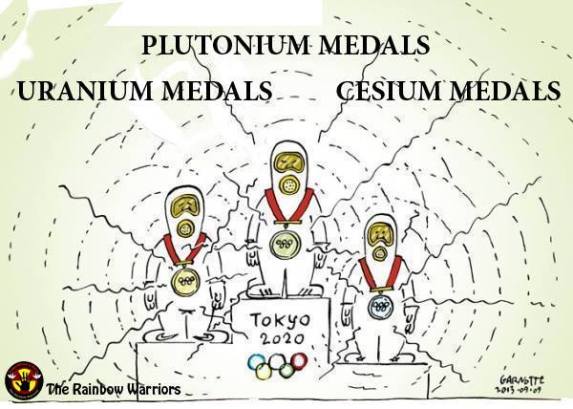
Tokyo Olypics: is it safe to promote Japan’s so-called “recovery” by sending athletes into a nuclear exclusion zone?
|
‘Fukushima today: “I’m glad that I realized my mistake before I died.” Bulletin of the Atomic Scientists, By Thomas A. Bass | March 10, 2021”……….After a lighting ceremony at J-Village, the Olympic torch will be run for three days through Fukushima’s nuclear exclusion zone. The zone is now a checkerboard of remediated areas and other places that are closed off behind accordion fences. Japan hopes to focus our attention on the refurbished schools and town halls, re-opened train stations, and two new museums that have been built in Fukushima, while trying to keep the TV cameras away from the ruined houses and radioactive cars lying nearby. The torch will then be run to Fukushima City, 40 miles to the northwest, where the first six Olympic games in softball and baseball are scheduled to be played after the games officially open July 23. But is it safe to promote Japan’s so-called “recovery” by sending athletes into a nuclear exclusion zone? The area has been tidied up and dotted with LED monitors showing the latest cesium releases from F1, comparable to the devices that measure airborne radiation levels found in other parts of the world. But these airborne releases are only part of the story—and not the most worrisome part. In 2013, scientists discovered that Fukushima’s exploding reactors had showered Japan with microparticles, or little glassy beads, of radioactive cesium and uranium. Hot spots from these microparticles can be found in vacuum cleaner bags and automobile air filters as far away as Tokyo. Fukushima prefecture is full of radioactive hot spots, and these hot spots keep moving as microparticles are washed down from the forested mountains that make up 70 percent of the prefecture, researchers said in Nature Scientific Reports. In 2019, a survey conducted for Greenpeace found hot spots in the J-Village parking lot, where children participating in a youth soccer match were eating their lunch. Greenpeace measured radiation levels at over 71 microSieverts per hour (one microSievert is one-millionth of a Sievert, or one-thousandth of a milliSievert)—1,775 times higher than the normal reading in this area before the Fukushima disaster of about 0.04 microSieverts per hour. The elevated reading, which translates to roughly about 0.62 Sieverts over the course of a year, meant that anyone breathing dust from the J-Village playing fields could be ingesting radioactive particles—little death stars lighting the way to cancer and genetic mutation. Since then, researchers have found radioactive hot spots at the Azuma baseball stadium in Fukushima City and all along the route to be run by the Olympic torch bearers….. https://thebulletin.org/2021/03/fukushima-today-im-glad-that-i-realized-my-mistake-before-i-died/?utm_source=Newsletter&utm_medium=Email&utm_campaign=ThursdayNewsletter032021&utm_content=NuclearRisk_Bass_03102021 |
|
Every hour, Fukushima reactor 2 emits more than 10,000 times the yearly allowable dose for radiation workers

|
Fukushima today: “I’m glad that I realized my mistake before I died.” Bulletin of the Atomic Scientists, By Thomas A. Bass | March 10, 2021 ”………..What we know about nuclear disasters at Chernobyl, Fukushima, and elsewhere comes primarily from modelling what is known as the “source term”—the types and amounts of radioactive material that were in a reactor’s core and then released to the environment by an accident. These models are revised as we learn more about the prevailing winds and other factors but are still only models; ideally, one wants to examine the reactors’ cores themselves. Unfortunately, even 10 years later, no one can get close to Fukushima’s reactor cores, and we do not even know precisely where they are located. As recently as December 2020, Japan’s Nuclear Regulatory Authority (NRA) announced “extremely serious” developments at Fukushima that were far worse than previously thought, the Asahi Shimbun newspaper reported. TEPCO had discovered that the massive shield plugs covering the reactors were emitting 10 Sieverts of radiation per hour—a lethal dose for humans (though it should be noted that reactor cores are normally examined by robots, unless these, too, are destroyed by radiation). Because Fukushima now has more contaminated material at higher doses than previously estimated, “this will have a huge impact on the whole process of decommissioning work,” said NRA chairman Toyoshi Fuketa. The effective dose of radiation required to sicken or kill you is measured in Sieverts, a unit named after Rolf Sievert, the Swedish physicist who first calibrated the lethal effects of radioactive energy. A dose of 0.75 Sieverts will produce nausea and a weakened immune system. (Sieverts are used to measure the relative biological damage done to the human body, while becquerels and curies are units that describe the amount of radiation emitted by radioactive material.) A dose of 10 Sieverts will kill you, if absorbed all at once. A dose somewhere in-between 0.75 and 10 Sieverts gives you a fifty-fifty chance of dying within 30 days. Guidelines for workers in the nuclear industry limit the maximum yearly dose to 0.05 Sieverts, or 50 milliSieverts—the equivalent of five CT scans, says Harvard Health Publishing. (This is a high figure compared to the 1 milliSievert per year that is considered acceptable for the general public; a physicist familiar with the industry explained that the thinking is that workers in the nuclear energy industry are implicitly being paid to take on the risk.) So how many Sieverts are currently being produced by Fukushima’s melted reactors? The latest reading from reactor No. 2 is 530 Sieverts per hour. This means that every hour the heart of the reactor is emitting more than 10,000 times the yearly allowable dose for radiation workers…… https://thebulletin.org/2021/03/fukushima-today-im-glad-that-i-realized-my-mistake-before-i-died/?utm_source=Newsletter&utm_medium=Email&utm_campaign=ThursdayNewsletter032021&utm_content=NuclearRisk_Bass_03102021 |
|
Radiation from Fukushima meltdown collects in timber in affected region
Japanese government hopes that not-yet-designed robots might clean up Fukushima nuclear mess
clean up Daiichi and revitalize Fukushima Prefecture, once known for everything from seafood to sake. The effort will take so long that Tepco and government organizations are grooming the next generation of robotics experts to finish the job.
https://www.cnet.com/features/for-fukushimas-nuclear-disaster-robots-offer-a-sliver-of-hope/
Fukushima nuclear accident costs so far $188billion, projected final costs of $740 bn.
 David Lowry’s Blog 10th March 2021, Pediatrician Dr Alex Rosen, a leading figure in the German branch of the International Physicians for the Prevention of Nuclear War (IPPNW) said it was “luck and divine intervention” that wind from the west blew most of the radiological releases out over the Pacific Ocean, meaning the Fukushima accident released more radioactivity to the oceans than the Chernobyl accident and all the nuclear weapons tests together.
Buffett Institute for Global Affairs located in Evanston, Illinois, and the Bulletin for the Atomic Scientists, based in Chicago, to launch a new international interdisciplinary collaborative study on “Nuclear Disaster Compensation: Lessons from Fukushima: Interviews with Experts and
Intellectuals, edited by anthropology professor Hirokazu Miyazaki.
http://drdavidlowry.blogspot.com/2021/03/nuclear-fuk-ed.html
Japan’s main opposition party -”Japanese society is viable without operating nuclear power plants”
|
Mainichi 12th March 2021, Yukio Edano, leader of the main opposition Constitutional Democratic Party of Japan (CDP), expressed his intention to aim for the elimination of
nuclear power in Japan on March 11 — the 10th anniversary of the 2011 Great East Japan Earthquake and tsunami — after earlier stating it was no easy task. Edano’s declaration appeared to be a response to criticism over
his recent comment that “ending nuclear power is not easy.” Edano told reporters at the Diet, “It has been demonstrated during these 10 years that Japanese society is viable without operating nuclear power plants. I intend to make a society that does not depend on nuclear power permanent.” https://mainichi.jp/english/articles/20210312/p2a/00m/0na/002000c |
|
1 This Month
Chernobyl: The Lost Tapes – A good documentary on Chernobyl on SBS available On Demand for the next 3 weeks– https://www.sbs.com.au/ondemand/tv-program/chernobyl-the-lost-tapes/2352741955560

of the week–London Campaign for Nuclear Disarmament

Tell the Ukrainian Government to Drop Prosecution of Peace Activist Yurii Sheliazhenko
To see nuclear-related stories in greater depth and intensity – go to https://nuclearinformation.wordpress.com
-
Archives
- April 2026 (139)
- March 2026 (251)
- February 2026 (268)
- January 2026 (308)
- December 2025 (358)
- November 2025 (359)
- October 2025 (376)
- September 2025 (257)
- August 2025 (319)
- July 2025 (230)
- June 2025 (348)
- May 2025 (261)
-
Categories
- 1
- 1 NUCLEAR ISSUES
- business and costs
- climate change
- culture and arts
- ENERGY
- environment
- health
- history
- indigenous issues
- Legal
- marketing of nuclear
- media
- opposition to nuclear
- PERSONAL STORIES
- politics
- politics international
- Religion and ethics
- safety
- secrets,lies and civil liberties
- spinbuster
- technology
- Uranium
- wastes
- weapons and war
- Women
- 2 WORLD
- ACTION
- AFRICA
- Atrocities
- AUSTRALIA
- Christina's notes
- Christina's themes
- culture and arts
- Events
- Fuk 2022
- Fuk 2023
- Fukushima 2017
- Fukushima 2018
- fukushima 2019
- Fukushima 2020
- Fukushima 2021
- general
- global warming
- Humour (God we need it)
- Nuclear
- RARE EARTHS
- Reference
- resources – print
- Resources -audiovicual
- Weekly Newsletter
- World
- World Nuclear
- YouTube
-
RSS
Entries RSS
Comments RSS
 nuclear-news