The Taishan death blow

China’s EPR reactor accident should end French reactor projects
The Taishan death blow — Beyond Nuclear International Radioactive leak at Chinese reactor could finish French nuclear exports https://wordpress.com/read/feeds/72759838/posts/3403922693
By Stéphane Lhomme, Nuclear Observatory
If the opacity maintained by the Chinese regime prevents us, for the time being, from knowing the exact consequences of the radioactive leak involving the EPR no.1 reactor at Taishan, revealed on June 14 by CNN, it is, on the other hand, already possible to see how this unfolded and to recommend some next steps.
The fault in the fuel duct seals inside the Taishan EPR dates back to October 2020, that is to say, it had already been going on for more than eight months: the operators of the reactor — the Chinese and the French company Framatome — were perfectly well aware of the gravity of the situation and had jointly decided to hide the existence of the problem from not only the surrounding population but also from the International Atomic Energy Agency.
Luckily, the information ended up seeping out via the American subsidiary of Framatome (Areva NP Inc.). This latter, likely after discussions with the CIA and the White House, happily informed CNN.
Indeed, now that the situation at the EPR at Taishan is known around the world, it will be difficult for the Chinese to continue to operate the reactor under conditions that are most likely beyond its “scope of authorized operational safety” — contrary to what Framatome claims in order not to offend the Chinese.
It is widely known publicly that China and the USA, the two biggest global powers, are huge geopolitical and economic rivals. It is clear that if the Taishan 1 EPR, and perhaps its twin, Taishan 2, must be shut down for an extended period, this will be an inconvenience for China, which occasionally lacks electricity in this region. Hence the guilty pleasure felt by the Americans in revealing the problem.
But this will still remain only a limited problem for China where, contrary to what one sometimes reads or hears, nuclear power is a marginal energy source, consisting of less than 1% of the country’s energy consumption.
On the other hand, it is quite possible that the French nuclear industry will be the big loser in this affair, one that could represent a fatal blow for EDF’s EPR construction projects in France and overseas. Indeed, given that the EPR construction sites managed by the French — Areva in Finland, EDF in France and Great Britain — are veritable industrial and financial disasters, the promoters of the EPR reactor have been desperately clinging to the “good Chinese example”.
That is because the two EPRs at Taishan were built and brought on line (in December 2018 and September 2019 respectively) with “only” a few years delay and the cost overruns were officially limited to a few billion (according to China which, one must remember, is a dictatorship where “information” is totally controlled).
The situation currently unfolding in China demonstrates that, despite the alleged prowess of the Chinese nucleocrats, the Taishan EPRs are not going any better than those the French are trying desperately to build. This event will certainly sow enormous doubt among the few foreign leaders who are still considering ordering EPR reactors, despite all their setbacks. It is surely the straw that broke the camel’s back, or rather the radioactive leak that caused the (defective) EPR containment to overflow.
Likewise, this incident should motivate French political leaders (but also Finnish and British ones) to finally take responsibility and definitively halt EPR construction at Olkiluoto (Finland), Flamanville (France) and Hinkley Point (Great Britain), and to stop announcing future EPR projects in India and elsewhere.
Safety concerns on Taishan reactor, but China wants to be world’s nuclear leader by 2050
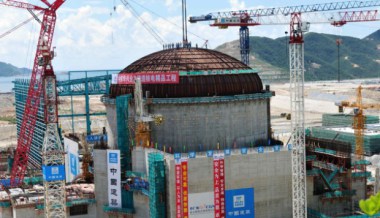
China’s nuclear safety queried over Taishan reactor, but it wants to lead world by 2050 SCMP, Stephen Chen in Beijing, 21 June 21
- Road map drawn up by the country’s nuclear experts sets series of goals to help it catch up with the West on safety
- Increase in radioactivity in Taishan did not spread outside reactor, data showed, but Chinese nuclear industry trails in software and hardware
China aims to become a dominant player in the world nuclear market in less than 30 years and have the highest safety standards and lowest costs, a government advisory body has said.
For decades, China tried to catch up with safety standards in Western countries, led by the United States and France. But now China plans to challenge them, the Chinese Academy of Engineering (CAE) said in a report published last Tuesday…….
by 2050, the road map describes China leading the setting of new industry standards for global nuclear power and taking “a bigger share in the international market”.
The increase in radioactivity in Taishan was caused by leaking fuel rods known as “leakers”
They are still used by many nuclear power plants globally, but the US had by 2013 eradicated them from more than 90 per cent of its reactors, …….
The Taishan radioactivity was viewed in some quarters as an environmental threat that the Chinese government had tried to cover up.
China’s National Nuclear Safety Administration had posted the event on its website on April 7, but the scientists who produced the road map admitted that the country’s nuclear safety was not yet up to the standards in the West, even if its nuclear reactors had no safety incidents in the past three decades.
Safety improvements require cutting-edge technology such as computer programs simulating the operation of a reactor, and materials to make critical components. The Chinese nuclear industry is behind in both software and hardware, according to the report.
Chinese nuclear power companies have produced numerous software products for nuclear plant design, operation and safety evaluation, but did so in isolation, and their reliability and modelling of serious accidents had room for improvement, said senior nuclear safety scientist Huang Hongwen in the report commissioned by the CAE.
China has also been dependent on Western suppliers of some hardware components critical to safe operation of nuclear plants, according to the report.
“Some of our high-precision nuclear safety equipment is still in the hands of others,” Huang wrote.
The US government imposed a sanction – which remains in place – on the Chinese nuclear power industry in 2019, banning the sale of any nuclear-related technology or goods to China except in the event of an immediate environmental threat such as radioactive leakage. The US government said it was investigating the Taishan event………….
Wang Junhao, president of Zhejiang University of Finance and Economics, wrote in the journal Economic Theory and Business Management in April that the penalties for safety lapses were too light to act as a deterrent.
“When a hidden safety hazard was discovered by regulatory inspections, the financial loss was too small,” Wang said. “There must be greater punishments.” https://www.scmp.com/news/china/science/article/3138214/chinas-nuclear-safety-queried-over-taishan-reactor-it-wants-lead
No need for nuclear arsenal once Kashmir issue is resolved: Pakistan PM
, Business Standard, 20 June 21
Pakistan’s nuclear arsenal is “simply a deterrent” to protect the country and there will no longer be any need for it once the Kashmir issue is resolved, Prime Minister Imran Khan has said
Pakistan’s nuclear arsenal is “simply a deterrent” to protect the country and there will no longer be any need for it once the Kashmir issue is resolved, Prime Minister Imran Khan has said as he asserted that if the Americans have the resolve and the will, the issue can be sorted out.
Pakistan has 165 nuclear warheads as of January this year and it appears to be expanding its nuclear arsenals, a study by Stockholm International Peace Research Institute (SIPRI) said last week. Pakistan had 160 nuclear warheads as of January last year, it said.”I don’t know where they’ve come up with this. Pakistan’s nuclear arsenal is simply a deterrent, to protect ourselves,” Prime Minister Khan said during an interview with the news programme Axios on HBO, which was reported by Dawn online.
Khan said that he was “not sure” whether it was growing. “As far as I know, it’s not an offensive thing. Any country which has a neighbour seven times its size would be worried.
He was responding to a question by the interviewer who asked, “Intelligence analysts say Pakistan has the fastest growing nuclear arsenal anywhere in the world. Why?”
Khan went on to say that he was “completely against nuclear arms”.
“I always have been. We’ve had three wars against India and ever since we have had a nuclear deterrent, there has been no war between the two countries. We’ve had border skirmishes but we’ve never faced war.
“The moment there is a settlement on Kashmir, the two neighbours would live as civilised people. We will not need to have nuclear deterrents,” the cricketer-turned-politician said.
To another question, Khan said that the US had a big responsibility when it came to Kashmir.
“If the Americans have the resolve and the will, [the Kashmir issue] can be sorted out,” he said.,,,,,,,, https://www.business-standard.com/article/current-affairs/no-need-for-nuclear-arsenal-once-kashmir-issue-is-resolved-pakistan-pm-121062101422_1.html
The Fukushima nuclear disaster and the Tokyo Olympics

“There was a very clear political agenda by Shinzo Abe, to use the Olympics to rehabilitate the impression of both Fukushima and the nuclear disaster domestically and globally,”
“It’s hard for me to support the idea of using the Olympics to present a narrative of recovery, where so much recovery remains to be done.”
The Fukushima nuclear disaster and the Tokyo Olympics, Engineering and Technology, By Max Bernhard
Wednesday, June 16, 2021 Before Covid-19 forced a delay, Japan’s government saw the ‘Recovery Olympics’ as a way to show the Fukushima nuclear disaster was under control. 10 years on, critics say many issues remain unresolved.
Members of the Japan women’s soccer team began the Olympic torch relay on 25 March this year, kicking off a four-month countdown to the Tokyo Summer Games after a year-long delay due to the Covid-19 pandemic. The brief opening ceremony – closed to the public and attended only by a small number of dignitaries – took place on a football pitch in J-Village. The sports complex lies just 20km south of Japan’s Fukushima Daiichi nuclear power plant, where a devastating earthquake and subsequent tsunami killed more than 18,000 people and triggered a triple nuclear meltdown in 2011. J-Village was used as a base for the thousands of clean-up workers tasked with decommissioning the plant.
Long before the pandemic forced Japan to delay the Games, then-Prime Minister Shinzo Abe pegged the sporting mega-event as a way to show that Japan had overcome the disaster and to promote reconstruction efforts in the region. Ten years on, questions over radiation in the area, its prospects for recovery, and the decommissioning of the reactor, as well as Japan’s overall energy policy, remain.
Abe’s successor Yoshihide Suga has said the Games would also be a sign of overcoming another tragedy. Going ahead with the event would be “proof that humanity has defeated the pandemic”, he said last year. But here, too, not everyone agrees. With less than two months to go until the official start of the Olympics, the Japanese government has recently extended its state of emergency in Tokyo and several other prefectures until at least 20 June. While the number of new Covid-19 infections has been going down and cases remain relatively low in an international comparison, a stretched-out fourth wave has strained the country’s medical sector.
Meanwhile, Japan’s vaccination efforts have been significantly lagging behind other developed nations. Less than 3 per cent of the population have been fully vaccinated as of 27 May 2021 and polls show that most of the public wants the Games cancelled. Despite that, Suga has been iterating his commitment to hold the Olympics in Tokyo this summer.
To assure members of the International Olympic Committee (IOC) that the event in Tokyo would be safe, then-Prime Minister Abe promised in his 2013 pitch to host the 2020 Games that the situation at the destroyed Fukushima nuclear plant was “under control”.
Three years later, Junichiro Koizumi, a former prime minister and fellow member of Abe’s Liberal Democratic Party, called this promise a lie. “I think Abe understands the arguments on both sides of the debate, but he has chosen to believe the pro-nuclear lobby,” Koizumi, who became an outspoken critic of nuclear energy following the catastrophe, said at a press conference in Tokyo in September 2016.
“There was a very clear political agenda by Shinzo Abe, to use the Olympics to rehabilitate the impression of both Fukushima and the nuclear disaster domestically and globally,” says Sean Burnie, a senior nuclear specialist for Greenpeace East Asia, who has surveyed radiation in Fukushima dozens of times since the nuclear meltdowns happened.
Following the disaster, Japan halted all its nuclear reactors. Since then, it has restarted only nine out of a possible 42 across five power plants, while more than 20 are set to be decommissioned. Before the 2011 disaster, Japan generated about a third of its energy from nuclear power, and there were plans to increase that to around 40 per cent. The Japanese government’s current energy policy plans for 30 to 35 reactors operating by 2030, meaning about 20 per cent of the country’s power would come from nuclear energy. That target is also part of the government’s plan to significantly reduce carbon emissions in the country by the end of the next decade. This target requires at least a further 21 reactors to be back online.
One of the major obstacles to those restarts is public opinion, says Burnie. “The perception of Fukushima is that because you have an accident, you can’t rehabilitate, you can’t bring people back to live there, it’s not safe, and the decommissioning of the plant will take many, many decades, or centuries longer,” he adds. “So trying to create a new image, a new perception of Fukushima on the nuclear issue is really important [to the Japanese government].”
Changing public perception played a significant role in the government’s decision to host events in Fukushima and to use the framework of the ‘Recovery Olympics’, Burnie says, adding that the desire of the prefectural government and general society in Fukushima to communicate their region’s recovery was also a factor. “I think it creates a sense of slight schizophrenia because people want to have some good news … the Olympics were seen as perhaps a positive.”
At the same time, there was widespread criticism because the significant investments into the Olympics were seen as taking resources away that could have gone towards the area’s general reconstruction. The entire cost of hosting the 2020 Games is projected to be more than $15bn (£10.6bn), including $2.8bn for the postponement and an estimated $900m for measures to curb the spread of Covid-19. The Tokyo Games are the most expensive to date, according to a 2020 University of Oxford study that looked at Olympic costs since 1960. “There are still tens of thousands of people displaced, people still living in emergency housing. Obviously, the whole radiological situation is still complex and hazardous. There were mixed feelings about it,” Burnie says.
A year ago, when international visitors to the Games were still considered a possibility, some questioned whether it was safe for athletes and spectators to visit sporting venues in Fukushima or even Japan in general. South Korea reportedly considered providing its own food for athletes out of radiation concerns, although the move was seen as political by some.
Levels of radiation in Japan have decreased thanks in part to a massive programme by the government to remove the top layer of soil in affected areas. The contaminated soil is stored in millions of black one-cubic-metre bags that are piled up on temporary open-air areas scattered across the prefecture before being transported to interim storage sites. As of April 2020, about 6.7 million of the black bags were still stored in Fukushima, according to the Ministry of Environment.
While the plant’s operator managed to stabilise the damaged reactors at Fukushima Daiichi, melted nuclear fuel buried deep into the ground below the plant is still to be located and removed – an endeavour that is projected to take at least four more decades. Meanwhile, in April, the government approved plans to gradually release more than one million tonnes of contaminated water into the sea…………………
at the end of 2019 Greenpeace conducted radiation measurements around J-Village, where the Olympic torch relay would later kick off, and found several hotspots.
Continue readingWhat actually happened at Taishan?
What actually happened at Taishan? https://www.rnanews.eu/what-actually-happened-at-taishan-nfla-call-on-nuclear-regulator-to-carefully-investigate-possible-r-140634.html?fbclid=IwAR2W5hoUwNH-6fgYOgVv6LIbM4wVWPGA1cLA4i8_XAC0PPIpz4odlGmSTcI NFLA call on nuclear regulator to carefully investigate possible radioactive leak and its implications for Hinkley C & Sizewell C | NFLA, 16 June 21,
The UK & Ireland Nuclear Free Local Authorities (NFLA) is concerned to read many contradictory reports over what has been called a ‘radioactive leak’ by some and ‘performance issues’ by others at the Taishan nuclear plant some 100kms from Hong Kong in the Guangdong region of China. NFLA has written to the UK nuclear regulatory, the Office for Nuclear Regulation (ONR), to ask it to investigate this matter with real urgency in terms of the implications for similar reactors being considered for the UK.
The Taishan plants developed in China use the same EPR (European Pressurised Reactors) technology being planned for the Hinkley Point C plant in Somerset and currently being considered in a public inquiry at Sizewell C in Suffolk.
Taishan is a prestige EPR project built after China signed a nuclear electricity generation agreement with ÉDF. Construction started in 2009, and the two units started generating electricity in 2018 and 2019, respectively. It is 70% owned by CGN, and 30% by Framatome, a subsidiary of EDF.
This incident came to light following an investigation by CNN, and it appears to have been going on for some considerable time.
According to the CNN investigation, in late May, one of the EPR reactors started venting radioactive gases – it is not known precisely why or when. The CNN article mentions possible fuel failures, and this is a possibility. It appears the Chinese nuclear regulator and the Chinese Government reacted by proposing to increase the safety limits for residents downwind in order to keep the reactor operating, and they told Framatome of this intention. Framatome objected to such an action and said China should instead shut down the reactor to find out what had gone wrong. The response from Chinese authorities was negative to this suggestion. As a result, Framatome (unusually) submitted an operational safety assistance request to the US Government on June 3rd, formally asking for a ‘legal waiver’ that would allow them to address an urgent nuclear safety matter. This was sent to the US Department of Energy (DOE), warning their officials that the nuclear reactor was leaking fission gas.
On June 8th, EDF asked the US DOE for an expedited review of their request, according to a memo obtained by CNN. “The situation is an imminent radiological threat to the site and to the public and Framatome urgently requests permission to transfer technical data and assistance as may be necessary to return the plant to normal operation” read the memo. Framatome reached out to the US government for assistance, the document indicates, because the Chinese government agency was continuing to increase its limits on the amount of radioactive gas that could safely be released from the facility without shutting it down, according to the documents reviewed by CNN.
Since this report came out, EDF and the Chinese authorities have tried to downplay that any serious incident took place, suggesting these matters were merely “performance issues” within safely levels. It should be noted though that an extraordinary board meeting has been requested by Framatome with its Chinese partners to discuss the matter. (2)
NFLA believe some kind of safety incident could well have taken place at the Taishan reactor, and sincerely hopes that it has not been anything approaching a major nuclear incident. The reaction of the Chinese nuclear regulator is of real concern to us, as is the large level of confusion that has clearly taken place over this incident.
NFLA has written to the UK Chief Nuclear Inspector asking for the Office of Nuclear Regulation to investigate this incident as part of the nuclear regulators’ Multinational Design Evaluation Programme, which includes a working group on the EPR that focuses on reviewing lessons learnt from commissioning, construction and early phase operations. Any concern that comes from this incident needs to be learnt quickly given the development of a similar reactor at Hinkley Point and a proposed reactor at Sizewell. For NFLA, this incident only goes to confirm its concern that the EPR reactor is highly complex and difficult to build, and safety issues could well remain within it.
NFLA Steering Committee Chair Councillor David Blackburn said:
“The murky details of what has actually happened to one of the Taishan Chinese EPR reactors in this incident is indicative of the lack of transparency that remains in the global nuclear industry. It also shows the real communication problems that can occur between in this case the French and Chinese nuclear companies and regulators. I hope this has not been a serious incident, but the detail initially provided to CNN suggests something has gone wrong and needs to be carefully considered in terms of its impact on this new nuclear reactor. It confirms to NFLA that there remain so many inherent issues in new nuclear that it would be far better to pursue instead safer, cheaper, more easily realisable and radioactive waste-free renewable energy alternatives.”
Ends – for more information please contact Sean Morris, NFLA Secretary, on 07771 930196.
French nuclear company and Chinese government once again have a problem with their much vaunted EPR nuclear reactor design
Nuclear reactor problem a new headache for designer and China. Bangkok Post, 16 June 21, PARIS – The emergence of problems in a new-generation nuclear reactor in China threatens to undermine efforts by its French designer to sell it elsewhere, and could hurt Beijing’s nuclear industry, analysts said.
French energy giant EDF and the Chinese government have sought to ease concerns about a gas build-up at the Taishan Nuclear Power Plant after a CNN report of a potential leak at the site.
The Chinese foreign ministry said Tuesday that radiation levels remained normal at the site in southern Guangdong province and there were no safety concerns.
But it is the latest snag to hit EDF’s much-vaunted EPR reactor.
The Taishan power station became in 2018 the first site worldwide to use the pressurised water design, which has been subject to years of delays in similar projects in Britain, France and Finland.
A second EPR reactor was launched at Taishan a year later. The facility is partly owned by EDF along with state-owned China General Nuclear Power Group, the majority stakeholder and operator of the plant.
EDF said the plant’s number one reactor experienced a build-up of gases in part of the cooling system following the deterioration of the coating on some uranium fuel rods.
The French company was first informed about the problem with the fuel rods in October, but only learned about the gas build-up on Saturday, according to EDF.
The problem and the silence of Chinese authorities triggered criticism of EDF, whose EPR reactor is supposed to be safer, last longer and produce more electricity than previous versions.
– EDF seeks contracts –
It seems that both the Chinese nuclear regulators and the French nuclear corporations may have acted in bad faith,” said Paul Dorfman, a researcher at the University College London’s Energy Institute.
“If so, this new EPR debacle should have important consequences for any further plans for new EPR builds in France, the UK, and internationally,” he added…….
The Taishan incident comes as EDF, which is currently struggling to finish the Flamanville EPR in France after more than a dozen years of work, is hoping to win new contracts.
France, which must eventually decide whether to renew its park of ageing nuclear reactors, is holding off on making a decision until Flamanville comes online, which is now expected in late-2022 at best………. https://www.bangkokpost.com/world/2133307/nuclear-reactor-problem-a-new-headache-for-designer-and-china
Is the leak in a nuclear reactor in China due to a Framatome manufacturing defect ?
Is the leak in a nuclear reactor in China due to a manufacturing defect in
the Drôme? The nuclear rods for reactor n ° 1 in Taishan, China, are
manufactured by the Framatome site in Romans-sur-Isère. One of the
hypotheses considered to explain the leak in the circuit could be a
manufacturing defect.
It is difficult to know for the moment what caused
the leak within the reactor n ° 1 of the EPR of Taishan, in China. In
recent months, “rare gases” have been identified in the primary circuit
after the degradation of a few rods containing the uranium pellets. These
pencils are made in Romans-sur-Isère, on the Framatome site.
France Bleu 16th June 2021
Is China covering up a nuclear leak?
US assessing reported leak at Chinese nuclear power facility, By Zachary Cohen, CNN, June 14, 2021
The US government has spent the past week assessing a report of a leak at a Chinese nuclear power plant, after a French company that part owns and helps operate it warned of an “imminent radiological threat,” according to US officials and documents reviewed by CNN.
The warning included an accusation that the Chinese safety authority was raising the acceptable limits for radiation detection outside the Taishan Nuclear Power Plant in Guangdong province in order to avoid having to shut it down, according to a letter from the French company to the US Department of Energy obtained by CNN.
Despite the alarming notification from Framatome, the French company, the Biden administration believes the facility is not yet at a “crisis level,” one of the sources said.
While US officials have deemed the situation does not currently pose a severe safety threat to workers at the
plant or Chinese public, it is unusual that a foreign company would unilaterally reach out to the American government for help when its Chinese state-owned partner is yet to acknowledge a problem exists. The scenario could put the US in a complicated situation should the leak continue or become more severe without being fixed.
https://edition.cnn.com/2021/06/14/politics/china-nuclear-reactor-leak-us-monitoring/index.html
Explosion forced Indian Navy to return nuclear submarine to Russia?
Explosion forced Indian Navy to return nuclear submarine to Russia?
Explosion forced Indian Navy to return nuclear submarine to Russia? The INS Chakra was inducted into the Indian Navy in 2012 on a ten-year lease The Week, Web Desk June 09, 2021 On June 4, Twitter was abuzz after photographs from Singapore showed the Indian Navy’s nuclear-powered submarine INS Chakra transiting through the Malacca Straits.
Later in the day, reports emerged that the warship was on its way back to Russia. India agreed to lease the INS Chakra from Russia nearly two decades ago and inducted it into the Indian Navy in 2012 on a ten-year lease. The Non Proliferation Treaty (NPT) bans the sale of nuclear-powered vessels, but is silent on leasing of such ships. This was the second Indian Navy submarine to have the name Chakra.
The ‘early’ return of the INS Chakra had triggered a buzz as she was the only nuclear-powered attack submarine in the Indian Navy. Attack submarines are meant primarily to destroy enemy surface ships and submarines. The Chakra was from a Russian class of submarines that NATO codenamed the Akula (shark in Russian). Before being handed over to the Indian Navy, the Chakra was known as the Nerpa in Russian service….
On Wednesday, Russian state news agency TASS reported the early return of the INS Chakra was necessitated due to an explosion on board the vessel in the spring of 2020, which damaged both its hulls. The Chakra, like many other Russian-designed submarines of its era, is a ‘double-hulled’ submarine, with a pressure inner hull and a lighter outer hull to allow for more buoyancy and capacity to absorb damage in the event of being hit by a torpedo or mine.
The Russian language website of TASS quoted a source in the Russian “military-industrial complex” as saying, “The explosion of a high-pressure air cylinder on the Chakra submarine… occurred in the spring of 2020.” The report claimed the high-pressure air cylinder was located between the two hulls. In addition to damage to the hulls, the explosion also damaged “electronic weapons and hydro-acoustic equipment”.
Previous accidents………. https://www.theweek.in/news/india/2021/06/09/explosion-forced-indian-navy-to-return-nuclear-submarine-to-russia.html
Euphoria about nuclear costs, especially about decommissioning – Institute for Energy Economics and Financial Analysis (IEEFA) warns Indonesia.

IEEFA: Nuclear power euphoria in Indonesia is all smoke and mirrors with no current technical, financial or market viability,
Renewables should be the focus of Indonesia’s net-zero pledge. (IEEFA Indonesia): In growing energy markets like Indonesia, decision makers are facing a barrage of pro-nuclear media coverage as the nuclear industry floods the market with panels and webinars focused on the potential of nuclear power.
A new report from the Institute for Energy Economics and Financial Analysis (IEEFA) highlights that while nuclear is promising as a baseload substitute for coal power, it currently has no technical, financial, or market viability in the Indonesian context. Author of IEEFA’s report Elrika Hamdi says that Indonesian nuclear power supporters often promise that nuclear will be an affordable, safe and sustainable solution for the problem of over-reliance on fossil fuel.
Yet, 70 years after the first nuclear power developments were announced, the technology is quickly losing market share as global power markets pivot toward more cost-competitive renewables and storage solutions.
“Despite the steady erosion of nuclear power’s competitive potential, key Southeast Asian energy ministries continue to be lobbied by nuclear advocates. Many of these lobbyists are international backers of new small modular reactor (SMR) technologies, who are actively engaging with governments and utilities around the region,” says Hamdi.

As old generation large-scale nuclear units face decommissioning, there is little consensus about how long it will take for newer small-scale nuclear technologies to be economically viable or how long-standing safety and waste disposal risks will be addressed.
“Determining the suitability of nuclear for the Indonesian power market will be a challenging task that will require honest and deep engagement by senior policymakers to ensure there is a high degree of accountability as Indonesians need to know the real cost of having nuclear in the power system as well as how the government will handle the problem of nuclear waste.”
Hamdi says that the short-list of nuclear power issues includes technology reliability, safety and safeguards, the geographic conditions of Southeast Asia, the prospects for decommissioning, waste treatment and permanent disposal, fuel availability, affordability, and the risk of persistent cost overruns and frequently overlooked shut-down costs.
Research has shown that an estimated 97% (175 out of 180 projects examined) of nuclear power projects exceed their initial budgets. The average cost overrun for a nuclear power plant was US$1.3 billion per project with construction delays adding 64% more time than initially projected.
Nuclear waste disposal costs also complicate the cost estimation process—typically raising project costs as political risk factors crystallize. The inability of leading nuclear nations to find safe and affordable solutions for permanent high-level nuclear waste disposal leaves expensive back-end cost issues on the table.
The economics of nuclear power in Indonesia is also blurred by the fact that under existing regulations, nuclear accident liabilities for nuclear owners/operators are capped at a maximum of IDR 4 trillion (US$276 million) for power plants with a capacity of more than 2000MWe. It is cut in half as the capacity decreases. This means smaller nuclear reactors would be liable for only a fraction of potential accident costs.
“These open-ended cost issues make it hard to evaluate claims about the market viability of nuclear power in Indonesia’s cost-sensitive market. This is particularly true when most established nuclear nations are pivoting away from commitments to new nuclear power facilities as more flexible renewable plus storage options reshape power sector economics,” says Hamdi.
“If a decision is reached to move ahead with pilot stage nuclear projects, policymakers and the government will need to do a lot of policy work including the technical evaluation, the regulatory preparation and the financial support, including preparation of the currently non-existent third-party liability insurance framework.
“This will place a serious burden on a government already taxed by the response to the COVID-19 pandemic and efforts to revitalize the financially constrained PT Perusahaan Listrik Negara (PLN), Indonesia’s national power company.”
PLN also recently pledged to become carbon neutral by 2060. However, the plan released shows nuclear only entering the energy mix in 2040. This demonstrates that PLN is realistic about the technical, financial, and market challenges that need to be overcome if nuclear power is to successfully integrate into Indonesia’s future energy mix.
Hamdi says that until these issues have been acknowledged and fully addressed, the safe path for Indonesia, for now, would be to pause and set realistic goals for its power development strategy.
This includes taking advantage of Indonesia’s abundance of renewable energy resources and market viability.
“Currently only 2.5% of Indonesia’s 400GW renewable energy potential has been utilized. That means that new technology options such as nuclear must compete with the deflationary cost curve in evidence with increasingly low-cost and low-risk renewable power solutions.
“New innovations to support grid flexibility such as demand response and storage are providing a cost-effective alternative to baseload-heavy planning disciplines. This trend raises questions about how small-scale nuclear reactors will fit into a more diverse power market where more cost-competitive renewable options could under-cut untested technologies that are years away from realizing economies of scale.
“The smaller, easily dispatchable, and walk-away safe promise of the new Gen-IV SMR technology offer is promising, IF and when the technology reaches commercial stage. But until such technology is proven to be technically and financially feasible, Indonesia’s safest option is to pause and set a more realistic net-zero scenario with resources and technologies that are already readily available with less cost, less risk, and less future liabilities.”
Read the report: Tackling Indonesia’s Nuclear Power Euphoria
Fukushima waste water dumped in Pacific Ocean – a critical environmental issue threatening marine pollution

Is Japan’s Nuclear Wastewater Dumping Reckless? THE ASEAN POST, Anna Malindog-Uy6 June 2021
it is important to speak about one of the most critical environmental issues that might cause marine pollution in the Pacific Ocean and beyond soon.
It can be recalled that a few months back, Japan alarmingly announced that it will release around 1.25 million tons of contaminated water or wastewater from the destroyed Fukushima nuclear power plant into the sea. These 1.25 million tons of wastewater can fill up around 500 Olympic-sized swimming pools.
What’s pretty disquieting is the fact that, thus far, there has never been any precedent in the world or actual practice of discharging such a huge volume of wastewater into the sea. Even the International Atomic Energy Agency (IAEA), though not opposed to Japan’s decision, has no relevant experience in this regard.
Accordingly, it will be hard to assess the long-term effects of such dumping of radioactive waste into the sea. Likewise, according to some reports, no independent testing of the water will be allowed as previously promised. ………
Perplexing
But one perplexing thing about all this is the fact that the United States (US) seems to be in agreement with this decision. In a tweet, US Secretary of State, Antony Blinken said “We thank Japan for its transparent efforts in its decision to dispose of the treated water.” This is a bit idiosyncratic and out of the ordinary given that the US continues to ban the import of farm and seafood products from the Fukushima region just like some other countries, precisely because of fears that these marine and agricultural products are contaminated with radioactive materials.,……….
Protests
Nevertheless, countries in East Asia like South Korea, China, and even Taiwan are protesting against Japan’s unilateral decision to dump radioactive waste into the Pacific Ocean. This is because it will be hazardous to marine ecosystems and resources, and will affect the fishing industries of these countries. ……….
Roque, an expert on international law said that “I can only repeat the principles of International Environmental Law that I hope all countries will comply with. The first principle is we are one ecosystem. The second principle is that we are interconnected and the third principle is that the polluter must pay.”……….
it’s not only neighbouring countries that have expressed their opposition and resistance to the plan of dumping wastewater into the sea. Even the Japanese people themselves are opposed to it.
For instance, the local fisherfolks of Fukushima have publicly announced their opposition to the plan saying, “…the said plan will undo the years of work rebuilding their industry’s reputation since the plant was destroyed and ruined by the huge tsunami in March 2011.”
In a Yahoo Japan survey, 41.5 percent of the 31,035 respondents disagreed with the government’s plan.
Conclusion
The unilateral plan of the Japanese government to dump wastewater in the Pacific Ocean needs to be reconsidered and studied further. Japan should at least show the necessary courtesy to consult and discuss its decision with its immediate neighbours like South Korea, China, Taiwan, and even beyond East Asia given the seriousness of the matter.
It should be noted that the bodies of water in Asia are very much connected and pollutants originating from the Fukushima water will no doubt reach other nearby areas, affecting local marine and the coastal environments and people’s health. Thus, as a responsible member of the community of nations, Japan should think twice before proceeding with its plan and prudently consult with countries that will directly be affected by such a decision.
However, Japan being a privileged country may not heed the call of its neighbours probably because it has the backing of the US. But if something goes wrong with the said plan, developing countries like the Philippines will surely be adversely affected and left on their own to suffer the negative consequences. ……
It is also quite shocking that the international media and even the mainstream media in the Philippines is downplaying this issue which is of great importance.
Another baffling issue is why has the IAEA sanctioned Japan’s decision when not much study has been done yet on the effects of dumping such a huge volume of radioactive wastewater into the sea. ……..https://theaseanpost.com/article/japans-nuclear-wastewater-dumping-reckless
Japanese government is weakening its support for nuclear power.

Japan has softened its commitment to nuclear power in a draft economic
growth strategy to be finalized later this month after facing opposition
from several Cabinet ministers, government sources said Thursday.
The government has dropped the key phrase that it “will continue to seek to
make the most out of nuclear power” after protests from Environment
Minister Shinjiro Koizumi and administrative reform minister Taro Kono, who
are proponents of renewable energy in order to achieve a carbon neutral
society, according to the sources.
The draft is being compiled at a time when Tokyo is seeking to take a leading role in combating global warming
under Prime Minister Yoshihide Suga. The continued commitment to nuclear
energy was sought by the Ministry of Economy, Trade and Industry. The draft
now says, “While reducing reliance (on nuclear power) as much as
possible, (the government will seek to) steadily proceed with the
restarting of reactors in the country while placing utmost priority on
safety.”
Japan Times 3rd June 2021
https://www.japantimes.co.jp/news/2021/06/03/national/nuclear-power-commitment/
China again urges Japan to revoke decision to dump nuclear wastewater
China again urges Japan to revoke decision to dump nuclear wastewater https://news.cgtn.com/news/2021-06-03/China-again-urges-Japan-to-revoke-decision-to-dump-nuclear-wastewater-10Nq
CGTN China once again urges Japan to revoke its decision to discharge contaminated water from the Fukushima nuclear plant into the ocean, Chinese Foreign Ministry spokesperson Wang Wenbin said on Thursday.
He made the remarks at a daily press briefing when asked to comment on recent reports about wastewater leakage at the Fukushima nuclear plant and fresh protests by an environmental group in South Korea against the discharge plan.
Tokyo Electric Power Company (TEPCO), the owner of the plant, found nuclear waste leakage from a storage tank at the Fukushima Daiichi Nuclear Power Plant, and the concentration of radioactive substances in the waste is 76 times higher than the standard amount, Japanese media reported on Tuesday.
In response, Wang said he had noticed multiple reports about wastewater leakage at the Fukushima plant, and seafood there was repeatedly detected with radiation levels exceeding standards.
“On the one hand, such reports expose that the nuclear waste disposal measures taken by TEPCO and the Japanese government are inadequate and have many loopholes. On the other hand, they fully demonstrate that contaminated water treatment is very complicated and has far-reaching impacts, which require a proactive, cautious and responsible attitude,” Wang said.
Japan has unilaterally decided to release the Fukushima nuclear wastewater into the sea before exhausting all safe ways of disposal, without fully disclosing relevant information and consulting with neighboring countries and the international community, which is an “extremely irresponsible, selfish and rash act,” Wang pointed out.
Despite being widely questioned and opposed at home and abroad, Japan insists on the plan, which is “even more wrong,” he added.
“We once again urge the Japanese side to revoke the wrong decision, shoulder its due responsibilities, and return to the track of consulting and reaching agreement with all stakeholders and relevant international institutions, instead of continuing acting as a troublemaker,” Wang said.
China warns of ‘nuclear showdown’ with the United States
China warns of ‘nuclear showdown’ with the United States
China has launched a blistering attack on the West threatening it with a “high intensity showdown” possibly involving nuclear weapons. news.com.au, 2 June 21,
The Chinese government’s mouthpiece newspaper has launched a blistering attack on the United States threatening it with a “high intensity showdown” possibly involving nuclear weapons.
Hu Xijin, the editor of the Chinese state-run newspaper the Global Times, said enhancing China’s nuclear program was now vital to the country’s “strategic deterrence” against the United States.
His comments came shortly after US President Joe Biden called for a further investigation into the origins of the coronavirus pandemic.
…….. “We must be prepared for a high-intensity showdown between the US and China, at which point a large number of DF-41 and JL-2 and JL-3 will be the backbone of our strategic will. “Our nuclear missiles must be so numerous that the US elite will tremble at the thought of military confrontation with China at that time.
“On such a basis, we can calmly and actively manage our differences with the US and avoid all kinds of gunfire. https://www.news.com.au/technology/innovation/military/china-warns-of-nuclear-showdown-with-the-united-states/news-story/19b296a931815cc6e9a7947c95c95116

Abdul Khan and the illegal and immoral world of nuclear proliferation

Smiling Buddha and how Khan network’s inside job made Pakistan a nuclear state, Financial Express, May 31, 2021 By Subhash Jangala
By conducting the first confirmed nuclear weapons test by a non-member of the UN Security Council, India caught the entire international intelligence community unawares.
On 26th May 2021, India celebrated Buddha Jayanti, the anniversary of the great soul obtaining enlightenment. Exactly 47 years ago, on the Buddha Jayanti of 1974, Smiling Buddha ushered India into the nuclear age. By conducting the first confirmed nuclear weapons test by a non-member of the UN Security Council, India caught the entire international intelligence community unawares. Thousands of miles away from the test site in Pokhran, Rajasthan was Almelo, a tiny municipality in eastern Netherlands. As the news of the Indian nuclear test trickled in, a silent storm started brewing in a man’s heart. 1974’s Buddha Jayanti not only heralded India’s geopolitical assent, it also flagged off Pakistan’s steep decline in international status and reputation.
Abdul Qadeer Khan, a Pakistani metallurgical engineer employed in a uranium enrichment plant in Almelo, took India’s successful nuclear test to heart. In his work, Khan got several opportunities to work with Highly Enriched Uranium (HEU) in Netherlands. Khan quickly dispatched a letter to Pakistan’s newly powerful Prime Minister, Zulfiqar Ali Bhutto explaining why HEU was the miracle cure for Pakistan’s struggle with making a plutonium bomb. After several attempts, Bhutto did give Khan a hearing and was impressed. Thus began a decades-long saga of illegal and criminal transfer of nuclear materials and technologies from across the world into Pakistan and then via Pakistan to other states like Iran and Libya.
Back in the 1970s and 80s, Anti Money Laundering regulations and investigation into Proliferation Finance weren’t as developed as they are today. This allowed Khan and the Pakistan Government to run a complex international network of benami companies and suppliers that have created and helped sustain a nuclear black economy. A deeper study of the proliferation episode makes for interesting reading……………………..
As years progressed, Khan used his contacts to obtain components from across the world, expanding Pakistan’s chances of testing their first nuclear bomb. At the same time, the West, unmindful of Khan’s dogged belief in his experiment and Pakistan’s tenacious resolve to match India kiloton-for-kiloton, took a laid-back and lackadaisical route to control the black nuclear economy that Pakistan was helping create. Eventually, his endearing nature and Pakistan’s resolute support, Khan managed to assemble all the components required to make his nuclear dream go live.
However, Khan’s dream did not end with making Pakistan a formidable opponent to India in the nuclear battlefield. Khan expanded his activities deeper into the illegal and immoral world of nuclear proliferation. He helped create a market where any budding nuclear adventurist could order from a list of raw materials which could be sourced from any of the reliable suppliers across the world. A “Flipkart for Nuclear dummies” was born. This market place operated from the following places, [shown on map on original]
Khan Research Laboratories in Pakistan and SMB Computers in Dubai (a front company) operated as the hub and the rest were all procurement or delivery centres. An investigation by the Malaysian Police into one such transaction revealed the inner workings of the network. The same is presented below in 8 steps. [diagram on original]
……….. The most important link that connected the entire network was the fact that, apart from the core individuals, no entity had a clue what was being produced and for whom.
The fraud continued for a while. On a fateful day in 2004, the US exposed the outlines of the world;s largest nuclear proliferation ring. In a dramatic television appearance Feb. 4, Abdul Qadeer Khan, the father of the Pakistani bomb, acknowledged that he had secretly provided North Korea, Libya, and Iran with crucial building blocks for making nuclear weapons. Khan, considered a national hero, apologized to the people of Pakistan for what he had done and was pardoned by the then Pakistani President Gen. Pervez Musharraf shortly afterward.
On this Buddha Jayanti, the story of AQ Khan should alert sanctions compliance organisations across the globe to the new challenges like the need to transition to a low carbon energy economy, introduction of advanced materials and growth of underground markets through the dark web. International organisations should re-dedicate themselves to technology, co-operative diplomacy, Exchange of Information and cross-cultural capacity building to ensure rogue proliferators and black markets don’t emerge in newer and more sophisticated areas of crime.
(The author is an officer of the 2011 batch of the Indian Revenue Service. He is presently posted as Joint Director (OSD) in the Directorate General of Administration and Taxpayer Services at New Delhi. Prior to this role, he worked as a Tax Diplomat in the Foreign Tax and Tax Research Division of the Central Board of Direct Taxes. The views expressed are the author’s own, and do not represent the official position or policy of the Government of India or Financial Express Online.) https://www.financialexpress.com/world-news/smiling-buddha-and-how-khan-networks-inside-job-made-pakistan-a-nuclear-state/2262259/
1 This Month
Chernobyl: The Lost Tapes – A good documentary on Chernobyl on SBS available On Demand for the next 3 weeks– https://www.sbs.com.au/ondemand/tv-program/chernobyl-the-lost-tapes/2352741955560

of the week–London Campaign for Nuclear Disarmament

Tell the Ukrainian Government to Drop Prosecution of Peace Activist Yurii Sheliazhenko
To see nuclear-related stories in greater depth and intensity – go to https://nuclearinformation.wordpress.com
-
Archives
- April 2026 (126)
- March 2026 (251)
- February 2026 (268)
- January 2026 (308)
- December 2025 (358)
- November 2025 (359)
- October 2025 (376)
- September 2025 (257)
- August 2025 (319)
- July 2025 (230)
- June 2025 (348)
- May 2025 (261)
-
Categories
- 1
- 1 NUCLEAR ISSUES
- business and costs
- climate change
- culture and arts
- ENERGY
- environment
- health
- history
- indigenous issues
- Legal
- marketing of nuclear
- media
- opposition to nuclear
- PERSONAL STORIES
- politics
- politics international
- Religion and ethics
- safety
- secrets,lies and civil liberties
- spinbuster
- technology
- Uranium
- wastes
- weapons and war
- Women
- 2 WORLD
- ACTION
- AFRICA
- Atrocities
- AUSTRALIA
- Christina's notes
- Christina's themes
- culture and arts
- Events
- Fuk 2022
- Fuk 2023
- Fukushima 2017
- Fukushima 2018
- fukushima 2019
- Fukushima 2020
- Fukushima 2021
- general
- global warming
- Humour (God we need it)
- Nuclear
- RARE EARTHS
- Reference
- resources – print
- Resources -audiovicual
- Weekly Newsletter
- World
- World Nuclear
- YouTube
-
RSS
Entries RSS
Comments RSS
 nuclear-news