Aukus fallout: for years, US told India it couldn’t share nuclear submarine technology. ‘And now this
Aukus fallout: for years, US told India it couldn’t share nuclear submarine technology. ‘And now this …’
Deal between Australia, the US and Britain to share nuclear-powered submarine technology has some in India asking why it hasn’t been granted similar access to US technology…….. https://www.scmp.com/week-asia/politics/article/3149446/aukus-fallout-years-us-told-india-it-couldnt-share-nuclear?module=perpetual_scroll&pgtype=article&campaign=3149446 Pranay Sharma 20 Sep 21.
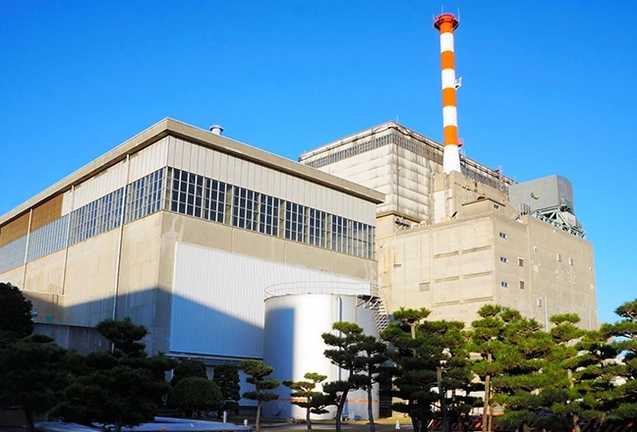
Japan eyes disposal abroad of radioactive plant equipment
Watch out! Japan’s hoping to export now its radioactive junk!
September 20, 2021
Japan plans to ease regulations to allow exports of large, disused equipment from nuclear power plants for overseas disposal as a way to reduce the mountains of radioactive waste accumulating at home.
The setup would mark a major shift from the government’s existing principle of disposing of all radioactive waste inside the country.
The industry ministry mentioned the revised disposal policy in the draft of the updated Basic Energy Plan, which awaits Cabinet approval in October at the earliest.
Even if the plan is approved, it will likely take some time for the government and nuclear plant operators to clear a slew of hurdles, such as estimating the costs of the project and ensuring the safety of shipments.
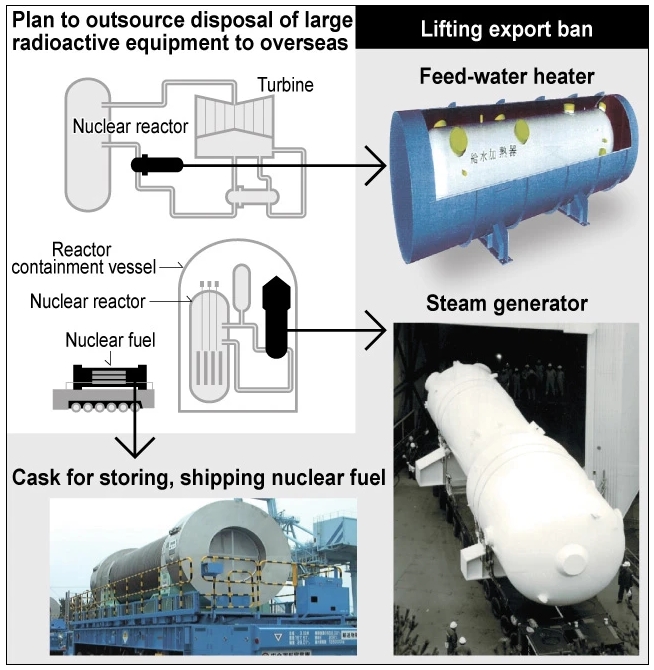
The Ministry of Economy, Trade and Industry, which oversees the nuclear industry, is considering outsourcing the disposal of three kinds of large low-level radioactive equipment overseas: steam generators, feed-water heaters and nuclear fuel storing and shipping casks.
These components range in size from 5 to 20 meters and weigh 100 to 300 tons.
Although they are not highly contaminated, compared with nuclear debris generated by spent fuel, they must be disposed of and managed properly, including being buried deep in the ground for years.
The ministry is considering their export as an “exceptional measure” to deal with the grave issue of the radioactive waste accumulating at nuclear facilities across Japan.
“Export regulations will be reviewed to allow for export (of low-level radioactive waste) when certain conditions are met, such as their safe recycling into useful resources,” the draft for the latest version of the Basic Energy Plan said.
The industry ministry is soliciting public opinions on the outsourcing plan until Oct. 4.
Nuclear plant operators have decided to decommission 24 reactors, including the six units at the crippled Fukushima No. 1 nuclear plant.
Work to dismantle those reactors is expected to go into full gear starting in 2025.
Excluding the reactors at the Fukushima plant, the decommissioned units will produce an estimated 165,000 tons of low-level radioactive waste.
But more than 90 percent of that waste has nowhere to go for dismantling and disposal.
Japan still lacks a dedicated disposal site for equipment used at nuclear plants, forcing plant operators to store the waste at their facilities.
The ministry says the storage of the out-of-service equipment is getting in the way of the decommissioning process.
Experts say some businesses in the United States and Sweden clean, melt and recycle metal from radioactive waste sent by foreign countries.
“Japan should first learn the know-how of disposal by outsourcing the work to foreign businesses with a reliable track record in the area and eventually become capable of doing it at home,” said Koji Okamoto, a professor of nuclear engineering at the University of Tokyo.
Under the Joint Convention on the Safety of Spent Fuel Management and on the Safety of Radioactive Waste Management, signatory countries that produce radioactive waste are obliged, in principle, to dispose of it within their territories.
But they can export the waste as exceptional cases if they obtain the consent of countries where business partners are based.
However, Japan’s Foreign Exchange and Foreign Trade Control Law bans such exports.
Utilities have pressed the government for a change in the disposal policy, and the industry ministry has been reviewing the existing setup alongside experts on nuclear technology.
Although the ministry intends to follow the principle of doing away with the waste within Japan, it plans to approve exports of the three types of nuclear plant equipment on condition that they will be recycled.
Ministry officials say the plan can be achieved through a revised ministry directive, without having to change the law.
The equipment intended for recycling overseas could include components kept at nuclear plants that still generate power.
But the ministry needs to work out many issues to turn the plan into reality.
Nuclear plant operators have the primary responsibility for disposing of low-level radioactive waste. And the actual costs these Japanese companies would have to pay to recyclers overseas is still unknown.
The bill could be far more expensive than initially estimated.
How to safely ship the radiation-contaminated equipment abroad is another unresolved issue.
The amount of nuclear waste in Japan has been growing since the 2011 Fukushima nuclear disaster. Utilities have gradually resumed operations at nuclear plants, but some have decided to decommission reactors, particularly aging ones, largely because of the costs needed to upgrade them under new safety standards.
For decades, Japan has been unable to secure a final disposal site for such waste inside the country, mainly because of opposition from residents of candidate sites.
TEPCO bungles placement of 100 fire detectors at nuclear plant
September 20, 2021
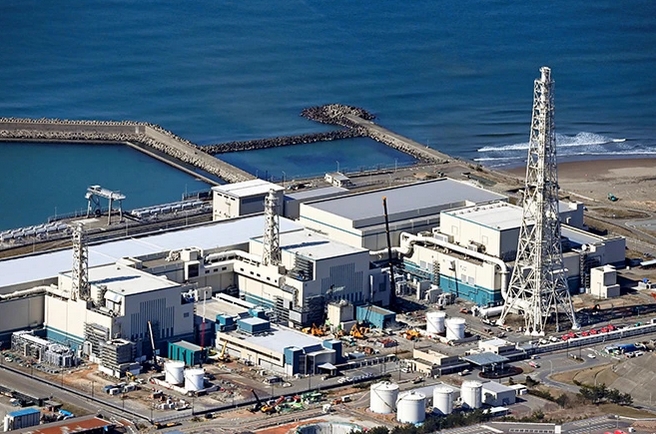
Tokyo Electric Power Co. has continued its bumbling ways concerning safety measures, misplacing dozens of fire detectors at its Kashiwazaki-Kariwa nuclear plant in Niigata Prefecture, sources said.
TEPCO is seeking to restart the No. 7 reactor at the sprawling nuclear plant, but the utility has run into a host of problems following stricter safety standards implemented after the 2011 disaster at its Fukushima No. 1 nuclear plant.
In the latest incident, about 100 fire detectors were not placed in locations set under safety regulations, the sources said.
The misplacements could delay the detection of heat and smoke from a fire, hampering an immediate response to such a potentially disastrous event.
Under the new safety regulations, nuclear plant operators are required to place a fire detector at least 1.5 meters from an air conditioner vent or other opening. That rule is based on the fire protection law.
Inspectors from the government’s Nuclear Regulation Authority in February noticed that a smoke detector was placed only about 1 meter from the ventilating opening in the storage battery room of the No. 7 reactor building.
TEPCO said it has since moved the detector to the proper location and confirmed through visual checks that the other fire detectors were installed in the right places.
But an additional NRA inspection in April found that two other fire detectors were misplaced.
Following that finding, TEPCO undertook a fresh check of about 2,000 detectors throughout the nuclear plant.
The company reported to the nuclear watchdog on Sept. 16 that more cases of misplaced detectors were confirmed, bringing the total to about 100, according to the sources.
With seven reactors, the Kashiwazaki-Kariwa nuclear plant is among the largest in the world in terms of capacity. It is also the only nuclear facility that TEPCO can restart since the company decided to decommission both the Fukushima No. 1 and No. 2 nuclear plants.
TEPCO is eager to put the Kashiwazaki-Kariwa plant back online because burning fossil fuel at its thermal plants has proved costly.
But the NRA in April ordered the company to stop preparations toward a restart following revelations of a number of safety flaws.
In January, the company announced the completion of work to bolster safeguarding of the No. 7 reactor, which has an output of 1.35 gigawatts.
However, fire-prevention work was not finished at many locations of the nuclear plant.
News outlets also reported in January that an employee of the plant entered the central control room of a reactor by using the ID of another employee in September last year, a serious breach of the NRA’s anti-terrorism measures.
In addition, it was found that security devices designed to detect unauthorized entry had not been working properly at 15 sites at the plant since March last year.
TEPCO left most of these devices unfixed for about a month.
The company is expected to submit a report to the NRA on how to prevent a recurrence by Sept. 23.
Is AUKUS pact a signal to India to go for nuclear attack submarines?
With a new aircraft carrier, six new Kalvari class diesel attack submarines and Vishakhapatnam class of destroyers, the Indian Navy is going to be very potent force in the Indo-Pacific by 2025. By Shishir Gupta, Hindustan Times, New Delhi SEP 18, 2021 With Australia signing a pact with US and UK to go in for eight nuclear powered conventional attack submarines or SSNs to deter China in Indo-Pacific, India also needs to have a relook at its 1999 conventional submarine plan and move swiftly towards nuclear powered sub-surface vessels.
The AUKUS pact will not be without security ramifications for the Quad partners as there is a distinct possibility that China may build an SSN for its client Pakistan citing the transfer of nuclear reactor under AUKUS to Australia. This will create a bigger security headache for India and for other countries in the IOR. https://www.hindustantimes.com/india-news/is-aukus-pact-a-signal-to-india-to-go-for-nuclear-attack-submarines-101631944254552.html
Malaysia and Indonesia warn Australia’s Indo-Pacific pact could trigger nuclear arms race
Malaysia and Indonesia warn Australia’s Indo-Pacific pact could trigger nuclear arms race, Taipei Times, 19 Sep 21
The new AUKUS alliance will involve Australia, the US and Britain exchanging technology and intelligence
Australia will have access to US nuclear technology, which will enable it to build nuclear submarines
Australia’s nuclear arms ban remains in new deal
Birmingham said there was no “quid pro quo” in Australia agreeing to step up its strategic relationship with the UK and the US.
He insisted that nuclear weapons would not be based within Australia’s jurisdiction. “We’ve been clear, Australia’s position in relation to nuclear weapons does not change, will not change,” he said yesterday.
“We will meet all of our non-proliferation treaty arrangements and obligations and not be changing any of our policies in relation to the nuclear weapons technology.”
Birmingham did not rule out an increase in the number of UK and US military personnel on Australian shores. “We already have US troops and marines who work in Australia on rotational deployments at times,” he said………….
it is not just the French who have been made uneasy by the AUKUS arrangement, which is still to be worked out in detail. Australia’s allies in the Indo-Pacific have also raised concerns over what the deal will mean for tensions in the region.
Malaysia said on Saturday that Canberra’s decision to build atomic-powered submarines could trigger a regional nuclear arms race, echoing concerns already raised by Beijing.
“It will provoke other powers to also act more aggressively in the region, especially in the South China Sea,” the Malaysian prime minister’s office said, without mentioning China……https://www.taipeitimes.com/News/world/archives/2021/09/20/2003764684
China fears that the nuclear-powered submarines could be armed with nuclear weapons at short notice

US FORCES US submarine launches Trident II nuclear missiles in stunning show of strength U.S,Sun Olivia Burke, Sep 19 2021
THE US Navy triumphantly test-launched Trident D5LE nuclear missiles on Friday in a stunning show of strength.
The scheduled two-missile deployment of the unarmed revamped weapon took place off the coast of Cape Canaveral, Florida from the USS Wyoming (SSBN-742) submarine……
The Navy boasted of the “unmatched reliability” of the new “sea-based nuclear deterrent” as tensions continue to increase with China.
It was the 184th successful Trident II (D5 & D5LE) SWS missile test flight and follows the last launch in February this year off the coast of Florida……..
“This same team is now developing the next generation of the Trident Strategic Weapon System, which will extend our sea-based strategic deterrent through 2084,”
The Navy also revealed the submarine missiles have been given “a life extension program to address potential impacts from aging and obsolescence”.
They are now primed to be stationed amongst the rest of the fleet alongside the UK Vanguard-class, US Colombia-class, UK Dreadnought-class.
With an estimated annual cost of $170million, the US spend a whopping $2.4million each year to run the Ohio-class submarines.
….the launch comes in the wake of the revelation of the UK’s and US’ plans to build nuclear-powered submarines for Australia.
AUKUS’ ALLIANCE
The alliance has angered China, who fear the subs could be armed at short notice with nukes, despite assurances they will only carry conventional weapons.
The countries leaders carefully navigated the announcement without directly mentioning China’s imposing power – but hinted at their intentions behind the move by discussing “democracy, freedom of navigation, and security.”
The new Indo-Pacific security pact, known as AUKUS, will give the land Down Under the technology to deploy nuclear-powered submarines.
It is part of an agreement intended to counter China’s rising military might – that they have splashed six times more cash on than Australia.
With 42 times more soldiers, 55 times more tanks, 13 times more submarines and 16 times more fighter jets, they eclipse the Aussies artillery.
And with 3.3 million troops in service, Beijing dwarves Australia’s 80,000 soldiers – but AUKUS has still managed to seriously ruffle some feathers.
CHINA’S FURY
Chinese Foreign Ministry spokesman Zhao Lijian condemned the alliance as “seriously damaging regional peace and stability, intensifying the arms race, and undermining the Treaty on the Non-Proliferation of Nuclear Weapons”.
China is believed to have between 250 and 350 nuclear weapons, compared to America’s colossal arsenal of 5,800 and Russia’s total of 6,375. ……. https://www.the-sun.com/news/3691458/us-submarine-trident-ii-nuclear-missiles-chinas-threats/
New radiation scrubber begins cleaning water at Fukushima plant
New radiation scrubber begins cleaning water at Fukushima plant, Japan Times 19 Sep 21The operator of the crippled Fukushima No. 1 nuclear plant on Thursday powered up an additional water treatment facility to scrub contamination from the massive quantities of radioactive water stored there.
The new, mobile facility filters radioactive strontium from water used to cool three reactors that partially melted down in March 2011, said operator Tokyo Electric Power Co., and can handle 300 tons of water a day……
The procedure will reduce radioactive strontium in the water to about one-thousandth of its current level, the utility said.
However, removing strontium will not in itself render the water safe. It then needs to be treated by another system at the plant which filters out around 60 kinds of radioactive materials.
But there is an important reason why the strontium takes precedence. Removing that isotope before the others will make the water far less of a hazard in the event of a major leak into the ocean.
Meanwhile, an estimated 400 tons of groundwater continues to seep into the reactor basements every day, forcing the utility to find ways to store it. Tepco already has 400,000 tons of toxic water stored at the site, which will all need to be treated one day. https://www.japantimes.co.jp/news/2014/10/03/national/new-radiation-scrubber-begins-cleaning-water-at-fukushima-plant/
Tepco technicians ignored Fukushima filters leaking radioactive water.
Technicians at Japan’s wrecked Fukushima nuclear power plant have acknowledged neglecting to investigate the cause of faulty exhaust filters key to preventing radioactive pollution, after being forced to replace them twice. Representatives of the Tokyo Electric Power Company made the revelations Monday during a regular review of the Fukushima Daiichi plant at a meeting with Japanese regulatory authorities.
The plant suffered triple meltdowns following a massive earthquake and tsunami in 2011. “At the core of this problem is TEPCO´s attitude,” said a Nuclear RegulationAuthority commissioner, Nobuhiko Ban, at the meeting. TEPCO has been
repeatedly criticized for coverups and delayed disclosures of problems atthe plant. In February, it said two seismometers at one reactor remained broken since last year and failed to collect data during a powerful quake.
Company officials have said that 24 out of 25 filters attached to water treatment equipment had been found damaged last month, after an alarm went off as workers were moving sludge from the unit to a container, temporarilysuspending the water treatment. The operation partially resumed last weekafter filter replacement. The filters are designed to prevent particles from escaping into the air from a contaminated water treatment system – called Advanced Liquid Processing System, or ALPS – that removes selected radioactive isotopes in the water to below legally releasable limits.
Daily Mail 14th Sept 2021
North Korea, nuclear proliferation and why the ‘madman theory’ is wrong about Kim Jong-unç
North Korea, nuclear proliferation and why the ‘madman theory’ is wrong about Kim Jong-unç https://theconversation.com/north-korea-nuclear-proliferation-and-why-the-madman-theory-is-wrong-about-kim-jong-un-167939, Colin Alexander, Lecturer in Political Communications, Nottingham Trent University 15 Sep 21, The two missile tests conducted by North Korea in recent days have reopened discussions about the country, its leadership, its foreign policy, its perception around the world and the use (and usefulness) of nuclear weapons as an option within global politics.
North Korea’s official Korean Central News Agency announced on September 12 that it had test-fired a new long-range cruise missile, believed by analysts to be the country’s first missile with the capacity to carry a nuclear warhead.
Three days later the South Korean military said the North had launched “two unidentified ballistic missiles” into the Sea of Japan, prompting Japan’s outgoing prime minister, Yoshihide Suga, to order his country’s defence agencies to investigate.
North Korea usually makes grand nuclear statements like the ones we have seen in recent days during early September to mark the founding of the DPRK on September 9 1948. As such, these tests are as much about domestic propaganda and internal regime prestige as they are about threat to the outside world.
More broadly though, North Korea’s advance of its nuclear weapons technology – off and on since the 1950s – has made its integration with the rest of the international community much less likely. This is primarily on account of its development coming at considerable cost and sacrifice to the small nation.
No moral high ground
It can be argued that, given the indiscriminate barbarity of the destruction that a nuclear attack would cause, no state has a moral right to nuclear weapons over that of another state. But countries which already have a nuclear arsenal will often push the line that while it’s OK for them to have a nuclear stockpile, other countries do not necessarily have that right. These communications often rely on a manufactured sense of who is responsible and stable-minded and who is irresponsible and unstable. In short, it is an attempt to create a polarised world of good and evil.
This simplistic polarisation is encouraged through government communications regarding foreign policy. But they also depend on wider more implicit perception management strategies. These include harnessing the agendas of global mainstream news media and exporting popular culture products, films, television programmes and the like, that seek to encourage certain worldviews and to marginalise ones that are undesirable to the world’s most powerful nations.
It should always be remembered that the United States is the only state to have used nuclear weapons as an act of war (twice during 1945). Yet it declares North Korea to be a nuclear threat based on its “madness” (Donald Trump repeatedly called Kim Jong-un “mad”). But if we are to believe revelations from the upcoming book Peril by journalists Bob Woodward and Robert Costa, America’s top military personnel had to take action in the final months of the Trump administration to limit any risks of a nuclear showdown with China.
It’s probably true to say that few aspiring candidates for high office are going to say that they would never use their country’s nuclear capability in any circumstance. But it could also be said that any head of government who boasts of their readiness to use nuclear weapons is demonstrating their lack of fitness to govern. But, as the first part of this paragraph suggests, no candidate is likely to make this assertion.
Madman’ theory wrong
There is no evidence that the previous leaders of North Korea, Kim Il-sung or Kim Jong-il, were assessed by psychologists and found to be suffering from mental ill health. This is also true of Kim Jong-un, the country’s current leader – in fact before Kim’s summit with Trump in 2018, a former State Department psychiatrist, Kenneth Dekleva, who creates psychological profiles of foreign leaders, told America’s National Public Radio that: “I think the madman theory was wrong.”
I would say he’s smart, that he’s a very, very savvy diplomat, a leader with a sense of gravitas. He wants to be a player on the world stage.
For Simon Cross, a colleague of mine at Nottingham Trent University, “madness” is an imprecise term and a cultural construct that does not require a trained medical professional to identify it, but it resonates with ease with audiences when uttered by someone they trust. Stephen Harper at the University of Portsmouth, says our perception of what represents “madness” is based on uncritical interpretations of the past and fantasies and inclinations within the human mind towards what he calls “self-haunting”. These tropes are perpetuated, confirmed and even encouraged at the persuasion of powerful individuals reinforced by mainstream media content.
So, for example, the Hollywood films Team America: World Police (2004) and The Interview (2014), despite being satires of North Korea’s leaders, promote this idea of the North Korean leader and his senior advisers as mad. And Trump kept hammering at this with his regular references to Kim as a “madman”, as “crazy” and as a “little rocket man”.
North Korea’s prevailing international image of being mad is thus predominantly the creation of hostile external parties. But Pyongyang has also played up to it at times when it has been deemed useful – as the psychologist Dekleva said earlier in this article, it could be a useful tool of diplomacy. This is a theme explored by Niccolo Machiavelli in his book The Prince in 1517.
That said, what is perhaps most interesting is the extent to which recent US administrations and their allies appear to have come to believe the madness story – despite the fact that they are largely responsible for it. This has been the case with successive US administrations – but whether they genuinely believe it, or perpetuate it because it is convenient to their wider foreign policy ambitions to do so, remains to be seen.
China still way behind USA in nuclear weaponry: time for diplomacy and negotiations on arms control
China’s nuclear build-up: The great distraction, The Hill, BY ROSE GOTTEMOELLER, — 09/13/21 President Biden is reviewing America’s nuclear posture. By January, we should know what he thinks about U.S. nuclear weapons, what policies should govern them and how many we need. Congress is watching closely, and the Senate and House of Representatives are sure to debate the results; they always do.
But this year will be different. A new player has entered the field — China.
China is modernizing its nuclear forces. The recent discovery of three intercontinental ballistic missile (ICBM) silo fields in remote regions west and north of Beijing point to a big build-up of weapons and a different strategy for their use. Since acquiring nuclear weapons from the Soviets, the Chinese have taken the stance that they would not build up a large and highly alert force but instead would be ready to retaliate. This “second strike deterrence posture” has served them well, but now the Chinese seem to have decided it is not enough.
Which is why it is urgent that the Biden administration (and the Kremlin) get them to the table to ask them. Chinese nuclear force posture and strategy should be an equal concern in Washington and Moscow.
We can ask the Chinese separately, or together, but ask them we should. All three countries might even agree to take some early steps, such as exchanging deployment plans and information about nuclear doctrine. Such confidence-building measures would build mutual predictability and may stave off a nuclear arms race.
Most importantly, we must not panic. Even if the Chinese deploy intercontinental ballistic missiles in each of their new silos, the U.S. will still have a large and capable nuclear force structure and many more nuclear warheads. Some authorities have predicted that the Chinese may be able to quadruple their warhead numbers in coming years. If one goes by the Stockholm Peace Research estimate of 350 Chinese warheads, then China would end up with 1,400 total warheads. That compares with over 4,000 warheads available for deployment in both the United States and Russia. We need to keep a sharp eye on what they are doing but not rush into making rash changes in our own nuclear forces. ………………..
Most importantly, we must not panic. Even if the Chinese deploy intercontinental ballistic missiles in each of their new silos, the U.S. will still have a large and capable nuclear force structure and many more nuclear warheads. Some authorities have predicted that the Chinese may be able to quadruple their warhead numbers in coming years. If one goes by the Stockholm Peace Research estimate of 350 Chinese warheads, then China would end up with 1,400 total warheads. That compares with over 4,000 warheads available for deployment in both the United States and Russia. We need to keep a sharp eye on what they are doing but not rush into making rash changes in our own nuclear forces. https://thehill.com/opinion/international/571973-chinas-nuclear-build-up-the-great-distraction
N.Korea tests first ‘strategic’ cruise missile with possible nuclear capability
N.Korea tests first ‘strategic’ cruise missile with possible nuclear capability https://www.reuters.com/world/asia-pacific/nkorea-test-fires-long-range-cruise-missile-kcna-2021-09-12/ By Hyonhee Shin and Josh Smith
- Tests involved new, long-range cruise missiles – KCNA
- New missiles represent serious capability for N.Korea – analysts
- U.S. military: Launches highlight threat to N.Korea’s neighbours
- Tests came before meeting by U.S., Japan, S.Korea to discuss N.Korea
- SEOUL, Sept 13 (Reuters) – North Korea carried out successful tests of a new long-range cruise missile over the weekend, state media said on Monday, seen by analysts as possibly the country’s first such weapon with a nuclear capability.Reporting by Hyonhee Shin and Josh Smith; Additional reporting by Idrees Ali in Washington; Editing by Daniel Wallis, Peter Cooney and Lincoln Feast.
Irradiated man kept alive for nuclear research
Paul Richards, Nuclear Fuel Cycle Watch Australia, 10 Sept 21, TOTAL DESTRUCTION
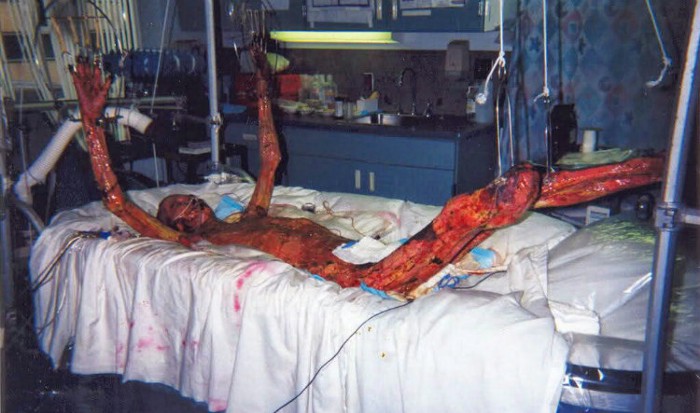
Although most of Hisashi Ouchi’s body had been completely destroyed, including his DNA and immune system, the doctors kept him alive as a human experiment.They kept him alive for a total of 83 days until he died of multiple organ failures.
During those 83 days, Hisashi Ouchi underwent the first transfusion of peripheral stem cells, as well as several blood transfusions and skin transplants.However, neither the transfusions or transplants could keep his bodily fluids from leaking out of his pores.
During the first week of experiments, Hisashi Ouchi had enough consciousness to tell the doctors“I can’t take it anymore… I am not a guinea pig…”but they continued to treat him for 11 more weeks. The nurses caring for him also recorded the narcotic load to abate pain was not enough to give him relief. At the time of recording his death, his heart had stopped for 70 minutes and the doctors chose this time not to resurrect him.
UNBREAKABLE RECORD To this day, Hisashi Ouchi holds the record for the most radiation experienced by a surviving person, however, this is not an accomplishment that his family likely celebrates.
The case of malpractice by these doctors is extremely horrific and one of the greatest examples of human torture of the 20th century.Thankfully, medical professionals values, would not be superseded by the nuclear state, so this record in all probability will never be broken._____________More on why the accident happened:https://sci-hub.se/…/abs/10.1080/00963402.2000.11456942 from https://www.facebook.com/groups/1021186047913052
U.S., Japan, S.Korea to meet over N.Korea nuclear standoff
U.S., Japan, S.Korea to meet over N.Korea nuclear standoff, By Josh Smith SEOUL, Sept 10 (Reuters) – Officials from the United States, South Korea and Japan will hold a meeting on North Korea next week in Tokyo, South Korea’s foreign ministry confirmed on Friday.
The three countries have been discussing ways to break a standoff with North Korea over its nuclear weapons and ballistic missile programmes, which have drawn international sanctions.
……………. U.S. President Joe Biden’s administration has said it will explore diplomacy to achieve North Korean denuclearisation, but has shown no willingness to ease sanctions.
…… Pyongyang has also said it is open to diplomacy, but that it sees no sign of policy changes from the United States, citing issues such as sanctions as well as joint military drills with South Korea.Reporting by Josh Smith and Hyonhee Shin in Seoul and David Brunnstrom in Washiington; Editing by Kevin Liffey and Alistair Bell https://www.reuters.com/world/us-japan-skorea-meet-over-nkorea-nuclear-standoff-2021-09-10/
Energy Markets Bet Against Nuclear As Election Nears In Japan

Energy Markets Bet Against Nuclear As Election Nears In Japan, Oil Price, By Haley Zaremba – Sep 08, 2021 Japanese Prime Minister Yoshihide Suga shocked the world on Friday when he announced that he will be stepping down and declining to seek re-election after serving one term. ………
one candidate has emerged as a major frontrunner. ….. Taro Kono served as the minister in charge of battling Covid-19 in Japan. It is looking likely that Kono will garner the support of the Liberal Democratic Party (LDP), whose majority in the Japanese parliament ensures that any candidate who heads the party will ultimately win the race for Prime Minister. Kono emerged as the clear frontrunner in Japanese media polls over the weekend that asked respondents to indicate their preferred leader.

It remains to be seen whether Taro Kono will take the helm of Japan, but if he sticks to his guns, the Japanese nuclear energy sector could soon recede into the rearview.
In addition to being known for his role in combating the novel coronavirus pandemic, Kono is also a noted anti-nuclear advocate with a long history of outspoken dissent about the nuclear energy that currently represents a fifth of Japan’s energy mix. Due to this history, the news of Kono’s ascent toward the Prime Minister position on Monday has already sent shockwaves through Japan’s energy markets.
So far, renewable energy markets are winning big. “Frenzied buying from retail traders sent Japan’s renewable energy stocks soaring Monday,” in response to Kono’s emergence as a top contender according to reporting from Bloomberg. Solar and biomass power company Renova Inc. saw its stock increase by 15% while solar firm West Holdings Co. hit an all-time high after its stocks jumped 9%. These gains came at a cost to nuclear energy firms and power companies, and Kansai Electric Power Co. stocks notably dropped 2.7%.
Although the markets have already spoken, it remains to be seen whether Kono will stick to his staunchly anti-nuclear stance if he enters office as Prime Minister. “Whether he will actually reflect his previous stance into his policies once the race for the prime minister position begins is a different story,” Norihiro Fujito, chief investment strategist at Tokyo’s Mitsubishi UFJ Morgan Stanley Securities Co. was quoted by Bloomberg. “The market is just getting ahead of itself.”
…….. Currently, the national plan “calls for renewable sources to provide between 22% and 24% of Japan’s electricity by 2030, and for nuclear energy to provide between 20% and 22%.” But nuclear energy is a hard sell in Japan, a country that is still recovering from the devastating 2011 Fukushima nuclear disaster
Just this week, a full decade after the tragedy caused by an earthquake and ensuing tsunami, the International Atomic Energy Agency is reaching out to Japan to work alongside them in their continuing struggles to manage the radioactive waste still piling up after the 2011 accident. Japan has continued to use more than a million tonnes of water to cool the damaged reactors and prevent a meltdown, and now they’re running out of storage space for the radioactive waste water. Their plan? Dump it into the Pacific Ocean.
The continued complications and hazardous aftereffects of the nuclear disaster at Fukushima throw the dark side of nuclear into stark relief for the Japanese public. ……… It remains to be seen whether Taro Kono will take the helm of Japan, but if he sticks to his guns, the Japanese nuclear energy sector could soon recede into the rearview. https://oilprice.com/Alternative-Energy/Nuclear-Power/Energy-Markets-Bet-Against-Nuclear-As-Election-Nears-In-Japan.html
IAEA Seeks Japan Transparency in Release of Fukushima Water
IAEA Seeks Japan Transparency in Release of Fukushima Water, By Mari Yamaguchi | September 8, 2021 TOKYO (AP) — Experts from the International Atomic Energy Agency asked Japan on Tuesday for full and detailed information about a plan to release treated but still radioactive water from the wrecked Fukushima nuclear plant into the ocean.
The three-member team, which is assisting Japan with the planned release, met Tuesday with government officials to discuss technical details before traveling to the Fukushima Daiichi plant for an on-site examination Wednesday. They will meet with Japanese experts through Friday…….. https://www.claimsjournal.com/news/international/2021
1 This Month



26 September – International Day for the Total Elimination of Nuclear Weapons


PLEASE OPPOSE HR 8255 AND S.3639 – bills would accelerate satellite deployment, with no environmental review or safeguards – https://ncstd5li.quorum.us/campaign/169331/
To see nuclear-related stories in greater depth and intensity – go to https://nuclearinformation.wordpress.com
-
Archives
- September 2026 (245)
- August 2026 (330)
- July 2026 (355)
- June 2026 (287)
- May 2026 (306)
- April 2026 (356)
- March 2026 (251)
- February 2026 (267)
- January 2026 (308)
- December 2025 (358)
- November 2025 (359)
- October 2025 (375)
-
Categories
- 1
- 1 NUCLEAR ISSUES
- business and costs
- climate change
- culture and arts
- ENERGY
- environment
- health
- history
- indigenous issues
- Legal
- marketing of nuclear
- media
- opposition to nuclear
- PERSONAL STORIES
- politics
- politics international
- Religion and ethics
- safety
- secrets,lies and civil liberties
- spinbuster
- technology
- Uranium
- wastes
- weapons and war
- Women
- 2 WORLD
- ACTION
- AFRICA
- Atrocities
- AUSTRALIA
- Christina's notes
- Christina's themes
- culture and arts
- Events
- Fuk 2022
- Fuk 2023
- Fukushima 2017
- Fukushima 2018
- fukushima 2019
- Fukushima 2020
- Fukushima 2021
- general
- global warming
- Humour (God we need it)
- Nuclear
- RARE EARTHS
- Reference
- resources – print
- Resources -audiovicual
- Weekly Newsletter
- World
- World Nuclear
- YouTube
-
RSS
Entries RSS
Comments RSS
 nuclear-news