Ukraine war triggers debate on Japan’s nuclear option
In a new and volatile strategic environment, a decades-old commitment on non-proliferation is up for discussion.

14 Mar 2022
In the wake of the Ukraine conflict, Shinzo Abe, Japan’s former prime minister and now head of the largest faction of the ruling Liberal Democratic Party (LDP), has suggested that Japan consider hosting US nuclear weapons facilities on Japanese soil, similar to some European nations, such as Germany, which have nuclear sharing arrangements with the United States.
Abe’s suggestion was made in the context of Ukraine having renounced nuclear weapons in 1994, leaving itself vulnerable today. The announcement also comes on top of deepening concerns about China’s growing military assertiveness around Japan’s maritime space and beyond, and the dangerous situation on the Korean peninsula with threats from the nuclear-capable rocket-launching North Korea.
Debates over whether Japan should host nuclear weapons or even go fully nuclear are not new. In the mid-1970s, a book-length study by John Endicott considered the nuclear option. In the early 2000s, then Chief Cabinet Secretary Yasuo Fukuda and Deputy Chief Cabinet Secretary Shinzo Abe (both of whom later served as prime minister) again raised this prospect. It was quickly put to rest by Japan’s security analysts. Discussion has since continued among political and scholarly communities as to whether Japan should go nuclear, opt for a nuclear sharing arrangement with the United States by hosting nuclear weapons, or maintain its current non-nuclear weapons status.
Some smaller conservative opposition parties want to include nuclear options in policy discussions while considering Japan’s strategic objectives.
This latest eruption though is in a different context. This time, chairman of the General Council of the LDP Tatsuo Fukuda, who like his father Yasuo Fukuda before him holds an influential ruling party post and is touted as a future prime minister, has suggested that “we must not shy away from any debate whatsoever”. Last year’s LDP party presidential candidate and current LDP policy chief Sanae Takaichi also favours a debate. Some smaller conservative opposition parties want to include nuclear options in policy discussions while considering Japan’s strategic objectives. The main opposition parties have, however, strongly resisted any such prospects, arguing in favour of Japan’s non-nuclear status.
Abe’s suggestion was promptly and solidly rejected by Prime Minister Fumio Kishida, as well as by the leader of the Komeito, the junior coalition partner of the ruling LDP. Even Defence Minister Nobuo Kishi, Abe’s younger brother, adopted into the Kishi family, also dismissed the idea of hosting nuclear weapons on Japanese shores. Kishi may have expressed this view in order to align with his boss, Prime Minister Kishida, rather than reflecting his true thinking on the matter, given his political pedigree.
ishida quickly confirmed that Japan firmly adheres to the three non-nuclear principles adopted in 1967, to not possess, produce or permit the introduction of nuclear weapons into Japan’s territory. These principles remain sacrosanct, even though Japan has made substantial departures in defence and security matters in the past decade.
Abe’s comments can be understood in this context, which emanates from a rapidly evolving strategic environment, regionally as well as globally. As prime minister, Abe had introduced several policy initiatives that were unthinkable in previous decades, such as removing bans on defence-related exports, allowing Japan to work with allies and partners in collective self-defence, establishing Japan’s first National Security Council (NSC), and issuing the first-ever National Security Strategy (NSS).
Not only has the Kishida government announced an intended update to the NSS, first issued in 2013, it has also promised to revise the National Defence Program Guidelines and Mid-Term Defence Program issued in 2013 and 2018. All these updates and revisions are undertaken in view of a rapid transformation in the strategic environment.
The Kishida government is likely to go even further and consider acquiring strike capabilities to ensure Japan’s territorial integrity and the safety of its people as well as protect US military assets in Japan, including some 50,000 US defence personnel.
The long-time self-imposed constraints on Japan’s defence spending, keeping it to less than one per cent of GDP, are also likely to be breached soon. The LDP under Kishida’s leadership has promoted for the first time the idea of spending two per cent of GDP in its policy documents just before the last general election in October 2021. Although such a change seems unlikely any time soon due to Japan’s poor fiscal health and significant public opposition, defence spending will definitely increase, as it has over the past decade.
Japan, along with Germany, has often been recognised as an example of a “civilian state”. Germany currently hosts US nuclear weapons facilities and, in view of the Ukraine conflict, has announced a significant increase to its defence budget. Calls are now being made to urge Japan to follow suit.
The postwar US-Japan Treaty of Mutual Cooperation and Security has ensured that Japan has lived happily under US extended deterrence, including the nuclear umbrella. This arrangement is unlikely to change, barring an existential threat to Japan’s territory and sovereignty. But what seemed to be taboo in terms of Japan’s strategic policy – that is, breaching one per cent of GDP on defence spending and developing strike capabilities – is now being discussed seriously. No policy in international relations is eternal, it must change as a nation’s interests change.
https://www.lowyinstitute.org/the-interpreter/ukraine-war-triggers-debate-japan-s-nuclear-option
Ukraine war triggers debate on Japan’s nuclear option,
The Interpreter. PURNENDRA JAIN, 14 Mar 22,
In a new and volatile strategic environment, a decades-
old commitment on non-proliferation is up for discussion.
In the wake of the Ukraine conflict, Shinzo Abe, Japan’s former prime minister and now head of the largest faction of the ruling Liberal Democratic Party (LDP), has suggested that Japan consider hosting US nuclear weapons facilities on Japanese soil, similar to some European nations, such as Germany, which have nuclear sharing arrangements with the United States.
Abe’s suggestion was made in the context of Ukraine having renounced nuclear weapons in 1994, leaving itself vulnerable today. The announcement also comes on top of deepening concerns about China’s growing military assertiveness around Japan’s maritime space and beyond, and the dangerous situation on the Korean peninsula with threats from the nuclear-capable rocket-launching North Korea.
Debates over whether Japan should host nuclear weapons or even go fully nuclear are not new………….. Discussion has since continued among political and scholarly communities as to whether Japan should go nuclear, opt for a nuclear sharing arrangement with the United States by hosting nuclear weapons, or maintain its current non-nuclear weapons status.
This latest eruption though is in a different context. This time, chairman of the General Council of the LDP Tatsuo Fukuda, who like his father Yasuo Fukuda before him holds an influential ruling party post and is touted as a future prime minister, has suggested that “we must not shy away from any debate whatsoever”. Last year’s LDP party presidential candidate and current LDP policy chief Sanae Takaichi also favours a debate. Some smaller conservative opposition parties want to include nuclear options in policy discussions while considering Japan’s strategic objectives. The main opposition parties have, however, strongly resisted any such prospects, arguing in favour of Japan’s non-nuclear status.
Abe’s suggestion was promptly and solidly rejected by Prime Minister Fumio Kishida, as well as by the leader of the Komeito, the junior coalition partner of the ruling LDP. Even Defence Minister Nobuo Kishi, Abe’s younger brother, adopted into the Kishi family, also dismissed the idea of hosting nuclear weapons on Japanese shores. Kishi may have expressed this view in order to align with his boss, Prime Minister Kishida, rather than reflecting his true thinking on the matter, given his political pedigree.
Kishida quickly confirmed that Japan firmly adheres to the three non-nuclear principles adopted in 1967, to not possess, produce or permit the introduction of nuclear weapons into Japan’s territory. These principles remain sacrosanct, even though Japan has made substantial departures in defence and security matters in the past decade…………….
Not only has the Kishida government announced an intended update to the NSS, first issued in 2013, it has also promised to revise the National Defence Program Guidelines and Mid-Term Defence Program issued in 2013 and 2018. All these updates and revisions are undertaken in view of a rapid transformation in the strategic environment……………….
| Japan, along with Germany, has often been recognised as an example of a “civilian state”. Germany currently hosts US nuclear weapons facilities and, in view of the Ukraine conflict, has announced a significant increase to its defence budget. Calls are now being made to urge Japan to follow suit. The postwar US-Japan Treaty of Mutual Cooperation and Security has ensured that Japan has lived happily under US extended deterrence, including the nuclear umbrella. This arrangement is unlikely to change, barring an existential threat to Japan’s territory and sovereignty. But what seemed to be taboo in terms of Japan’s strategic policy – that is, breaching one per cent of GDP on defence spending and developing strike capabilities – is now being discussed seriously. No policy in international relations is eternal, it must change as a nation’s interests change. https://www.lowyinstitute.org/the-interpreter/ukraine-war-triggers-debate-japan-s-nuclear-option |
11 years on, Fukushima morass still poses danger
| 11 years on, Fukushima morass still poses danger By KARL WILSON in Sydney | CHINA DAILY 2022-03-14 ”…………………………. Little progress has been made on the most pivotal and hardest work of decommissioning the Fukushima Daiichi power plant-how to remove the nuclear residue from the meltdown. The plant owner, Tokyo Electric Power Co, has said it could take another 30 years to retrieve undamaged fuel, remove resolidified melted fuel debris, disassemble the reactors and dispose of contaminated cooling water.The International Research Institute for Nuclear Decommissioning of Japan estimated that the nuclear waste mix from melted fuel rods and other materials in pressure vessels that melted during the accident could weigh as much as 880 metric tons. Hiroaki Koide, a retired researcher at Kyoto University, said the Japanese government and Tokyo Electric Power Co’s 30-40 year plan for decommissioning the reactors could not be achieved because it would be “impossible even in 100 years” to remove the large amount of scattered nuclear debris, which would have to be sealed in a “sarcophagus”. Moreover, 11 years after the disaster, the reactors at Fukushima are still being cooled down, said associate professor Nigel Marks of the physics and astronomy department at Curtin University, Western Australia. “And this will continue for many years to come. A vast number of large storage tanks have been built on the site, but space is rapidly running out.” Despite resistance from locals and neighboring countries, the Japanese government is sticking with its decision in April last year to discharge the nuclear contaminated water into the sea starting in spring next year. About 1 million tons of radioactive wastewater, now stored in 1,000 tanks on the site, was used to cool the reactors and contains radioactive cesium, strontium, tritium and other radioactive substances……………. http://global.chinadaily.com.cn/a/202203/14/WS622e7e15a310cdd39bc8c4ef.html |
China continues to resist U.S. demand to join “global web to strangle Russia”
Global TimesMarch 15, 2022 US cannot expect China to cooperate under its suppression: Global Times editorial Edited On Monday, Member of the Political Bureau of the CPC Central Committee and Director of the Office of the Central Commission for Foreign Affairs Yang Jiechi met with US National Security Advisor Jake Sullivan in Rome, Italy. They […]
China continues to resist U.S. demand to join “global web to strangle Russia” — Anti-bellum Global Times editorial https://wordpress.com/read/feeds/113283937/posts/3888946559
Edited
On Monday, Member of the Political Bureau of the CPC Central Committee and Director of the Office of the Central Commission for Foreign Affairs Yang Jiechi met with US National Security Advisor Jake Sullivan in Rome, Italy. They conducted candid, deep and constructive communication on China-US relations and international and regional issues of common concern. Yang said the implementation of the consensus between the two heads of state is the most important task for China-US relations. He stressed that the Taiwan question concerns China’s sovereignty and territorial integrity, and expounded on China’s solemn position on issues related to Xinjiang, Tibet and Hong Kong, pointing out that these issues concern China’s core interests and are China’s internal affairs that allow no foreign interference. In addition, Yang also expounded on China’s position on the Ukraine issue. Readouts of the White House before and after the talks both mentioned Ukraine issue and maintaining open lines of communication between the US and China.
Some analysts believe that it is more likely that the US has proposed the meeting, because judging from the posture, it is the US that needs to ask China for help in the context of the Russia-Ukraine conflict.
…Washington has taken some petty actions a day before the meeting, all related to Ukraine issue. For example, US media quoted “anonymous senior US officials” as saying that Russia had asked China for “military aid,” including drones, after the Russia-Ukraine conflict escalated. Moreover, Sullivan on the same day claimed that there will “absolutely be consequences for large-scale sanctions evasion efforts or support to Russia to backfill them.” Washington’s intention to threaten Beijing is obvious. It is an old US diplomatic tactic to use disinformation and intimidation to secure a favorable position in negotiations. But China never buys it.
These actions from the US also show that Washington is quite anxious about the Ukraine issue. It wants China to dance to its tune. What the US hopes for is to weave a global web to strangle Russia, making all countries part of this web without any “loophole.” The US is the instigator of the Ukraine crisis; yet, it wants to exploit the whole world to expand its own strategic interests. This makes people wonder: Where does the US get its confidence from? Has it been dominating the world for so long that it thinks it even controls the lever of the Earth’s rotation? If Washington wants to forcibly tie China-US relations to the Russia-Ukraine crisis, it is on the wrong track and will definitely be disappointed.
The Russia-Ukraine crisis is worthy of talks, but not in this way. A Chinese saying goes, “Let he who tied the bell on the tiger’s neck take it off.” The problem that was created by the US cannot and should not be solved by China. Besides, China and the US should handle their relations well before they can better coordinate stances as the third parties. In other words, Washington should make practical moves to make China feel the US is a reliable major power.
Last year, US leaders and senior officials have stated that the US has no intention to seek a new Cold War or change China’s system, that the revitalization of US alliances is not anti-China, that the US does not support “Taiwan independence”, and that it is not looking for conflict or confrontation with China. But all these are still no more than empty words. The US Congress recently passed an act that is politically manipulating the map of the island of Taiwan, creating “two Chinas” and “one China, one Taiwan.” This was not only a blatant provocation of China’s territorial integrity but also another proof that Washington betrays its promises. There are many other examples. In this circumstance, why does the US think that China should “help” it out?
On the Ukraine issue, China has been independently making judgement in the spirit of objectivity and fairness and based on the merits of the matter itself. It has been playing a constructive role in facilitating peace talks. China has repeatedly called international community to jointly support Russia-Ukraine peace talks, achieve substantive results as soon as possible, and promote de-escalation of the situation. Such a responsible attitude will not budge, even slightly, under US pressure….
In terms of diplomacy, the US appears to be rather inconsistent now. The profound reason is Washington’s shortsightedness. This has led the US into a quagmire when dealing with foreign relations. It can only solve the problems superficially, and it arrogantly believes the world should be at its service. As a result, it always fails to handle relations with other major powers and leaves a mess in regional issues. If the policy elites in Washington cannot change their minds, it will never find the keys to solve these problems.
Court rejects bid to suspend nuclear reactors in Takahama

March 11, 2022
NAGOYA–The Nagoya District Court on March 10 dismissed a citizens’ request that the government order Kansai Electric Power Co. to halt two reactors at its Takahama nuclear power plant as a safety precaution.
Nine plaintiffs from Fukui, Aichi and three other prefectures filed a lawsuit against the government seeking to suspend the No. 3 and No. 4 reactors at the facility in Takahama, Fukui Prefecture.
They argued that the nuclear power plant’s disaster-prevention countermeasures for dealing with ash from volcanic eruptions are insufficient.
“(The government) did not deviate from its discretion for not having ordered the suspension,” said Presiding Judge Tomohiro Hioki.
After the 2011 triple meltdown at Tokyo Electric Power Co.’s Fukushima No. 1 nuclear power plant, the government’s regulatory authority introduced a new “backfit” provision.
That requires utilities to prepare countermeasures for issues that have emerged after new findings, such as the effects natural disasters can have on their existing nuclear power plants. It also allows the regulator to halt reactors if they do not meet its standards.
This marks the first judicial ruling over the backfit provision.
In June 2019, Japan’s Nuclear Regulation Authority issued backfit orders for seven reactors at three Kansai Electric nuclear power plants, including the No. 3 and No. 4 reactors in Takahama.
The regulator contended that Kansai Electric had not taken sufficient measures against volcanic ash in the event of an eruption at Mount Daisen in Tottori Prefecture.
But it did not order Kansai Electric to halt its reactors on the grounds that there is no imminent risk of eruption.
“Mount Daisen is not categorized as an active volcano, so the NRA’s decision not to order the suspension was not a deviation from or abuse of discretion,” the district court ruling said.
The regulator had decided on its response after it was briefed by Kansai Electric, and did not establish a deadline for completing the countermeasures. On both points, the court ruled that the regulator’s actions were legal.
But on the other hand, the court also accepted some of the arguments made by the plaintiffs.
The presiding judge said that in the current situation, with the anti-volcanic measures not yet completed, the plant “holds realistic possibilities of safety deficiencies” and also “has some risk of receiving significant damage.”
Eleven years on and impact of Fukushima still felt in Japan.Eleven years on and impact of Fukushima still felt in Japan.
Eleven years on and impact of Fukushima still felt in Japan.
The 11 March marks the eleventh anniversary of the terrible accident at the Fukushima nuclear power plant in Japan. With the world’s attention now focused on the dangers posed to nuclear plants by the conflict in Ukraine, Nuclear Free Local Authorities also want to highlight the dangers posed to coastal nuclear plants by the sea.
Operated by the Tokyo Electric Power Company (TEPCO), the Fukushima Daiichi Nuclear Power Plant was hit by two natural disasters, an earthquake closely followed by a tsunami, on 11 March 2011. When the earthquake was detected, the reactors automatically shut down, cutting off the electricity supply; this in turn caused diesel electric generators to kick in to provide power to the essential coolant system. However, the 46-feet high tsunami which followed overwhelmed the sea defences, shutting off the generators and flooding reactors 1 to 4. Without coolant, a disaster unfolded with three nuclear meltdowns, three hydrogen explosions and a release of radiation from reactors 1, 2, and 3.
Atmospheric radiation forced government authorities to evacuate 154,000 people from the surrounding area over a 20-mile radius; the accident was classed as a Level 7 incident on the International Nuclear Event Scale for its overall impact on neighbouring communities – the same designation given to the disaster at Chernobyl in 1986. Radiation was carried in the air and in the oceans for many miles, and fishing in contaminated water remains prohibited to this day.
In a 2018 report, written for the NFLA by renowned independent radiation expert Dr Ian Fairlie, it was revealed that Japanese authorities attributed the deaths of nearly 2,000 people to the effects of the evacuations necessary to avoid high radiation exposures from the Fukushima disaster, including at least 56 from related suicides, and evidenced the significantly increased rates of diseases, mental illness, despair and societal detachment amongst evacuees.
Many Japanese remain displaced from their original communities and are still fearful of the long-term health impact of radiation exposure, with a recent compensation case filed against TEPCO by six young adults who have suffered from thyroid cancer.
There is also the costly and problematic legacy of clean-up, including the millions of tons of seawater, used to cool the irreparable reactors and now contaminated and stored in barrels. The Japanese government now intends to build an underwater pipe out to sea and discharge the radioactive water there. The NFLA stands in solidarity with the many Japanese who are bitterly opposed to the plans, especially the local fishing community.
NFLA Steering Committee Chair, Councillor David Blackburn, said: “British anti-nuclear activists will I am sure mark this anniversary sombrely. Although we see in Ukraine, nuclear power plants threatened by the conflict, we ignore at our peril the dangers posed to such facilities by our natural environment.
“As at Fukushima, most British nuclear power plants have also been located on the coast. Building is now underway at Hinkley Point C, and there are plans to develop further new large and smaller plants at various other sites by the sea, most notably at Sizewell and Bradwell.
The NFLA remains implacably opposed to any new nuclear plants, on grounds of cost and safety, and because of the toxic legacy of decommissioning and waste they bring. However, we must also oppose them because, although they damage our environment, in coming decades these plants might in turn be threatened by the sea. Nuclear sites are being impacted by coastal erosion and rising sea levels caused by global heating, and military nuclear bases, including those where Trident missile submarines are based, are also under threat.”
“There has been recent excellent research on this subject and the NFLA is inviting all of those interested in the subject, particularly Councillors and anti-nuclear campaigners from coastal communities, to join us for a special webinar in April.”
Councillor Blackburn will be chairing the NFLA webinar ‘Might the sea have them? Climate change and coastal nuclear infrastructure’ on Wednesday 6 April, 6-7pm with Dr Sally Brown from Bournemouth University and NFLA Policy Advisor Pete Roche.
The link to book a place on the webinar can be found at:
Court rejects bid to suspend nuclear reactors in Takahama
Court rejects bid to suspend nuclear reactors in Takahama https://www.asahi.com/ajw/articles/14569930
By HARUKA ONO/ Staff Writer, March 11, 2022 NAGOYA–The Nagoya District Court on March 10 dismissed a citizens’ request that the government order Kansai Electric Power Co. to halt two reactors at its Takahama nuclear power plant as a safety precaution.
Nine plaintiffs from Fukui, Aichi and three other prefectures filed a lawsuit against the government seeking to suspend the No. 3 and No. 4 reactors at the facility in Takahama, Fukui Prefecture.
They argued that the nuclear power plant’s disaster-prevention countermeasures for dealing with ash from volcanic eruptions are insufficient.
“(The government) did not deviate from its discretion for not having ordered the suspension,” said Presiding Judge Tomohiro Hioki.
After the 2011 triple meltdown at Tokyo Electric Power Co.’s Fukushima No. 1 nuclear power plant, the government’s regulatory authority introduced a new “backfit” provision.
That requires utilities to prepare countermeasures for issues that have emerged after new findings, such as the effects natural disasters can have on their existing nuclear power plants. It also allows the regulator to halt reactors if they do not meet its standards.
This marks the first judicial ruling over the backfit provision.
In June 2019, Japan’s Nuclear Regulation Authority issued backfit orders for seven reactors at three Kansai Electric nuclear power plants, including the No. 3 and No. 4 reactors in Takahama.
The regulator contended that Kansai Electric had not taken sufficient measures against volcanic ash in the event of an eruption at Mount Daisen in Tottori Prefecture.
But it did not order Kansai Electric to halt its reactors on the grounds that there is no imminent risk of eruption.
“Mount Daisen is not categorized as an active volcano, so the NRA’s decision not to order the suspension was not a deviation from or abuse of discretion,” the district court ruling said.
The regulator had decided on its response after it was briefed by Kansai Electric, and did not establish a deadline for completing the countermeasures. On both points, the court ruled that the regulator’s actions were legal.
But on the other hand, the court also accepted some of the arguments made by the plaintiffs.
The presiding judge said that in the current situation, with the anti-volcanic measures not yet completed, the plant “holds realistic possibilities of safety deficiencies” and also “has some risk of receiving significant damage.”
Japan’s nuclear power plants are “not designed for war” and if attacked by missiles, “radioactive materials will be scattered

March 9, 2022
At a meeting of the House of Representatives’ Committee on Economy, Trade, and Industry on March 9, Chairman Toyoshi Sarada of the Nuclear Regulatory Commission said, “There is concern that radioactive materials will be spread” in the event of a missile attack on a nuclear power plant in Japan. We do not believe that this can be avoided with the current facilities. This was in response to Makoto Yamazaki of the Democratic Party of Japan’s Constitutional Democratic Party of Japan, who asked a question in response to an attack on a nuclear power plant by Russian forces that invaded Ukraine.
The government has explained that it is taking counterterrorism measures for nuclear power plants in Japan, but has not clearly stated the danger of a military attack. Mr. Sarada explained to the METI Committee that “we do not envision an armed attack due to a conflict between two countries (in terms of safety) in our examinations,” he said. If a nuclear power plant is occupied, “the entire control of the plant will be seized. After that, any situation is inevitable.
Defense Vice Minister Makoto Oniki responded that improvements in missile technology have made it more difficult to intercept missiles and that “we will not rule out any options, including an enemy base attack capability, and will consider them in a realistic manner. Yamazaki insisted, “When we consider the risk of attacks from earthquakes, terrorism, and wars such as this one, we still have to close nuclear power plants. (Nobuko Ohno)
https://www.tokyo-np.co.jp/article/164656?rct=politics&fbclid=IwAR1bhmFl-fr7XINio8_gpNzEymxIFuu0QywGS9IoBTTaZLEPvI4edynhpaA
Japan’s power companies move to reduce plutonium stockpiles held overseas
Utilities move to reduce plutonium stockpiles held overseas, https://www.asahi.com/ajw/articles/14556963 By JUNICHIRO NAGASAKI/ Staff Writer, March 8, 2022 Japan’s leading power companies decided to transfer ownership of tons of plutonium stored in Britain and France for reprocessing in a quest to reduce the stockpile as quickly as possible.
The plan was unveiled Feb. 18 by the Tokyo-based Federation of Electric Power Companies of Japan (FEPC). The recycling program will allow operators of pluthermal generation facilities to use plutonium produced by other utilities.
Japan has nearly 40 tons of plutonium in storage, fueling international concerns over its potential for use in nuclear weapons.
Major utilities in Japan commission facilities in Britain and France to extract plutonium from spent nuclear fuel produced at atomic power plants in this country. It is processed into mixed-oxide (MOX) fuel for reuse at domestic nuclear plants.
Japan’s plutonium stockpiles in Britain and France totaled 21.8 tons and 15.4 tons, respectively, as of December 2020. Britain shut down its only MOX plant in 2011, which means it can no longer reprocess plutonium.
As a result, and for accounting purposes, pluthermal operators such as Kyushu Electric Power Co. will exchange their plutonium reserves in Britain for the stockpile in France for use by Tokyo Electric Power Co. and other utilities that have yet to introduce pluthermal generation. The plutonium will then be reprocessed and imported back to Japan.
As a first step, 700 kilograms of plutonium will come under the ownership transfer program for use in fiscal 2026 at the No. 3 reactor of Kyushu Electric’s Genkai plant in Saga Prefecture.
The FEPC anticipates that pluthermal power production will be in service in at least 12 reactors across Japan by fiscal 2030.
As things currently stand, the technology only applies to four reactors: the No. 3 reactor of the Genkai plant; the No. 3 reactor of Shikoku Electric Power Co.’s Ikata plant in Ehime Prefecture; and the No. 3 and No. 4 reactors of Kansai Electric Power Co.’s Takahama plant in Fukui Prefecture.
For that reason, utilities have not managed to drastically reduce the volume of stored plutonium.
A reprocessing facility operated by Japan Nuclear Fuel Ltd. in Rokkasho, Aomori Prefecture, to recover plutonium from spent nuclear fuel is scheduled for completion in the first half of fiscal 2022.
But there are fears the treatment plant will not start full-scale operations to stop plutonium from accumulating further. With that in mind, the FEPC began considering how to reduce the amount of stockpiled plutonium.
Wildfire on South Korea’s east coast threatens nuclear and liquefied natural gas plants
Wildfire on South Korea’s east coast threatens nuclear and liquefied natural gas plants
ABC Sat 5 Mar 2022 Thousands of South Korean firefighters and troops are battling a large wildfire that has been tearing through an eastern coastal area and threatened a nuclear power station and a liquefied natural gas plant.
Key points:
- Around 7,000 personnel, 65 helicopters and 513 vehicles have been deployed to contain the fire
- President Moon Jae-in issued an alarm as the fire reached the perimeter of the seaside nuclear power plant
- The operator reduced production to 50 per cent and cut off some electricity lines as preventive measures
The fire began Friday morning on a mountain in the seaside town of Uljin and burned across more than 6,000 hectares to the nearby city of Samcheok………………..
Around 7,000 firefighters, troops and public workers as well as 65 helicopters and 513 vehicles, have been deployed to contain the fire, which after reaching Samcheok began moving southward back toward Uljin, driven by wind……………
President Moon Jae-in issued an alarm Friday afternoon as the fire reached the perimeter of a seaside nuclear power plant in Uljin, forcing the operator to reduce production to 50 per cent and cut off some electricity lines as preventive measures.
Hundreds of firefighters were deployed to the plant and kept the blaze under control before winds drove it northward toward Samcheok………… https://www.abc.net.au/news/2022-03-05/south-korea-wildfires-threaten-nuclear-lng-plants/100885914
Wildfires threaten a nuclear power plant in South Korea
Thousands of South Korean firefighters and troops are battling a large
wildfire that has been tearing through an eastern coastal area and
threatened a nuclear power station and a liquefied natural gas plant.
ABC News 5th March 2022
https://www.abc.net.au/news/2022-03-05/south-korea-wildfires-threaten-nuclear-lng-plants/100885914
Sky 6th March 2022
Japan’s Supreme Court rules on damages for people whose lives were disrupted by Fukushima nuclear catastrophe
Japan’s Supreme Court on Friday has ruled that victims of the Fukushima
disaster should be paid compensation for the tragedy. In a first decision
of its kind, the court said that Tokyo Electric Power (Tepco) should should
pay 1.4 billion yen ($12m or about £9.1m) in damages to about 3,700
residents whose lives were upended by the nuclear disaster in 2011. The
damages cover three of more than 30 class-action lawsuits filed against the
company. The compensation will average to about 380,000 yen ($3,290) per
plaintiff, public broadcaster NHK reported.
Independent 4th March 2022
PM Kishida rules out Japan’s possession of nuclear weapons
PM Kishida rules out Japan’s possession of nuclear weapons
February 25, 2022 (Mainichi Japan) TOKYO — Prime Minister Fumio Kishida has ruled out the possibility of Japan possessing nuclear weapons as part of the “capacity to strike enemy bases” that his government is seeking to acquire.
At a House of Councillors Budget Committee session on Feb. 24, Kishida said, “The three non-nuclear principles (of not possessing, not producing and not permitting the introduction of nuclear weapons) are our national policy. There are no options of using or possessing nuclear arms.”…………………….. https://mainichi.jp/english/articles/20220225/p2a/00m/0na/018000c
Concern in Tamil Nadu over spent nuclear fuel storage at Kudankulam site
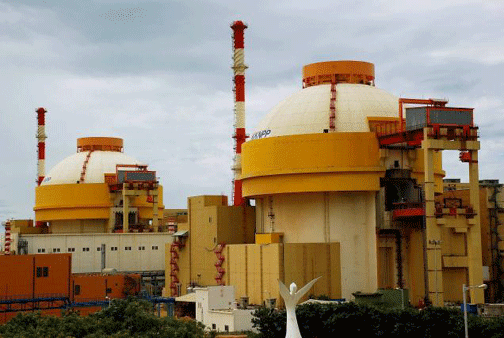
Tamil Nadu flags concern over spent nuclear fuel storage at Kudankulam site https://indianexpress.com/article/cities/chennai/tamil-nadu-flags-concern-over-spent-nuclear-fuel-storage-at-kudankulam-site-7780809/
Chief Minister M K Stalin flagged the issue with Prime Minister Narendra Modi in a letter about the issue pertaining to the power plant located in Tamil Nadu’s Tirunelveli district.
The Tamil Nadu government on Friday opposed the Nuclear Power Corporation of India Limited’s proposal to store spent nuclear fuel (SNF) at the Kudankulam Nuclear Power Plant (KNPP) site and suggested it be sent back to Russia, according to an earlier agreement or store it in an uninhabited area.
Chief Minister M K Stalin flagged the issue with Prime Minister Narendra Modi in a letter about the issue pertaining to the power plant located in Tamil Nadu’s Tirunelveli district.
Six nuclear power reactors of 1000 MW each are envisaged in this project. Out of the six, units 1 & 2 have already been commissioned, while 3 & 4 are under construction and units 5 & 6 are yet to be established, Stalin said.
The Nuclear Power Corporation of India Ltd. proposes to construct Away from Reactor (AFR) facilities in the nuclear power plant site itself for the storage of the SNF generated from all six reactors,” the Chief Minister said.
In this regard, I wish to inform that when the Ministry of Environment, Forests and Climate Change had earlier accorded permission to Units 1 & 2, the agreement was to collect and store the spent fuel temporarily within the unit’s premises (At Reactor) and then send it back to the country of origin, Russia,” he said.
However, it was subsequently decided to store the SNF permanently in the AFR facility to be located within the unit premises. “This decision was taken without consulting the state government,” he said.
Stalin told the Prime Minister that there was “deep concern and apprehensions” among the people of Tamil Nadu, including various political parties, regarding the hazards and potential danger of the AFR storage facility of the SNF within the plant premises.
Several such facilities across the world have faced accidents leading to “disastrous impacts” on the environment and the people residing in and around such plants, he said.
The local people are apprehensive of the fallouts and have been protesting against the AFR facilities within the complex.
“Therefore, I request that in the interest of public safety, health and welfare of the people of Tamil Nadu, action may be taken to transport back the SNF to Russia. This must not only be for units 1 & 2, but also for the subsequent four units. In case this is not a feasible option, the spent fuel may be permanently stored in a Deep Geological Repository (DGR) in an uninhabited and ecologically non-sensitive area,” the Chief Minister told Modi.
Legal action on Fukushima nuclear disaster’s impact on health
 | |||

Fukushima Disaster’s Impact on Health Will Be Challenged in Court https://thediplomat.com/2022/02/fukushima-disasters-impact-on-health-will-be-challenged-in-court/
A link between radiation from the Fukushima nuclear disaster and cancer will be the focal point of the civil court case against operator TEPCO. By Thisanka Siripala, February 17, 2022
Almost 11 years have passed since the Fukushima Daiichi nuclear power plant catastrophe. But even as Fukushima prefecture gets ready to launch a new revitalization slogan – “Making Fukushima’s reconstruction a reality one step at a time” – it is still struggling to overcome the lingering aftereffects of the accident. Earlier this month, a group of six men and women diagnosed with thyroid cancer as children filed a class action case against Tokyo Electric Power Company (TEPCO), seeking $5.4 million in compensation.
Eastern Japan was hit by a massive magnitude 9.1 earthquake and 15-meter tsunami on March 11, 2011. The disaster shut off power and cooling to three reactors at the Fukushima Daiichi nuclear power plant, triggering the release of radiation for up to six days.
The plaintiffs, who are aged between 17 and 27, are seeking to hold TEPCO responsible for the thyroid cancer they developed. Two have had one side of their thyroid removed and four others have had a complete thyroidectomy and are planning or undergoing radiation therapy. The treatment has forced them to drop out of school or college and give up on their dreams. The plaintiffs argue that their thyroid cancer has created barriers to their education and employment as well as marriage and starting a family.
The Fukushima Daiichi meltdown was the worst nuclear accident since Chernobyl in 1986, which was followed by a spike in cancer cases in the region. In Japan a health survey conducted by the Fukushima prefecture found 266 cases of cancer among the 380,000 people aged under 18 at the time of the accident. The lawyers representing the plaintiffs argue that pediatric thyroid cancer is extremely rare, with an annual incident rate of two cases in one million people
The plaintiffs added that in the past decade they have been forced to stay silent due to social pressure and the risk of public outrage over speaking out about the connection between the Fukushima nuclear accident and their thyroid cancer.
The Federation of Promotion of Zero-Nuclear Power and Renewable Energy, a civic group that includes five former Japanese prime ministers, sent a letter to the EU urging the elimination of nuclear power. In the letter, they stated that many children are suffering from thyroid cancer as a result of the Fukushima nuclear power plant accident.
However, the Japanese government believes there is no causal link between exposure to radiation from the accident and the children developing thyroid cancer. Prime Minister Kishida Fumio said at a House of Representatives Budget Committee meeting that “it is not appropriate to spread false information that children from Fukushima are suffering from health problems.”
At a press conference Takaichi Sanae, chairperson of the ruling LDP’s Policy Research Council refuted the letter sent by the federation. She stressed the government’s position that the cases of childhood thyroid cancer have been assessed by experts who have determined the accident is unlikely to have caused cancer.
Fukushima prefecture’s expert panel say there could be the possibility of “over-diagnosis” due to increased vigilance after the disaster, suggesting that some patients diagnosed with cancer did not need treatment. They say they are continuing to investigate the nature of each diagnosis. The Ministry of Environment also said they will continue to disseminate knowledge based on scientific findings to dispel rumors about the health effects of radiation.
Last week, the Fukushima reconstruction and revitalization council met to discuss the “diverse needs of the prefecture” and a long term response to support evacuees. Governor of Fukushima Uchibori Masao acknowledged that the prefecture is “facing many difficulties including the reconstruction and rehabilitation of evacuated areas and rebuilding the lives of evacuees and victims of the disaster.” There are also plans to establish a new national research and education organization in Fukushima that will devise measures to prevent and dispel rumors fueling discrimination toward evacuees and Fukushima food.
Taiwan recently lifted its blanket food import ban on Fukushima produce introduced in the wake of the disaster but there are 14 countries and regions that still maintain import restrictions. Additionally, Japan’s decision to discharge more than one million tonnes of low-level radioactive water from the crippled Fukushima nuclear power plant into the sea is another issue attracting negative publicity abroad.
1 This Month



26 September – International Day for the Total Elimination of Nuclear Weapons


PLEASE OPPOSE HR 8255 AND S.3639 – bills would accelerate satellite deployment, with no environmental review or safeguards – https://ncstd5li.quorum.us/campaign/169331/
To see nuclear-related stories in greater depth and intensity – go to https://nuclearinformation.wordpress.com
-
Archives
- September 2026 (245)
- August 2026 (330)
- July 2026 (355)
- June 2026 (287)
- May 2026 (306)
- April 2026 (356)
- March 2026 (251)
- February 2026 (267)
- January 2026 (308)
- December 2025 (358)
- November 2025 (359)
- October 2025 (375)
-
Categories
- 1
- 1 NUCLEAR ISSUES
- business and costs
- climate change
- culture and arts
- ENERGY
- environment
- health
- history
- indigenous issues
- Legal
- marketing of nuclear
- media
- opposition to nuclear
- PERSONAL STORIES
- politics
- politics international
- Religion and ethics
- safety
- secrets,lies and civil liberties
- spinbuster
- technology
- Uranium
- wastes
- weapons and war
- Women
- 2 WORLD
- ACTION
- AFRICA
- Atrocities
- AUSTRALIA
- Christina's notes
- Christina's themes
- culture and arts
- Events
- Fuk 2022
- Fuk 2023
- Fukushima 2017
- Fukushima 2018
- fukushima 2019
- Fukushima 2020
- Fukushima 2021
- general
- global warming
- Humour (God we need it)
- Nuclear
- RARE EARTHS
- Reference
- resources – print
- Resources -audiovicual
- Weekly Newsletter
- World
- World Nuclear
- YouTube
-
RSS
Entries RSS
Comments RSS
 nuclear-news