Radioactive cesium found in whales off Japanese coast
Whales in Japan Could Face Radiation Poisoning Gamut News 15 June 11 Japan is reporting that two whales, caught by whalers there along the northern coast, had traces of radiation assumed to come from leaks at the damaged nuclear power plant. Out of a total of 17 whales caught off the Pacific coast of Hokkaido, two showed traces of radioactive cesium…..http://gamutnews.com/20110615/25100/whales-in-japan-could-face-radiation-poisoning.html
Fukushima Investigation Panel might be taken over by Nuclear Industry
the possibility of METI officials renewing their push for control of the panel. With Kan expected to step down in the near future, the energy mandarins may still have their way. ( Image below from Japan Nuclear Industry Trying To Hijack Fukushima Investigation Panel )

Japan Nuclear Industry Trying To Hijack Fukushima Investigation Panel by Alexander Higgins – June 13, 2011 Japan’s largest newspaper is reporting that bureaucrats associated with the nuclear industry in Japan are trying to hijack the Fukushima investigation panel.
While the prime minister has rebuked their first attempt, he is expected to step down any time now at which point they will try to take it over again. METI tried to gain influence over Fukushima panel Asashi Shimbum 2011/06/12 – BY SHINJI MURAMATSU Continue reading
Deception and mistrust crippled Japan’s response to Fukushima disaster
many of the residents around the plant who evacuated went north, on the assumption that winds blew south during winter in that area. That took them directly into the radioactive plume, he said — exposing them to the very radiation that they were fleeing….

 In Nuclear Crisis, Crippling Mistrust NYT, By NORIMITSU ONISHI and MARTIN FACKLER, June 12, 2011 “…..it became clear that a prime minister who had built his career on suspicion of the collusive ties between Japan’s industry and bureaucracy was acting nearly in the dark. He had received a confusing risk analysis from the chief nuclear regulator, a fervently pro-nuclear academic whom aides said Mr. Kan did not trust. He was also wary of the company that operated the plant, given its history of trying to cover up troubles… Continue reading
Over-exposure to radiation- six more Fukushima workers reported
Six more Tepco staff exposed beyond limit | The Japan Times Online June 14, 2011 Radiated workers may be drop in Fukushima bucket Kyodo Six more workers involved in efforts to contain the nuclear crisis at the crippled Fukushima No. 1 power plant are feared to have been exposed to radiation above the emergency limit, Tokyo Electric Power Co. said Monday. Continue reading
Public kept in the dark as Taiwan passes unpopular pro nuclear budget
Green Citizen Action Alliance secretary-general Tsuei Su-hsin (崔愫欣) said it was undemocratic for legislators to arbitrarily pass the huge budget when many of the details are kept secret from the public, not to mention barring citizens from observing the voting process from inside the legislature.
Lawmakers pass new nuclear funding, Taipei Times, By Shih Hsiu-chuan and Lee I-chia14 June The legislature yesterday voted down a set of anti-nuclear motions proposed by the Democratic Progressive Party (DPP). Holding just one-third of the legislative seats, the DPP failed in 11 attempts to block the use of nuclear power, despite support from anti-nuclear activists who have staged a protest outside the legislature since Sunday night. Continue reading
The problem of Pakistan’s risk of nuclear terrorism
Pakistan nuclear terror: an interview with Stanford’s Scott SaganA leading expert on South Asian nuclear security discusses the risks of terrorists seizing materials from Pakistan’s arsenal.Global Post,David CaseJune 13, 2011“…… To get a better sense of the risks that the arsenal could fall into terrorist hands, GlobalPost spoke with Scott D. Sagan, one of the world’s leading authorities on Pakistan’s nuclear program….. “I think that the security of both Pakistani nuclear weapons and Pakistani fissionable will remain a serious concern for the United States and all international actors….. Continue reading
Injustice of nuclear waste near Taiwan’s indigenous people
it was unfair for Aborigines, who usually consume less energy than other people in Taiwan, to be exposed to the dangers of coal mines in the past, and now nuclear waste….
Lawmakers pass new nuclear funding, Taipei Times, By Shih Hsiu-chuan and Lee I-chia 14 June “……Pani (拔耐), an Aboriginal woman and cofounder of Raging Citizens Act Now, provided a clear picture of the implications of nuclear energy for ordinary citizens. Continue reading
India’s unrealistic nuclear power plans
Nuclear trade with India risks boosting arms race – The West Australian,Scott Ludlam,13 June 11 “……I have spent time in India studying the nuclear industry, which is famous for its unrealistic projections of future civil nuclear prospects. Continue reading
100 anti-nuclear rallies across Japan’s cities
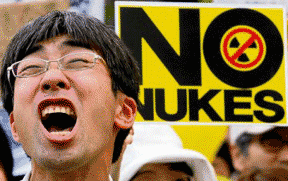 around 100 anti-nuclear events were staged nationwide, including in the western cities of Osaka and Hiroshima, which were devastated by a US atomic bomb in 1945. In the capital an estimated 6000 demonstrators, some carrying placards reading “We don’t want nuclear power plants”, marched by the head office of the Fukushima plant’s operator, Tokyo Electric Power Company (TEPCO), in a rally organised by the Japan Congress against Atomic and Nuclear Bombs..
Japan marks 3 months of pain News.com.au AAP * June 12, 2011 THOUSANDS of people rallied in Japan as the country marked three months since its horror quake and tsunami. Radiation continues to leak from the crippled Fukushima Daiichi nuclear power plant, 225 kilometres northeast of the capital, amid simmering public frustration over the government’s slow response to the triple catastrophe…. Continue reading
Lingering radioactive disaster for Japan’s ‘no go’nuclear zone
 The narrow strip of hilly coastal country between Fukushima City – a metropolis of 2 million – and the crippled Daiichi nuclear plant on Japan’s east coast, is a no-go zone occupied by an invisible enemy – potentially life-threatening radiation. It is in the ground, in the atmosphere and in the sewerage…..
‘Exploding clouds of radioactive steam and debris were swept by strong winds across a broad arch of countryside, including Iitate and Minamisoma. Mountain forests, streams, rice fields, school grounds and houses were contaminated
 A long wait for solace in a ravaged land, Sydney Morning Herald, Russell Skelton, June 11, 2011 Almost 100 days since the earthquake and tsunami devastated Japan, the nation struggles to give hope to its citizens Continue reading
Sri Lanka’s fears of nuclear radiation from India’s nuclear plant
the chance of a radiation affecting Sri Lanka is higher than places in India, because the former comes within 30-40 kilometres of India’s plant in Tamil Nadu.
India’s N-plan worries Lanka, seeks help for radiation safety, Business Standard, Shine Jacob / Kolkata June 13, 2011, A shock in Fukushima, Japan, was causing fear waves across the world and now even in Sri Lanka, which has no nuclear reactors at all. Concerned over the nuclear programmes in South India, Sri Lanka has sought India’s assistance in developing a radiation monitoring and safety centre in the north-western part of that country. Continue reading
Radioactive strontium found in groundwater and sea near Fukushima
 High level of strontium found at Fukushima plant | The Japan Times OnlineJune 13, 2011 Kyodo, Radioactive strontium up to 240 times the legal concentration limit has been detected in seawater samples collected near an intake at the crippled Fukushima Daiichi nuclear plant, Tokyo Electric Power Co. said Sunday.
The utility said the substance was also found in groundwater near the plant’s Nos. 1 and 2 reactors. The government’s Nuclear and Industrial Safety Agency said it is the first time that the substance has been found in groundwater.The agency said it is necessary to carefully monitor the possible effects of the strontium on fishery products near the plant.
Strontium tends to accumulate in bones and is believed to cause bone cancer and leukemia….High level of strontium found at Fukushima plant | The Japan Times Online
Disillusion of Japanese over TEPCO and Fukushima radiation
A long wait for solace in a ravaged land, Sydney Morning Herald, Russell Skelton, June 11, 2011″……..Emotions towards the government and some local authorities vary from fury to resignation. People are incensed by dithering politicians, and last week’s challenge to Prime Minister Kan’s leadership was seen as displaying callous disregard for the national recovery effort.
There is widespread contempt for the mostly anonymous, seemingly slippery and always secretive management of TEPCO. The company has a long history of dodgy auditing and cover-ups at the Fukushima plant.Since the nuclear meltdown, some 80,000 people have been evacuated from the towns and villages surrounding the crippled power station. Nobody interviewed by The Saturday Age within 200 kilometres of the reactor feels safe or has confidence in the government to effectively manage the recovery and reconstruction.
At first, the dithering Democratic Party government set the evacuation zone around the Fukushima plant at 10 kilometres, then 20 and by the end of this month it will be extended to a recommended but voluntary 30 kilometres. The International Atomic Energy Agency has said the exclusion zone should be 40 kilometres, and Australia’s radiation protection authority has suggested a precautionary zone of 80 kilometres….
A long wait for solace in a ravaged land
Mainstream media not reporting the full story on Fukushima disaster
 Water remains a primary complication; 15 million highly radioactive gallons await proper treatment and storage. That’s equivalent to about thirty highly contaminated Olympic-sized swimming pools. It is unclear how much of this water has already been released into the Pacific Ocean, but it is likely in the hundreds of thousands, if not millions of gallons.
Japan Update, Footprints Sara Barczak , 10 June 11 Unfortunately, the mainstream media is reporting increasingly less on the nuclear disaster at the Fukushima Dai-ichi plant in Japan. Nonetheless, radioactivity continues to be released into the air and water at the severely damaged facility. Continue reading
High radiation levels in No. 3 reactor force workers to stop nuclear cleanup
 Fukushima: Radiation in No. 3 reactor too high for work H5 NI Via NHK: Radiation in No. 3 reactor too high for work. The operator of the damaged Fukushima Daiichi nuclear plant says radiation levels in one of the reactor buildings remain too high for workers to do their jobs.
Tokyo Electric Power Company, or TEPCO, sent 9 workers into the No.3 reactor building for about 20 minutes on Thursday, in a bid to start stabilizing the reactor. The utility plans to inject nitrogen gas into the containment vessel to prevent accumulated hydrogen from causing an explosion. It also intends to install a system to cool the reactor with circulating water.
The workers withdrew after measuring radiation of 100 millisieverts per hour near the reactor’s containment vessel. TEPCO says it intended to limit the workers’ exposure to below 5 millisieverts per hour. But as all 9 received higher doses, it has suspended work while considering a course of action…http://crofsblogs.typepad.com/h5n1/2011/06/fukushima-radiation-in-no-3-reactor-too-high-for-work.html
1 This Month



Shut down the radiation-damaged Heysham nuclear reactors now
To see nuclear-related stories in greater depth and intensity – go to https://nuclearinformation.wordpress.com

Say No to NASA’s Reckless Nuclear Reactor on the Moon
Say No to NASA’s Reckless Nuclear Reactor on the Moon
-
Archives
- October 2026 (256)
- September 2026 (339)
- August 2026 (330)
- July 2026 (355)
- June 2026 (287)
- May 2026 (306)
- April 2026 (356)
- March 2026 (251)
- February 2026 (267)
- January 2026 (308)
- December 2025 (358)
- November 2025 (359)
-
Categories
- 1
- 1 NUCLEAR ISSUES
- business and costs
- climate change
- culture and arts
- ENERGY
- environment
- health
- history
- indigenous issues
- Legal
- marketing of nuclear
- media
- opposition to nuclear
- PERSONAL STORIES
- politics
- politics international
- Religion and ethics
- safety
- secrets,lies and civil liberties
- spinbuster
- technology
- Uranium
- wastes
- weapons and war
- Women
- 2 WORLD
- ACTION
- AFRICA
- Atrocities
- AUSTRALIA
- Christina's notes
- Christina's themes
- culture and arts
- Events
- Fuk 2022
- Fuk 2023
- Fukushima 2017
- Fukushima 2018
- fukushima 2019
- Fukushima 2020
- Fukushima 2021
- general
- global warming
- Humour (God we need it)
- Nuclear
- RARE EARTHS
- Reference
- resources – print
- Resources -audiovicual
- Weekly Newsletter
- World
- World Nuclear
- YouTube
-
RSS
Entries RSS
Comments RSS

