Cancer in nuclear workers even though radiation exposure was low
The current guidelines for workers’ compensation due to radiation exposure only certify leukemia among various types of cancer. In these cases compensation is granted only when an applicant is exposed to more than 5 millisieverts of radiation a year


 Nuclear plant workers developed cancer despite lower radiation exposure than legal limit, Mainichi Daily News, Japan) July 27, 2011 Of 10 nuclear power plant workers who have developed cancer and received workers’ compensation in the past, nine had been exposed to less than 100 millisieverts of radiation, it has been learned. Continue reading
Always a most dangerous nuclear plant – Fukushima
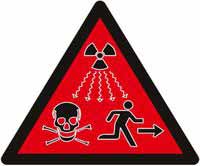 SPECIAL REPORT-Fukushima long ranked Japan’s most hazardous nuclear plant One of 5 worst nuclear plants in world for exposure to radiation
* Tepco prioritised cost-savings over radiation standard
* Tepco says old plants like Fukushima have high radiation
* Foreign workers used to avoid exposing staff to high radiation
* Improvements made at Fukushima before disaster hit
By Chisa Fujioka and Kevin Krolicki, TOKYO, July 26 (Reuters) – Japan’s Fukushima Daiichi nuclear plant ranked as one of the most dangerous in the world for radiation exposure years before it was destroyed by the meltdowns and explosions that followed the March 11 earthquake. For five years to 2008, the Fukushima plant was rated the most hazardous nuclear facility in Japan for worker exposure to radiation and one of the five worst nuclear plants in the world on that basis. The next rankings, compiled as a three-year average, are due this year. Reuters uncovered these rankings, privately tracked by Fukushima’s operator Tokyo Electric Power, in a review of documents and presentations made at nuclear safety conferences over the past seven years…..
As Japan debates its future energy policy after the worst nuclear accident since Chernobyl, a Reuters review of the long-troubled record at Fukushima shows how hard it has been to keep the country’s oldest reactors running in the best of times. It also shows how Japan’s nuclear establishment sold nuclear power to the public as a relatively cheap energy source in part by putting cost-containment ahead of radiation safety over the past several decades. …..http://www.reuters.com/article/2011/07/26/idUSL3E7IE3Z920110726—
USA’s secret efforts to prevent Pakistan’s nuclear arsenal
Japanese media self censorship on Fukushima nuclear crisis
Journalist Takeharu Watai warned that many media organizations have been indulging in what appears to be “self-censorship” in covering the no-go zone around the crippled nuclear power station and its premises due to various constraints.
Symposium critical of media coverage on nuclear plant crisis, Mainichi Daily News, Japan) July 26, 2011, A symposium themed on nuclear power plants and the media was held in Tokyo on the heels of the accident at the Fukushima No. 1 Nuclear Power Plant. Continue reading
Japan about to censor Internet news on nuclear radiation?
On June 17, 2011 the Japanese Parliament passed “The Computer Network Monitoring Law” . Prof. Ibusuki of Seijo Univ. Law Dept. comments that “The Computer Network Monitoring Law will enable the police to monitor anyone’s internet activity without restriction.”…
 The question is, will METI draw the line at “clarifying” erroneous information, or will it act to clamp down and suppress sources of information that it finds inconvenient?
New Japan Law Cleanses Bad Nuclear News, UK PROGRESSIVE, THEODORA FILIS | JULY 24, 2011 Friday, July 15, the Ministry of Industry and Trade (METI) – Agency for Natural Resources and Energy, opened a call for bids (tender) regarding the “Nuclear Power Safety Regulation Publicity Project”, for contractors to monitor blogs and tweets posted about nuclear power and radiation……. Continue reading
How USA conned Japan into developing nuclear energy
 U.S. used atomic power cooperation to remedy Japan’s ‘ignorance’, Mainichi Daily News, Japan) July 24, 2011, TOKYO (Kyodo) — The United States used atomic power cooperation with Japan in the 1950s to ease the Japanese public’s aversion to nuclear weapons and remedy their “ignorance” about nuclear power, declassified U.S. papers showed Saturday. Continue reading
Seeking a new and democratic reform of Japan’s energy system
We now need to find viable alternatives to nuclear power. It is clearly necessary to make greater use of alternative power sources, such as renewable energy, small gas-powered turbines and surplus power from independent generators installed by companies and rooftop solar panels at households……replace the centralized generation approach with a decentralized system based on distributed energy facilities
To promote such dispersed generation, transmission services should be separated from the production of electric power to ensure fairer operations
 EDITORIAL/ Seeking a society without nuclear power generation: Let consumers regain leadership in developing energy policy, The Asahi Shimbun, July 13
This is the last of a five-part editorial series proposing ways for Japan to achieve a society that does not depend on nuclear power generation for its energy supply. Continue reading
Majority of Japanese want nuclear power to finish
Japanese support PM’s call to do away with nuclear power: poll, Jul 24, 2011, (Reuters) – More than two-thirds of Japanese support Prime Minister Naoto Kan’s call to do away with nuclear power, a media poll showed on Sunday, underscoring growing opposition to atomic energy in the wake of the crisis at the Fukushima Daiichi plant Continue reading
Meeting between North and South Korea
Two Koreas meet to discuss nuclear issue, By Jack Kim and Andrew Quinn, SEOUL/NUSA DUA, Indonesia Jul 22, 2011 (Reuters) – The nuclear envoys of South and North Korea met on the sidelines of an Asian forum in Bali on Friday, an official in Seoul said, in the first high level contact since tensions spiked on the Korean peninsula last year….. Continue reading
Brief memorial visit to Okuma’s irradiated zone
Wearing full-body protective gear and white face masks because of the continued risk of radiation exposure, the families bowed their heads in silence
Villagers hold memorial in nuke plant’s shadow, The Modesto Bee, By ERIC TALMADGE – Jul. 24, 2011, OKUMA, Japan — Under tight government supervision, dozens of villagers from a town where the Fukushima Dai-ichi nuclear plant is located ventured deep into an irradiated no-man’s land Sunday to hold a belated memorial for friends and relatives killed by Japan’s earthquake and tsunami. Continue reading
Tragedy of a Japanese farmer who cares about his cows
 VIDEO http://www.ukprogressive.co.uk/new-japan-law-cleanses-bad-nuclear-news/article13589.html New Japan Law Cleanses Bad Nuclear News,,UK PROGRESSIVE THEODORA FILIS | JULY 24, 2011 “……..Uncanny Terrain: Yoshizawa’s ranch is 14km downwind from the Fukushima Daiichi Nuclear Power Plant. The government ordered him to kill his 300 cows. Most of his neighbors’ animals are gone, but some have been released and joined his herd. Yoshizawa refuses to kill his cows. He wants them to be studied for the effects of radiation. Continue reading
Nuclear industry’s massive costs have been underestimated
Kenichi Oshima, a professor of environmental economics and policy at Ritsumeikan University, has done some calculations and has reached a completely different conclusion….
“If we were to funnel funds earmarked for reprocessing and the nuclear budget, it would be very feasible to get power generation with renewable sources of energy off the ground.”
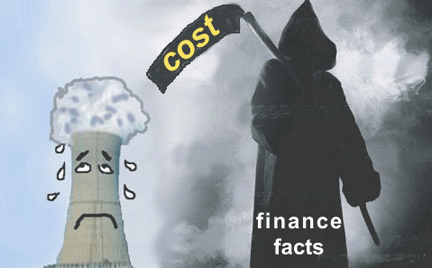
Contrary to power company figures, cost of nuclear power generation highest: research Mainichi Daily News, 23 July 11 Utility companies across the country continue to tout the low cost of nuclear energy on their websites. Continue reading
All radioactive beef to be bought by Japanese govt?
Government may buy all radioactive beef, Asahi.com 23 July 11, The central government is considering buying all beef with levels of radioactive cesium exceeding government standards in an effort to try to address rising consumer concern and falling prices for Japanese beef. Continue reading
Move to keep old Japanese nuclear reactors beyond use by date
UPDATE 3-Japan utilities push to extend life of nuclear plants, Jul 22, 2011
* Chubu says to beef up tsunami defences at Hamaoka by Dec 2012
* Debate intensifies as safety fears square off vs economy worries
By Kaori Kaneko and Osamu Tsukimori, TOKYO, July 22 (Reuters) – Two Japanese utilities moved on Friday to extend the life of reactors at a pair of central coastal nuclear plants, fuelling already fierce debate over energy policy in the wake of the Fukushima radiation crisis.
Doubts on the credibility of Japan’s nuclear regulator
The errors will adversely affect the operations of all nuclear power stations across the country, casting a damper on the planned stress tests from the outset..
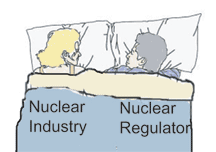 ..Goshi Hosono, state minister for the nuclear crisis, is aiming to separate NISA from its parent body, the Economy, Trade and Industry Ministry, which is promoting nuclear power generation in Japan. However, structural changes alone are insufficient. Whether NISA can function as a nuclear safety regulator will be severely tested.
Errors in nuclear plant data highlight checking system insufficiencies, Mainichi Daily News, By Takuji Nakanishi, Mainichi Shimbun, 23 July 2011 The discovery of errors in data incorporated in a report on the No. 3 reactor at the Genkai Nuclear Power Plant in Saga Prefecture illustrates problems with its operator’s checking system and the government regulator’s ability to examine safety data. Continue reading
1 This Month
23-25 October – on Zoom – World BEYOND War’s annual global conferenc


Shut down the radiation-damaged Heysham nuclear reactors now
To see nuclear-related stories in greater depth and intensity – go to https://nuclearinformation.wordpress.com

Say No to NASA’s Reckless Nuclear Reactor on the Moon
Say No to NASA’s Reckless Nuclear Reactor on the Moon

-
Archives
- October 2026 (231)
- September 2026 (339)
- August 2026 (330)
- July 2026 (355)
- June 2026 (287)
- May 2026 (306)
- April 2026 (356)
- March 2026 (251)
- February 2026 (267)
- January 2026 (308)
- December 2025 (358)
- November 2025 (359)
-
Categories
- 1
- 1 NUCLEAR ISSUES
- business and costs
- climate change
- culture and arts
- ENERGY
- environment
- health
- history
- indigenous issues
- Legal
- marketing of nuclear
- media
- opposition to nuclear
- PERSONAL STORIES
- politics
- politics international
- Religion and ethics
- safety
- secrets,lies and civil liberties
- spinbuster
- technology
- Uranium
- wastes
- weapons and war
- Women
- 2 WORLD
- ACTION
- AFRICA
- Atrocities
- AUSTRALIA
- Christina's notes
- Christina's themes
- culture and arts
- Events
- Fuk 2022
- Fuk 2023
- Fukushima 2017
- Fukushima 2018
- fukushima 2019
- Fukushima 2020
- Fukushima 2021
- general
- global warming
- Humour (God we need it)
- Nuclear
- RARE EARTHS
- Reference
- resources – print
- Resources -audiovicual
- Weekly Newsletter
- World
- World Nuclear
- YouTube
-
RSS
Entries RSS
Comments RSS

