US President Donald Trump says South Korea has approval to build nuclear-powered submarine
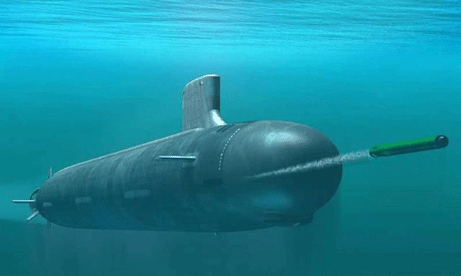
30 Oct 25, https://www.abc.net.au/news/2025-10-30/south-korea-permission-to-build-nuclear-submarines/105951210
In short:
Korea has been given permission by Donald Trump to build a nuclear powered submarine.
The permission is a dramatic move that would admit South Korea to a small group of nations that possess this type of vessel.
The US president met with leader on his ongoing tour of Asia.
US President Donald Trump says he has given South Korea approval to build a nuclear-powered submarine, a dramatic move that would admit Seoul to a small club of nations possessing such vessels.
Mr Trump, who has been meeting with South Korean President Lee Jae Myung and other regional leaders during his visit, also said Seoul had agreed to buy vast quantities of US oil and gas.
The submarine will be built in a Philadelphia shipyard, where South Korean firms have increased investment, Mr Trump wrote on social media.
Mr Trump and Mr Lee finalised details of a fraught trade deal at a summit in South Korea on Wednesday.
Mr Lee had also been seeking US permission for South Korea to reprocess nuclear fuel.
Nuclear restrictions easing?
Seoul is barred from reprocessing without US consent, under a pact between the countries.
“I have given them approval to build a nuclear-powered submarine, rather than the old-fashioned and far less nimble, diesel-powered submarines that they have now,” Mr Trump wrote on his Truth Social platform.
South Korea’s Industry Ministry said its officials had not been involved in any detailed discussions about building the submarines in Philadelphia.
While South Korea has a sophisticated shipbuilding industry, Mr Trump did not spell out where the propulsion technology would come from for a nuclear-powered submarine, which only a handful of countries possess.
The US has been working with Australia and Britain on a project for Australia to acquire nuclear-powered submarines, involving technology transfers from the United States.
The US has so far only shared that technology with Britain, back in the 1950s.
Mr Lee said when he met Mr Trump on Wednesday that allowing South Korea to build several nuclear-powered submarines equipped with conventional weapons would significantly reduce the burden on the US military.
He also asked for Mr Trump’s support to make substantial progress on South Korea being allowed to reprocess spent nuclear fuel, or on uranium enrichment.
This is not allowed under the nuclear agreement between the two countries, even though South Korea possesses nuclear reactors to generate power.
Approval raises questions
Mr Lee’s predecessors had wanted to build nuclear-powered submarines, but the US had opposed this idea for decades.
Daryl Kimball, executive director of the Washington-based Arms Control Association, said the issue of South Korea acquiring such submarines “raises all sorts of questions.”
“As with the AUKUS deal, (South Korea) is probably looking for nuclear propulsion services suitable for subs, including the fuel, from the US,” he said.
Mr Kimball said such submarines usually involved the use of highly-enriched uranium and would “require a very complex new regime of safeguards” by the International Atomic Energy Agency, which has a key role in implementing the Treaty on the Non-Proliferation of Nuclear Weapons (NPT).
“It remains technically and militarily unnecessary for South Korea to acquire the technology to extract weapons-usable plutonium from spent fuel or to acquire uranium enrichment capabilities, which can also be used to produce nuclear weapons,” he said.
“If the United States seeks to prevent the proliferation of nuclear weapons worldwide, the Trump administration should resist such overtures from allies as strongly as it works to deny adversary access to these dual-use technologies.”
Jenny Town, who heads 38 North, a Korea-focused research group in Washington, said it was inevitable that South Korean demands for US cooperation on nuclear issues would grow, given recent allegations about Russian technical cooperation to help nuclear-armed North Korea make progress towards acquiring nuclear-powered submarines.
Kim Dong-yup, a North Korea studies professor at Kyungnam University, said the Lee-Trump summit had formalised a “transaction scheme of security guarantees and economic contributions” for maintaining the extended deterrence and alliance in exchange for South Korea’s increased defence spending and nuclear-powered subs and US investments.
“In the end, this South Korea-US summit can be summarised in one word: the commercialisation of the alliance and the commodification of peace,” he said.
“The problem is that the balance of that deal was to maximise American interests rather than the autonomy of the Korean Peninsula.”
How North Korea outsmarts US intelligence agencies—and what they should do to adapt

Bulletin, By Lauren Cho | October 27, 2025
In the summer of 2017, the United States learned a humbling lesson. For years, American intelligence agencies had assessed that North Korea would need several more years—until 2020 or even 2022—before it could field a missile capable of striking the continental United States. Then, on July 4, Pyongyang launched an intercontinental ballistic missile that reached deep space and re-entered at high velocity.
By that September, North Korea had detonated a hydrogen bomb more than 15 times stronger than the weapon that destroyed Hiroshima. The Central Intelligence Agency and its sister agencies had anticipated that this day would eventually come. But their inability to predict the rapid pace of advancement remains one of the starkest intelligence failures of recent decades. It was not simply a matter of bad luck or faulty technical analysis. It was the result of two forces that intersect again and again in the history of US assessments of North Korea’s nuclear program: Pyongyang’s deliberate use of strategic deception, and the institutional inertia of the US intelligence community.
From the first suspicions of a clandestine weapons program in the 1980s through the collapse of the 1994 Agreed Framework, the inconclusive Six-Party Talks, and the dramatic summits of 2018–2019, a familiar cycle has emerged: Washington enters negotiations determined to halt or roll back North Korea’s program. North Korea agrees on paper but continues developing weapons in secret, denying violations and then unveiling new capabilities with a missile test or nuclear detonation. The agreement collapses, and Washington returns to the negotiating table with hopes of restoring momentum toward denuclearization.
Each turn of this cycle reveals a recurring blind spot. American analysts focus on observable indicators and static assumptions, while North Korea manipulates visual evidence and creates ambiguity to gain time.
Defining intelligence. To the public and political leaders, any unpleasant surprise is an intelligence failure. Scholars define it more precisely. Richard K. Betts, an American political scientist who is one of the leading thinkers on this issue, has argued that failures are not rare anomalies but inevitable outcomes of systemic, cognitive, and organizational barriers. Intelligence agencies must operate under conditions of uncertainty and ambiguous evidence. The greater the ambiguity, the greater the influence of preexisting beliefs.
In the case of North Korea, ambiguity is not simply an accident involving limited information. It is a condition carefully constructed by the regime.
Strategic deception—deliberate manipulation of information to influence an adversary’s perceptions—has become a central component of North Korea’s nuclear armament strategy. American intelligence agencies have repeatedly struggled to adapt to this strategy, because they are weighed down by bureaucratic norms that prize continuity over change and reactivity over anticipation.
Strategic deception is most effective when the target already wants to believe a certain narrative……………………………………………………………………………………………………………………………………………………………………..
Rethinking US intelligence on North Korea. What, then, is to be done? Absolute accuracy in intelligence is unattainable, but incremental improvement is possible. The patterns seen in previous US-North Korean relations suggest several possible reforms. First, intelligence organizations must build for adaptability, not stability. They must prioritize agility, encourage analysts to test assumptions, reward dissenting perspectives, and treat ambiguity as a strategic variable. Rather than forcing ambiguous evidence into existing frameworks, agencies must recognize that adversaries actively manipulate ambiguity.
Also, analysts need more than satellite imagery and signals intercepts. They need linguistic, cultural, and psychological expertise to decode the narratives that adversaries craft. Deception is a cognitive process, not just a technical one. Countering it requires cognitive tools. Intelligence that is accurate but ignored is still a failure.
Finally, agencies must improve communication with policy makers, making uncertainty clear and resisting the urge to present false precision. The goal is not to eliminate ambiguity but to help decision makers understand it and prepare for multiple scenarios……………………………. https://thebulletin.org/2025/10/how-north-korea-outsmarts-us-intelligence-agencies-and-what-they-should-do-to-adapt/?utm_source=ActiveCampaign&utm_medium=email&utm_content=How%20North%20Korea%20outsmarts%20US%20intelligence&utm_campaign=20251024%20Monday%20Newsletter%20%28Copy%29
Three workers at nuclear fuel reprocessing plant possibly exposed to internal radiation

AOMORI – https://www.japantimes.co.jp/news/2025/10/29/japan/society/nuclear-plant-internal-exposure/
Three workers may have suffered internal radiation exposure while working in a spent nuclear fuel reprocessing plant in Rokkasho, Aomori Prefecture, Japan Nuclear Fuel has said.
The men in their 20s to 40s are employees of a partner company sent to work in a controlled area of the plant, according to an announcement by Japan Nuclear Fuel on Monday.
Radiation was detected inside the nasal cavity of one of the three, who is in his 40s, prompting the company to check whether all three had been internally exposed.
None of them has reported any change in their health condition so far, Japan Nuclear Fuel said.
According to the company, the three were working to replace filters that remove radioactive materials from gas emitted from a tank, in a building used for denitration of uranium-plutonium mixed solution, when radiation levels rose at around 11:10 a.m. Friday.
After they left the area, as instructed, contamination was found on the outer surface of the filters of their protective masks.
When contamination is detected, workers are typically instructed to cover air intake filters with tape to prevent further contamination and replace the filter while holding their breath.
However, two of the three breathed without filters for up to three minutes, according to Japan Nuclear Fuel. It is not clear when that occurred.
The company is still investigating why the two men breathed without filters. It is also analyzing urine and stool samples from the three workers to determine whether internal radiation exposure occurred, and investigating the cause of the increase in radiation levels.
Stabilizing the U.S.-China Rivalry.

| RAND think tank, famous for its influential policy papers which have shaped US-Russian relations, has released an eye-opening call for a change of course on China. This comes by way of the latest Trump-China escalations which, it appears, have greatly worried insiders of the ‘deep state’ system; enough so that for once they have begun swallowing their pride and envisioning a calmer, more placating approach toward China so as not to upset the global status quo too much. |
Michael J. Mazarr, Amanda Kerrigan, Benjamin Lenain, Oct 14, 2025, https://www.rand.org/pubs/research_reports/RRA4107-1.html?utm_source=substack&utm_medium=email
The geopolitical rivalry between the United States and China embodies risks of outright military conflict, economic warfare, and political subversion, as well as the danger that tensions between the world’s two leading powers will destroy the potential for achieving a global consensus on such issues as climate and artificial intelligence. Moderating this rivalry therefore emerges as a critical goal, both for the United States and China and for the wider world.
The authors of this report propose that, even in the context of intense competition, it might be possible to find limited mechanisms of stabilization across several specific issue areas. They offer specific recommendations both for general stabilization of the rivalry and for three issue areas: Taiwan, the South China Sea, and competition in science and technology.
Key Findings
Several broad principles can guide efforts to stabilize intense rivalries
- Each side accepts that some degree of modus vivendi must necessarily be part of the relationship.
- Each side accepts the essential political legitimacy of the other.
- In specific issue areas, especially those disputed by the two sides, each side works to develop sets of shared rules, norms, institutions, and other tools that create lasting conditions of a stable modus vivendi within that domain over a specific period (such as three to five years).
- Each side practices restraint in the development of capabilities explicitly designed to undermine the deterrent and defensive capabilities of the other in ways that would create an existential risk to its homeland.
Each side accepts some essential list of characteristics of a shared vision of organizing principles for world politics that can provide at least a baseline for an agreed status quo.- There are mechanisms and institutions in place — from long-term personal ties to physical communication links to agreed norms and rules of engagement for crises and risky situations — that help provide a moderating or return-to-stable-equilibrium function.
Recommendations
Six broad-based initiatives can help moderate the intensity of the U.S.-China rivalry
- Clarify U.S. objectives in the rivalry with language that explicitly rejects absolute versions of victory and accepts the legitimacy of the Chinese Communist Party.
- Reestablish several trusted lines of communication between senior officials.
- Improve crisis-management practices, links, and agreements between the two sides.
- Seek specific new agreements — a combination of formal public accords and private understandings — to limit the U.S.-China cyber competition.
Declare mutual acceptance of strategic nuclear deterrence and a willingness to forswear technologies and doctrines that would place the other side’s nuclear deterrent at risk.- Seek modest cooperative ventures on issues of shared interest or humanitarian concern.
More-specific strategies should guide efforts to stabilize the issues of Taiwan, the South China Sea, and competition in science and technology
- Stabilizing the Taiwan issue should focus on creating the maximum incentive for Beijing to pursue gradual approaches toward unification.
- For the South China Sea, combine deterrence of military escalation with intensified multilateral and bilateral diplomacy to create a medium-term route to a peaceful solution as the default international process and expectation.
- In the U.S.-China science and technology rivalry, manage the worst aspects of emerging technologies for mutual security and the condition of the rivalry, and step back from the most extreme versions of efforts to undermine the other side’s progress.
Japan Weighs Nuclear-Powered Submarines Amid Regional Tensions
Rojoef Manuel. The Defense Post, October 10, 2025
Japan is considering developing nuclear-powered submarines after a state-backed panel formally recommended research into “next-generation propulsion” systems for the Japan Maritime Self-Defense Force (JMSDF).
Submitted to the Ministry of Defense last September, the proposal marks the first time an official advisory group has opened the door to studying nuclear propulsion, signaling a potential departure from Japan’s long-standing policy limiting military use of nuclear energy, Army Recognition reported……………………………………………………………………………………
Legal, Political Barriers Remain
Despite the new strategy, Japan’s postwar laws still make such development difficult. The Atomic Energy Basic Act restricts nuclear technology to peaceful uses, while Japan’s “Three Non-Nuclear Principles” forbid manufacturing, acquiring, or receiving nuclear weapons.
Chief Cabinet Secretary Yoshimasa Hayashi also reiterated last year that the East Asian government has “no plans to possess nuclear submarines” under its current law……………………………………………………………. https://thedefensepost.com/2025/10/10/japan-nuclear-submarines/
Nuclear victims hold global forum in Hiroshima

Oct 7, 2025, HIROSHIMA – https://www.japantimes.co.jp/news/2025/10/07/japan/nuclear-victims-forum-hiroshima/
Victims of atomic bombings and nuclear tests gathered in Hiroshima to discuss eliminating nuclear damage, 80 years after the atomic bombings of the city of Hiroshima and Nagasaki during World War II.
The global forum, hosted by two antinuclear organizations over two days through Monday, adopted a declaration stating that nuclear weapons and human beings cannot coexist and demanding that no further nuclear damage be caused on Earth. The event was held for the first time in 10 years.
On Sunday, hibakusha atomic bomb survivors from Hiroshima and South Korea shared their experiences, and participants debated on the issue of uranium mining. A social activist from Jaduguda in eastern India, where the country’s first uranium mine is located, explained regional divisions and health problems among residents, arguing that the chain of nuclear violence starts from uranium mining and that it is always the socially vulnerable who pay the price.
On Monday, participants discussed the U.S. hydrogen bomb tests at Bikini Atoll in the Marshall Islands and the nuclear accident at the Fukushima No. 1 nuclear power plant.
The forum also adopted a declaration calling for giving compensation and rights to nuclear victims, including access to accurate information and participation in policy decision-making processes.
For Haecho and the global citizens aboard the humanitarian flotillas’ safe return and for a Free Palestine!
Oct. 4th, 2025, From the Edges, Gangjeong Mission Station, Association of Gangjeong Villagers Against Jeju Naval Base, Gangjeong Peace Network, The Frontiers, People Making Jeju a Demilitarized Peace Island, St. Francis Peace Center, Civic Exercise Gathering, Jeju Green Party, Inter-Island Solidarity for Peace of the Sea, Hot Pink Dolphins
(Translated by Curry) https://savejejunow.org/for-haecho-and-the-global-citizens-aboard-the-humanitarian-flotillas-safe-return-and-for-a-free-palestine/
It has been over a week since Gangjeong peace activist Haecho set sail as a volunteer aboard the humanitarian flotilla ‘Thousand Madleens to Gaza’ bound for Gaza. The flotilla is expected to reach Gaza’s territorial waters within a week.
We earnestly pray that Haecho, who courageously joined this arduous journey, reaches the Gaza coast, delivers relief supplies like milk powder and food to the starving people, and returns safely. We also strongly demand that the United States and Israel immediately and unconditionally cease the massacre of Palestinians. We strongly urge the South Korean government to take all necessary measures to protect its citizen participating in the humanitarian flotilla.
Since October 7, 2023, Israel’s invasion, massacres, and systematic starvation policy have resulted in the death of approximately 67,000 Palestinians. According to a UN report, one in three people go hungry all day, and one in five households suffer from extreme food shortages. The majority of victims are women, children, and the elderly. The deaths of non-human beings living on Palestinian land and sea cannot be properly documented or quantified.
In July 2024, the International Court of Justice concluded that Israel’s long-term occupation, settlement, and annexation policies in Palestine violate international law. However, the United States has vetoed six UN resolutions calling for a ceasefire in the Gaza Strip. In late September, Trump and Netanyahu presented a ‘Gaza peace plan’ that did not explicitly mention the establishment of a Palestinian state as demanded by the international community. This peace plan effectively demands the unconditional surrender of Hamas, which in fact governs the Gaza Strip, and amounts to nothing less than a deceptive plan for the United States and Israel to permanently dominate Palestine.
The South Korean government remains among the 35 countries out of 193 that have yet to recognize Palestine as a state, despite 158 nations having done so. The South Korean Navy also faced condemnation for inviting Israeli naval commanders to the maritime weapons exhibition held in Busan this past May. Furthermore, Dana Petroleum, wholly owned by the Korean public corporation Korea National Oil Corporation (KNOC), secured exploration rights for gas fields in Palestinian waters illegally sold by Israel. Meanwhile, war weapons companies like Hanwha Systems, Hanwha Aerospace, and Korea Aerospace Industries (KAI) have formed partnerships with Israeli arms firms, complicit in Israel’s massacre of Palestinians. Hanwha Systems is constructing a space center in the Jeju mid-mountain area. Satellites produced there are likely to be used for military purposes, potentially becoming tools for further massacres. Samsung mobile phones distributed in the Middle East and North Africa, including Palestine, came pre-installed with Israeli spyware, victimizing masses of users. HD Hyundai excavators are used to demolish Palestinian homes and build illegal Jewish settlements. The recent proposal by the Korean National Assembly for a ‘Resolution Urging Israel to Halt the Massacre in the Gaza Strip’ at least lessens the shame for those living in a country that has stood with the perpetrator of genocide.
The ‘Thousand Madleens’ humanitarian flotilla (11 ships) and the ‘Sumud Flotilla’ (42 ships) bound for Gaza have carried hundreds of beautiful citizens from over 50 nations who set sail to stop the unrelenting slaughter and starvation, to turn fear into hope. Our friend Haecho is proudly one of them. In a letter before departure, Haecho wrote, “When I embrace my fear, and approach it with different attitudes, I learn that when we feel fear we can also experience a will toward beauty or hope.” This learning and awareness came from sailing the waters of Jeju Island and East Asia, meeting people along the way. “I carry this precious learning and support with me to Gaza,” she stated. She also shares that while participating in the ‘Grand March for Life and Peace’ in Jeju and the ‘Birds and People’s March’ on the mainland, she felt “On the road and on the sea, I feel my body becoming a conduit connecting here and there, me and you, past and future.” She believes that “through solidarity with the people of Jeju, Saemangeum, Okinawa, Taiwan, Hong Kong, Palestine, and countless others, we can break through the blockade imposed by capital and military might.” Having visited Gangjeong as a teen, Haecho, now in her twenties, participated in the 2023 Gong Pyeong Hae (共平海) voyage connecting Taiwan, Okinawa and Jeju, the 2024 voyage of the Golden Rule ship—a symbol of the anti-nuclear movement—and the planned 2025 Jeju-DMZ voyage. Gangjeong and Jeju were her training grounds for peace activism.
On the afternoon of October 3rd, Korean time, news broke that all 42 vessels of the Global Sumud Flotilla, including the Mikeno ship near the Gaza coast, had been attacked and seized by Israel. The ‘Thousand Madleens’ flotilla, to which Haecho belongs, is also expected to face raids and seizures, causing grave concern. Citizens worldwide are watching Gaza. Climate activist Greta Thunberg appealed for greater solidarity among citizens, saying, “Be human!” Upon hearing news of the attack on the Sumud flotilla, countless people took to the streets in protest across the globe—in Germany, France, Greece, Tunisia, Turkey, Italy, Argentina, Mexico, and elsewhere. Workers in Genoa, who had already blocked weapons shipments bound for Israel, sealed off railways and train stations. Spain, which had sent its own warship to protect the Gaza humanitarian flotilla, recalled its Israeli diplomat. The Colombian government ordered the expulsion of Israeli diplomats and terminated its free trade agreement with Israel. Turkish prosecutors stated their intent to investigate whether Israel violated international law by arresting over 20 Turkish citizens, specifically regarding deprivation of liberty and seizure of means of transport. The Malaysian Prime Minister held talks with foreign leaders, requesting support for the immediate release of Malaysian activists and firmly demanding an end to Israel’s atrocities and plunder against Palestine. Given the peril faced by its own citizen, one cannot help but compare and closely watch the South Korean government’s future response.
We stand with the countless global citizens who support the humanitarian flotillas to Gaza and demand an end to the U.S. and Israeli occupation and massacre of Palestine. We strongly demand the following from the South Korean government and corporations, the United States, and Israel:
One. Israel must lift the blockade on the Gaza Strip and immediately cease the seizure of civilian vessels! Ensure the safety of the international citizens who were aboard the hijacked humanitarian flotilla and release them all immediately and unconditionally!
One. Israel must guarantee that all relief supplies reach the people of Gaza, who are suffering extreme hardship due to prolonged massacres and starvation policies!
One. The South Korean government and National Assembly must take all measures to protect their citizen aboard the humanitarian flotilla and strongly protest Israel’s violations of international law and human rights abuses!
One. The South Korean government must recognize Palestine as an independent state and cease all cooperation with Israel, a criminal state that thoroughly disregards international law!
One. Korean government agencies and corporations such as Hanwha, Samsung, KAI, HD Hyundai, and Korea National Oil Corporation must immediately cease all cooperation with the Israeli government and companies which are complicit in the massacre of Palestinians!
One. The United States and Israel must withdraw their deceptive Gaza peace plan and cease all aggression and massacres!
Liberation of Gaza is liberation for all!
Liberation of Palestine is liberation for all!
Free Free Palestine!
Peace Without Denuclearisation? Kim Challenges U.S. To Rethink Nuclear Stance

Oyeronke Oyerinde, 5 Oct 25, The Organisation for World Peace
North Korea’s Kim Jong Un has declared that he is open to dialogue with Washington if the United States drops its demand for denuclearisation, which he previously stated he would never accept. During a recent speech at the Supreme People’s Assembly, Kim insisted that his country’s nuclear arsenal is essential for survival, calling recent proposals from the U.S. and South Korea “disingenuous” attempts to weaken his regime. Yet, striking a different note, he also expressed “fond memories” of U.S. President Donald Trump, with whom he held three unprecedented summits. Kim’s statements mark his first direct reference to Trump since the start of Trump’s second presidency in January, raising speculation that Pyongyang sees him as the only credible partner for renewed talks. Rachel Minyoung Lee, an analyst at the Stimson Center, described Kim’s comments as “an invitation to Trump to rethink U.S. policy on denuclearisation.”……………………………………………………………………………
Despite sharp rhetoric, Kim notably did not renounce the 2018 Singapore Declaration, which laid out goals for peacebuilding, new U.S.-North Korea relations, and eventual denuclearisation. This suggests that space for dialogue still exists, though only if both sides are willing to temper their demands. For the U.S., this could mean considering interim steps such as freezes or arms-control-style agreements, as part of a broader peace framework.
The alternative is an escalating arms race on the peninsula. South Korea warns that North Korea is close to developing a missile capable of striking the continental U.S. with a nuclear warhead, a milestone that could trigger further militarisation and raise the risk of miscalculation. Meanwhile, sanctions continue to exact a toll on ordinary North Koreans, worsening food shortages and isolating a population already cut off from much of the world.
The path to peace and security in Northeast Asia cannot rest on ultimatums that no side will accept. Peace is dependent on creative diplomacy: freezing nuclear development, reducing military exercises, opening humanitarian channels, and fostering trust through incremental agreements. Kim’s statement is a challenge, but also an opportunity. If the U.S. and its allies can move from absolutist positions towards pragmatic steps, dialogue could resume. The Korean peninsula has suffered too long under the shadow of war, and what is needed now is not maximalist posturing but the courage to take its first, fragile steps toward peace. https://theowp.org/peace-without-denuclearisation-kim-challenges-u-s-to-rethink-nuclear-stance/
Leah McGrath Goodman, Tony Blair and issues on torture (with added radiation)


Published by arclight2011- date 15 Sep 2012 -nuclear-news.net
[…]
Accusations: Despite the mockery of the film Borat, leaked U.S. cables suggest the country was undemocratic and used torture in detention
Other dignitaries at the meeting included former Italian Prime Minister and ex-EU Commission President
Romano Prodi. Mr Mittal’s employees in Kazakhstan have accused him of ‘slave labour’ conditions after a series of coal mining accidents between 2004 and 2007 which led to 91 deaths.
[…]
Last week a senior adviser to the Kazakh president said that Mr Blair had opened an office in the capital.Presidential adviser Yermukhamet Yertysbayev said: ‘A large working group is here and, to my knowledge, it has already opened Tony Blair’s permanent office in Astana.’
It was reported last week that Mr Blair had secured an £8 million deal to clean up the image of Kazakhstan.
[…]
Mr Blair also visited Kazakhstan in 2008, and in 2003 Lord Levy went there to help UK firms win contracts.
[…]
Max Keiser talks to investigative journalist and author, Leah McGrath Goodman about her being banned from the UK for reporting on the Jersey sex and murder scandal. They discuss the $5 billion per square mile in laundered money that means Jersey rises, while Switzerland sinks.
http://www.youtube.com/watch?v=gA_aVZrR5NI&feature=player_detailpage#t=749s
And as well as protecting the guilty child sex/torturers/murderers of the island of Jersey I believe that they are also protecting the tax dodgers from any association.. its just good PR!
FORMER Prime Minister Tony Blair was reportedly involved in helping to keep alive the world’s biggest takeover by Jersey-incorporated commodities trader Glencore of mining company Xstrata.
11/September/2012
[…]
Mr Blair was said to have attended a meeting at Claridge’s Hotel in London towards the end of last week which led to the Qatari Sovereign wealth fund supporting a final revised bid from Glencore for its shareholding. Continue reading
North Korea building nuclear weapon stockpile, says Seoul
North Korea is believed to have accumulated large quantities of
weapons-grade uranium, according to South Korea. Seoul’s Unification
Minister Chung Dong-young on Thursday cited an assessment that Pyongyang
possesses 2,000kg (about 4,400 pounds) of highly enriched uranium “at a
purity of 90 percent or higher”. If confirmed, the amount would also
signal a sharp increase in North Korea’s stockpile of nuclear material.
Intelligence provided by civilian experts reveals that North Korea is
operating four enrichment plants, he added.
Aljazeera 25th Sept 2025, https://www.aljazeera.com/news/2025/9/25/north-korea-building-nuclear-weapon-stockpile-says-seoul
South Korea would accept a Trump-Kim deal to freeze nuclear programme, president tells BBC
BBC, Jean Mackenzie, Seoul correspondent, 22 Sept 25
South Korea’s president has said he would agree to a deal between Donald Trump and Kim Jong Un in which North Korea agreed to freeze production of its nuclear weapons, rather than get rid of them.
Lee Jae Myung told the BBC North Korea was producing an additional 15-20 nuclear weapons a year and that a freeze – as “an interim emergency measure” – would be “a feasible, realistic alternative” to denuclearisation for now.
North Korea declared itself a nuclear power in 2022 and vowed to never relinquish its weapons.
“So long as we do not give up on the long-term goal of denuclearisation, I believe there are clear benefits to having North Korea stop its nuclear and missile development,” Lee Jae Myung said.
“The question is whether we persist with fruitless attempts towards the ultimate goal [of denuclearisation] or we set more realistic goals and achieve some of them,” Lee added.
President Lee, who entered office in June, wants to establish peaceful relations with North Korea and reduce tensions, which flared under his predecessor Yoon Suk Yeol, who was impeached for trying to impose martial law last year.
The South Korean leader has been vocal about wanting President Trump to resume nuclear talks with Kim, which broke down in 2019 during Trump’s first term, after the US asked the North to dismantle its nuclear facilities.
In a speech to parliament on Sunday, the North Korean leader suggested he would be willing to negotiate with Trump – but only if the US dropped its demand for the North to denuclearise.
Lee told the BBC that he thought it possible that Trump and Kim could come back together, given they “seem to have a degree of mutual trust”. This could benefit South Korea and contribute to global peace and security, he added.
In a speech to parliament on Sunday, the North Korean leader suggested he would be willing to negotiate with Trump – but only if the US dropped its demand for the North to denuclearise.
Lee told the BBC that he thought it possible that Trump and Kim could come back together, given they “seem to have a degree of mutual trust”. This could benefit South Korea and contribute to global peace and security, he added.
The BBC sat down with the South Korean president at his office in Seoul, ahead of his trip to the United Nations General Assembly in New York on Monday.
South Korea currently holds the presidency of the UN Security Council, but Lee would not be drawn on whether the body was failing South Korea, because for years both China and Russia have blocked attempts to impose further sanction the North over its nuclear programme.
“While it’s clear the UN is falling short when it comes to creating a truly peaceful world, I still believe it is performing many important functions,” Lee said, adding that reforming the Security Council was “not very realistic”.
Asked whether China was now enabling North Korea’s nuclear weapons programme, Lee said it was “impossible to know”, but based on his current knowledge this was not his understanding………………………………………………………………………………………………………………………. https://www.bbc.com/news/articles/cwy91w0e1z2o
Fukushima recovery plagued with setbacks

Perhaps the most significant stumbling block, acknowledged by Tepco on July 29, is the “unprecedented” technical complexity of locating, contacting, removing, and containerizing 880 tonnes of highly radioactive melted reactor fuel still smoldering at the bottom of the three devastated reactors.
In 14 years’ time, engineers managed to design, build, test, and rebuild a one-of-a-kind robot that removed less than one-gram of the waste fuel from reactor No. 2 last year. That November “breakthrough” was three years behind schedule, “and some experts estimate that the decommissioning work could take more than a century,” CBS News and Mainichi Japan reported.
Melted fuel, radioactive soil and a struggling fishing industry are some of the lingering legacies of the Fukushima nuclear disaster, writes John LaForge
Japan is one of the most earthquake-prone areas in the world, and the regular quakes raise traumatic memories of the March 11, 2011, record-breaker that left 19,000 dead and smashed the six-reactor Fukushima-Daiichi site. This summer, a magnitude 5.5 quake struck just off Japan’s southeast Tokara coast on July 3; a mag. 4.2 quake hit east of Iwaki, in Fukushima Prefecture July 12; and a mag. 4.1 quake shook the same area July 25.
In late July, a mighty 8.8-magnitude quake struck Avacha Bay in Russia’s Far East, triggering tsunami warnings and evacuations across the entire Pacific Rim. The U.S. Geological Survey said the earthquake was one of the strongest ever recorded.
The owner/operator of the wrecked reactor complex, Tokyo Electric Power Co., evacuated its entire staff of 4,000 in response to warnings of a possible nine-foot tsunami, after first halting its pumping of radioactive wastewater into the Pacific.
Elsewhere in Japan, over 1.9 million people were urged to evacuate the eastern seaboard, and a 4-foot tsunami wave did strike north of Fukushima at Iwate Prefecture, some 1,090 miles from Avacha Bay, site of the major Russian earthquake.
China partially lifts ban on Japanese seafood imports
China “conditionally resumed” the importation of Japanese seafood products on June 30 ⸺ except from the 10 prefectures closest to the Fukushima disaster site ⸺ after conducting water sample inspections off the coast of the site. Beijing had banned all such imports from Japan as a protest and precaution, following the 2023 start of deliberately discharging large volumes of radioactively contaminated cooling water into the Pacific Ocean.
The 2023 ban was imposed to “comprehensively prevent the food safety risks of radioactive contamination caused by the discharge of nuclear wastewater from Fukushima into the sea,” China’s General Administration of Customs said then. Shocked by Japan’s action, Beijing’s Foreign Ministry added that the discharge was an “extremely selfish and irresponsible act,” which would “push the risks onto the whole world (and) pass on the pain to future generations of human beings,” the Agence France-Presse reported.
Chinese customs officials said June 30 the seafood import ban would continue for ten prefectures, namely Fukushima and its nine closest neighboring states. Products from other regions will need health certificates, radioactive substance detection qualification certificates, and production area certificates issued by the Japanese government for Chinese customs declarations, the government said.
Relatedly, Hong Kong announced that it will maintain its ban on Japanese seafood, sea salt, and seaweed imports from the same ten prefectures still targeted by mainland China ⎯ Fukushima, Gunma, Tochigi, Ibaraki, Miyagi, Niigata, Nagano, Saitama, Tokyo, and Chiba ⎯ citing ongoing concerns about the risks associated with the discharge of radioactive wastewater.
Tepco Lost $6 Billion as Meltdown Recovery Falters
Tokyo Electric Power Co. Holdings corporation (Tepco) lost $5.8 billion (903 billion yen) between April and June this year as the owner and operator of the triple reactor meltdown at Fukushima became overrun with the costs of inventing, designing, building, and testing robotic machines with which to remotely extract the ferociously radioactive melted reactor fuel from deep inside the earth-quake and tsunami-wrecked reactors.
There are a total of over 880 metric tonnes of “corium” or melted and rubblized uranium and plutonium fuel in three reactors that Tepco claims it will extract. Nikkei-Asia reported August 1 that Tepco says it has $4.7 billion “earmarked for future demolition work” (700 billion yen), which doesn’t even cover this spring’s one-quarter loss. Tepco has said that its preparations for the extraction are “expected to take 12 to 15 years.”
The quarterly financial loss makes a mockery of announced plans by the government and TEPCO to fully complete decommissioning of the rubbished reactors by 2051.
Two out of 14-to-20-million tonnes of radioactive soil buried on PM’s office grounds, in “safety” parody
In a surreal display of political slapstick on July 19th, the office of Japan’s Prime Minister Shigeru Ishiba buried on his office’s garden grounds two cubic meters of radioactive soil scraped up during Fukushima clean-up operations (in which some 14-to-20 million cubic meters of topsoil and debris were collected) ⎯ “to show it is safe to reuse.”
Nippon Television reported that “The radioactive cesium concentration in the soil being buried is 6,400 Becquerels per kilogram” (Bq/kg). “Becquerels” are a standard measuring unit of radioactivity. The 6,400 is below the legally permitted limit of 8,000 Bq/Kg.
The radiation emitted by the soil originates from cesium-137, which was released in large amounts by Fukushima’s melting and exploding reactors and subsequently fell to the ground as fallout. Cesium fallout continues to contaminate vast areas of forest and farmland in the region.
The millions of tons of collected soil now in storage are being tested and sorted to identify material with cesium at 8,000 Bq/Kg or less. Several million tons of it may then be used as fill in construction projects, road-building, and railway embankments all around Japan. Asphalt, farm soil, “or layers of other materials should be used to seal in the radioactivity,” Akira Asakawa, an Environment Ministry official with the soil project, told the Agence France-Presse.
The PM’s demonstration plot is the first “reuse” of the poisoned waste, while experiments elsewhere have been halted due to public protest. The PM’s contaminated dirt was covered up with about eight inches of normal soil to provide some radiation shielding.
Any radiation exposure is unsafe, but adverse effects like radiation sickness, immune disorders, or cancers caused by contact with the radioactive soil would take years or decades to appear, owing to the latency period between radiation exposure and the onset of induced health problems. The joke seems to be that since Prime Minister Ishiba hasn’t dropped dead after walking by, low-dose exposure must be harmless.
Readers may remember a very similar high-level comedy sketch performed by former President Barack Obama, who traveled to Flint, Michigan in May 2016. Drinking water supplies there had been contaminated with lead and to calm the public uproar, Obama sat before the cameras and theatrically downed a glass of water. The straight-faced routine was proof positive and rock-solid confirmation beyond a doubt that Flint’s tap water was safe to drink. Bottom’s up!
Fukushima Disaster Response to Last Eons
Countless dilemmas and setbacks have plagued the now 14-year-long emergency response to the triple reactor meltdown and widespread radiation releases that began on March 11, 2011, at Fukushima on Japan’s northeast coast.
Perhaps the most significant stumbling block, acknowledged by Tepco on July 29, is the “unprecedented” technical complexity of locating, contacting, removing, and containerizing 880 tonnes of highly radioactive melted reactor fuel still smoldering at the bottom of the three devastated reactors.
Unprecedented is the key word here, since the industry has never before had to contain such a large mass of wasted and unapproachable radioactivity. All the work of dealing with the wasted fuel must be done robotically and remotely, since the waste’s fierce radioactivity kills living things that come near. Just planning and preparing to remove the “corium” material will take at least another 12 years.
Toyoshi Fuketa, head of a regulatory body overseeing the site, said at a press conference earlier that “The difficulty of retrieving the first handful of debris has become apparent,” the Kyodo News agency reported.
In 14 years’ time, engineers managed to design, build, test, and rebuild a one-of-a-kind robot that removed less than one-gram of the waste fuel from reactor No. 2 last year. That November “breakthrough” was three years behind schedule, “and some experts estimate that the decommissioning work could take more than a century,” CBS News and Mainichi Japan reported.
The torturously slow process has made Tepco’s early prediction of complete cleanup by 2051 (40 years’ time) appear to have been made up for PR reasons.
Tepco said July 29 that it would need another 12 to 15 years’ worth of preparation ⎯ until 2040 ⎯ “before starting the full-scale removal of melted fuel” at the No. 3 reactor. Tepco earlier claimed that “full-scale” extraction would begin four years ago, in 2021 according to the daily Asahi Shimbun August 1.
Of an estimated 880 tons of debris, only 0.9 grams have been recovered to date. With one million grams in a tonne, Tepco has only 879 million-plus grams to go, and “A simple calculation based on the time since the accident suggests the removal process could take another 13.6 billion years to complete,” the Asahi Shimbun smirked.
China’s reactor report card omits embarrassing emission info’
China issues annual reports on its extensive nuclear power operations known as “China Nuclear Energy.” The 2024 edition, its latest, made headlines by omitting for the first time information on the routine radioactive gases and liquids released from its operating reactors.
Kyodo News reported that the omission may be a way to avoid accusations of hypocrisy, as China has strenuously condemned Japan’s discharge of radioactively contaminated wastewater into the Pacific. At the same time China’s domestic reactors in 2022 reportedly “released wastewater containing tritium at levels up to nine times higher than the annual discharge limit” set by Japan’s discharge authorities. ###
John LaForge is a Co-director of Nukewatch, a peace and environmental justice group in Wisconsin, and edits its newsletter. This article first appeared on Counterpunch.
Quake less alarming than tsunami threat to China’s coastal nuclear power plants

REACTORS: A tremor yesterday posed minimal danger to Kinmen, but a greater risk would come from tsunamis striking Chinese coastal nuclear plants, an expert said
Taipei Times, By Wu Liang-yi and Jake Chung / Staff reporter, with staff writer, 21 Sept 25, https://www.taipeitimes.com/News/taiwan/archives/2025/09/21/2003844164
Taiwan’s nuclear engineers and the Central Weather Administration (CWA) yesterday said that an earthquake near Kinmen County was less concerning than the potential risk posed by earthquake-triggered tsunamis striking nuclear power plants along China’s coast.
A magnitude 5.0 quake on the Richter scale, the strongest recorded in the Kinmen region in 32 years, struck at 6:56am yesterday.
The CWA said its epicenter was in the Taiwan Strait, about 93.9km east of Kinmen County Hall, at a depth of 17.2km.
Nuclear engineer Ho Li-wei (賀立維) said that while nuclear power plants are designed to withstand strong earthquakes, their cooling systems are more vulnerable.
Ho cited the 2011 Fukushima Dai-ichi disaster, where the plant’s cooling system was damaged by a tsunami triggered by the Tohoku earthquake, ultimately leading to hydrogen explosions that destabilized the facility.
If the same happened to Chinese coastal nuclear power plants, irradiated water could seep into underground aquifers or be carried into the sea, posing a devastating threat to Taiwan’s fisheries, he said.
Kinmen and Lienchiang counties would face particular risk due to their proximity to China, he said.
On the issue of spent fuel pools, Ho said that used fuel rods are stored in pools to dissipate heat and radiation, often requiring years of cooling before they can be transferred to dry storage.
The number of spent fuel rods in pools far exceeds those in active reactors, making them a significant security risk, he said.
CWA Seismological Center Director Wu Chien-fu (吳健富) said that the Kinmen earthquake was not on a fault line and carried little risk of causing a major quake.
Tsunami-generating earthquakes must reach at least magnitude 7 on the Richter scale and occur at depths of less than 30km, Wu said, adding that the likelihood of such conditions arising in the Taiwan Strait is not high.
While the Strait’s shallow waters make it theoretically vulnerable to tsunamis, Wu said that even waves generated by distant quakes would be greatly diminished by the time they reached the area.
Additional reporting by CNA
Can the US, Russia and China break their nuclear talks impasse?
With a key US-Russia arms treaty due to expire in February, the world is at risk of entering a new era of strategic instability, analysts warn.
Shi Jiangtao, SCMP, 21 Sep 2025
US President Donald Trump’s summit in Alaska last month with Russian leader Vladimir Putin failed to revive long-stalled nuclear negotiations or advance efforts to preserve the last major arms control pact between Washington and Moscow, which is set to expire in February.
Trump’s subsequent push for trilateral “denuclearisation” talks involving China elicited a firm refusal from Beijing, underscoring challenges to extending the New Strategic Arms Reduction Treaty (New START) amid fears of a fresh nuclear arms race, analysts said.
Following the summit, Beijing, with its long-standing policy of “no first use” and a nuclear strategy rooted in self defence, spurned Trump’s proposal, with Chinese foreign ministry spokesman Guo Jiakun calling it “neither reasonable nor realistic”…………………………(Subscribers only) https://www.scmp.com/news/china/diplomacy/article/3326243/can-us-russia-and-china-break-their-nuclear-talks-impasse?module=perpetual_scroll_0&pgtype=article
Saudi Arabia, nuclear-armed Pakistan sign mutual defence pact
Saudi Arabia and nuclear-armed Pakistan signed a formal mutual defense pact on Wednesday, in a move that significantly strengthens a decades-long
security partnership amid heightened regional tensions. The enhanced
defense ties come as Gulf Arab states grow increasingly wary about the
reliability of the United States as their longstanding security guarantor.
Israel’s attack on Qatar last week heightened those concerns.
Reuters 17th Sept 2025,
https://www.reuters.com/world/asia-pacific/saudi-arabia-nuclear-armed-pakistan-sign-mutual-defence-pact-2025-09-17/
1 This Month

of the week – Shut Down Drone Warfare!


Tell the Ukrainian Government to Drop Prosecution of Peace Activist Yurii Sheliazhenko

Petition to revoke the licensing of the Near Surface Nuclear Disposal Facility (NSDF) at Chalk River. https://www.ourcommons.ca/petitions/en/Petition/Details?Petition=e-7247
To see nuclear-related stories in greater depth and intensity – go to https://nuclearinformation.wordpress.com
-
Archives
- March 2026 (237)
- February 2026 (268)
- January 2026 (308)
- December 2025 (358)
- November 2025 (359)
- October 2025 (376)
- September 2025 (257)
- August 2025 (319)
- July 2025 (230)
- June 2025 (348)
- May 2025 (261)
- April 2025 (305)
-
Categories
- 1
- 1 NUCLEAR ISSUES
- business and costs
- climate change
- culture and arts
- ENERGY
- environment
- health
- history
- indigenous issues
- Legal
- marketing of nuclear
- media
- opposition to nuclear
- PERSONAL STORIES
- politics
- politics international
- Religion and ethics
- safety
- secrets,lies and civil liberties
- spinbuster
- technology
- Uranium
- wastes
- weapons and war
- Women
- 2 WORLD
- ACTION
- AFRICA
- Atrocities
- AUSTRALIA
- Christina's notes
- Christina's themes
- culture and arts
- Events
- Fuk 2022
- Fuk 2023
- Fukushima 2017
- Fukushima 2018
- fukushima 2019
- Fukushima 2020
- Fukushima 2021
- general
- global warming
- Humour (God we need it)
- Nuclear
- RARE EARTHS
- Reference
- resources – print
- Resources -audiovicual
- Weekly Newsletter
- World
- World Nuclear
- YouTube
-
RSS
Entries RSS
Comments RSS
 nuclear-news