Japan ceases policy of promoting nuclear energy
Japan drops nuclear promotion, Today, Oct 29, 2011 TOKYO – Japan’s government abandoned its policy of promoting atomic power, saying it will reduce reliance on the sector in its first annual review of energy since the Fukushima nuclear disaster. Continue reading
India’s nuclear power safety problems are getting worse
Admitting problems, the federal Department of Atomic Energy (DAE) has said there could be a delay in the two projects.
Meanwhile, the state government of West Bengal state has refused permission to a proposed 6000 MW facility near the town of Haripur that intended to host six Russian reactors. ..
activists and experts have called for an audit by an independent body. They say that given the non-transparent nature of India’s state-controlled nuclear energy sector – there is no way to estimate whether safety issues will be carefully followed

 India’s Rising Nuclear safety Concerns , Asia Sentinel, Siddharth Srivastava, 27 Oct 11, Concerns about safety of nuclear power plants (NPPs) are threateningIndia’s massive investment plans in the sector..
Post the Fukushima nuclear disaster in Japan populations around proposed Indian NPP sites have launched protests that are now finding resonance around the country, raising questions about atomic energy as a clean and safe alternative to fossil fuels. Continue reading
Support for India’s Kudankulam anti nuclear protestors
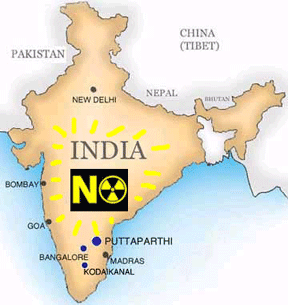 Kudankulam anti-nuclear team hopeful of support of local bodies, Economic Times, 28 OCT, 2011, JOE A SCARIA, CHENNAI: The anti-nuclear protests at Kudankulam entered the tenth day on Thursday, with leaders of the rainbow organisations demanding scrapping of the nuclear plant in the village hopeful that the newly-elected local body representatives will support their cause.
AIADMK had scored an emphatic win last week in the local body elections in Tamil Nadu. The nuclear plant at Kudankulam was an election issue across Kanyakumari, Nagercoil and Tirunelveli districts. The polls have also thrown up a number of independent candidates in panchayats like Idinthakarai, where the protests are being staged, and at Kudankulam. “We are speaking to the newly-elected local body representatives and they are in support of our demand,” convenor of the Coastal People’s Federation M Pushparayan, one of the organisations fighting for closure of the Indo-Russian joint ventureKudankulam Nuclear Power Project, told ET.
The Centre had set up a 15-member expert committee to study the issue, but protest leaders say they want a halt to the work at the plant before they can hold discussions with the expert committee.
Roughly 500 people are taking turns each day for the relay fast at Idinthikarai village, close to the Kudankulam nuclear power plant. Pushparayan said villagers from Koottapanai and Kuttuthalai were on fast on Thursday. Among the prominent persons visiting the site on Thursday was the Church of South India’s bishop for Tuticorin, JAD Jebachandran.
Protestors have also expressed disappointment over the composition of the expert committee. “We are not against the committee, but the fact is that the committee was set up without our knowledge and also without taking the state government into confidence,” Pushparayan said.
The Tamil Nadu Cabinet had passed a resolution demanding halt to work at the project, and J Jayalalithaa had assured her support to the local people during the local body poll campaign. .. http://economictimes.indiatimes.com/news/politics/nation/kudankulam-anti-nuclear-team-hopeful-of-support-of-local-bodies/articleshow/10514024.cms
Dealing with wrecked Fukushima nuclear reactors will take decades
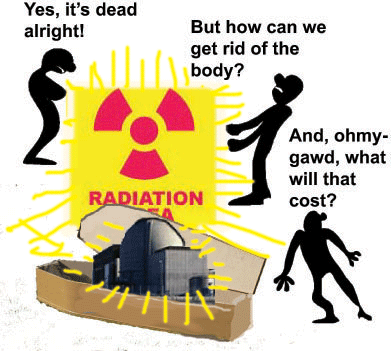
 Three decades needed to make Fukushima safe, ABC News, By North Asia correspondent, October 28, 2011 30 years to decommission: Inside the Fukushima nuclear plant A draft report by Japan’s nuclear agency says it will take more than 30 years to decommission the shattered Fukushima nuclear plant.
Authorities hope to have the stricken reactors in a state of cold shutdown by the end of the year. The draft report from the cabinet’s nuclear agency estimates that reactors number one through to four at the Fukushima plant will not be fully decommissioned until 2042.
As well as achieving cold shutdown of the reactors, each reactor building has to be decontaminated, and then fuel from the spent fuel pools has to be collected.
The final stage involves collecting nuclear fuel from inside the four reactors. Reactors one, two and three all suffered meltdowns after a tsunami slammed into the plant in March… http://www.abc.net.au/news/2011-10-28/fukushima-nuclear-decommission/3605094/?site=melbourne
Russian nuclear experts have left India’s Kudankulam nuclear project site
Russian team leaves Kudankulam site,THE HINDU 28 Oct 11A team of experts from Atomstroyexports, the Russian firm that supplies technology and the equipment for the 2 X 1,000 MWe nuclear reactors of Kudankulam Nuclear Power Project, who had camped at Kudankulam to inspect the quality of the work completed so far and witness the functioning of the equipment installed, have left the site. The Russians took this decision as they could not get permission to go to the KKNPP site from Anu Vijay Township, where they were staying in the wake of the ongoing protest against the nuclear power project…. http://www.thehindu.com/news/cities/Madurai/article2574703.ece
Commonwealth Heads of Government Meeting – behind the scenes, India lobbies for Australian uranium
 India lobbies for Australian uranium, THE HINDU PRISCILLA JEBARAJ, 28 Oct 11 “……Informal, behind-the-scenes diplomacy is a key part of the CHOGM summits, and India seemed to be using the opportunity to lobby for a change in Australia’s uranium exports policy banning sales to India, which is not a signatory of the Nuclear Non-Proliferation Treaty (NPT).
The issue reportedly came up at Mr. Ansari’s meeting with Australian Leader of the Opposition Tony Abbott on Thursday. Mr. Abbott heads the centre-right Liberal Party of Australia, which favours allowing Australia — which has the world’s largest reserves of uranium — to export the mineral to India…..
Mr. Ansari is also likely to discuss the issue at his bilateral meeting with Australian Prime Minister Julia Gillard later this week. The ruling Labour party is split on the issue, which is expected to be a subject of hot debate at the party conference this December. Foreign Minister Kevin Rudd argued that India’s civil nuclear power programme was not dependent on Australian uranium.
“If you hear an argument from an Indian businessperson that the future of the nuclear industry in India depends exclusively on access to uranium, that is simply not sustainable as a proposition. Have a look at the data,” he said at a mining industry breakfast, according to a report by Australian news agency AAP. Both Indian officials and businessmen have been raising the issue on the sidelines of the CHOGM. “There is no problem in terms of global supply, let’s just be very, very blunt about this.”However, Resources Minister Martin Ferguson who supports uranium exports to India, said he was eager to debate the issue at the party conference, which could turn out to be pivotal for India’s hopes of accessing Australian uranium….http://www.thehindu.com/news/national/article2574653.ece
TEPCO wants $12 billion from Japanese government to avoid bankruptcy
 Tepco to Ask for $12 Billion From Government, Nikkei Reports, October 27, 2011, By Tsuyoshi Inajima Oct. 28 (Bloomberg) –– Tokyo Electric Power Co. will ask the government for 900 billion yen ($12 billion) to avoid bankruptcy, the Nikkei newspaper said, the first state support since the Fukushima nuclear disaster almost eight months ago.
The aid will be the first disbursement from the Nuclear Damage Liability Facilitation Fund that was set up last month. Tepco and the fund have been drafting a business plan to pave the way for government support for the utility, which may have to pay 4.5 trillion yen in compensation to residents and businesses hurt by the disaster by March 2013.
Tokyo Electric’s Fukushima Dai-Ichi atomic plant has been discharging radiation since the March 11 earthquake and tsunami knocked out cooling systems, causing three meltdowns and explosions. The catastrophe forced 160,000 people to flee radiation and damaged fishing, farming and forestry businesses….Tepco may face 8.6 trillion yen in funding shortages during the next decade if none of its nuclear power plants come back online and electricity prices aren’t increased, a government panel said earlier this month after reviewing the company’s finances. ..http://www.businessweek.com/news/2011-10-27/tepco-to-ask-for-12-billion-from-government-nikkei-reports.html
Fukushima’s radiation pollution of the Pacific ocean
 Fukushima’s nuclear pollution of Pacific the world’s greatest: nuclear monitor, The Vancouver Sun, Agence France-Presse October 27, 2011 The IRSN cites deep-water fish, fish at the top of the marine food chain and molluscs and other filtrating organisms as “the species that are the most sensitive” to caesium pollution.
PARIS – France’s nuclear monitor said on Thursday that the amount of caesium 137 that leaked into the Pacific from the Fukushima disaster was the greatest single nuclear contamination of the sea ever seen….. Continue reading
China waking up to the danger of its nuclear program
 Nuclear-safety risks rising in China, warns minister, Economic Times, 27 OCT, 2011, BEIJING: China is facing increasing safety risks from its nuclear power plants as existing facilities age and a large number of new reactors go into operation, the country’s environmental minister said in comments published on Wednesday. “The safety standards of China’s early-phase nuclear facilities are relatively low, operation times are long, some facilities are obsolete and the safety risks are increasing ,” said Zhou Shengxian in a speech published on the website of China’s parliament, the National People’sCongress. Zhou told legislators that the scale and pace of nuclear construction had accelerated, a larger range of technologies had been introduced, and potential sources of radiation had become more widespread, making it harder to monitor safety .
China has 13 nuclear reactors in operation and another 28 under construction, but it has suspended all new project approvals in the wake of the tsunami in northeast Japan, which left the Fukushima Daiichi reactor on the brink of meltdown. After the suspension, Beijing launched a nationwide inspection of all nuclear sites, including reactors already operating and those under construction, and is drawing up comprehensive new industry guidelines.. http://economictimes.indiatimes.com/news/politics/nation/nuclear-safety-risks-rising-in-china-warns-minister/articleshow/10503077.cms
Why China might put nuclear warheads in underground tunnels
try to understand China’s strategic challenges and why it might go to some fairly extreme lengths to try to solve them.
 The “Underground Great Wall:” An Alternative Explanation James M. Acton PROLIFERATION ANALYSIS, OCTOBER 26, 2011 It is tempting to dismiss the story in Monday’s Wall Street Journal claiming that China has around 3,000 nuclear warheads as the kind of reporting that could only be considered “fair and balanced” on Fox News and just ignore it. After all, as long ago as 2004, Jeffrey Lewis tracked down the origin of media reports cited by the Journal that China has 2,350 nuclear weapons. Embarrassingly, the source is an online essay based on bogus U.S. intelligence information that was posted by a Singapore University student. Moreover, it hardly seems worth wasting storage space on the Carnegie server explaining why it is invalid to estimate the size of China’s contemporary arsenal by taking a 1960s U.S. intelligence report that predicted how many warheads China would have in 1973 and then assuming that it has built up at a constant rate since then. Continue reading
South Korea’s nuclear regulator serving the industry rather than safety

concerns that this organization created to regulate nuclear power plant safety will merely serve to bolster the industry and serve as its shield
A conflict of interest in nuclear safety oversight, THE HANKYOREH , 26 oct 11, Today sees the launch of a presidential commission on nuclear safety and security. It was established to assume the safety regulation duties of nuclear power promotion organizations and conducting proper examinations of nuclear power safety so that citizens can rest easy. But the commission has gotten off on the wrong foot.
The individual appointed as the commission’s chair, a position comparable Cabinet minister, is Seoul National University Emeritus Professor of Nuclear Engineering Kang Chang-soon, a leading figure in the nuclear power industry. Kang reportedly held the post of vice chairman of the Korea Atomic Industrial Forum, an organization of nuclear power industry figures, only to resign that post just after his nomination. He previously served as an outside director for Doosan Heavy Industries and Construction, a firm that builds nuclear power plants, and as an advisory committee member for the Korea Hydro and Nuclear Power Company, which manages them. He has taken on numerous projects commissioned by nuclear power companies and stated his belief that South Korea should increase its reliance on nuclear power to 70%. Continue reading
Japan’s radioactive used cars
Radioactive second-hand cars dog Japan, BY:THE AUSTRALIAN, RICHARD LLOYD PARRY , October 26, 2011 RUSTING hulks disguised with new paint, and mileage clocks reset – the wiles of the second-hand car dealer are well known.
However, motorists in Japan are facing an unfamiliar peril. They are being offered used cars with low mileage, well-maintained engines and sound bodywork. The only flaw is that they are dangerously radioactive. Continue reading
Empowering Japanese people with knowledge about nuclear radiation
 Journalists must empower those who have to stay near Fukushima plant (Part 4), Mainichi Daily News, 25 Oct 11 Eight days after the nuclear disaster at the Fukushima No. 1 nuclear plant began to unfold, samples of spinach and raw milk were found to be contaminated with radioactive iodine in amounts exceeding the provisional permissible amount set by the Food Sanitation Act.
Government officials have tried to underplay the dangers with messages such as, “It’s all right as long as you’re not eating 4,200 servings of spinach,” and “Even drinking 1 liter of milk every day will not cause any problems.”
However, the problem boils down to how much radiation we’re exposed to at the dinner table. Continue reading
Duqu – a new computer worm hacking into classified nuclear information
 The Duqu worm was designed primarily to steal technical documents, especially to those relating to nuclear power plants and industrial controls systems by masquerading as an image file. Security experts have warned of a similar “Stuxnet 2” attack since Duqu was discovered.
Japanese military contractor hacked, Foreign Policy, By Kedar Pavgi , October 24, 2011 Mitsubishi Heavy Industries, a Japanese military contractor, confirmed today that a hacking incident from this past August released confidential information regarding classified warplanes and nuclear power plants. Continue reading
Work halted at Kudankulam Nuclear Power Project as protest hunger strike continues
 Anti-nuclear protesters’ relay fast enters day 6 at Kudankulam, Net Indian, United News of India, Tirunelveli, October 23, 2011 The third phase of relay hunger strike being observed by protesters against the Kudankulam Nuclear PowerProject (KKNPP) at Idinthakarai coastal hamlet in this district of Tamil Nadu entered the sixth day today.
Hundreds of people, including women, are observing the relay hunger strike in front of St Lourdes Church, demanding that the Centre scrap the project, fearing possible nuclear radiation leakage once the plant begins power production and their displacement from their native villages.
Due to the peoples’ stir, work on the Indo-Russianproject was affected for the 11th consecutive day as scientists and technocrats were not able to reach the site. http://netindian.in/news/2011/10/23/00016703/anti-nuclear-protesters-relay-fast-enters-day-6-kudankulam
1 This Month
23-25 October – on Zoom – World BEYOND War’s annual global conferenc


Shut down the radiation-damaged Heysham nuclear reactors now
To see nuclear-related stories in greater depth and intensity – go to https://nuclearinformation.wordpress.com

Say No to NASA’s Reckless Nuclear Reactor on the Moon
Say No to NASA’s Reckless Nuclear Reactor on the Moon

-
Archives
- October 2026 (231)
- September 2026 (339)
- August 2026 (330)
- July 2026 (355)
- June 2026 (287)
- May 2026 (306)
- April 2026 (356)
- March 2026 (251)
- February 2026 (267)
- January 2026 (308)
- December 2025 (358)
- November 2025 (359)
-
Categories
- 1
- 1 NUCLEAR ISSUES
- business and costs
- climate change
- culture and arts
- ENERGY
- environment
- health
- history
- indigenous issues
- Legal
- marketing of nuclear
- media
- opposition to nuclear
- PERSONAL STORIES
- politics
- politics international
- Religion and ethics
- safety
- secrets,lies and civil liberties
- spinbuster
- technology
- Uranium
- wastes
- weapons and war
- Women
- 2 WORLD
- ACTION
- AFRICA
- Atrocities
- AUSTRALIA
- Christina's notes
- Christina's themes
- culture and arts
- Events
- Fuk 2022
- Fuk 2023
- Fukushima 2017
- Fukushima 2018
- fukushima 2019
- Fukushima 2020
- Fukushima 2021
- general
- global warming
- Humour (God we need it)
- Nuclear
- RARE EARTHS
- Reference
- resources – print
- Resources -audiovicual
- Weekly Newsletter
- World
- World Nuclear
- YouTube
-
RSS
Entries RSS
Comments RSS

