8 months after Fukushima nuclear disaster, dangerous radiation level
 Tepco Finds Dangerous Level of Radiation at Fukushima Station, , Bloomberg, By Chris Cooper, Nov. 6 — Tokyo Electric Power Co. found a dangerous level of radiation at its wrecked Fukushima nuclear plant, eight months after the March 11 earthquake and tsunami that caused the worst atomic crisis in 25 years.
Workers at the company usually called Tepco detected 620 millisieverts of radiation an hour on the first floor of Reactor 3 on Nov. 3, the highest level found in that unit, it said.
The level of radiation is more than the 500-millisievert short-term dose recommended as the maximum for emergency workers in live-saving situations, according to the World Nuclear Association. The company and government officials are trying to contain the worst nuclear crisis since Chernobyl in 1986 after the March 11 earthquake and tsunami caused a loss of cooling and the meltdowns of three reactors.
Tepco will today start taking radiation out of water used to cool spent fuel rods, spokesman Hiroki Kawamata said today by phone…..http://www.businessweek.com/news/2011-11-06/tepco-finds-dangerous-level-of-radiation-at-fukushima-station.html
TEPCO nuclear company makes $8 billion loss, gets $11.5 billion in public funds

 Japan Approves Billions in Aid to TEPCO, Voice of America, 5 Nov 11 Government agreed Friday to a deal giving $11.5 billion in public funds to the Tokyo Electric Power Company (TEPCO) to cover costs in the aftermath of the March 11 earthquake and tsunami that crippled its Fukushima nuclear power plant.
The government said the funds would help TEPCO with cleanup and dismantling of the plant and compensation payments to residents of the area. The money comes from a fund made up of all Japanese nuclear plant operators and the government. In return, the utility must reduce its operating costs by more than $32 billion over the next 10 years and lay off more than 7,000 workers.
Engineers at Fukushima are still trying to bring the reactors to a stable cold shutdown by the end of this year. News of the bailout came on the same day TEPCO forecast a nearly $8 billion loss for the current fiscal year, ending in March. http://blogs.voanews.com/breaking-news/2011/11/04/japan-approves-billions-in-aid-to-tepco-2/
The danger of Pakistan’s nuclear weapons situation

 Which sinks the U.S. into the nadir of absurdity. It funds a terrorist-sponsoring state while conducting a massive undeclared war on part of that state’s territory. It wants that state’s assistance to end the Afghanistan war while that state’s soldiers help insurgents wage it. And seeking a world without nuclear weapons while its “Major Non-NATO Ally” drastically increases the probability that terrorists will acquire a the most dangerous weapon of all.
Pakistan Carts Its Nukes Around In Delivery Vans, Wired.com By Spencer Ackerman November 4, 2011 Pakistan is taking nuclear paranoia to a horrifying new low. And it’s making the world a vastly more dangerous place in the process. Continue reading
Low security of Pakistan’s nukes
Pakistan’s nuclear weapons vulnerable to theft: report, Google News, 5 Nov 11 WASHINGTON — Pakistan has begun moving its nuclear weapons in low-security vans on congested roads to hide them from US spy agencies, making the weapons more vulnerable to theft by Islamist militants, two US magazines reported Friday.
The Atlantic and the National Journal, in a joint report citing unnamed sources, wrote that the US raid that killed Al-Qaeda chief Osama bin Laden in May at his Pakistani compound reinforced Islamabad’s longstanding fears that Washington could try to dismantle the country’s nuclear arsenal.
As a result, the head of the Strategic Plans Divisions (SPD), which is charged with safeguarding Pakistan’s atomic weapons, was ordered to take action to keep the location of nuclear weapons and components hidden from the United States, the report said. Khalid Kidwai, the retired general who leads the SPD, expanded his agency’s efforts to disperse components and sensitive materials to different facilities, it said.
But instead of transporting the nuclear parts in armored, well-defended convoys, the atomic bombs “capable of destroying entire cities are transported in delivery vans on congested and dangerous roads,” according to the report. The pace of the dispersal movements has increased, raising concerns at the Pentagon, it said…..http://www.google.com/hostednews/afp/article/ALeqM5hl_vZqjJHYTQL-3LlinxBrEl8oJQ?docId=CNG.d8a458444a1f0fb688322c8410b26047.431
Japanese mothers demand radiation protection, and closure of nuclear power
The women are calling for two things. First, they want to protect children living in highly contaminated areas by giving them the officially sanctioned ‘right to evacuate.’ This would include government compensation and support that would enable children and their families to relocate on a voluntary basis.
Secondly, they want to close down all nuclear power plants in Japan. “Fukushima women feel very strongly that there is no safe nuclear power,” “This is the lesson to be learned from Fukushima.”
The women have asked for a response from the state by Nov. 11—exactly eight months after the deadly quake.
 Fukushima Women Demand Better Protection for Children Exposed to Radiation, TIME.com , November 3, 2011 Lucy Birmingham. About 100 women from Fukushima, Japan, have started a week-long sit-in at a government office in Tokyo to demand greater protection for children affected by radiation. “Many children and their families are trapped in Fukushima because they can’t afford to move,” explains Ayako Oga, 38, a housewife living in the prefecture and one of the sit-in organizers. “The government has set the accepted radiation exposure rate too high.” Japan’s standard rate for exposure to radiation is 1 millisievert per year. For Fukushima residents alone the accepted exposure rate is up to 20 millisieverts per year. The International Commission on Radiological Protection considers this rate the top level and says it should not be exceeded over the long term.
National and prefectural governments have determined that until the 20 millisieverts level they are not obligated to offer financial support to residents, certain businesses or schools wanting to relocate outside the irradiated areas. At the heart of the debate is the question of who has a ‘right to evacuate.’ “At Chernobyl, the right to evacuate, which means government support, was given from 1 to 5 millisieverts. In Japan it’s 20,” Continue reading
What it’s really like to be a cleanup worker at Fukushima
Those on the lower rungs, say labour advocates, are particularly
vulnerable. They often have no corporate health, pension or redundancy
benefits. ….
the hardest work was done by the low-level labourers. They had so much rubble to clear, he says, that they often keeled over in the heat under the weight of their protective gear.
Taken out in ambulances, they would usually be back the following day.
Cleaning up Japan’s nuclear mess, The twilight zone, Its owner fears not just radiation leaking out of the Fukushima plant, but also bad news, The Economist Nov 5th 2011 | IWAKI | IT IS another world beyond the roadblocks stopping unauthorised traffic from entering the 20km (12.5-mile) exclusion zone around the
Fukushima Dai-ichi nuclear power plant. ….
The air of secrecy is compounded when you try to approach workers involved in the nightmarish task of stabilising the nuclear plant. Many are not salaried Tepco staff but low-paid contract workers lodging in Iwaki, just south of the exclusion zone. Continue reading
India’s Kudankulam nuclear project halted
 Work halts at Kudankulam, The Hindu, T. S. SUBRAMANIAN 4 Nov 11,Personnel unable to enter plant: AEC chairman Work at the Kudankulam Nuclear Power Project (KKNPP) in Tamil Nadu has “halted” because the plant personnel are “unable to go inside” and this situation has arisen “when we need several thousands of people to work inside during the last phase of work” of commissioning of the first reactor there, said Srikumar Banerjee, Chairman, Atomic Energy Commission. Continue reading
India’s top nuclear scientist wants a stop to nuclear power programme
India does not need nuclear energy: Top scientist, Nov 3, 2011, By Kumar Chellappan Chennai DNA One of the pioneer nuclear scientists in the country says that India can very well suspend its entire nuclear programme. “It is true that we have spent thousands of croresof rupees to set up nuclear power plants. But we will be forced to spend thousand times more than that in the eventuality of a nuclear disaster,” said Dr MP Parameswaran, former scientist of the Atomic Energy Commission. Continue reading
The $64 billion question – 3 reasons why Japan should nationalise TEPCO
 Japan’s nuclear conundrum, The $64 billion question, Once the Fukushima nuclear plant is stable, the government should temporarily nationalise its operator The Economist Nov 5th 2011
The government should act fast to nationalise Tepco and hold it temporarily in public ownership as it clears out the old management and oversees the clean-up. Then it should reprivatise a thoroughly reformed utility. Three reasons argue for Tepco to be nationalised. Continue reading
Taiwan’s President Ma contradicts himself on nuclear power shutdown
Ma’s promises on energy policies — advocating commercial operations for the fourth nuclear plant, and in the meantime offering that the government would rather sacrifice the power plants than allow nuclear disasters to happen — sound tempting, but are completely contradictory, DPP’s presidential candidate, Tsai Ing-wen, proposed, yesterday.
Ma’s government had only promised to give up on the use of nuclear energy when natural disasters strike, but by then nothing done could relief the calamity that had taken place, Tsai argued.
 Existing nuclear plants to be shut down: MaThe China Post, 4 Nov 11President Ma Ying-jeou promised yesterday that the licenses of the existing three nuclear power plants will not be renewed after they expire, and if the fourth power plant begins stable operations before 2016, early shutting down of the first nuclear power plant will be considered Continue reading
Japanese fears on radioactive debris
Radiation fears behind debris refusals / Remaining refuse may cause secondary damage, hinder reconstruction efforts, The Yomiuri Shimbun, 4 Nov 11 The start Wednesday of shipments of debris from the Great East Japan Earthquake to Tokyo, the first destination for such refuse outside the Tohoku region, was a long-awaited first step toward wider disposal of the wreckage.
However, an Environment Ministry survey released Wednesday showed that only 54 local governments and garbage-disposal unions, less than 10 percent the figure in a previous survey, were considering accepting debris from disaster-hit areas. Continue reading
South Korea’s radiation hotspot – from Japan, or from China?
The Institute of Nuclear Safety has previously reported that cesium-137 has been detected over the past 10 years in South Korea’s air and soil when so-called yellow dust blows in from China .
 Radiation Hot Spot Detected in South Korean Pavement,Voice of America , November 3rd, 2011 South Korea’s Institute of Nuclear Safety says it has discovered a patch of pavement in Seoul is emitting radiation at levels 10 times higher than normal. Continue reading
New bursts of fission at the crippled Fukushima power plant
The three reactors — together with spent fuel rods stored at a fourth damaged reactor — have been leaking radioactive material since the initial disaster, and new episodes of fission would only increase their dangers.
 Fears of Fission Rise at Stricken Nuclear Plant in Japan, NYT, By HIROKO TABUCHI November 2, 2011 TOKYO — Nuclear workers at the crippled Fukushima power plant raced to inject boric acid into the plant’s No. 2 reactor early Wednesday after telltale radioactive elements were detected there, and the plant’s owner admitted for the first time that fuel deep inside three stricken plants was probably continuing to experience bursts of fission. Continue reading
Indian government’s nuclear plans fraught with problems
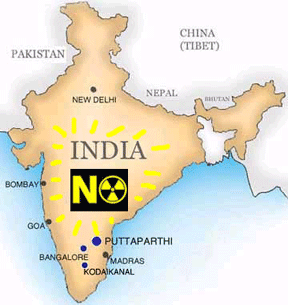 The anti-nuclear lobby has filed a Public Interest Litigation (PIL), while protests are on the rise at Jaitapur in Maharashtra, a new site for a large reactor project, which got the approval for work to begin.
In Kudankulam, protests have been getting bigger. The Chief Minister, Ms J. Jayalalithaa herself wrote to the PM,
There is also the question of ageing of the existing reactors.
Daunting road ahead for nuclear power, THE HINDU, M. SOMASEKHAR, 2 Nov 11 The Department of Atomic Energy is bullish on the power programme, but achieving the target of 20,000 MW by 2020 is plagued by resource crunch, technology issues and environmental problems. Continue reading
One nuclear reactor restarts in Japan
First nuclear power plant restarted in Japan since tsunami, Herald Sun November 02, 2011 A NUCLEAR reactor in southern Japan was to begin producing electricity again today, its operator company said, in the first restart of a stalled atomic power plant since the Fukushima disaster. Continue reading
1 This Month
23-25 October – on Zoom – World BEYOND War’s annual global conferenc


Shut down the radiation-damaged Heysham nuclear reactors now
To see nuclear-related stories in greater depth and intensity – go to https://nuclearinformation.wordpress.com

Say No to NASA’s Reckless Nuclear Reactor on the Moon
Say No to NASA’s Reckless Nuclear Reactor on the Moon

-
Archives
- October 2026 (219)
- September 2026 (339)
- August 2026 (330)
- July 2026 (355)
- June 2026 (287)
- May 2026 (306)
- April 2026 (356)
- March 2026 (251)
- February 2026 (267)
- January 2026 (308)
- December 2025 (358)
- November 2025 (359)
-
Categories
- 1
- 1 NUCLEAR ISSUES
- business and costs
- climate change
- culture and arts
- ENERGY
- environment
- health
- history
- indigenous issues
- Legal
- marketing of nuclear
- media
- opposition to nuclear
- PERSONAL STORIES
- politics
- politics international
- Religion and ethics
- safety
- secrets,lies and civil liberties
- spinbuster
- technology
- Uranium
- wastes
- weapons and war
- Women
- 2 WORLD
- ACTION
- AFRICA
- Atrocities
- AUSTRALIA
- Christina's notes
- Christina's themes
- culture and arts
- Events
- Fuk 2022
- Fuk 2023
- Fukushima 2017
- Fukushima 2018
- fukushima 2019
- Fukushima 2020
- Fukushima 2021
- general
- global warming
- Humour (God we need it)
- Nuclear
- RARE EARTHS
- Reference
- resources – print
- Resources -audiovicual
- Weekly Newsletter
- World
- World Nuclear
- YouTube
-
RSS
Entries RSS
Comments RSS

