Scene inside wrecked nuclear reactor in Japan
Scene of devastation inside Japan reactor SMH, 12 Nov 11Media allowed into Japan’s tsunami-damaged nuclear power plant for the first time on Saturday saw a striking scene of devastation: twisted and overturned trucks, crumbling reactor buildings and piles of rubble virtually untouched since the wave struck more than eight months ago.
Representatives of the Japanese and international media, including The Associated Press, were allowed into the plant with the government’s chief official in charge of the world’s worst nuclear disaster since Chernobyl in 1986. The tour was intended to demonstrate how much the situation at the plant has stabilised since the March 11 tsunami, though reporters had to wear full-body protective gear and submit to radiation scans afterward.
Mangled trucks, flipped over by the wave, remain along the roads inside the complex. Piles of rubble stand where the walls of the plant’s reactor structures crumbled, and large pools of water still cover parts of the sprawling campus…….
the government has predicted that it will take another 30 years at least to safely remove the nuclear fuel and decommission the plant. It could also be decades before tens of thousands of residents forced to flee the 20km exclusion zone around the plant will be able to return. Some experts say even that estimate is optimistic…. –http://news.smh.com.au/breaking-news-world/scene-of-devastation-inside-japan-reactor-20111112-1ncx4.html
Fukushima nuclear disaster: how it was for the workers when it happened
 Report Details Initial Chaos at Stricken Nuclear Plant, NYT By MATTHEW L. WALD November 11, 2011 Fukushima Daiichi Unit 1 was stuck in darkness, and everyone on site feared that the reactor core was damaged. It was the day after a devastating earthquake and a towering tsunami had hit the plant, and the workers knew that they were the only hope for halting an unfolding nuclear disaster. Continue reading
Blockade by protestors delays Kudankulam nuclear plant
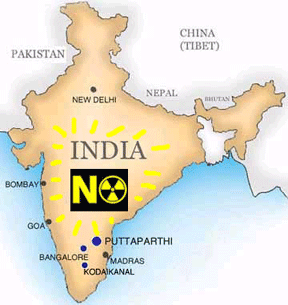 Commissioning of India Kudankulam nuclear plant delayed BBC News, 10 Nov 11 Commissioning of a controversial planned nuclear plant in the Indian state of Tamil Nadu has been delayed by a few months, officials have told the BBC. Kudankulam plant Chief Superintendent MK Balaji said that the delay was due to public protests at the site which had disrupted building work.
He said that the site had been subjected to a total blockade by protesters since 13 October. Protesters say the facility is unsafe and in an earthquake area. They fear a repeat of the disaster at Japan’s Fukushima plant…. http://www.bbc.co.uk/news/world-asia-15684591
India’s nuclear propagandist, Abdul Kalam is a fake
 From our Antinuclear correspondent in India, 9 Nov 11 I was reading Kalam’s report on how Koodankalam was safe and why nuclear is the future for India when I had a suspicion about his educational background. All his rantings seemed very unscientific to me so I did some research and found out that HE IS A TOTAL FAKE! He has only a degree (bachelor’s in science) BSc and the prefix Dr. has been conveniently been added by him in front of his name to promote himself as a doctor of science. In fact he has not received even an honorary doctorate degree from any institution or group as they sometimes arbitrarily give someone a doctorate even if they have just a fifth standard education in India (as in the case of Kurananidhi, former chief minister of Tamil Nadu who according to a report in Facebook apparently has stashed away 3500 crores of indian rupees in Swiss Banks (an astounding amount).
Kudankulam nuclear power plant good for the rich, and Russia, not for the poor

 The nuclear debate Electricity for whom? Deccan Herald Bharat Jhunjhunwala, 10 Nov 11
Diversion of just 2 per cent of present power generation can meet the needs of all of India’s unelectrified households.
Local people are opposing construction of the Kudankulam nuclear power plant in Tamil Nadu. People of Ratnagiri in Maharashtra are opposing the Jaitapur nuclear plant. Mamata Banerjee has scrapped the proposed nuclear power plant in Purba Medhinipur. Continue reading
Strength and determination of India’s anti nuclear movement
Protests galore expected in Kudankulam IBN Tamil Nadu | Nov 10, 2011 Press Trust of India Chennai: Extending support to locals agitating against Kudankulam Nuclear Power project, about 100 anti-nuclear activists will embark on a yatra from Madurai to the site on Thursday.
The activists, under the aegis of Chennai Solidarity Group for Kudankulam Struggle would start their journey from Madurai on November 10 and stop at towns and villages en route to Kudankulam to explain “the terrible environmental and health effects of nuclear energy.”
At Kudankulam, they would conduct a national seminar titled “National Conference on Safety issues at Nuclear installations in India.” The Yatra will culminate in Chennai on November 13, where a seminar for students would also be held. There are also plans to hold a photo-exhibition, depicting the horrors of nuclear energy, a press release from the group said.
The yatra has been organised by National Alliance of Anti-Nuclear Movements. Some of those attending the yatra are nuclear physicist Suvrat Raju, Prof Banwarilal Sharma, mathematician and former president of the International Congress of Mathematics and Thomas Kochery of National Fishworkers Forum, it said. (Watch CNN-IBN live on your iPad. IBN7 and IBN Lokmat too. Download the IBNLive for iPad app. It’s free. Click here to download now) http://ibnlive.in.com/news/tn-protests-galore-expected-in-kudankulam/200859-62-128.html
Christian Bishop backs Kudankulam anti nuclear struggle
 Tuticorin Bishop clarifies stand on Kudankulam nuclear plant row Christian Today, By: George Anthony, 10 November 2011, Rumours that the Church had distanced itself from the people’s movement against the Kudankulam Nuclear Power Project (KNPP) in Tamil Nadu are just imaginary. The Bishop of the Tuticorin Diocese has affirmed that the Church backed the locals in the struggle….
In a statement issued on Wednesday, the Bishop said he was with the people “morally and spiritually”. “As per the Catholic Church’s teachings and the Tamil Nadu Bishop Council’s resolution, I continue to show my solidarity with my people who are under great fear and anxiety concerning the Kudankulam Nuclear Plant,” he said.
Taiwan urged to abandon nuclear power – unaffordable costs
many people thought it was a waste of money to have spent NT$320 billion (US$10.6 billion) to construct the Fourth Nuclear Power Plant in Gongliao District (貢寮), New Taipei City, and not allow it to operate, but it would actually cost twice that amount to retire the plant after it begins operations.
 Writer urges Taiwan to abandon nuclear power Taipei Times, By Lee I-chia / Staff Reporter, 10 Nov 11 COSTLY:Japan-based writer Liu Li-erh said the rising costs of the crisis at the Fukushima Dai-ichi plant should be a warning, particularly around the Taipei metropolitan area
Saying that the compensation for damage caused by the nuclear crisis at the Fukushima Dai-ichi nuclear power plant in Japan was way beyond what Tokyo Electric Power Co (TEPCO) or the Japanese government could afford, a Japan-based Taiwanese writer yesterday urged Taiwan to abandon all nuclear power. Continue reading
Tokyo now testing radiation in fresh and processed food
Tokyo city starts radiation tests on food in shops Google News, (AFP) – 8 Nov 11 TOKYO — Tokyo city government on Tuesday began radiation tests on samples of food bought in shops to reassure residents amid a contamination scare after a major nuclear accident in northeast Japan.
It is rare that authorities check on products at the point of sale and the the inspection includes processed food as well as fresh produce. The metropolitan government is measuring radiation on vegetables and other fresh food to complement pre-shipment tests at places of
production. Continue reading
Fukushima elections: 90% of candidates want nuclear power scrapped
90% of Fukushima candidates want N-reactors scrapped The Yomiuri Shimbun, 9 Nov 11 Nearly 90 percent of candidates planning to run in the upcoming Fukushima prefectural assembly election think all the reactors at the stricken Fukushima No. 1 nuclear power plant should be decommissioned, according to a Yomiuri Shimbun survey.
All 87 potential candidates responded to the survey, whose findings suggest radiation decontamination and other nuclear issues will be key points in this campaign–a change from previous prefectural assembly elections.
An official announcement of the election will be made Thursday, and Fukushima Prefecture residents will go to the polls Nov. 20. The election has been postponed due to the March 11 disaster and ensuing nuclear crisis.
According to the survey, 76 candidate, or 87.3 percent, said the Nos. 5 and 6 reactors at Tokyo Electric Power Co.’s nuclear plant should be decommissioned. The Nos. 1 to 4 reactors have already been designated for decommissioning.Regarding the Fukushima No. 2 nuclear power plant, the future of which has not been decided, 72 people, or 82.7 percent, said the plant should be decommissioned…..http://www.yomiuri.co.jp/dy/national/T111108005264.htm
Inadequacy of Japan’s radiation cleanup plan
Accident risk makes nuclear costs even more expensive
Japan study factors accident risk into nuclear power cost estimates Nov 8 (Reuters) – The cost of generating nuclear power in Japan would rise by up to 1.6 yen per kilowatt hour if the risk of a serious nuclear accident like the one in Fukushima is factored in, a government panel of experts estimated, providing a key element for the government to decide on its post-Fukushima energy policy.
Lawmakers and officials are working to come up with a new energy policy after the Fukushima radiation crisis made it difficult, if not impossible, to build more reactors in the world’s third-biggest generator of nuclear power…..
now that the crisis at the Fukushima Daiichi nuclear plant forced its operator, Tokyo Electric Power Co , to pay compensation for residents who have been evacuated and extra costs to decommission the crippled reactors, a new estimate on the cost of nuclear power was needed to include these factors…..
The cost for the risk of an accident could rise further if compensation payments to help evacuees and cover other damages increases from the current estimate, based on actual payments related to the Fukushima Daiichi plant, of 5 trillion yen ($64 billion) for a model reactor, the panel said…. http://www.reuters.com/article/2011/11/08/nuclear-japan-estimate-idUSL4E7M81Q620111108
Nuclear crisis as Indian villagers reject bribes
 N-plant crisis: Villagers reject Kalam’s proposals, Hindustan Times 8 Nov In a major setback to the central government, which is trying to resolve the Kudankulam nuclear plant crisis, villagers protesting against the plant have dismissed former president APJ Abdul Kalam’s endorsement of the project. They have also refused to accept Kalam’s proposals on the development of Kudankulam and neighbouring areas.
The former president had visited the project site in Tirunelveli district on Sunday. Kalam had also come up with a 10-point development plan, which includes building of four-lane highways, houses, schools, hospitals as well as cold storages, in Kudankulam and surrounding areas.
“If anyone thinks that he or she can bribe the villagers like this, they are sadly mistaken,” said anti-nuclear activist SP Udayakumar on Monday.
Villagers who had been on a relay hunger strike for weeks at Idinthakkari village, continued their protest on Monday.
They said Kalam was speaking for the government. “Is Kalam a president, PM or a minister to come out with a plan? Whose sanction has he got to make such recommendations?” questioned a protester.”The plan does sound great. But why a 500 bed hospital? Do they think that so many people will fall ill,” asked a villager. http://www.hindustantimes.com/India-news/TamilNadu/N-plant-crisis-Villagers-reject-Kalam-s-proposals/Article1-765800.aspx
Call for better “marketing” of nuclear power
Market N-technology properly: Kalam to scientists IBN Live, 8 Nov New Delhi: “Market nuclear technology properly.” This was the brief message former President APJ Abdul Kalam had for nuclear scientists.
“Today the nuclear technologists are all doing
great work for the world, but it is essential for the services of nuclear science and its future prospects to be marketed as the only
continuously available clean energy source,” he told an international conference.
Kalam’s message comes in the backdrop of protests over the Kudankulam nuclear power project in Tamil Nadu following concerns over safety and environmental issues.
The Department of Atomic Energy had admitted that it had not succeeded in reaching out to the locals on the safety aspects of the Kudankulam nuclear project…http://ibnlive.in.com/news/market-nuclear-technology-properly-kalam/200165-3.html
Kudankulam activists withstand pressure to drop their anti nuclear protest
 the activists have also alleged that a person who was in no way connected with the ongoing protests was included in the expert panel formed by the state government to represent the protestors. PMANE had suggested M Pushparayan, convener of Coastal People’s Federation and M P Jesuraj as members of the panel. But Udayakumar alleged that another person was inducted into the panel as people’s representative
 Safety of nuclear plant ‘old wine in new bottle’ : Activists – Times of India TNN | Nov 7, 2011, KUDANKULAM : Activists protesting against thenuclear plant at Kudankulam brushed aside the justifications by former president Abdul Kalam on the safety of the nuclear plant and termed them as ‘old wine in a new bottle.’ They also and stated that they would not hold talks with him.
Protestors also maintained that their agitation against the Kudankulam Nuclear Power Project (KKNPP) would continue till the plant is shut down. Continue reading
1 This Month
23-25 October – on Zoom – World BEYOND War’s annual global conferenc


Shut down the radiation-damaged Heysham nuclear reactors now
To see nuclear-related stories in greater depth and intensity – go to https://nuclearinformation.wordpress.com

Say No to NASA’s Reckless Nuclear Reactor on the Moon
Say No to NASA’s Reckless Nuclear Reactor on the Moon

-
Archives
- October 2026 (219)
- September 2026 (339)
- August 2026 (330)
- July 2026 (355)
- June 2026 (287)
- May 2026 (306)
- April 2026 (356)
- March 2026 (251)
- February 2026 (267)
- January 2026 (308)
- December 2025 (358)
- November 2025 (359)
-
Categories
- 1
- 1 NUCLEAR ISSUES
- business and costs
- climate change
- culture and arts
- ENERGY
- environment
- health
- history
- indigenous issues
- Legal
- marketing of nuclear
- media
- opposition to nuclear
- PERSONAL STORIES
- politics
- politics international
- Religion and ethics
- safety
- secrets,lies and civil liberties
- spinbuster
- technology
- Uranium
- wastes
- weapons and war
- Women
- 2 WORLD
- ACTION
- AFRICA
- Atrocities
- AUSTRALIA
- Christina's notes
- Christina's themes
- culture and arts
- Events
- Fuk 2022
- Fuk 2023
- Fukushima 2017
- Fukushima 2018
- fukushima 2019
- Fukushima 2020
- Fukushima 2021
- general
- global warming
- Humour (God we need it)
- Nuclear
- RARE EARTHS
- Reference
- resources – print
- Resources -audiovicual
- Weekly Newsletter
- World
- World Nuclear
- YouTube
-
RSS
Entries RSS
Comments RSS

