Renewables, energy efficiency better options for India than nuclear power
Koodankulam struggle: Western nations are learning from their mistakes, India is not The Weekend Leader, By Nityanand Jayaraman & Sundar Rajan, 30 Nov Chennai “…….Nuclear power is not the only option for generating electricity. There are a number of conventional and non-conventional sources of energy that can be explored for generating electricity.
It is a fact that in more than 60 years of post-independence industrialisation and modernisation, the contribution of nuclear energy to the total electricity generation is less than 3%.
Renewable energy sources already contribute more than 10% of India’s electricity and large hydro projects deliver about 22%. Large dams, though, have exacted a devastating toll on the environment and lives of adivasi communities. Continue reading
Jaitapur nuclear plant delayed in haggles over Nuclear Liability Law, and Nuclear Non Proliferation Treaty
 Jaitapur nuclear plant work may not start before 2014 France, says
  Bernard Bigot, remains committed to fulfil all its obligations LiveMint.com 28 Nov 11Makarand Gadgil Mumbai: French Atomic Energy Commission chairman Bernard Bigot said on Monday that work on the Jaitapur nuclear power project in Ratnagiri district of Maharashtra was unlikely to start before 2014 due to regulatory hurdles
He referred to the delay in concluding the commercial contract between Areva and the government-owned Nuclear Power Corp. of India Ltd (NPCIL) Continue reading
Illness of Fukushima nuclear plant director – could be radiation caused?
Fukushima nuclear power plant director steps down suddenly due to ‘illness’ The director of Japan’s damaged Fukushima nuclear power plant is stepping down due to illness, with officials refusing to confirm whether his condition is radiation related. The Telegraph By Danielle Demetriou in Tokyo 28 Nov 2011 Masao Yoshida, 56, has been hospitalised for “treatment of illness” and will relinquish his director post at Fukushima Daiichi nuclear power plant in northeast Japan from Thursday.
His sudden departure without a specific medical explanation is likely to prompt speculation surrounding the possible connection between his medical condition and exposure to high radiation levels at the plant……
Mr Yoshida has been on site at Fukushima Daiichi plant for more than eight months, ever since the March 11 earthquake and tsunami knocked out crucial cooling systems and sparked the ongoing crisis…. http://www.telegraph.co.uk/news/worldnews/asia/japan/8919991/Fukushima-nuclear-power-plant-director-steps-down-suddenly-due-to-illness.html
Taiwan’s nuclear waste dilemma

 Activists challenge government on nuclear waste management policy, Taiwan News, Central News Agency, Taipei, By Hsu Chih-wei and Elizabeth Hsu Nov. 28 (CNA) Environmental groups charged Monday that Taiwan’s government has not resolved how to deal with nuclear waste and proposed suspending operations at the country’s three nuclearpower plants until the issue was dealt with.
The environmentalists made the appeal at an environmental assessment meeting held by the
Cabinet-level Environmental Protection Administration (EPA) on the government’s radioactive waste management policy. During the meeting, officials from the Atomic Energy Council (AEC), the country’s top nuclear regulatory body, presented a report on its proposed approach to dealing with nuclear waste that will become official policy ifapproved by the EPA assessment committee. One of the plan’s centerpieces was to have nuclear waste recycled overseas beforeshipping it back to Taiwan for permanent storage.
But environmental activists, including Green Citizens’ Action Alliance Deputy Secretary-General Hung Shen-han, were not convinced the solution was viable and advocated shutting down Taiwan’s three nuclear power plants until the issue was clearly addressed. Hung contended that one way or another, radioactive waste had to be stored either at home or abroad, and no foreign country has so far been willing to lease Taiwan land for storage of the waste. He acknowledged that radioactive waste could be recycled overseas but said the leftover material was still unstable and would still have to be stored in Taiwan, which he saw as a bad option.
Hung compared nuclear waste to a ticking time-bomb that threatened the life and
property of Taiwan’s people because of the unstable geographic nature of the island, which is prone to earthquakes. …. The government has selected Wuchiu in Kinmen and Daren in Taitung to serve as permanent storage sites for the waste, but it has encountered strong opposition from people in the two townships. http://www.taiwannews.com.tw/etn/news_content.php?id=1771961
India’s confused nuclear weapons policy
Nuclear weapons have limited, not augmented, India’s strategic options, BY:RAMESH THAKUR , THE AUSTRALIAN . November 29, 2011 “….India’s nuclear weapons policy remains confused. ……..Under prime minister Jawaharlal Nehru’s formative influence, India’s nuclear policy used to be that of a disarmament champion informed by a strategic vision. By contrast, its policy as a nuclear-armed state since 1998 has been ad hoc and episodic.
……Before 1998, India refused to let interests come in the way of principles. Since 1998, India has defined national security so narrowly that values are not allowed to “infect” interests. ……..Recent decades have involved a flexing of muscle devoid of value-promoting notions of good governance.
India is the proud possessor of nuclear weapons, but projects little sophisticated sense of how to use them for deterrence, defence or compellence guided by strategic doctrines. Pakistan has concluded that India’s non-response to serial terrorist provocations is the product of nuclear stalemate in the subcontinent, meaning that, far from augmenting, nuclear weapons have further limited India’s strategic options.
In the meantime, the poverty of India’s moral leadership is reflected in the near-total lack of nuclear disarmament leadership. India needs to bestir itself to make the transition to a norm entrepreneur once again.
Does India seek nuclear abolition? Does it wish to join the NPT-licit powers in converting the NPT from a de jure nuclear prohibition into a de facto non-proliferation regime? Or would it be happiest with the early collapse of the NPT regime and relaxed at proliferation?
Without these answers, India’s nuclear policy will remain ad hoc, reactive and hostage to events and forces outside its control.. http://www.theaustralian.com.au/news/world/nuclear-weapons-have-limited-not-augmented-indias-strategic-options/story-e6frg6ux-1226208508350
People’s Movement Against Nuclear Energy details faults in Kudankulam report
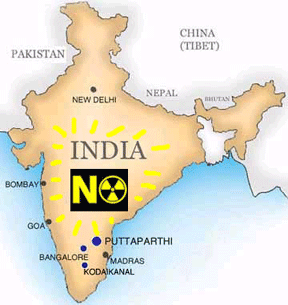 Activists dub report on Kudankulam as flawed, THE HINDU 27 Nov 11 Rebuttal by People’s Movement Against Nuclear Energy soon The People’s Movement Against Nuclear Energy (PMANE) on Sunday slammed the report of the Government-appointed expert committee on Kudankulam as being extremely flawed, premised on obsolete demographic data and opaque on the risks from sub-volcanic activity near the site or health impact on the local population.
The PMANE also released a letter to Chief Minister Jayalalithaa seeking her intervention in scrapping the project.
In the letter to the Chief Minister–copies of which were circulated to media – PMANE leaders flayed the Expert Group for ignoring valid questions on liability and declining to give specific or scientific information on nuclear waste or the fresh water needs of the KKNPP. The Expert Group had not talked to any section of the public nor tried to allay the fears and concerns of the people.
“Campaign of canards” The letter also took exception to the Central government’s “campaign of canards” about the anti-nuke activists receiving foreign funds, support and guidance to drive a wedge in the movement and sought to reassure the Chief Minister that there was not an iota of truth in these charges. Continue reading
Millions of fishermen and farmers would be affected by India’s nuclear power plans
 Both areas support millions of subsistence fishing and farming families who, faced with the forced acquisition of their land and loss of livelihoods, pose a formidable opposition to a government sensitive to the loss of a core constituency.
Dr (Anil) Kakodkar projected that India would be generating 650,000MW of nuclear power by 2050. That’s 650 1000MW nuclear reactors,” he says. “You would almost need to evict the entire fishermen population of India.”……..
Heat rises beyond the smog in India AMANDA HODGE, SOUTH ASIA CORRESPONDENT : The Australian November 26, 2011 “….. In India, where its nuclear capability has traditionally stirred great national pride, Fukushima gave meaning and pictures to environmentalists’ warnings. “People are realising that if something like this can happen in Japan, where everything runs on time, it can definitely happen here,” Greenpeace India nuclear spokeswoman Karuna Raina says.
India’s anti-nuclear fervour is centred on two huge atomic energy projects: one built and ready to go in Koodankulam in southern Tamil Nadu, the other mooted for Jaitapur on the fertile coast of Maharashtra. Continue reading
Secrecy in Japan’s radiation studies
 Will the Government of Japan’s radiation studies on the
 people exposed to radiation include removing tissue and bone samples after they have died? Will they inform the public or keep it a secret? dedicated to the mystery surrounding the 2 tsunami dogs 26 Nov 11
The citizens that were exposed to radiation from the Fukushima Prefecture have a surprise coming to them. It won’t matter to them, actually, because this will happen to them after they die. It is justwhat has been happening with the animals that have been killed andtheir bodies examined for cesium levels. Don’t think that it won’t happen to the Fukushima citizens that have been exposed to radiation.
Those same scientists that are examining the animals will want to examine the people also. This is where the Government of Japan will either tell people or keep it a secret and just take the samples and hope that no one will notice. The scientists that are like vultures
waiting, will want those samples to see what the levels of cesium are in those people.
If they think that their participation of the research being done by the Government of Japan on their exposure to the radiation is limited to just being monitored, it is not. Continue reading
Japanese anti nuclear activists ignored by media
activists say they are being ignored by the domestic media and threatened by ultra-nationalist groups.
“The Japanese newspapers and TV stations all take so much advertising money from the power companies that they won’t report on the strength of the anti-nuclear movement or cover our protests,”
Anti-nuclear protesters have an unlikely ally in Masayoshi Son, Japan’s richest man.
 Japan’s anti-nuclear protesters find the going tough, despite Fukushima disaster Polls show the public turning against nuclear energy after Japan’s Fukushima disaster. But low coverage of protests and powerful business and political interests have complicated efforts to promote change. Christian Science Monitor, By Gavin Blair, Correspondent / November 23, 2011 Continue reading
Japan’s new nuclear watchdog – an unknown quantity
“Concrete steps will be taken only after actual health problems have come to light, and if such damage could be recognized as a pollution-caused disease like Minamata disease, the sources said.”
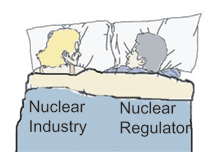 This item is a bit of a worry. Nothing in here to say that those made ill from radiation will get any help. And the suggestion is that it will be hard for them to prove it – so don’t expect any help? – Christina Macpherson
N-watchdog gets health role / New agency to handle residents’ well-being, not just reactors, The Yomiuri Shimbun, 25 Nov 11 A new nuclear safety agency to be established in April will deal with health problems caused by radioactive materials released from the Fukushima No. 1 nuclear power plant, it has been learned. Continue reading
How Japan rigged public opinion to support MOX plutonium nuclear reactor
 Rigging opinions on nuclear power, Japan Times, , Nov. 28, 2011, EDITORIAL A third-party committee of the Hokkaido government on Wednesday reported that the then chief of the regional government’s nuclear power safety measures section asked Hokkaido Electric Power Co. in July 2008 to collect opinions that favored the use of MOX (mixed oxide) nuclear fuel in the No. 3 reactor of its Tomari nuclear power plant.
The chief made the request because a majority of opinions collected by the Hokkaido government up to that point had been decidedly against the use of MOX fuel, which contains both plutonium and uranium, the committee said.
This is just the latest revelation of attempts to rig public opinions on nuclear power. Continue reading
Background to India’s Koodankulam anti nuclear campaign
Heat rises beyond the smog in India AMANDA HODGE, SOUTH ASIA CORRESPONDENT : The Australian November 26, 2011 “ “…..The nucleus of the campaign to stop Koodankulam can be found near India’s southern-most tip in the Tamil Nadu fishing village of Idinthakarai, and the man driving it is SP Udayakumar. The articulate idealist with a doctorate in political science says that opposition to the project dates back to the late 1980s, when it was conceived as a symbol of the India-Soviet relationship. Continue reading
India’s nuclear ambitions, and Australia’s uranium cash cow, now at risk
In the shadow of increasingly fierce grassroots opposition, India’s nuclear ambitions – and Australia’s future uranium cash cow – are looking decidedly less promising.
 India’s nuclear ambitions come up against people power, BY:AMANDA HODGE, IDINTHAKARAI, TAMIL NADU :The Australian . November 26, 2011 1 India’s Koodankulam nuclear power project is like the proverbial cockroach in an atomic storm. It has survived the fall of the Soviet Union, the assassination of an Indian prime minister and the Boxing Day tsunami, when waves surged over the site where it now stands.
The first of six reactors to be built on the shore of India’s southernmost tip in Tamil Nadu was to have been switched on next month, 23 years after Mikhail Gorbachev and the slain Rajiv Gandhi signed off on the friendship project.
Instead it has hit another obstacle – an emerging national anti-nuclear campaign that has gained serious momentum since Japan’s Fukushima meltdown in March. Continue reading
Anti nuclear movement winning hearts and minds in India
Anti-nuke lobby seems to be winning the battle in India:Expert IBN Live ,Nov 25,2011 Bangalore, Nov 25 (PTI) A key member of the Indian nuclear establishment today cautioned that if protestors of Koodankulam project in Tamil Nadu succeed in their objective, the country’s entire nuclear programme could be in jeopardy. “..if they (protestors in Koodankulam) are able to succeed, then they can succeed in shutting down the entire nuclear programme …..Member of the Atomic Energy Commission M R Srinivasan told PTI. His warning came even as the protest by locals against the Koodankulam nuclear power project in Tamil Nadu’s Tirunelveli district entered the 100th day yesterday. Srinivasan, a former Secretary to the Department of Atomic Energy, said the “anti-nuclear movement” in the country has become “very strong with lot of support from elsewhere”.
“It seems they (anti-nuclear lobby) are winning the battle”, he said. Srinivasan said “anti-nuclear people are working in an orchestrated way” in Koodankulam. “They are all joining up together…anti-nuclear people in the United States, Australia, Finland, Germany”. “It’s orchestrated completely. Why should school children sit (in protest) morning to evening? Do they understand the issues involved?. They have been told by their parents, they have been told by some religious leaders. So, it (the protest) goes on”. http://ibnlive.in.com/generalnewsfeed/news/antinuke-lobby-seems-to-be-winning-the-battle-in-indiaexpert/914642.html
Nuclear power for India – neither safe nor necessary
 NUCLEAR EMERGENCY IN JAPAN: LESSONS FOR INDIA, Aid Netherlands, Shankar Sharma November 25, 2011 “…..While it is clear as to why Japan has put so much importance for the safety and reliability of its nuclear power plants (it is relying on its nuclear power industry for about 30% of its total electricity supply), can we assume similar checks and balances in India where the installed capacity of nuclear power is only about 2.8%?
In this background and with the potential for nuclear catastrophe our society has to seek answer to a credible question: whether the planned addition of more than 60,000 MW of nuclear power by 2031-32 (as per Integrated Energy Policy, IEP) is in the interest of our society?. It is also the high time that the proposed Jaitapur nuclear power park in Maharastra, and similar nuclear power parks in West Bengal, Andhra Pradesh and Gujarath are put to such a critical and objective analysis. A document by DAE (A Strategy for the Growth of Electricity in India: http://www.dae.gov.in/publ/doc10/index.htm) indicates the aspiration of the department to increase the nuclear power capacity to 274,560 MW by 2052. It is very unlikely that the huge risks involved in such a large number of nuclear reactors in the form of vast nuclear power parks can be acceptable to a densely populated and poor country like ours.
The other question that needs to be answered honestly is that in the backdrop of all the associated high risks, are nuclear power plants essential to our society? Can we not manage the legitimate demand for electricity from so many other benign options? …..http://www.nl-aid.org/continent/south-asia/nuclear-emergency-in-japan-lessons-for-india/
1 This Month
23-25 October – on Zoom – World BEYOND War’s annual global conferenc


Shut down the radiation-damaged Heysham nuclear reactors now
To see nuclear-related stories in greater depth and intensity – go to https://nuclearinformation.wordpress.com

Say No to NASA’s Reckless Nuclear Reactor on the Moon
Say No to NASA’s Reckless Nuclear Reactor on the Moon

-
Archives
- October 2026 (219)
- September 2026 (339)
- August 2026 (330)
- July 2026 (355)
- June 2026 (287)
- May 2026 (306)
- April 2026 (356)
- March 2026 (251)
- February 2026 (267)
- January 2026 (308)
- December 2025 (358)
- November 2025 (359)
-
Categories
- 1
- 1 NUCLEAR ISSUES
- business and costs
- climate change
- culture and arts
- ENERGY
- environment
- health
- history
- indigenous issues
- Legal
- marketing of nuclear
- media
- opposition to nuclear
- PERSONAL STORIES
- politics
- politics international
- Religion and ethics
- safety
- secrets,lies and civil liberties
- spinbuster
- technology
- Uranium
- wastes
- weapons and war
- Women
- 2 WORLD
- ACTION
- AFRICA
- Atrocities
- AUSTRALIA
- Christina's notes
- Christina's themes
- culture and arts
- Events
- Fuk 2022
- Fuk 2023
- Fukushima 2017
- Fukushima 2018
- fukushima 2019
- Fukushima 2020
- Fukushima 2021
- general
- global warming
- Humour (God we need it)
- Nuclear
- RARE EARTHS
- Reference
- resources – print
- Resources -audiovicual
- Weekly Newsletter
- World
- World Nuclear
- YouTube
-
RSS
Entries RSS
Comments RSS

