USA and North Korea were close to agreement on uranium enrichment
U.S. will trade food for uranium agreement from North Korea, Negotiations yield several advances Detroit Free Press, Dec. 19, 2011 The U.S. is poised to announce a significant donation of food aid to North Korea this week, the first concrete accomplishment after months of behind-the-scenes diplomatic contacts between the two wartime enemies. An agreement by North Korea to suspend its controversial uranium enrichment program will likely follow within days.
A broad outline of the emerging agreement has been made known to the Associated Press by people close to the negotiations.
Discussions have been taking place since summer in New York, Geneva, Switzerland, and Beijing. They already have yielded agreements by North Korea to suspend nuclear and ballistic missile testing, readmit international nuclear inspectors expelled in 2009, and resume adialogue between North Korea and South Korea, according to the people,
who spoke on condition of anonymity because of sensitivity of the negotiations…..
http://www.freep.com/article/20111219/NEWS07/112190328/U-S-will-trade-food-uranium-agreement-from-North-Korea?odyssey=mod%7Cnewswell%7Ctext%7CFRONTPAGE%7Cs
Indonesia ratifies the Comprehensive Nuclear-Test-Ban Treaty (CTBT)
We applaud the fact that all of the nuclear-capable countries in Europe, Latin America, and many in other regions of the world have ratified the CTBT. With Indonesia’s ratification, the number of countries that have yet to do so has decreased to eight: China, Egypt, India, Iran, Israel, Pakistan, North Korea and the United States.
 Endorse the nuclear test ban, Aljazeera, 18 Dec, Carl Bildt and Patricia Espinosa Cantellano Carl Bildt is Foreign Minister of Sweden. Patricia Espinosa Cantellano is Foreign Minister of Mexico. The eight remaining non-signatory countries should adopt the treaty to make the planet safer, foreign ministers say. Stockholm/Mexico City
– Indonesia’s parliament has just taken a historic step, one that makes the planet
safer from the threat of nuclear weapons. The importance of Indonesia’s decision to ratify the Comprehensive Nuclear-Test-Ban Treaty (CTBT) cannot be overstated. This is a golden opportunity for the remaining eight countries to endorse the CTBT and enable it to
come into legal effect. Continue reading
Nationalise Fukushima nuclear plant – to get to the truth- says Japan’s former Prime Minister
Hatoyama: Nationalize Fukushima N-plant The Yomiuri Shimbun, 18 Dec 11 Only by bringing the Fukushima No. 1 nuclear power plant into government hands can scientists thoroughly discover what caused the nuclear crisis, former Prime Minister Yukio Hatoyama says in an article published in the Dec. 15 issue of the British science journal Nature.
In the two-page article coauthored by Hatoyama and Tomoyuki Taira, a fellow Democratic Party of Japan member of the House of Representatives, Hatoyama said the Fukushima plant “must be nationalized so that information can be gathered openly.”
“A special science council should be created to help scientists from various disciplines to work together on the analyses,” he said. “Through such a council, the technologies needed for decommissioning and decontamination…can be developed.”
It is extremely rare for a major science journal to carry an article written by a former prime minister as a cover story, according to an official of Nature Japan.
In the article, Hatoyama criticizes Tokyo Electric Power Co., the operator of the crippled plant, for disclosing only limited information to Diet committees. He also hints at the possibility of recriticality at the plant and says there is still much about the crisis that needs clarification, including the state of the molten fuel within the nuclear reactors.
Hatoyama also says that he and Taira obtained data on samples of contaminated water TEPCO obtained from the basement of the plant’s No. 1 reactor and asked an outside research institute to reanalyze them…. http://www.yomiuri.co.jp/dy/national/T111215005428.htm
India: 10,000 peaceful anti nuclear protestors march, and promise further action
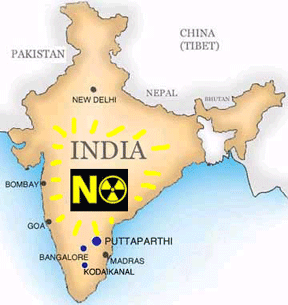 Anti-nuclear protestors take out rally, stage peaceful demo Radhapuram (TN) Dec 18 (PTI) About 10,000 anti-nuclear protestors today took out a procession from a temple at nearby Koodankulam to this town and staged a peaceful demonstration, condemning Prime Minister Manmohan Singh’s statement that the Nuclear Power project would be operationalised in a couple of weeks and resolved to picket the plant if work resumed.
Pushparayan, Convenor of People’s Movement Against Nuclear Energy (PMANE), which is spearheading the stir, said the organisation would intensify its agitation from January 1 if their demand for removing the fuel rods loaded into the reactor were not removed by that date.
Police said the procession and the demonstration passed off peacefully and that adequate security had been deployed to ensure no untoward incidents took place. Earlier in the day, PMANE condemned Singh’s ‘anti-people’ and ‘autocratic’ statement on KNPP, saying it betrayed the fact that the state government’s resolution to
halt work was never honoured earnestly or implemented effectively.
http://ibnlive.in.com/generalnewsfeed/news/antinuclear-protestors-take-out-rally-stage-peaceful-demo/935954.html
 VIDEO Huge protest planned in Kudankulam over PM’s statement by ndtv on Dec 18, 2011 With the Prime Minister announcing that the Kudankulam plant will be operationalised in a couple of weeks, at Ground Zero, villagers have called for a huge protest rally today, from Kudankulam to nearby Radhapuram in Tamil Nadu. “If the Nuclear Power Corporation of India or the Department of Atomic Energy tries to restart the work at the Kudankulam nuclear plant, we will lay a siege with thousands of people and their families immediately at the site, and number two in order to protest against PM’s statement made in Russia we are going to hold a rally from Kudankulam to Radhapuram,” said SP Udhayakumar, Convenor, People’s Movement against Nuclear Energy. http://www.youtube.com/watch?v=lPPlEavM3VE
China might not save the nuclear industry, as they had hoped
Even before Fukushima, China’s government was asking tough questions of its nuclear growth ambitions. Late last year, its State Council Research Office issued a report outlining a number of concerns about the expansion program.
Since Fukushima, China’s government has pressed the pause button on nuclear expansion
the new generation AP1000 reactors that make up a large portion of the proposed nuclear capacity are not yet in operation anywhere in the world. It is an as yet unproven technology
there is reason for the people of China to be asking questions about the country’s ability to deliver large-scale, hi-tech projects as memories of July’s tragic Wenzhou high-speed rail crash, in which 40 passengers died, are still fresh in their minds….. Nuclear will remain a fringe source of power in China

 China’s nuclear ambitions move to the slow lane, BY: PAUL GARVEY , The Australian, December 19, 2011 CHINA has been the one ray of hope in a miserable year for the global uranium industry. But sadly for uranium stocks, it looks increasingly likely China’s substantial nuclear reactor development program will take much longer to roll out than planned.
With the nuclear industry under review across Europe and Japan in the wake of the Fukushima disaster earlier this year, China has represented one of the only, and certainly the largest, growth market for uranium. Continue reading
Small scale Wind- Solar hybrid system powering a whole village
 Nepal’s Dhaubadi turns Asia’s first ‘renewable energy village’, Times of India Dec 17, 2011, |KATHMANDU: Dhaubadi, in remote Nepal has become Asia’s first ‘renewable energy village’ with the installation of mini wind-solar hybrid power system with the financial and technical support from ADB.
The two sets of 5 kw wind turbines complimented by 2 kwp of solar PV panels can generate 43.6 kwh per day electricity which can light 46 households of the village, according the Asian Development Bank country office in Nepal. The installation of this ultra-modern facility will allow women to cook and clean, and children to study or play after dark, ADB says in a press release issued at a function today.
The villagers are now able to see television, charge their cell phone sets, operate computers and read at night with the help of the wind-solar power system. Erecting greenhouses to absorb solar energy and manage water uses for high-value cash crop and vegetable production is also being planned which will augment income generation activities in the village community.
Energy fuels economic growth and poverty reduction. Reliable and efficient energy services underpin the expansion of economic and employment opportunities, the continuing progress in social development, and the sustained improvement in standard of living, observed S Hafeez Rahman, ADB’s director general for South Asia Development.
The Wind-Solar hybrid system was installed under ADB’s regional technical assistance (RETA) for Effective Development of Distributed Small Wind Power System in Asian Rural Areas of with the Alternative Energy Promotion Centre of the Ministry of Environment is the implementing agency in Nepal. The USD 3.8 million RETA will contribute to ADB’s Energy for All initiative by increasing access to energy in remote rural areas.
In view of the Nepal’s chronic energy shortage and its abundant wind and solar resources, as well as the government’s strong commitment towards a low-carbon economy, ADB has selected Nepal as the first pilot country for its small wind power initiative.
The lessons learnt from Nepal on the deployment of small wind power system in rural areas will be very useful in scaling up the systems in Nepal and replicating in other ADB member countries, said Kangbin Zheng, ADB’s senior investment specialist. Articles.timesofindia.indiatimes.com/2011-12-17/developmental-issues/30528393_1_s-hafeez-rahman-solar-energy-small-wind-power
Working at Fukushima nuclear plant likely to be a death sentence?
Government was likely avoiding the huge task of evacuating major cities like Iwaki and Fukushima.
He also expressed concern for those working to recover the plant. He said: “Working at Fukushima is equivalent to being given an order to die”…..
Fukushima nuclear shutdown: ‘No progress is being made’ ZDNet By Hana Stewart-Smith | December 16, 2011, Summary: The Japanese government says that troubled nuclear plant
Fukushima is under control. But an undercover journalist suggests that no progress is being made towards recovery.
The Japanese government announced publicly today that the troubled Fukushima plant is now under control, having achieved a ‘cold shutdown‘….This is reassuring news for the public after the reactor sprung a leak earlier this month, pouring out an estimated 45 tonnes
of radioactive water, which may have reached the sea….
However, freelance journalist Tomohiko Suzuki, who worked undercover at Fukushima for over a month, disputed this news. Suzuki spoke to reporters at a Foreign Correspondents’ Club of Japan conference yesterday, telling a very different story to the one officially given
by the Government. Continue reading
Nuclear “Cold Shutdown” – a good “spin” phrase, but not actually true
Again, should “Cold Shut Down” be a term applicable to broken reactors with molten cores in their basements?, Paul Langley’s Nuclear History Blog, December 19, 2011 probably not. The actual pressure vessels are empty and unsealed, and the state of the fuel and its precide disposition are unknowns. If you dont know the temperature and whereabouts of the fuel, how is that “cold shutdown”. The fuel has gone feral. Just like the industry.
Partial quote: http://www.huffingtonpost.com/2011/12/16/japan-nuclear-crisis-cold-shutdown_n_1152889.html
Japan Nuclear Crisis: Prime Minister Says Tsunami-Devastated Nuclear Power Plant Has Reached Stable State Of ‘Cold Shutdown’
“…..The government said Fukushima Dai-ichi has reached cold shutdown “conditions”_ a cautious phrasing reflecting the fact that TEPCO cannot measure the temperatures of melted fuel in the damaged reactors in the same way as with normally functioning ones.”…… http://nuclearhistory.wordpress.com/
India’s Prime Minister working for foreign nuclear companies, not for the people?
We wonder whether the PM is working for us (Indians) or for foreign companies,”
Udayakumar, Co-ordinator of the People’s Movement of Nuclear Energy, spearheading the protests, said the PM’s remarks indicated that work was going on “secretly” at the site. “This is against Tamil Nadu assembly resolution demanding a halt to the work at the plant till the people’s fears are allayed,” he said.
 Kudankulam: protestors want uranium from site gone by year end DNA, Dec 17, 2011, Anti-Kudankulam nuclear power plant protestors today criticised Prime Minister Manmohan Singh’s announcement that the project would be operationalised in a few weeks and set December 31 as the deadline for the Centre to remove the uranium kept in the plant or else face “intensified agitation”. Continue reading
The term “cold shutdown” is not appropriate to the Fukushima nuclear reactors
Japanese Government speeds rezoning of contaminated areas. Paul Langley’s nuclear history blog 18 Dec 11 The appropriateness of the use of the term “cold shutdown” in relation to the Fukushima reactors in meltdown has been discussed in an editorial by the Mainichi Daily News, Japan, 17 Dec 2011. It is term applicable to a reactor in normal mode, not disaster failure meltdown mode.
The pressure vessels are essentially in a vastly abnormal state, and although the Japanese Government states venting of radionuclides has “significantly” stopped, things are still very abnormal in the Fukushima reactors. Neither TEPCO nor the Japanese Government understands the true state of the escaped fuel, nor how much the reactor vessels have been eroded. Continue reading
Kudankulam Anti nuclear protestors strengthen their resolve
Day after PM’s message, protesters stick to guns , Hindustan Times, Chennai, December 19, 2011 A day after Prime Minister Manmohan Singh said the Kudankulam nuclear power plant in Tamil Nadu could not remain idle and would be commissioned in a couple of weeks, people agitating against the project and the Centre appeared headed for a showdown. The protesters have set December 31 as the deadline for the removal of fuel assemblies (used to build the core of a reactor) from the plant complex, Continue reading
Fukushima nuclear plant nowhere near ‘under control’ despite govt’s claims
 The nuclear power lobbyists are the ones who can claim credit for stabilizing their own situation and getting the government under control.
 Fukushima power plant is far from ‘cold’,Deutsche Welle, Alexander Freund , 16 Dec 11 http://www.dw-world.de/dw/article/0,,6682457,00.htm The Japanese government has claimed to have reached a cold shutdown in Fukushima. But experts are skeptical and believe it could take another 40 years to get the situation under control. Headlines from Japan surely sound good: Fukushima is under control, the dilapidated nuclear power plant is stable.
But these headlines are nothing more than a euphemism. The situation at Fukushima is nowhere near under control. Continue reading
Unreliable claim that Fukushima nuclear plant is now ‘stable’
 TEPCO has not been able to take direct measurements of the temperatures at the bottoms of the containment vessels, and the site is still too radioactive for the fuel rods’ status to be visually confirmed.
Radiation levels are too high for people to get close to the reactors, leaving engineers and scientists to make important judgments using computer simulations, scattered bits of data and guesses.
Skeptics cast doubt on Fukushima status, even as Japan declares nuclear reactors ‘stable’ Christian Science Monitor, By Arthur Bright, December 16, 2011 Japan’s government declared that the damaged reactors from the Fukushima disaster were ‘stable.’ Not everyone is convinced. The Japanese government announced that the Fukushima nuclear complex, heavily damaged by the March 11 tsunami in the world’s worst nuclear disaster since Chernobyl, is now stable. But serious doubts remain about Fukushima’s status, as officials remain unable to confirm the status of the reactors’ fuel and an undercover report impugns the clean-up efforts’ efficacy.

Prime Minister Yoshihiko Noda told a government nuclear emergency meeting that “The reactors have reached a state of cold shutdown” and are “stable,”
reports Reuters. Mr. Noda and his environment and
nuclear crisis minister, Goshi Hosono, both said that the situation at
the plant is under control , though the clean-up may still take decades. The Tokyo Electric Power Co. (TEPCO), which operates the reactor and has been leading the clean-up, had been attempting to achieve cold shutdown before the end of the year. Continue reading
White polyester box covers Unit 1 of Japan’s stricken Fukushima Daiichi nuclear plant
A Circus Tent for Fukushima Daiichi? WSJ, DECEMBER 15, 2011, The polyester cover erected over Unit 1 of Japan’s stricken Fukushima Daiichi nuclear power station was fashioned in the shape of atight-fitting, non-descript, white box. Continue reading
Secrecy caused delay in dealing with Fukushima nuclear disaster
Secret Weapons Program Inside Fukushima Nuclear Plant? U.S.-Japan security treaty fatally delayed nuclear workers’ fight against meltdown Global Research, 12/4/11 by Yoichi Shimatsu “….Death of Deterrence …. in 2009, the International Atomic Energy Agency (IAEA) issued a muted warning on Japan’s heightened drive for a nuclear bomb— and promptly did nothing. The White House has to turn a blind eye to the radiation streaming through American skies or risk exposure of a blatant double standard on nuclear proliferation by an ally. Besides, Washington’s quiet approval for a Japanese bomb doesn’t quite sit well with the memory of either Pearl Harbor or Hiroshima.
In and of itself, a nuclear deterrence capability would be neither objectionable nor illegal— in the unlikely event that the majority of Japanese voted in favor of a constitutional amendment to Article 9. Legalized possession would require safety inspections, strict controls and transparency of the sort that could have hastened the Fukushima emergency response. Covert weapons development, in contrast, is rife with problems. In the event of an emergency, like the one happening at this moment, secrecy must be enforced at all cost— even if it means countless more hibakusha, or nuclear victims.
Instead of enabling a regional deterrence system and a return to great-power status, the Manchurian deal planted the time bombs now spewing radiation around the world. The nihilism at the heart of this nuclear threat to humanity lies not inside Fukushima 1, but within the national security mindset. The specter of self-destruction can be ended only with the abrogation of the U.S.-Japan security treaty, the root cause of the secrecy that fatally delayed the nuclear workers’ fight against meltdown. http://www.globalresearch.ca/index.php?context=va&aid=24275
1 This Month
23-25 October – on Zoom – World BEYOND War’s annual global conferenc


Shut down the radiation-damaged Heysham nuclear reactors now
To see nuclear-related stories in greater depth and intensity – go to https://nuclearinformation.wordpress.com

Say No to NASA’s Reckless Nuclear Reactor on the Moon
Say No to NASA’s Reckless Nuclear Reactor on the Moon

-
Archives
- October 2026 (219)
- September 2026 (339)
- August 2026 (330)
- July 2026 (355)
- June 2026 (287)
- May 2026 (306)
- April 2026 (356)
- March 2026 (251)
- February 2026 (267)
- January 2026 (308)
- December 2025 (358)
- November 2025 (359)
-
Categories
- 1
- 1 NUCLEAR ISSUES
- business and costs
- climate change
- culture and arts
- ENERGY
- environment
- health
- history
- indigenous issues
- Legal
- marketing of nuclear
- media
- opposition to nuclear
- PERSONAL STORIES
- politics
- politics international
- Religion and ethics
- safety
- secrets,lies and civil liberties
- spinbuster
- technology
- Uranium
- wastes
- weapons and war
- Women
- 2 WORLD
- ACTION
- AFRICA
- Atrocities
- AUSTRALIA
- Christina's notes
- Christina's themes
- culture and arts
- Events
- Fuk 2022
- Fuk 2023
- Fukushima 2017
- Fukushima 2018
- fukushima 2019
- Fukushima 2020
- Fukushima 2021
- general
- global warming
- Humour (God we need it)
- Nuclear
- RARE EARTHS
- Reference
- resources – print
- Resources -audiovicual
- Weekly Newsletter
- World
- World Nuclear
- YouTube
-
RSS
Entries RSS
Comments RSS

