Developing nuclear weapons together – Japan and UK
UK and Japan agree to act in unison on nuclear interests Enformable, 13 April 12, For the first time in history, Japan has agreed to develop weapons with a country other than the United States, proclaiming the agreement will strengthen bilateral defense cooperation, including joint weapons development. Continue reading
In 3 days, Japanese government runs up sloppy safety standards, to keep the nuclear industry going
It even appears that the government intentionally worked out looser standards so that utilities can meet them in order to hasten the reactivation of Oi nuclear plant’s idled reactors.
Economy, Trade and Industry Minister Yukio Edano says there is no need for reactivation of nuclear reactors stopped for regular inspections if the overall supply of electric power is sufficient.

 New standards for reactivating nuke reactors are too hasty and sloppy , 11 April 12, http://mainichi.jp/english/english/perspectives/news/20120409p2a00m0na018000c.html The government should be criticized for having moved too hastily and in a sloppy manner when it set new standards for deciding whether to reactivate nuclear reactors, even though the criteria are crucial in ensuring the safety of the public.
Prime Minister Yoshihiko Noda and three Cabinet ministers concerned approved the standards on April 6 with an eye to approving resumption of operations at the No. 3 and 4 reactors at the Oi Nuclear Power Plant in Fukui Prefecture, which are currently suspended for regular inspections. Continue reading
There’s gold in them thar dead nuclear reactors

Christina Macpherson's websites & blogs
And some of us thought that the nuclear industry wasn’t profitable any more!
Well, after ripping off the taxpayer all these years they will now be back in business with a vengeance. The almost eternal task of buryng dead nuclear reactors could turn out to be even more profitable than ever
UK in nuclear decommissioning deal with Japan http://www.reuters.com/article/2012/04/10/japan-britain-nuclear-idUSL6E8FA3JP20120410 by Oleg
Vukmanovic; Edited by David Holmes LONDON, April 10 Apr 10, 2012 (Reuters) – Britain and Japan signed a framework civil nuclear co-operation pact opening up Japan’s multi-billion pound decommissioning sector to UK companies, the UK energy ministry said.
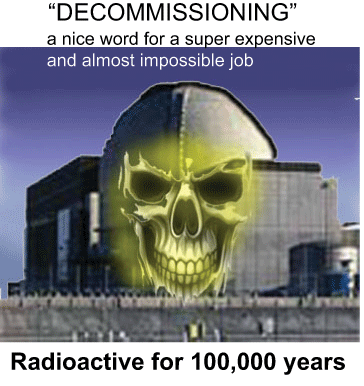
The announcement on Tuesday came as UK Prime Minister David Cameron kicked off his tour of Asia in Japan. The tour is aimed at boosting trade and investment ties, while the nuclear pact follows the devastating Fukushima nuclear plant meltdown in March last year. Continue reading
Japanese government still wants to promote the nuclear industry’s future
Critics said the government fears not so much a power crunch as revealing that the country actually can get by without nuclear energy when the last running reactor is halted on May 5 for scheduled maintenance.
Tensions run high over restart of Japan’s nuclear reactors, Times Live, Takehiko Kambayashi Sapa-dpa | 10 April, 2012 A 70-year-old temple master went on a week-long hunger strike in late March at the Fukui prefectural government offices against the central government’s efforts to restart idled reactors on the coast of the Sea of Japan.
If idled reactors at the Oi Nuclear Power Plant in the prefecture are allowed to restart, it would lead to the reactivation of other units across the country, said Tetsuen Nakajima, the chief priest of Myotsuji, a temple in Obama city. Continue reading
Sri Lanka will raise safety objections to India’s Koodankulam and other nuclear reactors


 Sri Lanka concerned over radiation from India’s nuclear plants, Economic Times, 9 APR, 2012, COLOMBO: Sri Lanka today expressed concern over possible impact of radiation from India’s nuclear power plants located in the southern region, as it prepares to raise the issue with global atomic watchdog IAEA.
The official raising of concern with the International Atomic Energy is to be made in September, the power and energy minister Champika Ranawaka said. “We respect the right of India to have nuclear power stations. But our concerns are on the possible radiation affects they could have on Sri Lanka. We have already written a letter”, Ranawaka said…… Sri Lankan energy officials say at least three nuclear plants are located on the southern coast of Tamil Nadu which is separated from the island by a narrow strip of sea…… Koodankulam nuclear plant in India’s Southern coast is just 250 km from Sri Lanka’s northwest coastal town of Mannar.
Sri Lanka Atomic Energy Authority does not possess adequate facilities to face a threat of nuclear accident. http://economictimes.indiatimes.com/news/politics/nation/sri-lanka-concerned-over-radiation-from-indias-nuclear-plants/articleshow/12594324.cms
Fukushima evacuees will be returning to a still contaminated zone
Decontamination needed even after residents return, The Yomiuri Shimbun, 10 April 12, If decontamination work does not continue for a certain period in areas highly contaminated by radioactive substances from the Fukushima No. 1 nuclear power plant, returning residents will be exposed to at least 100 millisieverts of accumulated radiation over 30 years, the Science Council of Japan said Monday. Continue reading
Risk of zero nuclear power being effective: Japan’s govt anxious to avoid this
There is something altogether unnerving about safety standards which are admittedly adapted not primarily for safety’s sake, ……but rather to convince host communities and the public of the safety of nuclear plants.
Japanese officials are concerned that if all of the nation’s nuclear power plants are shut down, that the rising sentiment in the island nation will prevent any of the commercial reactors to start once again.
“They want to avoid setting a precedent of the country operating without nuclear power because it will create a huge barrier in terms of restarts,” “People will question why we need it,”
Top Japanese Officials endorse new nuclear safety standards created in less than one weekEnformable, Lucas W Hixson, 7 Apr 12, The government is accelerating plans to give it’s the official nod to the restart of the No. 3 and No. 4 reactors at the Ohi plant in Fukui Prefecture after the Japanese Nuclear Safety Commission approved the results of Kansai Electric’s first-stage stress tests on the two reactors in March.

Earlier this week on Tuesday, Japanese Prime Minister Noda instructed Economy minister Yukio Edano to draft nuclear safety standards before judging whether to restart reactors 3 and 4 of the nuclear plant at Oi in Fukui Prefecture.
Despite having only held their third meeting, as of Thursday the Japanese central government have drafted, adopted, and generally endorsed new nuclear safety standards in record time.
The Japanese government is expected to take action on the new agreement following a meeting on Friday pending some modification on the wording of the draft by the Economy, Trade and Industry Ministry. However, there is no need to restart the reactors if the region has sufficient power, or if energy-saving measures can sufficiently reduce power consumption…… Continue reading
Japan: prefectures next to town of Oi don’t want Oi’s nuclear reactors restarted
 Debate growing over ‘local’ reactor consent Governors of prefectures without units seek greater say in process Japan Times, By ERIC JOHNSTON, April 6, 2012 OSAKA — Dissent between those inside Fukui Prefecture who want two reactors in the town of Oi restarted quickly and those in adjacent prefectures who want to wait for stronger safety measures or are opposed altogether, highlights the dilemma Tokyo faces in obtaining local consent. Continue reading
Japanese government can override community opposition to nuclear reactor restarts
The new accident touched a nerve among the public at a time when Japan’s government is working to convince its people that atomic power is vital.
Chief Cabinet Secretary Osamu Fujimura underscored that there was no legal requirement for local communities to sign off on the restarts.
Japan races to get nuclear reactors running again China Daily-Reuters 2012-04-06 About 12 tons of radioactive water has leaked at Japan’s Fukushima Daiichi nuclear power plant while the Japanese government is racing to get two nuclear reactors of Kansai Electric Power Company running again by next month. Continue reading
Japan: Governor of critical region Shiga threatens to oppose nuclear reactor startups
“It appears to me that they are compromising technological safety in a half-baked way,”
reactors should not be restarted until a new, more independent regulatory agency is set up.
Japan Shiga threatens to rain on nuclear restarts Apr 6, 2012 (Reuters) – Japan’s western Shiga prefecture, one of the nation’s biggest sources of drinking water, threatened on Friday to oppose the restart of nearby nuclear reactors unless the government met several demands designed to prevent a repeat of the Fukushima disaster.
Shiga, whose Lake Biwa provides water for 14 million people, more than one in 10 Japanese, lies near a string of nuclear plants in adjacent Fukui prefecture – giving Shiga a distinctive voice in the debate over the future of atomic power. Continue reading
Japan’s government wants to restart nuclear reactors, but under pressure not to
Experts say the government is racing to try to restart two nuclear reactors by next month out of fear that surviving a total shutdown would make it hard to convince the public that atomic energy is vital to avoid serious power shortages.
A group of seven lawmakers from ruling and opposition parties, which wants Japan to abandon nuclear power, urged the government on Friday not to approve restarts hastily……
Cut nuclear reliance to zero: Japan energy minister abs-cbn news, by Risa Maeda, Reuters 04/07/2012 TOKYO – Japan should aspire to phase out nuclear power completely, its energy minister said on Friday, even as the government struggles to persuade a wary public that it is safe to restart reactors after the world’s worst nuclear crisis in 25 years. Continue reading
Far from being over, Japan’s government fears worse to come from Fukushima
Such an event would cause widespread nuclear fallout throughout the region and force the government to evacuate the nearly 10 million residents of Tokyo and surrounding areas, a scenario which government emergency planners are now taking into serious consideration.
 It’s Not Over: Government Plans for the Worst: Forced Evacuation of Tokyo. Mac Slavo SHTF Plan.com, April 3rd, 2012 While it has for the most part disappeared from mainstream view, the Fukushima nuclear disaster is anything but over. In fact, the situation in Japan has gone from bad to worse.
Bottom line: There is no way to contain the radiation.
Even more alarming is that the U.S. Nuclear Regulatory Commission (NRC) and other agencies have warned that the nuclear storage pools (the containment units that are being used to cool the nuclear fuel) have been damaged and may collapse under their own weight. Continue reading
Protest movement against nuclear power grows amongst rural Indians
 “We have been holding a sit-in protest outside the Fatehabad mini-secretariat. We now plan to join hands with protesters fighting against the setting up of a nuclear plant in Jaitapur and those protesting in Koodankulam.”
Farmers are incensed that three elderly protesting farmers have already lost their lives in this agitation which has now completed over 580 days.
Protest against Haryana nuke plant intensifies http://www.deccanchronicle.com/channels/nation/north/protest-against-haryana-nuke-plant-intensifies-152
April 3, 2012 By Rashme Sehgal Farmers in Haryana have stepped up their campaign against the setting up of the Gorakhpur Nuclear Power Plant in the Fatehabad district of the state.
The Nuclear Power Corporation of India Ltd (NPCIL) has earmarked over 628 hectares of land to set up a 2,800-MW power plant which will use pressurised heavy water reactors at a cost of `13,000 crores. The villages earmarked for site selection include Gorakhpur, Kumaharia and Kajalhedi. Continue reading
Fukushima nuclear plant not ‘under control’ as radioactive water spills
 Tons of radioactive water spill from Fukushima nuclear plant http://rt.com/news/fukushima-nuclear-water-leak-378/ 05 April, 2012, Officials at the Tokyo Electric Power Company (TEPCO), which acts as the operator of the crippled nuclear
facility, say there is reason to believe some of the 12 tons of radioactive water has flowed into the Pacific Ocean.
A leak was found in a pipe attached to a temporary decontamination system. The water, once it has been used to cool the reactors, contains massive amounts of radioactive substances and is put into the water-processing facility so it can be recycled for use as a coolant.
“Our officials confirmed that cooling water leaked at a joint in the pipes,” a TEPCO spokesman told reporters, adding that “it is possible that some of the water may have flowed outside the facility and pouredinto the ocean.”
This accident is the latest of several leaks of radioactive water at the plant, undermining the government’s claim that the shuttered reactors were now under control.
Just last month, about 120 tons of radioactive water leaked at the plant’s water decontamination system and about 80 liters (21 gallons) seeped into the ocean, according to TEPCO. The plant, which is just north-east of Tokyo, was crippled by
meltdowns and explosions caused by Japan’s massive earthquake and tsunami
France wants to be sure of not being liable for nuclear accidents, in selling nukes to India
According to the new Rules of the Civil Liability for Nuclear Damages Act, the foreign suppliers of nuclear material to Indian nuclear power plants would not be held liable for 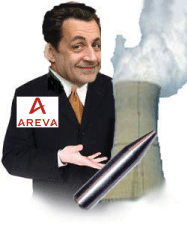 accidents caused by defective or faulty equipment supplied by them if the accident takes place after a guarantee period specified by them
France waits for India to clarify N-liability framework IBN LiveNew Delhi, 5 April 12, : In the midst of the run-up to the French presidential elections, France has been in dialogue with India to clarify issues relating to the nuclear liability law, and is waiting for New Delhi to establish the legal framework before signing commercial contracts for setting up atomic reactors. Continue reading
1 This Month
23-25 October – on Zoom – World BEYOND War’s annual global conferenc


Shut down the radiation-damaged Heysham nuclear reactors now
To see nuclear-related stories in greater depth and intensity – go to https://nuclearinformation.wordpress.com

Say No to NASA’s Reckless Nuclear Reactor on the Moon
Say No to NASA’s Reckless Nuclear Reactor on the Moon

-
Archives
- October 2026 (199)
- September 2026 (339)
- August 2026 (330)
- July 2026 (355)
- June 2026 (287)
- May 2026 (306)
- April 2026 (356)
- March 2026 (251)
- February 2026 (267)
- January 2026 (308)
- December 2025 (358)
- November 2025 (359)
-
Categories
- 1
- 1 NUCLEAR ISSUES
- business and costs
- climate change
- culture and arts
- ENERGY
- environment
- health
- history
- indigenous issues
- Legal
- marketing of nuclear
- media
- opposition to nuclear
- PERSONAL STORIES
- politics
- politics international
- Religion and ethics
- safety
- secrets,lies and civil liberties
- spinbuster
- technology
- Uranium
- wastes
- weapons and war
- Women
- 2 WORLD
- ACTION
- AFRICA
- Atrocities
- AUSTRALIA
- Christina's notes
- Christina's themes
- culture and arts
- Events
- Fuk 2022
- Fuk 2023
- Fukushima 2017
- Fukushima 2018
- fukushima 2019
- Fukushima 2020
- Fukushima 2021
- general
- global warming
- Humour (God we need it)
- Nuclear
- RARE EARTHS
- Reference
- resources – print
- Resources -audiovicual
- Weekly Newsletter
- World
- World Nuclear
- YouTube
-
RSS
Entries RSS
Comments RSS

