Fukushima children did receive high radiation to thyroid glands
Study finds lifetime thyroid doses of radiation in Fukushima children July 11, 2012 By YURI OIWA/ Staff Writer Children in Fukushima Prefecture likely received thyroid gland doses of internal radiation, despite earlier government assurances that the levels of such doses were zero, according to an independent study…… subscription only
http://ajw.asahi.com/article/0311disaster/fukushima/AJ201207110058
Tsunami affected areas can redevelop with renewable energy
The goal of the Kesen project is to generate at least 50 percent of the region’s electricity through solar and other renewable-energy sources
Rice paddies that were inundated with seawater in March 2011 can yield more profit if they’re covered with solar panels than if they’re rehabilitated as agricultural land.
 Tsunami Cities Fight Nuclear Elites To Create Green Jobs By Stuart Biggs – Jul 10, 2012 Bloomberg Rikuzentakata, like many cities on Japan ’s rugged northeast Pacific coast, was in decline even before last year’s tsunami killed 1,700 of its 24,000 inhabitants and destroyed most of its downtown buildings.
With two-thirds of the remaining residents homeless, Mayor Futoshi Toba questioned whether the city could recover, Bloomberg Markets magazine reports in its August issue. Damage to infrastructure and the economy, he said, would force people to move away to find jobs. Sixteen months later, the city is trying to rebuild in a way that Toba says would reinvent the region and provide a model to overcome obstacles that have hobbled the Japanese economy for more than 20 years: the fastest-aging population in the developed world, loss of manufacturing competitiveness toChina and South Korea and reliance on imported fossil fuels.
Rikuzentakata is part of a government program to create one of the country’s first so-called ecocities.
They would be smaller and more self-sufficient and would lower costs through technology and create new jobs in renewable energy to replace those lost to the decline of agriculture and fisheries……. Continue reading
Fukushima Report castigated governments for poor attention to radiation and health issues
Comments from Report of The Diet’s Fukushima Nuclear Accident Independent Investigation Commission “…... The report prodded the central and local governments to address health issues on grounds that exposure of even 100 millisieverts or less could lead to problems.
It said the 20-millisievert standard for reviewing evacuation zones was too high, especially when considering the health of children and pregnant women.
The commission also castigated the central and Fukushima prefectural governments for not taking steps to assess health problems caused by internal radiation .”exposure”….” http://ajw.asahi.com/article/0311disaster/fukushima/AJ201207060088
SAFECAST monitors nuclear radiation in Japan
 News Summary: American praised for radiation data
http://news.smh.com.au/breaking-news-technology/news-summary-american-praised-for-radiation-data-20120710-21s6x.html July 10, 2012 – The Associated Press NUCLEAR WINDS: Japanese seeking information on radiation levels in the aftermath of the Fukushima disaster are turning to a volunteer group founded in the U.S. that has created a detailed and constantly updated visual database online. Sean Bonner, one of the founders of the group called Safecast, http://blog.safecast.org/about/ said nothing could have been more natural than to jump in and fill the need.
FEARFUL AFTERMATH: Many Japanese were terrified about the health effects of radiation in the wake of the Fukushima disaster, and had no idea whether their homes, schools and offices were safe. They were also frustrated by the lack of government or other official data on
radiation. Geiger counters were selling out.
FILLING THE NICHE: Within weeks, Bonner and his team created a handmade Geiger counter connected with a GPS feature that he calls “bGeigie,” a reference to Japanese-style “bento” lunchboxes. It is attached to cars and takes a reading every five seconds, resulting in
a massive store of data. There are 30 to 35 such mobile devices traversing Japan and 320 fixed devices. Safecast made the technology and the data open, sharing the design and findings, and has now collected more than 3 million measurements across Japan. Other
volunteers have developed online maps with the data.
Tamil Nadu officials lie – pretense of an emergency drill near Koodankulam Nuclear Power Plant (KKNPP)

 ‘Kudankulam nuclear plant faked emergency drill’ Chennai: IBN Live, Tamil Nadu | Jul 08, 2012 The official claim of having conducted a mandatory three-stage emergency drill at Nakkaneri hamlet, situated within 7 km from the Koodankulam Nuclear Power Plant (KKNPP) in Tirunelveli district, on June 9 was termed ‘a blatant lie’ by the People’s Union of Civil Liberties (PUCL), which sent a fact-finding team to the place on June 13 and 20, after the villagers denied the version of the authorities.
No drill was conducted and the people of Nakkaneri were surprised to read about it in the newspapers the next day, the PUCL said, and accused the district administration of spreading falsehood through the media.
Announcing the findings in Chennai on Saturday, the team members said that they spoke to 22 people, including senior citizens and panchayat officials, and learnt that on June 9, a team of about 40 policemen had landed at the village, blocking the roads and checking a few vehicles before dispersing in the evening.
The next day, a press note was released saying an offsite emergency drill was held successfully in Nakkaneri. PUCL national secretary P Suresh said that the offsite emergency preparedness exercise was mandatory to get clearance from the Atomic Energy Regulatory Board (AERB) to load fuel into the reactor….
http://ibnlive.in.com/news/kudankulam-plant-faked-emergency-drill/270033-62-128.html
Researchers tracking patients’ medical radiation as it adds up

 Experts plan to track radiation doses from medical checks Asahi Shimbun, http://ajw.asahi.com/article behind_news/social_affairs/AJ201207090009 July 09, 2012 By YURI OIWA/ Staff Writer Concerned about an increase in radiation exposure at hospitals, a group of researchers plans to set up a system to track patients’ cumulative radiation doses and protect children from potential harm. Continue reading
“Regulatory Capture” by the global nuclear industry, not just Japan
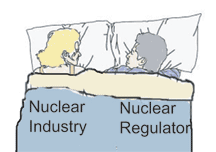 in the Japanese original of Thursday’s report…it explains the disaster in terms of “regulatory capture” – that is, that the relationship between the regulators and the regulated was much too close, enabling the regulated to subject the regulators to undue pressure and influence.
he supposedly Japanese qualities that the report outlines, such as obedience, reluctance to question authority, “sticking with the programme” and insularity, are not at all unique to Japan, but are universal qualities in all societies.
The Fukushima report hides behind the cultural curtain By claiming the disaster was ‘made in Japan’, an official report reinforces, yet does not explain, unhelpful stereotypes Naoko Shimazu guardian.co.uk, 6 July 2012 More than a year after a catastrophic earthquake and tsunami struck Japan on 11 March 2011, the Fukushima nuclear accident independent investigation commission released an 88-page report this week delivering the indictment that Fukushima could not be considered a natural disaster but a “profoundly man-made disaster”.
It went on to state that “this was a disaster ‘made in Japan’. Its fundamental causes are to be found in the ingrained conventions of Japanese culture: our reflexive obedience; our reluctance to question authority; our devotion to ‘sticking with the programme’; and our ‘insularity’.”…. Continue reading
United States, Russia, China, France, UK refusing to sign ASEAN Weapons Free Zone treaty
 Nuclear states shun ASEAN treaty Supalak Ganjanakhundee, The Nation, Phnom Penh July 9, 2012 Powers won’t sign weapon-free accord this week Nuclear weapons states will not sign the protocol of the Southeast Asian Nuclear Weapons Free Zone treaty (SEANWFZ) at this week’s Asean meeting as many of them still have reservations, Foreign Minister Surapong Towichukchaikul said yesterday.
Nuclear powers including the United States, Russia, China, France and the United Kingdom were supposed to sign the protocol when their representatives attended the Asean ministerial meeting in Cambodia this week. However, many of them voiced reservations to the group at
short notice over their rights and sovereignties in zones defined as “nuclearweapons free”. Continue reading
Earthquake danger for nuclear power plants
 Earthquakes are a fairly common occurrence in Japan, and so, if the earthquake was indeed the cause of the accident, it would call into question the safety of much of Japan’s nuclear fleet, including, presumably, the reactors at the Ohi plant.
The Nuclear Power Conundrum, Bill Chameides Dean, Duke University’s Nicholas School of the Environment HUFFINGTON POST, 07/06/20 “…. a report released on Thursday by the Fukushima Nuclear Accident Independent Investigation Commission concluded that last year’s accident in northeastern Japan at the Fukushima Daiichi power plant operated by the Tokyo Electric Power Company (Tepco) was “profoundly a man-made disaster — that could and should have been foreseen and prevented.”
While the official story has been that the accident was caused by the “once-in-a-millennium” tsunami, the report concludes that damage resulting from the earthquake (before the tsunami struck) could have been liable as well. Continue reading
People’s welfare the last priority – damning report on Fukushima nuclear catastrophe
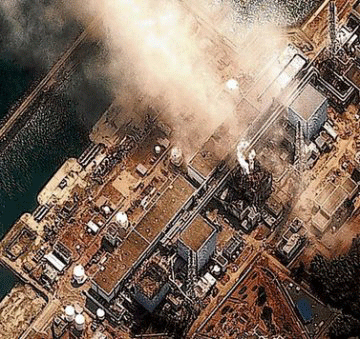 FINAL REPORT (2) : Concern for people’s lives was not a priority July 06, 2012 THE ASAHI SHIMBUN Concern for people’s lives seemed to be the last thing on the minds of officials at Tokyo Electric Power Co. or the central government as they scrambled to contain the nuclear disaster in Fukushima Prefecture last year.
This is one of the grim assessments that emerge from the final report issued July 5 by a Diet task force that investigated the accident at the Fukushima No. 1 nuclear power plant. The Diet’s Fukushima Nuclear Accident Independent Investigation Commission suggested that health and safety concerns simply were not a priority.
The commission was especially critical of the lack of safety measures taken in the past as well as the initial response to the disaster triggered by the magnitude-9.0 Great East Japan Earthquake on March 11, 2011. It concluded that plant operator TEPCO and the central government showed an utter lack of responsibility in doing everything possible to protect the lives of those most affected.
Delay in implementing measures proved to be costly The final report pointed to problems that arose after TEPCO and the Nuclear and Industrial Safety Agency (NISA) failed to implement safety measures even though they knew the plant was dangerously vulnerable to a major earthquake and tsunami crashing into the coast.
“The accident cannot be said to have been totally unexpected and there is no way that responsibility can be avoided,” the report stated. http://ajw.asahi.com/article/0311disaster/fukushima/AJ201207060088
Fukushima disaster workers forced to do cleanup without safety precautions
 there was never any health supervision or monitoring of radiation doses. I am worried about the amount of radioactive substances that may have built up in my body.”
FINAL REPORT (4) : TEPCO failed to warn nuke plant workers after 3/11 http://ajw.asahi.com/article/behind_news/social_affairs/AJ201207060070, THE ASAHI SHIMBUN Workers who remained in the Fukushima No. 1 nuclear plant even after it was hit by the huge earthquake and tsunami to deal with the fast-moving crisis were praised as heroes dubbed the “Fukushima 50.”
But the reality was that most were forced to do the dangerous work without vital information and safety precautions, the report by the Diet’s investigation panel has revealed.
The final report by the Diet’s Fukushima accident investigation panel has revealed that workers at the nuclear plant after the onset of the disaster were forced to tackle the accident without adequate information and or safety precautions.
The report, issued by the National Diet of Japan Fukushima Nuclear Accident Independent Investigation Commission on July 5, also reveals what Tokyo Electric Power Co. employees and subcontractors experienced and felt during operations after the Great East Japan Earthquake and tsunami hit the Fukushima No. 1 nuclear plant on March 11, 2011. Continue reading
“Neighbourly” campaign by Japan’s anti nuclear activists
they decided to open Yanaka no Iie (“Yanaka house”)–more precisely the home of member Naoko Nishimura–to monthly screenings followed by issue-related discussions over wine and coffee.
Anti-nuclear activists turn to home movie screenings http://ajw.asahi.com/article/behind_news/people/AJ201207060081, July 06, 2012 By LOUIS TEMPLADO/ AJW Staff Writer Protests take on many forms. Some chant in front of the seats of power; others march. But another way to protest is to invite people into your living room to watch movies. Continue reading
Most Fukushima evacuees did not know of the nuclear accident for days
much of the public remained unaware of the crisis for days.
FINAL REPORT (3) : 80% of evacuees did not know about Fukushima crisis on 3/11 http://ajw.asahi.com/article/0311disaster/fukushima/AJ201207060051 July 06, 2012 THE ASAHI SHIMBUN More than eight out of 10 people in the evacuation zone around the Fukushima No. 1 nuclear power plant had no idea there was anything wrong on March 11, 2011, according to the Diet investigation into the accident. Continue reading
Report points to earthquake as cause of Fukushima nuclear catastrophe
The 641-page report criticized Tepco as being too quick to dismiss earthquake damage as a cause of the fuel meltdowns at three of the plant’s six reactors, which overheated when the site lost power.
Inquiry Declares Fukushima Crisis a Man-Made Disaster, NYT, By HIROKO TABUCHI, July 5, 2012 TOKYO — The nuclear accident at Fukushima was a preventable disaster rooted in government-industry collusion and the worst conformist conventions of Japanese culture, a parliamentary inquiry concluded Thursday. Kyodo News, via Associated Press
The report, released by the Fukushima Nuclear Accident Independent Investigation Commission, challenged some of the main story lines that the government and the operator of the Fukushima Daiichi Nuclear Power Plant have put forward. Most notably, the report said the plant’s crucial cooling systems might have been damaged in the earthquake on
March 11, 2011, not only in the ensuing tsunami.
That possibility raises doubts about the safety of all the quake-prone country’s nuclear plants just as they begin to restart after a pause ordered in the wake of the Fukushima crisis…… Continue reading
Japanese govt caving in to “nuclear village”, but nuclear future uncertain
Many experts, though, say the nuclear interests are unlikely to win the longer-term battle given the hidden costs of atomic power exposed by Fukushima and a new set of forces pushing for a bigger role for renewable sources of energy such as solar power.
“They (the nuclear interests) are fighting with their backs to the wall”
Reactor restarts, but Japan’s energy policy in flux The Asahi Shimbun, July 04, 2012 Buffeted by industry worries about high electricity costs on one side and public safety fears about nuclear power on the other, Japan’s leaders are still struggling to craft a coherent energy policy more than a year after the Fukushima disaster.

Critics say Prime Minister Yoshihiko Noda, whose top priority is raising the sales tax to curb bulging public debt, is caving in to Japan’s “nuclear village” — a powerful nexus of utilities,
bureaucrats and businesses — by restarting the first of Japan’s 50 reactors to come back on line since the crisis. Continue reading
1 This Month
23-25 October – on Zoom – World BEYOND War’s annual global conferenc


Shut down the radiation-damaged Heysham nuclear reactors now
To see nuclear-related stories in greater depth and intensity – go to https://nuclearinformation.wordpress.com

Say No to NASA’s Reckless Nuclear Reactor on the Moon
Say No to NASA’s Reckless Nuclear Reactor on the Moon

-
Archives
- October 2026 (199)
- September 2026 (339)
- August 2026 (330)
- July 2026 (355)
- June 2026 (287)
- May 2026 (306)
- April 2026 (356)
- March 2026 (251)
- February 2026 (267)
- January 2026 (308)
- December 2025 (358)
- November 2025 (359)
-
Categories
- 1
- 1 NUCLEAR ISSUES
- business and costs
- climate change
- culture and arts
- ENERGY
- environment
- health
- history
- indigenous issues
- Legal
- marketing of nuclear
- media
- opposition to nuclear
- PERSONAL STORIES
- politics
- politics international
- Religion and ethics
- safety
- secrets,lies and civil liberties
- spinbuster
- technology
- Uranium
- wastes
- weapons and war
- Women
- 2 WORLD
- ACTION
- AFRICA
- Atrocities
- AUSTRALIA
- Christina's notes
- Christina's themes
- culture and arts
- Events
- Fuk 2022
- Fuk 2023
- Fukushima 2017
- Fukushima 2018
- fukushima 2019
- Fukushima 2020
- Fukushima 2021
- general
- global warming
- Humour (God we need it)
- Nuclear
- RARE EARTHS
- Reference
- resources – print
- Resources -audiovicual
- Weekly Newsletter
- World
- World Nuclear
- YouTube
-
RSS
Entries RSS
Comments RSS

