Japan moving towards renewable energy
the Japanese Wind Power Association has put the longer-term wind potential at over 200 GW, on and offshore, even taking account of locational constraints. That is similar to Japans total present energy generating capacity.
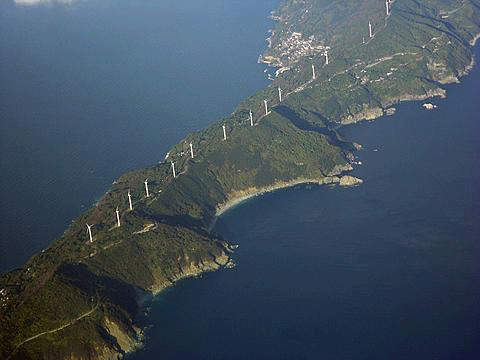
the aim would be to create a 50 trillion yen ($628 billion) green energy market by 2020 through deregulation and subsidies to promote development of renewable energy and low-emission cars.
Greening Japan’s energy http://environmentalresearchweb.org/blog/2012/07/greening-japans-energy.html 15 July 12 As part of its policy of moving away from nuclear power, the Japanese government is pushing ahead with renewables and improved energy efficiency. Given the urgent need to cut energy demand, following the shut down of all its nuclear plants in May, it encouraged voluntary energy saving initiatives, with some success. Continue reading
Japanese medical authorities quiet about high thyroid nodules in Fukushima’s children
the rate of thyroid nodules in children 5 to 10 years after the Chernobyl accident was 1.74%. The results in Fukushima are merely one year after the accident. This is a much faster progression

 Just 0.8% of children in 2001 Japanese control group had thyroid cysts or nodules — 36% in Fukushima study
Fukushima Children’s Thyroid Examination: How Shunichi Yamashita would like doctors to deal with the results. Introduction Fukushima Voice May 2012,
This is a letter sent from Shunichi Yamashita, M.D., from Fukushima Medical University to the members of Japan Thyroid Association, of which he is the president. The letter “asks” or rather “instructs” the members, who are likely to be the thyroid specialists, on how to
deal with the thyroid ultrasound results of Fukushima children. Continue reading
Nuclear danger very real – at Fukushima and at San Onofre
Nuclear Dread On Both Sides Of The Pacific IndyBay by Michael Steinberg Jul 14th, 2012 Nuclear problems are still growing on both sides of the Pacific, at Fukushima and San Onofre…….. Japan Ignored Ominous Signs Continue reading
Cancer and birth deformities toll, due to uranium radiation in Punjab groundwater
The effect of all this can be seen in the growing number of patients in the Malwa belt with cancer and other diseases and children being born with abnormalities. In fact, a train that connects Bathinda with Bikaner in neighbouring Rajasthan is known as the ‘Cancer Express’ as it ferries a large number of cancer patients from Punjab to Bikaner for treatment at a cancer hospital.
Groundwater contaminated, Punjab battles uranium curse Times of IndiaI Jul 13, 2012, CHANDIGARH, The high incidence of cancer and other diseases in Punjab’s Malwa belt has been highlighted over the last decade. Now, union Rural Development Minister Jairam Ramesh has confirmed the presence of uranium and other heavy metals in groundwater in the state, particularly the Malwa region, and serious efforts are afoot to control the damage. Continue reading
Anti nuclear protest in Tokyo: police crack down
Japanese Journalist: “Like Palestine” at Tokyo protest — ‘Iron fence’ erected as last resort of Prime Minister’s regime http://enenews.com/japan-journalist-like-palestine-at-tokyo-protest-iron-fence-erected-as-last-resort-of-prime-ministers-regime By ENENews Ryusaku Tanaka’s Journal from July 13, 2012 translated by Dissensus Japan:
In front of the Prime Minister’s Office, it became like Palestine.
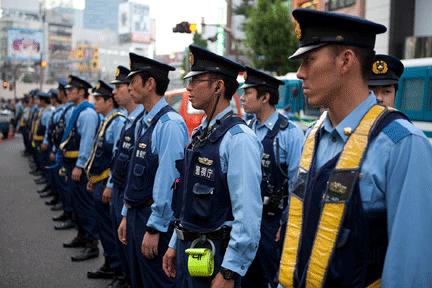
See more pictures of Friday’s Tokyo anti nuclear protest at http://shoottokyo.com/2011/06/13/anti-nuclear-protests-across-tokyo/#comment-23926
During the meeting against the restarting of nuclear power that happens every friday, the police separated the sidewalk from the roadway with iron fences after having considered it was dangerous that people overflow on the roadway (It happened at the meeting last week and two weeks ago). The jurisdiction, Enforcement Division of Kôjimachi Police station explained in a phone interview: “It’s for the security of the crowd”. But isn’t it the same thing than to surround palestinian people saying that It’s to avoid terrorism? As I went to report about the wall of Palestine since the process of its plan, I couldn’t help comparing it.
The movement against the policy of Noda’s regime to promote nuclear power spreads. They don’t want people to have this image. It seems that their worries are increasing much stronger because the snap general election will be hold soon. Their plant scheme succeeded at first glance.
The iron fence is the last resort of PM Noda’s regime and of the Police and has a very bad reputation among the protesters.
High radiation stalls efforts to close down Fukushima nuclear reactor No.3

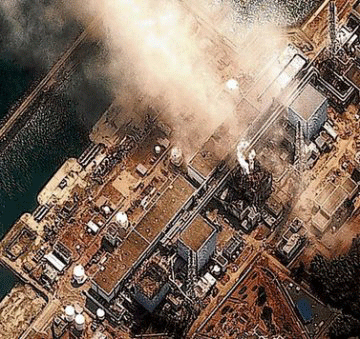 VIDEO Robot probe detects high radiation at No.3 reactor http://www3.nhk.or.jp/daily/english/20120713_10.html The operator of the Fukushima Daiichi nuclear plant has detected high levels of radiation in the basement of the No. 3 reactor, with a maximum dose of 360 millisieverts per hour.
Tokyo Electric Power Company sent in a robot on Wednesday to the room where the suppression chamber is located. It was the first robot to probe this area of the plant. TEPCO released video taken inside. They show that a door on the southwestern side is broken. There is no other apparent damage or sign of water leakage.
But high levels of radiation were detected. Readings exceeded 100 millisieverts per hour in a number of locations. Average levels were higher than those in the No.2 reactor.
Engineers lost control of the remote-controlled robot after around 3 hours of operation. They say there are problems with the connecting cable and they’ve been unable to regain control.
TEPCO officials say they have no option but to leave the robot where it is for the time being.
This may pose a problem to the utility’s efforts to decommission the reactor. The operators are in a hurry to identify and repair damage to the reactor’s suppression chamber and containment vessel. They want to pump in water in order to remove the melted fuel lying at the bottom.
High radiation level at Fukushima school, even after ‘decontamination’
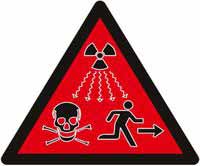 1,000,000 Bq/kg of cesium detected at Fukushima school… after being ‘decontaminated’ — “It’s obvious they will just leave it” – Local Official y 13th, 2012 By ENENews July 11, 2012 post by Koichi Oyama, Minamisoma city council member, translated by Dissensus Japan:
1.000.000 Bq detected in a school after a decontamination conducted!
A University’s research team collected lichen at the entrance of the gymnastic hall of a school that restarted after a decontamination operation, and the sample measured the Cesium radiation level, 989.000 Bq/Kg.
It’s obvious they will just leave it. I told them my ideas at least, but I’m not sure if this inspired them to do anything. No one makes decision to get rid of dangers.
I want to believe that at least “school principal” won’t leave the danger at the place where students walk by. I would go there tomorrow to make sure. Read the report here
Unusual number of birth deformities at Fukushima hospital
Evacuee: Fukushima hospital worker says 5 out of 7 babies were born with birth defect, Down’s syndrome, or lost by miscarriage — After this, husband agreed to evacuate July 13th, 2012 By ENENews Original published June 13, 2012 by a Fukushima evacuee, translated by Dissensus Japan:
Someone I know finally moved out of Fukushima to Mie (middle west of Japan). I wasn’t close to her, but she told me a major incident occurred that inspired her to be scared of radiation.At a hospital in Fuksuhima where she was working in, 5 babies out of 7 were born with birth defect, Down’s syndrome or lost by miscarriage.
- 2 Down’s syndrome
- 1 born with 6 fingers
- 1 anencephalia
- 1 miscarriage
- 2 other infants were 4 months old old at the time. They have been followed over time.
Speaking in terms of probability, it’s hardly possible this happens in a same hospital. This terrified her. With experts’ knowledge and experiences, it reached the conclusion that this was associated with radiation.
After this, her husband finally agreed and her family evacuated home.
Nuclear capable missile tested by India
India tests nuclear-capable Agni-I missile South Asian News Agency (SANA) ⋅ July 13, 2012 ⋅ ALASORE, India on Friday successfully test-fired its indigenously developed nuclear capable Agni-I ballistic missile, with a strike range of 700 km, as part of the Army’s user trial from a test range at Wheeler Island off Odisha coast..
.. The trajectory of the missile, which has an operational strike range of 700 km, was tracked by sophisticated radars and electro-optic telemetry stations located along the sea coast and ships positioned near the impact point in the downrange area.
Weighing 12 tonnes, the 15-metre-long Agni-I, which can carry payloads up to 1000 kg, has already been inducted into the Indian Army. http://www.sananews.net/english/india-tests-nuclear-capable-agni-i-missile/
Dangerous experimental process to remove fuel rods from Fukushima’s No.4 nuclear reactor
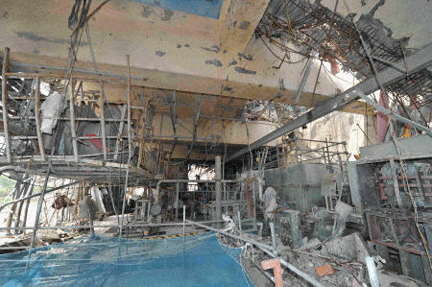 Fuel rods to be removed from No. 4 fuel pool Ene News — Concerns about sea water damage — Special container so fuel doesn’t going critical — Test date not revealed ‘for security reasons’ July 13th, 2012 the Fukushima Daiichi nuclear power plant will soon start test runs for removing fuel rods from a storage pool of the No. 4 reactor.
Removal Procedure A crane will be used to pull each of the 2 rods out of the pool, and then place them in a special container on the 5th floor of the reactor building.
The container will prevent the fuel from going critical.
Another crane will lower the container to the ground, where a truck will take it to a facility called a “common pool.”
Four cables will be used to prevent the container from falling.
Damage to Metal Container? TEPCO will also check if there’s any damage to the metal container used to store the fuel rods. This is a concern because seawater was used to cool the reactor after last year’s accident.
Security Reasons TEPCO says it cannot reveal the date of the test for security reasons.
http://enenews.com/fuel-rods-to-be-removed-from-no-4-fuel-pool-concerns-about-sea-water-damage-special-container-so-fuel-doesnt-going-critical-date-not-revealed-for-security-reasons
Time that Japan’s media covered public anti nuclear movement
Prime Minister Yoshihiko Noda had disregarded the will of the people when he ordered the restart of reactors at the western Oi plant the day after receiving a petition of 7.5 million names.
Japanese media in general should be more active in covering the demonstrations, including those that have taken place outside the prime minister’s office every Friday.
“Before March 11 (last year), all the media played the role of supporting the myth of nuclear safety… It is important for media to be aware of and make known what citizens want in  this movement,”
Japan govt, media colluded on nuclear: Nobel winner http://www.google.com/hostednews/afp/article/ALeqM5hG6h3G7rcakPrCAdnw_l90r1U6DA?docId=CNG.427d33cc188c7ac8e827e556ac125a3a.891 (AFP) – 12 July 12, TOKYO — Nobel-winning author Kenzaburo Oe said Japan’s post-war government and media colluded to give nuclear power a stranglehold, as activists readied for what they hope will be the biggest rally in decades. Continue reading
Rapid growth of China’s solar sector as solar panel prices plummet
The global solar sector has witnessed some extraordinary growth in the past couple of years. According to Bloomberg New Energy Finance, the prices of solar panels have fallen by almost 42% in a single year to $0.87 per watt.

 CHINA SETS 2015 SOLAR ENERGY TARGET AT 21GW Solar PV Investor, BY SARFARAZ KHAN | 12 JULY 2012 Although the massive target might seem overly ambitious to some, most of the industry analysts believe that it is still very modest. China’s local media has revealed that the National Energy Administration (NEA) has decided to quadruple the country’s 2015 solar energy target to 21GW. Continue reading
Some Fukushima children have “lifetime” radiation dose to thyroid glands
Several children were judged to have received an equivalent lifetime dose to the thyroid.
But the government says it does not plan to notify the parents out of fear of creating anxiety.
Fukushima kids cop ‘lifetime’ radiation dose http://www.radioaustralia.net.au/international/2012-07-12/fukushima-kids-cop-lifetime-radiation-dose/978786 12 July 2012, A Japanese study has found some children who live near the Fukushima nuclear plant have received “lifetime” doses of radiation to their thyroid glands. Continue reading
Japan cutting electricity consumption through summer
 Japan begins power saving despite nuclear restart, Business Recorder, 02 JULY 2012 TOKYO: Electricity saving targets came into effect in Japan on Monday as the country eyes a power shortfall over the hot summer, despite the weekend re-start of a nuclear reactor.
The government has asked households and businesses served by six utilities in central and western Japan to voluntarily cut consumption of electricity by between five and 15 percent on summer 2010 levels through to September 7.
Power consumption usually rises in the summer as people turn on air conditioners to cope with the sometimes sweltering weather. A seven-percent reduction target will also come into force in Japan’s northernmost — and more temperate — island of Hokkaido on July 23….
The targets come as Japan ended almost two months without any functioning nuclear reactors, with the restart Sunday of Unit No. 3 at Oi nuclear power plant……
http://www.brecorder.com/world/south-asia/65136-japan-begins-power-saving-despite-nuclear-restart-.html
Japan Atomic Energy board “sanitises” education about nuclear radiation
The editing of the supplementary reader was commissioned to the Japan Atomic Energy Relations Organization, where senior officials of power utilities serve as board members.
Both the supplementary reader and the teacher’s guide tout the benefits of radiation, but neither of them mentions last year’s nuclear disaster and the public’s alarm about high levels of radiation exposure
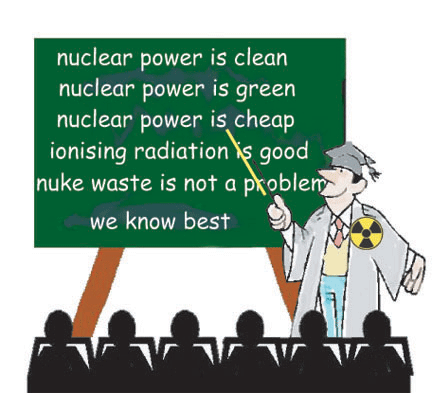
No well-trodden path for radiation literacy classes in Fukushima schools July 12, 2012 THE ASAHI SHIMBUN, by Yasuhito Watanabe and Midori Iki. Schools in Fukushima Prefecture, still reeling from last year’s nuclear disaster, find themselves in uncharted territory with a new addition to their curriculums: radiation literacy classes.
Fukushima’s prefectural board of education ordained that between one and three hours of homeroom activity, or “integrated studies,” be set aside every year for the topic from this academic year through all grades. Continue reading
1 This Month
23-25 October – on Zoom – World BEYOND War’s annual global conferenc


Shut down the radiation-damaged Heysham nuclear reactors now
To see nuclear-related stories in greater depth and intensity – go to https://nuclearinformation.wordpress.com

Say No to NASA’s Reckless Nuclear Reactor on the Moon
Say No to NASA’s Reckless Nuclear Reactor on the Moon

-
Archives
- October 2026 (199)
- September 2026 (339)
- August 2026 (330)
- July 2026 (355)
- June 2026 (287)
- May 2026 (306)
- April 2026 (356)
- March 2026 (251)
- February 2026 (267)
- January 2026 (308)
- December 2025 (358)
- November 2025 (359)
-
Categories
- 1
- 1 NUCLEAR ISSUES
- business and costs
- climate change
- culture and arts
- ENERGY
- environment
- health
- history
- indigenous issues
- Legal
- marketing of nuclear
- media
- opposition to nuclear
- PERSONAL STORIES
- politics
- politics international
- Religion and ethics
- safety
- secrets,lies and civil liberties
- spinbuster
- technology
- Uranium
- wastes
- weapons and war
- Women
- 2 WORLD
- ACTION
- AFRICA
- Atrocities
- AUSTRALIA
- Christina's notes
- Christina's themes
- culture and arts
- Events
- Fuk 2022
- Fuk 2023
- Fukushima 2017
- Fukushima 2018
- fukushima 2019
- Fukushima 2020
- Fukushima 2021
- general
- global warming
- Humour (God we need it)
- Nuclear
- RARE EARTHS
- Reference
- resources – print
- Resources -audiovicual
- Weekly Newsletter
- World
- World Nuclear
- YouTube
-
RSS
Entries RSS
Comments RSS

