New nuclear reactor now being built North of Tokyo

 Work resumes on Japanese nuclear reactor http://www.abc.net.au/news/2012-10-02/japan-resumes-reactor-work/4290390 By North Asia correspondent Mark Willacy,2 Oct 12, A Japanese power firm has resumed construction of an atomic reactor, despite government plans to phase out nuclear power in the wake of the Fukushima disaster.
The reactor – 650 kilometres north of Tokyo – is being built by the J-Power company which had planned to have it operational in two years’ time. The company says it has now resumed construction of the reactor which was halted work after the Fukushima meltdowns. Continue reading
Fukushima compensation payments 1.24 trillion yen, and rising
TEPCO must compensate nuclear accident victims quickly The Yomiuri Shimbun, 2 Oct 12
The government should further enhance its system to resolve disputes over compensation for damage caused by the crisis at the Fukushima No. 1 nuclear power plant so people suffering from the nuclear accident can be helped appropriately and quickly.
By late September, 940,000 compensation claims had been made against Tokyo Electric Power Co., the operator of the nuclear plant, for damage caused by the crisis. The claimants and TEPCO have reached agreements in 860,000 cases. The total compensation has already reached 1.24 trillion yen and will increase further. This shows the seriousness of the accident, which has forced 160,000 local residents to evacuate.
Under a compensation scheme for the damage caused by the crisis, the government first pays evacuees the money and later requires TEPCO to repay it. Compensation is calculated based on criteria set by the government’s Committee for Dispute Resolution for Compensating Damages from the Nuclear Power Plant Incident.
The criteria require TEPCO to pay compensation for such expenses as evacuation transportation fees and damage to farmers and other people who lost their businesses due to the crisis.
The agreement ratio has been high in initial compensation negotiations, but many crisis victims are still dissatisfied with the amount of reparations…… http://www.yomiuri.co.jp/dy/editorial/T121001002720.htm
Japan’s Indistry Minister calls for a quick phaseout of nuclear energy
 The most serious problem is spent fuel buildup at each plant as well as an additional storage at a fuel reprocessing plant in Aomori prefecture, northern Japan. The country lacks plans about what to do with the highly radioactive waste.
Minister: Japan Must Quickly Phase out Nuke Energy abc news, By MARI YAMAGUCHI Associated Press TOKYO September 29, 2012 Japan’s industry minister said the country must give up nuclear power plants as soon as possible because they pose too much risk in one of the world’s most earthquake-prone countries.
Yukio Edano said last year’s meltdowns after a tsunami hit the Fukushima Dai-ichi plant showed that nuclear power’s cost is too high. He expressed the opinion in his new book of policy views that hit stores Saturday.
Edano, who served top government spokesman during the height of the nuclear crisis last year, said he came to the conclusion after seeing “what was believed to be masterpiece of modern technology succumb to natural disaster so easily.”
“Now I want to eliminate nuclear power plants as soon as possible,” he wrote in the book, “Even if I get a beating, I must say this.”…. Continue reading
Fukushima’s new hospital equipment can NOT measure internal radiation
 Technohill, the Japanese distributer of this equipment commented on their website that this equipement cannot measure internal exposure unlike the hospital explained on their press conference.
Fukushima hospital imported new WBC equipment, distributer “It can’t measure internal exposure” http://fukushima-diary.com/2012/09/fukushima-hospital-imported-new-wbc-equipment-distributer-it-cant-measure-internal-exposure/ by Mochizuki September 29th, 2012 Kuwano kyoritsu hospital in Koriyama city held a press conference on 9/24/2012. Continue reading
India’s nuclear energy program just not happening

 India’s ticking nuclear crisis: Part I Charu Sudan Kasturi, Hindustan Times New Delhi, September 30, 2012 India has missed its five-yearly nuclear power generation target by 74%, its plans crippled by the protests at Kudankulam and other nuclear plant sites that have left the country’s energy security roadmap under a cloud of uncertainty. The government had set an already modest target of adding 3380 MW of additional nuclear power by 2012 to the country’s 3900 MW capacity at the start of the 11th Five Year Plan in 2007.
But failure to convince local people and activists at almost every site handpicked for a nuclear plant has left the Nuclear Power Corporation of India Limited (NPCIL) with only 880 MW to show as nuclear power added over the past five years.
Similar protests over the coming few years could seriously jeopardize India’s current energy security strategy, energy economists, government experts and NPCIL officials have cautioned.
Mushrooms containing radioactive cesium sold in Western Japan
 Cesium from mushroom made in Kyushu, sold in west coast of Japan
http://fukushima-diary.com/2012/09/cesium-from-mushroom-made-in-kyushu-sold-in-west-coast-of-japan/ by Mochizuki on September 30th, 2012 · According to the report of Ministry of Health, Labour and Welfare, cesium was measured from mushroom made in Ohita prefecture, in Kyushu of western Japan. It was sold in Niigata prefecture, west coast of Japan.
Also, cesium was measured from mushroom made in Shizuoka prefecture, in central Japan. It was also sold in Niigata prefecture, west coast of Japan.
Sample 1
Product : Dried mushroom
Date : 9/24/2012
Cs137 : 5.9 Bq/Kg
Production : Ohita
Sample 2
Product : Dried mushroom
Date : 9/24/2012
Cs137 : 6.3 Bq/Kg
Production : Shizuoka
Punjab goes all out for solar power
 Punjab to set up solar photo-voltaic power packs across state: http://www.hindustantimes.com/Punjab/Chandigarh/Punjab-to-set-up-solar-photo-voltaic-power-packs-across-state/SP-Article1-937965.aspx Majithia Punjab is all set to set up solar photo-voltaic power packs in households across the state in a major move to encourage use of solar energy for basic electricity needs, Non-Conventional Energy
Minister Bikramjit Singh Majithia said on Sunday. He said the government was making all
efforts to fulfill the gap in demand and supply of electricity by installing more generating capacity in the renewable energy sector as well as conventional sector.
Majithia said Punjab has considerable sun light available for more than 330 days in a year and this abundant energy could be utilised for generation of power during the day time through solar photo-voltaic power plants.
He said the state is endowed with vast potential of solar energy estimated at 4-7 KWH per one sq mt of solar insulation level and added that Punjab government was committed to tap this resource.
He also said the Punjab Energy Development Agency (PEDA) has planned installation of Solar Power Packs at households in the state of capacity 500Wp to 1000Wp.
Majithia said the Ministry of New & Renewable Energy has sanctioned the Central Financial Assistance of Rs. 3.03 crore as first installment and with total project cost of Rs. 10 crore.
He said that besides generating power, Solar Photo-voltaic Power Packs were environment friendly and carbon neutral and were easily produced and consumed.
The Punjab government has set up Akshey Urja shops in all districts of the state, where people can buy these at 30 % subsidy.
India interrogates, deports visitors who have anti nuclear opinions
The three activists were going to visit India for only a few days. They had hoped to avail of the tourist visa on arrival to visit the “temples of modern India”. They came in solidarity, good will and peace. Neither they nor their friends in India had imagined that being “anti-nuclear” would be seen as a threat by the Indian government.
 Are you going to Kudankulam? http://www.dnaindia.com/analysis/column_are-you-going-to-kudankulam_1745780 29 Sept 12, Bela Bhatia | Agency: DNA , September 27, 2012 On Tuesday this week, three Japanese visitors who are part of the anti-nuclear movement in Japan were refused entry to India and deported on arrival at Chennai. Reading the account sent by them from Kuala Lumpur makes for not-exactly-pleasant reading.
“When we got off the plane and approached the immigration counter, one personnel came to us smiling… [and took] us to the immigration office. [There were more than five personnel there.] … one asked me [Yoko Unoda] whether I am a member of No Nukes Asia Forum Japan. ‘You signed the international petition on Kudankulam, didn’t you?’ … another person asked, ‘Mr Watarida … he is involved in the anti-nuclear movement in Kaminoseki, right?’
‘Are you going to Kudankulam? Who invited you all? … Who will pick you up at Tuticorin airport? [they had a copy of the itinerary of the domestic flight] Tell me their names. Tell me their telephone numbers. Continue reading
No worries! India’s government says it can handle Fukushima type disaster
 Kudankulam can handle Fukushima type disaster: NPCIL tells SC First Post India 27 sept 12, New Delhi: The Supreme Court was Thursday told that the Kudankulam Nuclear Power Project (KNPP) in Tamil Nadu was absolutely safe and fully equipped to deal even with Fukushima type of accident.
The Nuclear Power Corporation of India Limited (NPCIL) told the apex court bench of Justice KS Radhakrishnan and Justice Dipak Misra that KNPP was “absolutely safe” even without the 17 recommendations by the Atomic Energy Regulatory Board (AERB), which were being put in place out of abundant caution….. Pointing to the rarity of such incidents at nuclear power plants, the NPCIL said that there had been only three major nuclear plants accidents that includes 1979 Three Mile Island accident, 1985 Chernobyl disaster and 2011 Fukushima Daiichi nuclear disaster…. http://www.firstpost.com/india/kudankulam-can-handle-fukushima-type-disaster-npcil-tells-sc-471173.html
Democratic freedoms trampled: the sorry story of India’s Kudankulam nuclear power project
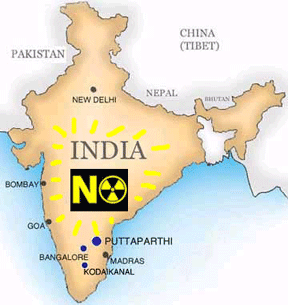 Despite mass opposition, India pushes ahead with operationalizing nuclear plant WSWS, By Arun Kumar and Kranti Kumara 27 September 2012 Despite mass protests by villagers, the Indian government in partnership with the Tamil Nadu state government is pushing ahead with the loading of nuclear fuel at the recently built 2000 MW Kudankulam Nuclear Power Plant (KNPP) located on the Tamil Nadu coast.
This massive power plant is a joint venture between India and Russia and has cost 172 billion Rupees (about $3.2 billion) to build. The plant currently houses two nuclear pressurized water reactors (PWR) reactors, each capable of driving a 1000 MW electric generator. But there are plans to construct four additional reactors at the site…..
Despite the deep misgivings of the population, the Indian elite, without any democratic debate, is rushing feverishly ahead, claiming that nuclear plants are essential to satisfying growing domestic electricity needs.
This particular plant is causing great concern among villagers and fishermen living in its vicinity, because it is situated right next to the ocean just like the Japanese Fukushima plant. Built at the southern tip of the state, KNPP is highly vulnerable to undersea earthquakes and tsunami that are an ever-present danger in the Indian Ocean region. That such concerns are far from hypothetical was demonstrated when the plant installations got inundated from ocean waves unleashed by the massive undersea earthquake that occurred in the Indian Ocean in 2004….
Last April witnessed a particularly brutal response by joint forces deployed by the Indian and the state governments. The police cut off water, food and power-supply to protesting villagers and imposed a curfew in the villages where the agitation has been centered. Nearly 200 people were arrested including women and children. Subsequently protests abated somewhat as the People’s Movement against Nuclear Energy (PMANE), which has led the agitation, called it off in the hope that the Tamil Nadu and Indian judiciaries would intervene on its behalf.
However, by late August the Madras High Court gave the green light to the Indian government to proceed with the steps it needs to take to make the plant operational. An appeal was then filed by an anti-nuclear activist with the Indian Supreme Court asking the court to halt further progress on operationalizing the plant, since 11 of the 17 critical safety measures recommended by the government’s own Atomic Energy Regulatory Board (AERB) had not been implemented.
Around this time, widespread protests resumed and the police responded with still greater violence. On Sept. 10 a protesting fisherman, 48 year-old Antony John, was shot dead. A young girl was also trampled to death when police resorted to charges to break up the protests. To observe and terrify those conducting a water protest, the Coast Guard flew low-flying aircrafts. One of the protesting fisherman named Sathyam panicked when a surveillance aircraft flew low, then slipped hitting his head against a boulder and subsequently died. Sathyam’s funeral became a rallying point for opposition to the nuclear power plant attracting large number of villagers from neighbouring areas.
Earlier this month, India’s Supreme Court refused to even hear the petition against operationalizing KNPP. In so doing, the court ignored publicly available evidence of shoddy workmanship, the dangers inherent from using an untested reactor design, and the fact that over 1 million people live within a 30 Km. radius of the plant, which violates even the AERB’s feeble safety regulations.
Following this, the Indian government proceeded post-haste to begin loading enriched-uranium fuel rods into one of the reactors. The government has said that it expects the fuel loading to be complete by Sept. 28 and the plant fully operational soon afterwards.
This move provoked the villagers into intensifying their agitation.
On Saturday, Sept. 22, over 500 fishing boats laid siege for several hours to the Tuticorin port about 100 Km north of KNPP. This port is used for unloading nuclear fuel rods from ships for transportation to the reactor at the plant. Simultaneously other protestors including villagers led by PMANE undertook “Jal Satyagraha” (Water Agitation), by standing in waist-deep water in the ocean near the plant and forming a human chain.
Solidarity protests also sprung up across the state. But the police repression has continued unabated with arrest warrants being issued for activist-leaders, many of whom including PAME leader Udayakumar have now gone into hiding. Under the pretext of looking for protest leaders, the police in bands of 10 have gone on a rampage, breaking down doors and ransacking the houses of villagers living in the Kudankulam area. This is clearly an attempt by the government to terrorize the populace into submission.
Kudankulam has been practically sealed off by armed policemen who are allowing only the transport of essential goods into the area. Public transport has also been barred from entering some of the areas surrounding the plant.
To the consternation of the authorities, the protests have now snowballed with growing numbers of people, including students, advocates and villagers, joining protests across the state and even in the Bangalore, the capital of the neighbouring state of Karnataka. … http://www.wsws.org/articles/2012/sep2012/indi-s27.shtml
The truly fearful state of Fukushima’s nuclear reactors

 http://ifyoulovethisplanet.org/?p=6282 Arnold Gundersen with the latest on Fukushima, including the perilous worldwide consequences if reactor no. 4 collapses
Doomed Planet For A Failed Species? Fukushima’s Tragic Nuclear Consequences Richard Wilcox Activist Post 29 Sept 12“……….Gundersen was also recently interviewed by the intrepid Helen Caldicott, medical doctor and long time anti-nuclear  campaigner (12). The entire interview is highly recommended listening, not only for its incredible technical information, but also to enjoy the brilliance and humor of two of our most venerable activists.
Where are the leagues of other nuclear engineers speaking out with such  expertise? There are not many. Gundersen has intimate knowledge of what is happening at the FNPS and one wonders how he gets his information. Other than that in the public domain are there at least some concerned officials feeding him data? Gundersen tends to speak conservatively and there is certainly room for other interpretations of the situation. He may be sugar-coating the truth at times, but I think he rarely or never exaggerates the dangers.
These are main points summarized from Gundersen and Caldicott’s conversation:
- Unit 4 is being cleaned up so that Tepco can put in place the crane to remove the fuel rods. This work will not be completed before 2015 or 2016. Tepco plans to construct a building on top of what is currently there at Unit 4 in order to put in place a huge crane for removing the rods, which will then be placed in casks on the ground.
- There are concerns that the fuel rods will be damaged, but ideally they can just pull them out and put them into dry cask storage. There is a chance they will not be removed easily and get “jammed” when they try pull them out. This could take years!
- It is a very long, involved process. “They are taking way too long.” This process has to be repeated for the other reactor fuel pools as well. In the meantime we have to hope there is not another large earthquake, even though geologists think there is a likely chance of one.
- The fuel in Units 1, 2, 3 is melted down to the bottom of the reactors or “lying on the concrete” at the foundation of the reactor buildings. It took ten years to remove fuels from a melted reactor at Three Mile Island after its disaster in the US in 1979. TMI was a minor accident compared to Fukushima.
- The three reactor units at Fukushima are so highly radioactive that a million bq/liter is measured in water in surrounding buildings. That means that in the reactor buildings themselves the radiation would be exponentially higher.
- Gundersen believes the radiation is so high in the reactor areas that workers cannot do the job. The only “solution” will be to pour concrete on top of the units while “walking away for three hundred years, obviously monitoring it.” This could happen in a few years from now.
- However, Caldicott points out that the radiation will seep down into the water table for the rest of time. Arnie agrees: there is no good solution. Although “the solution would be to bore holes from underneath, and constantly pull water from out from under the building so it can be treated.” This would have to be done for a couple of hundred years to prevent contamination of the Pacific Ocean.
- If Japan’s economy shrinks, cracks, contracts and or collapses due to a variety of factors, will they have the knowledge and money to carry on with this project? Gundersen estimates the cost of the Fukushima disaster will be 500 billion dollars. The Japanese taxpayer will pay for it.
- Weighed against Japan’s rapidly aging and declining population the Japanese will be carrying a huge economic burden. The detrimental health effects from radiation will effect a substantial proportion of Japan’s population into the mists of time but will be covered up and hidden from public view, even as they perish…… http://www.activistpost.com/2012/09/doomed-planet-for-failed-species.html
Japan’s new Nuclear Regulation Authority setting new guidelines
Nuclear Regulation Authority to set new guidelines http://japandailypress.com/nuclear-regulation-authority-to-set-new-guidelines-2713469 By Ida Torres / September 27, 2012 The newly launched Nuclear Regulation Authority is set to come up with new guidelines on nuclear disaster management, particularly expanding the area for urgent measures in the event of a nuclear accident.
Currently, the area is just at a 8-10 kilometer radius, but after the Fukushima power plant crisis in 2011, they believe the area should be expanded to a 30 kilometer radius.
The authority will also survey a fault under the Oi nuclear power plant in Fukui Prefecture after an independent survey by KEPCO showed that the fault might be active.
Part of the new guidelines that the authority is expected to draft would be to make these guidelines sanctioned under special regulation so that the local governments and entities would be required to comply and obey the instructions. Also, prefectural and municipal governments will be required to come up with new or revised disaster management
plans so authorities can determine which areas will be under priority measures. They also need to devise detailed evacuation plans for residents, especially those that are in the radius of the power plants.
The government is doing all it can to be more prepared for nuclear meltdown threats, especially after the aforementioned Fukushima events. They abolished the Cabinet Office’s Nuclear Safety Commission, which initially drafted these guidelines, to give way to the Nuclear Regulation Authority
Indian villagers have sound reasons to distrust their government
 Despite mass opposition, India pushes ahead with operationalizing nuclear plant WSWS, By Arun Kumar and Kranti Kumara 27 September 2012“…….It is not just the safety of the plant that the villagers are angry about. While the Indian government has spent huge amounts to build ultra-modern facilities for the nuclear plant’s employees, including a fully-equipped hospital, villagers are barred from using them. Most of the villagers and fishermen live in squalor and poverty lacking even basic facilities such as running water.
Moreover the villagers put no faith in the ability of the Indian elite to manage a nuclear accident given the government’s display of a mixture of incompetence and callousness during and after the 1984 Union Carbide disaster in Bhopal. The uncontrolled release of toxic gas at Bhopal, which caused over half a million casualties including over 20,000 deaths, was the worst industrial disaster in world history. Even after the passage of 38 years, the government has left the plant site and its surroundings severely contaminated with toxic substances. No one has been held criminally responsible and the Indian government has essentially connived to this mass crime by agreeing to accept a measly $470 million in compensation from Union Carbide.
Despite this horrible precedent, the Indian government has agreed that the Russian firm that has supplied and built KNPP’s reactor will have zero liability in the event of an accident
In a desperate attempt to justify the state suppression of the protests, Prime Minister Manmohan Singh has brazenly declared that the anti-nuclear protestors are acting at the behest of United States-based Non-Governmental Organisations (NGOs) that want to derail India’s “progress”.
The Indian establishment is justifying its single-minded pursuit of nuclear power plants by claiming that it will help reduce the chronic electricity shortage that afflicts the country. Such arguments are duplicitous as there are far more cost-efficient ways to produce electricity than from nuclear power plants.
But motives other than providing cheap electricity are propelling the Indian elite to expand the country’s nuclear power industry—first and foremost its drive to increase its arsenal of nuclear weapons. With the signing of the India-US Nuclear Accord in 2008, the Indian elite can now utilize domestic uranium reserves for weapons production while obtaining and gaining expertise in the latest state-of-the-art nuclear technology. http://www.wsws.org/articles/2012/sep2012/indi-s27.shtml
India’s government upset that Sri Lanka worries about nuclear radiation
India to discuss Kudankulam safety with Sri Lanka Sachin Parashar, TNN | Sep 29, 2012, NEW DELHI: Taken aback by what it describes as “propaganda” in Sri Lanka against the Kudankulam nuclear power plant, India has offered to discuss the safety aspect of the pressurized water reactors with Lankan authorities.
The dialogue mechanism between the two nations for cooperation on nuclear issues
will include talks on Kudankulam safety when a Sri Lankan committee visits India later this year.
“The safety aspect will be a part of the broader agenda for talks over cooperation in nuclear energy but we are already telling them that India will abide by all international conventions over nuclear safety at Kudankulam,” said an official dealing with Sri Lanka. Although the
government in Sri Lanka has not raised any objection to the reactors, the Indian establishment in Colombo has been stunned by a spate of reports in the local media — in the run-up to loading of fuel in the first unit at Kudankulam – about how these reactors were going to adversely impact the island nation….. http://timesofindia.indiatimes.com/india/India-to-discuss-Kudankulam-safety-with-Sri-Lanka/articleshow/16596952.cms
High levels of radiation on Lanyu (Orchid Island)
 “Two Japanese academics have found unusual levels of radiation at more than 10 locations around Lanyu, with the level at one location as high as 500 times more than the environment background value — this shows that the issue of radioactive pollution is very serious on the island,”
Activists demand survey of Lanyu radiation levels, Taipei  Times, 29 Sept 12, PARADISE LOST? Professors warn that radiation levels pose a threat to both residents and visitors of the island and may cause cancers and cardiovascular diseases By Loa Iok-sin / Staff reporter Environmentalists yesterday called on the Atomic Energy Council (AEC) to conduct a thorough survey around Lanyu (蘭嶼, also known as Orchid Island) as a report released by Japanese academics shows that an unusual amount of radiation has been
found on the island and that the nuclear waste storage facility on the island may be leaking. Continue reading
1 This Month
23-25 October – on Zoom – World BEYOND War’s annual global conferenc


Shut down the radiation-damaged Heysham nuclear reactors now
To see nuclear-related stories in greater depth and intensity – go to https://nuclearinformation.wordpress.com

Say No to NASA’s Reckless Nuclear Reactor on the Moon
Say No to NASA’s Reckless Nuclear Reactor on the Moon
-
Archives
- October 2026 (190)
- September 2026 (339)
- August 2026 (330)
- July 2026 (355)
- June 2026 (287)
- May 2026 (306)
- April 2026 (356)
- March 2026 (251)
- February 2026 (267)
- January 2026 (308)
- December 2025 (358)
- November 2025 (359)
-
Categories
- 1
- 1 NUCLEAR ISSUES
- business and costs
- climate change
- culture and arts
- ENERGY
- environment
- health
- history
- indigenous issues
- Legal
- marketing of nuclear
- media
- opposition to nuclear
- PERSONAL STORIES
- politics
- politics international
- Religion and ethics
- safety
- secrets,lies and civil liberties
- spinbuster
- technology
- Uranium
- wastes
- weapons and war
- Women
- 2 WORLD
- ACTION
- AFRICA
- Atrocities
- AUSTRALIA
- Christina's notes
- Christina's themes
- culture and arts
- Events
- Fuk 2022
- Fuk 2023
- Fukushima 2017
- Fukushima 2018
- fukushima 2019
- Fukushima 2020
- Fukushima 2021
- general
- global warming
- Humour (God we need it)
- Nuclear
- RARE EARTHS
- Reference
- resources – print
- Resources -audiovicual
- Weekly Newsletter
- World
- World Nuclear
- YouTube
-
RSS
Entries RSS
Comments RSS

